







Abstract
The viscosity of CaO–SiO2–Al2O3–MgO–CaCl2 slags (C/S = 1.12) were investigated to elucidate the effects of chlorine ranging from 0.02 to 0.53 mass% on the blast furnace slags at high temperatures. Moreover, the Raman spectra of the quenched slags and the X-ray diffraction patterns of the slags cooled in air after viscosity measurement were thoroughly analysed to interpret the transformation of the structures of the slags with increasing the content of chlorine. The viscosity was found to decrease slightly with the increase of chlorine at a given temperature higher than 1673 K, and the critical temperature (T CR) decreased from about 1660 to 1590 K simultaneously which was possibly deriving from the precipitation of Ca2Al2SiO7, Ca3Al2(SiO4)3–xCl4 x and SiO2 in higher chlorine content. The degree of polymerisation for silicon–oxygen tetrahedra was found to decrease estimating from the decrease of the average amount of bridging oxygen calculated from the deconvolution results of the Raman spectra of the quenched slags, which provided the explanation for the decrease in viscosity. And that the apparent activation energy of the slags was commonly reduced by chlorine increasing demonstrated the decrease in the degree of polymerisation of molten slags simultaneously.
Introduction
Dangers of chlorine to blast furnace (BF) have recently drawn more concentrations of metallurgists because more HCl and other acid gases were brought into the gas pipelines with erosions and destructions to the pipelines and accessory equipments in the substitution of dry-dedusting for wet-dedusting technology which should have been absorbed by gas washing water in wet-dedusting technology BF. 1–4
The increase of chlorine in BF system resulting mainly from the injection of low-quality coal and waste plastics, 5,6 the employment of imported ores after seawater beneficiation, sinter sprayed with CaCl2 7 and coke coked by coal and waste plastics also leads to different degrees of effects on the BF smelting process, metallurgical properties of raw material and fuel and characteristics of molten slag simultaneously, 8–10 and the certain extent of circulation and accumulation of chlorine in BF makes these effects more obvious. 11,12
It has been well acknowledged that BF slag could absorb the chlorine, and hence would affect its performance. However, only few studies on the effect of chlorine on the molten slag were carried out, Myoung et al. 6 performed the effect of chlorine content on the viscosity of CaO–SiO2–12 mass%Al2O3–10 mass%MgO BF slag by adding CaCl2 powder and discovered that the viscosity at temperatures high than 1700 K was less than that of slags without chlorine by about 2.5 dPa s as the chlorine content increased up to 3.2 mass%, while the effect mechanism was not analysed further. Ito and Morita 13 characterised chlorine bearing phases in the synthetic CaO–SiO2–Al2O3–Cl slags, it was found that the chlorine only condensed in the amorphous phase and 9CaO·6Al2O3·5SiO2·CaCl2. Wang and Morita 14 measured the phase diagram of the SiO2–CaCl2 system and the liquid area of the CaO–SiO2–CaCl2 ternary system at 1723 K, two eutectics and an intermediate compound SiO2·CaCl2 were found in the SiO2–CaCl2 binary system, and the liquidus of the CaO–SiO2–CaCl2 ternary system at 1723 K was detected. In order to deal with the trend that the raw material and fuel with higher chlorine content were put into use, more investigations are acquired to study the effect mechanism of chlorine on the BF slag.
Therefore, the viscosities of CaO–SiO2–Al2O3–MgO–CaCl2 slags were investigated in the present study. Furthermore, Raman spectra and apparent activation energy of the slags were quantitatively applied to the mechanism analysis.
Experimental
Slag preparation
Chemical compositions of the slags investigated in the present study
Procedure of viscosity measurement
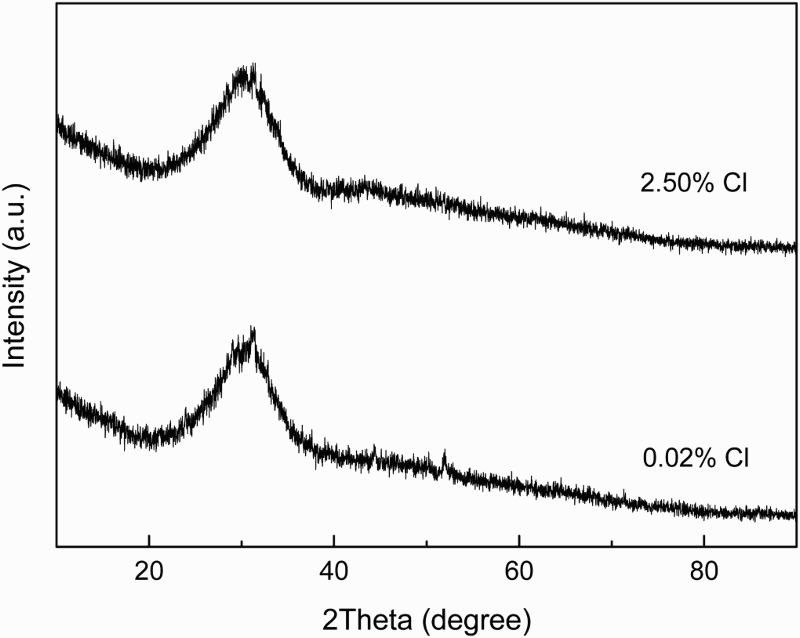
The viscosity measurements were carried out using the rotating cylinder method with a RTW-10 viscometer, and the schematic diagram of the experimental apparatus is shown in Fig. 1. The molybdenum crucible (inner diameter = 40 mm and height = 80 mm) containing about 140 g mixed slag was placed inside the furnace temperature zone, then the furnace was heated to the preset 1823 K from room temperature by the MoSi2 heating element and held for 0.5 h to homogenise the melts. The measurement of viscosity in the present study was started by lowering the molybdenum spindle into the slag about 7 mm above the bottom of the crucible carefully, and the slag viscosity was measured continuously during the cooling cycle until the viscosity reached up to about 3.5 Pa s. The slag was subsequently reheated to 1793 K and also held for 0.5 h to stabilise the temperature, the slag was partially quenched by pouring the melts into water and partially cooled in air afterwards. In the whole measurement process, the purified Ar gas at a flow rate of 0.3 NL min−1 was inlet to avoid the oxidation of the molybdenum crucible and spindle. The quenched slags after dried and ground less than 0.074 mm were sent for X-ray fluorescence to confirm the compositions, as also shown in Table 1, the final chlorine compositions of the investigated No. 1 to No. 5 BF slags were 0.02, 0.51, 0.93, 2.50 and 5.39 mass%, respectively. And the quenched slags No. 1 and No. 4 were subject to X-ray diffraction (XRD) to verify the amorphous state of all the slags, as shown in Fig. 2. Experimental apparatus for the measurement of slag viscosity XRD analysis of the quenched slags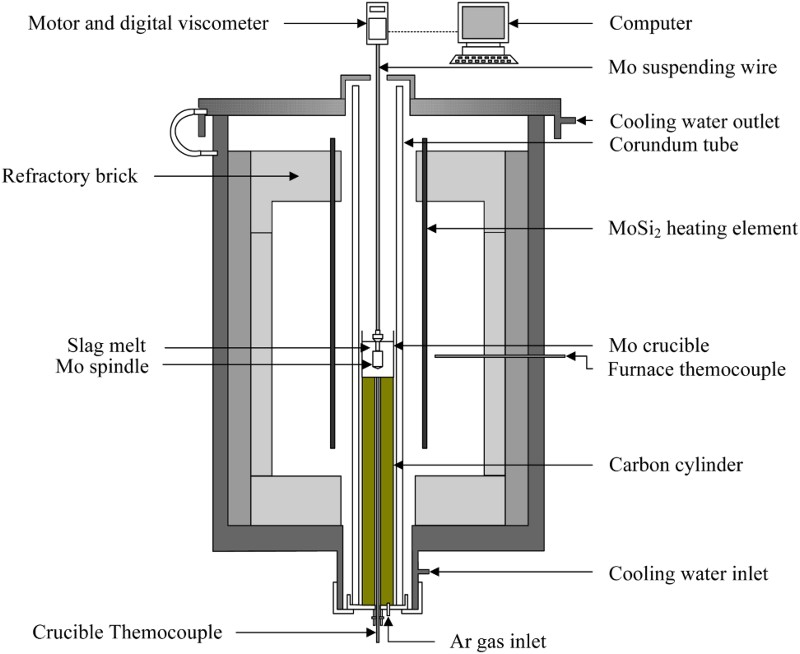
Raman spectroscopy analysis
Raman spectroscopy was applied to the quantitative analysis of the structures of the quenched slags. Raman spectra of the present grassy slags were acquired at room temperature in the frequency range of 200–1600 cm−1 using a semiconductor laser source having excitation wavelength of 532 nm coupled with Jobin-Y’ von Horiba 800 (LabRam HR, France) micro-Raman spectrometer. The PeakFit V4.0 software was employed to deconvolute the spectra, and then the relative abundances of the Q n units (Q 0, Q 1, Q 2 and Q 3, the 0, 1, 2 and 3 represent the number of bridging oxygen in silicon–oxygen tetrahedra, respectively) were calculated based on the area fractions of the best fitted Gaussian curves.
Results and discussion
Effect of chlorine on the viscosity and critical temperature of BF slags
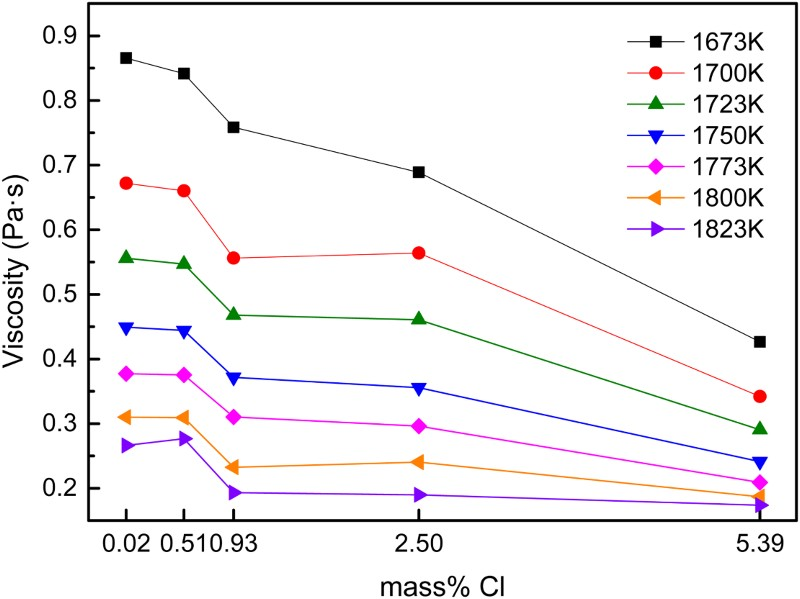
Figure 3 graphically represents the viscosities of the CaO–SiO2–Al2O3–MgO–CaCl2 slags (CaO/SiO2 = 1.12) as a function of the temperature. It is found that the viscosity gradually increases with decreasing temperature and this tendency is less significant as the chlorine content increases. In addition, the viscosity of BF slags decreases as the chlorine content increases at a given temperature higher than 1673 K and the chlorine effect is more noticeable at lower temperatures as shown in Fig. 4. Certainly, it is commonly known that the Ca2+ could increase the polymerisation of slags for the Ca2+ with lower ionisation potential is charge balanced with two open O− ions due to its large [CaO6] cage,
15
thus the actual effect of chlorine on the viscosity decreasing is greater. Viscosities of the BF slags as a function of temperature at different chlorine concentrations Effect of chlorine on the viscosities of the BF slags at temperatures from 1673 to 1873 K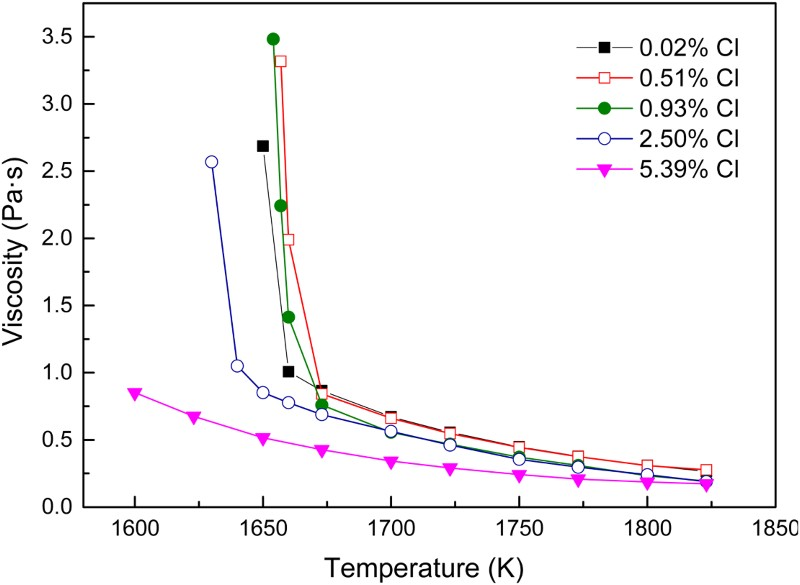
The critical temperature (T
CR) which has been defined as the temperature at which the viscosity increases suddenly and the slag becomes non-Newtonian in behaviour exhibits an abrupt change in the activation energy when viscosity measurements are carried out during the cooling cycle.
16–18
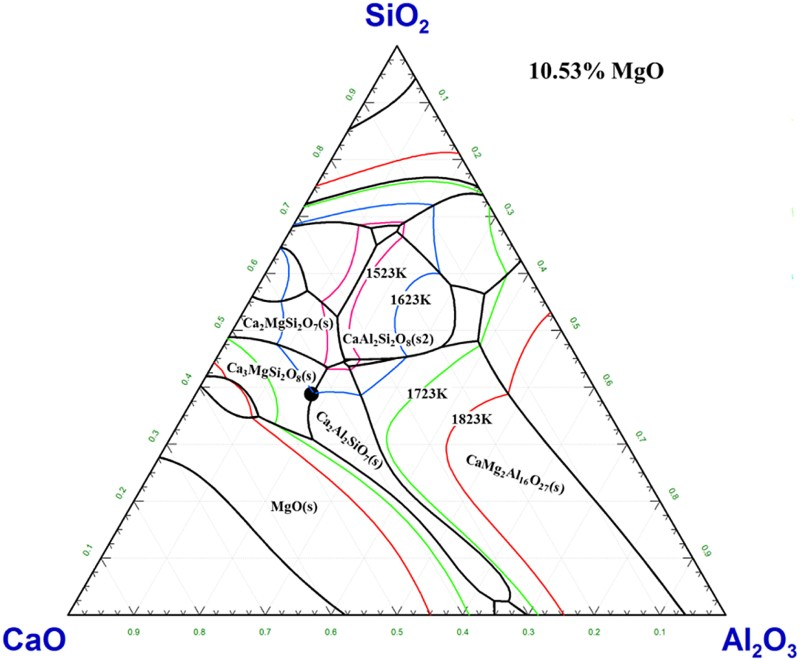
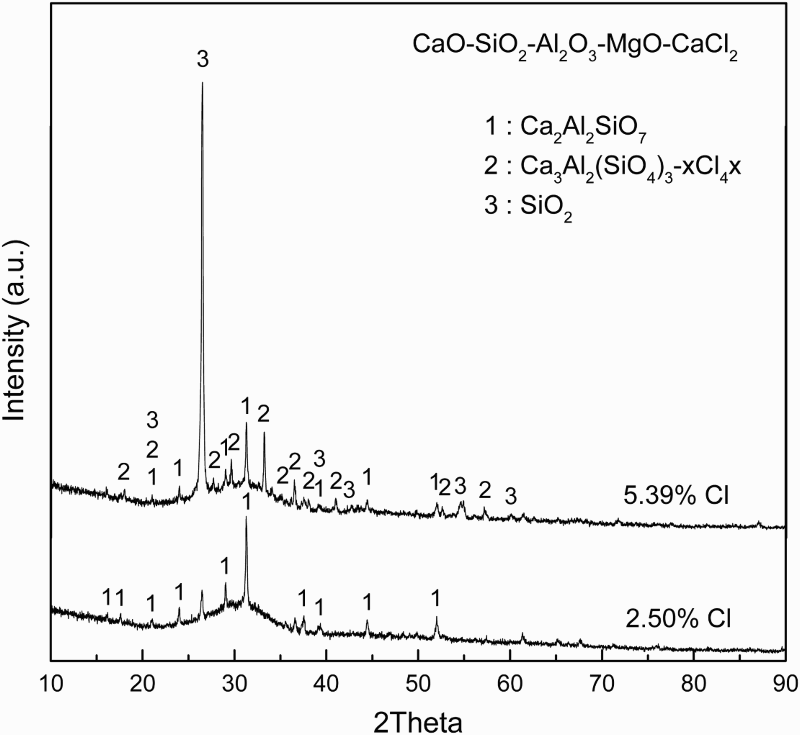
As shown in Fig. 5, the critical temperature of the slags decreases from about 1660 to 1590 K with increasing chlorine content from 0.02 to 0.539 mass%, this trend can easily be expected from the XRD analysis of No. 4 and No. 5 slags cooled in air after viscosity measurement. As Fig. 6 shows, the primary crystallisation region of the studied quaternary BF slag (CaCl2 is excluded) is located in either Ca2Al2SiO7 or Ca3MgSi2O8, while it is certified to be the Ca2Al2SiO7 precipitation by the XRD patterns of present No. 4 and No. 5 slags as shown in Fig. 7. Meanwhile, the tremendous decrease in T
CR may be caused by the precipitation of Ca3Al2(SiO4)3–xCl4
x and SiO2 detected in No. 5 slag, it can be concluded that the CaCl2 significantly reduces the T
CR of the CaO–SiO2–Al2O3–MgO–CaCl2 slags consequently. The slight enhancement in T
CR of No. 2 and No. 3 slags may be possibly resulting from the improvement of slag basicity, which can increase the solid suspended particles, despite of the small additive chlorine content therein. Effect of chlorine on the critical temperature of the BF slags Phase diagram of the CaO–SiO2–Al2O3–(10.53 mass%)MgO slag system XRD analysis of No. 4 and No. 5 slags cooled in air after viscosity measurement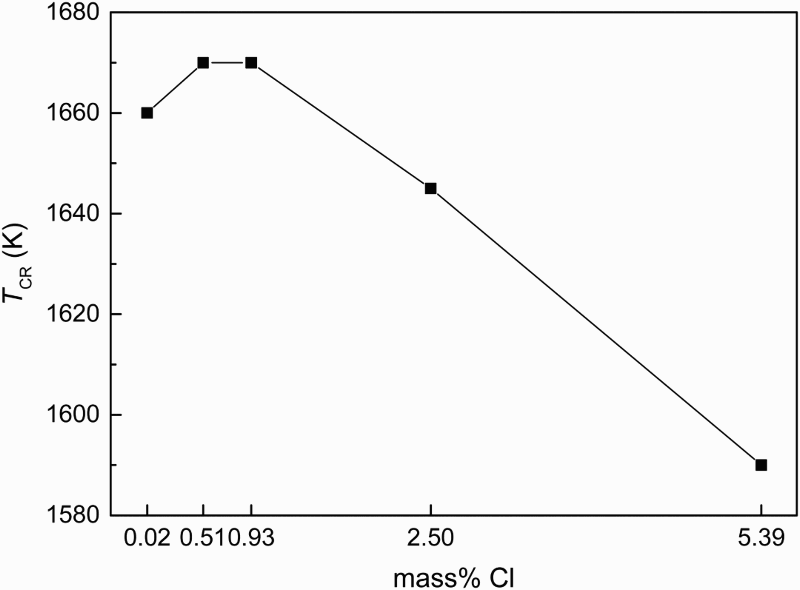
Raman spectra analysis of the structures of BF slags by the chlorine addition
The room-temperature Raman spectra of the five quenched slags as a function of wavenumbers ranging from 700 to 1300 cm−1 are shown in Fig. 8. The major bands at 850–880 cm−1, 900–930 cm−1, 950–980 cm−1 and 1040–1060 cm−1 are related to the occurrence of zero, one, two and three bridging oxygen per tetrahedrally coordinated silicon (BO/Si), respectively.
15,19–22
It is found that the Raman spectra for silicon–oxygen tetrahedra gradually shift to lower wavenumber with increasing the chlorine content of the investigated BF slags, and the intensity of the high frequency Q
3 band is very weak. Consequently, it is undoubtedly that the chlorine acts as a role in the depolymerisation of the BF slags. Raman spectra of the quenched BF slags with different chlorine contents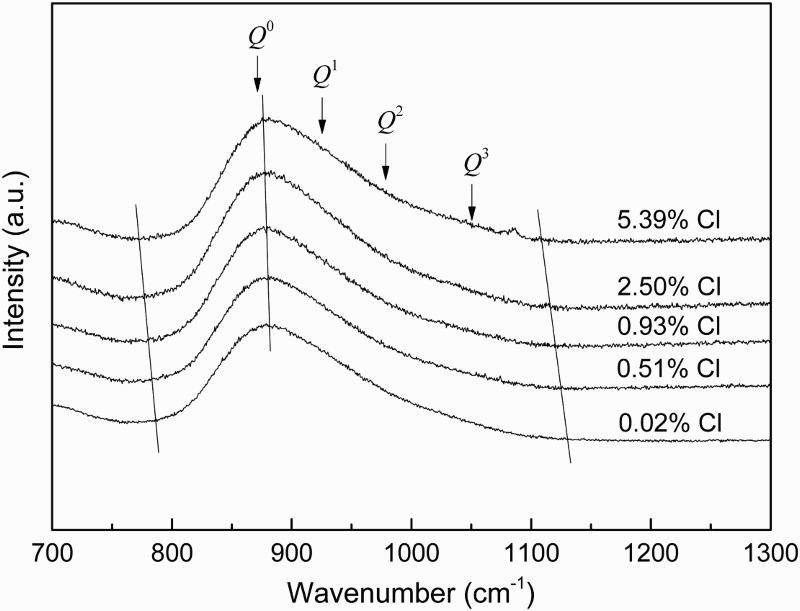
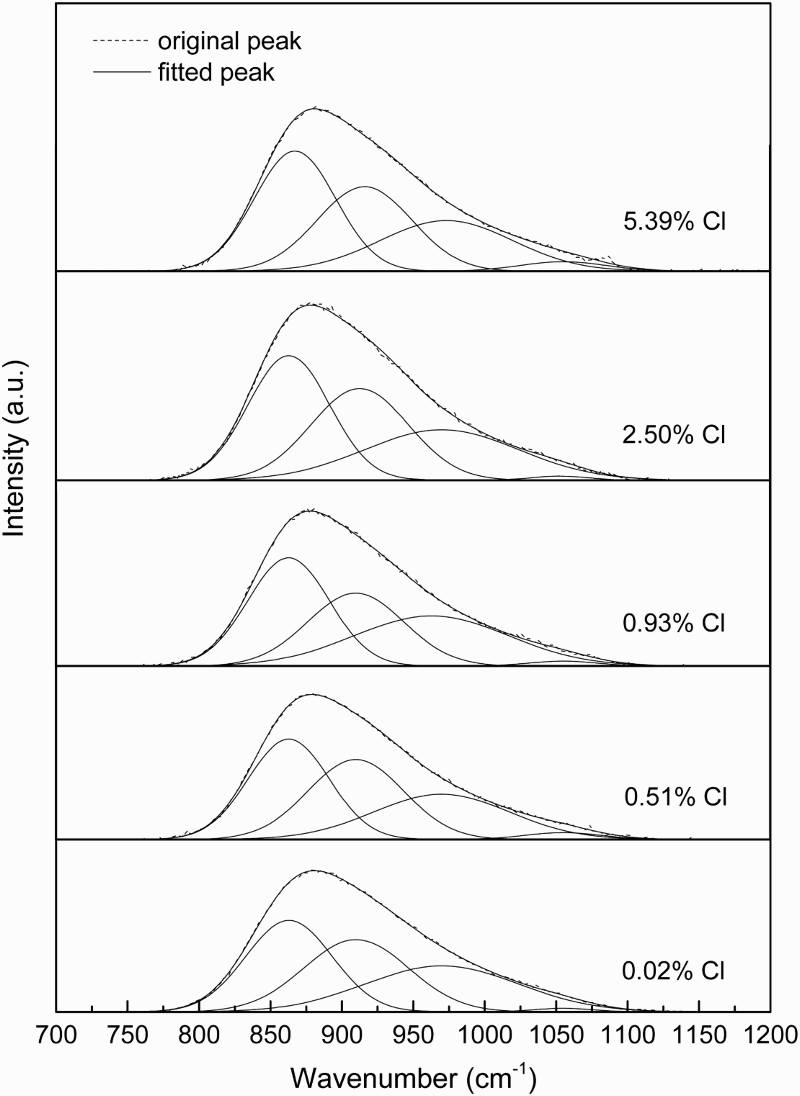
The measured Raman spectra of the quenched slags with different chlorine contents are deconvolved on the basis of Gaussian functions with the minimum correction coefficient equalling 0.9989, and the results are shown in Fig. 9. The relative area fractions of Q
0 (SiO4-monomer), Q
1 (Si2O7-dimer), Q
2 (SiO3-chain) and Q
3 (Si2O5-sheet) units obtained from the Gaussian deconvolution of Raman spectra are listed in Table 2. The fraction of Q
0 unit increases and the fractions of Q
1 and Q
2 units decrease continuously as the chlorine content increases, which indicates the Si2O7-dimer and SiO3-chain structures are depolymerised into simpler SiO3Cl-monomer and Si2O6Cl-dimer structures as follows
23
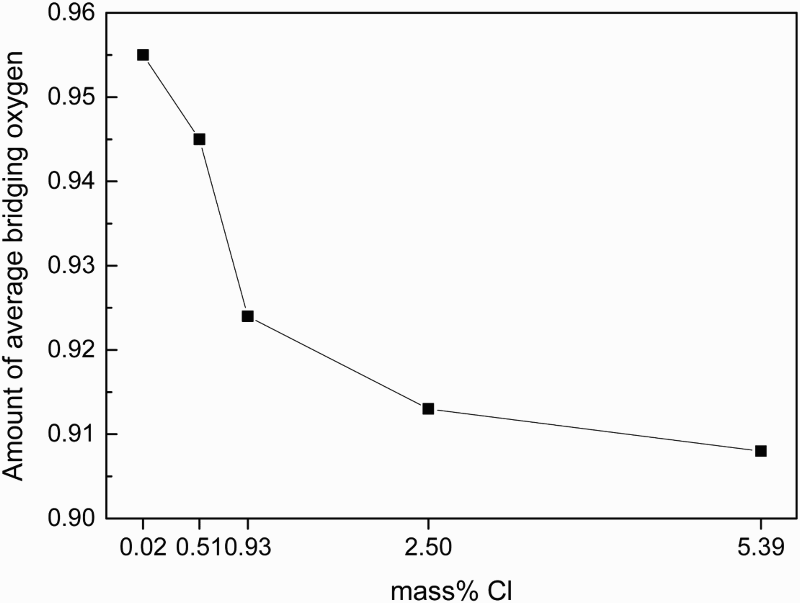
: Deconvolved results of Raman spectra for samples in different chlorine contents Effects of chlorine on the average amount of bridging oxygen

Relative area fractions of Q
n units of the five Raman spectra
Activation energy for the viscous flow of the BF slags
The activation energy reflects the energy barrier for viscous flow. Thus, the variations in the apparent activation energy for the viscous behaviour imply the change in the structures of molten slag.
23,25
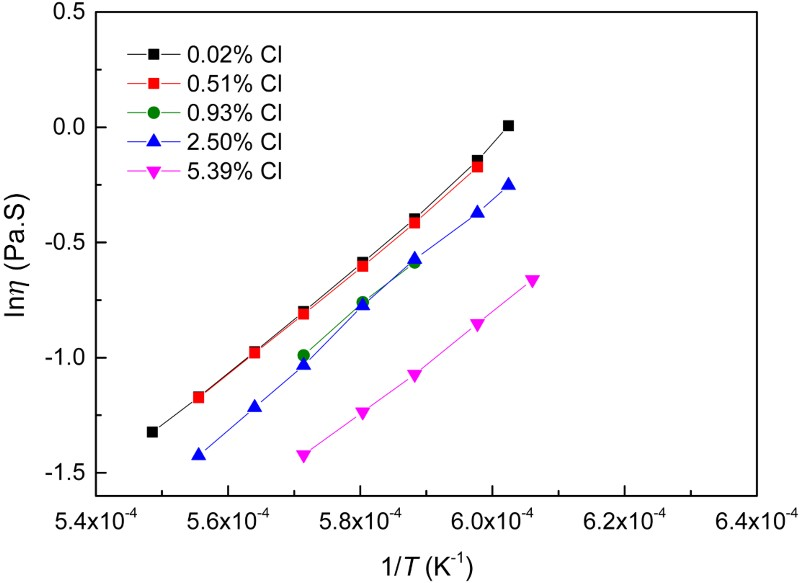
The degree of polymerisation of the slag network structure is the characteristic function of temperature and composition. It is assumed that the composition of the slags during experimental procedures is a constant, the apparent activation energy of slags can be approximated from the following Arrhenius equation: Arrhenius plot for the BF slags in the Newtonian flow region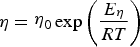
Apparent activation energy of the molten slags
Conclusions
The viscosities of CaO–SiO2–Al2O3–MgO–CaCl2 slags were measured to elucidate the influence of chlorine on the BF slags at high temperatures, and Raman spectra of the quenched slags with chlorine content ranging from 0.02 to 0.53 mass% were analysed to illustrate the role of chlorine in modifying the structure of BF slags. The obtained consequences are summarised as follows: The viscosity of the investigated slags decreases with increasing the chlorine content at a given temperature higher than 1673 K and the effect of chlorine is more noticeable at lower temperatures. Meanwhile, the critical temperature (T
CR) decreases from about 1660 to 1590 K, which possibly results from the precipitation of Ca2Al2SiO7, Ca3Al2(SiO4)3–xCl4
x and SiO2 with more chlorine addition in BF slag. The effects of chlorine on the viscosity of the present BF slags can be interpreted based on the decrease in the degree of polymerisation by chlorine anion, which is verified by the decrease of the average amount of bridging oxygen calculated from the deconvolution results of the Raman spectra of the quenched slags. By the addition of chlorine in BF slags, the apparent activation energy generally decreases, which is consistent with that of viscosity changes by the depolymerisation of the slags. Therefore, the decrease in the apparent activation energy demonstrated the decrease in the degree of polymerisation of molten slags.
Footnotes
Acknowledgements
This work was financially supported by the Key Program of the National Natural Science Foundation of China (No. U1260202) and the 111 Project (No. B13004).