






Abstract
Let me begin with an anecdote: A few years ago, I was approached by a professor of chemistry from the Technical University of Darmstadt for support of a project that he and a friend, a ballet choreographer from Düsseldorf, had come up with. The idea was to stage a ballet that would manifest — or document — an important event in science history, i.e. the discovery of the structure of the benzol molecule. As some readers might know, this discovery occurred in a dream. The dreamer was August Kekulé (1829–1896), in the mid-19th C. a renowned professor of chemistry at the University of Bonn. Kekulé's specialty was the determination of the structure of organic compounds, including benzol. At the time it was known that the molecule included six carbon atoms, but not how they were arranged. Kekulé wrote many years later that on a winter's day in 1861 he fell half asleep at his desk observing the dance of sparks in the fire place. In his mind these suddenly became carbon and hydrogen atoms dancing in a ring before him reminding him of the ancient symbol of Ouroboros, a snake whose head devours its own tail. This was also the solution to his search. The carbon atoms were — or are — arranged in a hexagon. For a symbolic representation see Fig. 1
Ouroboros Snake and Benzol Molecular Structure. Source: Wikipedia. August Kekulé. Accessed May 28, 2015.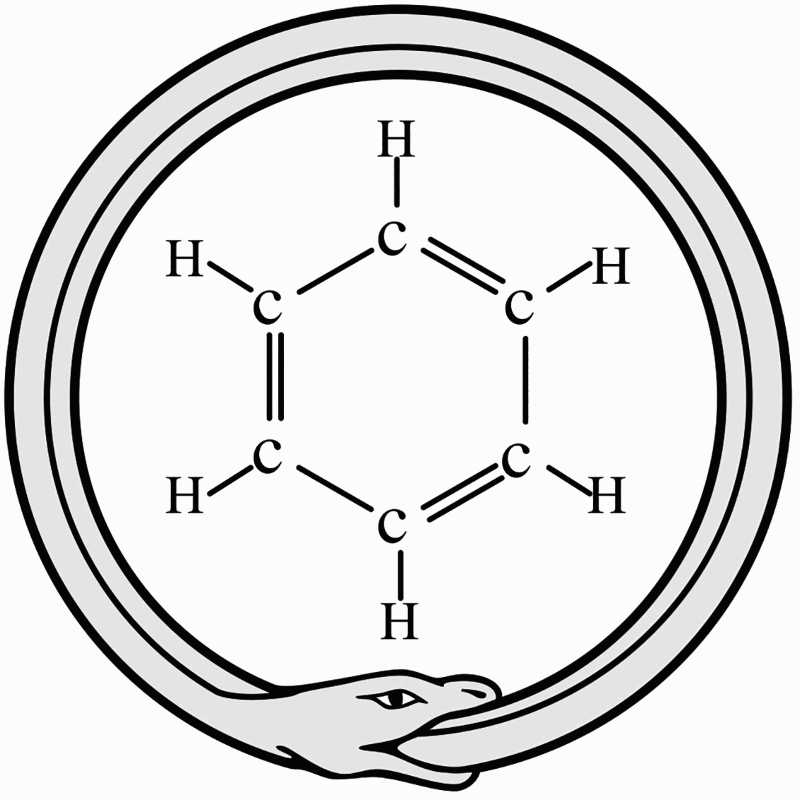
In 1865 Kekulé published the research that followed his dream, first in French, then in 1866 in German. It was this dream that the two gentlemen from Darmstadt and Düsseldorf wanted to put on stage. For this, they needed funds. The Andrea von Braun Foundation loved the idea and granted support for ‘Kekulé's Dream’.
Why? That has to do with the aims of this particular organization of which I have the privilege to be the managing director. The foundation was founded in 2001. The admission process was lined with hurdles. The licence to start a non-taxable foundation in Germany always hinges on its aims. These are subjected to detailed questioning by the tax authorities and only if they are convinced that the work of the new foundation will generate effects that are in general or specific support of what in Germany is referred to as ‘Gemeinwohl’, perhaps best translated as public weal or well-being, will they give the green light. In this case the overarching idea of the founders was that the new foundation would contribute to the dismantling of barriers between disciplines. This required a number of clarifying discussions with the government, but in the end it worked out.
The foundation's aims are pursued along the following principles:
Cooperation and mutual enrichment of fields of knowledge maximally distant from one another, covering both individual cases as well as issues of interdisciplinarity in general Generation of synergies between different philosophies, tools, and approaches Strengthening of interdisciplinary dialogues Publication of results
The benefits from this are manifold. The most important of these rests on the general realization that there is not a single significant issue in a modern society that can be resolved within a single discipline. Be it youth unemployment, climate change, migration, education, demographic shift, globalization, IT-privacy, monetary policy, traffic congestion or divorce rates, they all require the involvement and expertise of many fields of knowledge. Nevertheless, separate silos of knowledge with different labels typically identify the established mode of learning in developed societies, e.g. quantum physics, scripture, microbiology, optics, industrial design, Asian history, macroeconomics, criminal law etc. Disciplinary focus starts at the very latest in the third year of primary school and lasts all the way to advanced university degrees and beyond. The more an individual — or science in general — advances in any field, the narrower that field is defined. Similarly, the organizational structure of education or science ministries typically follows curricula and research fields. Anybody who has written a book will have encountered the publisher's question in what shelf of the bookstore it should go. Management? Self-help? Biographies? Travel? Biology? Gardening etc. The real gains lie elsewhere: Even a cursory look at the list of Nobel laureates reveals a remarkably high share of individuals who achieved the prize for venturing outside their disciplinary boxes. Only gradually are we beginning to realize that what we lack are mechanisms to allow the productive and frictionless interaction of widely differing disciplines.
Overcoming such gaps between fields of knowledge not only makes cooperation easier and less costly, it also generates vast new possibilities. If they are willing, experts from one field can learn from the other and unlock potentials that previously were beyond the horizon of expectations. Surprising and unexpected leaps of ideas become possible. Knowledge begins to grow not along evolutionary lines, but allows revolutions of learning without — it must be added — similar leaps in costs. It is to this that the foundation attempts to contribute.
Of course, with limited funds it can at best be no more than precisely that: a contribution. Depending on the vagaries of financial markets the foundation can typically fund between €80,000 and €250,000 per annum, hardly enough to change the world or even to develop some fancy new drug, say, but enough to generate a number of interesting studies or dissertations, support publications, travels, or conferences. Occasionally it is possible to leverage funds by cooperating with larger foundations. Our most successful project in this respect was the willingness of our Board to fund a new chair for interdisciplinary science management at a university with €25,000 which in turn moved two other larger organizations to come up with €365,000 each, which was enough to put the chair on a permanent basis.
We try to keep operations frugal. There is one managing director who works on a pro bono basis and one half-time administrative assistant. Initially, the Board of Trustees who has the final say in all funding decisions, was planned to be quite large since the activities of the foundation was going to be based in so many fields of knowledge. It quickly became apparent that this was financially out of reach. The Board was therefore reduced to three individuals with a good general knowledge and mental openness. It is up to the applicants to explain what their plans are in generally understandable terms.
Language, thus, quickly became a crucial item. Since the classic universal genius is an extinct species, crossing disciplinary borders rests on the ability of experts to communicate successfully with experts from completely different fields. Today all of us are laypersons in 99% or more of all fields of knowledge. Anybody wanting to communicate with somebody from a different field therefore has to do so in everyday language that any newspaper reader can grasp. For many, that is not easy to do, for our foundation it is a requirement that needs to be fulfilled in every successful application.
Further requirements and conditions:
Every application has to touch upon at least two different disciplines that should be as far removed from one another as possible. A project that combines chemistry and physics, for example, or economics and law, or theatre and music would not be supported therefore. These are disciplinary pairings with a long history of interaction and similar traditions, success factors, and values. But projects with widely ranging fields of knowledge, e.g. soccer and religion, or Tibetan philosophy and quantum physics, or zoology and acoustic cognostics have been supported and proved to be highly interesting ventures. Projects mostly lie in the academic sphere, but do not need to. We also include non-academic projects based in the crafts, at schools, theatres, and amateur groups or in the esoteric or ‘traditional’ fields. To be honest, we have not dealt with an application for support from a shaman or a witch doctor so far, not because we would refuse it, but because shamans and witch doctors do not write applications. We expect every project to contribute to the body of interdisciplinary experience. For this reason, every successful applicant has to agree that after the completion of his or her project they will author a so-called ‘learning paper’ which explains both the content of that project and the interdisciplinary lessons learnt. What worked, what did not, what went wrong, how was it fixed, or not, and what were the reasons? In this way, we also learn from failed projects of which there have been a two or three. These learning papers, a few of which have been collected and translated into English in this edition of the ISR, are published in the foundation's twice-yearly newsletter and made accessible on our home page (141 as of August 2016). At irregular intervals the foundation grants a prize for the best learning paper. Most of the projects are based on applications coming in from the outside, increasingly, however, the foundation also instigates projects of its own. Applications are accepted in German and English. Presently about 15% are submitted in the latter language with a growing tendency, even among applications originating in Germany. Due to locally scattered references and academic sojourns abroad quite a few are lingually mixed. I think that is a good sign since it reflects an increasing level of cross-border research. We maintain a list of alumni whom we occasionally call upon to give lectures at conferences. We also use the list to forward call-for-papers, job openings, evaluations of new applications etc. All applications are digital. Others are not considered. There are no official forms to fill. Since applications can come from all quarters, one would be hard put to design a one-size-fits-all form anyway. We do, however, insist on conciseness. Originally we requested no more than 1MB or five pages, a limit that was regularly breached and that we learned to live with. Some time ago, however, we received a shoebox full of explanatory four-hour videotapes that we promptly returned unwatched. Based on all this our decision criteria are fairly straightforward and largely of a qualitative nature
- Methodological contribution to the ‘art’ of interdisciplinarity - Creativity and originality - Broader relevance - Simplicity and elegance - Didactic and linguistic quality
And the results? From the day the foundation went online, the number of applications has grown continuously. Here are some statistics:
Between the establishment of the foundation in September 2001 and December 2014 there have been
Ca. 7,000 (estimate) contacts, preliminary enquiries, questions (ca. 2/work day) Ca. 1,800 formal applications, of which 264 were submitted to the Board, of which 213 were accepted (11.8%), of which 43 were doctoral scholarships (by far the most costly form of support) and 59 major publications Ca. 70 applications were forwarded to other organizations Total grants amounted to a little under €2 Mill Project volumes ranged from €150 to €50,000 Ca. 600 (estimate) contacts, preliminary enquiries, questions 310 applications, of which 25 submitted to the Board, of which 21 were accepted (6.8%)
In the year 2014 alone there were
Unfortunately, applications have risen both in number and volume while funds available for distribution have largely gone the other way, mainly due to the current low-interest regime in the financial markets. This has meant that all applications have had to go through a finer sieve so that the acceptance rate declined. Nevertheless, we are quite satisfied with the results of our work.
Among the things we have learnt are the following:
Learning Papers The Key to Interdisciplinarity: Language Surprise: Gender of Applicants No Surprise: Age of Applicants Most interesting: The Types of Applicants
We believe that the foundation's most important and relevant contribution to society are these essays. They are usually about seven to ten pages long and need to be of a publishable quality. They are not refereed, largely for lack of suitably trained interdisciplinary referees, but reactions from readers point to a high degree of acceptance. Essentially, they constitute a collection of experience reports and Do's and Don'ts for projects that are interdisciplinary in nature, be it a single individual who bridges the gap between fields of knowledge or whole teams that bunch different fields of expertise and education together. In this volume of ISR we have assembled eight learning papers from the archives of the foundation. More will be forthcoming in a later issue. Except for the ones that were English in the original they have undergone translation. This proved to be no easy task, especially for cost reasons and time pressures. The translations are not perfect and we ask our readers’ forgiveness for the occasional instance of heavy-handed (-tongued?) expression.
As indicated above, a clear and simple explanation of what an applicant has in mind is crucial. We often return applications to their originators and ask for lingual improvement, partially for our own improved understanding, but largely in the interest of project success. The philosopher Arthur Schopenhauer, himself not an Olympian of clear and easy wording, coined the advice, ‘Use common words to say uncommon things.’ It is a good piece of advice, but not always easy to follow.
One thing we did not expect was that the particular requirements of the Andrea von Braun Foundation would attract far more women than men. The female share is hard to measure precisely since many applications are submitted by teams of two or more, but an educated guess puts the share of applications from women at well over 60%. If one just looks at successful applications this share rises even further. Indeed, seven of the eight papers submitted here are by women. One can speculate on the reasons for this imbalance. Two explanations come to mind, one is that the foundation carries the name of a woman, the other (and more to my belief) is that the specifics of interdisciplinary work are better suited for the minds and ideas of females and therefore also generate more interest there. Any enlightenment on this by readers would be highly appreciated.
Our applicants typically belong to one of two age groups: the very young ones, or rookies as the Americans call it, and the distinguished elder scientists. The conspicuous lack of mid-career scientists and researchers in their 30s and 40s can easily be explained: Interdisciplinary work is not without risks. These come in two shapes. One is that straying into a field other than one's own can lead to accusations of poaching by the inhabitants of that other field. Disciplines, university departments, institutes, professorial chairs and research programmes are often as heavily defended as medieval castles. One cannot just wander in and become part of the field, or only at the danger of being exposed as a dilettante. The other risk is that colleagues from one's own home territory — always on the lookout for gaining an advantage on a competitor — will be tempted to state that one has obviously run out of ideas or is not up to the demands of the home turf. Either way, this is not something one is particularly keen on if one has just achieved a certain level of acceptance, is perhaps head of a small team, has a family and is — at last — making a little more money. For beginning researchers — unprejudiced, enthusiastic and full of dreams — such considerations are immaterial. They do not care and want to work on whatever it is that has caught their fancy. If the need should arise a young geologist, for example, will therefore have no qualms to talk to a philosopher about his or her research or the problems encountered. In essence, the same is true for the elder or mature scientists. Once you have received a Nobel or any other prestigious award, have achieved an exposed position or have come up with world-shattering results you are more or less free to focus on whatever you like. Nobody will criticize it. If on top of that such endeavour should lead to new fundamental insights, all the greater the admiration.
It is hard to find common traits among all our beneficiaries. They come from most walks of knowledge. Many of them are advanced students from all areas of the academic universe. Others are retired professionals. There are artists (sculptors, painters, actors, composers, poets etc.), mothers, retired bureaucrats, even deep-sea divers, librarians, and priests. Quite often both successful as well as refused candidates return with a second project. The one thing we did notice, however, is that without fail they are likeable people with a good sense of humour. Most of them are extremely smart. They are fast and lateral thinkers, have many ideas and tend to view their home disciplines with a certain degree of detachment. They do not hesitate to make fun of what they are doing which obviously contributes to their openness towards other realms of thought. For some reason, among German applications Berlin seems to have more than its share, which can perhaps be explained that it is a city still in search of itself. ‘Poor but sexy’, its major called it some time ago. Perhaps interdisciplinarity needs a certain degree of restlessness, of dissatisfaction with existing circumstances, of a sense of entrapment. In previous times these were the people who would immigrate to what was then fittingly called the New World. One might postulate that today the New World is no longer a geographical term, but a mental one: daring to think along lines that no one has pursued before and where no one has been, much like Star Trek in fact. Possibly, just possibly, after many decades or centuries in which the sciences have drifted more and more apart we are finally coming to a point where the trend is turning and we receive our enlightenment not only from what we have learned, but also from those other interesting points out there that others have identified. The trend toward open access to scientific literature will certainly have helped.
In a way, I found a certain confirmation of this greater permeability of thought fields in one of the performances of ‘Kekulé's Dream’ that I happened to attend. The ballet was set up such that the dancers would act the role of the carbon and hydrogen atoms in the benzol molecule. They moved to the sounds of an abstract, but pleasing music, approaching each other, but never quite touching, force fields and valences becoming visible, molecules appearing and vanishing. It was surrealistic and at the same time familiar. In the row behind me there were three 18- or 19-year-old lads from a local secondary school. From their talking I gathered that they were about to take their final exams. Choices of careers and academic departments were looming. And then, in the middle of a fairly quiet part of the music I heard one of them say, ‘Hey, why don't we go for chemistry?’ Bingo! I thought. You sit in a ballet and get the idea to study chemistry. That is exactly what we want to achieve.