







Abstract
Complicite's A Disappearing Number is one of the best examples of contemporary plays that use theatrical strategies to convey complex scientific ideas. Complicite uses performance to stage the complex mathematical concepts of partition and infinite convergent series, taking inspiration from the statement by renowned British mathematician G. H. Hardy that “a mathematician… is a maker of patterns”. As well as performativity, other elements in the play contribute to performing mathematics on the stage, elements such as time and space, narrative structure, thematic content, and characterization. Complicite introduces a complex pattern that runs throughout the play to connect these elements to form a complete whole. These elements effectively work with each other to release a set of clues that guide the audience towards decoding the play's pattern. This study provides an in-depth analysis of these connections and the complex process of decoding the pattern in the play.
The arrival of a cavalcade of plays and performances that take science as their subject matter and scientists as their protagonists in the last three decades has created a true phenomenon. The best examples of this movement, known as the science play, such as Michael Frayn's Copenhagen (1998), Tom Stoppard's Arcadia (1992), and Timberlake Wertenbaker's After Darwin (1998), ‘literally enact the idea that they engage with’ (Shepherd-Barr 2006, 6). In these plays, the scientific ideas are weaved into the form and structure of the play so that both the architecture and the content of the play reflect the scientific idea under consideration. However, most of these well-known science plays are still rather mainstream in their theatricality. Despite the fact that they engage with science deeply and meaningfully, they are heavily textual and focus on biography or history, rendering the scientific ideas through the life of the scientific character. This gets the audience too wrapped up in plot and personalities. A recent second wave of science plays, however, as Kristen Shepherd-Barr has rightly noticed, is changing this conventional dramatic way of thinking about science on stage, ‘linking performance techniques and science in innovative ways that move away from the literary foci of works like Copenhagen or Arcadia and reclaim the theatricality of the science play’ (2006, 199). These newer plays that Shepherd-Barr classifies as ‘science performance’ (2006, 217) are devised or ‘made’ productions which employ cross- and multi-disciplinary approaches. In this category, theatrical works are not primarily scripted by a playwright; rather, they are created as a result of close collaboration between designers, performers, and directors. Since, in these plays, the actual science is embodied in the expressive nature of the performance rather than in the text, the dramaturgical and theatrical techniques are designed in such a way that they provide a visual exploration of scientific processes and concepts on stage. Science provides these pieces, in other words, with structuring schemata and visual principles, as seen in John Barrow and Luca Ronconi's Infinities (2002), Jean-Francois Peyret and Alain Prochiantz's Darwin trilogy (2004), and the works of Fuel Theatre, Metta Theatre, Curious Directive, and Unlimited Theatre.
Complicite's A Disappearing Number is one of the best examples of science performance. 1 The company's dramaturgical strategies, which include innovative multimedia techniques and choreography, as well as total theatre techniques combining projections, sound effects (live and pre-recorded), music, dance, and physical movement, generate a model of playing that encourages the audience to engage with complexity in the theatrical event. This quality places Complicite among the most successful theatre companies and A Disappearing Number among the best explorations of the metaphorical and theatrical potential of complex scientific discourses on stage.
One of Complicite's most remarkable attributes is its ability to create suggestive, incomplete forms that invite imaginative complexity from spectators, activating their creative agency. The company also inspires careful engagement with rhythm, tempo, musicality, and the dynamics of space:
an analysis through the use of movement of how a piece of theatre works: how it actually functions in terms of space, in terms of rhythm, almost like music in terms of counterpoint, harmony, image and action, movement and stillness, words and silence. (McBurney, qtd. in Williams 2005, 248–249)
There has been a rich body of research discussing and analysing the ways in which Complicite has used performance to convey the mathematical concepts that A Disappearing Number contains. Studies by Campos (2007), Abbott (2014), and Wiśniewski (2016) focus on discussing and analysing the ways in which patterns, numbers, and scientific concepts are staged in the play. These studies discuss the theatrical potential of scientific patterns in the play and decode the scientific meaning behind the theatrical strategies and dramaturgical techniques that Complicite use to convey complex mathematical ideas. However, together with the theatrical and dramaturgical aspects of the play, other elements such as its treatment of time and space, narrative structure, thematic content, and characterization are also at the service of conveying mathematics on stage. Complicite provides a complete theatrical experience in such a way that the audience can fully comprehend the play's scientific content, not only by seeing it performed on stage but also by discovering and analysing it in the same way that mathematicians work with mathematical formulas. The present study provides an in-depth analysis of the ways in which A Disappearing Number's temporality and spatiality, narrative, content, and construction of characters, together with its theatricality, work together to convey mathematics on stage. In this way, it expands the studies of Campos, Abbott, and Wiśniewski, which mainly focus on the dramaturgical and theatrical techniques that the play uses to enact science.
The inspirational source material of A Disappearing Number is the essay ‘A Mathematician's Apology’ by G. H. Hardy, an early twentieth-century Cambridge mathematician who believed that mathematical imagination and mathematical creativity were the same as other artistic endeavours. Hardy writes that ‘A mathematician, like a painter or a poet, is a maker of patterns’ (13). The essay opens with a biography of Hardy written by C. P. Snow, which includes a vivid description of his collaboration with the Indian self-taught genius, Srinivasa Ramanujan, a collaboration that forms the basis of A Disappearing Number. The play follows the collaboration from the two mathematicians’ first encounter in Cambridge in 1913 until Ramanujan's return to India in 1919, and weaves it with a theatrical exploration of mathematical concepts that are demonstrated in their full complexity, beauty, and glory.
The iconic line in Hardy's A Mathematician's Apology, that a mathematician is a ‘maker of patterns’ (2005, 13), becomes the fundamental ingredient of the play. The concepts of partition and convergent infinite series are used as tools to complete this process of pattern making. To convey Hardy's iconic statement through the medium of theatre, Complicite introduces a hidden pattern into the play and fills it with a series of clues that enable the audience to detect it after a long, complex process of pattern making and breaking. During this theatrical experience, the audience themselves turn into mathematicians, involved in the same process of discovery that actual mathematicians are involved in when decoding the hidden relations between numbers to eventually create beautiful mathematical patterns. The audience also finds the clues and analyses them in order to decode the hidden pattern of the play, a web of boundless connections that go beyond the limitations of time and space and connect a set of characters and events that despite their temporal, spatial, and cultural differences connect with each other and join infinity within a mathematical context. This web of connections runs throughout the play like glue, holding together different elements of the play such as time and space, narrative structure, and thematic content. The scientifically metaphorical style of A Disappearing Number and its reinforcement of the themes of infinite connectivity and the aesthetic comprehension of mathematics, in the sense that Hardy intended, form the play's elements in a patterned mathematical fashion, which requires a great deal of calculation to solve the equation of the play.
A Disappearing Number juggles scenes from two stories and two interrelated time periods. The scenes that feature the mathematical collaboration between Ramanujan and Hardy are constantly alternated and overlapped with contemporary scenes that revolve around the romantic relationship between Ruth Minnen, a lecturer in mathematics at Brunel University with a research interest in Ramanujan's work, and her husband, Al Copper, an American born to Indian parents, a businessman with no appreciation for mathematics or acquaintance with his familial roots. The two worlds are connected by Ruth's passion for mathematics and her fascination with Ramanujan's work. In order to study his mathematics in further detail, Ruth travels to India, but dies of a brain aneurysm on a train speeding across the Indian countryside. Al subsequently visits India to follow in Ruth's final steps; there he meets Aninda Rao, a fictional physicist with a research interest in the connection between string theory and Ramanujan's mathematics. Two more present-day characters complete the narrative tableau of A Disappearing Number: Surita Bhogaita, a Brahmin student of African origin whose ancestors left India in 1869, and the offstage character, Barbara Jones, an Indian Bangalore-based BT customer services employee, who helps Al get Ruth's cell phone number transferred to his name.
Mathematics is embedded into the content of A Disappearing Number. The audience is directly introduced to mathematical ideas through Ruth and Aninda's lectures, the former at Brunel University and the latter at CERN in Switzerland. The play's mathematical identity is fully formed when the complex mathematical concepts that it discusses are incorporated into its architecture. Complicite uses the underlying structure in mathematical patterns as a key schema to design different components of the play. A Disappearing Number opens in a university lecture hall where an excited Ruth sets off on a lecture ‘to go through one or two very basic mathematical ideas that are integral to this evening so that the recurrent mathematical themes become clear’ (Complicite 2011, 21). She then explains that a mathematical ‘sequence’ consists of a set of numbers called ‘terms’ that follow a particular pattern. Some sequences have obvious patterns and some do not. ‘To find the hidden pattern’, she continues, ‘you sometimes need to look at them in a new way’ (Complicite 2011, 21). This opening scene gives the audience members a modest clue that in order to keep track of the play they will need to reformulate how they think of the experience of watching a play, and regard it instead as a process of mathematical pattern-making. Soon after this, they are confronted with a chaotic stew of separate images, moments, episodes, and glimpses that turns the universe of the play into a jumble of visual and aural experiences that constantly take them backward and forward in time from one location to another. Faced with this collage of fragmented pieces, the audience must begin to sort them out, put them in order, and make connections between them. They are, in other words, asked to constantly make patterns out of piles of chaotic fragments, necessary theatrical elements that are placed next to each other in the same format as the terms in a mathematical sequence regulated by complex hidden patterns.
In A Disappearing Number the process of pattern making and breaking is strictly ruled by a mathematical object called the partition function, an area in which Hardy and Ramanujan carried out significant investigations. Partition concerns the number of ways in which an integer can be broken down into a sum of smaller integers. For instance, three can be partitioned in three distinctive ways (3, 2 + 1, 1 + 1+1), while there are four partitions of four (3 + 1, 2 + 2, 2 + 1+1, 1 + 1+1 + 1). This mathematical concept is integrally imbedded in the play, a piece that is not continuous, that is constructed from fragments that are disjointed but whose sum forms the totality of the play. This element also functions as a complement to the play's main thematic principle: interconnectedness of everything that continues on through infinity. However, since our actual world cannot physically contain the infinite, Complicite creates a universe where the mathematical concept of convergent infinite series, another field to which Ramanujan and Hardy made an extraordinary contribution, conceptualizes our relation to the idea of infinite connectivity. In mathematics, when the sum of the terms of an infinite sequence equals a finite value, a convergent infinite series is created. For example, the infinite series
 + … will eventually make 2. In A Disappearing Number, the characters constantly connect with each other to eventually form themselves into a sequence whose individual terms melt into each other and become one entity only in infinity.
Infinite time and space
One aspect of A Disappearing Number that plays an important role in the theatrical conveyance of the mathematical concepts of the play, including the idea of infinity
there are no gaps between the numbers, like there are no gaps in time or space; they are continuous. And if time is continuous, then we are linked to the past and future. And if space is continuous we are linked to the absent. (Complicite 2011, 30) , is its treatment of time and space. Complicite breaks through the temporal and spatial limitations of the proscenium arch and allows the characters to inhabit a universe over which the following theory rules:
Complicite's presentation of all time and all space as always there, with no gap or break in between, serves the purpose of illustrating that the mathematical patterns of infinity can become a source with which we can relate to infinite time and the infinite absence. The temporal and spatial terms of the time/space sequence of the play, in other words, continue forever, so that we are united with infinity. This sense of mathematically structured ‘infinite travel’ through time and space is beautifully illustrated in Scene Three through Al's act of counting: 1, 2, 3 … He stops but his voice, in a recording, continues to count up. He listens and then begins to count backwards: −1, −2, −3. Again he stops speaking but his voice continues. Now we hear the counting voices in both directions. This counting forwards and backwards from 1 and their continuing to count after their creation has ceased reinforces the idea of the continuity of time and space until infinity; we leave the immediate present, count backwards into the past, join infinity, count forwards into the future, join infinity, and continue like that forever. A company of nine actors who are nearly always on stage, continuously switching contexts, contributes to this sense of infinity; in the same scene, after every time/space shift, the actor whose presence on stage has caused the forward movement into the past walks back through the screen, where he/she entered from, followed by the company disappearing one at a time into the darkness of the screen. The screen becomes a door into another world through which people step into infinity. This subtle use of dramaturgical and theatrical techniques, as well as the play's episodic spatio-temporality, enables Complicite to show that in the world of theatre, the past, present, and future, and here and there, collapse into a static continuum and create a time-less ‘now’ and a space-less ‘here’ that directly contributes to the representation of mathematical infinity.
The fast and fluid time/space travel in A Disappearing Number creates a chaotic jumble of events that are grabbed from different temporal and spatial dimensions to be placed next to each other. The play's unusual employment of time/space leads to an episodic, fractured narrative that unfolds a series of parallel stories simultaneously. But is there any pattern to these time/space and narrative fluctuations? The answer will be provided after a discussion of the play's narrative structure.
Mathematicians calculate the narrative
A Disappearing Number consists of a main narrative within which there is a set of interconnected partial narratives (six of them) whose fragments constantly interrupt each other's linear flow and force one another to leap-frog from one temporal point to another within their own time/space frame. Due to their interconnectedness, the partial narratives also contribute to each other's development by containing part of each other's fragments. This makes the play's main narrative a jumble of separate images, moments, episodes, and glimpses, whose significance and relation to each other and to the partial narratives is not immediately clear. Members of the audience are drawn into continuous analysis of the fragment release process to make and remake the necessary connections.
The discontinuous narrative structure of A Disappearing Number makes the fragment-hunting a complex process with different stages. 4 The audience first determines to which partial narrative the released fragment belongs, then locates it on the temporal/spatial spectrum of the identified partial narrative, and finally provides a linear sequence of chronologically ordered fragments that are tied together with the string of logic. It eventually analyses the partial narratives in relation to each other to come up with a linear main narrative. By creating this complex process of fragment hunting and narrative assembly Complicite gives the audience the unique chance of getting personally involved in the scientific content of the play, and creating by themselves beautiful and provocative patterns from complexity. In doing so, the company not only shares the experience of pattern making with the audience, but also places mathematical thinking at the heart of the play: the audience sorts through the fragments, arranges them, and connects them to create patterns. This is the same process that mathematicians go through when, to quote Stephen Abbott, ‘training their focus on some unfamiliar corner of the mathematical landscape’ (2014, 234). 5 The fragments of episodes from Ruth's life, for example, are presented across several scenes of the play, always interrupted by fragments from other partial narratives including those of Al's, Ramanujan's, and Hardy's. This Complex narrative structure allows Complicite to illustrate the mathematical concept of partition, 6 as well as Hardy's perception of mathematics as an artistic process of pattern making. Similar to the numerical content of the concept of partition in mathematics, the narrative elements of the play first divide and then combine with each other to create beautiful patterns of connection in audiences’ heads, as if they are mathematicians solving complex mathematical formulas.
In terms of the theatricality of A Disappearing Number, the idea of mathematical sequences is either conveyed by the actors frequently being positioned in lines of human ‘series’, or by video replays of the live action in the form of an endless sequence of images. The most explicit enactment of partition takes place in a remarkable scene late in the play (Scene Ten). In this scene, characters from different time periods are onstage together: Hardy and Ramanujan are in Cambridge in 1915, Al is in the present locked in a lecture hall, Ruth is in Al's past phoning him, and Aninda is in the present giving a mathematics lecture in Switzerland. While Aninda is explaining different ways to partition the numbers 2, 3, 4, and 5, the actors act out different groupings with either their bodies or stage props. As Stephen Abbott explains,
For the partitions of 2, Hardy and Ramanujan move together and then apart. For the partitions of 3, the blocking takes Ruth and Al in and out of proximity with Aninda. For 4, Ruth unconsciously illustrates the various partitions using her 2 feet and 2 shoes. (2014, 233)
But what determines the arrangement of the terms of the main narrative sequence of A Disappearing Number? Is there any formula for placing the fragments next to each other and drawing connections between them? The answer lies in the play's central thematic principle: boundless connectivity.
Boundless connectivity
The stimulus that triggers the instant and haphazard narrative jumps is thematic similarity. Within the larger scope of the main narrative, the force that determines the arrangement of the fragments of the partial narratives is the content of the fragments. In other words, the fragments of the partial narratives that are thematically connected are placed next to each other to form the main narrative sequence. The thematic pattern that guides the narrative development renders the plotline chaotic but serves one main purpose, which is the reinforcement of the play's central thematic principle: everything is interconnected through time and space.
This thematic similarity also gives the dynamics of the chaotic time/space map of the play an appearance of order and pattern. A Disappearing Number uses a complex system of message exchange to reveal patterns and instant connections between temporally and spatially distanced terms of the play's time–space sequence. The event being enacted onstage instantly interacts with another event in another unit of time and space by sending it a message, and becomes thematically entangled with it. As a result of this, the terms in the time/space sequence are mysteriously embedded and entangled with their preceding and following terms, breeding a beautiful pattern of thematically connected elements; they find each other, interact with each other, and become entangled, despite whatever vast distance lies between them. In Scene Three, for instance, what gets the young Indian woman in 1869 entangled with Churchill in 1946 is India's nationalist movement. In 1860, under the sovereignty of the British Empire, thousands of indentured Indian labourers were sent to Natal in South Africa to develop the sugar industry. However, as a result of efforts made by Indian nationalists, not only was the indentured labour to Natal terminated, but also the Indian Independence Act was passed by the British Parliament in 1946. This event is instantly followed by a thematically similar event, the death of Hitler in 1945; immediately after the end of World War II, India gained her independence, because many years of war against Germany had destroyed the economy of Britain to such an extent that it could no longer financially support its armed forces and was therefore not able to contain the growing freedom movements in its colonies, including India. It therefore seems fair to say that Hitler played a lead role in India's independence. Accompanied by the sounds of war, this event is instantly linked with the one in which Britain's involvement in the war against Hitler is announced, followed by Hardy's lecture about Ramanujan's death, whose health worsened in England because of the scarcity of vegetarian food during the war. From here on, the common theme connecting the rest of the scene's events is death; three deaths are entangled across time and space, Ramanujan's, Hardy's, and Ruth's. This narratively charged message exchange is the main pattern-making device in the play, and causes distanced realms to become entangled, creating a complex network of connections, the workings of which resemble the complex process of the creation of patterns in the realm of mathematics. A Disappearing Number is full of these hidden connections and complex entanglements. The thematic arrangement of these distanced events determines the development of the time/space sequence of the play. In other words, the pattern that governs the order of succession in the play's time/space sequence is a thematic relationship that is entirely dependent on a complex process of message exchange between the events that the members of that sequence contain.
Together with the process of message exchange, the strong similarities that Complicite establishes between the characters gets them instantly entangled beyond the boundaries of time and space and reinforces the idea of boundless connectivity. This character similarity is suggested by two elements: mathematics and Indian ancestry. Ramanujan and Hardy in the early twentieth century are connected with Ruth in the twenty-first century through their passion for numbers and mathematics. American Al and British Surita in the present day are linked to the historical Indian Ramanujan through their Indian ancestry. Aninda and Barbara in the present day are connected to other past and present characters scattered across the world through both numbers and Indian ancestry. These characters from different temporal and spatial dimensions become entangled once their similarities are established and remain the same until the very end of the play. This creates a pattern of relations amidst the chaos of the play that, although it is hard to grasp at first glance, gradually reveals itself in the form of a web of hidden connections.
This pattern of connection between distanced characters is also reflected in their explorations of the mathematical landscape in pursuit of truth and understanding. Each character starts a solitary journey across the world of mathematics, the destination of which is unification with other characters. This unification is illustrated through the mathematical theory of partition echoed in the play by many images of division. As Campos has rightly noticed, the stage in A Disappearing Number is divided into different parts by several screens, constantly shifting up and down and revolving around the characters, further emphasizing their separation. The scenography of the play also contributes to this sense of division; because of the screens and light effects, the characters seem to be isolated in different areas of the stage and cut off from one another (Campos 2007, 331). This division is also echoed in the play by the separations that the characters have to endure: Al is parted from Ruth, for example, due to his inability to understand her passion for mathematics, and is alienated from his past and cultural roots as an Indian. Hardy is also distanced from Ramanujan due to the differences in their methodologies, as the latter was famous for achieving his theorems through imaginative mathematical leaps, and this was strange to the former, as Louise Whiteley (2007, 48) notes, ‘raised as he was on a strict diet of logical proofs’. However, as a result of the characters’ quest for truth and understanding, a beautiful pattern emerges that makes these divisions the source of entanglement and connection. While locked in the lecture hall and thinking through his past with Ruth, Al reads Hardy's A Mathematician's Apology, a book that helps him get an insight not only into the life of Ramanujan and his romantic and passionate relationship with mathematics, but also into the mind of his wife as a mathematician. Hardy's book and Al's memories of Ruth take him on a journey, the destination of which is a union with his wife and his familial roots. While Ruth journeys across India in search of mathematical truth and a sense of ultimate connection and belonging, she prepares the way for Al looking for his roots and understanding in the same place. India for him becomes a multifaceted, abstract space containing a completeness of everything: a better understanding of his wife and her passion for mathematics, as well as his own origins as an Indian. Once Ruth is dead, Al has to find a new home, a new place to belong to, a place that turns out to be his country of origin. Al's travels, in other words, take him to India but also to the other reality of numbers and equations, which helps him gradually come to terms with his wife's death. His leap into mathematics, in Campos's words, is in itself ‘going elsewhere’ (2007, 331). In the world of the play, therefore, seemingly disconnected realms form a pattern of connections in which characters located in different temporal and spatial scales interact with each other in the context of a search for truth and understanding.
Ramanujan and Hardy also make the same truth-seeking journey across the land of mathematics. Ramanujan travels from Madras to Cambridge in pursuit of mathematical truth, and Hardy's collaboration with him puts him on a journey that takes him beyond the dry and rigorous practical applications of mathematics to the realm of its intrinsic aesthetic value (Abbott 2014, 226–227). This impact is most evident in A Mathematician's Apology, a book he wrote at the end of his life: real mathematics ‘must be justified as art if it can be justified at all’ (Hardy 2005, 43), is how the nature of mathematics is summarized in the book.
The connection that Complicite establishes between these distanced and near characters (Ruth and Al, Ruth and Ramanujan, Ramanujan and Hardy), after going through a long process of division, underlines the metaphorical role of the partition function: the characters become the elements of a whole which first divides to eventually unite to equal the whole. This unification of characters is beautifully illustrated in the very last scene, when the distanced characters unite with each other at the sacred Cauvery River in India, in which Ramanujan used to swim. Having understood Ruth's passion for mathematics, Al decides to throw a piece of her chalk into the river: the same chalk she used to write numbers and equations in her lectures. Meanwhile, we hear Hardy's voice-over:
I still say to myself, when I am depressed or forced to listen to pompous and tiresome people: ‘Well, I have done one thing you could never have done, and that is to have collaborated with Ramanujan on something like equal terms’. (Complicite 2011, 88)
The river becomes a place where distanced characters can reunite with each other and become instantly entangled. These numerous interconnections indicate the power of mathematics as a time-less, space-less phenomenon that can interconnect time-bound and space-bound humans, no matter how far apart they are. It is a unification of divisions generated by mathematics. Mathematics, therefore, in the world of the play, turns into ‘a source of passion and inspiration’ (2014, 231), as Abbott says. It is a shared love that unites the characters despite their differences and eventually helps them understand each other as manifested in the beauty of mathematics.
This reconnection and unification of characters through the power of mathematics reinforces another recurring theme in Complicite's works: the creation of a utopian sense of connection among the people of the world by crossing boarders, times, and continents. Al, Ruth, Hardy, and Ramanujan, as Indians and Britons, conquer the history of conflict, enmity, and violence that defines their link to each other as an inseparable component of Britain's imperial venture in India, and instead find connection and unity in mathematics. The historical divide, in other words, turns into mathematical unification, an entangled network of human connections that overcomes the boundaries imposed by history, culture, time, and space through the power of mathematics. According to Reinelt (2001), however, Complicite's jump from historical divide to unity in mathematics becomes a dangerous move towards ‘linking everyone in an image of sameness’ (376). She argues that the stage has always been a place of cultural confrontation. When performance falls into essentialist ideas in the creation of various sensory levels of aesthetic experience in an attempt to engage the audience, this intercultural encounter may be reduced to eliminating the awareness and appreciation of difference and reifying the notion that artistic beauty must emerge from papering over historical, national, and ethnic differences. Reinelt is right in arguing that in its works, Complicite aims at universalizing experience in a number of ways, but it is only partially successful in A Disappearing Number. This attempted universalizing simultaneously draws the attention of the audience to both the unification of divisions through the power of mathematics and an appreciation of cultural specificity and difference, again in the context of mathematics. A Disappearing Number juxtaposes two extremely different approaches to mathematical creativity stemming from the cultural differences between the play's two famous mathematicians. The first approach relies on an unusual mathematical intuition embodied by Ramanujan, a religious Brahmin genius with no formal training in mathematics whose theorems, to use Du Sautoy's words in his introduction to A Disappearing Number, ‘were spilling from his mind thanks … to the inspiration of his goddess Namagiri’ (Complicite 2011, 14). The second approach is based on the rigors of a western definition of logic and proof practiced by Hardy. The contrast between the two mathematicians is emphasized in the play through the juxtaposition of Hardy's carefully planned life as a Cambridge university don with Ramanujan's as a man of intuition and inspiration. Hardy is depicted on stage drinking his coffee while reading a newspaper, riding his bicycle to college, enjoying a game of tennis, and writing his equations on sheets of paper in his college surroundings, while Ramanujan's wild creativity is conveyed through Indian dance and tabla music. At some point in the play, two actors, one writing down the equations, the other enacting the thought process through dance movements, both play Ramanujan's character (Campos 2007, 330).
In the course of their mathematical research, Ramanujan and Hardy encountered intercultural and interpersonal challenges that arose from their different working methods and cultural backgrounds; Hardy's western approach which favoured logic and proof constantly clashed with Ramanujan's instinctive and inspirational approach to mathematics, stemming from his Brahmin upbringing. His creative dynamics was highly rooted in intuition, allowing him to make his wild theorems from unexpected relationships in unlikely places. 7 As Hardy noted, ‘It seemed ridiculous to worry him about how he had found this or that known theorem, when he was showing me half a dozen new ones almost every day’ (qtd. in Albers, Alexanderson, and Dunham 2015, 60). It was therefore up to Ramanujan to supply the raw material and up to Hardy to provide the rigorous proofs that would make their papers eligible to be published in western journals. ‘It was a real cultural clash’, Du Sautoy explains, ‘like trying to marry the traditions of western classical music with the ragas and tablas of India’ (Complicite 2011, 14). But this union of opposites, an inspirational and intuitive mathematics with a rigorous proof-based one, gave rise to very powerful analytical methods in mathematics. This unification of opposites is depicted on the stage by fusing Indian and Western sounds and rhythms and the superimposition of images. At one point in the play, the image of Ramanujan is projected over Hardy while he is working on mathematical equations at his desk. In another memorable scene late in the play, as a half-naked Ramanujan is sitting on the floor rapidly writing equations on a small blackboard, the audience is presented with a ‘tihai’ (a highly syncopated Indian musical form involving tabla, voice, and dance) while papers are flying about and Hardy is circling around Ramanujan on a bicycle with numbers being projected everywhere.
By choosing the confrontation between two mathematicians with two opposite mind-sets arising from their cultural differences and their Western and Eastern upbringings as the focus of the play and by creating such a strong connection between them, Complicite suggests that at the heart of mathematical research, there are two contradictory and yet complimentary forces (intuition and logical proof) that work most effectively together to eventually create a work of genius. Reinelt, therefore, rightly argues that Complicite attempts to demonstrate that mathematical experience is shared universally, but to be fair, this attempt is made with a deep awareness and appreciation of cultural and ethnic differences of the mathematician characters. Thus, while the play aims at producing a certain universalism, it nonetheless recognizes cultural differences.
In order to illustrate the instant connection between characters despite their temporal and spatial distance, Complicite uses plenty of theatrical techniques, such as voice-overs, characters dissolving into the darkness of the screen and their sudden reappearance again through the screen, noises of objects such as trains, airplanes, and cars. These techniques enable Complicite to make characters instantly travel across the spectrum of time and space to the aliveness of the stage to connect with one another. But this connection is best illustrated through the overlapping of images. While being trapped in the lecture hall, Al places Ruth's belongings on an overhead projector: a piece of chalk, a scarf, Ruth's passport, Hardy's Apology, Ramanujan's picture, a Rough Guide to India, and a picture of Ruth and Al in bed. Objects from different time/space dimensions are gradually accumulated on the projector, making it a site where past and present and here and there can instantly connect. A Disappearing Number uses the trick of having a simple space, in this case a projector, as the centerpiece on which large temporal and spatial distances become a matter of a few centimetres and seconds.
But the links between characters do not conform to the rules governing our world; in the universe of the play these connections continue forever until infinity. Here, the mathematical content of the play once again conceptualizes our understanding of connection and entanglement. The characters’ abstract considerations of infinity are frequently overshadowed by the reality of death and loss, which provides a cruel contrast to Ramanujan and Ruth's research into infinity. However, the mathematics is also introduced as an effective device to create patterns with which the dead and absent can relate to the alive and present. In the world of mathematics, they become two lines stretching away forever, getting closer and closer to each other though never quite touching, except in infinity: as Ruth explains, ‘those two lines do actually meet … in infinity. The impossible is possible’ (Complicite 2011, 35). By letting go of the laws governing the actual world and allowing the patterns of mathematics to take control, the metaphorical structures for human relationships find the necessary space to emerge. Convergent infinite series such as
 + … = 2 become a metaphor for the impossible union of human beings. Here, science becomes the mathematics of love and relationships, an infinite entanglement between human beings. The love that exists between Ruth and Al continues forever until they meet each other again in infinity and reunite to become 2 (Sebesta and Stone 2008, 489), and Ramanujan and Hardy's collaboration continues forever until they also rejoin each other in infinity as mathematics partners and become 2. As Sebesta and Robin beautifully put it, ‘the language of math can communicate the aesthetics of emotion better than verbal language […] and can express that which might be imagined or felt’ (2008, 490). In this context, the death of Ramanujan from liver infection in England and Ruth's death in her journey to Chenai from a brain aneurism become highly significant. These mathematicians left their homelands due to their love for mathematics and a strong compulsion to understand, to eventually die in another country and join infinity via the magic of mathematics.
Contrary to what Sebesta and Stone suggest, however, the compulsion to understand does not lead to tragedy, and the deaths of Ruth and Ramanujan. Rather, the nature of their deaths shows their love for mathematics, the reward for which is to become infinite. They die because of their passion for mathematics and are eventually reunited with their loved ones in mathematical infinity. Complicite's use of convergent infinite series as a metaphor for human reunion that goes beyond the limits of our finite world turns the play into a theatrical enactment of a concept of infinity that can only be achieved through mathematics.
The end of A Disappearing Number further highlights Complicite's attempt to demonstrate that infinity can become a possibility through the power of mathematics. In the final image of the play, Ruth's voice is heard counting numbers. When the play is over, the voice keeps counting, fainter but still repeating, until it gradually fades out. For a while at least, through the magic of theatre, the numbers seem to be counting infinitely (Winston 2008, 33). As Hardy (2005, 12) explains in A Mathematician's Apology, ‘Archimedes will be remembered when Aeschylus is forgotten, because languages die and mathematical ideas do not. “Immortality” may be a silly word, but probably a mathematician has the best chance of whatever it may mean’. And indeed the offspring of Hardy and Ramanujan's collaboration is a mathematics that has guaranteed its immortality through the pages of history. Two opposite forces, Ramanujan and Hardy, collide, unite, and make a complete mathematical whole.
Complicite's careful use of dramaturgical strategies and theatrical techniques to transport pure mathematics onto the stage is best illustrated by the frequent projection of mathematical formulae and the constant appearance of numbers dancing around the theatre space, like snowflakes. The projected numbers often exceed the frame of the proscenium arch and encompass all the action and all the space, as if reaching out to touch the audience. The dancing digits and mathematical symbols are also projected over the actors’ bodies and onto surrounding screens to completely encompass them (Figure 1).
The projection of numbers and mathematical equations onto the actors.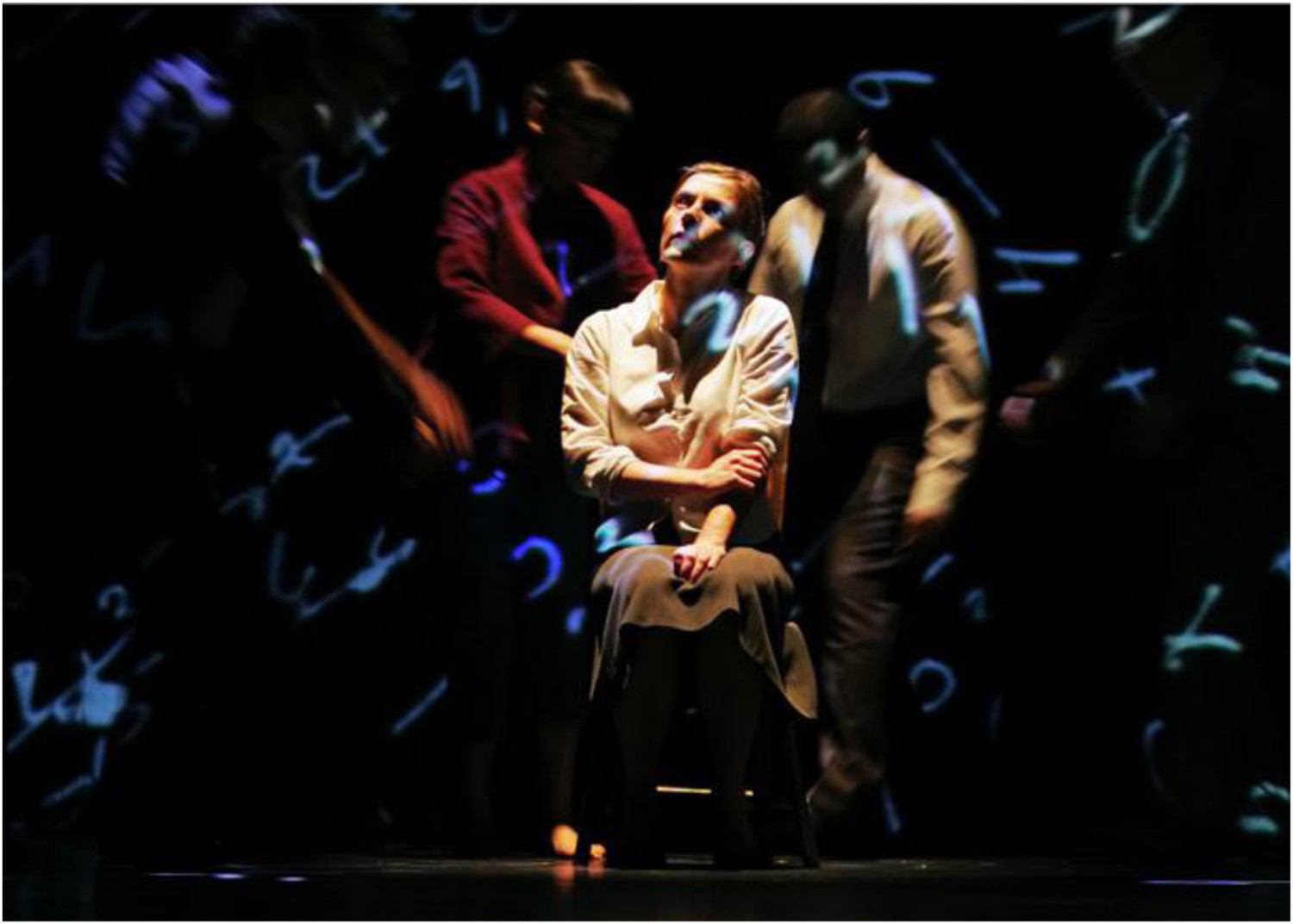
A Disappearing Number is one of the best examples of science plays that use the medium of theatre to convey scientific ideas. Hardy's iconic line about mathematicians as makers of patters in the same way that artists are runs throughout the play. The audience is in a constant process of pattern making and breaking to discover the complex patterns that govern the temporal and spatial arrangement, narrative structure, thematic content, and characterization. Different elements of each aspect of the play are scattered throughout the play with no ostensibly clear connection between them, and it is the audience's job to detect them, comprehend their relations, and put them in order, to eventually discover the patterns that govern them: the same thing mathematicians do when dealing with numbers and formulae. All these elements first divide and then combine to make a whole, the play, in the same manner as numbers do in the mathematical concept of partition. And these connections continue forever, until they reach infinity.
Footnotes
Disclosure statement
No potential conflict of interest was reported by the author(s).
Notes on contributor
1
A Disappearing Number was proceeded by another successful science performance by Complicite, Mnemonic, first produced in 1999. In this play, Complicite uses dramaturgical and theatrical techniques to enact the complex mechanism of simulation and connection on which the act of remembrance is based.
2
References to the theatricality and dramaturgy of the play are based on the 2007 production of the play at Barbican, a DVD of which is available from the Victoria and Albert Museum.
3
A Disappearing Number is only one example of science plays/performances that put different historical worlds in direct communication. Ira Hauptman's Partition (2003), Shelagh Stephenson's An Experiment with an Air-pump, Complicite's Mnemonic, After Darwin, and Arcadia, for instance, also displace the conventional map of theatrical time by jumping from one historical world to another, or by having different worlds simultaneously present on stage.
4
There is no doubt that the tradition of nonlinear narrative structure has been an integral element of Western avant-garde theatre for a long time, such as in surrealism, abstract expressionism, Brechtian epic theatre, the theatre of the absurd, and postmodernism. Such narrative structures have formerly also been present in traditional forms of theatre in various cultures such as in Tazieh (Condolence Theatre) and Shahnameh-Khani in Persian culture, in Panchatantra Katha in Indian culture, and in Tuluat Theatre in Turkish culture. In these traditional forms of theatre the time slightly or radically changes from one time frame to another and from one narrative to another. In A Disappearing Number, however, this nonlinearity of narrative structure is achieved by employing the mathematical concepts of partition, infinite convergent series, and Hardy's statement that ‘a mathematician … is a maker of patterns’ as the forces behind the narrative structure of the play. In other words, the nonlinear narrative structure is at the service of most effectively conveying the mathematical ideas that the play contains.
5
Rick Kemp has used the science of distributed cognition to discuss devised performance, arguing that due to the latter's tendency to be collaborative and multimodal, in the final devised performance the expression of the story is distributed, i.e. it arises in a context formed of multiple agents, including people (performers, designers, writers, musicians, technicians, etc.) and the physical environment (space, location, objects, light, sound, temperature, textures and so on). Distributed cognition provides for fruitful discussion of the formation and presentation of story in A Disappearing Number with reference to these agents, as well as the narrative structure discussed in the present study. See Kemp ( , 48–57).
6
7
There is a famous anecdote about Hardy and Ramanujan's collaboration: Hardy explains,
I remember once going to see him when he was ill at Putney. I had ridden in taxi cab number 1729 and remarked that the number seemed to me rather a dull one, and that I hoped it was not an unfavorable omen. ‘No’, he replied, ‘it is a very interesting number; it is the smallest number expressible as the sum of two cubes in two different ways’. (qtd. in Albers, Alexanderson, and Dunham 2015, 60)