







Abstract
Artificial Intelligence (AI) research has always been embedded in complex networks of cultural imagination, corporate business, and sociopolitical power relations. The great majority of AI research around the world, and almost all commentary on that research, assumes that the imagination, business, and political systems of Western culture and the Global North are sufficient to understand how this technology should develop in future. This article investigates the context within which AI research is imagined and conducted in the Amhara region of Ethiopia, with implications for public policy, technology strategy, future research in development contexts, and the principles that might be applied as practical engineering priorities.
Keywords
This is a sequel to the paper on ‘Ethnographic Artificial Intelligence’ that was presented at the second Cambridge workshop on Science in the Forest, Science in the Past (Blackwell 2019). The goal of this programme of research, as presented in that paper, has been to offer a new cultural critique of the field of Artificial Intelligence (AI) that steps away from the investment priorities and social anxieties of the wealthy nations where AI research is typically concentrated.
The original paper proposed an ethnographic programme of research, noting that AI research does not usually employ ethnographic methods. This new contribution has been written from ‘the field’ in Ethiopia, with two Ethiopian AI researchers joining the original author to report on the findings emerging from the project. It is hardly necessary to observe that the findings of an ethnographic research project are expected to be very different from those anticipated when the project starts – indeed, if they were not different, there would be no point in conducting ethnographic research at all!
One consequence is that this sequel must start by admitting the misunderstandings and errors of the original proposal. We will try to keep this apology short, in order to move on to the more interesting question of what is being discovered. The remainder of the paper then turns to the distinctive cultural, political and economic context of the Amharic-speaking people within the ethnically federal state of Ethiopia, and the question of what might be distinctive about AI research when conducted in this place. Some of the central concerns emerging from this analysis relate firstly to the fact that AI is a technology of the imagination, and secondly that much AI research presumes ‘intelligence’ will be manifested in ways that are universal among all people. We therefore ask what kinds of technological imagination are appropriate and attractive to Amharic students and researchers, and how these compare to the assumptions of AI as presented in the canonical research literature of AI within computer science.
The agenda of ethnographic AI
Blackwell's original paper offered a contextual critique of AI by drawing on the familiar example of von Kempelen's ‘Mechanical Turk’ – an automaton that fascinated audiences in the eighteenth Century by playing an expert game of chess (with the aid of an expert player hidden inside) (Schaffer 1999). Blackwell argued that human actors also appear ‘inside’ artificial constructs in other cultural settings, for example in the egwugwu puppets of the Nigerian Igbo (Achebe 1958/2010), and that the form of the resulting AI performances is shaped by the specific sociotechnical imaginaries (cf. Jasanoff and Kim 2015) of the cultures in which they are created. He observed that there was no reason to give priority to the early modern imagination of enlightenment Europe over that of early colonial West Africa, and also that some common dynamics might be identified in the comparison. In particular, all of these ‘artificial intelligences’ offer a kind of theatre that presents some essence of human agency imaginatively re-embodied in a constructed costume.
Blackwell argued that contemporary AI technology (including the new ‘Mechanical Turk’ created by the Amazon company – (Irani and Six Silberman 2013)) continues to be engaged in the exercise of abstracting and re-embodying human intelligence in more or less elaborate costumes, through the economic enterprise of big data and machine learning. The ethnographic proposal was to observe alternative essences of mechanical reasoning as they might be conceived in ‘Africa’, noting that even supposedly universal computations of basic arithmetic may be different or even more effective when expressed in a language such as Yoruba (Verran 2001).
The most embarrassing error in that original argument, when writing this sequel in Bahir Dar – the capital of Amhara – was the assumption that ‘Africa’ would offer a single analytic frame within which observations of Igbo and Yoruba culture could have any relevance at all to work being done in Bahir Dar. It was easy enough, as an AI engineer working in the University of Cambridge, to observe that people in ‘Africa’ might see AI differently. And indeed, they do, as discussed in the remainder of this analysis. However, most of the argument in the original paper, while being (possibly) relevant to AI research in Nigeria, must be discarded in the present work. Having used the African continent as a rhetorical device to gain some critical distance from the supposedly ‘universal’ perspective of Western computer science (Blackwell 2010), it is now necessary to be far more specific about the history and culture of the Amhara region.
Scholarship and technology in Amhara
Ethiopia draws with pride on one of the oldest continuous literary and cultural traditions in the world. The Ethiopian Orthodox Church has a rich and distinctive body of architecture, liturgical music, visual arts and especially the body of scholarship recorded in the Ge'ez language. Modern Amharic is directly descended from classical Ge'ez, and is still written in the Ge'ez script. Ge'ez has been preserved through a respected monastic tradition, and continues to be taught in church schools today. For centuries, the emperors of Ethiopia and its people have traced descent from the tribe of Judah, and much of the national symbolism draws on corresponding biblical imagery and Semitic languages, rather than identifying with the continent of sub-Saharan Africa.
This heritage includes philosophical, mathematical and astronomical texts that might well be imagined as antecedents of AI. As with any codified and preserved system of knowledge, these texts are linguistic technologies that become embodied within sociotechnical practices. The Ge'ez calendar, for example, encapsulates in the names of each month the understanding of the agricultural work that should be done in that month. To the AI researcher, this calendar can be interpreted as a formal model, inferred from observation, and used to guide action, just as would be expected for computational machine learning systems. Ethiopian scholars note various ways in which properties of computer systems such as binary arithmetic have been anticipated in Ge'ez texts.
National pride in the scholarly traditions of the Orthodox Church is further enhanced by archaeological evidence that locates the origins of humanity within the borders of modern Ethiopia. The famous Australopithecus skeleton ‘Lucy’ is displayed in the National Museum of Ethiopia, alongside many other skeletal remains and stone artefacts demonstrating that the earliest evidence of human culture can be found here. Devout Ethiopian Orthodox Christians will readily observe that Ethiopia must have been the location of the original Paradise, and even suggest that Ge'ez must have been the language of Adam.
Despite this inherited wealth of ancient knowledge, Ethiopia today is not a wealthy country. Investment in technology arrives sporadically, and in inconsistent ways. For example, many Ethiopians comment on the great quantity of investment from the People's Republic of China, highly visible in the construction industry. Such investments can result in serious distortions to the local economy. The eucalyptus timber that was introduced a century ago to build the walls of traditional dwellings is instead taken to the cities as scaffolding for construction of multi-storey concrete buildings. Concrete reinforcing rod is readily available, but in the Bahir Dar market, a blacksmith breaks this raw material into pieces to be hammered into axes, chisels and traditional iron ploughs for use by local farmers with their oxen.
Despite relying on pre-industrial farming methods, and tools that are hand-made from iron and wood, young people in the rural communities of Amhara are very much alert to the value of scientific education in addressing the challenges of their families. Rural schoolchildren say that they want to be water engineers or veterinary doctors – addressing the most significant and intractable problems of rural subsistence farming. In Bahir Dar and other cities, the value of information and communication technologies (ICT) for efficient urban life is similarly salient. Students of computer science see many opportunities for ICT to address health challenges, to make agricultural markets more efficient, or direct resources more efficiently toward the housing and transport problems of city residents.
Yet in ICT, just as in the construction industry, opportunities for local innovation are dependent on infrastructure investment priorities. Electronic media in Ethiopia have developed within a policy framework that struggles to prioritize popular engagement and debate, given an entrenched legacy of internal dissent in the wake of the Marxist-Leninist military junta of the 1970s and 80s. A more compatible partner for the state telecom company was Chinese company ZTE, whose 2006 investment was the largest in the history of telecommunications in Africa (Gagliardone 2016). The use of media in governance is exemplified by Woredanet, an initiative that broadcasts central directives to regional government offices rather than promoting decentralization or local engagement (Gagliardone 2014).
Nevertheless, as in many other developing countries, the cellular telephone network has been deployed far more rapidly than the wired internet, with the added advantage that mobile phones are more robust to intermittent failures of electrical power supply. But Ethiopia has continued to score at the bottom of regional and global rankings in terms of access to ICTs, and there is very little local software industry. Smartphone users expect operating systems and utility apps to be free, and there is little profit opportunity or investment in local language apps, beyond government support for national industries. Users of personal computers have an asymmetric relationship with multinational software companies, dependent on ‘cracked’ free versions of popular applications, but with talented programmers seeking jobs and investment from such companies in order to pay their salaries while they devote their free time to Christian charity and public service.
Artificial intelligence in Bahir Dar
How might the distinctive context of Ethiopia and Amhara shape research into AI? Bahir Dar University, where the Bahir Dar Institute of Technology was the first national centre of technology research, has a strong AI research group led from the ICT4D (Information and Communication Technologies for Development) Center. The focus of this group is specifically on the application of AI technologies for health, social and economic development.
Much of this group's research is focused on the application of natural language processing (NLP) methods. Typical research problems in NLP include speech understanding (deriving text from spoken audio), speech generation from text, document summarization, retrieval of information on the basis of a text query, answering questions, or translation between languages. At first sight, many of these problems might appear to Western readers to be solved already – ‘voice assistant’ products such as Amazon's Alexa, Apple Siri, or Google Assistant routinely do all of these things. However, two classical definitions of AI give cause for hesitation. The first is that, if these current techniques were able to maintain continuous natural conversations, we would be surprisingly close to meeting the criteria of the Turing Test – a development that seems very distant, both from critical analysis of the test itself (Collins 2018) and from the everyday experience of people using such products, which are often disappointingly stupid in practice. The second reason for hesitation is a perennial problem in all areas of AI research – that the central and exciting role of imagination in AI dissipates once a concrete invention has actually been achieved. This characteristic of AI as always-imaginary led to the tongue-in-cheek definition from the MIT AI Lab in the 1980s that ‘if it works, it isn't AI’.
So, in practice, the NLP technologies that are the focus of the ICT4D group in Bahir Dar concentrate primarily on creating the same kind of basic behaviour that is also being routinely deployed by companies like Apple, Amazon and Google – question-answering, speech synthesis and speech recognition. There are two important challenges in such research, one greater than the other. The first is to replicate the advances that have already been made in processing the English language, but applying the same techniques instead to Amharic. Amharic does have interesting and distinctive linguistic features, not least the phonetics of the Ge'ez script. This does involve a number of practical aspects that must be approached differently from standard methods.
But the greatest technical challenge is one that Amharic shares with many other languages of the world, which is that it is a ‘low resource’ language. NLP research, especially using machine learning methods, relies on large corpora of natural language text extracted from newspaper archives, dictionaries, literature, etc., and aggregated into research collections such as the British National Corpus. These annotated corpora are used to train statistical language models that recognize common features such as part-of-speech, word morphology, sentence structure, pronunciation, prosody and so on. In a low-resource language, each of these components of an NLP system must be reconstructed, often using much smaller data sets than were previously used to achieve state-of-the-art performance benchmarks in English. The problems of adapting research technologies originally constructed in English seem to recapitulate those of national digital initiatives such as the Schoolnet programme, that delivers educational content via large screens in schools across the whole country, but in a standardized English that can impede comprehension by students in regional language communities (Gagliardone 2014, 291).
Although there is a substantial disparity of data resources between academic research in English and academic research in low-resource languages, there is further and increasing disparity between the resources available to academic researchers in Western universities, and those of commercial laboratories such as Google or Facebook, whose parent companies have access to massive data sets contributed directly by the customers in their global monopoly businesses. Differences in the size of training data sets are particularly salient when ‘deep learning’ approaches are being used, because these methods require far larger quantities of data to extract the features and patterns for their statistical language models. The current vogue for deep learning research is highlighting the disparities in data resources between academic research in English versus Amharic, and the even greater disparity between commercial research in English, and academic research in Amharic.
The work of the AI group in Bahir Dar includes substantial effort dedicated to the adaptation of NLP techniques from US, UK and corporate research groups, all of which carry out their primary research in English. Researchers in the Bahir Dar group must either create their own data sets in Amharic, or else identify alternative strategies that are suited to low resource languages. Generally, the benchmark of achievement for their results, as with work in other low resource languages, is to see how closely the Amharic results approach those already achieved in English. Unfortunately, where very large English data sets have already been used with deep learning methods, it is unlikely that the results in Amharic will be technically superior to results previously achieved in English, especially if the algorithms used are the same ones that have been developed for, and proved effective with, the English language.
Nevertheless, effective NLP systems could be particularly valuable for the Amharic-speaking population of Ethiopia. Literacy rates in the Amhara region are low, and voice interfaces offer the potential for low-literacy individuals to access digital services for health, finance, agricultural expertise and other knowledge resources by speaking to computers rather than reading and writing. Research students in the ICT4D group at Bahir Dar aspire to deliver dialog-based systems of these kinds, as a public service and to improve the lives of their local population.
However, the disparity between practical value and research advances can be dispiriting for the AI researchers of Ethiopia. They do have an opportunity to apply their skills in ways that may benefit Ethiopian people, but the more reliable methods (that might routinely be applied to commercial products in rich countries) often seem unimpressive or outdated to laboratory researchers in those countries who use huge English data sets to experiment with deep learning methods. Academic assessment in Ethiopia, like other countries, rewards publications in high impact journals and competitive conferences. Results that simply replicate earlier results (even if applied to a new language) will not be considered sufficiently innovative for publication in the most prestigious venues.
Younger students, who have not yet carried out such experiments themselves, imagine that AI might also be the key to address the many technical and economic challenges faced by Ethiopian farmers. But as they learn more about the business-oriented research from the laboratories of Amazon, Google, Uber and others, they realize that Western research fashions have little relevance to the challenges of agriculture. The few Western research venues that do combine AI and agricultural research focus on applications such as greenhouse automation, GPS-guided tractors, or robot fruit-pickers – all projects that seem scarcely relevant in a countryside where there are no tractors, no greenhouses, and far more people than fruit trees.
One talented student interviewed at the ICT4D centre described the choice she faced as follows: ‘you can choose either to solve local problems, or to do research’. Like many educated people in Ethiopia, she is committed to using her skills to address local problems – but she does not expect this commitment will be a feature of her professional career. Based on her academic qualifications, she might find a salaried job as a software developer, perhaps for a multinational corporation, which would give her the freedom to contribute to more practical problems on a voluntary basis in her own time. Knowledge-based institutions in Ethiopia, such as local hospitals, also struggle to understand why academics are not interested in addressing local problems in their research. They see this as a social deficiency that must be characteristic of African countries – but don't universities everywhere in the world fail to make connections between research and local problems?
Pasteur's quadrant in Ethiopia
Why might Ethiopian students (or students in any country) believe that solving local problems is not compatible with research? A valuable perspective on this problematic dichotomy comes from the science policy analysis of Donald Stokes, whose book ‘Pasteur's Quadrant’ proposes an alternative characterization (Stokes 1997). Stokes sets out to challenge the assumption that scientific research can be classified on a simple axis from pure to applied – either seeking fundamental understanding for its own sake, or else motivated by the need to solve immediate problems. The Ethiopian student who tells us that ‘you can choose either to solve local problems or to do research’ is repeating precisely this choice between fundamental understanding versus immediate problems, which seems just as salient in Bahir Dar as it did to Stokes when carrying out his research into science policy in the USA.
But Stokes proposes a third alternative, in which research and application are not two extremes of a single continuum (Figure 1(a)), but intersecting orthogonal axes incorporating a sector that he describes as ‘Pasteur's Quadrant’ (Figure 1(b)). He contrasts the research style of Louis Pasteur with two other quadrants. The first is the search for fundamental understanding – exemplified by Niels Bohr, whose curiosity about the structure of the atom was purely intellectual. A second quadrant presents Thomas Edison as an archetypal example of the practical application of science, a practical inventor whose efforts are solely directed toward working engineering solutions. But rather than accepting Bohr and Edison as opposite extremes of a single continuum from pure to applied, Stokes suggests a third alternative, which he illustrates with the case of Louis Pasteur, and calls ‘use-inspired basic research’. Pasteur's investigations of germ theory were motivated by practical problems of disease infection and fermentation, but his discoveries also revolutionized the understanding of microorganisms, leading to breakthroughs in vaccination and pasteurization.
Pure and applied science, as characterized by Stokes (1997). Rather than being located at opposite ends of a continuum (a), pure and applied can be considered as orthogonal axes (b) in which different quadrants represent alternative combinations of research motivation.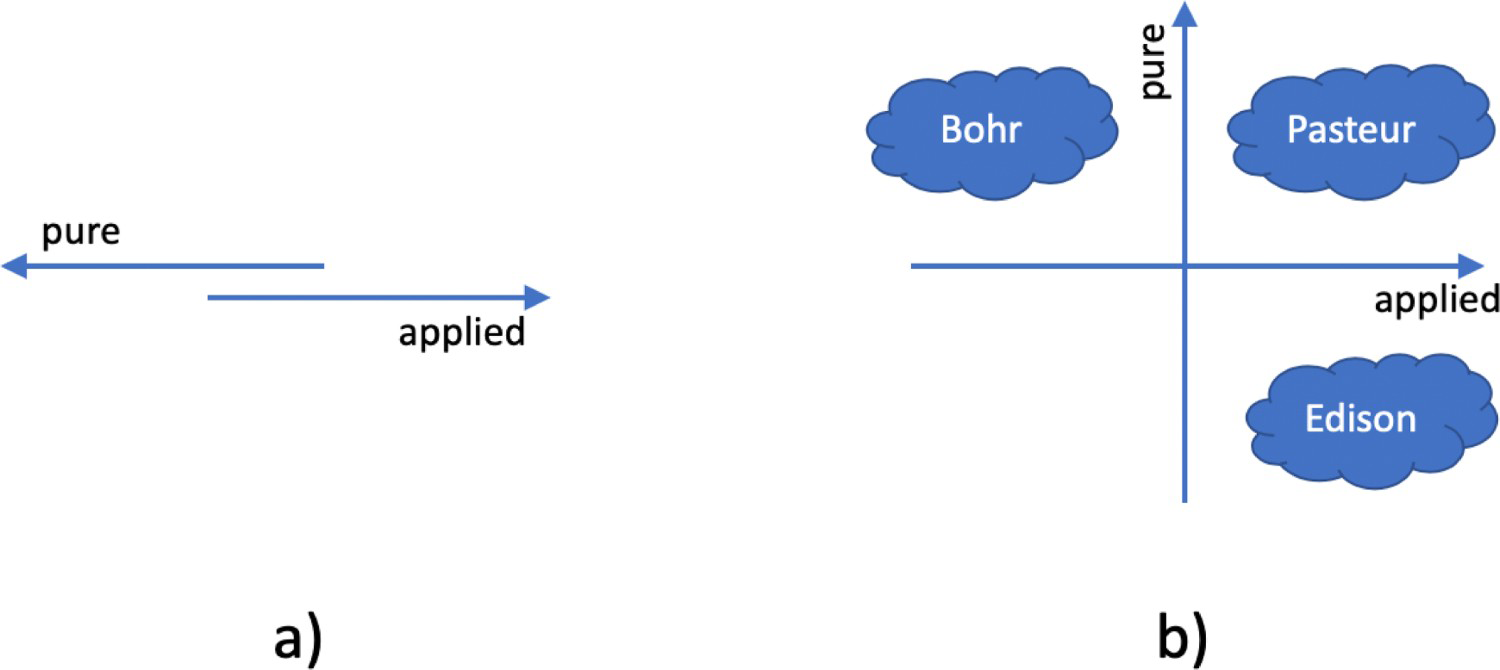
Is there any analogy to Pasteur's Quadrant in AI, and might this offer an alternative framing of AI research in Ethiopia? One important question might be to ask what is the pure research or ‘fundamental understanding’ sought in any kind of AI research? Is AI fundamentally concerned with understanding of humans? If so, is the fundamental understanding of humans necessarily universal? Will such understanding be the same wherever it is investigated, regardless of who the humans are, or of what culture they have inherited, or what their economic and political circumstances might be? Such attempted universalism seems extremely unwise, despite the AI reliance on supposedly universal principles of cognitive science (critiqued rather comprehensively by Geoffrey Lloyd in his book Cognitive Variations (Lloyd 2007)).
There seems ample potential here for new insights to be achieved, through use-inspired enquiry that starts from the Ethiopian context. Potentially, such new insights resemble the innovative perspectives that arise in interdisciplinary research (Wilson and Blackwell 2013). New theoretical discoveries come about, not by providing new answers to the same old questions, but rather from asking new questions.
But if an academic attempts to redefine the questions that define her field, how is she to publish, and how could her research proposals be considered as a priority for funding? Publishers and funders are accustomed to addressing the problems of rich countries. The attention economy logic of citation metrics and impact factors is that those countries where academics have ample time to read each other's work will also be the countries where the research questions are understood by consensus to be ‘the best’ questions, as determined by applying those metrics. Although African scientists do have access to local publication venues, which may be more likely to address local problems and ask local research questions, current systems of evaluating science will never allow such local venues to be recognized as equally valuable when compared to the attention invested by those in more leisured wealthy countries.
Imagining AI technology in Ethiopia
We have already suggested that AI is a technology of the imagination. One flippant (but not wholly inaccurate) way to define AI is that it is the branch of computer science where we try to make computers work the way they do in the movies. Indeed, many computer science students are inspired by particular science fiction movies they have seen, and devote years of research to recreating a fictional computer. A classic example is the transparent interactive projection in the movie Minority Report, which (although it seems somewhat impractical even in the movie) was often invoked by students at the time to explain why we should build systems where computer users wave their hands in the air rather than using keyboards or mice.
Noting the importance of imagination to perception of AI technologies among the general public, substantial research projects have been established to gain better understanding of the impact AI is having on the world, through closer reading of the science fiction books and movies that frame our understanding of technology. The Royal Society, with the Leverhulme Centre for the Future of Intelligence, recently published a report explaining why the narratives of AI are significant to understanding AI itself (Cave et al. 2018). Literary scholar Rachel Adams analyses in detail how the fantasies and morality tales of fiction from E.T.H. Hoffman's 1816 story The Sandman to Fritz Lang's 1927 film Metropolis and contemporary science fiction films such as Alex Garland's Ex Machina and Spike Jonze's Her prefigure the built-in stereotypes and gendered biases of AI technology products such as voice assistants Siri and Alexa.
It might even be argued that AI is in fact a branch of literature, rather than a branch of science. As with creative writing, the starting point for an AI project is a leap of imagination – imagining a way in which computers could be made to behave differently. The day-to-day mechanics of constructing AI is also remarkably literary – AI programs, like any software source code, are texts, typed and arranged from a computer keyboard (Colburn 1999; Cox and McLean 2013). And the reception of AI systems, as with the reception of literature, involves reading our screens and mobile devices in relation to systems of cultural expectation and understanding. When considering how ICTs come into existence in Ethiopia and other developing countries, Gagliardone notes that technology often starts as a kind of rhetoric and discourse, and varies from context to context (2016, 17). Bowman provides a valuable case study of this sociotechnical imaginary in the utopian ICT policies of Rwandan president Paul Kagame (Bowman 2015).
What could we imagine to be different, if AI was Ethiopian? Technology can certainly be re-imagined, when writing science fiction. For example, science fiction writers in other African countries have used the trope of alien arrival to reflect on an alternative to colonialism, in which advanced technologies become integrated into African reality, as in Tade Thompson's Rosewater series. Neill Blomkamp's South African movie District 9 reflects the logic of apartheid with disempowered aliens interned in concentration camps. The flipside of colonialism and segregation is the diaspora, and African science fiction also imagines scenarios in which expatriate scientists return or unite to apply their talents in their home country, which provides the central plot device of Nigerians in Space by Deji Bryce Olukotun.
The Ethiopian thriller Dertogada by Worku (2009, tr. 2012) is a fantasy dedicated to the memory of Ethiopia's most famous scientist, NASA employee Kitaw Ejigu. While the real Kitaw died without returning from the USA, the character in Dertogada survives to be struck by conscience ‘While I was putting all my efforts on the luxury of space research, my people were starving to death. Is there anything more meaningless than this?’ In the novel, Kitaw returns to Ethiopia to build secret underground laboratories, equipped with powerful computers and high-tech gadgets, and a staff of other Ethiopian scientists smuggled back from the countries that were exploiting their talents. The laboratory is hidden within one of the island monasteries that also harbour books of traditional medicine, philosophy and secret wisdom written in Ge'ez. The action hero discovering this hidden wealth is a monk-turned-doctor who integrates traditional wisdom with James Bond-style wits and sexual escapades. His adventures are presented as advancing Ethiopia's position in an international race against not only the rich countries, but countries like India that have achieved scientific leadership despite their relative lack of riches. Authorial commentary blames international philanthropists for destroying the ambition of Ethiopian people, making them dependent on charity rather than understanding their own wealth.
Far better known than science fiction books in Ethiopia is the Marvel comic series Black Panther – or rather the recent movie adaptation of those comics that seems to be familiar to every child, student and technology pundit in the country. The fictional Black Panther is King T'Challa, ruler of the African country of Wakanda. Wakanda is built on a mountain of a wondrous mineral, vibranium, which has many technological uses realized through the advanced knowledge of Wakandan scientists. Dedicated to using the resulting powers only in the cause of peace and prosperity, the Black Panther offers a counter-narrative to contemporary science and technology, in which the potential for benevolent African technocracy can be found in African soil. Although not so well known in Ethiopia until the recent movie production, it has been plausibly suggested that the hero King T'Challa of the original 1966 comic book was inspired by pan-Africanist Marcus Garvey, or even by Emperor Haile Selassie of Ethiopia.
The nationalism of imagined AI
Political leaders are obliged to offer some narrative of progress, but often accompanied by an element of ambivalence regarding the role of technology, since technical change seldom offers equal benefits to all. In the internet era, those benefits that technology does deliver are determined by multinational corporations that often seem beyond the control of national governments. Nevertheless, the current Prime Minister of Ethiopia, Dr Abiy, with a degree in computer science, an MBA and PhD, is clearly aligned with technology. His military career included founding a national Information Security Agency, followed by a government role establishing a centre monitoring science and technology research, and then to a term as Minister of Science and Technology before being elected Prime Minister.
There are two distinctive episodes in which Prime Minister Abiy's name has been drawn into the sociotechnical imaginaries of AI, and these have been mentioned many times by students discussing the significance of AI in Bahir Dar.
Sophia meets Dr Abiy
The first of these episodes is the story of ‘Sophia’, a humanoid robot who has become an international celebrity. Sophia was created by Hanson Robotics, a Hong Kong-based company that for many years has been a world leader in the manufacture of realistic robotic heads, handmade with a silicon skin, glass eyes and human-like hair. Hanson heads are particularly notable because they incorporate motors to pull the skin in the same manner as human facial muscles, meaning that they can imitate many human expressions. The mechatronic engineering is somewhat challenging, but reasonably conventional – not as complex, for example, as the amazing mechanical automata of the eighteenth century, which were also constructed to imitate human mannerisms. It could be said that the main achievement of Hanson, as with the automata of the eighteenth century, has been in the marketing of these mannequins – not simply as motorized dolls or moving waxworks, but rather representatives of AI. The Sophia model can be mounted on a (stationary) human-shaped body, and its movements synchronized with a speech synthesizer so that it ‘talks’ with coordinated facial expressions.
International publicity coups for the robot Sophia have included Hanson persuading the Saudi Arabian government that Sophia should be made a citizen of that country. This slightly perverse action (the robot is, after all, little more than a moving doll) gained press attention around the world, with many non-technical commentators on AI now debating the implications of robot citizenship, the implications of Sophia's gender (e.g. Adams 2019), and so on. But in Ethiopia, Sophia has special resonance for two reasons. The first is that one of the founders of a prominent Ethiopian company, iCog Labs in Addis Ababa, provided some of the software components for the robot's expressive movements when he was working for Hanson. The second, and far more significant to Ethiopians, is that Sophia has ‘visited’ Ethiopia (in boxed parts, some of which went dramatically astray before being reassembled), meeting Prime Minister Abiy, and saying some sentences in Amharic during this meeting. Staff at iCog Labs were also responsible for creating the software for this latter performance.
Press coverage of the event paid great attention to the fact that, while Sophia's ‘native’ language was English, Amharic was the first language that she had spoken besides English (AfricaNews 5/7/2018; ENA 2/7/2018). Amharic is spoken only in Ethiopia, so despite their pride in its origins and history, Ethiopians seldom see their language represented in any kind of international setting. As a result, the sight of this international celebrity robot speaking their language appeared to have been a profoundly moving event for some - and an event that the technocratic Abiy was very happy to endorse, staging photos of himself engaged in ‘conversation’ with Sophia, who impressed viewers even more by wearing a traditional Ethiopian dress for the occasion (https://www.africanews.com/2018/07/02/sophia-the-robot-meets-ethiopia-pm-attends-ict-expo). Ethiopian press emphasized that, not only was this a significant occasion for the Amharic language, but the contribution of iCog Labs showed how Ethiopian technologists were in the world class (https://www.rickiebyars.org/z-article-hub-city-live-project).
Building the real Wakanda
The second technological event that has captured the imagination of people in Ethiopia is the launch of a campaign to build the ‘real Wakanda’ in Ethiopia, inspired by the Black Panther movie, but using the romantic prospect of pan-African technocratic leadership as the starting point for a potentially massive programme of investment in an African technopolis.
Record producer turned entrepreneur Mikal Kamil started his property development career with proposals for the Los Angeles suburb of Compton. Famous outside the USA as the base for hip-hop group NWA, the group's 1988 debut album ‘Straight Outta Compton’ is considered to have inaugurated the genre of gangsta rap with tracks such as ‘Fuck tha Police’. Perhaps unsurprisingly, Compton is today a relatively impoverished neighbourhood, of the kind that might potentially be revived through investment in a ‘smart city’ centre for arts and entrepreneurship – precisely the proposal that was being promoted by Mikal Kamil as ‘HubCity Live!’ (PRNewsWire 2017).
The surprising turn of events making that project relevant to this narrative is that Kamil reinvented himself as a technological saviour of Ethiopia, relocating his property development proposal from Compton LA, to a small village outside the city of Bahir Dar (PRNewswire/Hubcity Live-Ethiopia 2018). The smart city concept that he describes as ‘Minchu’ (‘The Source’ in Amharic) is no longer a simple arts and entertainment centre, but a new kind of digital/architectural hybrid, transcending the current generations of AI and ubiquitous computing in a new synthesis of African humanity and advanced digital technologies.
A promotional video (HubCity Live! TV 2018) shows the people of Tis Abay crowding the dirt road into the village, holding photocopied signs that read ‘Welcome Mikal Kamil/Welcome to Tiss Abay Wakanda/Welcome Mikal Kamil, build the real Wakanda’. According to press releases, a local poet then delivers a powerful sermon:
When [Prime Minister] Abiy rose from the earth, to deliver his people from immigration and unemployment, Mikal came flying from heaven, like an angel. Tis Abay will become glorious like America. Mikal has arrived so, be happy youth. The American came to live in Tis Abay. Abiy told us to unite with one another. We've always been one and there were no outsiders. We are all united today with America. The Americans came to the waterfall. When they build the technological city, Tis Abay becomes the real Wakanda.
Tis Abay is otherwise famous to Westerners as the village closest to the Blue Nile falls. These are a popular scenic destination for tourists to Bahir Dar, many of whom make the hour-long journey over 30 km of rocky dirt road to see a beautiful waterfall from viewpoints along the hillside sheep trails of the river valley. In the Minchu promotional video, the village of Tis Abay, with its usual donkeys and corrugated iron store fronts out of shot, is replaced by architectural renderings of a dream city - the same renderings, in fact, originally used for Kamil's HubCity Live! promotion from Los Angeles, although now with the ‘Jewel of Compton’ legend from the earlier promotion edited out.
It seems there are three reasons for the choice of this village as a technological utopia under the patronage of Prime Minister Abiy. The first is that it has a waterfall, and a waterfall appears as an important ceremonial site in the Black Panther movie. The second is that Tis Abay is (reasonably) near the Amharan regional capital of Bahir Dar, which does have a well-established institute of technology, as well as a reputation among international visitors as an Ethiopian Riviera on the shore of Lake Tana. But the third reason is altogether more fascinating, and representative of the ways that the cultural and historical imagination of Ethiopia can become entangled with a technological future.
Students in Bahir Dar suggest that another reason for associating Bahir Dar with Wakanda, beyond the Tis Abay falls, is the rumours of mysterious knowledge in the ancient island monasteries of Lake Tana (also a key plot point in the novel Dertogada). The lake's status as ‘source of the Blue Nile’ (the river Abay) is a powerful metaphor encouraging belief in Bahir Dar, and in Ethiopia as the origin of life. A common belief in Ethiopia is that life itself flowed from Ethiopia down the Nile, with fertile soil washed into Egypt via the Abay – the same river described in the book of Genesis as the Gihon, which flowed from the Garden of Eden around the land of Cush.
Mikal Kamil does not hesitate to draw mythological analogies in support of his investment proposal. In an Ethiopian TV interview (Technology and Futurism), he describes the Ethiopian people as providing an emotional and spiritual intelligence that can correct the failings of AI, creating an embodied ubiquitous computing that is beyond Western notions of the smart city. He invokes a historical Cushite empire that he says lasted (improbably) more than 2 million years during which Ethiopia ruled the known world, and suggests that African-Americans can realize the promise of AfroFuturism only in Ethiopia.
Kamil is a hustler and would-be property entrepreneur, whose views on computing and AI draw on mysticism rather than science. Nevertheless, interventions like his really do capture the attention and imagination of Ethiopian people, apparently including Prime Minister Abiy. His sentiment that the magical ‘vibranium’ of the Black Panther movie is within the Ethiopian people themselves, is not so far from an argument for a human-centred AI in Ethiopia. The arguments on mystical grounds do attract opposition, though. Clerics from the local Orthodox church suggest that the HubCity proposal may be the work of the devil, and that the technology described as ‘inside’ Ethiopians might in fact represent plans to tag them with a microchip bearing the Mark of the Beast. If Bahir Dar, or Tis Abay, is indeed the original Eden where a second Paradise is prophesied to come, then Christians worry that Kamil might represent the great Foe of the book of Revelation, come to destroy the monasteries and the site of Eden, not bringing the technological paradise that he claims.
Kamil himself does take some care in addressing these themes, especially in the context of Ethiopia's political sensitivities, which have recently involved violence, church-burning and assassination in the southern Oromo region. Rather than referring directly to the wisdom of Ge'ez that might be preserved in the monasteries of Tana (and which some Ethiopians already fear is being stolen by researchers abroad, including a German research group dedicated to Ge'ez), Kamil invokes the even more ancient empire ruled from Ethiopia, and speaking the Cushite language of the south, rather than the Semitic origins of the church language Ge'ez and Amharic. He avoids suggestions that the African king of the Black Panther comics might have been modelled on the ‘Lion of Judah’ Haile Selassie, who is seen by some in the South as emblematic of rule by Amharic and Semitic elites. In a political appeal that could easily be shared by Abiy, Kamil says that Ethiopia must combine unity with their sense of duty (and moreover, an AfroFuturist unity, in which African-Americans will join their African brothers and sisters in a new Wakandan empire).
The threat of AI colonization
How attractive would it be for Ethiopians, if the country did become the centre for a new kind of African AI, for this imagined technological advance to be integrated as part of a global digital AfroFuturism?
A prominent feature of the national identity, often mentioned in discussion of national character, is that Ethiopia is the only country on the African continent that has never been colonized (despite residual legacies and tensions over Italian possession of Eritrea and occupation during WWII, and memories of Soviet support for the repressive Marxist-Leninist state of the 1980s). This results in habitual resistance to any analysis of the Ethiopian situation that suggests common features with postcolonial Africa, since Ethiopia never was a colony. It also results in careful concern for autonomy, and sensitivity to the possibility that Ethiopia might be being colonized through less direct means. Historical precedents in the seventeenth and eighteenth centuries included a long period of isolation ruled by Emperor Fasiladas and his successors from the Amharan city of Gondar. Rejection of overtures from the West continued until the nineteenth century reformer Emperor Menelik II enthusiastically adopted modern infrastructure including electricity and plumbing, railways and motor cars, post and banking services, and the telegraph and telephone.
Despite the unquestioned advantages and utility of communications and transport infrastructure to some in the country, the relatively abrupt policy reforms of Menelik left a legacy of some ambivalence regarding the way that an uncolonized country may become reliant on technology, or beholden to those who invent it. That ambivalence continues to be an aspect of current concern about Chinese investment in Ethiopian infrastructure (although this particular concern is also found in other countries of sub-Saharan Africa).
Many countries in the world might have similar concerns about the primarily Anglo-American innovations of the information technology era, and the undoubted power exerted by a very small number of global software corporations that have originated on the east and west coasts of the USA. But most countries have been either colonies or colonizers, meaning that technology is not their primary experience of colonialism. In Ethiopia, which has never been a colony, it is income, infrastructure and technology that present the clearest challenges to continued national autonomy. When it comes to the invisible infrastructure of software and the knowledge economy, Ethiopians are uneasily aware that digital media imposes ways of thinking and arranging their affairs that have not been chosen here (not least, the increasing ubiquity of English as the language of the Internet).
In the case of AI technologies, research students depend heavily on software infrastructure – standard libraries of subroutines and statistical algorithms – that are developed and distributed by a relatively small number of university research groups or (increasingly often) commercial laboratories. There is an uneasy suspicion that the companies distributing such software for free may do so, not only through a spirit of generosity to their academic peers, but perhaps to gain commercial advantage through the de facto establishment and even official adoption of their own technical ideas as future industry standards.
In a country that is sensitive to the colonial dynamics associated with technical infrastructure, reflection on these issues can be uncomfortable for AI researchers. It is not feasible for a relatively small research group to construct its own AI infrastructure – especially not for the intensive and expensive data processing associated with deep learning. The world-leading ‘cloud’ computation resources of Amazon Web Services are routinely made available for use by students in universities like Cambridge. But a representative of Amazon reports that they are not ‘cleared’ to operate at all in Ethiopia. A few Ethiopian researchers, with help from grants or private benefactors, are able to purchase the expensive processors necessary to experiment with deep learning algorithms, using open source code libraries obtained from Western labs. But this reinforces the dynamic through which researchers in Ethiopia, using the same tools as the better-funded laboratories that developed those tools, can only follow in the research footsteps of others.
Imagining an Ethiopian AI
Drawing together these threads, of the stories repeated by AI researchers and students, and the practical realities of their historical and political situation, is there a distinctive way of conceiving AI that is both technically and imaginatively distinctive?
Whatever concerns the AI researchers of other countries might have about the redefinition of their questions and evaluation criteria, could AI investors be persuaded to support a use-inspired basic research agenda (Pasteur's Quadrant) in Ethiopian AI? Although one might expect investors to be comparatively hard-headed, it might not be so difficult to persuade investors as it is to persuade scientists to change their minds – especially if imagination can be recruited.
A rhetorical strategy: From deep learning to broad learning
In seeking ways to stimulate new sociotechnical imaginaries for the AI research community (rather than simply social scientists and critical scholars), it would be necessary to develop rhetorical strategies that are recognizably situated within the technical vocabulary of the AI field, while co-opting conventional terminology to open up new ways of thinking.
One potentially fruitful metaphor for considering new theoretical approaches to AI might draw on the classical distinction in earlier generations of AI research between ‘deep’ and ‘broad’ algorithms for problem solving. In algorithms that search for optimal solutions to a problem, two well-known alternatives are ‘depth-first search’ versus ‘breadth-first search’. In depth-first search, the algorithm considers one possible course of action in a branching tree of possibilities, following through the consequences of that choice step-by-step either until the desired outcome is achieved, or else back-tracking to try a different branch if it fails. In the contrasting strategy of breadth-first search, all possible branches are considered and compared, before deciding which one to take first. (Sophisticated algorithms use some combination of these, guided by the structure of the problem or the available data).
We might use these terms to draw attention to the possible research strategies to be followed by AI researchers themselves, when seeking either theoretical breakthroughs or practical applications. At the time of writing, by far the most popular approach to AI research is that of ‘deep learning’. Many AI researchers are dedicated to exploring the potential of this neural network technique, which as explained above, is particularly relevant to problems where very large amounts of data and computational resources are available.
The current vogue for deep learning research, and the large proportion of the world's AI researchers digging in this particular hole, might be considered a ‘depth-first’ strategy in the global research portfolio – if the mine looks productive over here, let's all keep digging until it becomes clear that there is nothing left. Similar gold-rush strategies have been followed in the AI booms of previous decades, usually followed by an ‘AI winter’, in which disappointed investors and funding agencies withdraw their support from the field.
Is there any alternative to the current ‘depth-first’ stampede of research into deep learning methods? Might some researchers usefully explore other methods – perhaps a complementary breadth-first investigation that considers ‘broad learning’ methods rather than deep learning? What might a ‘broad learning’ algorithm look like (keeping in mind that the metaphorical move from depth-first/breadth-first search to deep-learning does not rest on any technical similarity between depth-first search and deep-learning, but is purely an exercise of rhetorical imagination)? A useful starting place for such a strategy could be to choose a context in which deep learning methods are less appropriate to the problems found there. Perhaps this might be because there are smaller quantities of data available? Or perhaps because there is less computational resource? Perhaps a useful setting in which to explore a new kind of broad learning algoritm might be a country like Ethiopia?
The word ‘broad’ can be applied in a couple of interesting ways, when considering what ‘broad learning’ in Ethiopia might imply. The first is breadth in the sense of cultural diversity. Many global AI companies worry that their staff are too homogeneous – too male, too white, too Western. This is not simply because they wish to present themselves as youthful and liberal (although they do wish that), but also because they are aware that a global business relies on a broad range of experience and understanding – especially in the ‘knowledge’ industries, where a huge company can rapidly disappear if it fails to recognize some change in the zeitgeist. If this is a problem in technology companies, it is also a problem in the international research establishment, and leading international conferences in deep learning such as NeurIPS (Neural Information Processing and Systems) have spawned initiatives including Black in AI (a mainly US-based inclusion group), and the Deep Learning Indaba (a series of summer schools taught in African countries by volunteers from corporate labs and Western universities), to help counter their institutionally narrow cultures.
The second potential application of the phrase ‘broad learning’, when considering possible strategies for AI in Ethiopia, is to consider the engineering structure of the AI systems themselves. At present, deep learning systems are trained using data acquired from thousands or millions of people – sometimes paid for their work, but more often simply captive customers or unwitting volunteers (Zuboff 2019). But these workers are not invited to reflect on the intention of the resulting system, to deliberate about its decisions, or even to be recognized for their contribution. This has the effect that the kind of ‘intelligence’ displayed is rather limited. Machine learning researchers prefer to compare the engineering performance of their algorithms by using standard labelled data sets, and do not often ask how the labels were acquired. As argued at the first Science in the Forest, Science in the Past workshop (Blackwell 2019a), these practices represent a kind of institutionalized plagiarism, in which un(der)-compensated workers are recruited to carry out intelligent tasks, but after AI systems are built from that data, their owners forget the original work, claiming the intelligence to be solely the work of a machine.
So a ‘broad learning’ alternative might be to draw on the breadth of human experience, rather than constraining workers to simply provide labels, captions and other simple data to train neural networks in relatively trivial discrimination tasks. Wages in Ethiopia are low, and unemployment is high, meaning that the engineering economics underlying knowledge system design ought to be radically different to the business models of Silicon Valley or Cambridge. A ‘broad learning’ system could draw in a greater breadth of human understanding through incorporating humans within the economic frame of the system design process, in a way seldom done by conventional AI researchers. Such systems might direct some queries or decisions to human workers, especially in cases where the narrow training of a typical machine learning system would render it unaware of important social or human context.
In fact, although unusual among Western AI researchers, such strategies are not completely unheard of, and certainly not technically infeasible. There is a degree of interest in ‘mixed initiative’ systems, ‘human-centred AI’ systems, ‘collective intelligence’ or ‘human-in-the-loop’ systems that aim to avoid the worst failings of fully-automated AI through applying a degree of human common-sense. Such approaches could already be used in Ethiopia, although the design principle could also be taken much further. It is quite notable that the approaches most popular in Western AI research tend to appeal to individualistic or market-oriented applications, with theoretical analyses that focus on personal convenience and economic advantage. Collective action in Ethiopian culture is notably different from the individualistic traditions associated with wealthy technology centres, and might well result in different design principles.
Unfortunately, there are a number of reasons why this strategy might not be appealing to AI researchers in Ethiopia. A practical problem is that human ‘components’ are less reliable and predictable than software algorithms. This would quite probably make such broad-learning AI systems more difficult to design and test than purely software alternatives. Secondly, even if such systems work effectively, how could the quality of the results be compared to the well-cited (and by circular definition world-leading) research coming from the USA or UK? A system that is designed to incorporate a human as one of its components could pass the Turing Test with trivial ease – so much ease that it might make the Test itself seem insultingly trivial. So the use of human ‘components’ cannot be allowed as a scientific alternative. It would be too easy, and hard science ought to be hard! 1
This quandary relates to the classical problem for science policy that has already been discussed in relation to interdisciplinary innovation and Pasteur's Quadrant. Real insights come, not from a new answer to the same question, but from asking a different question. This is precisely the advantage of doing AI in an Ethiopian context. Perhaps the Turing test was the wrong question? Why do we need AI systems that have no human components? Is it because a human component could not be part of a scientifically objective experiment? Or do the commercial investors in AI demand fully-automated solutions so that their software products can be scaled to the global level without the inconvenience of recruitment, personnel problems and so on? How might we argue that a distinctively Ethiopian broad approach to AI is not actually inferior, but superior to the deep-and-narrow alternatives?
Defining and inventing – whose imagination?
This argument has suggested that turning attention to the needs and resources of Ethiopia might result in the necessary conclusion that AI researchers are asking the wrong questions. Changing the question is not always appreciated as the response to a perceived problem, so how might western computer scientists, who consider themselves to have clearly formulated technical questions that define their fields, respond to a suggestion that the field be redefined?
The definition of AI does change, and has continued to change throughout the 70-year history of the field. Until now, the consensus definition has been established in Western countries, and African researchers have followed that lead. Inventing and promoting a different kind of AI does involve establishing a new consensus. But in a field that is so centrally formed by the exercise of imagination, the possibility of a new consensus does seem to be within reach.
In the case of AI, the definition of the technology also incorporates an implicit definition of intelligence itself. An automaton playing chess appeals to a world view in which the game of chess is the pinnacle of intelligent performance (Adam 1998). The egwugwu puppets of the Igbo suggest a world in which authority and respect for deliberation is vested in the ancestors that are embodied in those puppets.
So the currently paradigmatic AI systems that have been developed almost entirely in North America can be considered as reflecting new definitions of intelligence in that specific cultural and commercial context. Many of these systems are designed to optimize media attention, marketing and conspicuous consumption, suggesting that such activities have become the paradigms of intelligence in the era of our present digital economy. The consequences of such ‘intelligence’ for public discourse (whether implemented in mechanical or human form) have become quite clear as these technologies become ubiquitous in Western societies. It is hard to see how the increasingly prevalent commercial logic of surveillance capitalism can be relevant to the bulk of the population, in low income countries that have such low levels of access to ICT.
What of Ethiopia? Is it feasible that, while constructing new digital systems, Ethiopians might adopt different ideals and definitions? The nostalgic and nationalistic kinds of imagination we have described, while departing from conventional research activities in AI, do appeal to alternative imaginaries, where political symbolism and respect for spiritual understanding present an important context of innovation. Pride for tradition and collective responsibility offer a generative principle that is an alternative to the use of ICT for centralized control supported by foreign infrastructure investment. Speculation that Wakanda's fictional ‘vibranium’ might be a mystical essence inside the Ethiopian people may be sentimental, but in the case of AI, ‘intelligence’ really is a human property, not a mineral to be discovered through scientific investigation. Any properly scientific enquiry into AI should indeed be looking within ourselves – and certainly not just Western ‘selves’, but committed to a broad exploration of all human intelligences.
Footnotes
Disclosure statement
No potential conflict of interest was reported by the author(s).
1
These two sentences are ironic.