







Abstract
We interrogate mathematical modelling as an instrument of knowledge co-production by concentrating on the classical probabilistic operationalization of decision-making under uncertainty used for informing climate change mitigation options. We construct our co-productive assessment framework by first retrieving criticisms targeted at expected utility theory in relation to its epistemic and ethical limits in dealing with ‘true’ uncertainty. We then reflect on how ethical values should operate in relation to uncertainty in order to live up to the co-production ideal and specifically, to the principle of Responsible Research and Innovation. We thus undertake the perspective of a general modeller and test our reflections by imagining the classical probabilistic space of calculation as a space of negotiation between probabilities, ideas, values and beliefs. We thus propose an alternative ‘public’ space of calculation in which the conditions for co-production are set up on a pragmatic and moral account of rational expectations.
Keywords
Introduction
The concept of co-production has witnessed an increasing success in both scientific research and public discourses over science, pointing at the need to make science more inclusive of societal actors. Sustainability science, for instance, has been at the forefront of putting this idea into practice, namely by involving non-scientists in the design and implementation of a variety of research projects dealing with energy transition, water management, among other sustainability issues (Bäckstrand 2003; Miller and Wyborn 2020; Howarth and Monasterolo 2016; Chilvers and Longhurst 2016; Clark et al. 2016). At the institutional level, the concept of co-production has been endorsed in official research programmes, such as the ‘Science for and with society’ of the European Union, and also articulated through dedicated approaches to research and innovation, such as the Responsible Research and Innovation (RRI) approach in the Horizon 2020 programme prescribing public engagement in many funding calls.
Despite the vivacity of its welcoming, co-production in science is a difficult task. It is so not just because putting together scientists and non-scientists requires important design, facilitation and analytical skills, but also because co-production invites quite a radical approach to scientific knowledge such that no production of ‘facts’ can be totally dissociated from social and ethical values. In the seminal work of the leading Science and Technology Studies (STS) scholar Sheila Jasanoff (2004a, 2004b), the concept of co-production denotes the ‘state’ of modern knowledge, which proceeds along a constant and simultaneous interaction between epistemic and normative considerations. The first message from co-production is therefore that science and scientists should become more aware of the normative dimension embedded in their work: political, social and cultural values which affect the way scientific knowledge is held in terms of it being valid and useful.
The implications of knowledge co-production have mostly been explored in relation to science governance frameworks with the purpose to design new rules and institutions integrating scientists and ‘the public’ in the same public space of discussion. Yet, the extent to which this endeavour has resulted in a mutual engagement between the public and the scientists is unclear. Much of the literature on public engagement with science has focused on how to involve the public in science. Much less attention has been paid to the capacity of scientists to engage with the public and so recognize, embrace and embed the inherent public – and even political – dimension of scientific knowledge production (Wynne 2007, 2014). Post-Normal Science (PNS) is probably the most prominent example among renewed approaches to public engagement in science showing what can be deemed indeed ‘radical’ co-production, as it has offered quality assessment methodologies aimed at explicitly addressing the interrelation between facts and values (Saltelli et al. 2013; Saltelli 2020; van der Sluijs 2006; van der Sluijs and Wardekker 2015). Indeed, the seminal idea by PNS of extending the traditional peer review community beyond its own boundaries to include non-experts and, in general, anyone with a stake in the issue under study, is contained in the call for a renewed disposition by scientists – and not just ‘the public’ – to explore uncharted waters and languages (i.e. that of other disciplines as well as the public) (Funtowicz and Ravetz 1993). This idea professes a humble attitude in the context of addressing complex problems and limits to knowledge (Jasanoff 2003) and directly engages with the discomfort of this state of knowledge (Ravetz 1987). In this scientific endeavour, reflexivity appears at the heart of co-production, whereby the normative awareness about how values play out in the specific understanding of complex problems calls attention to, and at the same time, addresses how the institutional process that is in place, allows for such interplay to be discussed, scrutinized and be socially relevant.
The concept and framework of RRI mentioned at the beginning has tried to set up the ground for a new, more open, endeavour in the production of scientific knowledge in the spirit of co-production. Such openness has taken the direction of promoting the notion of ‘shared responsibility’ in science, whereby all societal actors, including researchers, citizens, policymakers and other stakeholders, ‘work together during the whole research and innovation process in order to better align both the process and its outcomes with the values, needs and expectations of society’ (https://ec.europa.eu/programmes/horizon2020/en/h2020-section/responsible-research-innovation). In such scheme, RRI is conceived as ‘a transparent, interactive process by which societal actors and innovators become mutually responsive to each other with a view to the (ethical) acceptability, sustainability and societal desirability of the innovation process and its marketable products’ (von Schomberg 2012).
In such ideal organization of science and the public sphere, it is implicitly assumed that science can indeed be more transparent and interactive, without much interrogation, however, of its effective capacities to be so. In this paper, we aim to proceed precisely with this interrogation. For this purpose we decided to focus on the instruments employed by scientists in their work, starting from methods and methodologies employed for representing problems and providing solutions. We therefore pose the following questions: if scientists are asked to embrace a new mode of knowledge production based on RRI and underpinned by the idea of co-production, are they equipped to do so? By maintaining our focus on the original meaning of co-production as a ‘state’ of knowledge, we therefore enquire into whether this latter also translates into a ‘state’ of mind by the knowledge producer (i.e. the scientist) and what role the instruments available to her play in furthering this process. Following the STS and PNS theoretical perspectives on co-production, we aim to provide the foundations of an evaluation framework of the co-productive qualities of those instruments; qualities that we define here in terms of how apparent the relation is between the epistemic and normative dimensions of knowledge and how usable this relation can be to foster reflexivity and mutual responsibility in public engagement in science.
In order to proceed with our analysis, our attention is set onto the use of a quantitative method used for assessing climate change policies, that is, mathematical modelling (MM). MM is pervasive in climate policy as it fulfils a number of purposes, including informing policy options based on assessing the impacts of anthropogenic climate change, and exploring mitigation and adaptation options through scenarios. The discussion of the co-productive qualities of MM will specifically develop in the framework of rational choice (RC) theory, including expected utility theory and the classical probabilistic approach to decision-making under uncertainty used for informing climate mitigation options. The application of the STS perspective on knowledge co-production to RC theory is certainly unconventional. We therefore need to construct a framework of discussion and for this we will dig into and build on the many criticisms raised against the RC framework in relation to the treatment of deep uncertainty. This is indeed a special spot that epistemology and sociology scholars have used to address the problematic role of values in science. We therefore decide to undertake the perspective of a general modeller engaging with the general public in order to explore how supportive the tools in her hands are for addressing the problem of values and perform co-production in the direction of greater reflexivity and responsibility. To the best of our knowledge, this area of inquiry has not yet been explored in the context of MM in general, nor in its most common application to economic models of climate change. Also, co-production is rarely queried from the perspective of the scientist, if not for the analysis of her motivations (Entradas et al. 2019). We think this is a gap that needs to be filled in order to understand the extent to which reflexivity and responsibility is effectively practiced in co-production.
For pursuing our analysis on MM and co-production, we will start by offering a classical operationalization of decision-making under uncertainty based on well-defined probabilities (Section 2). We revise key criticisms of this framework by focusing at first on the specific use of probabilistic modelling and then expanding our scope of analysis to expected utility theory more in general (Section 3). We understand that Sections 2 and 3 may appear somehow ‘banal’ to mathematically versed readers. However, for the sake of an interdisciplinary dialogue, we hope that the inclusion of this material makes the paper self-contained to a wider readership.
In the scope of expected utility theory, we try to capture the wide range of important reflections that have emerged over the link between uncertainty treatment, rational choice and value judgments. We elaborate on a set of different levels of criticisms addressing both epistemic and non-epistemic problems linked to MM in order to set out our assessment of the co-productive implications of the classical mathematical framework based on probability (Section 4). To this purpose, we choose to employ an analogy between the probabilistic framework of decision-making under uncertainty and a space of ‘negotiation between probabilities’ (Section 5). We therefore propose a first account of the main features for an alternative space of negotiation that is compatible with an STS and PNS understanding of co-production. We find the contribution of non-standard co-productive theories such as moral cognition and pragmatic deliberation, important to qualify the pragmatic, epistemic characteristics of such space as relying on an axiological account for rationality and rational choice (Section 6). Section 7 concludes with an invitation to the community of mathematical modellers to further explore the implications of co-productive knowledge for MM.
The classical approach to decision-making in mathematical modelling: rational choice and sequential decision-making
In the evaluation of climate policies, one common approach to deal with uncertainty is to use a probabilistic representation of events which implies, fundamentally, to quantify uncertainty in order to elaborate rational expectations about the future and make rational decisions in the present. John von Neumann and Oskar Morgenstern (1944) pioneered the use of expected utility as a way to ground the rationality of individual choice made under uncertainty.
In the expected utility framework, there is no differential treatment of uncertainty as all uncertainties are treated with the same probabilistic approach, i.e. assuming that the distribution of events is well-known, fair and replicable between the past and the future. In particular, fairness refers to the idea that the future can be parcelled into a fair distribution of events that are all equal in value and structure (Desroisières 1998). Probability thus enables a rational and seemingly unproblematic way to deal with uncertainty when deliberating the future.
Criticisms in the mathematical community are abound against this classical approach to uncertainty and the use of expected utility theory in decision-making. The most common criticism refers to, precisely, the non-differential treatment of uncertainty which does not take into consideration the heterogeneity in the nature of the events of study and our inability to accurately measure their future odds. These include events with low probability of occurrence but high impacts (Chichilnisky 2000; Basili 2006; Ravetz 2006); events that cannot be accounted for due to the presence of irreducible uncertainties (i.e. the so-called ‘unknown unknowns’); or events that are not-measurable and cannot be defined operationally due to ‘deep uncertainty’. These are the typical events associated with climate projections: extreme and highly uncertain.
Following these criticisms, alternative MM solutions to the use of the classical probability model have been proposed, especially when dealing with extreme uncertain events and catastrophic risks (e.g. Papadakis et al. 2018; Haimes 2016). However, the implications of these criticisms and solutions are not straightforward for co-productive knowledge. For initiating such inquiry, we need to retrieve the fundamentals of classical probabilistic dynamic decision-making, understand its logic and how it constructs the future starting from the present.
The classical approach to dynamic decision-making, which is based on expected utility and rational choice, is first of all sequentialist, in the sense that the logic governing the whole modelling process steps over of time. Discrete-time sequential decision problems have been described in several authoritative textbooks (e.g. White 1993; Puterman 1994; Bather 2000). In this paper, we formulate the mathematical approach for solving discrete-time sequential decision problems in the context of a policy maker faced with choosing one mitigation option at each decision time, from a set of
 possible climate change mitigation options for their country.
As a general policy goal, it is assumed that policy makers aim to maximize the expected social benefits of mitigation over a future time horizon T.
Mitigation options are constructed and evaluated through simulation models, which basically simulate alternative sequences of logical and plausible decisions to achieve the same goal. Mitigation options are constructed as ‘interferences with’ or ‘disturbances to’ the current situation, or more precisely, as providing alternative trajectories to the ‘business as usual’ trajectory. Figure 1 provides a schematic of two possible future trajectories of the ‘state’ of a selected country. We only consider the socio-economic status of the country as representative of its more general status; thus, we use the term ‘socio-economic status’ here in a broad sense, to indicate a multi-dimensional entity, which, for convenience of exposition, is collapsed into one dimension.
Future socio-economic trajectories.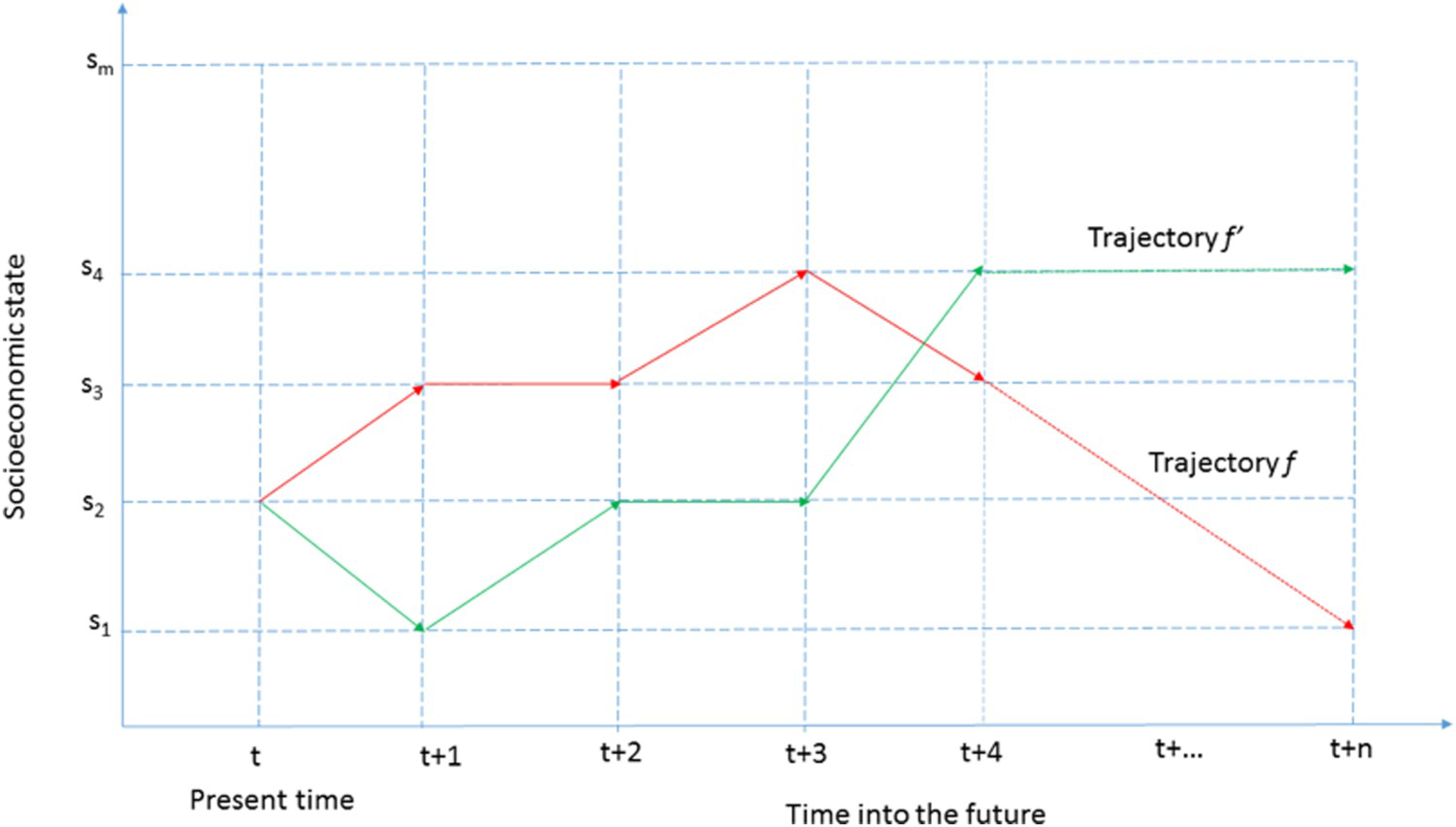
In Figure 1, the
 -axis represents time and the
 -axis represents the socio-economic state of the country. Both axes are discretized. The discrete times (in steps of unit time, e.g. 5 years) are denoted by the present time
 and future times
 , where
 and
and
 is the future time horizon of analysis. We assume
 possible socio-economic states exist which the country can attain
 ; the set of all these states is denoted by
 , i.e.
 . The states
 are assumed to be in ascending order of socio-economic status.
Of the two trajectories, trajectory
 represents the null or ‘business as usual’ scenario, which corresponds to no mitigation option. Trajectory
 on the other hand represents a future scenario corresponding to policy makers selecting a successive set of mitigation options enacted at sequential decision times
 respectively.
Figure 2 shows a schematic of the probabilistic evolution of the state at two successive times, beginning at the present time
Sequential decision-making. at which the socio-economic state of the country is naturally known.

If a policy maker selects a mitigation option at this time, then the socio-economic state of the country would evolve over
 to reach one of the discrete states in
 at time
 . Conditional on this socio-economic state, and the mitigation option selected at time
 , the country would also evolve over
 to reach one of the discrete states in
 at time
 .
.
The subsequent evolution of the state at future times is conditional on each subsequent present state and is governed by probabilistic rules. In other words, the socio-economic state at time
 depends probabilistically on the state at time
 and the decision taken at time
 . This type of stochastic process is known as a ‘homogeneous’ discrete-time Markov decision process.
One of the most important points in the classical approach for simulating the evolution of the state trajectory is that probabilities are assumed to be ‘well-defined’. In applied mathematics, probabilities are normally assigned to an exhaustive set of possible events. This means that a probability of occurrence is associated with each event and that the probabilities of the events sums to unity, indicating the totality of the modelled universe of events.
In sequential decision-making, rational choice prescribes that the policy maker chooses the sequence of mitigation options that maximizes the expected total benefit. By formulating the process as a discrete-time homogeneous Markov decision process, we can determine the sequence of decisions at all discrete times which maximize the total expected social benefits over the time horizon of interest (Puterman 1994; Hou, Filar, and Chen 2002).
The mathematical framework of decision-making presented in the above section shows that mitigation options essentially manifest themselves as a chronological sequence of decisions, in which one decision is always partly determined by the precedent one. The sequence of decisions, in turn, is applied probabilistically to bind the creation of trajectories, meaning that probabilities provide the connection between one decision and the following one – that is why they are called ‘transitional probabilities’.
For such scheme to work, probabilities must be ‘well-defined’, in the sense that they must ensure the effective passage from one sequence to the other and, most importantly, allow the whole sequence of events to reach an end, i.e. making certain the totality of all possible outcomes can be reached. Uncertainty is therefore levelled-out by well-defined probabilities in order to ensure that it does not compromise the mechanistic sequencing of events, neither in between events nor in their final outcome composition.
The relation between probability, uncertainty and the construction of alternative futures is therefore bounded by mathematical rules of logical consistency that bind the beginning, the end and everything in between the events as a matter of objective sequencing. This is very important from an epistemic point of view, since well-defined probabilities motivate the idea that the future, no matter how uncertain, can become an object of inquiry and a matter of policy decisions.
Expected utility theory counts on this type of probability-based progression between one decision and the next one to inform ‘rational’ decisions. In another application of expected utility theory, probabilities are not even required for engendering dynamic decision-making, as the progression between one decision outcome and the subsequent one is directly articulated within the very norms of rational behaviour embedded in the social welfare function (Abdellaoui 2004). This is the case of deterministic modelling, in which the norms of rational behaviour typically refer to use of a discount factor for weighting present and future consumption and guiding the maximization of individual utility (Adler et al. 2017; Vecchione 2012).
Whether in its deterministic or probabilistic operationalization, expected utility theory dismisses the presence of ‘true’ uncertainties and only conceives risk as the engine of rational choice – either in the form of well-defined, objective probabilities of events (probabilistic modelling), or in the form of trade-off decisions between present and future actions (deterministic modelling). As famously defined by Knight (1921), true uncertainty pertains to those situations in which unknown factors cannot be converted into an effective certainty and are so, by definition, unquantifiable (Berger and Smith 2019). These unknown factors can be associated with the behaviour of the system and parameters values; or with time-varying random disturbances (of different origins including unknown ones), which accrue with time and steer the economic trajectory away from its assumed deterministic path. For many, the quantification of such unknown factors resembles more a speculative than scientific exercise (Pindyck 2015; Spangenberg and Polotzek 2019; Saltelli 2020).
The presence of true uncertainty also challenges the assumption of predictable sequences of events. As we have seen in Section 2.1, the foundation of probability-based modelling counts on the assumption that events evolve at a future time depending only on their current state and the decision taken at the current time – what we called an ‘homogeneous’ Markov decision process. Yet, this assumption is challenged by the presence of path-dependency, meaning that the probability of the process reaching a certain socio-economic state at a certain time, depends on its past evolution through socio-economic states that the process visited in the past and the decisions made in the past (David 2007). Path-dependency has important implications for estimating the context for MM exercises for instance, whereby the final state of the system is determined not only by the variables of the system involved, but also by its emergent properties (Turner 1997). This particular form of path-dependency is called ‘hysteresis’ and is clearly incompatible with a Markovian decision process. Indeed, the taking into account of hysteresis leads to paying special attention to the dynamics of the economic system under consideration as well as its adjustments.
In the context of non-probabilistic modelling, Setterfield (2009) shows that hysteresis sets important limits to the standard operationalization of decision-making under uncertainty as in DICE, a largely used deterministic model, for calculating optimal abatement costs. Hysteresis has an influence on determining the initial level of investments for emission abatement, which according to Setterfield (2009) results in much higher than otherwise calculated in standard applications of DICE. This is not surprising after all, as DICE, at least in its original version, maintains technological change as exogenous to the evolution of economic trajectories (Nikas, Doukas, and Papandreou 2019). Yet, technological development plays a key role in determining the direction of economic trajectories and, indeed, a key player in path dependency theory. Technological development can trigger increasing returns and positive feedbacks, such as the relative benefits of the current economic activity increase over time compared to other options (Pierson 2000). This means that it can produce lock-in effects in the economic trajectory and induce fundamental deviations from expected states of the system such as to affect the calculation of future probabilities. Preceding steps in a particular trajectory can indeed increase the probability of further steps along the same path and induce further movement in the same direction.
What path dependency is therefore telling us is both that predictability is a weak postulate in rational choice theory, and especially that specific patterns of timing and sequencing matter to formulate ‘rational’ expectations. The role played by contingent or relatively ‘small’ events should therefore not be underestimated in the construction of systematic connections between past, present and future states.
The model, the modeller and her choices
Epistemic and non-epistemic responsibility
The epistemic limits on the classical probabilistic modelling approach and expected rationality theory discussed above, pave our way for engaging with the normative and ethical dimensions of MM. This is certainly not a new inquiry as many authors have approached the problematic relationship between epistemic, social and ethical values with reference to dealing with uncertainty and producing scientific evidence in the context of climate modelling. But there have been differences in approaching such topic.
The philosophical literature has mainly drawn on the ‘inductive risk’ argument by Rudner (1953) – then extended by Douglas (2000) – and concentrated on the responsibility of the scientist with reference to her choices over uncertainty treatment (Winsberg 2012; Winsberg, Oreskes, and Lloyd 2019; Parker 2014; Parker and Winsberg 2018; Lloyd and Schweizer 2014; Beck and Krueger 2016; van der Sluijs 2012; Tuana 2010). The economic and decision-analytic literature has rather focused on the policy side, that is, on how to make models useful for policy decisions in spite of uncertainty, including shifting the classical paradigm of ‘prediction’ in science for policy to the idea of ‘robust’ scientific outcomes (Lempert 2019).
The difference in the respective focuses by these two scholarships (i.e. the scientist in the former and the policymaker in the second) has left an important gap open over the way in which the values of the modeller that play out in her treatment of uncertainty, translate into the values of the policymaker deciding in condition of uncertainty. Some works have been developed in the direction of building an alignment between the values on the two sides of the science-policy spectrum, for instance by suggesting specific parametrizations that express distributive justice concerns (Adler et al. 2017; see Vecchione 2012 for a general overview of the distributive justice debate linked to the value of the discount rate). However, these solutions still contemplate social and ethical values as coming from ‘nowhere’ and existing independently from their carriers (i.e. the scientist and the policymaker). Values, however, exist in strict relation to the meanings and actions assigned to them; their assumed universality is therefore problematic.
We shall try to close this gap and bring some reflexivity in the way values operate in MM by retrieving some technical discussions over the use of contested assumptions and parameters in climate change assessment.
For this, an example is taken from economic modelling, showing that reflexivity about social and ethical values emerges precisely from discussing technical choices about how uncertainty should be represented and handled by the modeller in the model. In the context of estimating of the social cost of carbon (SCC) 1 and finding optimal abatement of CO2, Dietz (2011) 2 questions the representation given in the model by the US Interagency Working Group, of the typical decision-maker. In his critique, Dietz explains that the inclusion of probabilities of low global mean temperature changes only – and exclusion of economic impacts of +5°C – corresponds to a specific vision of the decision-maker as being neutral to ambiguity and risk. This choice, according to him, appears at least debatable in the case of climate change modelling. We argue that to characterize the decision-maker as neutral to risk and ambiguity is in fact no less than a judgment about her endeavour about an uncertain future. Here ‘neutrality’ is not the negation of political dispositions or values but the envelop for an ethical judgment about agency in climate change.
Dietz moves on with his critique by pointing to another issue: that of including – and excluding – catastrophic damages by way of choosing the value of specific assumptions. In his view, the form of the damage function (i.e. the potential impact on the global economy) is one of those crucial assumptions that deserves major attention despite data are largely unavailable to make reasonable estimations. The exploration of a state in which the composition of the economy is dramatically changed cannot be ruled out according to Dietz, as scientific warnings indicate that such possibility exists. The question we could then ask is whether this possibility matters or not in knowing the future. The problems of not knowing the future (i.e. bearing a risk in any decision outcome) and caring about the future (i.e. making decisions that would prepare for a certain future) are typically conflated in expected utility theory via the use of one specific parameter (Vecchione 2012); and yet, it is certainly true that we do not want to ask just any question about the future climate (Intemann 2015), nor shall we overlook that these questions are in fact exclusively set by modellers (Winsberg 2012; Douglas 2000).
The performativity of ‘intrinsic’ values and the artefactual properties of ‘external’ values
The examples taken from Dietz have important implications for our understanding of co-productive knowledge and responsible research and innovation. Indeed, it suggests quite clearly that modellers are ethically responsible for their choices of analysis and should be able to explain how such choices link up to the rationality of their model.
This is not an easy task however, because contested appreciations, values and solutions in relation to uncertainty tend to be ‘intrinsically’ worked out in the model (Tuana 2010) through a series of artefacts that purposively make it lose track of such values. We saw above the representation of the ‘ideal’ decision-maker as indifferent between alternative states of the future, an artifact that Desroisières (1998) explained as being characteristic of the use of classical probabilities and oriented to represent choices over uncertain futures as a purely technical, value-free operation. Similarly, the use of classical probabilities in MM allows creating a range of alternative trajectories and plausible scenarios that are by definition equally probable or their probabilities of occurrence add up to unity. However, they are all value free. In this way, the value judgements about the ethical, social and political implications of the resulting policy options, are said to remain ‘externalized’ to the ‘real’ decision-maker – who will eventually make choices over them (Tuana 2010; Havstad and Brown 2017). And yet, values are ‘intrinsic’ to the model to the extent that we decide to employ one artefact over another (Shackley et al. 1999; Shackley and Wynne 1996) or decide to enquire about one future over another according to what we anticipate as possible. Models can in fact turn into ‘self-fulfilling prophecies’ (Merton 1948) about how society would react to a certain event, with the prophecy being directly enacted by the modeller via her vision about social interactions. Certainly, the performativity of the model is not indefinite, as it is bounded by the model structure; nor, is it fully deterministic as it leaves open the possibility to that events would happen independently of human anticipation (Callon 2016). Yet, the presence of self-fulfilling prophecies raises the importance of clarifying how values operate in any application of MM and how they resonate with a certain representation of the future and a certain disposition on how to act in it.
Now the question is whether the artefactual properties related to the use of expected utility theory in general and well-defined probabilities in particular, still justify a certain science for policy enquiry into uncertain futures. Desroisières (1998) explained that the use of probability-based calculations and the concept of rational expectations about the future respond to the ethical need of justifying gambling with chance and creating a legitimate basis for government intervention. In the same direction, Winsberg (2012) argues that the extensive use of uncertainty quantification in climate modelling responds to the need of maintaining the division of labour between scientists and policymakers solid, including cordoning off social values from scientific expertise and clearing out the legitimacy basis of policy decisions from any value interference. If the purpose of inquiring into uncertain futures to date still heavily responds to the objective of shielding the government from accusations of external interference – namely, by providing ‘neutral’ information – then we may have a problem, as this justification is in principle incompatible with the science policy dispositions of co-production and RRI. In the next section, we shall explore what happens when the general modeller tries to embrace a more reflexive attitude toward knowledge production within the rules of the classical probability framework, such as to interrogate the ‘intrinsic’ values brought to bear in her analysis and understand their performative role in connecting the logic of sequencing uncertain events with the reason for sequencing them at all.
The space of co-production as a space of negotiation in the classical framework of decision-making under deep uncertainty
Let us imagine the mathematical framework in which the modeller operates as a space of negotiation. In the classical probability scheme, this space is fixed: probabilities are ‘well-defined’ and can combine in a variety of ways bound by the rule of summation to unity. Thus, considering three possible outcomes – A, B and C – if event A has probability 1/2 and B 1/3, then we know for sure that C will have a probability of 1/6. Even when C is not well-known or known with some degree of uncertainty, C will be mostly assigned a probability of 1/6; otherwise, C will push for a whole ‘renegotiation’ of probabilities with A and B.
We already see that the last operation involves implicit appreciations by the modeller about what sequence of probabilities should be enacted so as to describe a specific trajectory of decisions as well as a specific representation of their final outcome (c.f. Figure 1). The transition probabilities from any state should add up to unity. The rule of unity turns such operation into an objective method for managing uncertainty based on rational expectations. The rule of unity also allows postulating that negotiations will inevitably result into an agreement between ‘carriers’ of probabilities (whether they originate from different modellers or different sequencing of events by one modeller).
In our imaginative exercise, such setting implies that the rule of unity can also be considered as the fixed end to which any negotiator should aim because it corresponds to reaching of an agreement. Yet what happens if the modeller and his scientific peers are not the sole dwellers in this space of calculation/negotiation?
The shared space of negotiation: what rules and what boundaries?
We can think about this space as being shared between the modeller and other stakeholders and citizens, each of them having a different ‘reason for’ (e.g. reasons of interest or reasons of care) establishing their own probabilities and seeing them producing a certain sequence of events. As the space of negotiation is a mathematical space, we can fairly assign the modeller the role of leading such negotiation in a way that reflects, in primis, the technical capacities and epistemic limits imposed by the mathematical framework itself. But what about all the other non-epistemic considerations that we have explained in the above section? Indeed, the role of the negotiator is to confer the modeller a charge that is not only technical, but also moral. This charge consists in justifying why the end of the negotiation is fixed and not open, including who has established such an end and for which reason.
This charge emphasizes the responsibility of the modeller to set up the limits and terms of the negotiation in a fair way, that is, in a way that justifies the selection of an artefact for uncertainty (such as probability precisely) with the reason for inquiring into the uncertain future. If rational expectations about the future are to be determined in order to inform rational decisions in the present, then the way up to define what makes such expectations rational, is much less straight than rational choice theory would suggest. Beckert (2016) explains that, in fact, the expectations guiding the inquiry into the uncertain future are first of all ‘fictional’ and only then ‘rational’. Economic models’ perceptions of the future are fictional to the extent that they embed social beliefs among other things. Rationality works backwards by making sense of fictional expectations, rather than forward by constructing ‘objective’ events in the future.
One could say that a similar framework already exists with scenario buildings where fictions, in the form of story lines guide the development of uncertainty treatment (O'Neill et al. 2017; van Vuuren et al. 2017). Yet, this framework still has the limit of operating within the perimeter of the modelling community, which may be too narrow to live up to the principles of responsible research and innovation emphasizing the ethical component of science making and co-production, and employing reflexivity as a tool of dialogue beyond the traditional peer community.
Practical rationality and the tasks of the responsible modeller
In such a renovated account for rationality, the responsibility of the modeller would include separating the issue of justifying certain future end-states from the issue of how to achieve them. These two operations are typically conflated into one in the classical sequentialist approach, whereby the ‘reason for’ setting up a sequence of events is no more than to see such sequence building up some possible future – whatever that future might be. Instead, if end-states are given a visible and non-trivial status, then the modeller is confronted with the task of articulating the ‘reason for’ representing some future in the most pragmatic sense of simultaneously knowing and intervening in it. Thus, we are confronted here with a kind of ‘practical rationality’ that motivates the inquiry into events and their end-state as a matter of agency rather than calculation; hence, that considers agency as the basis for holding events as necessary rather than the formula of probabilities adding up to unity.
In this context, intentions and motivations become key to construct the trajectories of events as ordered, intelligible and rational. Through intentions and motivations, the social and ethical values of the modeller do not only become apparent, but also reveal themselves as in agreement or disagreement with the current social order (Boltanski and Thévenot 2006). It is so that modeller would have to justify why the negotiation space with the social order it implies, should stay fixed and bind the inquiry onto certain events. It can indeed be envisioned that in a co-productive setting, negotiations outweigh the limits of their space, for instance by showing disagreement with the current social order and its assumed embedded rationality. To go beyond these limits is equivalent to transgressing the rule of unity and postulate that the space of options is incomplete. This is a crucial point as incompleteness, in turn, invites (re-)entering an uncomfortable state of knowledge where boundaries are no longer fixed, and so it disturbs the internal epistemic order constituted within them. In such uncomfortable state of knowledge, uncertainty reimposes its fundamental role in signalling at the same time a state of disorder (or disagreement with the current order) and the need for recomposing it through some social agreement.
The idea that boundaries are not fixed is a given in co-production (Jasanoff 2005) as they provide the very interface for negotiating values and facts at the same time. Therefore, the identification of such boundaries in MM is key for setting the premises for a collective discussion and reflection about the sense of modelling a system, including framing the question at hand, generating new hypothesis, identifying what uncertainties matter, and setting the necessary artificial boundaries that any system requires for being modelled.
The classical mathematical framework of decision-making appears to seriously restrain the ability of the modeller to justify why certain future states merit ‘real’ consideration and why their frontiers cannot be pushed further. In addition, the classical framework also restrains the possibility to build a real co-productive experience with the other participants, one in which values can be discussed in relation to the social order constructed in the model, as well as in relation to the way uncertainty is represented and is dealt with while maintaining this order fundamentally unchanged.
In the following section, we thus propose an alternative epistemic framework in which values are used to support formulating a rational basis for dealing with uncertainty and exploring alternative visions of future.
For a ‘public’ space of calculation: from instrumental to axiological rationality
In the previous sections, we explained that the modeller implicitly embeds moral acts in her calculation and that these are a fundamental part of the negotiation process co-produced within the mathematical model. But how should we include moral considerations as part of a rational discussion? And especially, how should we build a collective rationality based on ends as opposed to means?
Max Weber introduced the notion of ‘axiological rationality’ to indicate that the rationality of decisions is not only instrumental, i.e. linked to means-end arguments, but also to ends per se (in Boudon 2010). Ends become rational when it is possible to understand the values behind them in a process that Boudon terms ‘cognitive morality’. The main idea behind this notion is that values can be understood as rationally bounded to specific ends even when they are not shared within a given community. It is like in stories, where the understanding of the end and, in many cases, of its morality, does not necessarily depend on us adopting the same values and embracing the same agency of the characters in the story (White 1987/1996). In stories, we can simply understand the meaning (or reason) behind actions without subscribing to it – as a matter of fact, we can also reject it.
In the practice of MM, we argue that something similar happens. Whatever the choice of approaches and methodologies are made when modelling a system, the modeller attempts to find a coherence – or alignment – between her intention to perform specific realities (in the form of estimating the impacts of mitigation options for example) and her ability to validate them (Berger 1964). This intention sets the reason for the model to run at all, that is, to represent and comment on some possible reality; the validation, in turn, serves to make an argument in favour of such reality being worth considering. Finally, the coherence and alignment between what is worth investigating and what is worth reflecting on, becomes no more than the expression of a rational argument in favour of bringing attention to an issue.
By focusing on intentions and validation, the modeller expresses her ‘reason for’ representing the future and can share this reason as a platform for negotiations with the other participants. The process of building collective rationality would therefore develop in a pragmatic way and through different steps. First, by inviting each participant to reflect on whether she subscribes to the ideas and representation of the future as through the sequencing of events made by the modeller. This stage should allow the participant to appreciate the trajectory constructed by the modeller as a meaningful ordering of events, endowed with a purpose and a sense. Second, by signposting the key decision moments in this process of ordering and sensemaking that are susceptible of deflecting the trajectory toward a new direction and a new order of events. This stage would enable each participant to endow each signpost with a meaning and a direction that the modeller might not have anticipated. Thus, a new conversation can follow about the desirability of a certain future ordering of events. The open, transparent and reflexive modeller would therefore be guided to represent a new and collective intention to see a certain future realized, hence a new and collective ‘reason for’ validating her model.
In such a process, the modeller could also be asked to explore the effects of having an incomplete space of calculation. Technically speaking, this is certainly problematic because it trespasses the classical probabilistic modelling, although alternative frameworks exist that explore this type of situation (e.g. Chateauneuf and Cohen 2009; Choquet 1953). What however interests us most here is that there is an important social, ethical and political dimension behind exploring an incomplete space of calculation. The extent to which such space can be considered ‘public’ in the sense of including public matters and concerns, depends of how far we want to inquire into it. ‘The public’ is something to be found according to the American pragmatist philosopher John Dewey (1927) and so, we argue, its space of calculation. As much as there is no such as a ‘given’ public, it cannot either be objectively calculated. The traditional idea of a ‘common will’ capturing the public interest is inadequate to describe the ideal of a representative decision-maker, as true representation cannot exist without putting the public into the condition of judging and contesting the current political and social order (Urbinati 2014). The understanding of ‘the public and its problems’ so as to follow Dewey, requires engaging with it. This means engaging with ideas, values and beliefs that are socially and politically relevant, but might not yet correspond to clear norms and rules of action. This is precisely the condition in which many new technologies and scientific innovations find themselves and, at the end, the very reason why their undertaking requires open confrontation across diverse participants. Without this, the inherent agency and performativity in the mathematical model is left unscrutinized. A situation as such undermines the basis for exploring mutual responsibility as envisaged in RRI and making reflexivity truly operative in knowledge co-production.
Conclusions and way forward
We have proposed to examine MM from a co-production perspective as we wanted to inquire into its instrumental capacity of supporting greater reflexivity and responsibility in science governance. We have focused on the classical probabilistic operationalization of sequential decision-making under uncertainty in order to set a simple scene for our analysis, such as one that counted on well-known concepts such as expected rationality, probability and uncertainty, and dig into their problematic features for co-productive and responsible knowledge. We therefore retrieved some of the criticisms that have circulated in the economic and philosophical literature in relation to (1) the technical problems of the classical framework, including its inability to accounting for deep uncertainty and uncertain futures via the use of rational expectations; and (2) the role of social and ethical values in MM applications.
We highlighted the problematic operationalization of social and ethical values in both their scholarly consortia, while clarifying their respective standpoints about (1) the ethical responsibility of the modeller in relation to value judgments, and (2) the political responsibility of the decision-maker in operating value trade-offs in policy decisions. We therefore built on these standpoints for achieving a ‘bridging’ characterization of social, ethical and epistemic values in MM, whereby the operationalization of these values responded to both the state and the performance of knowledge by the modeller in her model. We highlighted in practice the presence of an ‘invisible’ agency in MM which the modeller should always be aware of, and which qualifies precisely her co-productive state of knowledge as a source of reflexivity and responsibility towards its policy use.
We therefore imagined a general modeller confronted with an heterogenous public representing different ideas, beliefs and values about the social world, and constructed a stylised version of the classical probabilistic framework in order to reflect on its co-productive limits. We explained that the exposure of social and ethical values in such framework involves the discharge of a double moral burden by a general modeller to justify the reason and the sense of her trajectories, defined as the rules and the boundaries applying to her analysis of uncertain futures. The presence of transitional probabilities such as in the classical framework has the virtue of making the sequence of events and decisions visible as stepping over of time. It therefore offers, in principle, a way to signpost critical time steps at which values are susceptible to greatly affect the direction to the modelled trajectory of the system under analysis. However, as these probabilities are well-defined and subjected to the axiom of summing to unity, they operate within epistemic boundaries that frustrate the performative character of values in making sense of uncertain futures. If the mathematical space of calculation is meant to reflect some idea of ‘public-ness’ where a heterogeneity of actors and ideas are be discussed, then its boundaries and rules must be explicit in their value-leadenness and constantly interrogated by the modeller in a conversation with the broader public. For this, we argued in favour of a moral and pragmatic understanding of rationality that be operationalized through a sequential approach to decision-making where the constructivist and performative nature of future-making are not separated from the moral responsibility of dealing with uncertainty.
We therefore invite the mathematical community to explore sociological and philosophical approaches to science that could clarify the co-productive nature of their work as well as benefit the scientific quality and public relevance of climate change modelling. Our invitation points at endorsing the kind of ethical, normative and epistemic reflections that are implicitly embedded into the economic and mathematics scholarships, as we have here demonstrated. This invitation comes in relation to the demand for increased transparency and open governance in science, such as formulated in the principle of RRI. This demand is all the more important in a time in which the climate modelling community is consolidating its role as an ‘epistemic community’ in climate policymaking (Cointe, Cassen, and Nadaï 2019). This situation points to the risk of institutionalizing a form of group thinking endorsing an overly strict approach toward uncertain futures.
Footnotes
Acknowledgment
This work has been partly produced with the financial support of the Independent Social Research Foundation (ISRF), London, UK, under the Independent Scholar Fellowship Award (Fifth Grant competition). The authors also wish to thank two anonymous reviewers for their very helpful comments.
Disclosure statement
No potential conflict of interest was reported by the authors.
1

2