







Abstract
In the 1970s, Brazil sought to establish State policies aimed at technological autonomy in the field of Informatics, resulting in the origin of a national industry of computers. This paper will explore another measure that has been little explored by historiography: the control over imports of data processing equipment. Our research intends to show the control exerted by the Commission for Coordination of Electronic Processing Activities (CAPRE) and to discuss how its technicians performed the analysis of user requests, resulting in decisions that either allowed or not the installation of the requested systems. When analysing computer purchase contracts and evaluating the intended uses for the imported systems, they defined the ‘merit’ of each order and sought to raise users’ awareness on the problem of technological dependence. They reveal different discourses on the technological modernization (‘efficient/lowercost’ imported technologies versus ‘self–determination/autonomy’ views influencing society's perceptions on Informatics in the country.
Keywords
Introduction
Among the different perspectives that guided the development of Informatics in the world between the 1960s and 1980s (Flamm 1987), the Brazilian case is of interest because it was one of the few developing countries 1 that managed to articulate a great technocratic and legal structure in favour of an industrial, long term policy, targeting an industry of computers and peripherals with national technologies. Researchers such as Emmanuel Adler (1987) and Evans (1995) identified the actions of the Electronic Processing Activities Coordination Commission (Comissão de Coordenação das Atividades de Processamento Eletrônico – CAPRE) as essential for the construction of that policy. Although they consider import control as a vital instrument for the success of developmental initiatives, studies have tended to favour analyses of political articulations (Tapia 1995) and/or the dynamics of national industry (Tigre 1984; Evans, Tigre, and Frischtak 1992), especially focused on minicomputers, seen as spearheads of the nascent industry. 2
Our research intends to return its look to the import control process, 3 observing how its technicians performed the analysis of user requests, proposing technopolitical criteria 4 for the rationalization of computational resources. This mediation provoked friction with manufacturers and users, generating disputes for the most ‘adequate’ choice of systems to be implemented in the Data Processing Centers (DPCs) in the country. Observing this process of negotiation and dispute contributes to understanding the dynamics of relations between agents in the field of Informatics in a context of progressive computerization of Brazilian society in the late 1970s.
Context
The Brazilian Informatics field has undergone an important transformation since the second half of the 1960s. In addition to incorporating computers into productive activities, the first academic courses and associations such as the Society for Users of Computers and Subsidiary Equipment (Sociedade de Usuários de Computadores e Equipamentos Subsidiários – SUCESU) emerged, as well as the public and private service bureaux was expanded, such as the Federal Data Processing Service (Serviço Federal de Processamento de Dados – SERPRO) and DATAMEC, located among the largest data processing companies in Latin America in the 1970s. This Brazilian computerization process was based on the technological systems of IBM, Burroughs, Univac and Honeywell, which configured a reality imposed by the substitutive industrialization of imports model with the intensive inflow of capital and foreign technologies since the late 1950s. The so-called ‘Brazilian Economic Miracle’ (1967–1973) accentuated the expansion of computational resources (Figure 1), facilitated by the need to maintain the pace of expansion of the Brazilian economy.
5
Systems installed in Brazil and expansion rate (1968–1980). Source: CAPRE Reports.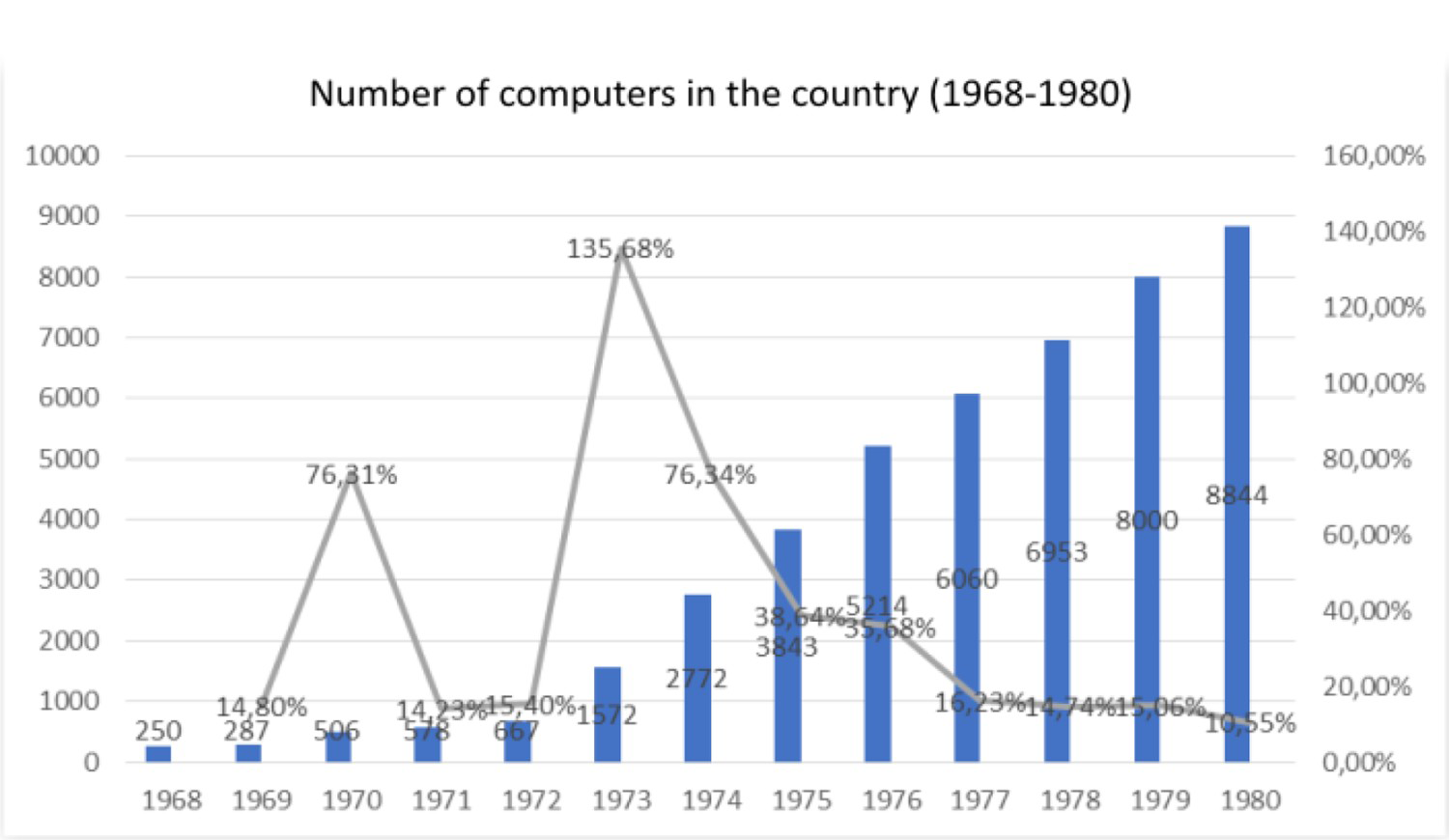
Although the Military Regime (1964–1985) encouraged the realization of diagnoses and the design of strategies for a native computer industry, such as the creation of the state-owned company COBRA Computadores in 1973, it was CAPRE's activities that best articulated solutions to such issues. Created on April 5, 1972, CAPRE ended up converging two perspectives or orientations that involved the process of ‘technization’ (Elias 1995) of computer technologies in Brazil: the first was focused on the rational use of the computer and its applicability in the different productive sectors of society, a concern that was already present in the performance of the Executive Group for the Application of Electronic Computers (Grupo Executivo para Aplicação de Computadores Eletrônicos – GEACE) in the late 1950s (Vianna 2016).
However, CAPRE's rationalization practices were reframed from a second perspective, related to the awakening of consciousness that occurred in the late 1960s regarding Brazilian technological dependence (Evans 1995; Adler 1987; Dantas 1998; Marques 2015; Vianna 2016): a generation of ‘frustrated nationalist technicians’ who started to occupy possible spaces in the state bureaucracy, such as CAPRE. Guided by technological nationalism 6 , agents such as Ricardo Saur, Ivan Marques, Mário Ripper, among others, used their technical knowledge and their nationalist political positions to encourage autonomous technological development.
When IBM tried to launch its minicomputer (IBM/32) on the Brazilian market in the beginning of 1976, with the intention of manufacturing it in the country and ‘benefiting’ Brazilian exports, it motivated technological nationalists to mobilize CAPRE instruments. Through Resolution 01/1976, a State policy in the field of Informatics was defined for the first time, guaranteeing a market reserve for minicomputers and peripherals produced in the country. From then on, CAPRE and its network of supporters established the prospecting of potential national candidates and technologies for manufacturing minicomputers, organizing competition for their production in late 1977. The process resulted in the choice of three national companies (SID, Labo and EDISA), in addition to COBRA Computadores, for manufacturing minicomputers in the country, based on the acquisition of foreign technological packages (respectively Logabax, Nixdorf and Fujitsu). CAPRE would progressively organize new market entries, choosing national initiatives in the production of modems, printers and terminals, resulting in the analysis of 142 manufacturing projects (54 approvals) at the end of 1979. That year, the national industry fostered by CAPRE's actions generated US$ 190 million in sales by national companies, close to 23% of the Informatics market in the country (Marques 2015).
These characteristics allowed it to assume a central position in the field of Brazilian Informatics in the second half of the 1970s. Led by Ricardo Saur, as Executive Secretary of CAPRE, the agency based its strength through technopolitical instruments and a sufficiently active technopolitical network, radically interfering in the relations established in the field until then, characterized by a ‘private’ negotiation between multinational manufacturers of computers and users, largely composed of businessmen. Not bad for an agency that had a character ‘commissioned’ from the Department of Planning (Secretaria de Planejamento – SEPLAN), with no autonomy to directly hire its employees and that never reached more than 80 members (some of them considered politically on the left), which remained essentially civil and flirted with social movements, in a period of authoritarianism, with the military concern to occupy positions in strategic sectors (Mathias 2004).
Although CAPRE had an advisory character until 1976, the rationalization measures employed by the agency served as a basis to strengthen its expertise and create procedures to analyse computational projects. Each federal agency was required to consult CAPRE when buying or renting equipment. 7 It was up to the Analysis Advisory of CAPRE to study the government entity's request, verifying the fulfilment of the criteria in a previous script and preparing a technical opinion, which was sent to the CAPRE plenary, made up of ministerial representatives. In turn, the counsellors analysed it and, in a favourable case, issued a resolution.
As a principle of ‘educating the Informatics consumer’, 8 CAPRE carried out its analyses, identifying common problems such as under/over-dimensioning of systems, resulting in the acquisition of computers with much lower or higher capacity for work planned by users, use of modern computers to emulate old systems and the absence of multiprogramming, which would influence the capacity and useful life of the computer used in a DPC. CAPRE was strong enough to issue, between July 1973 and May 1977, 51 resolutions on acquisitions of complete systems or expansions, better understanding the reality of the DPCs of the federal administration and perfecting technopolitical instruments. For this, they opened spaces for the technical-scientific community in order to participate in study commissions and encouraged the publication of works in the CAPRE Newsletter, as methodologies for ‘comparing digital system configurations’. 9
The development of a new model of the Informatics Master Plan (Plano Diretor de Informática – PDI) was an example of collective construction with the technical-scientific community: although it was a requirement that existed since the beginnings of the DPCs, public seminars were opportunities to adapt it to reality from the experiences of those involved. Considered the ‘main instrument for analyzing the global merit of an IT Project’, 10 the PDI defined what was needed to establish and maintain a DPC, what its operations would be, the existing human resources and the necessary investments. For it, the lifespan of each system was established, as well as the strategies to extend it (Graham and Thrift 2007), rethinking the workload distribution through multiprocessing techniques, software upgrades, among others.
As for the standard contract, the result of a working group organized by CAPRE on June 12, 1973, with representatives of state-owned entities, defined models for equipment rental and purchase contracts, accompanied by a script with the main information to be observed by the users in the act of contracting. It started to demand an ‘Acceptance Term’, and the acceptance of the equipment would only be given after the computer was delivered and thoroughly tested. The model imposed tougher terms on suppliers, requiring guarantees of training for the acquirer's technical staff free of charge and the imposition of penalties for delays in maintaining a system. 11
At the end of 1975, the agency also proposed a ‘roadmap for preparing consultations with CAPRE on the acquisition of data processing equipment.’ 12 This is because the technicians also wanted to know the DPC organization, if there were human resources available and in continuous training, what technical specifications were being used in the systems and computers, and what were the economic aspects of the machine purchase or rental. There was also investment in courses, such as seminars for Executives, to help decision-makers, who often did not know technical specifications, to know the real possibilities of a system. In addition to the wide distribution of the CAPRE Newsletter, these guidelines were distributed among users of private DPCs, which may influence their choices. In general, CAPRE's strategy was to give users greater knowledge about their system, giving them greater autonomy to negotiate or discuss technical issues hitherto imposed by IBM and other multinationals.
The power
When the II National Development Plan (Plano Nacional de Desenvolvimento – II PND) was launched by the Geisel government (1974–1979) in 1975, it was conceived as an ambitious substitute industrialization programme for heavy industry and basic inputs (Fiori 1994), which aimed to keep GDP growth at around 10% a year in a context of global economic recession caused by the 1973 Oil Shock. Informatics would be one of the areas that made up the II PND, as part of a ‘basic electronic industry’ to be developed in the country (Brazil 1974). It would be present in the synergy that was intended to develop with Communications, its integration in the modernization of administration and industry, and its role in the attempt to expand the production of electronics in the country, oriented towards export.
Despite the ambition of the plan, there was great governmental concern to face the continuous trade deficit, the lack of resources for investments
13
and breakdowns in the tripartite model of development
14
(Evans 1979). This led the Economic Development Council (Conselho de Desenvolvimento Econômico – CDE), an agency that brought together all the ministers and the President of the Republic, in order to align the country's economic policies, to impose new restrictions on imports at the end of 1975, reaching inputs and capital goods considered in high demand by the national industry – among them, data processing equipment, such as computers, video terminals and peripherals (Figure 2).
Main imported manufactured products (1974). Source: Dados e Ideias.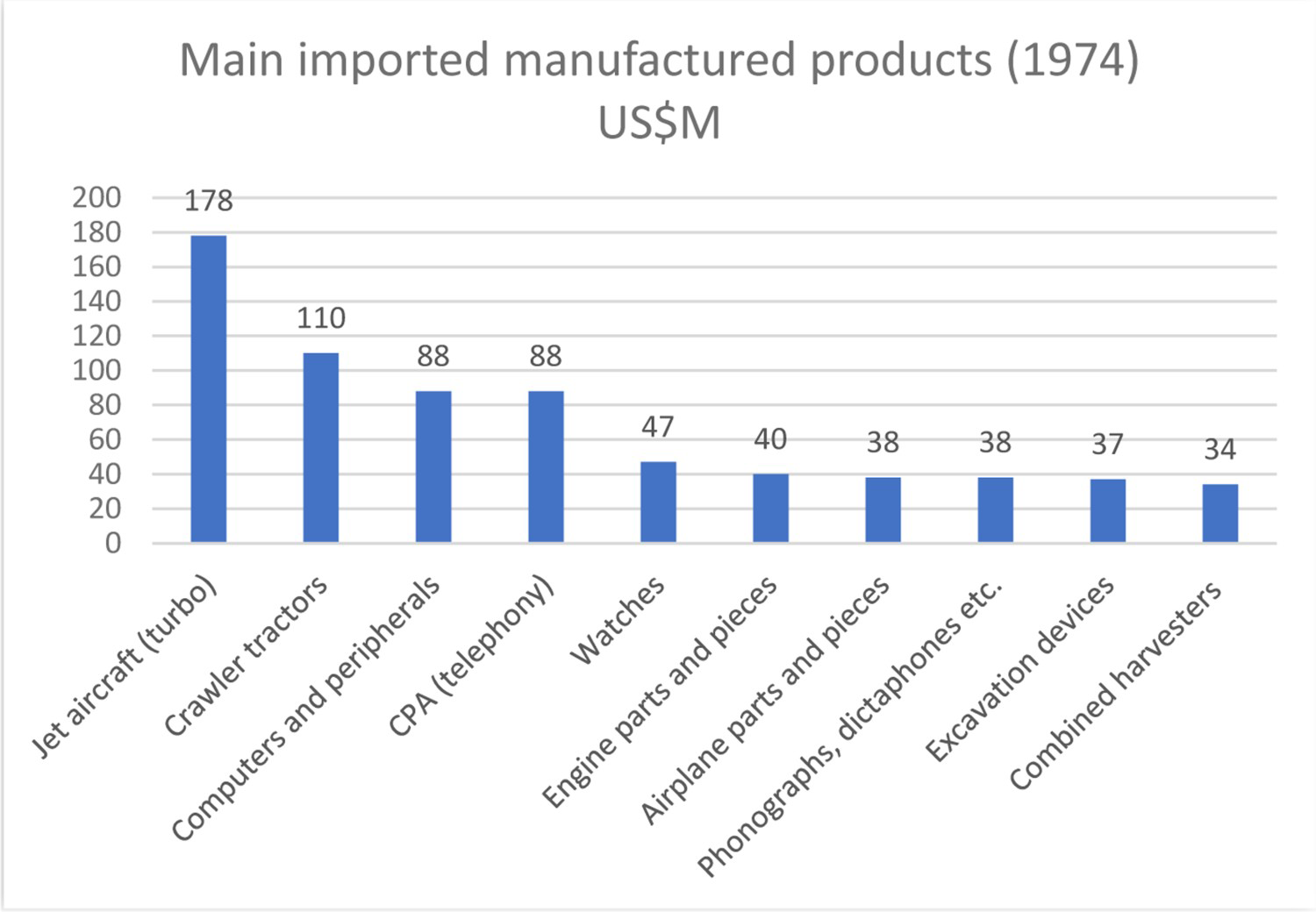
There was apprehension with the electronics sector. A study by Carteira de Comércio Exportação (CACEX) found that, in 1974, the 35 largest multinational companies had imported US$ 859.9 million in equipment, parts and components, and had generated only US$ 240.6 million in exports. 15 Regarding the field of Informatics, IBM and Burroughs together generated US$ 63.8 million in trade deficit for the country in 1974, while the growth of data processing equipment imports increased from 600% in millions of dollars between 1969 and 1974, reaching total spending of US$ 88 million in 1974.
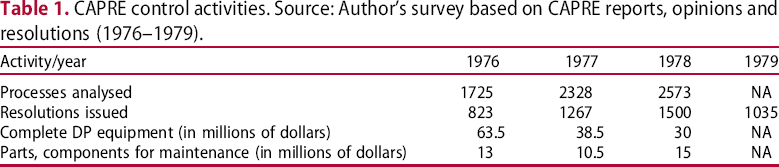
CAPRE control activities. Source: Author's survey based on CAPRE reports, opinions and resolutions (1976–1979).
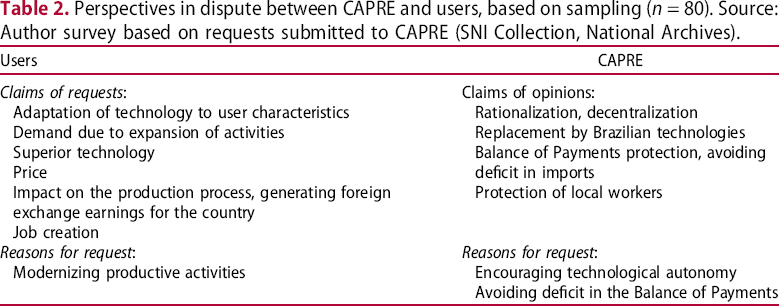
Perspectives in dispute between CAPRE and users, based on sampling (n = 80). Source: Author survey based on requests submitted to CAPRE (SNI Collection, National Archives).
This required the definition of criteria for the analysis of import orders. In a lecture at the IX National Congress of Data Processing (1976), Ricardo Saur informed that CAPRE needed to make an option regarding the methods of analysis of the projects that brought equipment import requests. The first option – imposing a quota system by companies – was abandoned in favour of a process that was ‘more laborious and more difficult to understand, which is to analyze each case for merit and real need for acquisition.’ 20 The point was to establish criteria that could not be summed up to a ‘multiple choice test’, 21 although there was a script designed to be followed by all pleading parties. Based on this, CAPRE technicians analysed each project, without an established deadline, according to the project qualities, presentation, objectivity and priority.
Formally, technicians set priorities for import. The first one was aimed at meeting the demands for parts and components needed for equipment already installed in the country, which directly involved IBM, Burroughs, Olivetti and other multinational companies in the field, with which CAPRE signed a gentlemen's agreement in 1976 (Dantas 1998). In exchange for companies not establishing stock of parts, the Executive Secretary of CAPRE ensured procedural speed in granting import quotas, allowing the use of generic import guides, so as not to leave them unable to serve their users. 22
The others involved importing components for the manufacture of data processing equipment in the country, parts for upgrades of installed systems (such as memory expansions of a mainframe) and the acquisition of ‘new computers with respective peripherals’, considered low priority. There were other issues that would influence decisions, such as whether the system belongs to a public university or to a company considered to be a priority branch of the economy (such as the export of manufactured goods). In short, there was a technopolitical orientation in the analysis of the processes, as can be seen from the explanations of the Executive Secretary of CAPRE in late 1976:
We have a double criterion to analyze the requests that companies place us to import equipment: the technical filter, where the planning and organization of the company's plan are considered, with purposes, goals, objectives, cost balance and human resources (certain companies ask for equipment but do not even have half the staff needed to take care of the system); and the adjustment of the country's needs; (…) if the company is not prepared to receive the equipment, if it does not have an administrative structure for that, if it does not have a team prepared in data processing, or if the company is not mature, if it does not have a master plan, if it does not know exactly what will do with the machine, in that case we advise you to stop a little to think, look for a bureau first, do something more priority in bureau, learn what data processing is and then come back.
24
Criticism quickly arose, especially from the multinationals IBM, Burroughs, Olivetti and others, which saw potential clients being affected by the restrictions, as well as the users represented by SUCESU. The companies claimed to understand the difficult economic moment that led CAPRE to exercise this control; however, they understood that the restrictive criteria would affect the productive means in the country. The Burroughs representative, on the occasion of the inauguration of the company's new building in Rio de Janeiro, in May 1976, declared that CAPRE's requirement of intensive use of a computer was impossible – ‘a farmer does not use his instrument, the hoe, for 24 hours a day’, 27 while for the president of IBM do Brasil, José Bonifácio de Abreu Amorim, the ‘market demand is legitimate (…) its structure will not change, but will only be repressed.’ 28
The reaction of the manufacturers was obviously understandable in view of the effects of their sales (Figure 3). The control established by CAPRE, combined with the market reserve for the manufacture of minicomputers and peripherals, determined the drop in its shipments abroad. For multinationals that explored the sale of small systems, such as Olivetti, the restriction had a devastating effect: the company had earned US$ 4.8 million in the Brazilian market in 1975, with US$ 2.7 million in minicomputers; in 1976, its sales fell to US$ 2.5 million and, in 1979, the company had only grossed US$ 341,000, without registering additional sales of minicomputers and dataentries.
Imports of IT goods (1969–1978). Source: CAPRE internal reports (1979).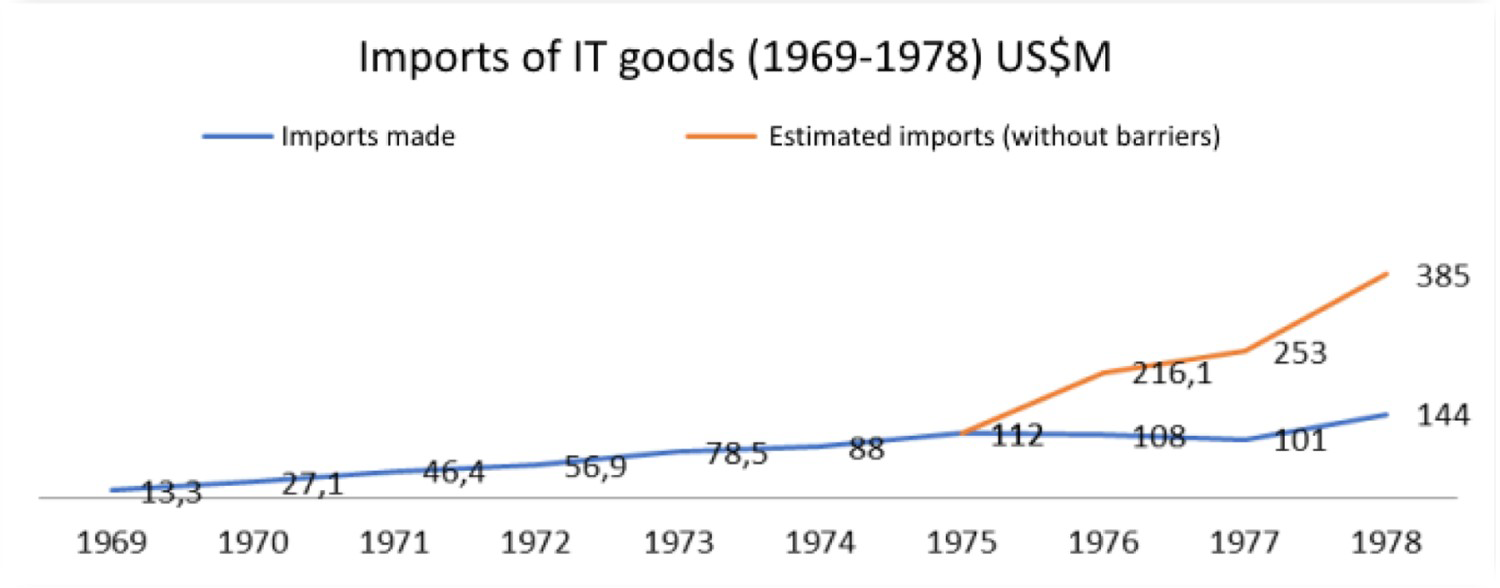
The restriction contributed to legitimize the technological nationalism of CAPRE technicians and heightened tensions with multinationals, generating ‘a real machine to hold’ the company. 29 IBM was forced to direct its production abroad and reduce the import of systems: the company had a positive balance in the country, varying between US$ 6 million (1976) and US$ 13.1 million (1978), that is, its operations retained resources in the country. This did not mean a peaceful conduct by the American company, which used numerous devices to circumvent control, such as the use of generic guides for importing IBM/32 minicomputers from 1976, in order to offer them in the Brazilian market, even though it is prohibited.
If the reactions of the multinational companies were expected, understanding the relationship between users and CAPRE, with their views at stake in the field of Informatics, was more complex – but it was possible to be explored through the requests submitted to CAPRE. One of CAPRE's first successful controls involved Makro S/A. The Dutch ‘self-service’ wholesale multinational company started its activities in Brazil in the city of São Paulo in 1972 and, three years later, opened its store in Rio de Janeiro. The company's DPC was based on an IBM 370/135 mainframe to generate administrative aspect and management reports, while its stores in São Paulo and Rio de Janeiro each used two HP2100A minicomputers, which were in charge of issuing invoices operated by sales terminals.
The company sent its import request to CAPRE on March 30, 1976, as it intended to expand its system in order to support the expansion of the commercial network in Brazil, which would lead to the incorporation of six new HP2100A minicomputers and replacing the old UNIVAC terminals, in the amount of US$ 1,175,389.00. After detailing to CAPRE technicians how the system works, the company pointed out that ‘the computer is the very essence of the Makro system’ just like ‘the loom is for weaving’, to the point that there were HP company's technicians who were exclusive to Makro. The company obviously mentioned its collaboration in the face of the country's economic crisis because, with its innovative system, lower prices were offered to small traders (exclusive customers of Makro), and therefore this could benefit the end consumer.
CAPRE recognized the importance of the computerized system for the performance of its activities, in addition to the relevance of Makro for the national economy, however the high value made CAPRE recommend reducing the request or else that it would be considered an investment by Makro's foreign shareholders (who should cover the import amount). 30 From there, a disagreement was generated: while Makro insisted that it was informed of the approval of its project unofficially 31 , CAPRE postponed an official position to force it to find a Brazilian alternative – at the time, the only one available would be the state-owned company COBRA Computadores, with its 700 computer line, based on Argus of the English company Ferranti.
On February 17, 1977, after negotiations at Makro's headquarters in the Netherlands, COBRA Computadores signed a contract to supply its minicomputers to the new stores in the country. The agreement was an important achievement for the future Braziilan computer industry – Makro was the first private customer of COBRA Computadores, strengthening its commercial position, since until then it only sold to government entities.
32
Even though the agreement with Makro did not solve COBRA's commercial problems
33
, it signalled that it was possible for CAPRE technicians to ‘guide’ buyers towards the acquisition of Brazilian technologies Figure 4.
Advertisements by COBRA Computadores about selling to Makro in March 1977.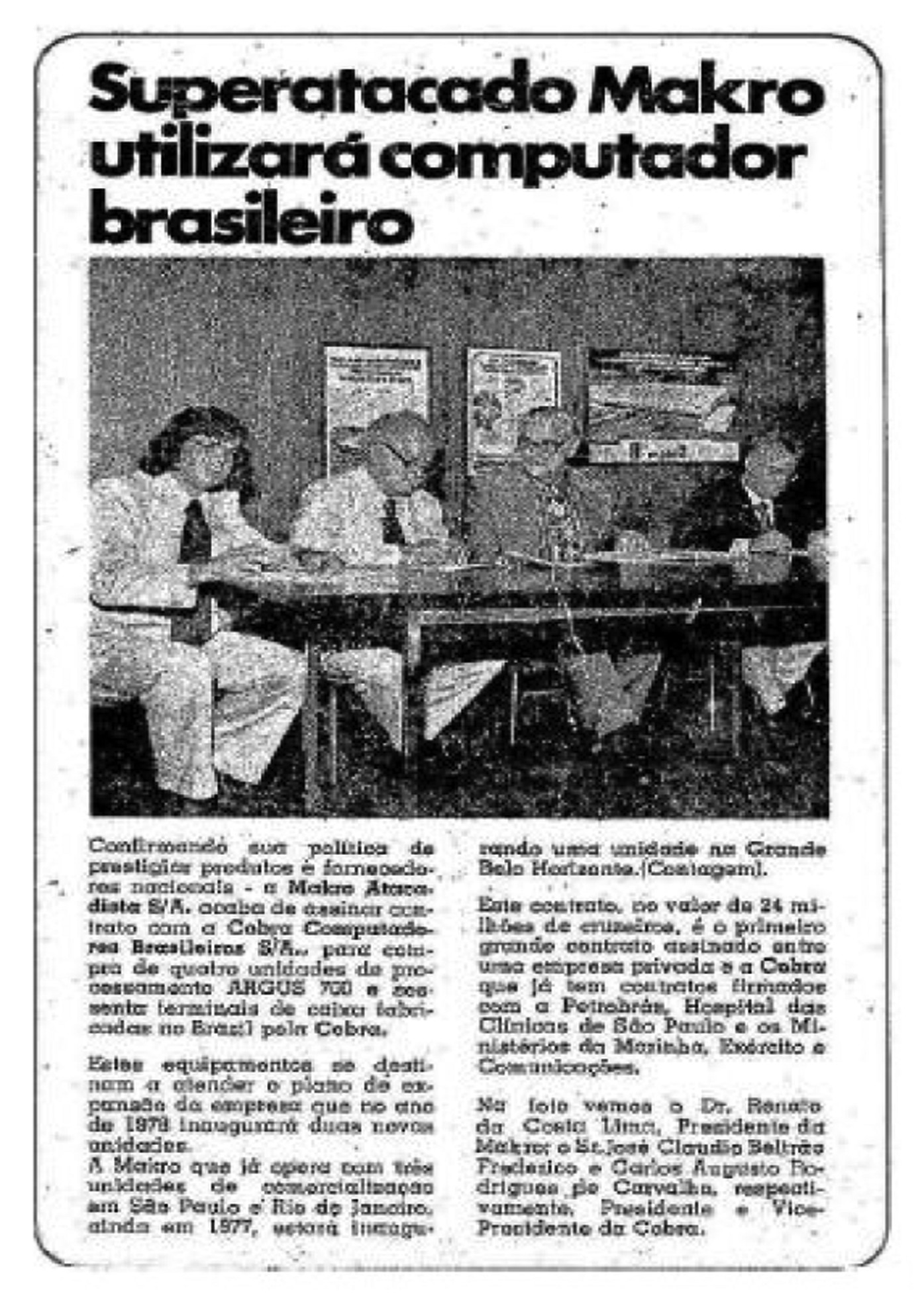
In particular, branches of multinational companies faced CAPRE's refusals: a sample of 50 requests in 1978 showed that they were all denied. An example was the process involving Montedison S/A. On June 21, 1978, the Italian multinational company in the field of medicines sent a request to CAPRE to rent a Honeywell Bull 62/40, with 192Kb of memory, with two 100Mb disks and other peripherals, valued at US$ 85,592.00. The idea would be to replace a Honeywell Bull G-120 dated 1972, due to the increased workload: it had gone from 435 h/month in 1975 to 528 h/month of computer usage. This caused the company to impose a rotation every five days to account for the tasks (for example, at each interval, there was no issuance of invoices, therefore, there were no deliveries). Montedison also complained about problems with maintenance and backup, and the impossibility of upgrading the machine, in addition to the obsolescence of its software.
The CAPRE technician acknowledged that the company had prepared itself properly: it had adequate facilities, presented a consistent PDI, with a good internal organization of its DPC and had established competition between manufacturers (between IBM and Honeywell) to decide the best equipment, without configuration excesses. However, the opinion was reviewed by his superior, who vetoed the import, alleging lack of a sizing study, that is, checking whether the size of the machine was adequate for the tasks reported. Montedison rebelled, claiming that it was at the limit of its processing capacity and was being forced to ‘block’ hours on other DPCs, with ‘serious consequences in the production area.’ 34 There was no agreement and, on June 18, 1979, CAPRE sent its standard letter of rejection for the import request.
On July 28, 1978, Labortex S/A, a subsidiary of the manufacturer of rubber products Continental (Germany), submitted a request to import an NCR-8250 minicomputer with 64Kb and peripherals worth US$ 21,390.00. 35 Until then restricted to a Burroughs L-2000 in which payroll and billing applications were processed, the company sought to expand its DPC and standardize its costs. For that, the NCR-8250 would allow the incorporation of the applications developed by the German headquarters, already active in other subsidiaries in the world, observing that ‘the absorption of this know-how (…) will be entirely free.’ Modernization through the implementation of seventy applications, which had taken two years of development in Germany, would be the key to the modernization of the Brazilian subsidiary.
However, the CAPRE analyst realized that if the Brazilian subsidiary standardized the systems with the German headquarters, the equipment would have a very low utilization rate (reduced to one work shift). In addition, it was a piece of equipment like the Brazilian minicomputers, with local alternatives. 36 NCR and Labortex started to plead for other solutions, such as using a video terminal from Scopus (Brazilian manufacturer) and importing the equipment without exchange coverage, that is, without the remittance of external resources. In reply to Labortex, CAPRE denied the import, remembering that the opinion focused on the technical nature and observing that, if ‘this request was approved, for consistency, other processes, with the same level of technical justification, would also have to be approved regardless of exchange rate.’ 37
Although this mediation goes through the technical debate, the allegations between the parties ended up justifying political positions, thanks to the interpretations given to the computer technological artefacts. If technicians and users saw that they were decisive for developing the country, they differed completely in perspectives:
CAPRE technicians, guided by the combination of technical procedures and political positions, saw computers as one of the vehicles of technological autonomy. A long-term, ambitious project that contemplates the mastery of its use and the development of computational technologies adapted to the local reality, aiming to overcome scientific, economic and social inequality in the country. Which even led to an attempt to ‘raise awareness’ among users, as recalled by CAPRE's Planning Advisor, Arthur Pereira Nunes:
Well, the three of us left: Me, Ivan da Costa Marques and Pegado. In reality, the sequence was the opposite: Ivan spoke about the importance of technology, strategy, there must be, it's time, Brazil has conditions. Then Pegado would show the keyboard concentrator and say we are already doing it, it works, we are able to do other things. And I would come in and say: because of that, there will be no more imports, whoever wants to import will have to show that they don't need the national item, that they can only solve with the imported one. That is, the blow was mine! Because the others heard these guys say some nice things and then they said: “But I won't be able to import anymore?”. It was a complicated thing, but there is no way. But you couldn't simply say “there is no way”, it had to be “there is no way, but we will generate alternatives”. The problem will only lessen if you don't import anymore. Look, concentrator will work, it can work.
38
However, this was problematic for users. The negotiations between CAPRE users and technicians were immersed in the change in the position of businessmen with the State, with the end of the Brazilian Economic Miracle. As Fiori (1994) realized, the Brazilian business community was never enthusiastic about nationalism and the growing intervention of the State in the Economy, but the conservative pact generated by the Civil–Military Dictatorship provided parallel forms of interlocution with technocracy in exchange for benefits (Schneider 1991). When Geisel limited the presence of business sectors in decision-making bodies, favouring technocracy (Codato 1995), accompanied by the economic crisis, the business community made public its criticisms of the State.
For SUCESU, CAPRE's restrictive actions left users ‘always lagging behind the most dynamic centres of the economy, making us less and less competitive’, as companies used outdated computers, ‘with less productivity.’ 42 Thus, computers were instruments of modernization and represented the efficiency and the solution of their administrative problems. Pragmatic, they questioned the parameters that guided CAPRE's analysis, criticizing that they forced them to choose old or unavailable systems, such as Brazilian minicomputers, whose industry CAPRE intended to promote.
Thus, the company Chocolates Garoto, prevented from obtaining a Burroughs B1885, claimed not to understand how the ‘wise members of this Commission’ could deny a genuinely Brazilian company, which generates jobs and foreign exchange to the country through the export of its products, the access to the modern technology required for these purposes. 43 In the same vein, Nitro Química S/A highlighted its contribution to the country's economy, understanding that it is unfair to ‘throw a general balance deficit against the company that generated a foreign exchange balance for the State’, the uncertainties that the national industry can supply the market and the contradiction of the State to encourage the modernization of national companies, without allowing them to appropriate the most modern technologies. 44 Martins Comércio tried to bypass CAPRE in its search for an IBM/3, appealing to the minister of SEPLAN, adding a letter that mentioned the importance of computational modernization to ensure the country's economic development. 45
These criticisms became public through periodicals specialized in Informatics 46 and also in the general press. One of the main newspapers in the country, Jornal do Brasil criticized the institution of ‘notary offices’ such as CAPRE, which benefited certain national manufacturers, ‘distributing entrance tickets’ without thinking about the modernization of users. 47 Even a leader of Digibrás, a state-owned company that should assist Brazilian manufacturers in absorbing or generating technologies, exposed his public criticisms of CAPRE, accusing it of promoting casuistic decisions, without being guided by a formally established policy. 48
For CAPRE, proposing to rationalize the existing equipment, in summary, was to establish a time for national manufacturers to occupy the market. The control brought some favourable results, as Evans, Tigre, and Frischtak (1992) realized: the full development of Brazilian banking automation was due to the veto on imports of traditional DP equipment from Olivetti and Burroughs. CAPRE's vetoes led banks not only to purchase equipment from the nascent Brazilian industry, but to actively participate as partners and/or found their own technology companies to solve their demands. In turn, CAPRE's protection allowed Brazilian manufacturers of peripherals such as video terminals and modems to find their space, through successful experiences of small companies such as Embracomp and Scopus (terminals), Parks, OZ and Elebra (modems).
However, there were difficulties in promoting alternatives in the short term to users. The key point was the Brazilian minicomputer companies that faced difficulties in absorbing the acquired technologies, partly due to commercial and technical inexperience, which resulted in the delay in occupying the market, generating a repressed demand. In 1979, the pressure increased when IBM started offering its new generation of medium computers, capable of competing in costs and processing capacity with Brazilian minicomputers. Without the prospect of a quick solution, CAPRE retained the maximum amount of imports without an efficient counterpart from the nascent Brazilian companies.
Final considerations
CAPRE had an impact on the construction of an expertise in Informatics, with strategies that aimed to define the most appropriate use of the computer according to the political and economic interests of the period. But the negotiations with users demonstrated another dimension – if the Makro case can be seen as a limit to this ‘persuasion’ in joining the nascent Brazilian industry, the restrictions imposed channelled the criticisms of the business community as another proof of statism and casuistry decision-making, which prevented the modernization so proclaimed to get the country out of the crisis. It must be seen within a process of removal of businessmen from the State in the context of the economic crisis and political openness, which contributed to the delay of alternatives – the Brazilian minicomputers – in occupying the market.
There was recognition of the distress between technicians and users, which led CAPRE's Executive Secretary to propose more flexible technopolitical instruments in August 1979. One of them was precisely the possibility of granting ‘a minimum degree of priority in meeting equipment requests when there are alternative solutions in the country’ quickly, without the technicians wasting time analysing the requests. This is because there was an aggressive action by the multinational companies in the ‘South/Southeast market (…) in a clear demonstration of definitive occupation of the market and consequent jettisoning, in the bud, of the Brazilian industry.’ 49
This request was approved, but its effects could not be evaluated, since CAPRE would be extinguished in October 1979, with the creation of the Special Department for Informatics (Secretaria Especial de Informática – SEI). An agency conceived within the National Information Service (Serviço Nacional de Informações – SNI), it brought an authoritarian facet on the computational issue, dismantling a technological nationalist network and reducing the spaces for public manifestation on Informatics. In the early years of SEI, the relationship with users would no longer be due to technological ‘awareness’, but through control in the name of National Security.
Footnotes
Disclosure statement
No potential conflict of interest was reported by the author(s).
1
The events of the Intergovernmental Bureau for Informatics (IBI) in the period certainly demonstrate the attempt by developing countries to build political alternatives. One of the recommendations of the IBI meeting in 1976 was that “developing countries must maintain the right to choose products and technologies better adapted to their needs and capabilities, selecting them according to a national planning and procurement strategy, rejecting equipment offered by industrial countries in the name of technology transfer” (IBI 1976, xiii). In most of the initiatives, the State had a primary role in order to obtain greater national control over initiatives in the field. For Latin America, the case of Chile (Medina 2011) and Argentina (Adler  ) can be highlighted.
2
It is important to highlight that the development of Brazilian Informatics acquired special academic interest from the 1980s. Due to space limit, we highlight works that sought to understand the dynamics between politics, industry and technological training, sometimes from a comparative approach, such as Adler (1987), Van Ryckeghem (1992), Pedersen (1994), Evans (1995), Luzio (1996), Schoonmaker (2002) and, more recently, Beck (2012) and Seward (2016). It is also worth noting a diversification of approaches and themes of historical research, especially from the years 2010, among which are Informatics and Education (Valente 2017), software and technological autonomy discourse (Cardoso 2013), business trajectories (Bortolini ) and authoritarianism and technological policy (Marques 2015).
3
Part of it was microfilmed by the Special Department for Informatics and ended up integrated into the collection of the National Information Service (Serviço Nacional de Informações – SNI), now made available by the Memória Revelada (Revealed Memory) project, in the National Archives.
4
5
Between 1967 and 1973, the country had unprecedented average growth rates (around 11% of GDP per year), with strong State incentives in the industrial productive sector, through the opening of credit lines and intervention in the labor market (decrease in wage purchasing power), in addition to foreign investments, aimed at exporting manufactures and technology acquisitions.
6
Technological nationalism was composed of a set of fragmentary ideas acting as a guiding principle for agents in the field of Brazilian Informatics. Edwards (1996) noticed the movement of these ideas in the construction of North American Informatics, a juxtaposition of anti-communist discourses, nationalism, techniques, technological artifacts that influenced technopolitical decisions. About Brazil, Adler (1987) properly observed this contradiction, between the Military Regime, guided by the National Security Doctrine, in which technologies should protect the country, and the technical-scientific community that, influenced by the ideas of the Economic Commission for Latin America and the Caribbean (ECLAC), held a more critical and social view on technological development. A somewhat complex and ambivalent relationship, as Motta () realized in his study of universities in the Civil-Military Dictatorship, taking into account that, despite the strong repression, there was an expansion of graduate studies and the number of scholarships for studies abroad, something that many technological nationalists have enjoyed, expanding their expertise. For alternate pathways of technological production in Latin America, see Medina, Marques, and Holmes (2014).
7
Decree no. 70.370, of April 5, 1972, art. 2nd, item b.
8
Statement of Ricardo Saur to the Chamber of Deputies on 08.21.1975 on the occasion of the Parliamentary Committee of Inquiry on Multinationals (1975–1976).
9
CAPRE Newsletter, v.1. issue 3 Oct./Dec./ 1973.
10
CAPRE Newsletter, v. 3 issue 3 Jul./Sep./ 1975. p. 55–62.
11
Resolution No. 17, dated 10.31.1973. CAPRE Newsletter, special issue, Dec. 1973.
12
CAPRE Newsletter, v. 3 issue 3 Jul./Sep./ 1975. p. 55–62.
13
The degree of deterioration in the Balance of Payments, with a record deficit in the Trade Balance in 1974 (US$ 4.69 billion), and the forecast of a continuation of the deficit in 1975 (which amounted to a negative US$ 3.54 billion), demanded that the government to exercise adjustment mechanisms (Baer ).
14
15
Dados e Ideias, issue 3, Dec./Jan. 1975/1976, p. 56
16
Resolution No. 104, dated 12.3.1975, gave CAPRE authorization to carry out this control. In summary, each buyer was obliged to submit the so-called import guides to the agencies designated by CDE to obtain consent and a priority. If priority was denied, the importer was obliged to deposit the equivalent value of the import to CACEX for a period of 360 days, forcing the importer to look for national alternatives. CAPRE would operate in 1977 with a quota of US$ 100 million, that is, it could grant priorities up to this amount without the need for a compulsory deposit.
17
Jornal do Brasil, 01.19.1976. For some nationalists, it was Ricardo Saur who had “convinced” his superiors that CAPRE should manage computer imports. “Gee Saur, you're crazy, you're going to stop this country!” – Statement by Mário Ripper to the author on 04.19.2013.
18
19
Import Process B1421079 and A0621079, request Laborgraf S/A, supplier Olivetti, on 10.03.1979.
20
DataNews, 11.01.1976.
21
Ibidem.
22
Interview with Ricardo Saur on 02.25.2013.
23
DataNews, 12.20.1976.
24
Dados e Ideias, issue 4, Feb./Mar. 1977 p.6.
25
“We fully assumed this CAPRE's unsympathetic role. And we thought it was great” – Paulo Roberto Ribeiro da Cunha, coordinator of Analysis Advisory at CAPRE. Dados e Ideias, issue 4, Feb./Mar. 1977, p. 8.
26
According to a CAPRE technician, making clear the negotiation between technicians and users: “Some guy wanted the equipment, he wanted the printer, he wanted everything … So at that time I learned to scale, to see what was needed. So I negotiated a lot with people. We did not deny a project, in fact, it was rare to deny it – it had to be a very bad project – and we were not against the development of institutions, but it was all about to measure what we really needed.” – Statement by Jorge Wanderley to the author on 01.23.2013.
27
O Globo, 05.20.1976, p. 24.
28
Dados e Ideias, issue 5, Apr./May 1976, p. 65.
29
Statement by Antônio Gil (IBM Brazil) to the author on 03.10.2014.
30
Opinion of CAPRE's analyst on the Makro S/A project on 6.13.1976.
31
Letter from the General Management of Makro S/A to the Executive Secretary of CAPRE on 12.7.1976.
32
SUCESU Magazine, Mar. 1977, p. 23.
33
COBRA was looking to consolidate a new product that would make the company viable on the market (the Sycor 400 minicomputer) while developing the technological project of the Brazilian minicomputer ‘G-10’.
34
Letter from the Administrative Director of Montedison S/A to the Executive Secretary of CAPRE on May 13, 1979.
35
Import Process B1370778, request Labortex S/A, supplier NCR, on 07.28.1978.
36
Technical opinion of CAPRE on 01.26.1979.
37
Letter from the Executive Secretary of CAPRE to the Administrative Director of Labortex S/A on 6.19.1979.
38
Statement by Arthur Pereira Nunes to Márcia Cardoso and Vítor Barcellos on 03.25.2009.
39
It was an interface created by the SERPRO team, led by Diocleciano Pegado, which allowed resizing data entry in a system, bringing together up to 32 keyboards for a CPU.
40
Although here there could be a dissatisfaction of parts of the technical-scientific community with the low use of technologies generated by the research centers, seeming to be “uncomfortable results of the training process” for qualified labor (Dados e Ideias, issue 1, Aug./Sep. 1976. p. 5). Technological nationalists like Claudio Mammana and Ivan Marques protested this situation. It should be noted that Claudio Mammana was among the creators of PADE, a medium-sized computer from USP, while Ivan da Costa Marques had developed with his team the Floating-Point Processor, a device that increased the processing capacity of the IBM1130, a computer that was popular among Brazilian universities.
41
Dados e Ideias, issue 2, p. 58, Oct./Nov. 1978.
42
O Globo, 10.25.1978, p. 24.
43
Import Process B0780579. Opinion of the CAPRE's analyst on the request of Chocolates Garoto on 09.12.1979.
44
Appeal by Nitro Química to CAPRE on 12.21.1979.
45
Letter from the Vice President of the Chamber of Deputies to the Minister of SEPLAN on 08.22.1979.
46
ComputerWorld did not miss the chance to instigate its readers by proposing to imagine a world in which government approval was required to buy any components for a computer. The article ‘Brazilian users face a sea of bureaucracy’ brought some criticism from users about CAPRE's procedures, protected by anonymity for fear of seeing their projects disapproved. ComputerWorld, 11.13.1978.
47
Jornal do Brasil 12.24.1977.
48
O Globo 07.09.1978.
49
Request from the Executive Secretariat to the CP on 08.13.1979. Minutes of the 32nd session of the CP on 8.30.1979. SEI Archive.