







Abstract
In this position paper, we use the example of The University of Texas at Austin's Planet Texas 2050 (PT2050) to argue that the Grand Challenge (GC) framework for ambitious research initiatives must create meeting grounds for transdisciplinary integration of science, technology, engineering, mathematics (STEM), arts, and humanities, along with community perspectives. We trace the historical trajectory of GCs, and reframe GC initiatives within the literature of inter- and transdisciplinarity. We present PT2050 as a case study of the infrastructural supports and imaginative process for creating level meeting grounds for transdisciplinarity. We demonstrate the benefits of these meeting grounds through projects, products, and funding generated. We contend that engaging arts, humanities, and community in co-design from the beginning is critical because complex, urgent challenges such as the climate crisis are embedded in human societies and demand solutions based in understanding of social, cultural, and historical contexts as well as STEM applications.
Keywords
Introduction
The emergence of the interdisciplinary ‘Grand Challenge’ is so widespread as to seem self-explanatory: a Grand Challenge calls for solutions to a problem that is complex or ‘wicked’ (Norton 2005), broad in implications, and inspirational in scope. In recent years, the idea that successful responses to such challenges will substantively advance knowledge and quality of life has been normalized across disciplines including the arts and humanities. In many Grand Challenge (GC) initiatives, however, the emphasis has been on technological solutions to social and environmental problems, and especially on solutions mediated by advanced computing technology. Even where multidisciplinary approaches to GCs are proposed, the different disciplines involved often rely on computational resources and an academic perspective that cultural critic Evgeny Morozov calls ‘technological solutionism’ (Morozov 2013). At least in their public presentation, many university-led GC initiatives appear 1 to skew toward the science, technology, engineering, and math (STEM) fields, and even when fields like the arts, humanities, and public health and policy are included, they gravitate toward the computational and quantitative corners of their disciplines. Reasonably, most of these GC initiatives seek to provide concrete responses to pressing problems in the near term (for example, to shift Los Angeles to renewable energy by 2050, as the GC at UCLA intends). These GCs can be classified as ‘functional’ initiatives, merging applied science and public policy.
In some ways, the Bridging Barriers GC initiative at The University of Texas at Austin follows this pattern, as the use of high-performance computing resources, technology-based solutions, and attention to policy outcomes characterize all three of its current programmes. 2 Like other Grand Challenge initiatives, Bridging Barriers seeks practical solutions and falls in the broad category of ‘functional’ GCs. In other ways, however, the UT initiative positions itself to address ‘grand challenges’ that are more ‘foundational’: how to integrate scientific and humanistic disciplines, quantitative and qualitative modes of inquiry, and academic and community-partner expertise to find solutions to problems that cannot be addressed by technology alone. As the global response to crises like climate change and the COVID-19 pandemic has demonstrated, scientific research and technological tools are not sufficient; it is necessary to understand how human beings across a wide range of cultural contexts view the world, what historical and social factors have contributed to that view, and how they might be engaged as active participants in developing solutions. This requires the contributions of the arts and humanities as well as the STEM fields, and it requires an environment in which non-academic stakeholders and scholars with very different disciplinary backgrounds are able to meet as equals and develop a shared perspective on a set of challenges.
The Planet Texas 2050 (PT2050) Bridging Barriers GC exemplifies this approach. It incorporates the resources of the Texas Advanced Computing Center (TACC) and quantitative scientific approaches to the past, present, and future impacts of climate change. At the same time, PT2050 places humanistic and scientific perspectives on an equal footing and involves community partners at all stages, engaging each discipline and sector on its own terms to make progress toward a more resilient 3 and equitable Texas in 2050 and beyond. This emphasis on disciplinary equity was deliberate and hard-won, and it has helped shift the concept and methods of the GC. Rather than compelling some disciplines to accommodate the frameworks of others or insisting that each field connect through shared computational approaches, PT2050 has established intellectual and cultural meeting grounds where different ways of knowing and practices come together to question disciplinary preconceptions and explore unexpected convergences. This approach has also fostered partnerships with stakeholder groups outside of academia, for whom these meeting grounds offer opportunities to contribute actively to research design and project goals. Such partnerships also ensure that the computational components of the GC support community-led dialogues.
PT2050 provides an instructive example for how GCs can create meeting grounds for co-designing climate resilience strategies. Integrating disciplinary epistemologies, methodologies, and stakeholder commitments ensures focus on both the science of climate stresses and the social and cultural factors that make these stresses most burdensome for marginalized groups. It allows us to embrace scientific research and innovations in computing and STEM while avoiding technological solutionism and foregrounding the human contexts fundamental to equitable responses to existential challenges. This position paper contrasts PT2050 to the historical trajectory of GCs, which have tended to prioritize STEM disciplines and technology-driven solutions; reviews how interdisciplinary and transdisciplinary research links to GCs; details the process by which PT2050 created transdisciplinary meeting grounds; describes a few of the projects it has catalysed; and concludes by highlighting the importance of engaging arts, humanities, and the community throughout GC co-design.
The evolution of the grand challenge concept: 1980s to present
The language of the GC has become a common feature in research and academia in recent years (Lemann 2019), suggesting the concept emerged organically in various disciplines. In fact, the notion of the GC entered the US research scene fairly abruptly in the late 1980s and has been closely associated with the physical sciences in general and computer science in particular (Hicks 2016; Kaldewey 2018). Early uses refer to space exploration (Keyworth 1985), and the term reappears in 1987 in a White House Office of Science and Technology Policy (OSTP) report, where a STEM-centric definition emerges: a GC is ‘a fundamental problem in science or engineering, with broad applications, whose solution would be enabled by the application of the high-performance computing resources that could become available in the near future’ (Huray 1987). Computational solutions to urgent societal challenges were subsequently presented as transformative for both science and society (Reddy 1988; Wilson 1989; Levin 1989). Commitment to computational solutions endured in US government backing for GCs for the rest of the 1980s (National Research Network Review Committee and Kleinrock 1988; United States 1989; Bush 1991).
Given the emphasis on computing resources and quantitative scientific research in GC discourse of the late 1980s and early 1990s, many initiatives from this era addressed future-oriented scientific problems with direct commercial or social applications, especially in environmental sciences, health, and computing (Olson 2016). While economics and policy concerns sometimes surface, technological solutions are paramount, and non-STEM disciplines appear in passing, if at all (Katsouleas, Miller, and Yortsos 2013). By the late 2000s, however, the term ‘Grand Challenge’ had begun to refer to more concrete and immediate problems facing society as a whole. In the first report of the European Commission's European Research Area Board (ERAB) in 2009, examples of GCs included ‘climate change, energy supply, water resources, ageing societies, healthcare and sustainable prosperity for all’ (European Research Area Board 2009). These GCs are open-ended and oriented to systemic change rather than to completing a mission like the moon landing. Such efforts call for multiple perspectives, attention to diverse stakeholders, and the assembly of ‘heterogeneous bits of work’ (Kuhlmann and Rip 2014); they also call for inclusion of the humanities and social sciences (European Research Area Board 2009).
This broader view of GCs surfaced when the concept reemerged in the US during the Obama administration in 2012. Under the direction of the OSTP, the ‘Strategy for American Innovation’ incorporated ‘Grand Challenges—ambitious goals on a national or global scale that capture the imagination and demand advances in innovation and breakthroughs in science and technology’ (Dorgelo and Kalil 2012). The efforts of the Obama administration thus targeted not only traditional STEM activities, but also ‘imagination,’ opening a space for the arts and humanities while bringing universities into collaboration with industry, federal agencies, and research laboratories (White House Office of Science and Technology Policy n.d.).
Since then a series of university-led GC initiatives has formed. Like their predecessors, these emphasize STEM-driven solutions, especially in the realms of health, environment, sustainability, and quality of life, in several cases drawing on advanced computational resources. A 2018 report from the University of California at Los Angeles (UCLA) lists ‘nearly 20 North American universities’ as leading GCs (Popowitz and Dorgelo 2018). While many of the most well-developed initiatives describe themselves as interdisciplinary, multidisciplinary, or transdisciplinary in their public materials and aim to connect with non-academic stakeholders, their self-presentation reflects the focus on STEM, quantitative research, and near-term policy or technological solutions that the GC concept has emphasized since the 1980s. It is difficult to determine how established GCs have incorporated the arts and humanities within this framework. While these programmes generate numerous research publications, there is little published work explaining the history, organization, philosophy, or practical operations of even well-developed programmes. One can, however, infer some of this information from the websites and public reports GCs provide. Here we use two of the most well-established university-led initiatives to illustrate the ways how quantitative disciplines in GCs may (or may not) be integrated with qualitative humanistic fields and the arts.
The first of these, at UCLA, bills itself as the first university-led GC (Rauser 2021). Beginning in 2012, UCLA went through a prolonged process of faculty-led brainstorming about the challenges it should confront and chose two areas—Sustainable LA (2013) and Depression (2015)—where measurable progress toward concrete goals was possible (Popowitz and Dorgelo 2018; UCLA Grand Challenges 2016). Both of these GCs integrate a wide range of participants, disciplinary perspectives, and stakeholder groups to address specific community needs, and both leverage the university's resources to create meaningful societal change. The sciences and computational approaches (e.g. modelling) play a central role, although each programme also has public policy and management goals. Both GCs emphasize interactions with community stakeholders, though in a number of concrete projects described, stakeholders seem to participate as research subjects or beneficiaries rather than co-designers. While the social sciences are well-represented, the humanities have a lower profile, at least among the research projects and leadership teams described on the initiative's webpages. The sub-projects funded by Sustainable LA in its early phase tended to operate primarily at the intersection of science, technology, and public policy: of 41 projects funded in 2016 and 2017, only two involved research that could be categorized as humanistic (both deploying cultural anthropology), and none were in the arts (UCLA Sustainable LA Grand Challenge 2022b). Similarly, as of 2022, a 21-member faculty advisory cabinet only includes three representatives of the humanities and the arts (UCLA Sustainable LA Grand Challenge 2022a).
The University of Minnesota followed a somewhat different path with the GC element of its 2015 Twin Cities Campus Strategic Plan (Grand Challenges Research Strategies Team 2016). The team that identified the challenges was convened by the Provost, not selected from the bottom up by faculty, but was reasonably interdisciplinary, with 16 of its 30 members from STEM fields and the rest hailing from business, public policy, social sciences, the humanities, performing arts, and design. Perhaps as a result of this disciplinary breadth, the five Minnesota GC programmes incorporate disciplines beyond engineering and sciences. However, arts leadership was more prominent in the first phase of the GC initiative, and even then arts and humanities fields were largely absent from the thematic areas including health, sustainable food supply, and clean water and ecosystems (Regents of the University of Minnesota 2016).
These examples demonstrate that the humanities have been late to GC conversations and underrepresented within them. While some humanities fields adopted the term to frame future research efforts by the end of the 2000s, these disciplines tended to work in computational environments, notably the digital humanities (Presner and Johanson 2009). Yet even digital humanists felt that non-computational humanities were equally relevant to these projects (Liu 2012). By 2016, consensus was emerging within both the sciences and the non-digital humanities that closer research collaboration across STEM, arts, and humanities would be efficacious. Calls in STEM publications for inclusion of these fields in GC programmes (Pedersen 2016) were matched with similar calls from humanities scholars (Bostic 2016).
Researchers have acknowledged the importance of artistic and humanistic knowledge production—meaning-making, storytelling, attention to culture, identity, history, and context—for communicating scientific research (Dahlstrom 2014). However, beyond just improving communication, deliberate and comprehensive integration of arts and humanities is necessary to GC programmes. Culture, beliefs, and human social behaviour are as central to achieving GC goals as STEM approaches (Honeybun-Arnolda and Obermeister 2019). A brief review of interdisciplinary approaches to research demonstrates the critical nature of this integration for GCs.
Grand challenge research across disciplines
The terminology for research that traverses disciplines is varied, with each term acquiring multiple meanings that often collapse, and sometimes contradict each other, in usage (Bernstein 2015; Max-Neef 2005). For our purposes, we distinguish interdisciplinary, multidisciplinary, and transdisciplinary. Interdisciplinary research integrates ‘knowledge and modes of thinking in two or more disciplines to produce a cognitive advancement—e.g. explaining a phenomenon, solving a problem, creating a product, raising a new question—in ways that would have been unlikely through single disciplinary means’ (Frodeman, Klein, and Mitcham 2012, 373). In contrast, multidisciplinary research lacks integration and suggests multiple disciplines working side-by-side on a shared problem (Frodeman 2013). In other words, multidisciplinary research aggregates knowledge from across disciplines, but interdisciplinary research seeks to synthesize and integrate knowledge from different disciplines (Bernstein 2015). The definition we use for transdisciplinary research describes research that incorporates stakeholders from outside of higher education— and their ways of knowing— into interdisciplinary, academic-based research (Bernstein 2015; Stokols 2006; Wickson, Carew, and Russell 2006; Bergmann et al. 2012; Horowitz et al. 2017; Lloret et al. 2020; Taub 2003; Lapaige and Essiembre 2010; Rigolot 2020; Scholz and Steiner 2015). In line with Klein et al., our usage also emphasizes ‘joint problem solving among science, technology, and society in order to manage complexity’ (Klein et al. quoted in Schmidt 2011, 256). In transdisciplinary research defined in this manner, stakeholder, local, and indigenous knowledges join traditional academic disciplines, integrated in an interdisciplinary way, to address the limitations of scientific knowledge (Barry, Born, and Weszkalnys 2008). This definition falls into the Zurich tradition of transdisciplinarity, which emphasizes creation and implementation of solutions to applied problems (Segalàs Coral and Tejedor Papell 2013; McGregor 2013; Bernstein 2015; Maasen and Lieven 2006). In contrast, Nicolescu's approach to transdisciplinarity presents a framework that moves beyond interdisciplinarity to seek a ‘unity of knowledge’ (Scholz and Steiner 2015, 527) via meta-integration of disciplines, norms, and values (Nicolescu, 2008; De Mello, 2008; Voss, 2008).
Barry and Born (2013) note that while humans have a long history of interdisciplinary approaches to knowledge production, more recent efforts to better link research outputs directly to urgent, complex societal problems such as climate change have intensified this interest. In the decades following World War II, the history of interdisciplinary science follows a trajectory similar to that of the notion of the ‘Grand Challenge,’ moving from ‘big science,’ mission-focused problem solving such as space research (Price 1963, 1986) to more socially complex problems requiring a broader interdisciplinary approach that includes social sciences, humanities, and arts (Frodeman and Mitcham 2007). Throughout this evolution, scholars have contended that problem-focused research must be grounded in interdisciplinarity or transdisciplinarity that provides equal footing for physical sciences, social sciences, arts, humanities and communities (Lidskog, Standring, and White 2022; Lahsen and Turnhout 2021; Soden et al. 2021; Schmidt 2011; Barry, Born, and Weszkalnys 2008).
Frodeman further argues that a ‘simple focus’ on interdisciplinary and transdisciplinary research approaches is not enough to address societal challenges (2010, 105). Scholars must attend to the why of interdisciplinary and transdisciplinary research as well as its methods and means. We argue that societal GCs present a significant why: they require transdisciplinarity that transcends field and epistemological boundaries because the sources and implications of a challenge like climate change can only be addressed through consideration of scientific knowledge and human behaviour and culture.
In sum, while early GC programmes centred around STEM, computational tools, and technological solutionism, in recent years, both STEM and humanities researchers have called for greater inclusion of arts and humanities in GC initiatives. Similarly, scholars and practitioners cite the growing need for transdisciplinary approaches that include holistic involvement of arts, humanities, social sciences, and communities alongside traditional scientific knowledge in order to address urgent challenges such as climate change. Yet few existing GC programmes fulfill the promise of transdisciplinary approaches as applied to socially complex, ‘wicked’ problems (Norton 2005). While Popowitz and Dorgelo (2018) have provided a useful description of GC programmes across North American universities, to our knowledge, the literature does not yet include a case study of a North American GC that seeks to place the arts, humanities, and communities on equal footing with more traditional scientific knowledge. Nor does the literature appear to include a GC team reflecting on its own values, formation, and processes for creating transdisciplinarity. We seek to fill these gaps by presenting the case of Planet Texas 2050, which demonstrates one successful approach towards creating transdisciplinary, university-led research focused on resolving socially complex and urgent challenges.
Creating infrastructure for transdisciplinary meeting grounds: The case of Planet Texas 2050
The global community's difficulty addressing climate change when the science is clear reminds us that scientific advances will only be one part of a successful response to urgent and dire challenges. The other elements will lie in the spheres of culture, perception, imagination, racial justice, social dynamics, and the built environment. These elements are central to PT2050, an internally funded, eight-year research programme that seeks to deepen knowledge about human-environment interactions under the stresses of climate crisis and population dynamics and to help build a healthy, safe, just, and ecologically and economically vibrant Texas by 2050. From its beginnings in 2016 as a programme within UT Austin's Bridging Barriers initiative, PT2050 has developed out of the creative ferment surrounding the outsized challenges of climate crisis. With commitments to integrate knowledge from across disciplines and co-design with community partners, we define our programme as transdisciplinary as differentiated from interdisciplinary in the previous section.
PT2050’s transdisciplinary meeting grounds were laid at the project's origins. In the fall of 2016, UT Austin's then-President Gregory Fenves announced the formation of a GC initiative, calling for new interdisciplinary research questions addressing significant societal problems affecting Texas and the broader world (Fenves 2016; Office of the Vice President for Research 2020). Over 800 researchers worked in teams to submit 125 two-page concept papers. The Office of the Vice President for Research (OVPR) then grouped these papers into six broad themes and invited small groups of researchers to develop ambitious roadmaps for addressing questions under these themes. Over the next several years, the OVPR facilitated the development of the GC programmes by creating opportunities for connection and collaboration. In particular, the OVPR provided staffing to coordinate researcher interactions in a year-long, bottom-up process that provided a gathering space for researchers from across campus, without dictating research questions, methods, outputs, or participants beyond the initial theme leads.
PT2050 leadership team membership, fiscal year 2018 to fiscal year 2020.
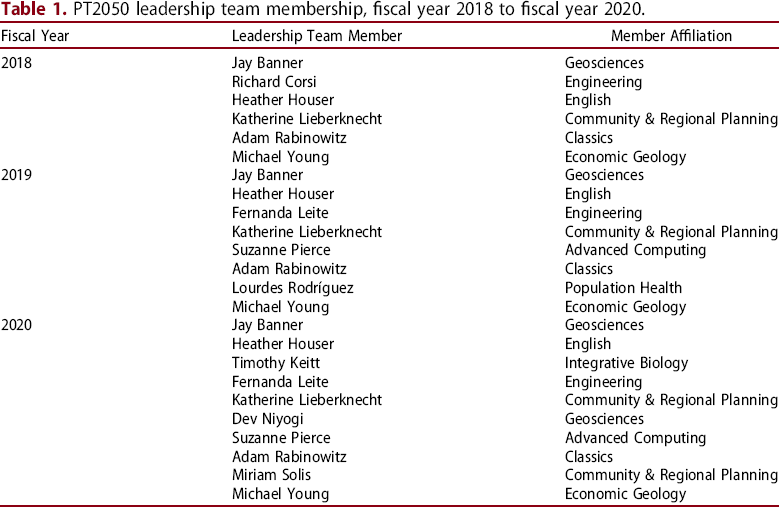
From the beginning, the OVPR promised funding for ‘people, resources, infrastructure’ and ‘help to secure significant extramural support,’ but no definite budgets or resource promises were made for about one year (Office of Vice President for Research 2016). Faculty and research scientists may initially have been motivated to participate because of the promise of future funds, but by keeping budgets unspecified for many months, the OVPR cultivated researcher relationships before competition for funding began. In a similar way, structured but understated leadership from the OVPR created a relatively level playing field for creative interactions and interdisciplinary inquiry in which no one discipline, academic unit, or individual's research agenda dominated.
About a year after the Bridging Barriers initiative launched, OVPR chose PT2050 to be UT Austin's first GC. The programme would receive $8–10M in internal funds and several faculty lines over eight years, receive staff support for administration and fundraising, and have access to an office suite in a central part of campus untethered from any particular academic unit. In exchange, PT2050 had to rapidly develop a governance structure and select initial research and outreach projects. At this juncture, the OVPR hired and paid for a full-time programme director for each GC theme. Programme directors have helped create meeting grounds by promoting equal distribution of power and resources amongst the different disciplines, facilitating interstitial connections between GC components, and implementing best practices from GC management (e.g. development of theories of change).
Since launching in January 2017, PT2050 has involved over 100 researchers from more than 35 academic units, from engineering and biological sciences to theatre and English. Like other GCs, PT2050 has incorporated high-performance computing, developing a cyberecosystem hosted at TACC that includes a data portal (DataX) and model integration platform (MINT) to serve as foundations for understanding interactions between human and environmental systems. But this cyberecosystem is also supporting community-led design projects with the Museum of South Texas History in the Rio Grande Valley and community organizing efforts in flood-prone Latinx neighbourhoods in Austin (Lieberknecht forthcoming). PT2050 research programmes similarly combine quantitative and qualitative methods: projects combine genetic and isotopic analysis with archaeological and historical approaches to study the interaction between environmental change and human mobility across long timescales; use both models and stakeholder conversations to correlate metropolitan growth and unequal exposure to climate change harms; and deploy participatory and creative research tools such as PhotoVoice to integrate local knowledge and lived experience into policy proposals. PT2050 researchers have explored social factors contributing to susceptibility to climate impacts and conducted ethnographic research on how ranchers in arid West Texas and Indigenous community members in Central Texas perceive and make sense of changes in historic and current water availability. The GC has secured research funding from federal agencies, foundations, private industry, and individual donors. It has also consistently involved stakeholders outside academia in this research. Specifically, advanced computing connects people through information, establishing digital portals that provide access to data, community-based projects that collect data in new ways, and narratives and visualizations that reflect a changing Texas and support marginalized communities.
While PT2050 harnesses advanced computing power to model scenarios about Texas's climate futures, developing equitable resilience strategies also requires understanding culture, beliefs, and human social behaviour. One of PT2050’s core values is equity. We know that marginalized communities experience magnified impacts from climate crisis (Barros et al. 2014; Rosenzweig et al. 2018; USGCRP 2017; Cushing et al. 2015; Jesdale, Morello-Frosch, and Cushing 2013; Uejio et al. 2011). As a result, researchers and practitioners must examine the equity and social and racial justice implications of climate resilience so that planning does not exacerbate existing inequities (Shi et al. 2016; Brown, Spickett, and Katscherian 2014). Accordingly, an equity and justice lens informs PT2050’s logic model, programme structure, and research plan, which also account for local knowledge and lived experiences of community members. With this attention to marginalization, equity, and local knowledge, PT2050 has explicitly committed to community connection, collaboration, and co-creation. Whereas the OVPR made interdisciplinary research a primary goal from the start of the UT Austin GCs, PT2050 leadership has insisted that transdisciplinarity is equally important for the GC's success. Transdisciplinarity grew from the GC development process, as team members from the humanities, planning and policy, and public health worked to integrate communities more fully into all stages of the GC lifecycle, rather than tacking on ‘broader impacts’ at the end.
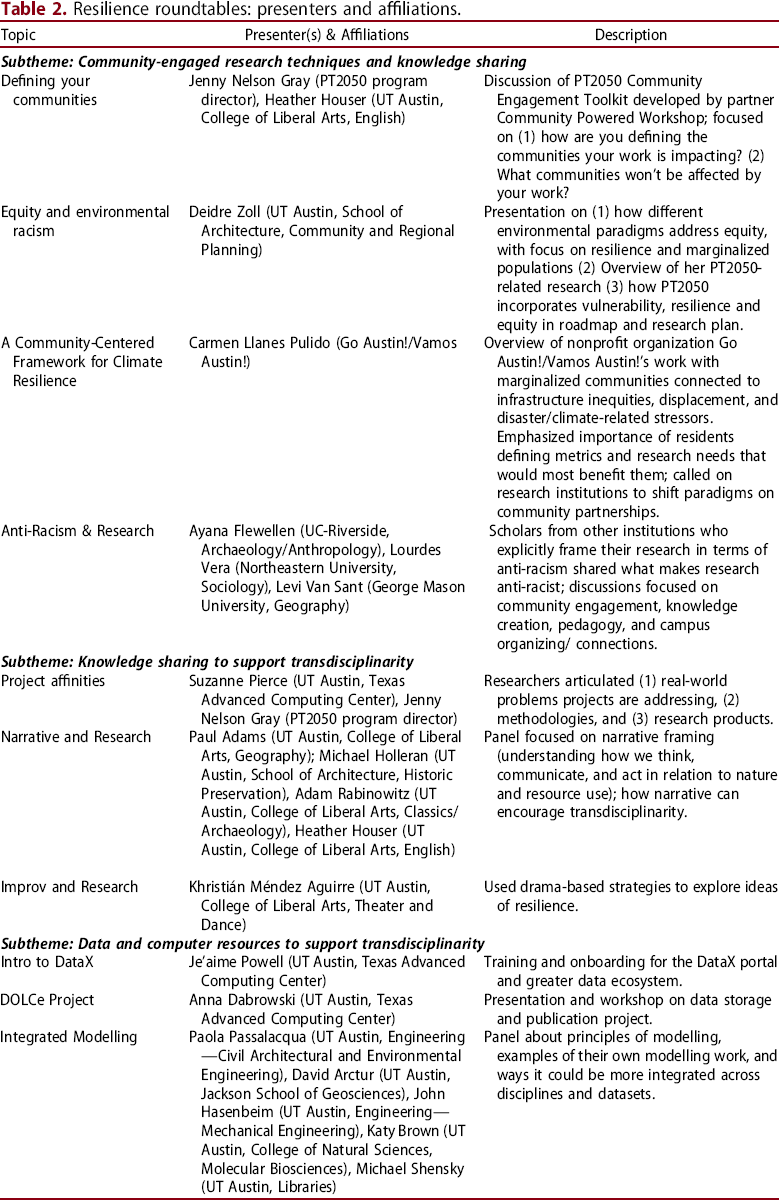
Resilience roundtables: presenters and affiliations.
Arts, humanities, and STEM meeting grounds
PT2050’s history, from its emergence from the OVPR process in 2016 through its ongoing research and partnership outcomes, reflects the importance of cultivating transdisciplinary interaction, exchange, and inquiry for fostering creativity and even chaos. GCs require bold thought and action within a structure—large universities—that can limit daring due to bureaucracy, resource competition, and siloing of disciplines. Within such institutions, it is often easier to encourage ‘shallow’ or ‘glib’ interdisciplinarity rather than the ‘deep interdisciplinarity’ and transdisciplinarity required for addressing systemic crises like climate change (Editors 2017; Renwick 2016; Rigg and Mason 2018). We did not begin by establishing SMART (specific, measurable, attainable, relevant, and time-based) goals because they can promote shallowness rather than depth (Gewin 2013; Castree et al. 2014). This is not to say that we jettisoned these values entirely, but rather that we needed first to establish meeting grounds on which different epistemologies and methods were equally valued and could integrate. It was crucial to understand colleagues’ perspectives and vocabularies and then find common ones. We needed to ignite wonder about unfamiliar approaches and spark imaginative potential of all disciplines amongst faculty and students alike (Daston and Park 1998; Dawkins 1998). Wonder and imagination were required for bold thought about climate resilience.
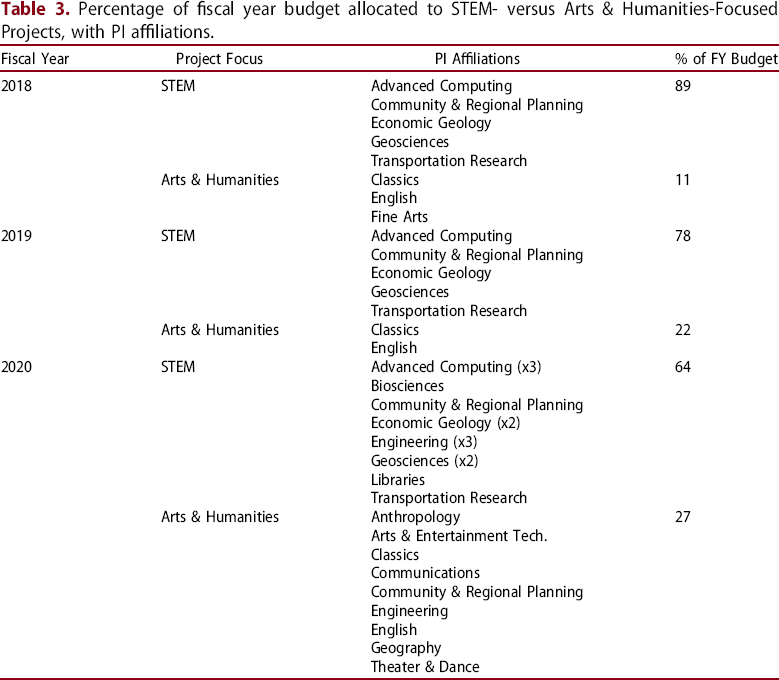
Percentage of fiscal year budget allocated to STEM- versus Arts & Humanities-Focused Projects, with PI affiliations.
Case projects: Where arts, humanities, and STEM meet
The fruitful inter- and transdisciplinary endeavours that resulted from the integration of STEM, arts, and humanities disciplines appear throughout PT2050’s portfolio. One particularly successful transdisciplinary example is the Texas Metro Observatory (TMO 2020), a communication and data platform dedicated to sharing information and ideas about Texas's communities to develop solutions to common problems stemming from urbanization processes. TMO results from the collaboration of an engineer, economist, architect, designer, computer scientist, community and regional planner, and public policy scholar, with input from community members and policymakers in Austin, Texas, and beyond. Highlights from the first two years of work include the People, Land, Water: Stories of Metropolitan Growth report (Texas Metro Observatory 2019); a set of online dashboards featuring socio-demographic, land use, and water use trends in the state, alongside social and climate vulnerability; and three academic manuscripts (Bixler et al. 2019; Lieberknecht 2019; Bixler et al. 2020). While this project uses digital interfaces and draws on the PT2050 cyberecosystem, it aims to make data comprehensible and useful for a range of stakeholders, as well as generate research questions. It also lends itself to further remixing: TMO data was adapted for the Texas Futures Virtual Reality Experience, an immersive interactive game that helps users conceptualize urban change across time.
TMO data and research networks have launched a new PT2050 project, ‘Equitable and Regenerative Cities’ (ERC) flagship, in which Austin residents, the City of Austin, and UT researchers are co-designing recommendations for citywide ‘climate resilience hubs.’ ERC has involved community members and stakeholder organizations from its inception, beginning with an initial investigation of how Texans view the impact of drought and severe winter storms on food security, led by Community Powered Workshop. Gathering local knowledge through surveys, interviews, and participatory mapping, the ERC team identified an opportunity to work with the City of Austin and community-based organization Go! Austin/Vamos! Austin to help locate and design resilience hubs to serve as neighbourhood mustering points in climate-related crises. In order to create a structure for integrating residents’ expertise with academic knowledge, ERC held an open call for community members to form a group of 10 Cities and Community Fellows (seven residents and three academics, joined by the two academic co-leads of the project) to advise the four-year project. Residents are paid a stipend to acknowledge their time and expertise and to include those who cannot afford to volunteer their time due to work and family obligations. Working with PT2050’s community engagement staff member, the Fellows designed a series of workshops, informal conversations, and lived-experience interviews to inform recommendations for how the city can integrate equity alongside regenerative systems principles in the siting, design, and implementation of hubs to incubate home-based climate preparedness and provide resources during climate-related events.
These projects demonstrate how PT2050 actively engages the imagination of scholars, students, and public participants not just through academic storytelling but also on a visceral, emotional level. As another instance, PT2050 funded a Collaborative Escape Room in its second year, and a team from the departments of Theater and Dance and Arts and Entertainment Technologies worked with over 100 students in more than ten courses created an immersive physical experience in which participants must escape a Gulf of Mexico research station facing an oncoming hurricane (Lorenzo 2020). To escape successfully, participants have to transfer data about the storm to the mainland for disaster planning. The design of the escape room drew on actual climate and meteorological modelling, and the difficulties of data transfer in the experience reflected real-life challenges the PT2050 team encountered in the development of DataX. This integration of computing and imagination is mirrored in the PT2050 cyberecosystem itself, which was designed to translate the results of scientific research and complex systems modelling into accessible, public-facing multimedia interfaces in a shared digital space (Gil et al. 2021).
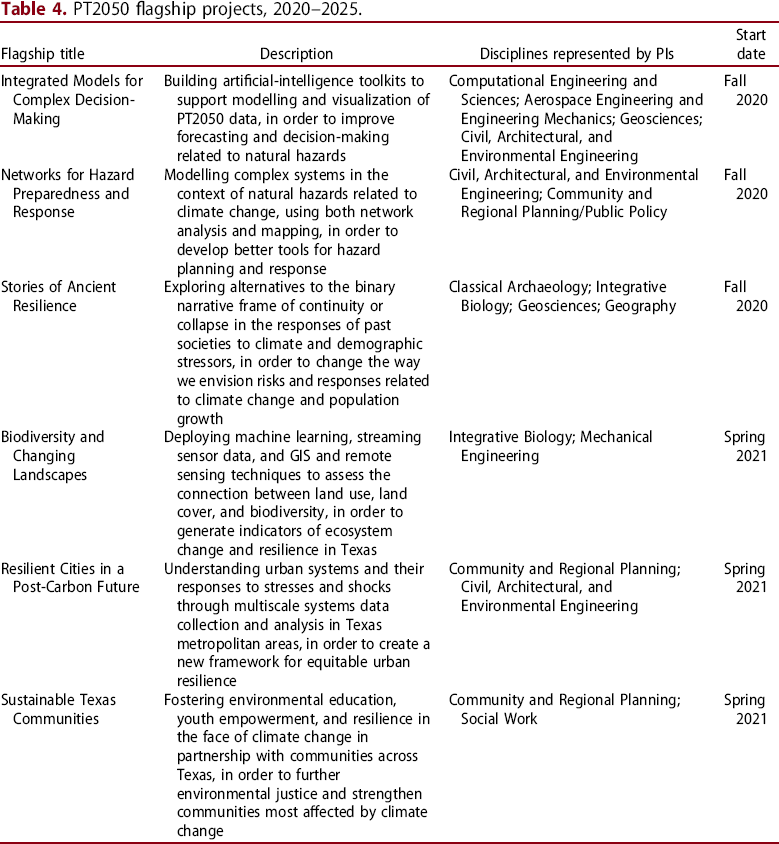
PT2050 flagship projects, 2020–2025.
Benefits of cultivating meeting grounds
Our external funding successes attest to the fruits of early arts and humanities investment. External proposals centred on these fields and on stakeholder engagement have been particularly successful. PT2050 is a co-PI on and was central to envisioning a successful Consortium of Humanities Centers and Institutes grant funded by the Mellon Foundation. This project expands our meeting grounds to include universities from the US, Lebanon, Australia, and South Africa, and prioritizes racial and social justice and the globally uneven nature of climate impacts. A successful National Science Foundation Smart and Connected Communities grant emerged directly from the TMO project; it involves five disciplines, and community partners led problem definition and scoping from the grant's inception.
In addition to bearing financial rewards, giving the arts and humanities prominence from the outset also combatted the ‘hegemony of the natural sciences’ and the ‘epistemic domination by technological disciplines’ that are common in GCs (Ledford 2015; Maxwell and Benneworth 2018). Research has shown how integral the arts and humanities are to the social outputs of GCs, and yet it also shows the obstinate barriers to their equitable inclusion in interdisciplinary climate research (Castree et al. 2014; Hulme 2011; Adger et al. 2013; Brom 2019). As PT2050 projects like ERC and the Escape Room demonstrate, arts and humanities perspectives and methods can promote thinking outside the status quo and create space for imagining futures unconstrained by practicalities (Heise 2017). At the same time, through collaboration they can return STEM researchers to the origin of their commitment to their fields: a desire to make people's lives better. The arts and humanities do so while emphasizing the diversity of values and lived experiences and accounting for the significance of race, ethnicity, gender, and other identity positions that determine the uneven impacts of climate and demographic challenges (Neimanis, Åsberg, and Hedrén 2015). Despite this, significant barriers to including the arts and humanities endure, in part because of norms within these disciplines that deviate from those within traditional STEM fields. Most notably, they resist quantitative results that integrate easily into computational platforms, and they operate on longer time horizons leading to fewer—if lengthier—publications and other outputs and smaller grant awards (Hulme 2011; Costa 2019; Olmos-Peñuela, Benneworth, and Castro-Martinez 2014).
Rather than perceiving these differences as obstacles, PT2050 has taken them as reasons to encourage conversation, imagination, and creativity. Acknowledging the friction between disciplinary positions has taken us out of the instrumentalist space of technological solutionism and into a productive space of inquiry, integration, and co-design with community stakeholders. Difficult questions about the integration of qualitative and quantitative data, the nature of objectivity, and the transcendence of the ‘basic vs. applied’ binary that governs research and funding persist. But wrestling with them is the praxis of a GC. One meeting ground for this work is provided by the Resilience Roundtables. A Resilience Roundtable, for example, made possible a serendipitous encounter between the Escape Room collaborators and researchers studying a pathogenic soil bacterium, Burkholderia pseudomallei, that is encroaching on Texas and is a hazard in flooded environments (Shensky et al. 2019; Shensky and Brown 2020). This encounter led to a brainstorming session about how the risks of this pathogen might be incorporated into a future version of the Escape Room. Such meeting grounds for exchange and creativity are crucial to the success of a GC like PT2050 that integrates disciplines and academic and community partners for change that goes beyond the academy.
Conclusion
As with the GC concept writ large, PT2050 is evolving. Each fiscal year has brought adjustments aimed at integrating diverse perspectives, methods, and experiences while also honing our mission to co-develop resilience strategies with community partners. A commitment to creating meeting grounds on knowledge from all fields and sectors can interact runs through these transformations. This commitment has yielded transdisciplinary outputs such as TMO, the Escape Room, community partnerships, and externally-funded proposals. When PT2050 began its third year in 2020, we reframed our programme to centre around six flagship projects founded on the preceding years of research, relationship building, and interdisciplinary exchange (see Table 4).
The pathway to these flagship projects was not linear, but our iterative, integrative, imaginative journey is instructive for institutions launching deeply interdisciplinary and transdisciplinary GCs. First, a firm foundation of infrastructural, financial, and human investments is essential, as is ensuring buy-in from researchers across the arts, humanities, social sciences, and STEM. Second, making space for stakeholders and community partners where they can contribute early and actively to developing research questions, approaches, and products helps move a GC from an interdisciplinary to a transdisciplinary approach. This shift is critical given the complexity and urgency of challenges such as the climate crisis. Finally, to break down divisions between STEM and arts and humanities disciplines in GCs, it is crucial to offer a level playing field from the beginning, rather than appending arts and humanities onto a STEM-focused project solely for communications purposes.
With these foundations, GCs should attempt to create meeting grounds for imagination, wonder, and productively difficult dialogue. Opportunities for transdisciplinary conversation, trust-building, and knowledge generation should be available in multiple forums. In PT2050, these have included participation in Resilience Roundtables, ‘listening tours’ with community stakeholders that can lead to enduring partnerships, and debates over discipline-specific terminology, methods, and sensibilities over shared meals and field trips.
Addressing GCs requires systemic change, rather than isolated missions. It requires transforming how researchers, stakeholders, and the public think about problems and solutions, not only transforming scientific research or technological innovation. Systemic change cannot be achieved in one or even three years. It requires both long-term investments and attunement to culture, perception, imagination, social dynamics, and racial and other inequities. Community stakeholders, artists, and humanities scholars are essential producers of knowledge in these domains, as well as the creators of stories, narratives, and visualizations that address the human dimensions of GCs. Engaging them in the co-design of GC programmes early in the process ensures that knowledge production dovetails with discovery-informed societal impact. It also helps ensure that strategies for change are equitable and do not re-inscribe or amplify systemic injustices.
Footnotes
Disclosure statement
No potential conflict of interest was reported by the author(s).
1
No one has yet attempted a comprehensive review of the proliferating university-led GCs, and this task is beyond the scope of this article. We recognize that some GCs may involve more input from the arts and humanities than is apparent from summary reports and websites. Our discussion here is based on an overview of select GCs at peer institutions carried out by the Office of the Vice President for Research, Scholarship and Creative Endeavors at UT Austin at the inception of the Bridging Barriers initiative, a review of the literature on GCs stretching back to the early 1980s, and an in-depth examination of both scholarly publications and online materials regarding several of the most prominent current GCs at US-based R1 universities.
2
Bridging Barriers also sponsors Good Systems, on the social impacts of AI, and Whole Communities Whole Health, on creating equitable health outcomes with communities.
3
Although several of the disciplines participating in this GC find the term ‘resilience’ problematic, due to racism (Ranganathan and Bratman 2021), insufficient attention to equity (Friend and Moench 2013; Joseph 2013), and perpetuation of the status quo (LeMenager and Foote  ), the GC leadership team found the most agreement around ‘resilience’ (rather than sustainability, climate adaptation, etc.) during the early years of the programme. In light of the critique surrounding this term, we adopted the following definition of resilience in our internal key terms and values document: ‘Resilience is often defined as the ability of a person, community, or system to withstand and recover from shocks due to environmental, sociopolitical, and economic stresses—but we take a broader view. We aim to improve communities’ ability to ‘bounce forward’ from shocks by examining the conditions that produce them and fostering civic dialogue, shared narratives, and social support systems.’