







Abstract

Electron backscatter diffraction (EBSD) is a scanning electron microscope (SEM)-based technique which has been applied in this study to characterise the crystallography of gold. The technique provides quantitative data defining grain boundaries, lattice orientation and defects which can be used to inform both the conditions of gold precipitation and subsequent transport of gold particles in the surficial environment.
The technique has been applied to native gold samples from the Klondike Gold District, Yukon, Canada, which is world famous for the extremely rich placer deposits. The geographical extent of the placers is small, which implies either that the source mineralisation is correspondingly rich, or that placer gold is a consequence of authigenic processes.
Straight twin boundaries (Figure 1) are a consequence of annealing above 250°C, and these are present in all hypogene grains studied (Hough et al. 2007). Placer grains exhibit the same feature, invalidating an authigenic origin. Furthermore deformation of the twin boundaries could find application in predicting distance travelled in the surficial environment.
Left: Reflected light image of gold in oxidised pyrite from quartz vein. Right: Orientation map (IPFZ) showing straight twin boundaries which are a result of annealing.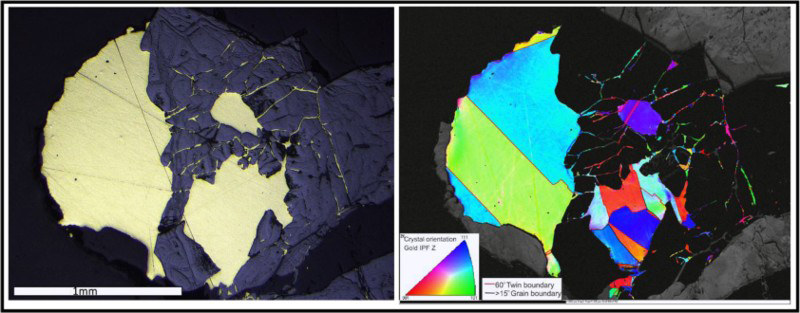
This study is the first to systematically characterise the internal crystallography of gold from a lode and placer source. Future research will integrate data from composition studies (electron microprobe, trace element mapping by LA-ICP-MS) with gold crystallography with a view to further illuminating ore forming processes at specific localities.