







Abstract
The Qianjiadian-Baixingtu uranium deposit (QBUD) is in the post-Jurassic extensional Kailu basin of northeast China. There is a well-developed fault system in and adjacent to the deposit, and uranium mineralisation appears controlled by faults F 1, F 2, and F 3. Lots of diabase (dolerite) intrusions related to regional faults are extensive throughout the QBUD. The ellipsoidal and lenticular mineralised bodies in the QBUD conflict with the interlayered oxidation genesis. Furthermore, heat from the diabase intrusions not only makes the wall rocks hard, but plenty of new cement minerals are precipitated from hot fluid flow (HFF). The clastic grains in the host sandstone are strongly altered by HFF. Carbonate cements involves calcite, ankerite, and Fe-rich dolomite. There are three inclusion temperature peaks: ∼90°C, 110-120°C, and 140-150°C, and three ranges of inclusion salinity: 5.0-10.0 wt-% NaCl equivalent, 10.1-15.0 wt-% NaCl equivalent, and 15.1-20.07 wt-% NaCl equivalent.
Introduction
Sandstone-type uranium deposits (SUDs) that were overprinted and reworked by or formed directly by hot fluid flow (HFF, originates from the deep-seated basin with temperature >75°) processes have been progressively recognised (Fan et al. 2006; Liu et al. 2006; Nie et al. 2010; Abzalov et al. 2015; Zhang et al. 2015). Nie et al. (2010) studied the SUDs in Niger, Africa, and suggested that within the Teguida area, uranium mineralisation in sandstone is caused by HFF, which is significantly different from the pattern of oxidation-related uranium mineralisation. Minerals like calcite, analcite, sericite, hematite, carbonate veins, and copper sulphides coexist with uraninite and coffinite within the ore-bearing layers are formed in response to the action of HFF (Nie et al. 2010). Research results from Liu et al. (2006) indicated that the temperatures of the fluid inclusions range from 140°C to 170°C. Some additional low-temperature hydrothermal minerals, such as pyrite, chalcopyrite, galena, and sphalerite, were formed that were controlled by HFF and are characterised by carbonatisation, silicification, hydromica, and pyritisation. Hence, it has been assumed that fluids occurring in the host sandstone of the Zhiluo Fm in the Dongsheng uranium deposit, Ordos Basin, are mainly inherited from uranium and oxygen-bearing fluids (UOF) on the surface and low-temperature hydrothermal fluids from deep buried strata (Liu et al. 2006). Fan et al. (2006) proposed that the sandstone of the Zhiluo Fm in Dongsheng area records three episodes of paleo-fluid migration events. The first and second episodes are recorded in siliceous cements and are primarily characterised by hydrocarbon inclusions with homogenisation temperatures of 89°C and 124°C, respectively. The third episode recorded in the carbonate cements possesses the characteristic of an aqueous fluid inclusion with a homogeneous temperature of 163°C. The occurrence of multi-phased paleo-fluid events is conducive to migration of uranium-bearing fluids and uranium enrichment. Zhang et al. (2015) demonstrated that vein-mass gypsum, calcite, hydrothermal metal sulphides, sulphates, and recrystallised minerals are ubiquitous across the Tamusu uranium deposit in the Bayinggebi Basin based on outcrops, core observations, and microscopic analysis, indicating uranium mineralisation was also affected by the overprint of HFF processes after the process of oxidation-related uranium mineralisation.
There are two large-scale SUDs in the Kailu Basin. The Qianjiadian uranium deposit (QUD) was discovered within the Kailu Basin in the late 1990s, then the Baixingtu uranium deposit (BUD) was found nearby. Until now, uranium exploration near the Qianjiadian–Baixingtu uranium deposit (QBUD) is still continuing and some new mineralised bodies are still being discovered. However, the genesis of the QBUD is still controversial. Previous research shows that the QUD is a deposit characterised by mineralisation near the redox transitional zone, and UOF seeped into the permeable sandstones of the Yaojia Fm (Late Cretaceous) from the Qianjiadian tectonic window (QTW) (Yu et al. 2006; Chen et al. 2007; Xia et al. 2010). However, this theory is challenged by some pieces of evidence from the latest detailed exploration. We found that some mineralised bodies, with the characteristics of apparent discontinuities, are actually irregular in shape (namely, massive, ellipsoidal, or lenticular), instead of the tabular or roll-front shape. Moreover, a large amount of diabase is identified within the QBUD. It cuts across the host sandstones and even across the mineralised bodies. However, thermal reworking of the host rocks after the formation of diabase beds is usually ignored and previous studies paid no attention to the links between the diabase, faults, and uranium mineralisation. Here, we aim to explore the relationship between uranium mineralisation and HFF based on the comprehensive evidence of the overprint of HFF, particularly observations of hydrothermal alteration and tests of inclusions preformed on the host rocks.
Geological setting
Regional geology
The Kailu Basin is situated in the southwestern part of the Songliao Basin and is composed of five major sub-tectonic units (Xu and Li 1995). According to the regional geological and geophysical data, the faults of the basement, which are distributed extensively in the Kailu Basin, are divided into four groups, i.e. the NE-NNE-, NW-SE-, E-W-, and S-N-trending faults (Figure 1). Most of the faults were formed in early Mesozoic and continued activity during the Jurassic-Cretaceous Yanshan movement (Hu et al. 2005; Ge et al. 2010). The NE-NNE- and NW-trending faults are the main faults of the basinal margins that lie within the study area or bound the depressions formed and evidently controlling the Meso-Cenozoic sedimentation.
Distribution of regional faults and the location of the study area (rectangle).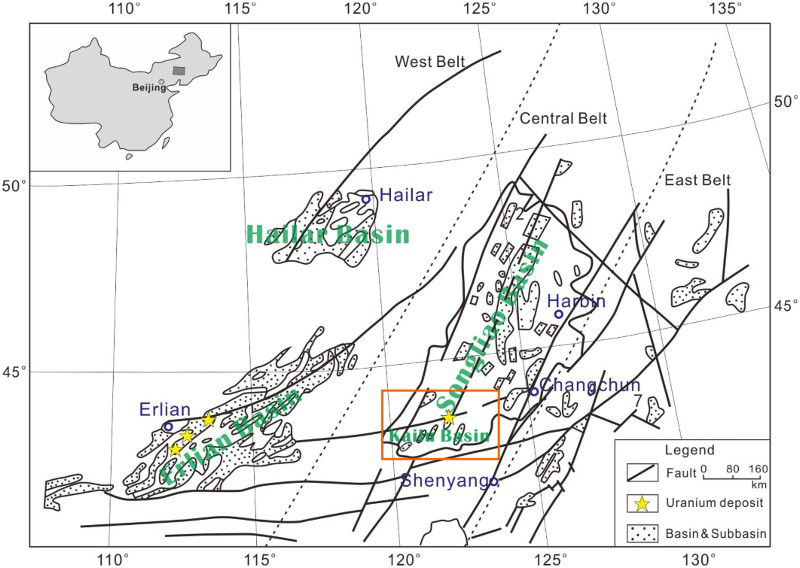
Ore deposit geology
The Qianjiadian Depression lies along the Xilamulun River fault belt in the Kailu Basin (Figure 1). The Xilamulun River fault is a suture zone between the North China Craton and Siberian Craton (Sun et al. 2004; Liu et al. 2008; Han et al. 2009) and was subsequently crosscut by the sinistral Nenjiang-Balihan fault and the central fault of the Songliao Basin (Han et al. 2009). The fault zone spreads throughout the Qianjiadian Depression, and crosses the QUD. In addition, the EW-trending fault activities lasted for a long time, i.e. from the Paleozoic to the Meso-Cenozoic, which was conducive to processes like HFF and energy at depth transporting to the surface via faults. Therefore, the later reworking on the QUD by HFF from the deep-seated sources deserves our attention (Figure 2).
Spatial distribution of diabase beds and faults within the region near the QBUD, the Kailu Basin. 1: Pliocene Taikang Fm; 2: Lower Cretaceous Sifangtai Fm; 3: Lower Cretaceous Nenjiang Fm; 4: Lower Cretaceous Yaojia Fm; 5: diabase; 6: Hercynian granite; 7: Locations and number of reverse faults; 8. Locations and number of normal faults; 9. Locations and number of interpreted normal faults; 10. Locations of assumed faults; 11: Location of profile a–a′ (Figure 4).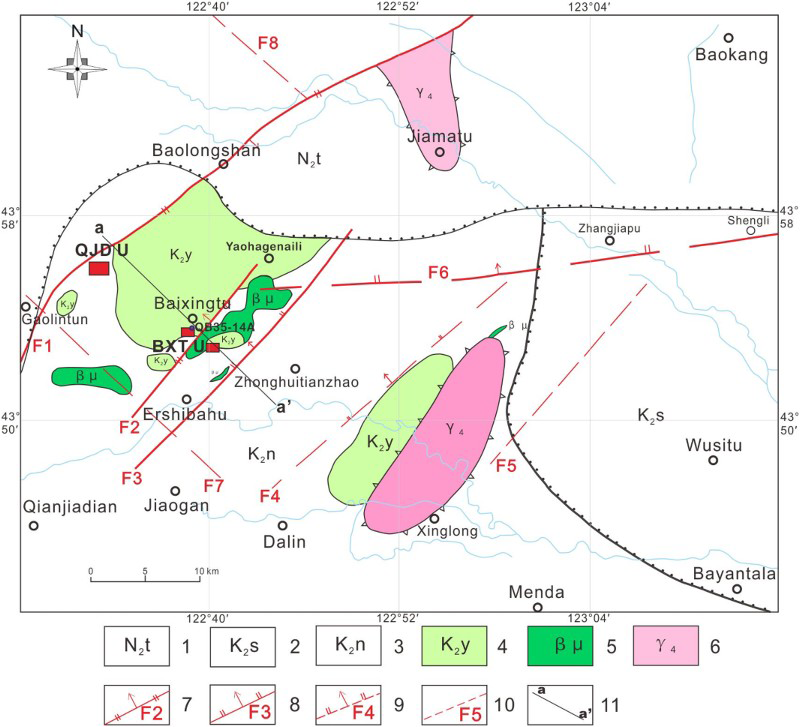
As shown in Figure 2, there are quite a few NE-trending faults (named F1, F2, …, F7, and F8, respectively) near the QBUD. Faults F1, F2, F3, and F7 in or near the deposits, which is likely controlled the distribution of diabase beds and uranium mineralisation. For example, the BUD is sandwiched between faults F2 and F3.
Uranium mineralisation of the QBUD in the Kailu Basin mainly occurs within the sandstone of the Yaojia Fm (Lower Cretaceous). The Yaojia Fm can be divided into two members: the upper Yaojia Fm II and the lower Yaojia Fm I. Uranium mineralisation is mainly hosted in the sediments of Yaojia Fm I, which correspond to the coarse-grained clasts deposited in a braided river environment, and part of the uranium mineralisation occurs in Yaojia Fm II, which is dominated by a meandering fluvial environment. Uranium-bearing sections are characterised by intercalation of mudstone and sandstone (Yin et al. 2000; Chen et al. 2005; Zhang et al. 2005). In general, the uranium-hosting sandstone is medium-coarse to medium-fine-grained with abundant carbonised plant and coaly fragments.
Data and methods
Data
This study encompassed field work and laboratory analyses: (1) Core observation of boreholes is given in detail, and the spatial distribution of the oxidation–reduction zone and typical phenomena (i.e. diabase) were examined for borehole correlation; (2) tests (i.e. electron probe microanalysis (EPMA), Raman spectroscopy (RAM)) of petrographic composition and mineralogy were performed, including sandstone petrology and alteration mineralogy, on 39 samples selected from the BUD in the Kailu basin to constrain the relationship between types of sandstone and uranium mineralisation; and (3) tests of fluid inclusion were carried out, including microscopic observation, fluid inclusion microthermometry, and salinity.
Methods
In this study, the EPMA was completed in the Key Laboratory of Nuclear Resources and Environment of Ministry of Education, East China University of Technology using: (1) a JXA-8100 electronic microprobe; (2) IncaEnery energy dispersal spectroscopy; (3) an acceleration voltage: 15.0 kV; and (4) a probe diameter with 1 μm beam probes and a current of 2.00 × 10⁻⁸ A. First, rough qualitative analyses were done using IncaEnery energy dispersal spectroscopy and then quantitative analyses were carried out on several uranium minerals selected from uranium-bearing ores by means of the observation and analysis of the mineral grains shown in the electron backscattering micrographs.
Experiments on the inclusion temperatures and RAM were also done as part of this study. Before the tests, we soaked the slices in absolute ethyl alcohol or acetone for 2–3 days. It was not until the particles were completely detached that the experiments began. The temperature and salinity determination experiments were performed at the Key Laboratory of Nuclear Resources and Environment of Ministry of Education, East China University of Technology using a Leica optical microscope combined with a Linkam THMSG600 heating-freezing stage.
Results
Petrographic features of borehole QB29-1
A detailed petrographic study of the uranium-bearing interval of borehole QB29-1 in the BUD is shown in Figure 3. The upper interval of the Yaojia Fm II at the depth of 174.5–192.0 m is of brick-red or purple mudstone with a sand/mud ratio nearly 1:1. The lower interval of the Yaojia Fm II at the depth of 192.0–217.3 m is organised as multi-cyclic fluvial sediments with a sand/mud ratio of 1:1. Each depositional cycle consists of grey medium- to fine-grained sands and purple mudstone, while depositional microfacies change from point bar to floodplain. There is more siltstone with ripple crossbedding and fine-grained sandstone in the upper cycles. The levees and crevasse spray are well developed locally. Core at the depth of 217.3–271.5 m is the upper interval of the Yaojia Fm I. It consists of five depositional cycles, dominated by sandy sediments. Each depositional cycle is composed of coarse-grained sand with muddy gravel, and medium-coarse- to fine-grained sands.
Interpretation of borehole QB29-1 in the BUD, the Kailu Basin. S: sandstone; M: mudstone; SS: siltstone; MS: muddy sandstone; FU: fining upward.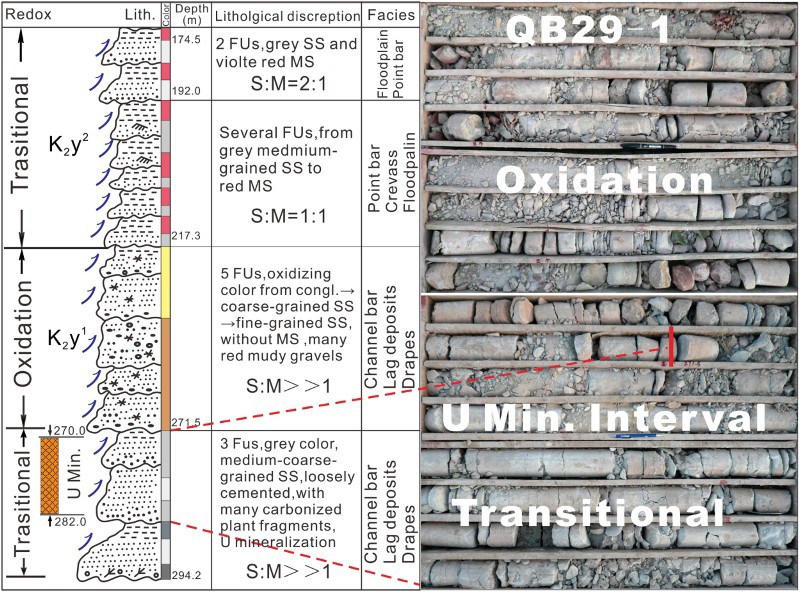
Core at the depth of 271.5–294.2 m is the lower interval of the Yaojia Fm I, consisting of medium-coarse to medium-fine-grained sandstone and grey to grey-white massive mudstone. It can be divided into three depositional cycles. Uranium mineralisation is hosted within the second and third depositional cycles at the depth of 270.0–282.0 m. Ore-bearing sandstones are grey-green pebbly medium-coarse-grained with plenty of carbonised plant fragments. Core at the depth of 174.5–217.3 m is the upper interval of the Yaojia Fm I deposited in a meandering fluvial environment. The upper interval of the Yaojia Fm I at the depth of 217.3–271.5 m was deposited from channel bar, lag, and drape microfacies of a braided river environment, which is characterised by less mud, coarse-grained, and permeable. The primary grey sandstone of the Yaojia Fm I has entirely changed into yellow and yellowish brown due to the subsequent interlayered oxidation. Core at the depth of 271.5–294.2 m is the transitional zone. Both sandstone and mudstone are grey to dark grey before oxidation.
Spatial relationship between uranium mineralisation and faults and diabase
Spatial relationship between uranium mineralisation and faults
As shown in Figure 4, the Yaojia Fm host rock rests unconformably on the Yixian Fm (Late Cretaceous). The Yaojia Fm I is composed of thick sand bodies and thin mudstone. Of these, a single sand body is up to 30–50 m thick. In addition, sand bodies are usually interbedded with thin red/grey mudstone (normally about 1–3 m thick and 5 m in one individual case).
Relationship of uranium mineralisation of profile a–a′ and sedimentary facies, faults in Qianjiadian–Baixingtu area. Location of the profile is shown in Figure 2.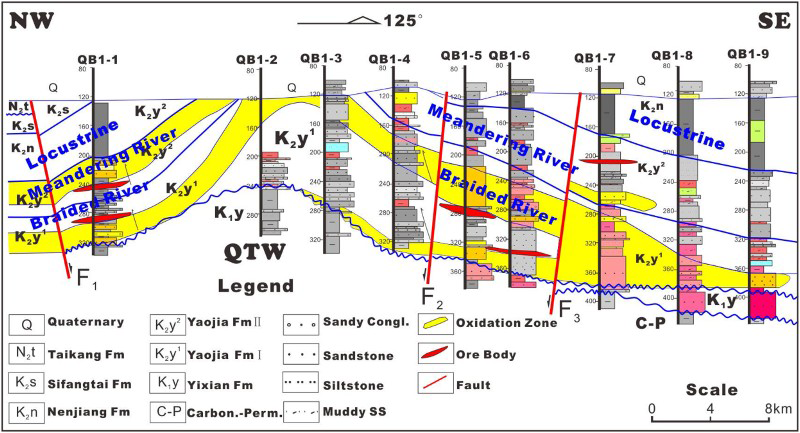
Sand bodies were oxidised and red in colour in boreholes QB1-7 and QB1-8 (Figure 4). However, in boreholes QB1-5 and QB1-6, the oxidised sand bodies are red/yellow; some un-oxidised ones remain grey. Sand bodies in the Yaojia Fm I in boreholes QB1-2, QB1-3, and QB1-4 are nearly grey and grey-white, and only a few mudstones remain red. Sand bodies in all boreholes near the NW side of QTW are partially oxidised and red in colour. In Figure 4, Fault F1 is at the NW side of borehole QB1-1, and faults F2 and F3 are located between boreholes QB1-4 and QB1-5, and QB1-6 and QB1-7, respectively. All these faults have been confirmed by both geological (buried depth variations of strata) and geophysical (seismic and electric prospecting) data. Two mineralised bodies within Yaojia Fm I at the NW side of QTW were confirmed by borehole QB1-1 near Fault F1. Likewise, boreholes QB1-5 and QB1-6 at the SE side of QTW between faults F2 and F3 also intersect two mineralised bodies. All uranium mineralised bodies hosted in Yaojia Fm I occur within the reduced sandstone (grey), which seems to be ‘suspended’ within the oxidation zone. This phenomenon is very common in the QBUD. Furthermore, the mineralised body intersected by borehole QB1-7 within Yaojia Fm I is also near Fault F3. Thus, the profile reveals that uranium mineralised bodies appear to be spatially related to faults (Figure 4).
Spatial relationship between uranium mineralisation and diabase
In previous uranium geological exploration in the Kailu Basin, the relationship between uranium mineralisation and diabase has often been ignored. However, approximately 70–80% of the drilled holes intersected the diabase beds in the QBUD during the exploration. Some diabase veins penetrate the host sandstone. Diabase is usually sandwiched between faults, and appears to be controlled by the faults. As shown in Figure 2, there are two large areas of diabase distributed within the study area. One lies on the southeast of the BUD and covers almost the whole area of the deposit. Diabase veins cut across strata obliquely or vertically, and some also occur along stratigraphic interfaces at different depths of a borehole. The other large area of diabase is located to the south of the QUD, and the southeast of the Gaolintun area is sandwiched between faults F1 and F2 and is likely to be influenced by the NW-trending Fault F1.
Figure 5 shows the stratigraphic column of borehole QB35-14A. There are five beds of diabase with different thicknesses between depths of 80 and 400 m, including one bed (Diabase I) in K2y1, three beds (Diabase II, III, and IV) in K2y2 and one bed (Diabase V) in the Nenjiang Fm. Sandstones in both the Yaojia Fm I and II near the diabase display high gamma logging values, e.g. mineralisation anomalies in the sandstone on top of the diabase at the depth of 203 m, weak anomalies in the fine sandstone on top of the diabase at the depth of 220 m, weak anomalies near the diabase at the depth of 295 m, and the main ore-bearing interval under the diabase at the depth of 330 m.
Spatial relationship between uranium mineralisation and diabase of Core QB35-14A in the QBUD.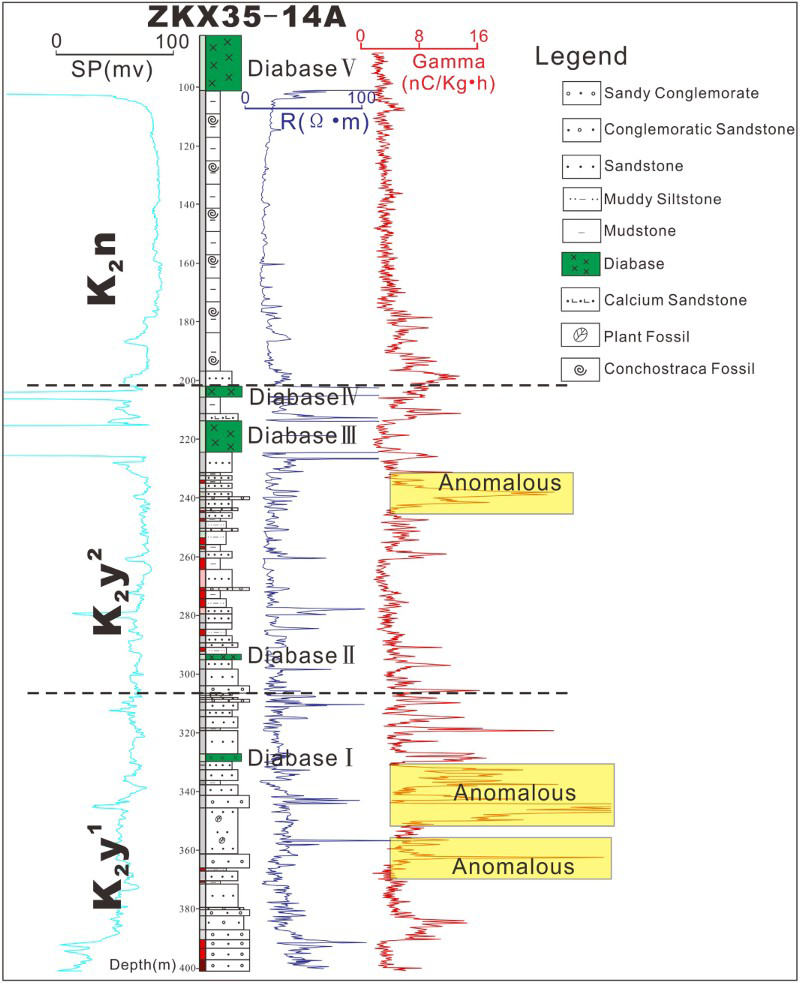
A variety of alterations due to the diabase intrusion are identified in many boreholes. According to petrographic observations of borehole QB41-6 at the depth of 213–214 m, fine-grained sandstone and muddy pebble conglomerate at the contact of diabase were strongly influenced by the heat of the diabase magma. Red mud-pebble conglomerates formed in a channel sedimentary environment of the Yaojia Fm are black or dark grey, rather than red (Figure 6(a)). In addition, some loose and brick-red mudstone in contact with the diabase was heated and baked into harder dark-red mudstone (Figure 6(b)). The dark-grey shale of the Nenjiang Fm at the depth of 139.03–139.13 m, near the contact of dark diabase, faded into a white colour and soft rocks were altered to become harder and tougher (Figure 6(c)). Large numbers of carbonate veins were observed within the mudstone near the diabase, such as the occurrence at the depth of 143.81 m in borehole QB33-2 (Figure 6(d)).
Rock alterations affected by the diabase intrusion. (A) Fine sandstone and dark mud-pebble conglomerate at the contact interfaces of diabase influenced by heat, QB41-6, 213–214 m; (B) baked dark-purple thin mud bed in sandstone and mudstone, well consolidation, hard, QB25-4, 261.25–263.2 m; (C) diabase and grey-white shale, QB25-14, 139.03–139.13 m; (D) plenty of carbonate veins cutting through mudstone, QB33-2, 143.81 m.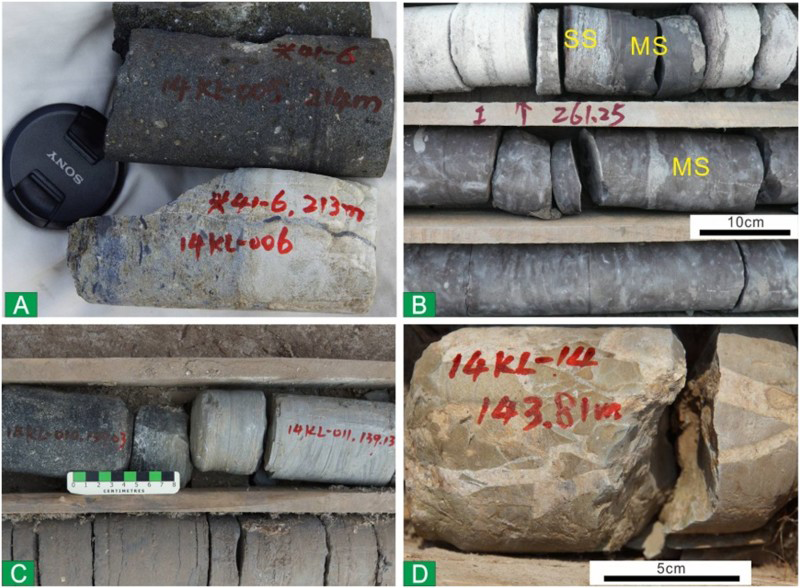
Alteration petrology and mineralogy
Sandstone petrology
We observed all the host sandstone samples and obtained volume percentages for three kinds of clastic grains for each sample: quartz, feldspar, and lithic fragments. The results of microscopic identification are as follows. The content of quartz (Q) is relatively low, largely ranging from 30% to 50%, some even from 10% to 20%, and very few with 60%. The quartz alteration is obvious in some samples, showing nibble- and harbour-like mineral edges, and partially was replaced by other minerals. Feldspar (F) is mainly composed of acid plagioclase and microcline. The content of feldspar ranges from 10% to 20% and only a few of feldspar is less than 10%. The majority of samples are medium-grained sandstones (0.08–1 mm), some medium-coarse-grained sandstones (>1.5 mm). There are few gravels, ranging from 2.5 to 4.8 mm. Feldspar is usually altered into sericite and kaolinite, but retaining the crystal shape. The host sandstone of the Yaojia Fm is characterised by a high content of lithic fragments (R), ranging from 40% to 60%, with an average of 49%. Volcanic fragments rank first in content, from 57% to 75%, followed by the metamorphic clasts ranging from 15% to 30%, and granite about 5–15% or less. The sandstone is moderately sorted and sub-angular to sub-rounded. Matrix contents normally range from 8% to 13%; only two samples exceed 15%. We put the percentage of each sample into the following ternary chart (Figure 7). As shown in Figure 7, most samples are lithic sandstone and some are feldsparthic lithic sandstone. Only one sample is lithic arkose.
Types of U-bearing sandstone from the BUD in the Kailu basin.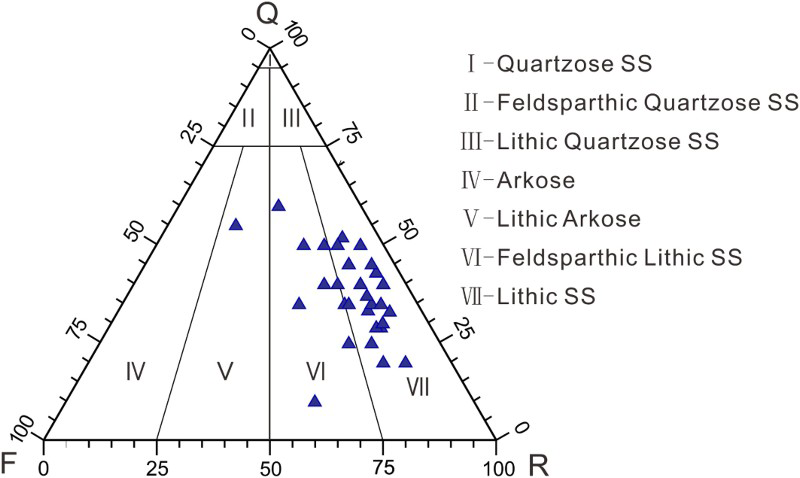
Alteration mineralogy
Parts of the feldspar and quartz grains were replaced by calcite. In addition, where calcite veins occur, sericite replaces clay minerals in the sandstone. As can be seen from Figure 8(a), feldspar and quartz are replaced. The pores of the sandstone are filled with euhedral carbonate minerals and vermicular kaolinite. The edges of the quartz grains are dissolved, feldspar is replaced by carbonate minerals, and kaolinite is surrounded by rhombohedral dolomite. The sample from borehole QianIV-24-25 (435 m deep) in the QUD shows that ankerite, replacing feldspar and quartz (or highly ferrous dolomite, Figure 8(b)) is euhedral with slight internal rings. Carbonate cements with brown-yellow colour indicate high iron content in the minerals. In Figure 8(c), clasts in the sandstone are often replaced by carbonate minerals, such as quartz replaced gradually by carbonate from the edge and centre. Other grains like feldspars are also replaced by carbonate. So, carbonate minerals usually fill the pores of sandstone. The mudstone sample (Figure 8(d)) from the Yaojia Fm was also influenced by HFFs. Mottled hematite and limonite are scattered within the mudstone (Figure 8(d)). Clay minerals in the mudstone have turned into sericite. The carbonate veins cut through the sericitised mudstone (Figure 6(d)).
(A) Carbonate (Cbn) cements in grey medium sandstone (+), QB13-12B, 302.9 m; (B) siderite mineral particles in grey-white medium sandstone with charcoal debris (+), QIV-24-25, 435 m; (C) carbonate cements replacing quartz in grey medium-fine sandstone (+), QB 41-6, 213 m; (D) vein carbonate cements and scaly sericite (+), QB 35-4, 263.75 m.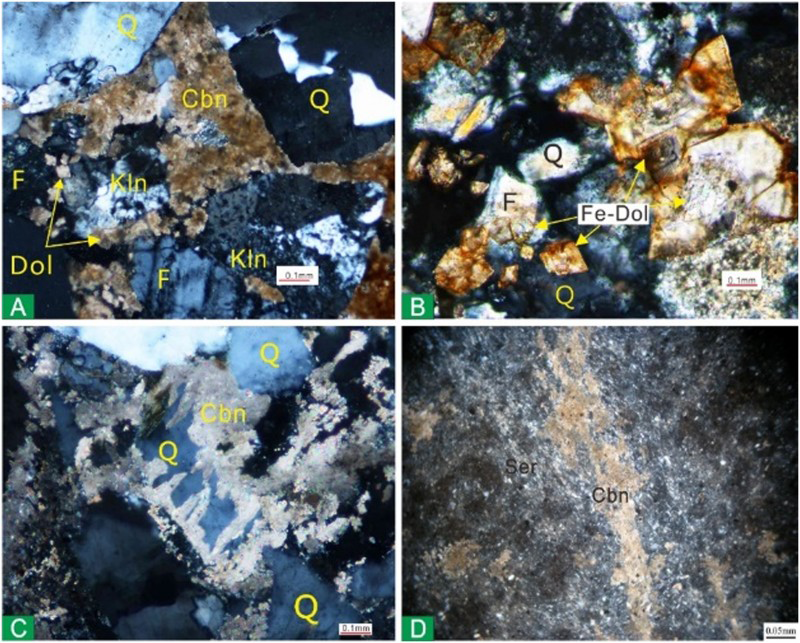
As mentioned above, carbonate cements are ubiquitous within the host sandstone of the Yaojia Fm. In order to establish the relationship between carbonate minerals and uranium minerals, we analysed them with an electron microprobe (EMP). As shown in Figure 9(a), calcite fills the pores among K-feldspar, quartz, and lithic grains. Coffinite (bright white) is associated with pyrite (grey-white) and calcite in the sandstone pores. In Figure 9(b), uraninite along with strawberry pyrite is in the pores. Calcite later finally fills all the pores in the sandstone. In Figure 9(c), some K-feldspar and quartz grains are obviously dissolved. Coffinite is dispersed along the edges of the clasts. In addition, dolomite later fills the interstices of the clasts.
Backscattered electron images-uranium minerals and carbonate minerals. (A) Calcite (Cal) replacing clastic particles and filling the pores, intergrowth of pyrite (Py) and coffinite (Cof) filling the pores of feldspar and particles; (B) calcite (Cal), uraninite (Ur) and pyrite (Py) together filling the pores of particles; (C) dolomite (Dol) and coffinite (Cof) together replacing feldspar and quartz, and filling the pores of particles; (D) ankerite (Ank) and coffinite (Cof) replacing feldspar and quartz, and filling the pores.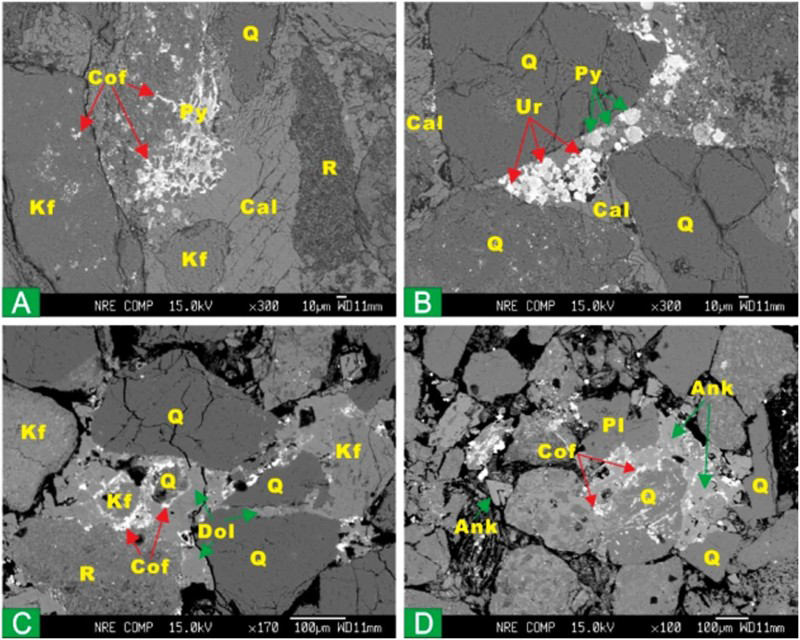
We quantitatively analysed the composition of carbonate minerals by EMP. The results from the carbonate cements show that, within calcite, the CaO content ranges from 53.99 to 66.08 wt-%, with an average of 57.59 wt-%; whereas the content of MgO exhibits a range from 0.13 to 0.36 wt-%, with an average of 0.22 wt-%. The content of FeO ranges from 1.05 to 1.83 wt-%, with an average of 1.43 wt-%, and the MnO content is in the range of 1.13–4.06 wt-%, with an average of 2.03 wt-%. In the ankerite cements, the CaO content ranges from 27.67 to 29.64 wt-%, with an average of 28.41 wt-%; the content of MgO is from 10.56 to 13.7 wt-%, with an average of 11.8 wt-%; the content of FeO ranges from 10.57 to 14.5 wt-%, with an average of 12.16 wt-%; and the MnO content is from 0.34 to 1.97 wt-%, with an average of 0.88 wt-%. In highly ferrous dolomite, the CaO content ranges from 2.94 to 5.87 wt-%, with an average of 4.59 wt-%; the content of MgO is from 3.93 to 11.69 wt-%, with an average of 8.49 wt-%; the content of FeO ranges from 35.46 to 41.87 wt-%, with an average of 37.25 wt-%; and the MnO content is from 0.33 to 0.96 wt-%, with an average of 0.65 wt-%.
As shown in Figure 10, the calcite zone (zone I), is mainly composed of Cao, the first phase of carbonate cements. The ankerite zone (zone II), contains a higher content of FeO (besides CaO and MgO) and is regarded as the second phase of carbonate cements. It occurs later than calcite and is associated with HFFs. Zone III is divided into two sub-zones (namely III1 and III2). Both of them pertain to highly ferrous dolomite with a certain amount of CaO and MgO. Based on observations of thin sections and BSE images, Nie et al. (2009) proposed that highly ferrous dolomite should be formed latest, which is associated with the later activities of the iron-bearing HFFs.
Chemistry of carbonates within sandstone of the ore-bearing layer in the Baixingtu area, the Kailu Basin.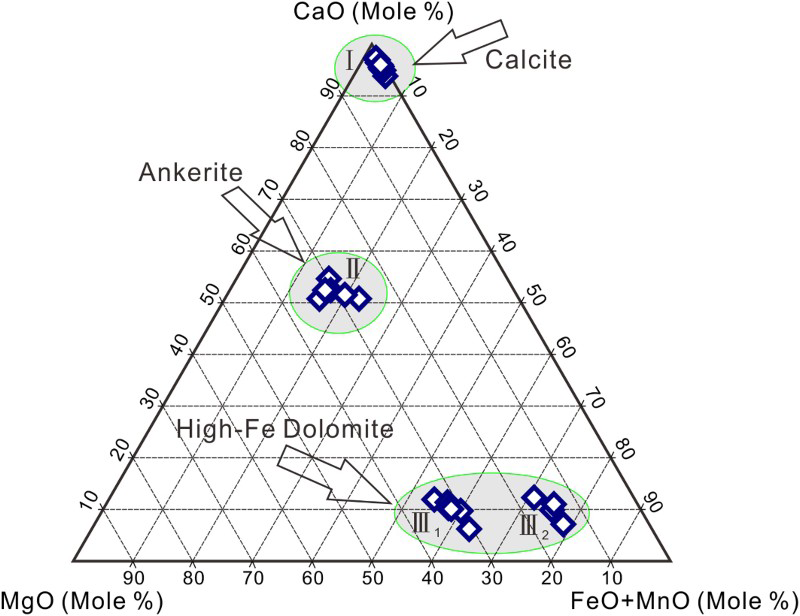
Inclusion thermometry and composition
The microscopic observations indicate that fluid inclusions are mainly hosted in quartz overgrowths and carbonate cements in the sandstone of the lower member of the Yaojia Fm. Samples, as shown in Figure 11(a, b, and e), are selected from borehole QB33-8 at 327.8 m depth. Figure 11(a) shows that the host sandstone with carbonate cements is grey-white medium-fine-grained. In addition, inclusions hosted in the carbonate cements are linear or randomly oriented. In the host sandstone, some inclusions are oval- and round-shaped within the carbonate cements (Figure 11(b)). As shown in Figure 11(e), liquid-rich inclusions are disseminated in the quartz overgrowths in the sandstone. In Figure 11(c), some round-shaped and liquid-rich inclusions are identified in carbonate cements hosted in grey medium sandstone. In Figure 11(f), several vein inclusion systems are dispersed within the sandstone in the cracks in the quartz. A sample selected from borehole QIV56-45 at 390.7 m depth is shown in Figure 11(d). The oval-shaped fluid inclusions are dispersed within the calcite in the sandstone.
(A) Linear and irregular-shaped inclusions in carbonate cements, QB33-8, 327.8 m; (B) oval- and round-shaped fluid inclusions in carbonate cements, QB33-8, 327.8 m; (C) Round-shaped and liquid-rich inclusions in carbonate cements, QB29b-4, 349.5 m; (D) Oval-shaped fluid inclusions in calcite, QianIV56-45, 390.7 m; (E) liquid-rich inclusions in quartz overgrowths, QB33-8, 327.8 m; (F) vein inclusion system along the healed cracks of quartz in sandstone QB29b-4, 349.5 m.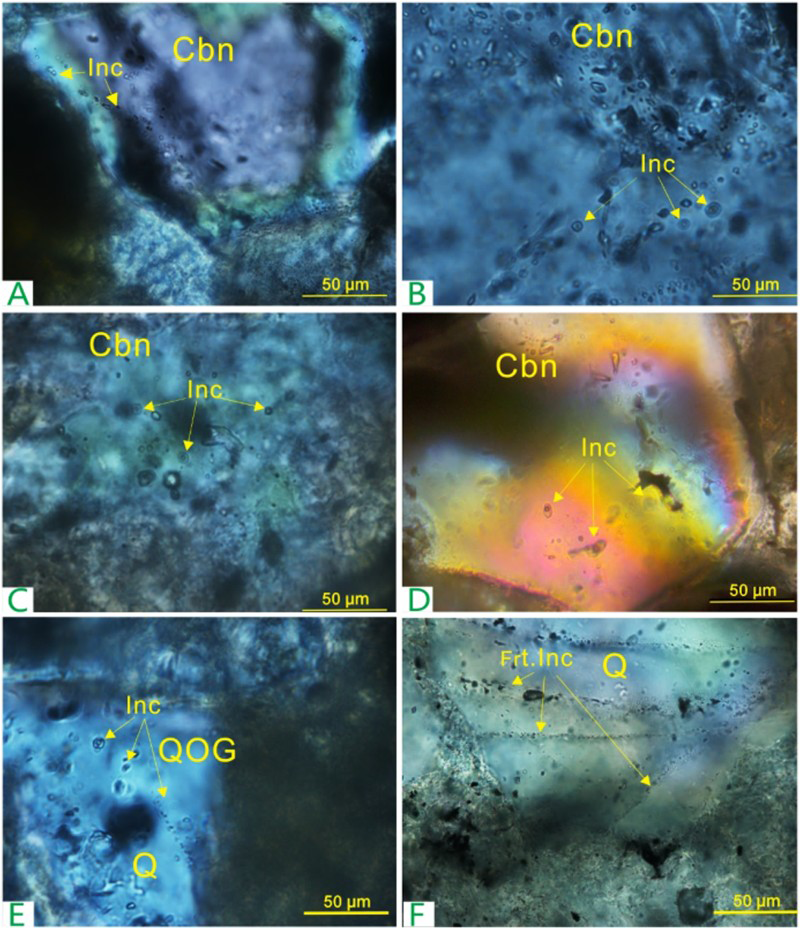
The fluid inclusion homogenisation temperatures (FIHT) are measured from the ore-bearing sandstone of the BUD in the Kailu Basin. FIHT of carbonate cements and quartz overgrowths range from 67.4°C to 178.8°C, with a mean of 118.7°C. There are three peaks of FIHT associated with SUDs reworked by HFFs in the Kailu Basin: 80–90°C, 110–120°C, and 140–150°C (Figure 12).
Histogram of homogenisation temperatures for carbonate cements and fluid inclusions of quartz overgrowth analysed.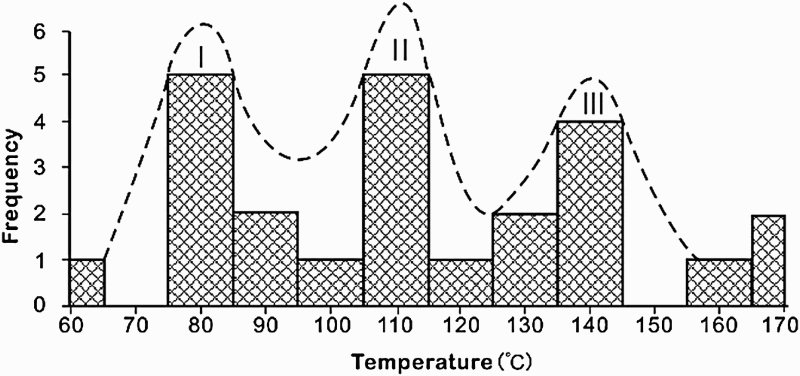
In the study, we compared the temperature data with phase diagrams of the NaCl–H2O solution tests so that the fluid systems and components were determined. Based upon the theory of a positive correlation between the natural crystalisation depression and the solute mole fraction, we calculated the salinity of low NaCl–H2O inclusions. The calculation equation is as follows:

where W is the weight per cent and Tm is the crystalisation temperature (Hall et al. 1988). The calculation shows that the values of inclusions from the ore-hosted sandstone in the Kailu Basin are extremely high, up to 20.07 wt-%, equivalent to the mass percentage of NaCl. The salinity of metallogenic fluids range from 5.86 to 20.07 wt-%, with a mean of 12.58 wt-%. The metallogenic fluid salinity of inclusions from carbonate cements is also very high, ranging from 14.87 to 20.07 wt-%, with an average of 16.66 wt-%. However, the salinity of metallogenic fluids hosted in quartz overgrowths ranges from 5.86 to 15.95 wt-%, with a mean of 9.81 wt-%.
As shown in Figure 13, the salinity of fluid inclusions of HFFs from the SUD in the Kailu Basin can be divided roughly into three ranges, i.e. low salinity range (5.0–10.0 wt-% NaCl equivalent), moderate salinity range (10.1–15.0 wt-% NaCl equivalent), and high salinity range (15.1–20.07 wt-% NaCl equivalent).
Frequency histogram of salinity for fluid inclusions in ore-bearing sandstone analysed.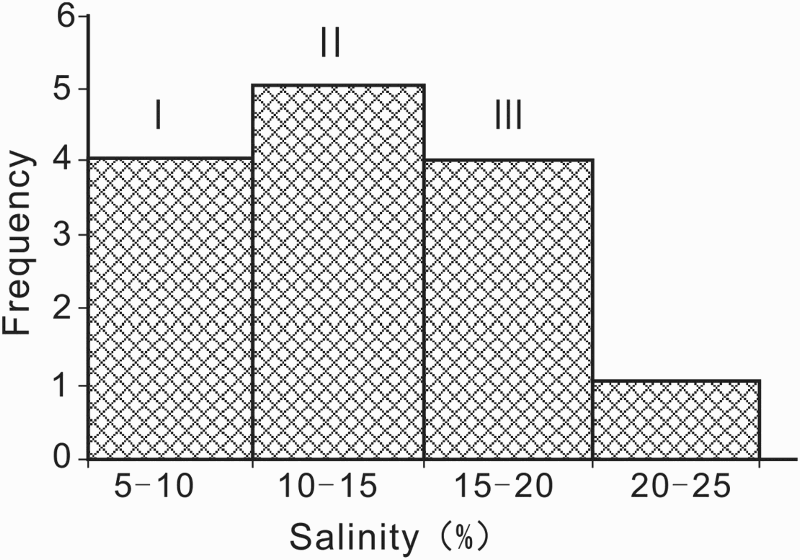
Discussion
Based on the borehole correlation (Figure 4), we found that the nearer the QTW, the weaker the oxidation for both the Yaojia Fms I and II. In addition, new geological exploration data indicate that mineralised bodies are mostly of massive, ellipsoidal, or lenticular in shape and are ‘suspended’ within the oxidation zone. They are completely different from those investigated in previous studies (Luo et al. 2007; Yu et al. 2008; Xia et al. 2010; Abzalov 2012; Abzalov and Paulson 2012; Penney 2012; Feng et al. 2017).
As described above, fluvial sandstone is the host rock of QBUD in the Kailu Basin. The host sandstone underwent diagenesis, oxidation, and subsequent hydrothermal alteration. As a result, cements and new minerals in sandstone were formed. However, due to HFF activities caused by mafic magmatism, the mudstone in the Yaojia Fm became harder and more compact. In addition, the colour of the mudstone faded or changed from red to dark-purple and a number of replacement minerals are preserved within the sandstone.
To understand the nature of HFFs within the Kailu Basin, C, O, and S isotopes of pyrite and carbonate cements in host sandstone were analysed (Luo et al. 2012). The results exhibit that the isotope ratios of ore and non-mineralised rocks, such as carbon isotopic values of δ13CPDB, are generally less than −20‰, indicating that there are two sources involved in uranium mineralisation (i.e. UOF from the surface and HFFs from the deep area, Luo et al. 2012). Likewise, within this study, the inclusion temperatures indicate that the sandstone cements of the host rocks of the SUD within the Kailu Basin have a mean temperature of 118.7°C, which indicates that mineralisation of the uranium deposit in the Kailu Basin was worked by low-temperature HFF. In contrast, if the mineralisation were from epigenetic UOF, the inclusion temperature should be much lower (Fan et al. 2006). Hence, we conclude that uranium mineralisation in the Kailu Basin was reworked by subsequent HFFs. These HFFs are derived from hydrothermal systems deeply seated in the basin, and/or related to diabase beds widely distributed within the study area (Figure 12). Furthermore, based on the separation of the salinity and temperature into three ranges, we propose that the SUD in the Kailu Basin was reworked by at least three kinds of HFFs.
The diabase beds are well developed within the Kailu Basin and penetrate into the host rocks. The geochronology of the diabase beds was studied by Luo et al. (2007), Ma et al. (2009), and Xia et al. (2010). Ma et al. (2009) proposed that the intrusion age of the diabase is about 51 Ma and Xia et al. (2010) concluded that its age is 49.4 ± 4 Ma. The isochron age of U–Pb of uranium minerals in the grey fine sandstone of the Yaojia Fm II by Luo et al. (2007) is 40 ± 3 Ma. The time corresponds to the Eocene epoch after the Nenjiang movement. Thus, both the interlayered oxidation or reworking by HFFs after the Nenjiang movement might cause uranium mineralisation. Xia et al. (2010) suggested that the isochron ages of U–Pb of uranium mineral are 53 ± 3 and 41 ± 4 Ma. As for the spatial distribution of faults, diabase, and mineralised bodies of the QBUD, they are closely related to each other. Therefore, within this study, we conclude that the uranium mineralisation was involved with the faults and HFFs associated with the diabase.
Conclusions
The QBUD in the Kailu Basin is a typical uranium deposit occurring within the rift basin of East China. It is distinctly different from the typical SUDs in western China, though the QBUD is hosted in the fluvial strata formed in the post-rift depression stage within the extensional rifted basin. The QBUD experienced two stages: (a) uranium enrichment in the redox transitional zone after the formation of the host rocks and (b) subsequent reworking as the overprint of HFF processes. We showed that the uranium mineralisation is closely related with faults and diabase in space and time. The QBUD is apparently controlled by faults F1, F2, and F3. In addition, uranium mineralisation correlated with the faults is associated with diabase. Thermal effects from the diabase turned wall rocks dark and harder. What is more, we note that the new cements were formed within the sandstone and mudstone due to HFFs inherited from the diabase magmatism. Because of HFFs, clasts within the host sandstone of the Yaojia Fm were partially replaced and dissolved. The appearance of a large number of carbonate minerals provides favourable conditions for the study of HFFs, such as carbonate veins, carbonate cements, and altered quartz identified from both macro and micro aspects. We further divide the carbonate minerals into three stages by the EMP results: first calcite, second ankerite, and third highly ferrous dolomite. Analytical results of the inclusion temperature and inclusion salinity of the carbonate cements and quartz overgrowths involved in uranium mineralisation indicate that there are three peaks of the homogeneous temperature of fluid inclusions associated with SUD reworked by HFFs in the Kailu Basin: 80–90°C, 110–120°C, and 140–150°C, and three ranges of salinity of fluid inclusions: 5.0–10.0 wt-% NaCl equivalent, 10.1–15.0 wt-% NaCl equivalent, and 15.1–20.07 wt-% NaCl equivalent.
Footnotes
Acknowledgements
We sincerely appreciate the great support and assistance provided by the Geological team No. 243 of CNNC in Chifeng, Inner Mongolia, and the Key Laboratory of Nuclear Resources and Environment of Ministry of Education, East China University of Technology, Nanchang, Jiangxi. Professor David Nobes from East China University of Technology helped to improve the English grammar and style.
Disclosure statement
No potential conflict of interest was reported by the authors.