







Abstract
Environmental considerations of steel manufacturing involve addressing the various aspects of steel production and utilization, namely sustainability based on life cycle assessments (LCAs). The Swedish steel makers took the pioneering national initiative towards a more holistic view on steel production and use. The initiative was funded by the Swedish Foundation for Strategic Environmental Research and co-funded by Swedish steel industries. The programme, named the ‘Steel Eco-cycle’, had the vision closing the loop in the manufacture and use of steel in society. The programme had a multi-disciplinary approach, built around a network of projects with researchers from universities and institutes, environmental specialists and industry sectors participating. The programme envisaged a total optimization of the steel eco-cycle from development of newer steel grades to utilization of steel scrap, thereby retaining the metal values in alloy steels, minimizing losses and recovering valuable metals from slag and dust. Another important objective of the programme was to upscale the process ideas, make industrial tests and eventually implement them in industry. A number of processes developed under this programme are currently being commercialized. The paper will present the steel eco-cycle programme concept and development for a number of innovations.
Introduction-metals and sustainability
During the past two decades, production of materials around the world has shown a very rapid increase, as shown in Figure 1. This, in turn, is reflected in sustainability issues as the demands for materials and energy are increasing rapidly, especially in the developing economies of BRIC countries.
Production of materials in Mt (left axis) and use of energy in EJ (right axis) for different regions for the years 1981 and 2005 (International Energy Agency (IEA)).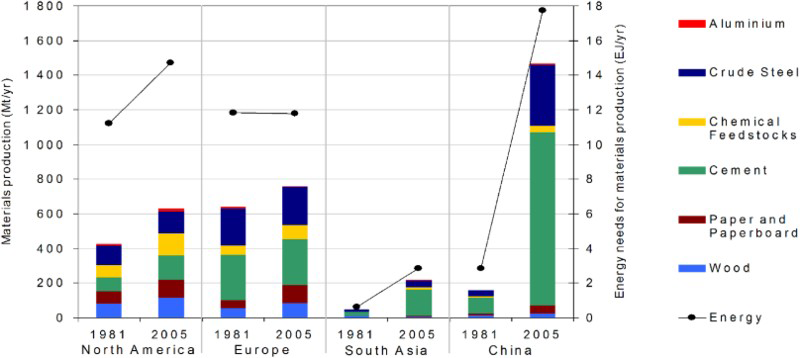
Among the metals produced in the world, steel occupies a very dominant position. The annual production of steel is 15 times more than the production of all the other metals put together as illustrated in Figure 2.
Annual production of some common metals in year 2010. (Worldsteel Association, PlasticsEurope AISBL, Gesamtverband der deutschen Aluminiumindustrie (GDA), United States Geological Survey (USGS), British Geological Survey (BGS)).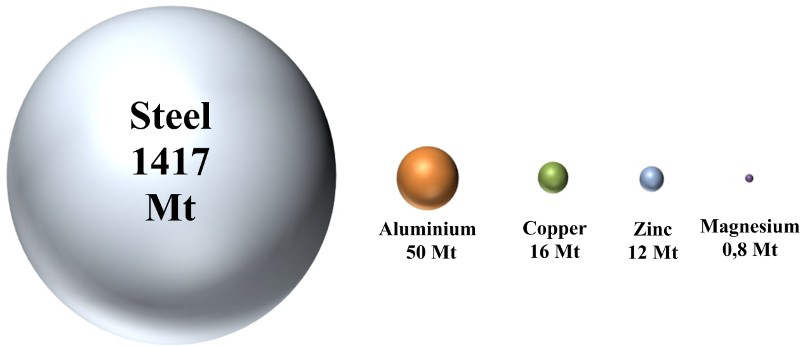
The use of steel in a particular society is strongly related to the society's economic development. Thus the demand for infrastructure improvement and, consequently, the demand for steel to construct buildings, bridges and automobiles in a given country increases rapidly when the GDP per capita surpasses $ 5, 000 (Spokesperson Göran Andersson). The increase typically reduces when the GDP per capita reaches $ 15, 000 (Spokesperson Göran Andersson). With the progress of this phenomenon, a steady state is reached, as in the case of developed countries where the in-use steel stock per capita is nearly constant and the demand for new steel actually tends to decrease. Within the European Union, the steel demand per capita has decreased from 337 kg in 2001 to 304 kg in 2015 (Spokesperson Göran Andersson).
In order to proceed towards a sustainable steel industry, it is crucial that the environmental issues are treated scientifically and that a life-cycle approach is adopted which encompasses the industry as well as society as a whole. This was the important driving force for the steel eco-cycle programme.
Spear-headed by the Swedish Steel Producers Association, the programme was conducted over a period of 8 years (2004–2012) with financial support from The Swedish Foundation for Strategic Environmental Research (MISTRA) amounting to ca. 10M
The programme had a clear focus on minimizing the impact of steel on the natural eco-system including CO2 reduction, decreased energy use and increased recycling and waste minimization. In essence, it aimed at ‘closing the loop’ as illustrated in Figure 3.
The steel eco-cycle concept – a schematic illustration.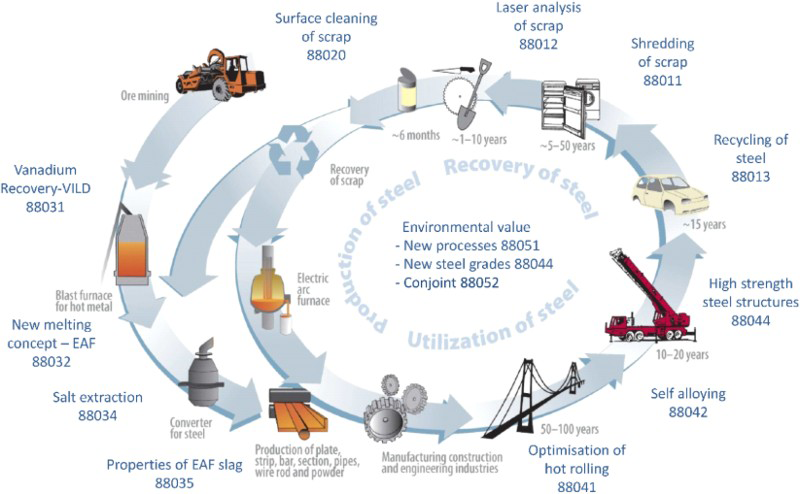
It can be inferred that the programme envisaged a total examination of the entire steel eco-cycle from raw materials through steel production and use to recycling and socio-economic aspects. The programme comprised projects dealing with improving raw materials quality, minimizing value losses, improving product quality and producing eco-friendly residual products. Knowledge transfer and technology implementation were other essential ingredients of the programme.
The programme was jointly carried out under the leadership of Swedish Steel Producers Association (‘Jernkontoret)’, with three Swedish universities, five national research institutes and 27 Swedish industries participating in the programme. The programme was broadly divided into four major areas with sub-projects, namely steel recovery, steel production, steel applications and life cycle assessment (LCA). The individual projects are further presented in the following sections.
The recycling process is not without its challenges. Products are often very complex, formed of a combination of several materials which complicates the recycling process. An attractive raw material produced in a recycling plant should be relatively homogenous and not too complex in nature. The elemental content of the material should be well-specified and the supply of the material should be in suitable quantities and associated with functioning logistic systems. The steel eco-cycle programme included an extensive survey of the past, present and future scrap flows in our society; an important tool for decision makers within the industry when it comes to adopting future techniques for scrap-based production. It is also a valuable tool for making prognoses of future scrap prices and supplies. The individual programme components are summarized below and more information is available in the corresponding scientific reports (Ponzio).
On-line classification of steel scrap using intelligent evaluation from a CCD-spectrometer equipped LIBS (88012)
A laser-based technique and prototype instrument was developed for fast on-line analysis of steel scrap. The technique enables the recycling industry to further specify what kind of material they are supplying. A more well-specified material, in turn, is of higher value as it enables a better use of the material in the steel production process. The prototype has been evaluated and tested in laboratory as well as in industrial settings, and commercial partners have shown interest in marketing the product (Gurella et al. 2012).
Recycling of steel in society (88013)
A model to illustrate the iron and steel flows in Swedish society and a new method to evaluate the alloy content in steel scrap deliveries have been developed. Furthermore, a model for steel scrap usage optimization from the viewpoint of economy, energy and carbon footprint, named RAWMATMIX, has been developed. Within the project, a method for random sampling analysis of different steel scrap piles has been evaluated to decrease the number of costly test melts for certain steel scrap classes (Gyllenram et al. 2011).
Surface cleaning of steel scrap (88020)
A method has been developed for simultaneous preheating and surface cleaning of steel scrap by making use of chlorine rich plastic waste. The concept has been developed through both small-scale experiments and large-scale pilot trials. Test results have indicated successful removal of zinc and organic compounds from the scrap without significant losses of metal, but further process optimization is needed (Ångström 2003).
Steel production
Steel is produced either from virgin iron and alloying elements or from steel scrap, or a combination of the two. Producing virgin materials for steel production is a necessary yet energy-intensive process. Since the global demand for steel is growing, and new grades with novel compositions are developed, the available scrap would not be sufficient to satisfy the need for raw material in the steel industry even if the recycling had been optimized to its fullest potential. Since mining is associated with an environmental as well as a financial cost, which also varies depending on which element is extracted, it is crucial that the steel industry uses raw material wisely and efficiently. Steel production also leads to a residual product, namely slag. The slag always contains metals to some extent, either in metallic form or as oxides. These metal values are wasted rather than utilized in the final steel. A slag containing expensive metal elements is associated with a high potential value, a value which could be realized if the industry had methods for extracting the valuable fractions from the residual product. The programme components related to the steel production process are briefly described below.
Recovery of vanadium in LD-slag – VILD (88031)
The project developed several cost-efficient methods for production of vanadium products based on Swedish and Finnish LD (BOF)-slag. These have been developed and verified on pilot and industrial scale tests. One of the methods is already undergoing a commercialization process and another one is under industrial evaluation. The project, including detailed LCA analysis and initial CAPEX and OPEX studies, has shown great economic and environmental potential in the developed methods (Ye et al. 2013).
Development of a novel process route for recovery of metal values from slags and dust (88034)
Research related to extraction of metal from slag by a new method, ‘Salt Extraction Process’ was also conducted under the steel eco-cycle programme. Successful electrode deposition of ferrochrome from the salt bath after salt extraction of Cr2O3-containing slags was demonstrated. This process was extended to the SO2-free production of electrolytic copper from sulphide ore and extraction of lead from CRT glass. Successful recovery of rare-earth metals from electronic wastes was also demonstrated.
Process developments towards the recovery of Fe and Mn from steel slags by oxidation-electromagnetic separation route were carried out successfully and nano manganese ferrites with optimized magnetic properties could be precipitated out of the slags by this innovative process (Ye et al. 2013).
Optimization of unit processes in steelmaking countering the loss of metal values in slags and dust (88032)
In this project, research related to minimization of metal losses to slags and dusts by studies of thermodynamic processes. Computer models were developed and used as a tool in combination with laboratory and industrial trials. Cr-losses were significantly lowered by replacing the oxygen in the injected gas partly or fully with CO2 during decarburization of steel melts both in the EAF and in the AOD process. A new process was invented for Mo addition in EAF furnaces and the Mo yield was increased from 90% to 99% in trials in a full-scale 60 ton EAF. Several steelmakers in Sweden have also shown strong interest in applying this process (Teng et al. 2010).
Leaching mechanisms and long-time quality of steelmaking slag and stabilization and reuse of AOD, EAF and ladle slags (88035, 88033)
The short and long-term quality of original and modified steel slags with a focus on leaching properties was studied. Theoretical investigations on a laboratory scale as well as industrial full-scale trials were conducted in order to present and develop scientifically based recommendations regarding slag compositions and handling processes with a view to making slag a marketable and valuable product. Several of the recommended techniques are today adopted and used by the Swedish steel industry (Yang et al. 2008; Yang et al. 2013).
Steel applications
Even though steel production requires large amounts of energy, much more energy use is often related to the use of the product. Although some steel structures are passive during their lifetime, e.g. buildings and bridges, many products are active and used in dynamic systems such as cars, trucks, trains, machine components, etc. The research conducted in the steel eco-cycle programme shows that large energy savings can be achieved in the use-phase of the product by choosing more advanced steels. The steel eco-cycle addressed two challenges in the steel application phase of the life cycle; how to minimize the energy use when producing high strength steels and how to quantify the material saving effects of replacing traditional steels with advanced high strength steels. The programme components related to steel applications are listed below.
Improving high strength steels with energy efficient processing routes for environmental benefits (88041)
The project studied how mechanical properties of steels can be maintained while decreasing the energy use of the metalworking process steps involved in the production by lowering the temperature during processing or by eliminating process steps. Laboratory and full-scale pilot tests were performed, resulting in more energy efficient rolling processes without compromising the quality of the end-product. Recommendations could thus be given to the strip, heavy plate and long products producers as to most promising processing parameters for obtaining optimal mechanical properties of the studied steels. For example, it was possible to reduce the slab reheating temperature with as much as 80°C for a particular case studied, thus reducing the energy use by up to 8%. Knowledge from this project provides the possibility to eliminate a hardening process step and improve the productivity during hot rolling of heavy plate and strip (Siwecki & Eliasson 2008).
High strength steel structures for reduced environmental impact (88044)
Minimum yield strength of conventional steel and advanced high strength steel where the weight reduction of advanced high strength steels contributes to saving of natural resources.
Minimum yield strength of conventional steel and advanced high strength steel where the weight reduction of advanced high strength steels contributes to saving of natural resources.
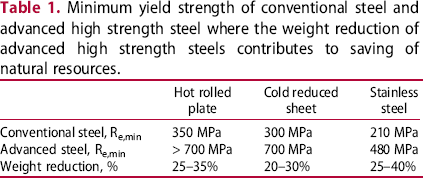
In order to realize the potential of the industrial-, environmental- and social-advantages related to the research performed within the steel eco-cycle programme, estimates of the environmental effects of all projects within the programme were performed from a life-cycle approach.
Evaluation of environmental impacts (88051)
The environmental data obtained, using an LCA approach, is considered to be a key element in the communication of the programme results. The LCA approach has also introduced comprehensive analyses of the project technologies as part of manufacturing chains, including upstream and downstream processes. Figure 4 illustrates the technical steps analysed in a total environmental impact assessment (Almemark & Hallberg).
Summary of environmental impact from the production stage to the recycling stage of steel.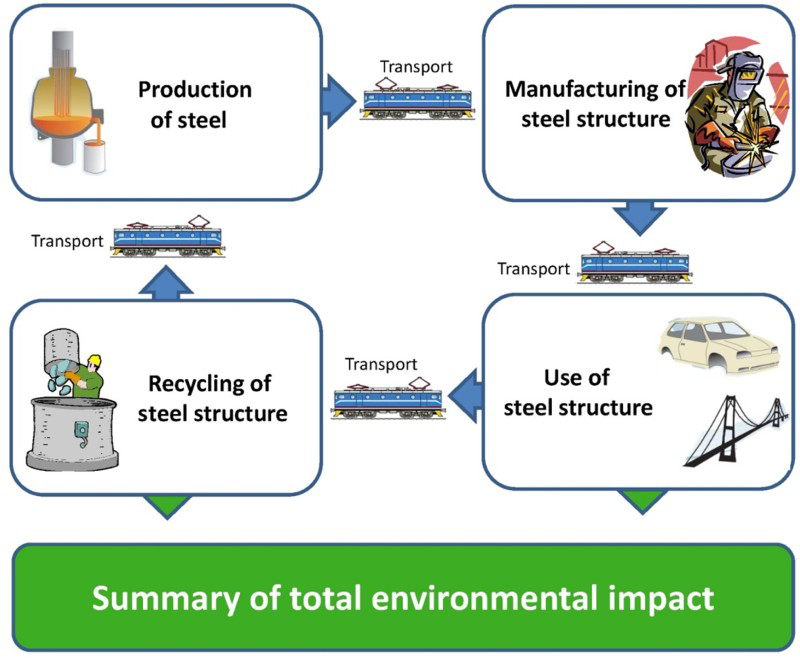
Attitudes towards environmental issues were studied for the steel industry and its stakeholders. The project assessed which of a number of factors that most influence environmental decision-making (knowledge, public concern, legislation, economy etc.). The results can be utilized in two ways; first, key stake holders’ attitudes to environmental issues were identified and this knowledge comprises a basis for strategic environmental decisions. Second, an easy-to-use manual on the method used in the project was written and can be used to conduct similar surveys in the future by the industry itself (Jönbrink et al. 2013).
Programme results
General achievements
Considering the steel eco-cycle programme as a whole, it is clear that substantial energy savings, reduced carbon emissions and cost reductions can be achieved in the Swedish steel sector.
Two very important conclusions can be formulated
Energy savings from increased efficiency of raw material and commodities in the steel production process is associated with even larger savings in the raw material production phase, typically by a factor of 3–6. A reduction of the amount of steel needed per functional unit in a market product is directly beneficial in the steel production but most importantly, much larger environment gains are associated with reduced emissions and energy use in the use phase of a product or a structure.
The savings in the use phase are often ascribed to the steel users rather than the steel manufacturers. This is done even though the steel eco-cycle evaluations show that a saved ton of CO2 emission in the production of steel when changing to a stronger steel for lighter structures is multiplied by a factor of 20 for active structures like vehicles when the use-phase is included.
Potential in process improvements
According to the environmental evaluation in the programme, the energy saving potential of the studied technical processes including upstream and downstream processes is 5 300 GWh/year if implemented in Swedish industry (which is equivalent to 1 MWh/ton crude steel for the reference year 2004) (Ponzio). This is almost ten times the goal formulated in the planning of the steel eco-cycle research programme. Furthermore, the emissions of CO2 could be decreased by an amount corresponding to 1.3 Mt/year. This is 130% of the original goal. The studies show that material savings in the steel industry normally result in a 3–6 times greater environmental improvement at the supplier of raw materials compared to at the steel-mill itself. Consequently, it is necessary to take a life-cycle approach to process improvement decisions in order to achieve breakthrough sustainable.
Potential in high strength steel applications
Potential environmental improvements when 1.3 million ton of conventional steel is replaced by 1.0 million ton of advanced high strength steel in the European vehicle fleet.
Potential environmental improvements when 1.3 million ton of conventional steel is replaced by 1.0 million ton of advanced high strength steel in the European vehicle fleet.
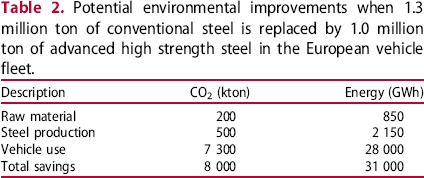
It is seen that the use of high strength steel in road vehicles has a substantial impact on energy and environment. The emphasis on the developing new grades of high strength steel is thus strongly emphasized.
Considering the above analysis, it is important to evaluate the situation with respect to alloying concepts from an environmental viewpoint to get a total picture. An assessment of up-stream data related to the total greenhouse gas emissions during the production of various alloys relevant to steel production is given in Figure 5.
Greenhouse gas emissions in the production of various metals/alloys (kg CO2e per kg of pure alloy metal) (Gabi LCA software and data base PE International).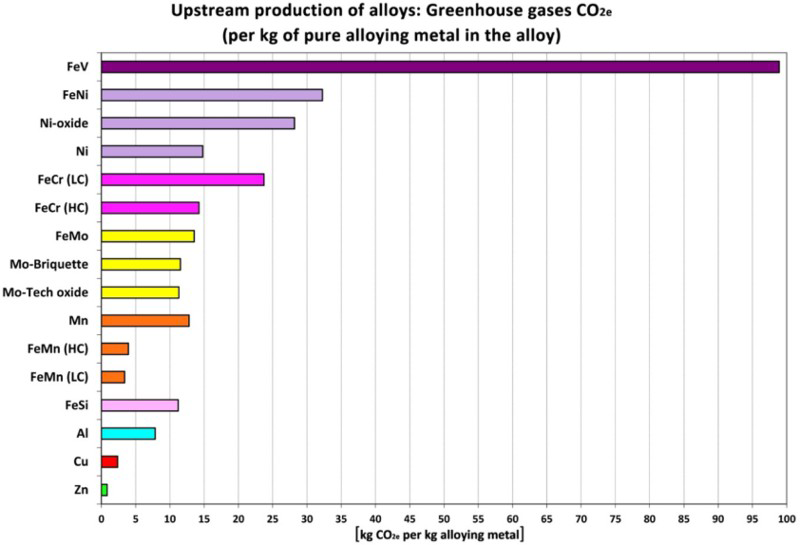
Greenhouse gases global warming potential (GWP) are expressed as carbon dioxide equivalents (CO2e). This value consists mostly of carbon dioxide but include also the GWP of emitted methane, nitrous oxide, etc. In order to get a total optimization of steel production and use, suitable compromises have to be made considering the geographic location, availability of raw materials, innovative process solutions and developments of high strength, light weight steel grades.
The steel eco-cycle programme clearly showed that the largest potential to improve environmental performance often is found outside of the steel mill, either in the use phase, where increased use of advanced steel grades may reduce material and energy use significantly, or upstream resulting from less need of natural resources. Thus, in order to reach the full potential to increase resource efficiency and reduce environmental impact, the whole life cycle of the steel from raw material handling to steel production, use and recycling must be considered.
Factors for success are:
Applying a life-cycle perspective when funding, performing, contextualizing and evaluating research and development projects. Ensuring an efficient knowledge transfer across disciplinary borders and between academia and industry. Keeping an awareness of differences and similarities in attitudes between different stakeholders. Preparing a willingness to see traditional residual product as industrial products alongside steel.
In order to proceed towards a sustainable steel industry, it is crucial that the environmental issues are treated scientifically and that a life-cycle approach is adopted which encompasses the industry as well as the society. This was probably main contributing factor for the success of the steel eco-cycle programme.
Footnotes
Acknowledgements
This paper is part of a special issue on Sustainability, waste processing and secondary resources.
Conflict of interests
The authors declare no competing financial interest.
Disclosure statement
No potential conflict of interest was reported by the authors.
Funding details
This research received no specific grant from any funding agency.