







Abstract
Background
Hispanic college students represent a growing proportion of the college population. Studies have found that an individual's perception of the drinking of others is linked to one's own personal use and that college students frequently overestimate the drinking of their peers. The current study builds on previous college student drinking literature by examining the influence that attending a Hispanic-serving institution (HSI) has on the personal alcohol use and perception of peers’ drinking norms among Hispanic college students.
Methods
This secondary data analysis utilized data from the American College Health Association's National College Health Assessment. Participants were self-identified Hispanics between the ages of 18 and 25 (N = 4336).
Results
Results indicated that there was a significant interaction between attending an HSI and the perception of the number of drinks of a typical student. Specifically, the perception of others’ drinking was more strongly linked to personal drinking for students in non-Hispanic serving institutions.
Conclusions
The protective effect of attending a Hispanic-serving institution may be related to a more culturally affirming college environment.
Keywords
Introduction
Hispanic enrollment at postsecondary educational institutions is increasing, including enrollment at Hispanic-serving institutions (HSIs). 1 HSIs are delineated in federal law as accredited and degree-granting public or private not-for-profit institutions in higher education where 25% or more of the undergraduate full-time students enrolled are Hispanic/Latino. 2 Further, just lower than their non-Hispanic, white counterparts, Hispanic college students report high rates of alcohol consumption. 3 , 4 The aim of the current study is to focus on the importance of descriptive norms and alcohol use. Descriptive drinking norms refer to perceptions of drinking by an identified reference group. 5 College students, who are exploring identities and social roles, may use norms to gauge their own drinking behavior. The literature linking norms to drinking suggests that normative perceptions significantly impact students’ drinking behaviors. 6 The purpose of this study is to investigate institution type as a moderator of the relationship between drinking norms and quantity of alcohol consumed in a sample of Hispanic college students.
Methods
Participants and Procedure
This secondary data analysis utilized data from the 2009 American College Health Association's National College Health Assessment (ACHA-NCHA). The 2009 ACHA-NCHA was administered at 117 postsecondary institutions that elected to participate. A total of 87105 students from these institutions participated. The ACHA makes the aggregate data available to investigators who are interested in research questions pertaining to college health. For the current study, inclusion criteria were self-identification as Hispanic, undergraduate status, and being between the ages of 18 and 25, resulting in a sample of 4336 students. Institutional review board (IRB) approval was obtained for secondary data analysis with ACHA-NCHA data.
Measures
Demographic Variables
Demographic variables included biological sex, enrollment status, and year in school. Three dummy codes were created for year in school, with year 4 or greater as the reference group. Enrollment status was 1 = Full-time enrollment, 0 = Part-time or “other” enrollment. Enrollment in an HSI was dummy coded (yes = 1; no = 0).
Norms
The ACHA-NCHA asks respondents, “How many drinks of alcohol do you think the typical student at your school had the last time he/she “partied/socialized?” Respondents entered in the number of drinks and were instructed to enter 0 if they believed the typical student did not drink alcohol.
Quantity of Alcohol Use
Quantity of alcohol use during participants’ last drinking episode was measured using responses to the following question, “The last time you “partied/socialized” how many drinks of alcohol did you have?” Respondents entered in the number of drinks. Nondrinkers were instructed to enter 0.
Data Management and Analytic Plan
Data were assessed for missingness and normality. Of the initial sample of 4336, there were 123 with missing data on 1 or more of the variables of interest (<3% of the sample). Two variables, norms and quantity of alcohol use, had skewness values exceeding 2. These variables were assessed for outliers. Both variables had values of alcohol consumption that appeared to be beyond a biologically feasible amount of alcohol to consume (e.g., 90 drinks on the last occasion of drinking). Thus, participants with values 3 standard deviations beyond the mean of the respective variable were excluded from the final analysis. This yielded skewness values of less than 2 for both variables. Data analyses were conducted with SPSS (version 22, IBM Corp) 7 and included descriptive statistics, t tests for differences between institution type and frequency of alcohol use and norms, and linear mixed model analysis to test predictors of alcohol use. The linear mixed model analysis, also referred to as multilevel modeling, accounts for nested data. 8 – 10 Participants are college students nested in institutions of higher education (Level 2 variables). Level 1 variables (person-level) included gender, year in school, enrollment status, and norms. HSI was a level two variable. The model also included a cross-level interaction term for HSI by norms. The dependent variable was quantity of alcohol consumed during the last drinking episode.
Results
Participant Characteristics
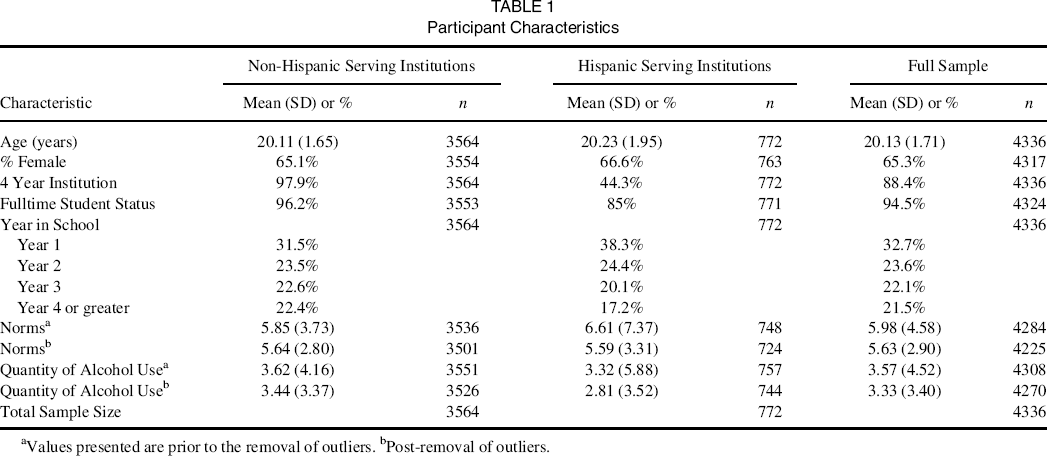
Values presented are prior to the removal of outliers.
Post-removal of outliers.
Fixed-Effects Estimates and Random Effects for Alcohol Use Quantity
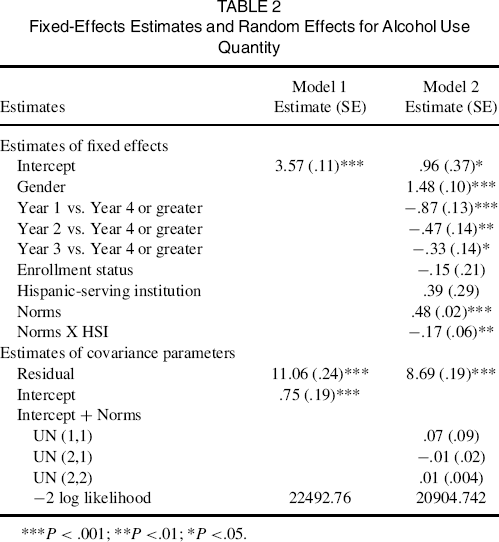
P < .001;
P <.01;
P <.05.
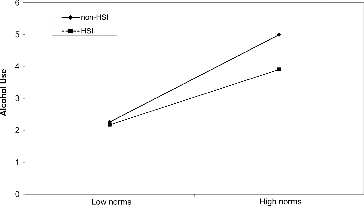
HSI by norms interaction.
Discussion
Hispanic college student attending HSIs consumed fewer drinks than those at non-HSIs, but did not differ in the estimation of the number of drinks a typical student drinks at their institution. Consistent with prior research by Larimer and colleagues, 11 students at HSIs still overestimate drinking by others. Attendance at an HSI was a moderator of the relationship between alcohol use norms and alcohol consumption. For both groups, as students estimate greater use by peers, personal consumption also increases. Furthermore, among those attending HSIs, the increase is less dramatic than for those at non-HSIs.
HSIs may temper the perception of peer drinking in a number of ways. HSIs often have institutional values that aim to support Hispanic students, promoting a greater sense of belonging, thereby reducing the risks associated with alcohol use. 12 There may be differences in who students perceive as the “typical” student. For students at non-HSIs, it is possible that the “typical” student is seen as a white, non-Hispanic male. 13 This, coupled with greater expectations of drinking on predominantly white campuses, may yield greater personal consumption. Nevertheless, it is compelling that even at HSIs the positive relationship between norms and alcohol use persists in what may be a more protective environment.
The current study has implications for prevention and future research. Motivational and norms interventions are a mainstay of prevention, but little is known regarding the effectiveness of such efforts with underrepresented groups and in particular, those attending minority serving institutions. 14 Further, there remains a need to understand the process of cultural adaptation for Hispanic students on different types of campuses. Schwartz and colleagues 15 posit that both the culture of origin and receiving culture impact the process of adaptation and related behavioral outcomes. Thus, college may represent a receiving culture for Hispanic emerging adults, and their process of adaptation may be impacted by alcohol use perceptions and the campus environment. Finally, future research may seek to further elucidate the interplay of these important cultural variables and drinking behaviors.
Funding
Marcel A. de Dios is funded by a career development award by the National Cancer Institute (K01CA160670-03). This grant supports Dr. de Dios in conducting a number of training and career development activities, including manuscript preparation.
Author Contributions
Authors Vaughan and Chang developed the research question. Authors Chang and Escobar undertook the literature search, and wrote the first draft of the introduction. Author Vaughan conducted data analysis and wrote the first draft of the methods, results, and discussion. Author de Dios revised the introduction and discussion. All authors contributed to the final manuscript commensurate with the order of authorship.