







Abstract

While marijuana remains the most widely used illicit drug in the United States 1 and is the subject of countless medical, psychological, and sociological studies, 2 its potential harms are not fully understood. One particular issue that has yet to be sufficiently explored is the potential dangers associated with administering tetrahydrocannabinol (THC) by means other than smoking flower cannabis. The academic and public health communities have started to assess and react to the increased availability of marijuana edibles now legally available in some states and sold as medicinal products in others. 3 – 5 Although this alternate form of consumption poses risk, notably the accidental ingestion of large quantities of THC by children, 5 a greater concern may be the emerging form of marijuana consumption known as “dabbing.” 6 Anecdotal evidence suggests that this behavior is becoming more common in the United States, but what is not in question is that dabbing is scarcely researched and inadequately understood at this time. The following paragraphs offer a brief introduction to dabbing, clarify what is known about the activity, and issue a call for research on a form of drug use that may have serious repercussions.
“Dabbing” is a term used to describe the inhalation of vaporized butane-extracted cannabis products (also called butane hash oil products or BHO; butane is used in production, not during administration—it is mostly purged from the product prior to use). These products take many forms depending on the manufacturing process and environmental conditions in which they were produced. In order of decreasing desirability, these forms are labeled “shatter,” “honeycomb,” “crumble wax,” “budder,” and “earwax,”
7
each of which are administered in a more complicated process than traditional flower cannabis use. The first step typically involves the user placing a titanium “nail” (a hollow cylinder about 4 inches in length with a broader surface on one end) into the open end of a modified water pipe (the entire apparatus is referred to as an “oil rig”; see Figure 1). The nail is heated by a blowtorch, typically to a high temperature where the nail becomes incandescent. A small amount of product, termed a “dab,” is then placed onto the surface of the nail; the dab is quickly vaporized. Unlike flower cannabis smoking, which typically involves repeated inhalations over time, “dabbers” inhale their entire selected amount in a single breath, likely administering more THC in that one breath than they would have during an extended period of flower cannabis smoking. Alternatively, dabbers may use what is termed a “swing” or “skillet” that pivots the metal heating service away from the water pipe, or they may even use an electronic vaporizer device, but the overall pattern remains similar.7
Apparatus used for administering dabs (butane-extracted marijuana products). The full apparatus would is referred to as an “oil rig,” whereas the metal addition is labeled a “nail.”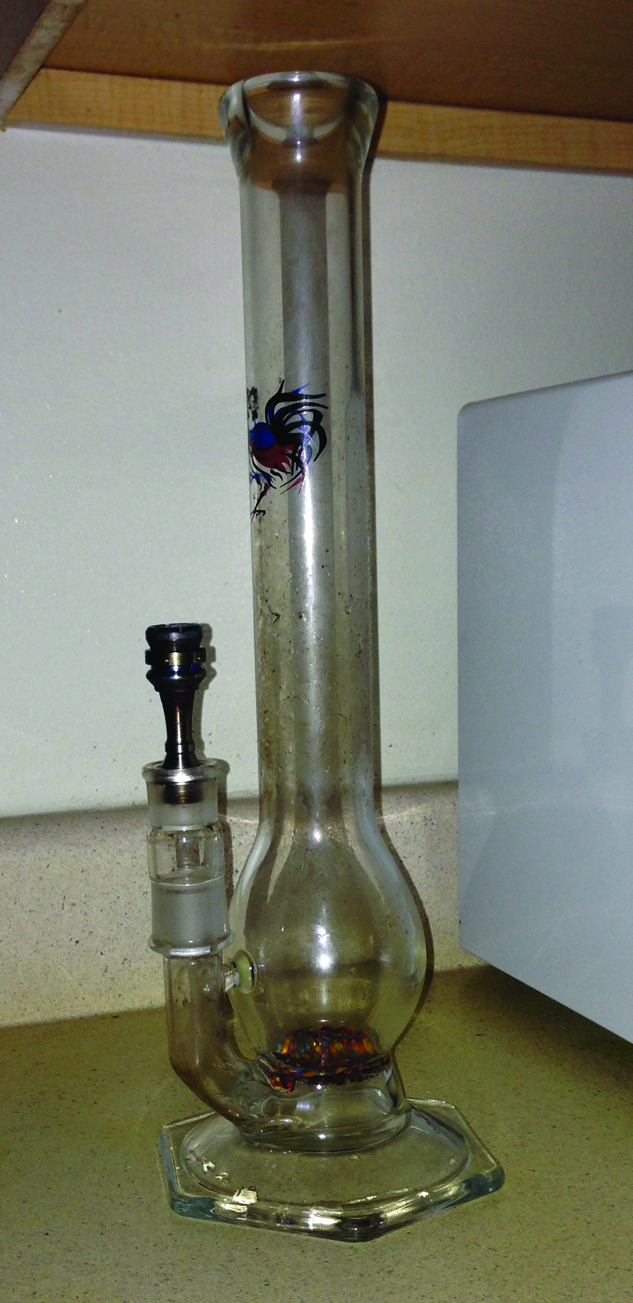
The academic, law enforcement, and health care communities have yet to adequately assess this behavior and its consequences. This behavior could be associated with an array of risks not typically associated with marijuana use, but research in the area is sorely lacking and is critical to the development of health care protocols, legal policy, and public health campaigns. In order to facilitate directed research in the area, we offer a series of 8 topics that need to be addressed so that efficient, tailored responses can be developed. First, the THC content of “dabs” should be evaluated. Some reports claim that well-manufactured products can have a THC concentration approaching or exceeding 80%, whereas others describe a much smaller number (though still 3–4 times that of flower cannabis). A much higher dose than to which typical flower cannabis users are accustomed is worrisome, but clinical research should determine if users are actually administering more THC or a similar amount (i.e., an equivalent amount in the form of a smaller quantity of a more concentrated form). Second, impurities in BHO products, both commercially produced and those created by amateur methods, should be quantified. Increased health consequences may be present from inhaling butane if the product was not adequately purged during manufacturing. To date, no study has assessed the efficiency of solvent purging from BHO products. Third, differences in burn risks among users should be evaluated, as dabbing requires a high-temperature blowtorch, which may remain lit between administrations/users, rather than a standard lighter.
Fourth, the acute physiological risks of dabbing as compared with marijuana have not been assessed. Some have suggested that the alternate administration and concentration could lead to acute health effects not commonly associated with flower cannabis use, 8 but no study explores this topic. Relatedly, the acute indirect effects of dabbing as compared with flower cannabis use are not well understood. Only one empirical study examines reports of dabbing. 8 The study did not find that dabbers self-reported additional accidents or falls as compared with flower cannabis use, but the work utilized only a small sample of experienced cannabis users. This methodology may not have detected all additional risks, some of which may be exacerbated among less experienced marijuana users. 8 Extensions of Loflin and Earleywine's 8 work are needed. Fifth, the potential chronic effect of dabbing should be evaluated, including the potential for this more potent form of THC to be associated with dependence and withdrawal.
Sixth, little is known about the prevalence of dabbing and characteristics of users. One study conducted in Washington State prior to the implementation of retail marijuana suggests that dabbing is a growing trend. 9 Among a convenience sample of marijuana users, Kilmer and colleagues 9 found that 52% of daily and near-daily users and 40% of past-month users of marijuana reported dabbing at least once. However, no prevalence estimates are available in marijuana prohibition states or for the population more generally. Self-report studies that describe prevalence, user characteristics, frequency of use, regional variations in use, and other related topics will be vital to informing public health campaigns and directing responses. Similarly, it will be important to examine the common settings of dab use including home use, use at parties, and the phenomenon of “dab lounges” in medicinal and recreational marijuana states.
The seventh area of serious concern is over the manufacturing process. In most recreational and medical marijuana states, the legal production of butane hash oil is highly regulated and restricted to licensed producers that utilize a closed-loop system (which allegedly provides a more stable and environmentally friendly way of dealing with volatile butane). These processes require additional evaluation. A greater concern is that butane hash oil can be manufactured in a far less sophisticated manner requiring few resources and only a limited number of simple steps. “Blasting” is terminology used to describe the process of passing liquid butane through a metal or glass tube packed with flower cannabis. The liquid passes through the plant material and exits the tube through a filtering device into a dish or tray to be collected. The liquid remains in the tray as the volatile butane evaporates. This solution may be heated or agitated to hasten and improve the purging of butane. Recreational users, aided by instructional videos available via social media, have replicated this process void of proper safety precautions. Herein lies the threat; amateur “cooks” using an open-loop process allow a volatile, flammable compound to build in a confined space such as a garage or workshop. Although the process is simpler, the consequences and risks may be similar to that of methamphetamine production. Several fires, explosions, and severe burns have been linked to the home production of butane hash oil 10 and severe penalties for the manufacturing of butane hash oil have been applied in many jurisdictions. However, at present, the prevalence of, and damage due to, home “blasting” is unknown. To date, numerous blasting-related fires may have been attributed to other causes. The rate of blasting fires and how to manage the issue warrants exploration.
Finally, the eighth area of research needed is to assess the impact of dabbing on the medicalization and legalization debates. Deregulation likely leads to increased availability of flower marijuana, a key ingredient in the manufacturing of butane hash oil, which may increase the prevalence of dabbing even if commercial production of extracts is banned. Although commercial production of extracts may reduce the rewards for home production—eventually negating some of the fire-related risks—it may also facilitate increases in dabbing due to ease and convenience. The dangers present in home manufacturing will thus need to be balanced with concerns over the extremely high levels of THC within extracts. As such, our final recommendation for research is a general harm-reduction assessment of alternate marijuana polices as they relate to dabbing. Such a study would explore more than general marijuana prohibition, decriminalization, medicalization, and legalization as policies for flower cannabis and extracts/concentrates need not be equivalent.
Assuming that the risks associated with dabbing are identical to those linked to flower cannabis is shortsighted. The lack of research on short-term or long-term effects of dabbing is troubling and leaves policymakers and practitioners uninformed. As a result, we encourage increased research on dabbing and offer 8 focus areas for future studies. As attitudes and policies have changed more generally on marijuana, it is important to examine new issues, such as the practice of dabbing, and ensure that research informs debates and policy reform.
Footnotes
Acknowledgments
The authors would like to thank Joel McCrory for his contributions to this work. This work was not funded. The authors report no conflicts of interest.