







Abstract
Background: People who inject drugs (PWID) have an elevated risk of suicide attempt. Although different substances are associated with suicide attempt, the overall risk posed by binge behavior, a high-risk pattern of drug use, remains unclear. The objective of this study is to assess the association between binge drug use and suicide attempt in a prospective cohort of PWID in Montreal, Canada. Methods: Participants answered a biannual interviewer-administered questionnaire compiling information on sociodemographics, pattern of substance use (cocaine, amphetamine, opioids, sedative-hypnotics, alcohol, and cannabis), and psychosocial stressors and related markers. The relationship between suicide attempt and binge behavior was modeled using generalized estimating equations (GEEs), controlling for type and pattern of substance use, sociodemographic characteristics, and significant mental health markers. Results: Among 1240 participants (mean age ± SD: 38.2 ± 9.8) at baseline, 222 (17.9%) reported binge during the past 6–months. PWID reporting binge were significantly younger (P < .001), less educated (P = .012), less likely male (P = .047), and had shorter history of injection (P < .001). In addition, they were younger at first injection (P = .014), reported higher rates of prostitution and psychological disorders (P = .003), and were more likely to use other drugs except cannabis and alcohol. Binge was independently associated with attempted suicide in the GEE multivariate model (adjusted odds ratio [aOR 95% CI] = 1.91 [1.38–2.65], P < .001). Conclusions: Among PWID at high risk of suicide attempt, those who binge represent a particularly vulnerable subgroup. Although the exact mechanisms underlying this finding remain unresolved, several hypothesis pertaining to the neurobiological and psychosocial consequences of binge, as well as common personality traits, warrant further investigations.
Introduction
People who inject drugs (PWID) constitute a particularly vulnerable subgroup among individuals with drug dependence and are highly susceptible to a myriad of adverse events. PWID are more likely to experience premature mortality due to medical conditions, drug overdoses, accidents, and violent causes. 1 – 3 Studies have also shown that PWID are at high risk for suicide attempt, with a 6-month prevalence estimated at 7% to 8%. 4 , 5
Suicide attempt is influenced by a multitude of risk factors pertaining to individual characteristics, such as sociodemographics, gender, and age, as well as others pertaining towards the pattern of substance abuse. A prior suicide attempt is the most important risk factor for suicide-related deaths. 6 , 7 Young age, female gender, and depression have been previously identified as risk factors for suicide attempts in PWID. 8 – 10 Two recent studies have shed light on the potential contribution of specific profiles of drug use to suicidal attempts in general and incarcerated drug user populations. 11 , 12 Artenie et al. 11 identified a positive association between suicide attempts and injection of stimulants as well as co-use of benzodiazepines in a cohort of PWID in Montreal, Canada. In another study conducted in Sweden, polydrug use was found to be associated with multiple psychiatric comorbidities, including suicide attempt, among inmates and individuals on probation. 12 Notably, bingeing has been repeatedly associated with suicide attempt in alcohol users 13 , 14 but is yet to be investigated as a risk factor in PWID.
Binge drug use has been reported by 48% to 71% of injection drug users, 15 , 16 suggesting that this phenomenon carries a heavy burden for PWID and may be associated with significant distress. It has been previously described as high-frequency or high-intensity drug consumption associated with a loss of control over substance use. 17 , 18 Mortality resulting from overdose, a pattern of drug use previously associated with binge, 19 – 21 is one of the leading causes of death among PWID. 22 , 23 In addition, binge drug use has been associated with various self-destructive behaviors such as drug use marathons, unprotected sex marathons, and nonfatal overdose. 16 , 24 , 25 However, the precise relationship between binge drug use and suicide attempt, if any, is yet to be elucidated. A better understanding of potential modifiable factors associated with suicidal attempts could prove critical in developing targeted intervention in PWID. The main objective of this study was to examine the association between binge drug use and suicide attempt among PWID. Given the aforementioned relation between binge and other risky behaviors, we hypothesized that binge drug use would be associated with suicidal attempts in our sample population.
Methods
Participants
Participants were selected from the HEPatitis COhort (HEPCO), an ongoing open prospective cohort of PWID in Montreal. HEPCO was established in 2004 to investigate determinants of hepatitis C virus (HCV) infection. To be eligible for the study, participants had to have injected drugs within the 6–months prior to enrolment, be at least 18 years of age, and reside in Montreal. Participants were recruited via street-level strategies such as word-of-mouth referral, community-based organizations, and from a previous prospective study of HIV transmission whose participants had been recruited using similar strategies. For the purpose of this study, only data collected between November 2004 and March 2011 were used for the analysis. Participants were followed up at 6-month intervals during this time frame. A detailed description of the recruitment and follow-up procedures has been previously published. 26 All participants signed an informed consent in compliance with the institutional review board regulations of the Centre Hospitalier de l'Université de Montréal (CHUM).
Measures
Data collection
Participants completed interviewer-administered questionnaires at baseline and every 6–months on sociodemographic characteristics, injected and noninjected substance use patterns, risk-taking behaviors, mental health status indicators, recent overdose, and suicide attempts during the past 6–months. Blood samples were also provided at every visit for human immunodeficiency virus (HIV) and HCV testing. The interviewers and nurses working on-site offered posttest counseling, information, and referrals to addiction, health, or HCV treatment services as needed. All study participants were offered CAD 20.00 upon completion of the questionnaire as compensation for their time.
Variable of interest and definitions
Consistent with previous reports, 4 the outcome of interest was a dichotomous measure of suicide attempt assessed by the following question: “In the past 6–months, have you attempted suicide?” In order to capture a wide range of binge types, to include both high intensity and frequency of drug use and to keep the our measure broad, the primary exposure variable, binge episode(s) of intravenous (IV) substance use, was assessed by asking: “In the past 6–months, did you ever take drugs in excess by losing control of your consumption, by injecting more than usual?”
Confounders
Drug use has been categorized under substance use patterns in 3 groups according to the number of days of use in the past 6–months based on the United States Office of National Drug Policy and Canadian recommendation for alcohol use: frequent (26 days or more for illicit drugs; 90 days or more for alcohol), occasional (1 to 25 days for illicit and off-prescription drugs; 1 to 89 days for alcohol), and none. 27 – 30 Substance use patterns also included age of first drug injection and lifetime duration of drug injection. Other potential confounders were grouped into 2 domains: sociodemographic characteristics and psychosocial stressors. These variables were previously identified as significant correlates of suicide attempt among drug-using populations. 4 , 27 The sociodemographic variables included age, gender, and completed high school education, defined as completing 10 years of school. Psychosocial stressors included living in unstable housing conditions (per-day accommodation, hotel, sauna, prison, or homeless), prostitution, and incarceration during the past 6–months. Other variables examined in the psychosocial stressors domain included history of psychological disorders during lifetime, measured by asking: “Have you ever been diagnosed with a psychological disorders before?” and treatment of anxiety/depression measured by asking: “During the past 6–months, have you received treatment or follow-up for anxiety/depression?”
Statistical analysis
Descriptive statistics were used to characterize the study sample at baseline and included frequency distributions for categorical variables a well as means and corresponding standard deviation (SD) for continuous variables. Group comparison (with and without binge at baseline during the past 6–months) on potential confounding variables was performed using chi-square test or χ2 distribution for categorical variables and nonparametric Wilcoxon 2-sample test with 2-sided t approximation for continuous variables, given their non-normal distribution. To examine factors associated with reports of suicide attempt, while accounting for within-subject correlation as a result of repeated measurements, we conducted generalized estimating equation (GEE) analyses for binary outcomes with autoregressive (first-order) covariance structure to calculate crude odds ratios (ORs) and corresponding 95% confidence intervals (CIs) for binge drug use patterns and suicide attempt. 31 The multivariate regression model was constructed by sequential introduction of binge drug use and blocks of variables pertaining to each of the 3 predefined domains of possible confounding variables. First, binge drug use was entered, followed by substance use patterns, sociodemographic factors, and psychosocial factors. This sequential introduction of variables permitted assessment of the impact of each of the 3 blocks of potential cofounders on the association between binge drug use and suicide attempt. The most informative variables were retained, restricting the P value to <.10 within each domain, and were selected through a process of backward elimination and subsequently introduced in the final, multivariate model. P values were 2-sided. Statistical analysis was conducted using IBM SPSS 20 (IBM, Armonk, NY, USA) and SAS 9.3 software (SAS Institute, Cary, NC, USA).
Results
Cohort description
Participants’ characteristics at baseline stratified according to binge and no-binge at baseline during the past 6–months (N = 1240 participants).
Wilcoxon 2-sample test.
Association measures
Univariate generalized estimating equation analysis of association between sociodemographics, substance use patterns, psychological factors, and suicide attempt (N = 5621 observations).
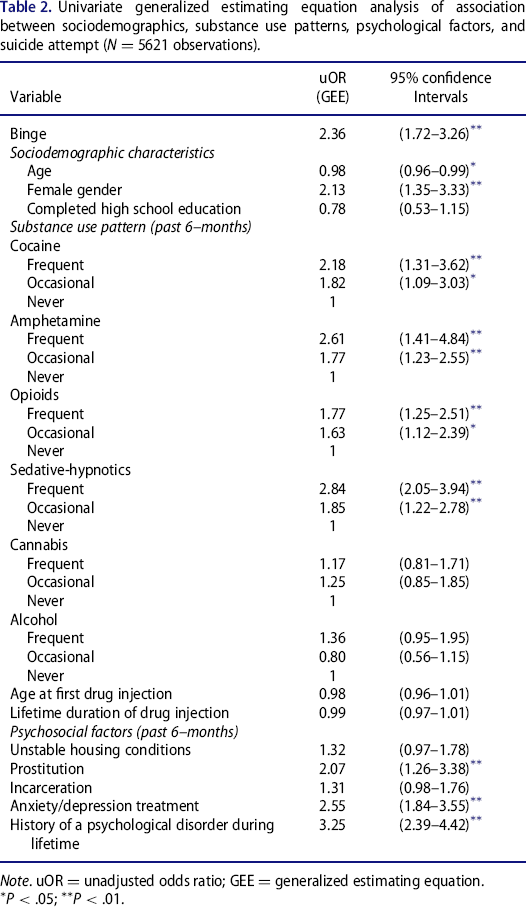
Note. uOR = unadjusted odds ratio; GEE = generalized estimating equation.
P < .05;
P < .01.
Multivariate generalized estimating equation analysis of the associations between suicide attempt and substance use patterns (Model A), with progressive introduction of variables of the sociodemographic (Model B), and psychosocial factors domains (Model C) (N = 5621 observations).
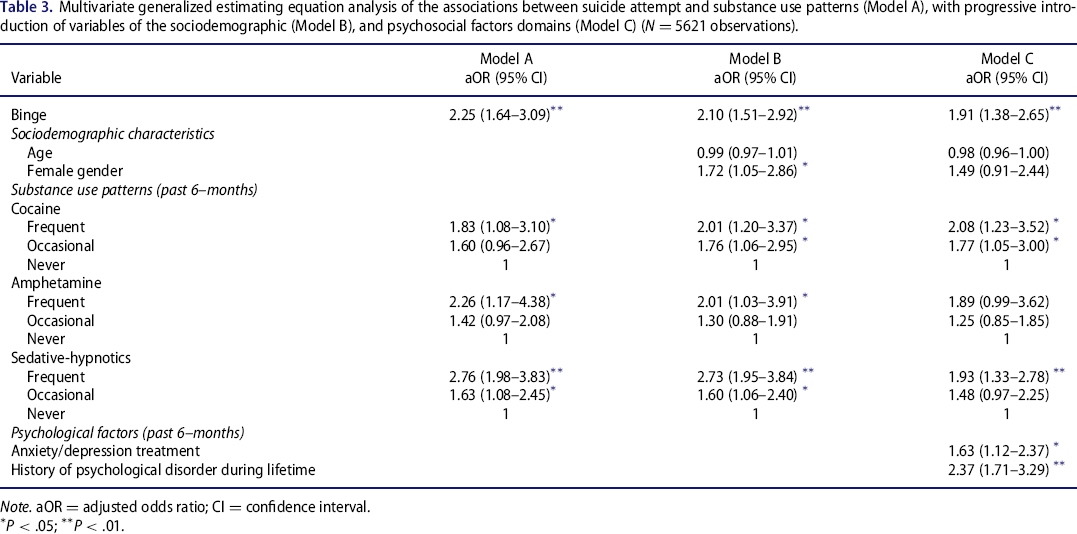
Note. aOR = adjusted odds ratio; CI = confidence interval.
P < .05;
P < .01.
Discussion
General finding
The main objective of this study was to measure the association between binge drug use and suicide attempt in a cohort of PWID. Our study was able to demonstrate that almost 6% of PWID reported a suicide attempt within the previous 6–months, consistent with previous research findings. 4 , 5 After controlling for sociodemographic characteristics, substance use patterns, and psychological factors, the odds of suicide attempts within the previous 6–months among PWID who reported at least 1 binge were almost double. A wide range of neurobiological, social, and behavioral changes could account for the current findings.
Neurobiological and cognitive implications of binge
In our study sample, binge remained associated with attempted suicide after controlling for a number of other factors. Binge episodes can have significant deleterious effects on many brain functions during both active drug use and in the days to follow. Chronic exposure to psychoactive drugs is associated with pathological modification of neuronal activity resulting in intrusive impulsivity. 32 In addition, impulsivity secondary to reduced frontal lobe activation has been previously documented during acute cocaine intoxication. 33 Through alteration of decision-making processes and failure of self-control mechanisms, sustained intoxication during binge episodes may increase risk of suicide attempt. 5 , 32 , 34 Moreover, excessive use of neurodepressants such as opioids and sedative-hypnotics has been implicated in development of affective symptoms, 35 which are directly associated with suicidal behavior. 36 This is in line with our results that demonstrate that frequent or occasional use of cocaine and frequent use of sedative-hypnotics were both independently associated with suicide attempt among PWID. 10 , 11
On the other hand, drug withdrawal syndromes are often associated with hypodopaminergic states that induce anhedonia, dysphoria, suicidal thoughts, as well as many other depressive-like features. 37 Increased suicide attempts in binge drug users could thus also be attributed to negative mood states often encountered during withdrawal following a binge episode. Prospective research may benefit from inclusion of relevant parameters to explore the chronology and proximity of binge episodes and subsequent suicide attempts in order to better understand the sequence of events preceding suicide among PWID.
Social and health implications of binge
Binge drug use is frequently associated with profound social, financial, and health-related adversities. Difficulty to withstand negative consequences associated with intense drug use may provide a plausible rationale explaining suicidality observed in PWID who binge. In a cross-sectional study aimed at identifying psychosocial implications of uninterrupted methamphetamines use among 451 individuals, over 75% of study participants experienced detrimental repercussions towards finance, legal issues, family, or relationship. The study also highlighted increased risky drug use patterns and sexual behaviors, including sex marathons and unprotected vaginal or anal sex among binge drug users. 25 Moreover, a study conducted in Vancouver, Canada, among PWID demonstrated that binge drug use predicts HIV seroconversion. 16 This study and others assert the high level of morbidity among injection drug users. Binge episodes may occur at times of significant distress among individuals trying to cope with a persistent burden related to their drug use. Ultimately, this response can be associated with additional problems, further challenging coping strategies of PWID. This could in turn possibly lead to increased distress and, in some cases, to a higher likelihood of suicide attempt.
Conversely, socioeconomic and health burdens associated with drug use and attempted suicide may partly stem from preexisting suicidal contemplation. Although ideation and attempt are similar yet distinct, previous research has highlighted that PWID with increased suicidal ideation were more likely to share needles/syringes or engage in unprotected sex. 38 Given the aforementioned association between ideation and risky behavior and in light of our results, it is possible that suicidal tendency may elicit risky sexual behavior and drug use patterns, including binge, which may in turn complement an ensuing suicide attempt. Future research should encompass delineating the precise relationship between a suicidal ideation and binge
Negative personality traits and impulsivity as common risk factors for binge and suicide
Another potential explanation for our results may lie in the predisposition of PWID to specific personality traits that could act as a common factor leading to both binge drug use and suicide attempt. For example, neuroticism is a type of personality that encompasses multiple facets of negative affectivity, including anxiety, irritability, worry, frustration, vulnerability, jealousy, and loneliness. 39 Neuroticism associated with impulsivity and anxiety has been linked to substance abuse and binge behavior. 40 , 41 Likewise, negative affectivity also predicts suicidal ideation, depression, and hopelessness. 42 Although it is well established that substance misuse can result in altered cognitive functions, premorbid personality traits specific to substance users could also lead to an increased risk of suicide. Such common premorbid vulnerability factors could explain the association between binge drug use and suicide attempts in our study sample. Hence, a comprehensive evaluation of pertinent individual personality and cognitive profiles among PWID who binge may provide relevant information regarding risk of suicide attempt. Furthermore, in-depth research is required to understand reciprocity between personality traits and binge drug use in PWID.
Limitations
Although being informative on a poorly studied association, our study also does not allow us to infer a causal link between binge drug use and suicide attempt. Although there is a close time frame between observations, it is impossible to determine if binge episodes in fact preceded suicide attempts reported within the same 6-month period. Our data did not allow us to establish a direction of causality, i.e., whether participants who binge are suicidal to begin with, or if binge behavior leads to suicidal tendencies. It is also difficult to elucidate if suicide attempt occurred during intoxication, withdrawal, or weeks after the binge episode. Another important limitation is related to study methodology, which predominantly relied on self-report questionnaires. Data were potentially susceptible to elements of bias, including recall and social acceptability, although data collected from previous studies in drug-using populations appear to be generally valid and reliable. 43 Moreover, the study design, which involved an every-6-month visit, did not allow us to collect data on individuals who completed suicide. Although the study underlines a positive association between binge and suicide attempt, the presented data may thus underestimate the incidence of suicide attempt in this population. In addition, variables linked to suicidal behavior such as physical health, relationship status/conflict, education/literacy, history of suicide among first-degree relatives, domestic violence, and history of childhood abuse 44 – 46 were not measured and may be confounders explaining the observed association. It may also be relevant to delineate whether or not binge drug use is more associated with suicidal ideation rather than suicidal attempt amongst individuals with ideation in PWID. 47 , 48 This distinction may prove critical in early identification of individuals particularly at high risk for suicide attempt among PWID.
Altogether, our study highlights a positive association between binge drug use and suicide attempt after controlling for sociodemographic factors, substance use patterns, and psychological factors. Although our results do not permit for the examination of the directionality of this relationship, our findings suggest that there is an important link between these two behaviors that deserves further investigation. Although the exact mechanisms underlying this finding are not completely understood, a number of hypothesis pertaining to the neuropsychological and psychosocial consequences of binge episodes, as well as common personality traits, warrant further investigations. Further studies using standardized psychiatric and objective cognitive assessments are required to enhance our understanding of the interconnection between binge and suicide attempt. Moreover, a detailed description of behaviors during and around the binge episodes and suicide attempts may be critical to truly understand the timeline of these events. This could also allow us to examine the direction of this relationship, in addition to future studies using adequate longitudinal approaches. Suicide risk is serious, yet it remains trivialized for PWID, with little action towards development of pertinent preventive measures or interventions. 48 This subgroup constitutes a complex population where suicide is more likely, compared with other populations with substance dependence. Given that history of a suicide attempt is the single most important risk factor for completed suicide and the specific vulnerability of PWID who report binge drug use, meticulous assessment and preventive interventions are critical in minimizing risk of suicide attempt and of completed suicide in this population. Further research should be tailored to challenge the understanding of the complex interplay between substance misuse and mental health, where targeted and specialized data collection is critical, especially in high-risk multiproblematic populations such as PWID.
Footnotes
Acknowledgments
The authors would like to thank Rachel Bouchard, the HEPCO research staff, as well as all study participants without whom this work would not have been possible.
The authors declare that they have no conflicts of interest.
Funding
The HEPCO study is funded through a Canadian Institute on Health Research grant (MOP135260; MOP210232) and additional support from the Réseau SIDA et Maladies Infectieuses du Fonds de la Recherche en Santé du Québec (FRSQ5227). This work was supported by the Quebec Network on Suicide, Mood Disorders and Related Disorders (FRQS-RQSHA). A.A.A. was supported by an MSc salary award through the National CIHR Research Training Program in Hepatitis C. D.J.A. holds a clinical researcher career award from the Fonds de Recherche du Québec—Santé (FRQS). Funding bodies did not have a role in study design; in the collection, analysis, and interpretation of data; in the writing of the report; or in the decision to submit the article for publication.
Author contributions
C.F. participated in the study design, conducted the analyses, and drafted the manuscript. M.F.G. reviewed data analysis and contributed to drafting and revision of the article. A.A.A. contributed to the study design, interpretation of findings, and revision of the manuscript. G.Z. made substantial contributions to the analysis of data and revision of manuscript. E.R. contributed by designing and directing the HEPCO cohort, its global analysis, and reviewing the article. J.B. and D.J.A. contributed to the study design, data analysis, interpretation of findings, and writing of the manuscript. D.J.A. oversaw the project, and J.B. directed the research study from which the data were derived. All authors approved the final version of the manuscript.