







Abstract
Background: Existing literature suggests that using stigmatizing language may promote negative attitudes and result in more punitive views toward individuals with addiction. It is unclear how the commonly used colloquial terms to describe opioid-exposed mother infant dyads impacts public opinion of pregnant women with opioid use disorder (OUD). We sought to examine the extent to which language such as “opioid addict” and “born addicted” influences the perception of pregnant women with OUD. Methods: We conducted a randomized case-based vignette study using a population-weighted sample of parents living in Tennessee, varying in the language used to describe an opioid-exposed mother infant dyad. Participant demographics, views on opioid prescribing, and opinions on criminal justice and child welfare responses following delivery were obtained. Ordinal logistic regression was used to examine the association between vignette type and punitive responses. Results: Eleven hundred participants completed the survey. Overall, 30.6% felt the mother should be arrested and 68.6% felt the mother should lose custody of her infant. There was insufficient evidence to suggest a difference in punitive response selection based on the vignette language (p = 0.27). In the adjusted model, the odds of answering a more punitive response among parents who received non-stigmatizing language was 0.8 (95% CI 0.59–1.08) compared to parents who received stigmatizing language in the vignette. Conclusions: Many parents hold punitive views toward mothers receiving OUD treatment that was not altered by using less value-laden language. Broader stigma-reduction interventions may be more effective.
Introduction
In response to the increasing rate of opioid use disorder (OUD) among pregnant women, states have implemented policies ranging from prioritizing access to treatment to criminalizing substance use in pregnancy. 1 – 5 Between 2014 and 2016, Tennessee became the first state in the United States to enact a law allowing for the prosecution of pregnant women using non-prescribed substances, creating one of the most restrictive statutes toward pregnant women with substance use disorder in the country. 6 , 7 Media coverage of the Tennessee law and other articles about the opioid epidemic in the perinatal period frequently used the terms “pregnant addict” and “addicted baby” to describe opioid-exposed mother-infant dyads. 8 – 11 Existing literature suggests that using stigmatizing language, such as the term “addict,” may promote negative attitudes and result in more punitive views toward individuals with addiction. 12 – 15 It is unclear how the Tennessee law and coverage by the media shaped public opinion of pregnant and parenting women with OUD.
In this context, we sought to understand public perception of pregnant women with OUD and how language referring to addiction may influence public opinion. We conducted a randomized survey experiment among a population-weighted sample of parents with children <18 years old, differing only in the terminology used to describe opioid-exposed mother-infant dyads. We hypothesized that using stigmatizing language would result in greater support for criminal justice and child welfare response than when using more appropriate terminology.
Methods
The Vanderbilt Child Health Poll was conducted by Ipsos using an online platform called KnowledgePanel, a large research panel created by using probability-based address sampling of US households 16 , 17 and additional online panels from Ipsos. Families included in KnowledgePanel or other panels living in Tennessee were invited in September 2019 to participate in larger survey around child health policy (focused on the well-being of children living in Tennessee, health insurance coverage, opioid use, and behavioral health). 18 Respondents were required to have at least one child under the age of 18 who lived in the same household. The survey was completed in English and had a median completion time of 10 min. Individuals received an email invitation to complete the poll online at their convenience and non-responders were sent frequent reminders. Ipsos provided participating households with Internet access and computer hardware if needed. Polling took place between October–November of 2019. Participants received a small incentive and entry into a larger raffle with both prizes and cash awards. Sampling continued until there was a large enough sample for the responses to be deemed representative of Tennessee families. Survey weights were created to provide state-wide estimates for parents with children <18 years old and to account for differential non-response bias.
Participants were presented with a case vignette of a mother with OUD who becomes pregnant, receives treatment, and whose infant requires treatment for neonatal opioid withdrawal. Vignettes were randomized to differ only in the description of mother (“opioid addict” v. “woman with opioid use disorder”) and baby (“born addicted” v. “develops drug withdrawal”), as follows:
Ms. Lee is a 23-year-old woman who [
Participants were asked if the mother should be arrested, not be arrested but have her infant placed in foster care or with a family member, or if the infant should be allowed to return to home in the mother's custody. Demographic data collected on participants included parent age, gender, education, race/ethnicity, marital status, household income, mother head of household (yes/no), employment status, homeowner status, and number of children <18 years old. Additionally, participants were asked about their views on opioids including frequency of prescribing, personal connection to someone suffering from addiction, and worry about addiction among their children as well as children in the state of Tennessee.
We summarized the characteristics of the sample and responses on infant discharge disposition using descriptive statistics, comparing the groups by vignette using Rao–Scott corrected Chi-square tests. We used ordinal logistic regression to examine the extent to which vignette type, characteristics, and views on opioids were associated with post-delivery custody responses from least (parental custody) to moderate (lose parental custody but not arrest) to most (arrest) punitive. All analyses were conducted in R version 3.6.2 (R Core Team, Vienna, Austria) using survey weights to permit population-level inferences. Hierarchical variable clustering using Spearman's ρ2 was performed to assess for collinearity. As a sensitivity analysis, final model was run without survey to assess whether any main results differ. The Vanderbilt University Medical Center Institutional Review Board reviewed this study and deemed it exempt from full review.
Results
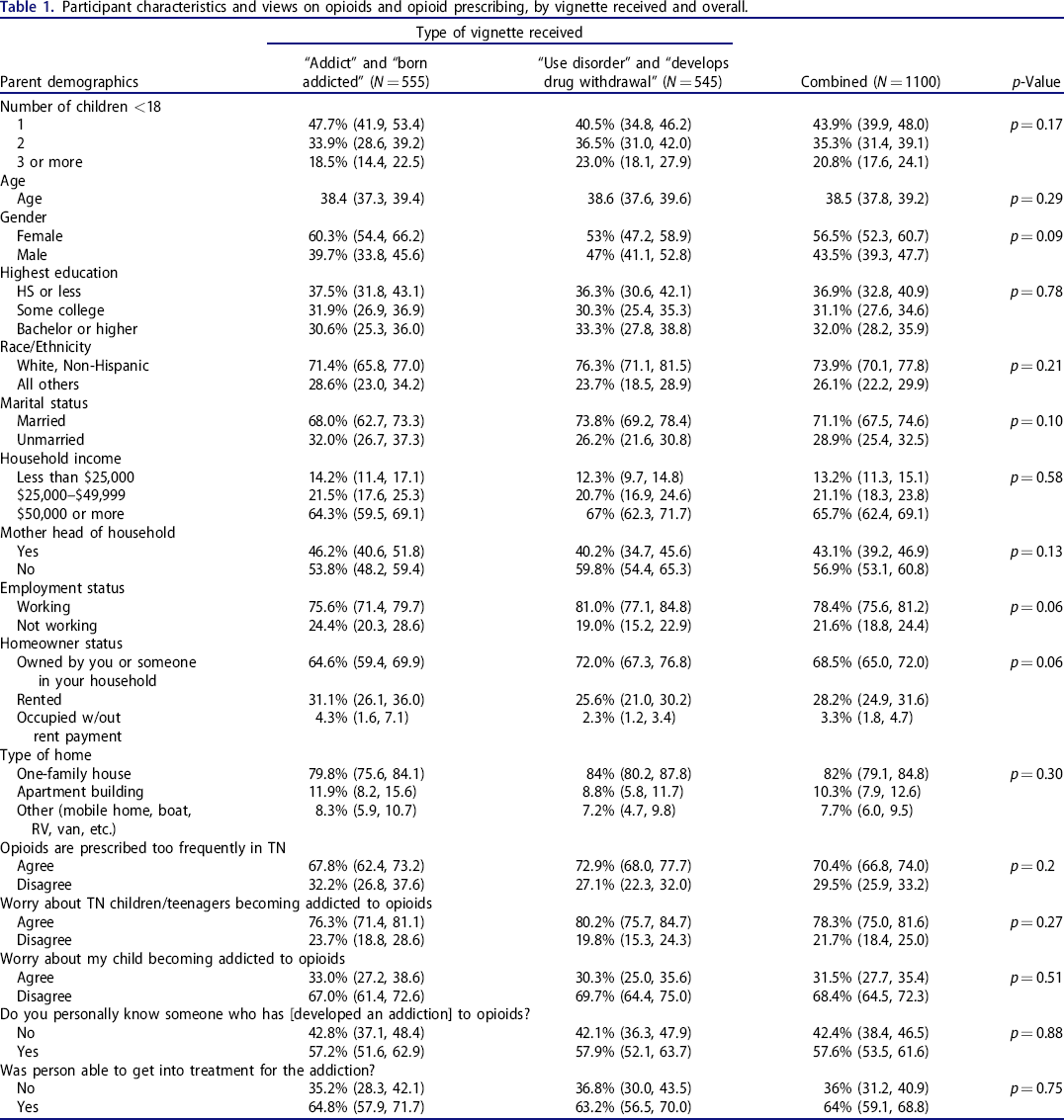
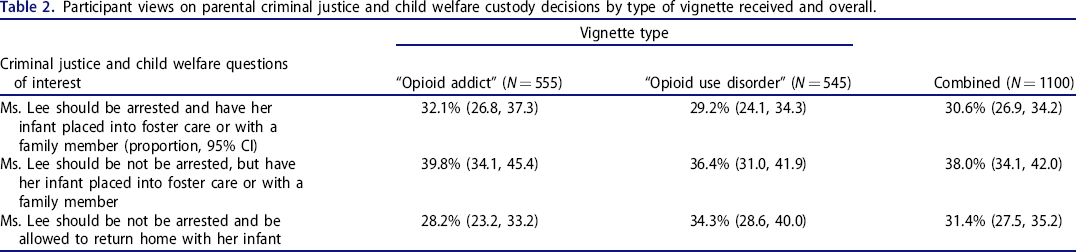
There were 1,100 participants who completed the survey. We observed no statistically significant differences in parent characteristics or prior views and experiences with opioids when stratified by vignette language at the α = 0.05 level (Table 1). There was no evidence to suggest a significant difference in punitive response selection based only on the vignette language (p = 0.27). In the combined sample, 30.6% (95% CI 26.9–34.2%) responded that the mother should be arrested and have her infant placed into foster care or with a family member; 38.0% (95% CI 34.1–42.0%) responded that the mother should not be arrested but have her infant placed into foster care or with a family member; and 31.4% (95% CI 27.5–35.2%) responded that the infant should be allowed to return home with the mother (Table 2). The results from our adjusted model (Figure 1) indicate that the odds of answering a more punitive response among parents who received non-stigmatizing language (“use disorder”) were 0.8 (95% CI 0.59–1.08) times those of parents who saw stigmatizing language (“addicted”) in the vignette. Parents who felt opioids are prescribed too frequently in TN were significantly more likely to answer a more punitive response (aOR 1.5; 95% CI 1.06–2.07).
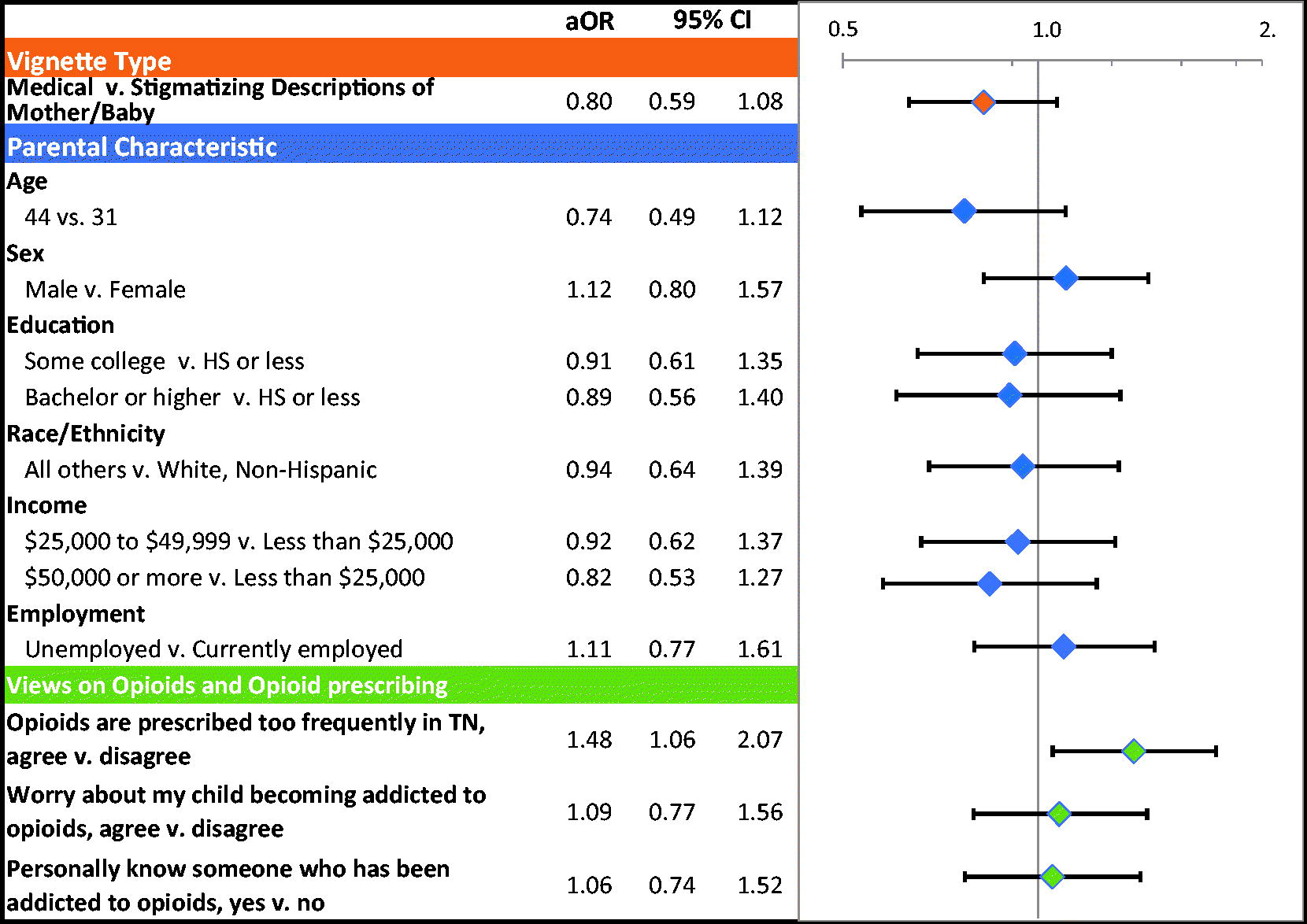
Adjusted ordinal regression assessing factors associated with punitive responses to parental custody at discharge for an opioid-exposed mother-infant dyad.
Participant characteristics and views on opioids and opioid prescribing, by vignette received and overall.
Participant views on parental criminal justice and child welfare custody decisions by type of vignette received and overall.
Review
This study examined the effect of using different terms to describe opioid-exposed mother-infant dyads. Regardless of which vignette a parent received, about one-third of participants felt that the mother who is receiving treatment for her OUD during pregnancy should be arrested, and two-thirds felt that the infant should be placed outside of her care. This finding highlights a high level of stigma toward pregnant women with OUD, including those in treatment. We did not find that the use of stigmatizing terms rather than medically appropriate language to describe the mother and infant significantly affected participants’ responses. Rather, the generally negative views toward mothers with OUD held by parents in Tennessee likely drove the findings we observed.
There has been a rise in punitive policies toward pregnancy and parenting women with substance use disorder in the United States over the past twenty years, despite evidence that they do not result in improved maternal or infant outcomes and have been shown to result in avoidance of prenatal care. 19 – 22 Even though the highly punitive Tennessee law was not renewed in 2016, while in effect it was one of the most punitive statewide policies and may have influenced the views of the parents in our study, yielding a high rate of parents who felt a criminal justice response was justified for a pregnant woman engaged in OUD treatment. Additionally, many parents favored removal of the infant from parental custody, further highlighting the negative views the general public has of mothers with OUD in treatment and their fitness to parent. Pervasive public stigma regarding addiction can result in barriers at the individual level (i.e., fear of stigmatization leading women to avoid care), and the health system and societal level (i.e., underinvestment in social services and addiction treatment; punitive rather than public health-focused policies). 12 , 23
In our final adjusted model, only concern around opioid prescribing in Tennessee, which has historically had one of the highest rates of opioid prescribing nationwide, was associated with more punitive views toward women with OUD, after adjusting for type of vignette received. In the context of a state sanctioning punitive responses to women with OUD as an approach to addressing the harms of increasing opioid use in, it may be that those most fearful of the impact of opioid use in their community have internalized these punitive actions as the appropriate way to address the opioid epidemic. Furthermore, well-intended efforts to reduce excess prescribing may in turn increase stigma toward individuals suffering from OUD.
There are important limitations to our study, including the use of a novel vignette and non-validated single question as our primary outcome measure. Some participants with less medical knowledge about neonatal opioid withdrawal syndrome may have misinterpreted the vignette and thought that if the infant required a prolonged hospitalization, then the mother was not in treatment at delivery, prompting the more punitive responses. Further, some participants may have chosen more punitive responses because the vignette did not specify how much ongoing treatment, support and care the dyad would receive after discharge. Additionally, there were likely unmeasured confounders that could have affected participants responses including urban v. rural location of dwelling, or personal or family history with addiction. Finally, the findings may not be generalizable beyond Tennessee, given the unique policy history in the state. These limitations notwithstanding, our finding of strongly punitive views of mothers receiving OUD treatment highlights the need to promote stigma-reduction interventions to ensure pregnant people with OUD feel well.
Conclusion
Many parents hold punitive views toward mothers receiving OUD treatment that were not altered by using less value-laden language. Efforts to address stigma should include person-first language, treatment-focused narratives, but also must extend beyond the choice of specific terms to address broadly-held perspectives about addiction. 12 , 24
Authors’ contributions
DMS contributed to the study design and drafted the initial manuscript. AH had full access to the data, performed the statistical analyses and takes full responsibility for the accuracy of the results reported. WD and MMD provided study oversight and critically revised the initial manuscript. SWP designed, obtained funding, and provided study oversight and critically revised the initial manuscript. All authors approved the final manuscript.
Footnotes
Disclosure statement
None of the authors report a conflict of interest. The content is solely the responsibility of the authors and does not necessarily represent the official views of the National Institutes of Health.