







Abstract
Background: High-intensity drinking (HID; 8+ U.S. standard drinks for women, 10+ men) is initiated during adolescence/emerging adulthood, increasing risk for negative outcomes, including blackouts. We examined baseline data from a study of risky drinking youth to identify factors associated with HID. Methods: Risky drinkers (ages 16–24) were recruited online (positive 3-month AUDIT-C score) as part of a larger study to examine social media interventions for risky drinking. We used baseline survey data to examine HID in relation to demographics, substance use–related variables, and individual and social factors. Results: Among 931 risky drinkers, 29.8% reported past-month HID, and those with HID reported greater substance use and consequences. In multivariable analysis, HID was associated with male sex; greater social motives, impulsivity, and motivation; lower self-efficacy; and greater likelihood of not living with parents, drinking with important peers, and parental disapproval of posting drinking pictures. When examining age group interactions (16–20; 21–24), underage drinkers with high sensation-seeking scores and lower parental disapproval of posting drinking pictures on social media reported greater HID. Conclusions: Among risky drinking youth, male sex, social motives, impulsivity, higher motivation to and lower-self-efficacy to reduce drinking, living away from parents, more frequent drinking with important peers, and lower parental disapproval of posting drinking pictures on social media were positively associated with HID. Further, HID was associated with greater health consequences, underscoring the need for HID interventions. Such interventions may benefit from enhancing motivation and self-efficacy, particularly in social contexts, as well as increasing positive peer and leisure activities to reduce HID.
Introduction
Adolescents and emerging adults comprise a high-risk group for short- and long-term consequences of alcohol use. 1 Although the risks of binge drinking (typically 4+ U.S. standard drinks for women and 5+ for men) are well-established, high-intensity drinking (HID) may intensify these risks. HID involves consumption of 8+ U.S. standard drinks for biological females and 10+ for biological males. 2 One in nine emerging adults report at least one past 2-week HID episode 3 with men having higher rates of HID versus women. 4 – 7 Peak HID prevalence occurs around ages 21–22 3 , 5 with men peaking (ages 21–22) prior to women (ages 21–24). One in seven high school seniors sustain an HID pattern as emerging adults. 8 , 9 Although HID is more common among underage college students away from home and amongst their peers (10+ drinks = 12.4%, 15+ drinks = 5.1%) compared to same-aged, non–college students (10+ drinks = 9.0%, 15+ drinks = 3.5%), 10 the overall prevalence in youth remains concerning. 11
HID is associated with other substance use 12 , 13 , academic/occupational problems, blackouts, impaired control and driving, injury, and altered brain functioning. 9 , 14 – 17 Emerging adults with HID of 15+ drinks are likely to endorse continued drinking despite serious problems (e.g., blackouts, fighting, legal issues). 18 Further, alcohol-use disorder prevalence among those with HID is more than twice that of those who binge drink only, 19 underscoring the need for targeted prevention interventions, 2 , 18 which should be tailored for young people. 5
Greater understanding of HID-related individual (e.g., motives, negative affect, attitudes) and social influences (e.g., peers, parents) may be particularly useful when creating tailored interventions. 20 For example, drinking motives are potential intervention targets. 21 In college students, coping, social, and enhancement motives are greater among students with HID compared to those with lower drinking. 16 For high school seniors, drinking motives involving coping, enjoying the taste, increasing other drug effects, and compulsion tend to distinguish those who report HID versus less risky drinking. 22 In a treatment sample, 40–60% of adolescents reported HID at baseline, and youth meeting this threshold had more drinking days than binge drinkers and non–binge drinkers, greater cannabis and illicit drug use, and more pronounced alcohol consequences. 23 Over time, high levels of social and enhancement alcohol motives differentiated those with HID versus those without HID, whereas decreasing coping motives were protective.
Internalizing factors (e.g., anxiety or depression symptoms), could also be related to HID, but are relatively unexplored. Instead, depression symptoms and heavy/binge drinking among youth are generally positively associated, with some variation by sex and across development. 24 – 26 Findings for the relationship between anxiety and heavy/binge drinking are mixed depending on the anxiety disorder examined and contextual factors surrounding drinking. 27 – 29 Externalizing factors (e.g., impulsivity, sensation seeking) could also be related to HID, given their associations with binge drinking. 30
Despite the robust role of social influences on youth drinking, 31 – 33 social factors are under-explored but likely associated with HID. For example, HID is more common on holidays, special occasions, and during sporting events, which commonly involve socializing with peers. 17 Similarly, college students not residing with parents are more likely to report HID. 10 Parent relationship quality is protective for heavy episodic drinking during the transition to emerging adulthood; 34 thus, it is plausible that parental factors may be protective against HID. For example, adolescents’ perceptions of parental disapproval of drinking are protective for consumption, 35 which remains true in the college years. 36 Given social media's ubiquity, youths’ perceptions of parental disapproval of posting alcohol pictures on social media could also be protective, as research shows that those engaging in this behavior have greater alcohol use. 37 , 38
To inform future targeted prevention efforts, we examined individual and social factors associated with HID among adolescents and emerging adults who screened positive for past 3-month risky drinking in a randomized controlled trial (RCT) of a social media–delivered alcohol intervention. 39 We characterize differences between risky drinkers with and without past-month HID on demographics and substance use-related factors. We hypothesized that those with HID would have a more severe profile of substance use, consequences, and injury/legal involvement, and that men and older ages would be more likely to report HID than women and younger ages. Given prior research, 23 when examining individual and social influences, we hypothesized that enhancement and social motives would be positively correlated with HID. Although the literature is mixed regarding coping motives and HID, we expected that coping motives and negative affect (depression, anxiety) would be positively related to HID. Similarly, we expected greater impulsivity and sensation seeking among those with HID, whereas we did not have directional hypotheses for motivation or self-efficacy to reduce drinking. We also hypothesized that HID would be positively associated with drinking with important peers and that parental factors would be protective. Finally, given developmental differences in adolescents and emerging adults, we conducted exploratory analyses examining interactions in individual and social factors by age group (16–20; 21–24), expecting parental influences would be stronger among underage drinkers.
Method
Procedures
Procedures received approval from our Institutional Review Board. Details regarding online study procedures were previously published. 39 Over 10 recruitment waves (2017–2019), we placed Facebook/Instagram ads for our study, which directed viewers to an online consent and screening survey. Trial eligibility included: age 16–24, U.S. residence, and a positive past 3-month AUDIT-C score (ages 16–17 years: ≥3 females and ≥4 males; ages 18–24 years: ≥4 females and ≥5 males). 40 – 44 To promote sample diversity, we recruited using ethnic affinity targeting and diverse ads depicting individuals with varying racial and ethnic characteristics.
Of 11,914 individuals who self-administered our screening survey, we invited 1,541 who screened positive on the AUDIT-C and passed verification processes, 45 , 46 to complete a baseline assessment ($30 gift card compensation) and submit a selfie for identity confirmation. Of 1,015 participants completing the baseline, 46 did not send a selfie, eight did not pass the selfie verification, four were too busy for the study, and two timed out. We enrolled 955 participants in the RCT with randomization to three 8-week social media conditions: social media intervention with incentives, social media intervention without incentives, and control. Comparison of those who completed enrollment to those who did not revealed that enrolled participants were older (M = 20.4 years, SD = 2.6 vs. M = 20.1 years, SD = 2.5; p < .05), more likely to be female (54.5% vs. 39.2%, p < .001), and had slightly lower AUDIT-C scores (M = 6.6, SD = 1.9 vs. M = 7.0, SD = 2.0; p < .001), but these two groups did not differ on racial or ethnic distribution.
The 8-week intervention conditions are detailed elsewhere. 47 Briefly, interventions involved electronic coaches posting and replying to predetermined content consistent with motivational interviewing and cognitive-behavioral approaches to address risky drinking. The control condition included entertaining social media content as an attention-placebo. Participants completed a 3-, 6-, and 12-month online follow-up assessment.
Measures
Demographics
Demographics (e.g., age, race, ethnicity) were measured based on prior work 48 and national studies. 49 , 50
Alcohol and other drug consumption
Participants completed a 30-day online Timeline Follow Back calendar 51 – 53 and were coded as having past 30-day HID at least once (8+ drinks for women, 10+ for men) or not at all. We also calculated total number of alcohol use and HID days. To characterize other drug use, we queried past 3-month use with response options 54 of 0 (never/none) to 7 (more than once a day) for: cannabis; cocaine, crack, or methamphetamine; ecstasy or molly; other illegal or recreational drug; misuse of prescription opioid pain relievers; misuse of prescription medications for sleep or anxiety; or misuse of prescription medications for ADHD. We summed these items for a total drug use score.
Substance use consequences, injury/legal factors, and prior treatment
For past 3-month alcohol consequences, we modified the Brief Young Adult Alcohol Consequences Questionnaire (see 39 for details) by removing two rarely endorsed items and substituting two original items reflecting property damage and fighting. 55 – 57 We used a total consequences score among 24 items (alpha = 0.93).
Driving under the influence was measured using a 3-month version of the Young Adult Driving Questionnaire's give drinking and driving items. 58 Responses (e.g., “In the past 3 months, how many times did you drive within one hour after drinking one or two beers or other alcoholic beverages?”) ranged from 0 (never) to 4 (10+ times) and we computed total scores (alpha = 0.85).
Lifetime nonfatal overdose experience was queried 59 : “In your lifetime, how many times have you lost consciousness or taken too much drugs, alcohol, or medications/pills, or more than your body could handle?”
Past 3-month intentional injuries due to a physical fight or being physically attacked was queried (yes/no) with an item adapted from the Adolescent Injury Checklist. 60 Frequency of lifetime arrests (none, once, more than once) was based on Add Health. 61
Lifetime mental health and substance-use treatment were queried with separate yes/no options: “Have you ever received psychological or emotional counseling?” and “Have you ever attended an alcohol or drug treatment center, including outpatient or inpatient counseling?” 61
Individual and social factors
Past 2-week depression and anxiety symptom severity were assessed with the Patient Health Questionnaire-8 62 and Generalized Anxiety Disorder-7. 63 Responses used a 4-point Likert scale (not at all to nearly every day); clinical cutoffs ≥10 indicated a positive screen.
Five motives items were abbreviated based on the Drinking Motives Questionnaire–Revised, 64 similar to prior research. 65 We calculated a mean of two coping items (“because it helps you when you feel depressed or nervous” and “to cheer you up when you're in a bad mood”; alpha = 0.83). One item each queried social (“because it makes social gatherings more fun”) and enhancement (“because you like the feeling”) motives. Items were selected based on prior subscale factor loadings, 64 , 66 relevance to the population, and reading ease. Participants rated how often their drinking was motivated by each domain (response options: 1 = almost never/never to 5 = almost always/always).
Current motivation (i.e., importance of cutting back drinking) and self-efficacy (i.e., confidence to do so “if you wanted to”) were assessed using motivational interviewing-based rulers 67 ranging from 1 (not at all) to 10 (very).
Impulsivity used the total score for the 8-item Barrett Impulsivity Scale 68 (alpha = 0.83). Sensation seeking was measured with the 4-item brief Sensation Seeking Scale (alpha = 0.78).
Based on prior work, 48 we quantified past 3-month frequency of drinking with important peers (“people with whom you have had contact during the past 3 months who are most important to you”). For each of five nominated individuals, participants reported frequency of alcohol use (1 = almost never/never to 5 = almost always/always) with that person, and we derived a mean score from these items.
Living with parents was assessed with a checklist of who participants lived with (yes/no). 61 Parental disapproval of regular drinking 69 was queried by asking: “How wrong do your parent(s) (or the people who raised you) feel it would be for you to drink regularly?”; response options included a 4-point Likert scale (very wrong to not at all wrong). Parental attitudes regarding their child posting drinking pictures on social media was assessed with an item 70 asking how much they agree or disagree with the statement that their parents (or the other people who raised me) “would be upset if they found online pictures of me drinking.” Five-point Likert responses ranged from strongly disagree to strongly agree.
Analyses
We calculated descriptive statistics for the total sample and by group: risky drinkers who did or did not report past 30-day HID. Using independent samples t-tests and chi-squared analyses, we compared those with and without recent HID on the individual and social variables above. We then used logistic regression to evaluate the simultaneous relationships between demographics and individual and social variables significant in bivariate comparisons in relation to the presence or absence of past 30-day HID. Variables included in the model were correlated |< .50|. Finally, interactions by age group (underage drinkers ages 16–20 vs. legal drinkers 21–24) with individual and social factors were tested individually in the model.
Results
Participant characteristics
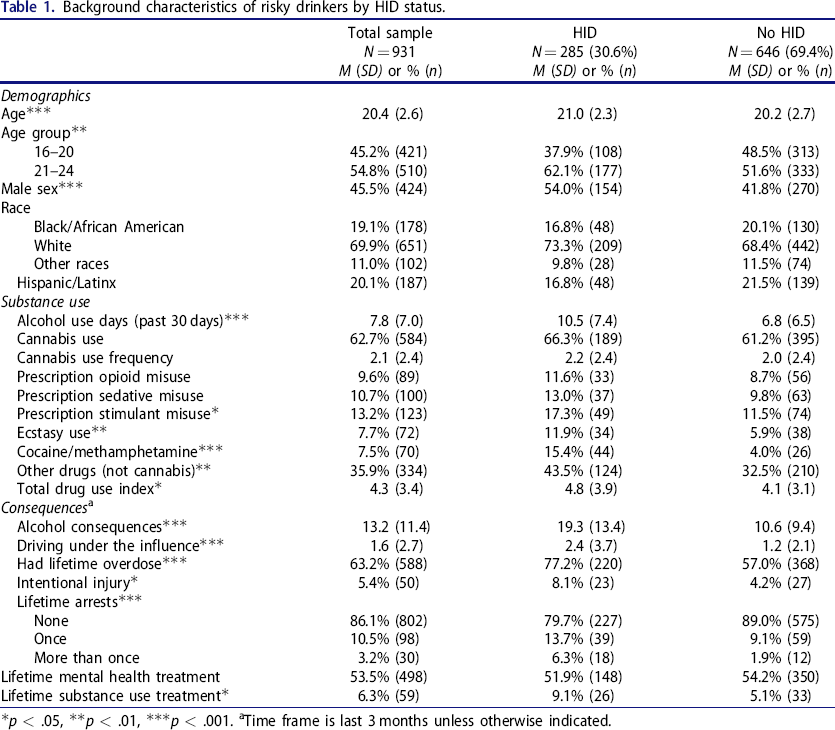
Table 1 displays demographics based on HID status. Participants were M = 20.4 years old (SD = 2.6 years) and 54.5% were female. They were mostly White (69.9%) with representation from Black/African American persons (19.1%) and Hispanic or Latino individuals (20.1%). Risky drinkers with HID were significantly older and were more likely to be men and to have higher levels of education than those without HID.
Background characteristics of risky drinkers by HID status.
p < .05,
p < .01,
p < .001.
Time frame is last 3 months unless otherwise indicated.
Substance use, consequences, injury/legal factors, and treatment
The mean number of HID days for the 29.8% of participants reporting past-month HID was 2.7 (SD = 3.1, range = 1–29). Individuals with HID had a higher likelihood of most substance use–related risk factors (Table 1), including significantly more drinking days, higher total drug use, and greater use of illicit drugs than those without HID. When examining misuse of prescription drugs, only stimulants were more likely to be used by those with HID. Risky drinkers with HID reported almost twice as many recent alcohol consequences, more frequent impaired driving, and more frequent lifetime nonfatal overdose than participants without HID. Those with HID were also more likely to have a recent intentional injury and at least one lifetime arrest. Mental health treatment did not differ significantly by HID status, but substance-use treatment was significantly greater among those with HID than those without.
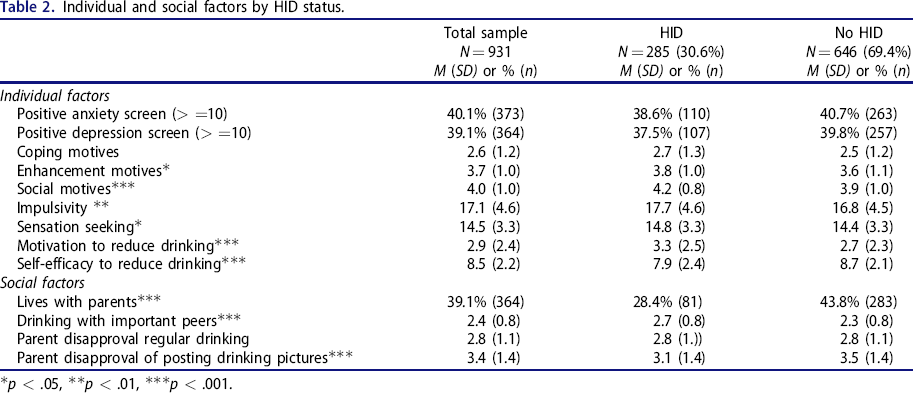
Individual and social factors by HID status.
p < .05,
p < .01,
p < .001.
Individual and social factors
Table 2 shows differences in individual and social factors by HID status. Those with HID reported significantly higher enhancement and social motives for alcohol consumption versus those without HID. Also, HID was associated with higher scores on impulsivity and sensation seeking. While participants with HID rated their motivation to reduce alcohol use significantly higher than those without HID, their self-efficacy to do so was significantly lower.
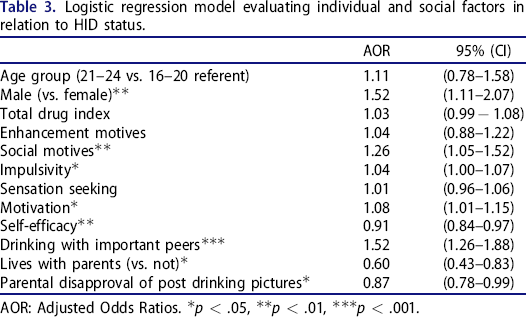
Logistic regression model evaluating individual and social factors in relation to HID status.
AOR: Adjusted Odds Ratios.
p < .05,
p < .01,
p < .001.
Frequency of drinking with important peers was higher among those with HID than those without. Regarding parental influences, participants with HID were significantly less likely to live with parents. Although perceptions of parental disapproval of posting alcohol pictures was lower for those with HID versus those without, parental disapproval of regular drinking was not related to HID.
Multivariable logistic regression analyses
The initial model focused on the main effects of demographics, and individual and social factors, in relation to HID status (Table 3). Risky drinking individuals with HID were significantly more likely to be male and not live with parents; they had greater social motives, impulsivity, and motivation to reduce drinking along with lower self-efficacy. They had greater frequency of recent drinking with peers and lower parental disapproval of posting drinking pictures. In this model, total drug use, enhancement motives, and sensation seeking did not significantly differentiate risky drinkers with HID.
Subsequently, we tested interaction terms based on age group (16–20; 21–24) with individual and social factors in the model. Age-group interaction terms for sensation seeking (p < .05) and parental disapproval of posting drinking pictures (p < .01) were significant. For underage drinkers, more sensation seeking increased their probability of HID, whereas sensation seeking did not affect HID risk for older drinkers; similarly, for underage drinkers, perceptions that parents would be upset if they posted drinking pictures online was protective, whereas it was nonsignificant for legal drinkers (Figures 1 and 2).
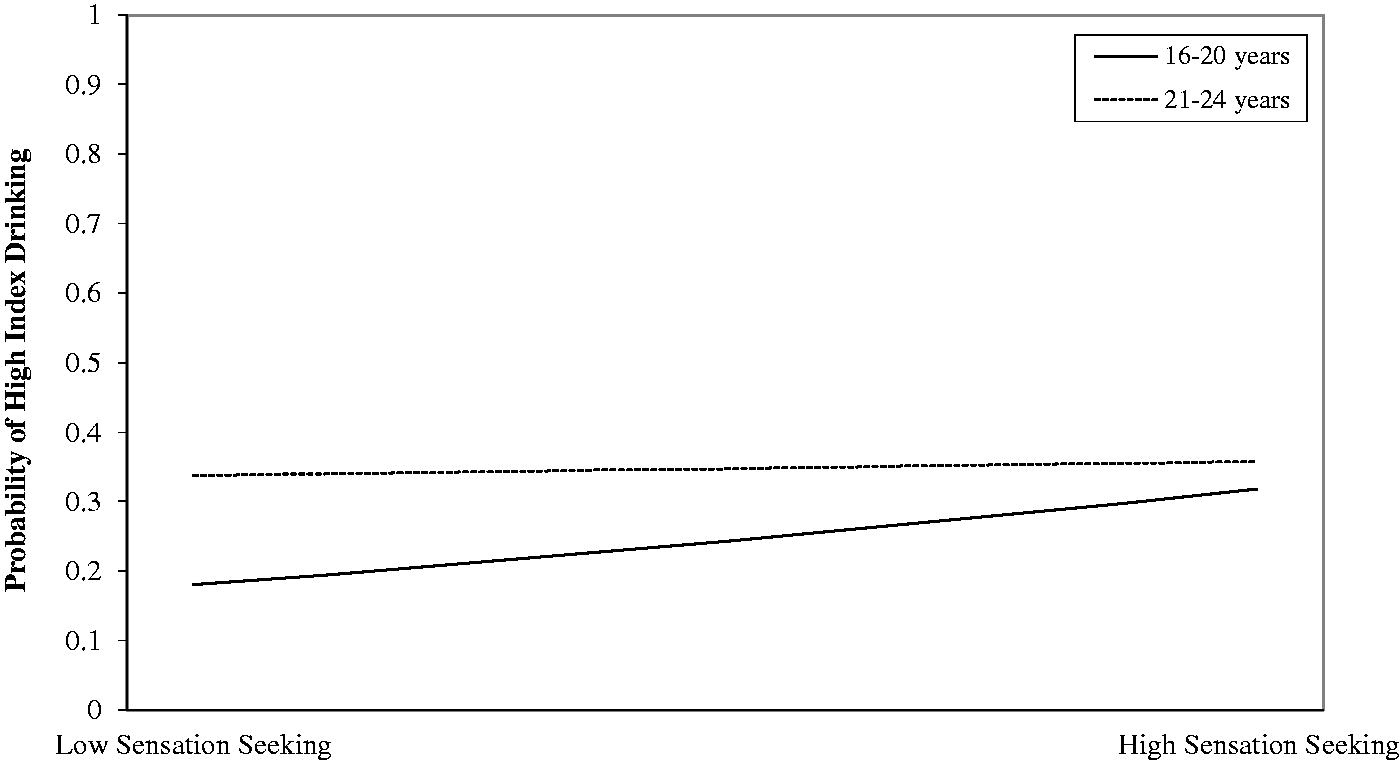
Interaction between age group and sensation seeking for HID.
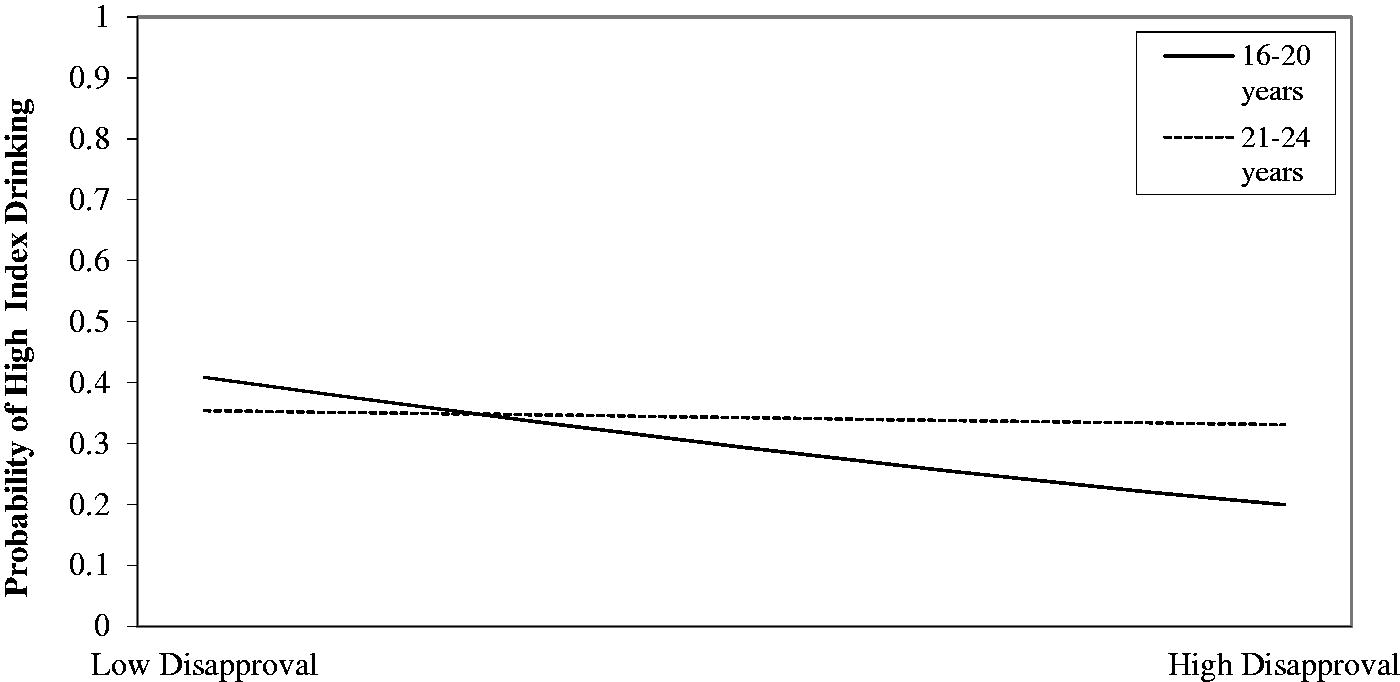
Interaction of age group by parental disapproval of posting drinking pictures online for HID.
Discussion
About a third of risky drinkers reported HID, whereas nearly two-thirds did not, underscoring a severity spectrum that should be considered when developing interventions to reduce consequences, such as blackouts. In addition to including a selective prevention sample, this research is novel in differentiating individual and social factors that set high-intensity drinkers apart from other risky drinkers.
Findings replicate and extend studies showing greater problem severity among youth with HID. Like others, 12 , 13 our data indicated that risky drinkers with HID drank more frequently, had more alcohol-related consequences, and were more likely to report impaired driving than their risky drinking counterparts who did not report past-month HID. We add novel findings that young people with HID were more likely to have a prior overdose, a past arrest, a recent intentional injury, and prior substance-use treatment. Finally, data suggest that the relationship between HID and drug use is nuanced, showing no significant association with cannabis use frequency, and a positive association with illicit drug use, prescription stimulant misuse (not prescription opioids or sedatives), and total drug -use involvement. These findings raise concern regarding consequences of concurrent or simultaneous of stimulants/other illicit drugs. Ecological momentary assessment studies are needed to understand the timing of co-use and associated consequences. Regardless, given our data showing substance-use consequences and legal/health consequences among risky drinkers with HID, and prior research suggesting that adolescents and emerging adults with higher alcohol consumption are less likely to respond to interventions, 71 , 72 our findings underscore the importance of identifying novel intervention approaches for HID.
To this end, we found key individual and social factors that could be addressed in interventions for those reporting HID. Specifically, although coping motives are often associated with more problematic drinking patterns, 73 coping motives, anxiety, and depression measures were unrelated to HID status among these risky drinkers. These findings mirror literature showing inconsistent associations between these factors and heavy drinking. 27 , 29 Risky drinkers with HID reported greater motivation to change their drinking, potentially reflecting their experience of alcohol-related consequences, overdose, injury, and legal involvement. However, motivation to reduce drinking was relatively low (∼3 out of 10), suggesting that many of these individuals are likely contemplative about reducing drinking. Moreover, the negative relationship between self-efficacy to reduce drinking and HID suggests a more entrenched pattern or set of circumstances surrounding drinking that may inhibit one's perceived ability to change, potentially reflecting their awareness of impulsivity and/or the role of social influences. Motivational interviewing 74 can be used to engage and bolster the self-efficacy of pre-contemplative drinkers, and could be studied among those with HID.
Social motives and influences distinguished those with HID. Specifically, drinking for social reasons was higher amongst those with HID versus risky drinkers without HID. Therefore, HID may reflect social activities (e.g., partying) and/or a propensity for risk-taking (i.e., consistent with findings for impulsivity and sensation seeking herein). In a parallel manner, frequency of drinking with “important” peers was positively associated with HID, highlighting peer relationships as prominent intervention targets for this unique subgroup. Although we do not have data about peers’ HID, peers are amongst the most robust influences on adolescent and emerging adult drinking. 31 – 33 Further, because living with parents was protective, it may be that individuals with greater independence have greater exposure to opportunities for heavy drinking with peers. Next, perceptions that parents disapprove of posting drinking pictures on social media were protective for HID and amplified among underage drinkers. This perception may reflect anticipated regret, which could result in less risky drinking, 39 and may be malleable with intervention, however, only if parents convey such disapproval, which could be beneficial public health messaging for parents. Those with HID could also benefit from emphasis on increasing motivation, confidence, and skills for identifying cognitive and behavioral strategies to reduce drinking in social situations, encouraging interaction with peers who drink at or below recommended levels, and/or by assisting youth in cultivating and sustaining non-drinking enjoyable peer-based activities. Strategies that address social network factors or capitalize on identification of opinion leaders 75 or strategic players embedded proximally in one's social network 76 should be considered.
Consistent with prior research 4 – 7 , we found that male sex and older age were associated with increased HID risk, despite the lower HID threshold among females. However, among younger, underage risky drinkers, risk for HID was amplified among those with greater sensation seeking and lower perceptions of parental disapproval of posting drinking pictures, suggesting that early interventions are needed. While school- or university-based interventions capture some younger-aged individuals, it is a challenge for the field to identify novel ways of reaching this at-risk population in health-care or other community settings. 77 – 80 In current times (i.e., coronavirus pandemic), no-contact, virtual, and scalable approaches to preventing substance-use problems are urgently needed 81 and these could include approaches using telemedicine or social media, 82 given our identification of this sample via social media recruitment.
Regarding limitations, recall bias is a concern of self-report data, yet our use of a Timeline Follow Back with event prompts aids recall and is a strength relative to surveys. We were limited to a 30-day HID measure, leaving more sporadic or seasonal HID patterns undetected. Although underreporting may be a concern, 83 research supports the validity of self-reported alcohol data. 84 Demand characteristics were likely lessened because surveys were confidential, participants knew that data would be separate from their names, and because there were no existing relationships between researchers and participants wherein a power differential could influence reporting. Some measures were limited to single items, potentially limiting variation. Further, the cross-sectional nature of these data preclude causality (e.g., consequences may not have occurred due to HID episodes). Additionally, factors across socio-ecological levels (e.g., alcohol policy, alcohol outlet density, parent/peer drinking behaviors) were not measured but can influence alcohol use. We recommend that such constructs be incorporated into future HID work. Finally, results may not be generalizable at a nationally representative level to all young risky drinkers.
By examining individual and social characteristics addressable in interventions, this study illuminates important differences that distinguish high-intensity drinkers from other risky drinkers. Findings suggest that behavioral interventions address individual characteristics, like sensation seeking, impulsivity, motivation, and self-efficacy, while considering social motives for use, harnessing positive peer influences, and potentially parents (at least for underage drinkers). Future research should test interventions for this population and determine individualized content and dose required to reduce HID.
Footnotes
Author contributions
Dr. Bonar led the analyses and drafting of the article and, assisted by Ms. Souweidane, designed and oversaw the study and wrote the first draft of the manuscript. Dr. Walton is principal investigator of the study from which data were obtained and was responsible for overall scientific direction as well as providing feedback on analyses and editing the manuscript. Drs. Blow, Bohnert, and Bauermeister are co-investigators on the study who provided support with analyses and important scientific content as well as contributing to the manuscript draft. Dr. Young is a consultant on the study and provided scientific guidance as well as contributing to the manuscript draft. All authors approve the manuscript and its submission to this journal.
Disclosure statement
The authors do not have any personal financial interests related to the subject matters discussed in this manuscript, with two exceptions. MW is a minor shareholder in Facebook and has a conflict-of-interest plan approved by the University of Michigan. SY has received an unrestricted gift from Facebook, on file with the University of California, Los Angeles (his prior academic appointment).
