






Abstract
Background:Since 2017, states, insurers, and pharmacies have placed blanket limits on the duration and quantity of opioid prescriptions. In many states, overlapping duration and daily dose limits yield maximum prescription limits of 150–350 morphine milligram equivalents (MMEs). There is limited knowledge of how these restrictions compare with actual patient opioid consumption; while changes in prescription patterns and opioid misuse rates have been studied, these are, at best, weak proxies for actual pain control consumption. We sought to determine how patients undergoing surgery would be affected by opioid prescribing restrictions using actual patient opioid consumption data. Methods: We constructed a prospective database of post-discharge opioid consumption: patients undergoing surgery at one institution were called after discharge to collect opioid consumption data. Patients whose opioid consumption exceeded 150 and 350 MME were identified. Results: Two thousand nine hundred and seventy-one patients undergoing 54 common surgical procedures were included in our study. Twenty-one percent of patients consumed more than the 150 MME limit. Only 7% of patients consumed above the 350 MME limit. Typical (non-outlier) opioid consumption, defined as less than the 75th percentile of consumption for any given procedure, exceeded the 150 MME and 350 MME limits for 41 and 7% of procedures, respectively. Orthopedic, spinal/neurosurgical, and complex abdominal procedures most commonly exceeded these limits. Conclusions: While most patients undergoing surgery are unaffected by recent blanket prescribing limits, those undergoing a specific subset of procedures are likely to require more opioids than the restrictions permit; providers should be aware that these patients may require a refill to adequately control post-surgical pain. Real consumption data should be used to guide these restrictions and inform future interventions so the risk of worsened pain control (and its troublesome effects on opioid misuse) is minimized. Procedure-specific prescribing limits may be one approach to prevent misuse, while also optimizing post-operative pain control.
Introduction
In response to a worsening opioid epidemic and increasing awareness of the adverse effects of opioids, multiple states, insurance companies, and pharmacies have developed regulations on opioid prescribing since 2017. 1 , 2 While the effect of these regulations on prescribing and adverse events have been evaluated through the lens of large-scale claims data, prescription patterns are an indirect proxy and only weakly corrected with patient opioid consumption. 3 , 4 These policies have not yet been evaluated in the context of actual patient opioid consumption.
In particular, individual states have implemented several wide-ranging policies to reduce inappropriate prescribing of opioids. 1 , 2 These initiatives have included mandates that prescribers access state prescription drug monitoring programs (PDMP) or obtain education regarding evidence-based opioid prescribing, as well as more direct restrictions on opioid prescriptions. While efforts vary widely by state, twenty-six states had passed laws by the end of 2017 that impose mandatory limits on the prescribing or dispensing of opioids for acute pain. 1 This number had increased to 39 by the end of 2019. Fourteen states impose limits on the daily dosage of opioids that can be prescribed for acute pain. 1 In addition, multiple states assert limitations on the duration of opioid prescriptions, with the duration ranging from 3 to 7 days. 1 Importantly, these limitations generally apply to all patients, including post-operative patients, though limited and conditional exceptions exist in some states pending additional provider authorization.
Similar efforts to curb inappropriate opioid use have been implemented by pharmacies. In 2018, one of the United States’ largest for-profit pharmacies limited initial acute opioid prescriptions to seven days and daily doses of 50 morphine milligram equivalents (MME). 5 Multiple pharmacy benefit managers have similar restrictions, limiting the initial opioid prescription to a seven-day supply and imposing restrictions on refills. 6 Given the disparate nature of the state and pharmacy regulations, the combined impact of opioid prescribing policies may be extreme. For instance, the aforementioned pharmacy's daily 50 MME limit constrains total prescription size in most states with a seven-day limit to a maximum of 350 MME. However, if a patient resides in a state with a three-day limit, the total prescription would be limited to 150 MME.
Multiple entities have also instituted limits on opioid refills. However, evidence suggests that a significant fraction of post-surgical patients require opioid refills to adequately treat their pain; a seven-day prescription may be inadequate for some patients. 2 , 4 , 7 A recent study found that 11–39% of surgical patients require a refill after a seven-day prescription, particularly among those undergoing neurosurgical or orthopedic procedures. 7 In the same way, the potential unintended consequences of opioid refill restrictions have been examined with real-world data, we must evaluate the impact of prescription size limitations, as little is known about where actual patient consumption falls in the context of these limits, in part due to the scarcity of consumption data. 2
In the current study, we sought to examine how state prescription limits would affect opioid-naïve surgical patients. We utilized a unique resource—a prospective institutional database of surgical patients’ observed post-discharge opioid consumption—to understand how prescribing limits relate to patient's actual consumption patterns.
Methods
We prospectively evaluated opioid consumption of all opioid-naive post-operative patients at our large academic medical center from October 1, 2017 to June 30, 2018. 8 Pre-surgery opioid exposure was determined by examining the record of prescribed medications in the medical chart. Opioid naïve patients were defined as having at least 30 days without opioid exposure. Procedures with <10 patients were excluded. Prescribers were not given any prescribing guidelines or requirements. Variables collected by abstraction from the medical record included baseline demographics, preoperative medications, perioperative surgical data, discharge prescriptions, and opioids dispensed. Discharged post-surgical patients were called by research staff at defined intervals within a month after discharge to evaluate opioid consumption. Patients were verbally consented to the phone. Patients were asked to obtain their prescriptions and count the remaining tablets. The initial prescription size was confirmed via chart review. Consumption of opioid medications was calculated from the amount filled compared with the number remaining; the accuracy of this approach to measure opioid consumption has been validated. 8 , 9 Queries were continued at regular intervals, up to one month, until a patient indicated that they were no longer taking opioid medications or their initial prescription was depleted; no patients were consuming opioids from the initial prescription beyond the one-month follow-up. Consumption values were converted to oral morphine milligram equivalents (MMEs) by standard conversions established by the Centers for Disease Control and Prevention. 10
Patients were excluded if any of the following were present: no working telephone number; additional surgeries or reoperation identified; readmission unrelated to pain; or incomplete medical records. For this study, we only evaluated opioid-naive patients. Surgical procedures were excluded if they had <10 patients in our dataset. The percentage of patients, by surgical procedure type, whose opioid consumption exceeded 150 and 350 MME was calculated. We also identified procedures for which the median and 75th percentile of opioid consumption exceeded these thresholds. We chose to examine the 75th percentile as prior studies and guidelines have used this value as an outlier threshold for typical opioid consumption. 11 – 13
All data were collected and managed using Research Electronic Data Capture. 14
The study was reviewed and approved by the institutional review board at our institution.
Results
A total of 2,971 opioid naïve patients were called after surgery to measure opioid consumption after discharge. Our validated telephone survey had a response rate of 79%. After applying the inclusion and exclusion criteria described above, 1,849 patients undergoing one of 54 distinct surgical procedures were included in our analysis (Supplemental Figure 1).
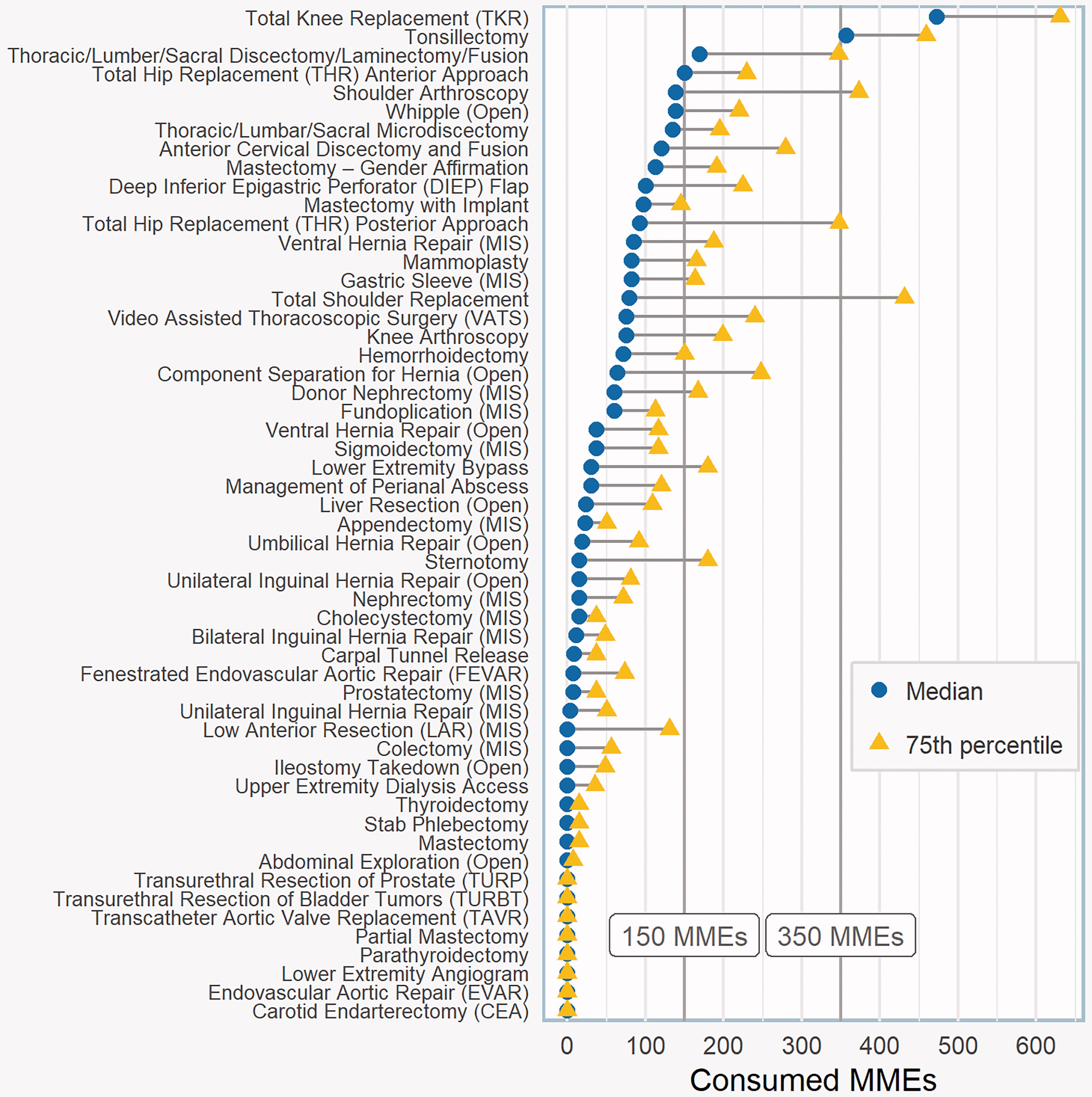
The median reported opioid consumption for each procedure (blue circle) and 75th percentile of reported opioid consumption (yellow triangle) are shown.
Overall, 21% of patients consumed more than 150 MME after discharge, and 7.3% of patients consumed more than 350 MME (Table 1). Procedure-specific analysis showed that 41 (76%) procedures included some patients who consumed >150 MME. The median consumption exceeded 150 MME for 4 (7.4%) procedures (Figure 1). The 75th percentile of consumption exceeded 150 MME for 22 (41%) procedures. Orthopedic, neurosurgical, and complex abdominal procedures most commonly exceeded this limit.
Numbers of patients and procedures that exceeded the 150 MME and 350 MME limits.

Twenty-five (46%) procedures included some patients who consumed >350 MME. The median consumption exceeded 350 MME for only 2 (3.7%) procedures. The 75th percentile of consumption exceeded 350 MME for 4 (7.4%) procedures. Consumption after orthopedic and spinal procedures most commonly exceeded this limit.
Procedure-specific volume and consumption estimates are available in Supplementary Table 1.
Discussion
In the context of the country's worsening opioid epidemic, there has been a national push to reduce opioid prescribing after discharge—with the important goal of reducing opioid misuse and diversion to other individuals. As a result, many limits on initial opioid prescribing after hospital discharge have been enacted. While they represent important initial efforts to curb unnecessary prescribing, these limits may have unintended consequences for a specific subset of post-surgical patients. To our knowledge, we have performed the largest study evaluating these policies in the context of the patient's observed prescription opioid use. Encouragingly, we found that most patients are unaffected by these limitations: the median opioid consumption for almost all surgical procedures fell below both the 150 MME and 350 MME limits. Nonetheless, a significant fraction of patients may still be affected by these policies. We considered below the 75th percentile of opioid consumption to represent typical consumption for each procedure. For procedures where typical consumption exceeds both the 150 and 350 MME limits, there will likely be patients whose post-surgical pain may not be appropriately controlled with these limits. Prior literature has shown that undertreatment of post-surgical pain may lead to the development of chronic pain and patients seeking alternate, sometimes illicit, sources of analgesia. 15 , 16 Our findings are consistent with prior research showing that orthopedic, neurosurgical, and complex abdominal procedures are associated with the highest amounts of opioid consumption. 7
These findings have three important implications. First, providers should be aware of the subset of procedures for which patients may require more opioids than initial prescribing limits allow, and should monitor closely to see if a refill is appropriate. Second, consumption data should inform the evidence-based revision of these prescription limits to minimize their unintended consequences. Finally, blanket prescribing limits alone do not motivate optimal opioid prescribing in surgery; additional complementary efforts are needed to achieve broader results.
Consumption data can be used to inform prescribing limitations
This study highlights how consumption data can be used to adapt prescribing limits and other regulations so they more precisely minimize excess opioid prescribing while also promoting appropriate early pain control and tailoring prescribing to individual needs.
To optimize opioid use post-operatively, we recommend procedure-specific prescribing limits. Tailored prescribing limits that reflect actual consumption patterns at the level of the surgical procedure would allow clinicians to more appropriately align their prescriptions with the anticipated needs of patients. For example, standardizing these limits across all states at the 75th percentile of MME consumption may still reduce excess opioid prescribing while minimizing unintended consequences of undertreating pain. However, increasingly restrictive opioid prescribing limitations—without parallel efforts to address the needs of all patients—may cause the pendulum on opioid prescribing for surgical pain to overcorrect for the subset of patients undergoing painful orthopedic, neurosurgical, and complex abdominal procedures.
Others have also advocated for procedure-specific prescribing limits; 2 – 4 the current study provides the data to demonstrate how procedure-specific limits might be developed. The results indicate procedures where opioid restrictions may lead to under-prescribing, as well procedures for which current limits permit adequate prescribing. As shown in Figure 1, we found that the 75th percentile of consumption was non-zero and below 150 MMEs for many procedures, including mastectomy with implant, Nissen fundoplication (MIS), ventral hernia repair (open), sigmoidectomy (MIS), management of perianal abscess, hepatic resection (open), appendectomy (MIS), umbilical hernia repair (open), unilateral inguinal hernia repair (open), nephrectomy (MIS), cholecystectomy (MIS), carpal tunnel release, FEVAR, prostatectomy (MIS), unilateral or bilateral inguinal hernia repair (MIS), low anterior resection (MIS), colectomy (MIS), ileostomy takedown (open), upper extremity dialysis access, thyroidectomy, and mastectomy.
Complementary efforts are needed beyond state limits
Blanket prescription limits are one tool for reducing opioid misuse; however, without additional complementary efforts, prescribing limits fail to incite the optimal use of prescription opioids among surgical patients. Consumption data, as leveraged in this study, can be used to build more precise complementary tools. Evidence-based surgeon education, especially on anticipated population-specific opioid usage and guidance on non-opioid analgesia, is one such tool that has shown promising results. 17 , 18 Other groups have established procedure-specific recommendations for opioid prescriptions after surgery. 19 Individual patient-level personalization using predictive modeling techniques is also being used at some institutions. 20
Electronic prescribing of controlled substances (EPCS), or the ability of clinicians to easily create an opioid prescription and refill by virtual signature, is another important adjunct that allows clinicians to feel comfortable with smaller initial prescriptions while also promptly fulfilling the needs of patients, with ongoing post-surgical pain, who require to refill prescriptions. 21
In addition, this study emphasized the fact that a subset of patients undergoing painful orthopedic, neurosurgical, and complex abdominal procedures have high-opioid consumption, relative to other commonly-performed surgical procedures. This represents an opportunity to developed tailored treatment pathways for these procedures, such as Enhanced Recovery After Surgery (ERAS) protocols—to reduce surgical pain, leverage non-opioid analgesia, and develop other adjuncts to pain control. 22
Limitations
An important limitation of our study is that the consumption patterns of opioid-exposed patients were not examined. This is a pervasive problem in surgical opioid literature: most existing post-surgical opioid prescribing research applies to opioid-naive patients only. 15 , 23 Treating the post-surgical pain of opioid-exposed patients is a space largely left up to clinical intuition. Moreover, while our results undoubtedly expose potential areas of under-prescribing, some findings of the current study, including procedure-specific patterns, may not be generalizable to all patient populations, as the current study utilizes consumption data from a single institution.
Furthermore, our assessment of post-discharge opioid consumption did not include any corresponding assessment of a patient's reported pain intensity or severity. This additional data would help contextualize the observed consumption data, and permit a greater understanding of how opioid prescribing limitations relate to post-surgical pain control. In addition, we do not examine whether quantities consumed above the 150 and 300 MME limits represent clinically significant amounts. Some individuals, who consumed just slightly above the defined limits, are unlikely to be clinically significantly impacted by the restriction. However, our findings strongly illustrate an unintended consequence of the blanket limitations; further consideration is needed to either deliver personalized post-operative opioid prescribing or facilitate greater access to opioid prescription refills for patients who are negatively impacted by the blanket limitations.
Conclusion
In summary, to appropriately treat post-surgical pain, patients undergoing select neurosurgical, orthopedic, and complex abdominal procedures may require more opioids than certain common prescription limits allow; providers should be attentive to the pain control needs of these patients who are more likely to require refills. Patient consumption data should be used to inform current prescribing limits and guide future opioid restrictions. While blanket prescribing limits were a powerful initial response to the opioid crisis, we now have the data to create better policy, prescribing recommendations, and clinical decision support tools.
Footnotes
Author contributions
KR, JM, CK, LN, and GB: study conception and design. KR, JM, CK, AF, JY, LN, and GB: data acquisition. KR, JM, CK, BB, AF, JY, and GB: analysis and data interpretation. KR, JM, CK, BB, AF, JY, and GB: drafting of the manuscript. JM, CK, BB, LN, and GB: critical revision.
References
Supplementary Material
Please find the following supplemental material available below.
For Open Access articles published under a Creative Commons License, all supplemental material carries the same license as the article it is associated with.
For non-Open Access articles published, all supplemental material carries a non-exclusive license, and permission requests for re-use of supplemental material or any part of supplemental material shall be sent directly to the copyright owner as specified in the copyright notice associated with the article.

