






Abstract
Advances in the neurosciences, especially neuroimaging, have dramatically transformed our understanding of human behaviour, mental processes, cognition and emotion. A key human behaviour and core value underpinning Western capitalism is that of competition and rivalry. In Australia, there is perhaps no better example of such rivalry than that between Sydney and Melbourne, which operates at cultural, financial and scientific levels. From sporting achievements to property prices, commodities and values across the two major cities are routinely compared as a proxy measure of their success and livability. This rivalry also extends to the scientific arena in which every November, when National Health and Medical Research Council (NHMRC) grants are awarded, anxious researchers agitate and repeat the mantra, “Did I get my grant, and how does it compare to my counterparts in Melbourne or Sydney?”. Sadly the joy of securing prestigious research funds is quickly extinguished if rivals in the other city have achieved the same.
Surprisingly, despite its pivotal influence on our way of life, rivalry has been sadly overlooked in neurobiological research. For example, a Medline review of ‘rivalry’ combined with ‘MRI’, ‘5H-T’ or ‘CSF studies’ failed to find any relevant publications, other than studies related to binocular rivalry (an area we plan to look at more closely before anyone else does). An understanding of this important human behaviour would help us to perhaps identify therapeutic targets for people who suffer from ‘hyporivalry’, so that potential treatments could be developed that allow these hyporivalrous individuals to re-engage with healthy competitive society.
AIM
The aim of our study was to identify neurobiological differences between denizens of Sydney and Melbourne, that is, to determine whether there are differences in key brain structures that may polarize individuals living in each city and thus promote rivalry. We proposed that measurements of cortical thickness in a key region of the brain implicated in both cognitive and emotional processes, namely the anterior cingulate cortex (ACC, Figure 1), may reflect cultural, financial and sporting differences between the two cities, especially as its structure maps accurately onto these two Australian cities (Figure 2). Specifically, we hypothesized that:
Australian Football League (AFL) premierships won by each city would be associated with greater cortical thickness due to the endorphin-mediated release of neurotrophins, and a relative lack of cortisol-related neuronal loss.
Median 2005 property prices would be associated with reduced cortical thickness due to the atrophic effects of high levels of circulating cortisol in stressed mortgagees.
Cortical thickness would be greatest in the city with the higher intellectual capital as measured by the number of 2005 NHMRC grants.
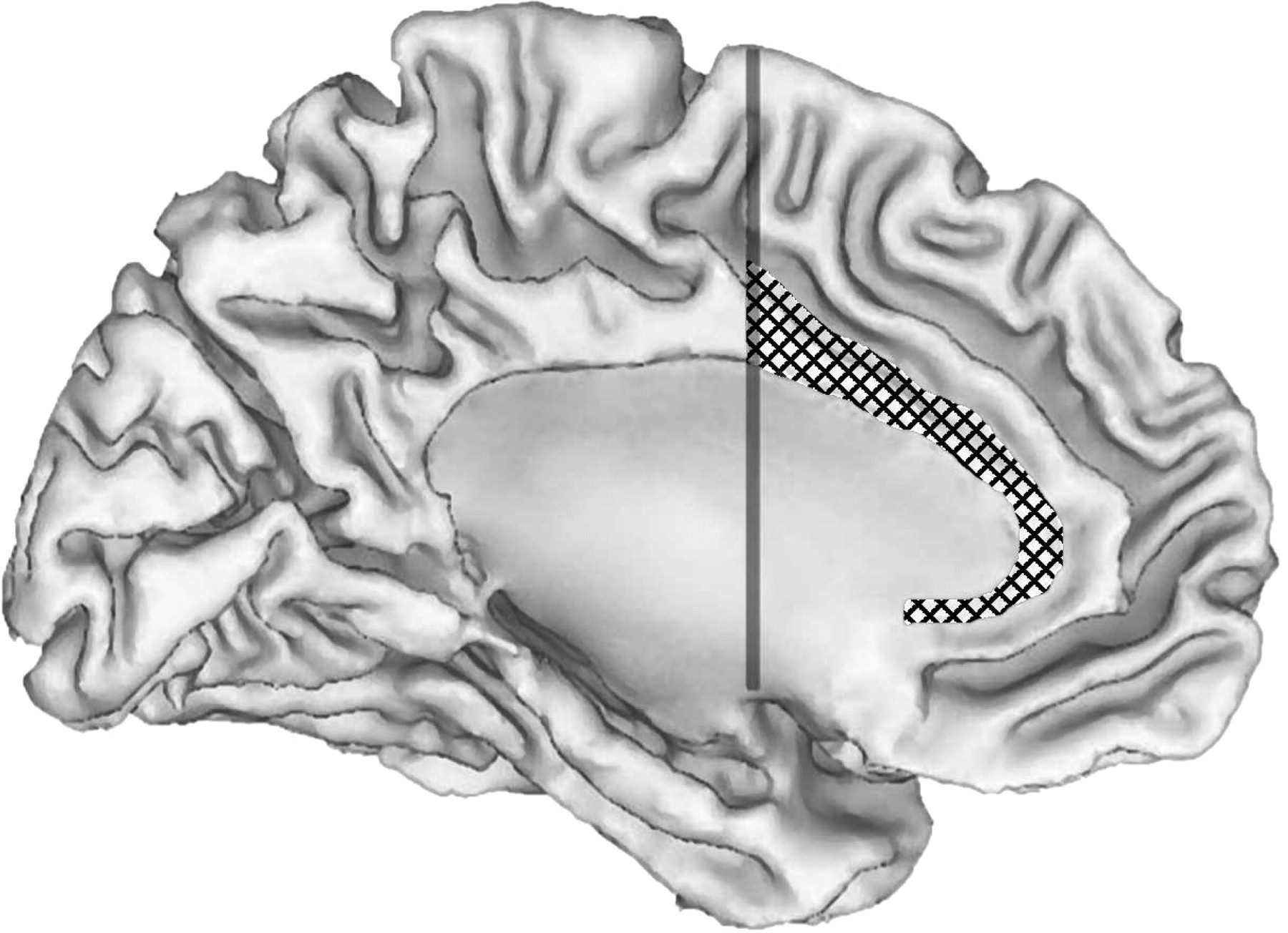
Medial surface of the cerebral cortex, with the anterior cingulate region as measured shown in □.
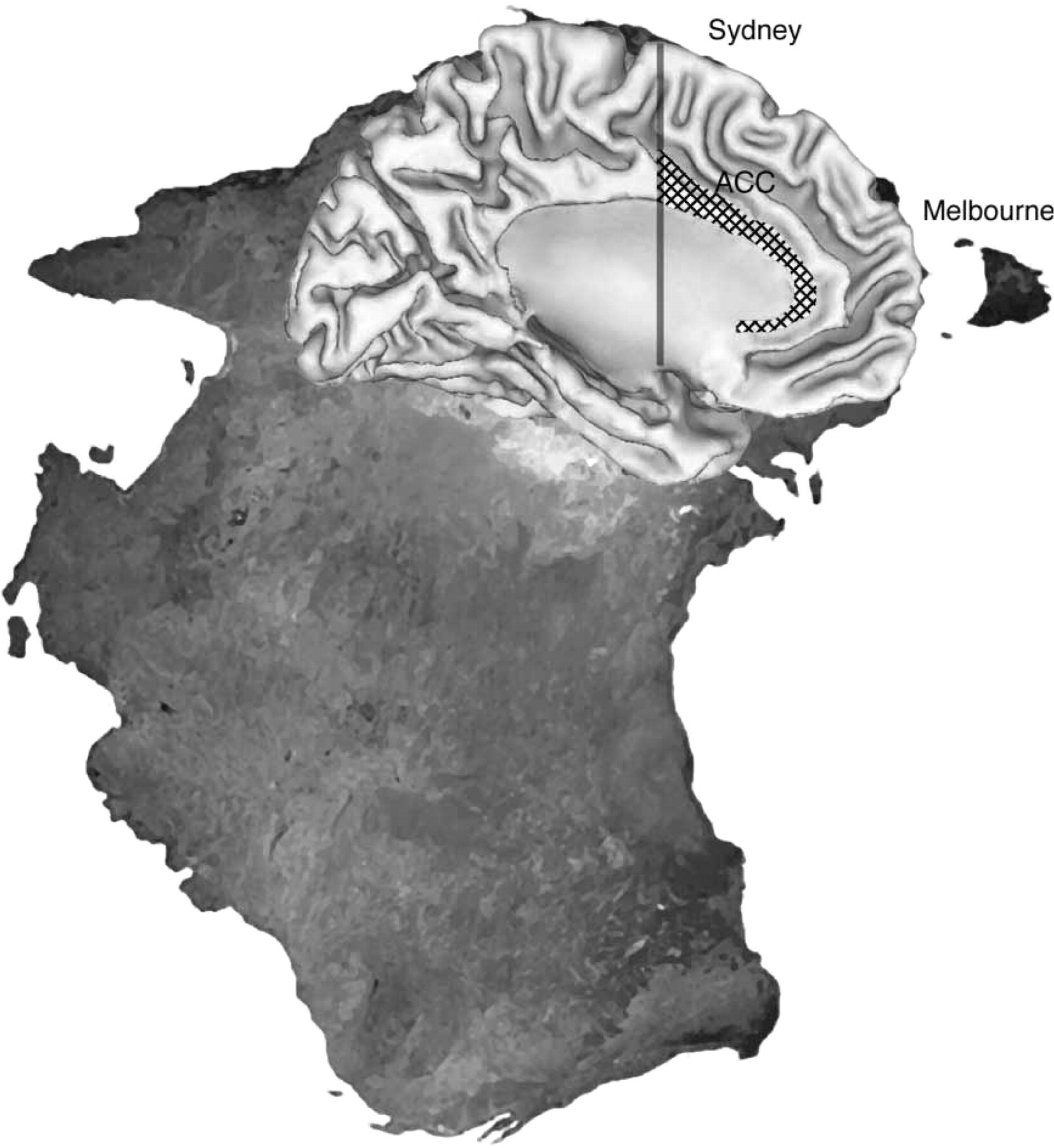
A surface rendering of the medical wall of the cerebal cortex overlaid on a geographic map of Australia. The highlighted region-of-interest correspond to the portion of the anterior cingulate gyrus in which the Melbourne–Sydney inter-state difference in cortical surface.
METHODOLOGY
Subject recruitment
Healthy adult control subjects who had undergone an MRI were identified from our large databases in both states. Subjects were screened for neurological, psychiatric and medical disorders and necessary demographic information, such as age and gender, was collected.
Rivalry measures
AFL premierships: the number of AFL premierships originating in each city during the period 1960–2005 were calculated. Property prices: the ratio of Sydney: Melbourne median property price for the year 2005 was determined through data widely available on the internet and at dinner parties in both cities. NHMRC grants 2005: the total number of NHMRC grants awarded to universities in each city was estimated by reference to the NHMRC website.
Image acquisition
Melbourne scans were acquired using a GE Signa 1.5 Tesla scanner at the Royal Melbourne Hospital, Victoria, Australia. A three-dimensional volumetric SPGR sequence generated 124 contiguous coronal slices. Imaging parameters were: time-to-echo, 3.3 msec; time-to-repetition, 14.3 msec; flip angle, 30°; matrix size, 256 × 256; field of view, 24 × 24 cm; voxel dimensions, 0.938 × 0.938 × 1.5 mm. MRI data were transferred from DAT tape to an SGI-02 workstation and coded to ensure participants’ confidentiality and blinded rating. Data were subsequently transferred to a Linux Debian 3.1 workstation for the bulk of the image processing. Sydney scans were also acquired on a 1.5 Tesla GE Signa scanner at the Royal Prince Alfred Hospital, Sydney, New South Wales, Australia. Imaging parameters were: time-to-echo, 5.3 msec; time-to-repetition, 12.2 msec; field of view, 24.9 cm; voxel dimensions, 0.977 × 0.977 × 1.6 mm thick coronal slices.
Image processing
The white (i.e., grey/white matter boundary) and pial (grey/cerebrospinal fluid boundary) cortical surfaces were tessellated with a triangular mesh comprising approximately 150 000 vertices per hemisphere, using methods described in previous studies,[1], [2] and as implemented in the Freesurfer software package (http://surfer.nmr.mgh.harvard.edu). Cortical thickness was calculated at each surface point by taking the shortest distance from a given vertex on the pial surface to the white matter surface and then back again, and then averaging these two values. The ACC comprised grey matter between the callosal and cingulate sulci (i.e., the anterior cingulate gyrus). The posterior border was a vertical plane through the anterior commissure.
RESULTS
As seen in Table 1, 20 subjects were available from each city. The Sydney group was slightly older, and had significantly higher intracranial volume (F = 8.712, p = 0.005). However, in spite of having lesser intracranial volume, Melbourne citizens had a significantly thicker ACC (F (1, 38) = 20.46, p < 0.0001), and this difference remained significant when age and intracranial volume were controlled (covaried) for (F (1, 36) = 13.63, p = 0.001).
Demographic, cortical thickness, and key cultural, financial and academic measures across Sydney and Melbourne. ACC, anterior cingulate cortex; SD, standard deviation; AFL, Australian Football League
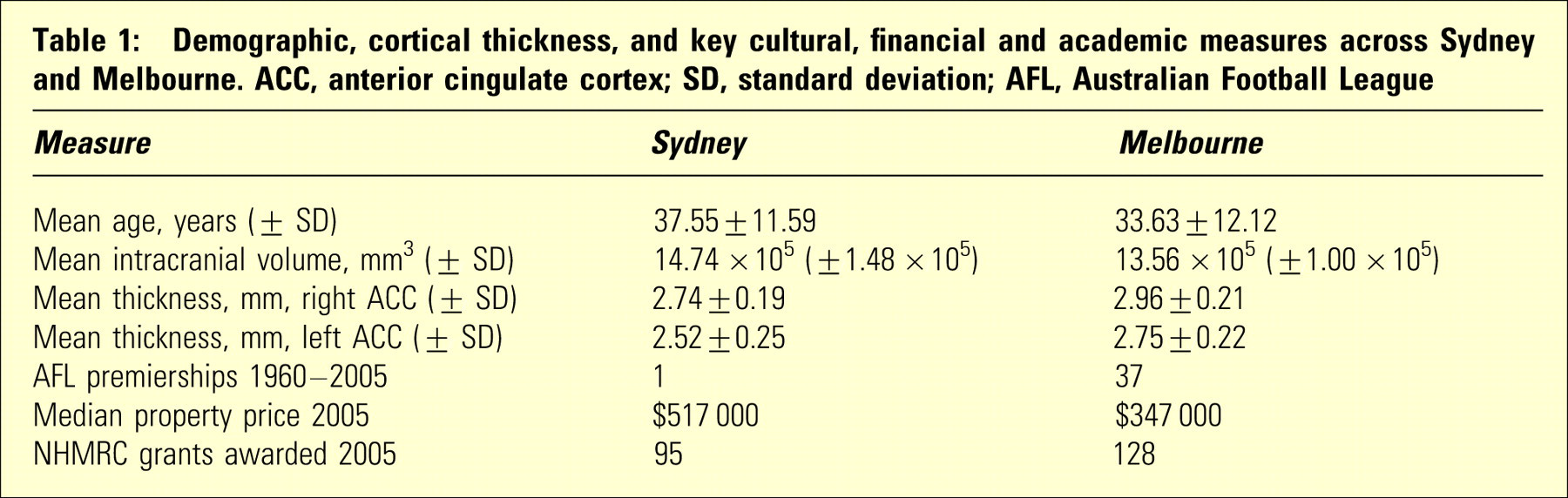
It is of note that the other variables compared to ACC thickness measures suggested that Sydney-siders were subject to higher property prices, a lower number of successful NHMRC grant applications, and significantly less success with respect to the number of AFL premierships won (Table 1).
DISCUSSION
The results of this seminal study suggest that cortical thickness may be influenced by both neurotrophic and atrophic factors related to the basic human behaviour of rivalry. We have identified increased cortical thickness in Melbourne residents compared to Sydney residents that appears to mirror some key differences in cultural, sporting, financial and academic measures between the two cities.
The relationship between city of residence and cortical thickness may be due to a number of factors. The most parsimonious model for understanding how environmental variables may affect cortical structure is Duman's growth factor model of stress-related disorders, where stress reduces levels of growth factors, particularly brain-derived neurotrophic factor (BDNF), and causes atrophy through reduced cell size and impaired neurogenesis.[3] This suggests that when confronted with high property prices, a relative lack of sporting success, and difficulties acquiring research funding, residence in Sydney is associated with decreased growth factor release and concomitant reductions in cortical thickness. The direction of causality is not entirely clear, however, as it is also possible that greater thickness in this key brain region, which is critical for cognitive control and emotional regulation, may well result in greater academic and sporting success, and possibly less market-driven inflation of property prices through mutual cooperation.
An alternative explanation is that thinning reflects a refinement of cortical processing resources. We know that during brain development there is extensive growth and subsequent pruning specifically of neural components, presumably so as to align structure with function. It is possible therefore that thinning is a more advanced stage of brain evolution. Those that have adapted to withstand greater stress are likely to gravitate towards such environments and only those with the necessary streamlining of thoughts and brain function are likely to succeed. Greater house prices in Sydney, for instance, are a clear reflection of such success. Over the years, economic prosperity has furnished Sydney with an intellectual influx in all fields of science and commerce. Greater opulence and satisfaction with lifestyle has meant that less importance has been attached to simple sporting achievements. Instead, Sydney-siders have developed a healthier view and allowed sport to be an integral part of a healthy lifestyle. Finally, it is also important to note that NHMRC grant funding is directed towards areas of need, and deprived regions and regions with limited individuals are given special consideration.
Historically, Melbourne and Sydney have shared an intense rivalry across many domains. Sydney is the financial capital of Australia, Melbourne the retail capital. Melbourne is home to Port Phillip Bay and the Yarra River, Sydney has Sydney Harbour. Melbourne has the MCG, Sydney the Opera House. Melbourne and Sydney have both had two Nobel Prize winners each. On and on the rivalry has gone.
A third and highly speculative possibility is that cortical thickness varies with latitude. Thicker cortex in Melburnians may reflect an evolutionary compensation for sustained cerebral hypothermia and vitamin D deficiency resulting from chronic lack of exposure to the sun's ultraviolet radiation. Melburnian neurons may have adapted to conserve energy, leading to a gradual build up in the lipid membrane of neurons and glia, thereby upregulating their thermal homeostatic levels and expanding the cortical mantle. Unfortunately, this does not bode well for Australians living in cities either closer to or further from the equator; Hobart residents may be facing a silent epidemic of cortical obesity, whereas Brisbane inhabitants may be in critical need for dietary supplementation. It may already be too late for Cairns.
Conclusions
Rivalry is defined as the state of two sides with ongoing competition. While much has been written about rivalry between cities (New York and Boston, Oxford and Cambridge, Florence and Rome), little has been scribed with respect to its neurobiology in humans. We hope that this is the first of many studies that aim to quantify the neurobiological differences between residents of Australia's two largest, most dynamic but most contrasting cities.
Declarations of interest
Dennis Velakoulis is Melbourne-based but a paid-up member of the Sydney Swans football club. Gin Malhi is Sydney based but originally from the United Kingdom. Mark Walterfang is Melbourne-based but, disturbingly, originally from Queensland