







Abstract
Does the personality of a doctor increase the likelihood of doctors having a complaint, law-suit or inquiry? We know that certain demographic factors and medical specialties correlate with a higher incidence of medico-legal matters, 1 – 4 with middle-aged male doctors who undertake interventional practice and work long hours having higher rates of medico-legal matters. However, the influence of personality on the incidence of medico-legal matters has not been previously explored.
There is a correlation between trait neuroticism and mental health problems in doctors, 5 – 7 including high rates of depression, suicide, and alcohol and drug abuse. 5 People who are stressed, depressed, alcohol dependent, dissatisfied or exhausted are less likely to provide the same standards of care as those who are not. 8 Negative patient outcomes have been reported if doctors are fatigued, overworked, depressed, anxious, or using excess alcohol. 9 Do doctors with a high neuroticism score have increased likelihood of poor performance and associated medico-legal matters?
Results from pre-registration house officers in England 10 found that females scored significantly lower on the extraversion and psychoticism subscales than men, and significantly higher on the neuroticism subscale of the Eysenck Personality Questionnaire (EPQ). High neuroticism scores were linked with increased psychological morbidity.
An Australian study, also using the EPQ, followed final year postgraduate medical students through their intern year. 11 The only gender difference was that females had higher neuroticism scores. High neuroticism scores were linked with higher psychological morbidity. However, EPQ scores did not predict objective performance measures (Willcock S, Daly M, Tennant C, unpubl. data, 2002).
A small study of doctors who had a complaint before the New South Wales Health Care Complaints Commission found that respondents scored significantly higher than the general population on the psychoticism subscale of the EPQ (p<0.001). 12 Do doctors who have high psychoticism scores (representing more ‘tough minded’ doctors who, at the extreme, lack empathy) have more medico-legal matters than doctors who do not rate highly on this subscale?
This study aims to investigate the personality profile of Australian General Practitioners (GPs) considering gender, work practice variables (e.g. hours of work, proceduralist or not) and whether or not the respondents had experienced medico-legal matters. We hypothesized that male doctors, proceduralists and those who worked long hours would have experienced more medico-legal matters. With consideration to these variables, we then hypothesized that doctors who score significantly higher on the neuroticism or psychoticism subscales of the EPQ were more likely to have had medico-legal matters. Other aspects of this study relating to psychological morbidity of doctors who have and have not experienced a medico-legal matter have been described elsewhere. 13 It was anticipated that some of the findings may also be relevant for doctors working in various specialties, including psychiatry.
METHOD
A descriptive comparative design was used. A cross-sectional self report survey was administered to GPs in May 2006.
Sample
A total of 1499 GPs were selected from a list of all GPs who were insured in 2006 with the Australian medical defence organization, UNITED Medical Protection (‘UNITED’), the largest medical insurer in Australia at that time (it merged with another company and was renamed Avant in 2007). The final sample included all GPs classified as proceduralists (n=530), and a random selection of 970 non-procedural GPs (as defined by UNITED) from a total of 6479. All selected GPs were informed of the study by mail, and were asked to complete and return a form noting their willingness to participate in the study. Two hundred and sixty mGPs (17%) declined, leaving 1239 GPs who were sent the survey, with ultimately 566 respondents (566/1499; 38% overall response rate and 45.7% survey response rate).
Data collection and procedures
The data came from two sources: (i) a cross sectional survey that assessed personality traits (using the EPQ), demographic and work practice information, and history of a medico-legal matter with any medical defence organization; (ii) information extracted from the UNITED Medical Protection database in which medico-legal matters were documented. Confidentiality and anonymity were maintained.
The survey was posted to GPs and included a reply-paid envelope. Four weeks later, a reminder letter was issued, again requesting participation and return of the survey.
Measuring personality using the Eysenck Personality Questionnaire
The EPQ is a self-report questionnaire and measures three major dimensions of personality: neuroticism, psychoticism and extraversion, which represent personality traits, not psychiatric diagnoses. Neuroticism is sometimes referred to as ‘emotionality’ and measures emotional stability or sensitivity. Psychoticism measures ‘tough-mindedness’ and, at the extreme, a lack of empathy. The extraversion subscale determines if the person is outgoing and talkative. Scores of the cohort are compared with community sample scores. The EPQ-Revised Short Scale questionnaire was used. 14
Measuring medico-legal matters (self-report and UNITED data)
The following medico-legal matters were listed in the questionnaire: a claim for compensation for damages, complaint to a healthcare complaints body, medical board inquiry, disciplinary hearing, Health Insurance Commission (HIC) inquiry, hospital dispute, pharmaceutical services inquiry, Medicare fraud inquiry, anti-discrimination board inquiry, coronial inquiry, criminal charge and ‘other’. Respondents were asked whether they had ever received assistance from any medical defence organization in any of the above medico-legal matters, and if these were ‘current’ or ‘past’ (closed). The same classification of matter was used by UNITED.
Statistical analysis
Statistical analysis was undertaken using SPSS (SPSS Inc, Chicago, IL, USA). Pearson product-moment correlations were performed to assess bivariate associations, and differences between categorical variables were measured using χ2 tests. Differences between two or more groups on a single variable were assessed using independent samples t-tests and one-way analysis of variance, respectively. Multivariate analysis of co-variance was performed (controlling age as a covariate) to examine the main effects and interactions between hours worked per week and number of current/past medico-legal matters (according to both self-reported data and data provided by UNITED) on the three personality factors (psychoticism, extraversion, and neuroticism). The multivariate analysis of co-variances were undertaken separately for males and females. Tukey honestly significant differences (HSD) post-hoc comparisons were performed where statistical differences were found. The critical alpha (α) level was set at 0.05 for statistical significance.
Doctors’ responses were considered as a group, and then comparisons were made between genders, hours of work groups, peer review attendance or not, solo and non-solo, and those who had experienced a medico-legal matter and those who had not.
Ethical considerations
Approval was granted through the Northern Sydney Central Coast Area Health Service and the University of Sydney Ethics Committees, and the UNITED Board. Anonymity and confidentiality of UNITED membership and data were protected at all times, as were survey responses. The survey contained a covering letter detailing that de-identified data relating to medico-legal matters held by UNITED would be issued to the study team if the survey data was returned. The study was funded from a Northern Sydney Health research grant and the McGeorge Bequest through University of Sydney.
RESULTS
Respondent demographic and practice characteristics and experience of medico-legal matters
There were 566 respondents. The mean age was 53 years (SD = 9.7), and 65% were male. Proceduralist GPs accounted for 32% of respondents. Peer review was attended by 42%, with a mean of eight sessions per year (SD = 9.6). Mean hours per week worked was 40.9 hours (SD = 15.1).
Type of medico-legal matter
Table 1 describes the type of medico-legal matter according to UNITED data.
Medico-legal history of the respondents
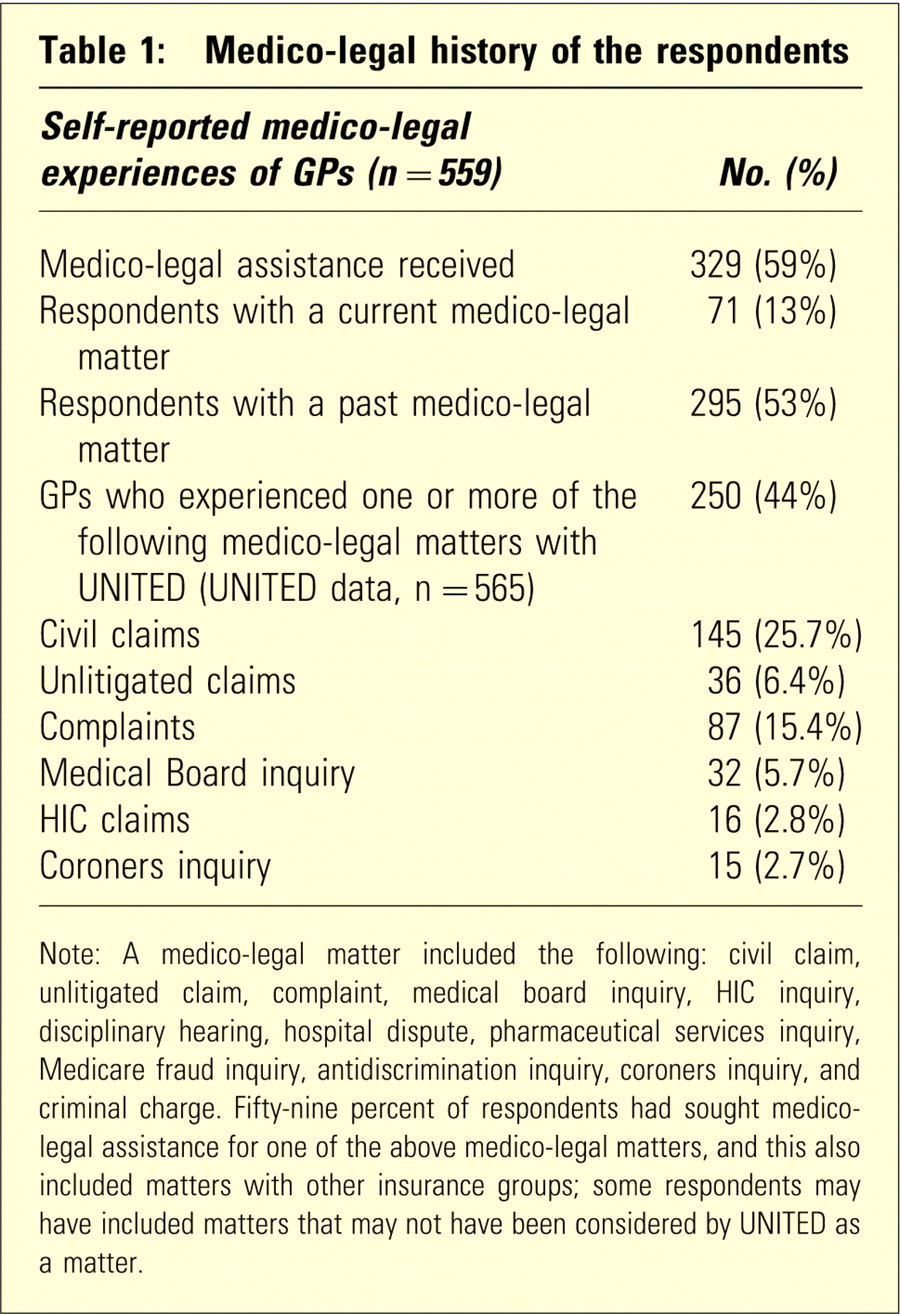
Note: A medico-legal matter included the following: civil claim, unlitigated claim, complaint, medical board inquiry, HIC inquiry, disciplinary hearing, hospital dispute, pharmaceutical services inquiry, Medicare fraud inquiry, antidiscrimination inquiry, coroners inquiry, and criminal charge. Fifty-nine percent of respondents had sought medico-legal assistance for one of the above medico-legal matters, and this also included matters with other insurance groups; some respondents may have included matters that may not have been considered by UNITED as a matter.
There were no significant differences in the proportion of respondents and non-respondents experiencing the key medico-legal events of claims, complaints or inquiries (p > 0.05).
Personality differences considering gender and practice variables
Gender
Males had significantly higher psychoticism scores (mean = 2.42, SD = 1.48) than females (mean = 1.81, SD = 1.30) (t(546)=4.84, p < 0.001), and females had significantly higher neuroticism scores (mean = 4.40, SD = 3.11) than males (mean = 3.64, SD = 3.20) (t(546)=2.68 p < 0.01).
Hours of work
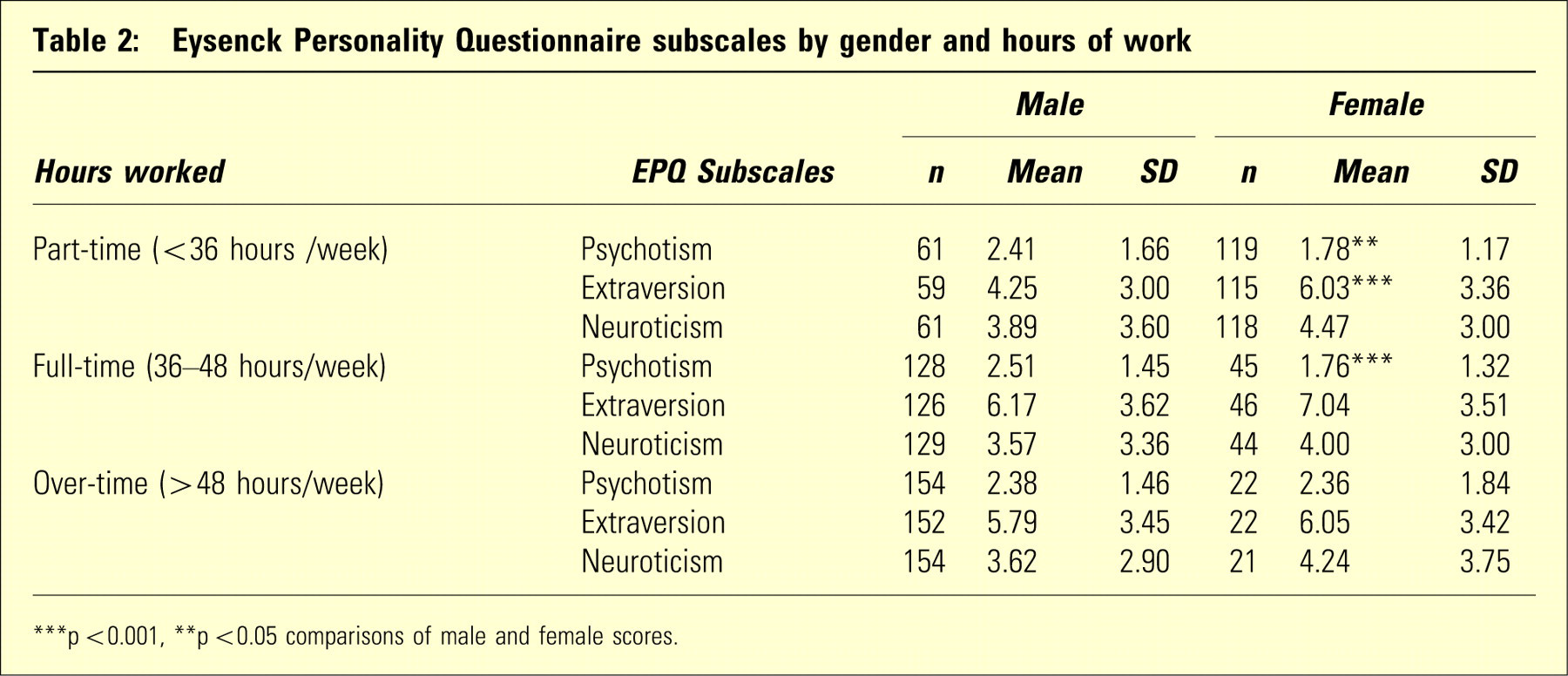
Due to the gender differences in hours worked, this personality comparison was done for males and females (Table 2). Hours of work was divided into three groups: part-time work of less than 36 hours, full-time work of between 36 and 48 hours, and an ‘over-time’ group of more than 48 hours per week. (These hours of work were chosen for two reasons: they are logical from an hours of work point of view, and they also divided roughly into thirds for comparisons.)
Eysenck Personality Questionnaire subscales by gender and hours of work
∗ p < 0.001,
∗∗ p < 0.05 comparisons of male and female scores.
Peer review
There was no difference in numbers of medico-legal matters for doctors who attended peer review (p > 0.05). However, there was a positive correlation between extraversion scores and doctors who attended peer review (r = 0.17, p < 0.001).
Procedural practice
A higher proportion of proceduralists experienced a medico-legal matter (69.3%) than non-proceduralists (53.9%) (χ2=11.78, df = 1, p < 0.001). However, proceduralists and non-proceduralists did not differ on personality scores (p > 0.05).
Solo practice
Solo practitioners and non-solo practitioners did not differ on personality scores (p > 0.05).
Male and female GPs’ experience of medico-legal matters and Eysenck Personality Questionnaire considering age and hours worked per week
A significantly higher proportion of males (65.7%) than females (46.5%) reported experiencing a medico-legal matter (χ2=19.44, df = 1, p < 0.001). Due to other gender differences previously reported in this paper with respect to hours worked per week and personality scores, the data for males and females were analysed separately.
GP experience of medico-legal matters was categorically divided into three groups: GPs with no medico-legal matters, one matter, and two or more matters. The data were analysed further according to self-report data and data provided by UNITED.
A 3 (hours worked per week: >48 hours/week, 36–48 hours/week, <36 hours/week)×3 (medico-legal matters: zero, one, two or more) between-subjects multivariate analysis of covariance was performed on the psychoticism, extraversion and neuroticism factors.
Age was entered as a covariate because there was a significant difference between the three groups of hours worked per week (F2,544=5.72, p = 0.003). Also, respondents who had experienced a medico-legal matter were significantly older (mean = 53.96 years, SD = 9.25) than those who had never experienced a medico-legal matter (mean = 51.26 years, SD = 9.84) (t(549)=3.28, p < 0.001).
Males: Self-report data
Of the male respondents, 107 reported no history of a medico-legal matter, 105 reported one matter, and 106 reported two or more matters.
After analysis with Wilks’ criterion, there was a significant main effect for hours worked per week on the combined personality factors (Wilks’ λ = 0.95; F6,612=2.73, p = 0.013), but not the number of medico-legal matters (p > 0.05). There was also a significant interaction between hours worked per week and number of current/past medico-legal matters on the combined personality factors (Wilks’ λ = 0.92; F12,810=2.06, p = 0.017).
On inspection of individual personality factors, there was a main effect for hours worked per week on the extraversion factor (F2,308=8.30, p = 0.0003). Tukey's HSD post-hoc comparisons showed that those who worked less than 36 hours per week had significantly lower scores (mean = 4.07, SD = 2.99) than those who worked 36–48 hours per week (mean = 6.11, SD = 3.64) (p = 0.001), and those who worked more than 48 hours per week (mean = 5.79, SD = 3.41) (p = 0.004).
There was also a main effect for number of medico-legal matters on the neuroticism factor (F2,308=5.31, p = 0.005). Tukey HSD post-hoc comparisons showed that those who had no medico-legal matters had lower neuroticism scores (mean = 2.95, SD = 2.96) than those who had one medico-legal matter (mean = 4.17, SD = 3.30) (p = 0.014) and those who had two or more medico-legal matters (mean = 3.98, SD = 3.33) (p = 0.038).
Males: UNITED data
According to UNITED data, the breakdown of medico-legal matters produced different sample sizes in which 157 respondents had no recorded medico-legal matter, 80 had one matter, and 91 had two or more matters.
The only significant finding was a main effect for hours worked per week on the extraversion factor (F2,318=5.89, p = 0.003). Tukey HSD post-hoc comparisons showed that those who worked less than 36 hours per week had significantly lower scores (mean = 4.14, SD = 2.98) than those who worked 36–48 hours per week (mean = 6.15, SD = 3.63) (p = 0.001) and those who worked more than 48 hours per week (mean = 5.78, SD = 3.47) (p = 0.006).
Females: Self report data
Of the female respondents, 90 reported no history of medico-legal matters, 53 reported one matter and 27 reported two or more matters.
Using Wilks’ criterion, there was a significant main effect for hours worked per week on the combined personality factors (Wilks’ λ = 0.92; F6,316=2.15, p < 0.05), but not the number of medico-legal matters (p > 0.05).
On inspection of each single personality factor, there was a main effect for hours worked per week on the extraversion factor (F2,160=3.19, p = 0.044). Females who worked less than 36 hours per week had lower scores (mean = 6.05, SD = 3.39) than those who worked 36–48 hours per week (mean = 7.27, SD = 3.24), and those who worked more than 48 hours per week (mean = 6.14, SD = 3.47).
Females: UNITED data
According to UNITED data, the breakdown of medico-legal matters produced different sample sizes, in which 121 respondents had no recorded medico-legal matter, 34 had one matter and 16 had two or more matters.
Using Wilks’ criterion, there was a significant main effect for the number of medicolegal matters (Wilks’ λ = 0.91; F6,318=2.45, p = 0.025), but not hours worked per week (p > 0.05).
On inspection of each single personality factor, there was a main effect for hours worked per week on the psychoticism factor (F2,161=3.39, p = 0.036). Females who worked less than 36 hours per week had lower psychoticism scores (mean = 1.77, SD = 1.17) than those who worked 36–48 hours per week (mean = 1.78, SD = 1.35) and those who worked more than 48 hours per week (mean = 2.47, SD = 1.84).
DISCUSSION
Female and male respondents demonstrate a different personality profile which resembles community norms where there are higher neuroticism scores in females and higher psychoticism scores in males.
Male respondents also exhibit different personality traits according to hours of work, in which those working part-time are more introverted than males working full-time or greater. Perhaps the introverted males, who are less outgoing and talkative, are more comfortable with fewer hours of face-to-face interaction, while females who work part-time may be doing so for more pragmatic reasons (e.g. parenting). On the other hand, females who work more than 48 hours per week demonstrate no differences in personality traits compared to males working the same amount of hours.
Gender personality differences and variance in hours worked per week make it difficult to postulate how personality factors are related to doctors who have and have not experienced medico-legal matters. However, the results of our study showed that male doctors who self-reported a medico-legal matter had higher neuroticism scores on the EPQ. Is this a chicken-and-egg phenomenon in which those with higher neuroticism traits could have a greater chance of incurring medico-legal matters, due to the links between high neuroticism traits and depression, anxiety, alcohol use and subsequent deterioration in work performance? Our findings from the psychological morbidity component of this study showed that those who had a current medico-legal matter had an increase in psychiatric morbidity and, in males, potentially hazardous alcohol use. 13
However, this finding of males with medico-legal matters having higher neuroticism scores was not replicated when we analysed the data provided by UNITED. This discrepancy could be explained by over-reporting of medico-legal matters by doctors who have higher neurotic tendencies, or could be accounted for by other matters experienced prior to membership with UNITED.
We had also hypothesized that doctors with high psychoticism scores (representing tough mindedness, and at the extreme a lack of empathy), would have had more medico-legal matters, but our results did not support this hypothesis. Perhaps a degree of ‘tough mindedness’ is not a negative trait in the practice of medicine.
Limitations
Our sample of 566 respondents represents three percent of Australian GPs (2003 workforce data). 15 When the sample was further divided by gender, medico-legal matters and hours of work, the small numbers of females may have limited our interpretation of the findings.
In addition, although the response rate in our study (45.7% to the survey) is comparable to other studies in this area, there is the possibility that those who chose to respond are in some way biased.
Finally, two data sets for medico-legal matters were analysed, and each had their strengths and weaknesses. Self-report data may have been more inclusive than UNITED data, in that respondents would have included matters with other medical insurers (or indeed no other medical insurers). However, relying on respondents to classify the type of medico-legal matter was difficult. At times, matters were included in self-report data which may not have been considered to be a medico-legal matter according to the UNITED criteria, and thus the self-report data may have been over inclusive. Further exploration of this found that those respondents who reported a medico-legal matter (with any medical defence organization), but did not have a matter recorded with UNITED, had significantly higher neuroticism scores. The next phase of this study will explore the legal processes in more detail.
Conclusions
The known demographic and practice variables that increase the likelihood of having a medico-legal matter were replicated here i.e. being older, working longer hours (more years and hours of practice), being male and a proceduralist. Our hypothesis of increased number of medico-legal matters for doctors with high psychoticism scores was not supported. In relation to neuroticism, there was an inconsistent pattern regarding an increase in medico-legal matters in that there was a higher self-reported number of matters in male doctors, but not so on UNITED data and not so in females. Neuroticism is the personality trait that is known to make a person more vulnerable to psychological morbidity, and this is supported in the literature regarding doctors’ health. Our hypothesis of increased medico-legal matters in doctors with high neuroticism scores was inconclusive but reduced work hours by male GPs with high neuroticism scores is an interesting finding of this study. Among other implications of this study for psychiatrists, psychiatrists need to remain mindful of their own health and the needs of their colleagues who they may work with, or see as patients, considering that those with high neuroticism traits appear to be more vulnerable to stressors of practice and daily life. When treating, advising or teaching our doctor/student colleagues, reducing hours of work in times of stress is important to keep in mind.