







Abstract
The digital age of post-truth is the ideal breeding ground for fake news and misinformation. In the world of social networks and the Internet in general, commercial interests hold primacy over the importance of the veracity of the information provided. In this study, we have carried out a quantitative and qualitative content analysis of the messages published as comments on the most popular videos about Pokémon Go published in Spanish on YouTube. The main objective of the study is to analyse not only the content of the videos but, above all, users’ reactions to the misinformation provided. The results confirm the hypothesis that misinformation is promoted by the crisis of truth as a journalistic and social value, by economic interest and by the lack of suitable media education. We conclude by advocating the need to recover truth as a journalistic and social value in the digital context, and to accept that media literacy is an essential task to be assumed by all educational agents: schools, media and social groups.
Background
Digitalization has resulted in considerable changes to the way in which information is coded, generated, transmitted, stored, received, processed and interpreted. Consequently, digitalization and the world of social networks have also led to a significant increase in misinformation, more as a result of infosaturation and infoxication than a lack of news. Although new and omnipresent forms of media make us more informed than ever, this does not necessarily mean that we are better informed. Roig (2018) argues that advances in the digitalization of our societies mean that the fight for power between states has been transferred to cyberspace, with political propaganda and misinformation inundating the Internet and social networks.
Since its inception, one of the key aspects of media education has been to promote awareness that the image is not the reality, that the media offers us interpretations and representations and that the degree of iconicity (photo, video, 3D, virtual reality, augmented reality) does not increase its veracity. Distancing oneself from information in order to be able to analyse and assess it, and in order to classify, catalogue and label media productions or verify information, becomes more and more complex in the digital era of convergence and jumble. In this quagmire of data, ‘nothing is either true or false’, since everything is the colour of the glass through which we look. As indicated by Frederiksen (2017), the identification and assessment of fake news has never been as difficult as in this digitally polarized political context in which we live; an ‘era of partisanship and mistrust’ (Mihailidis & Viottyrticle, 2017); a context of general disillusion in which the most successful politicians are those that claim to be ‘antipolitical’ (Berger & McDougall, 2015).
The convergence of media, genres and formats in the different networks shifts the communicative landscape towards an amalgam of multimedia texts and contexts in which the functions of informing, entertaining and educating are mixed; where the punchy announcement and competing to sell headlines dominates (Sánchez-Ventero, 2018); where news is cherry-picked without delving into the facts or their possible significance (Carr, 2008); where the task of informing is no longer the domain of the professionals; where information is increasingly turning into a spectacle (Postman, 1985); and where, in short, the truth is merged and fused with lies.
The border is diluted between what is represented and the representation, between the real and the virtual and between the ‘true’ and the ‘fake’. Augmented reality brings virtual and real worlds together, blurring the borders between the offline and online (BBC-Mundo, 2018). In this sense, it is interesting to see how, for example, the dances of the popular online game Fortnite become viral and transfer to real life, being repeated by sports people in moments of glory and people in the street; users record new dances that are posted on the Net, competing for Epic Games to include them as emotes in the game. What is the ‘real’ and who is bothered about it? What basic literacy is needed for this digital environment?
We live in an environment that is fertile territory for the success of fake news and fake worlds in the era of post-truth. The concept of ‘post-truth’ became popular during the Brexit campaign and the election of Donald Trump, and was accepted as a word by Oxford Dictionaries in 2016. According to Lewandowsky, Ecker, and Cook (2017, p. 353), this era of the post-truth ‘is the result of social megatrends such as the decline in social capital, the growth of economic inequality, increases in polarisation, a growing mistrust in science, and an increasingly fragmented media landscape’.
While misinformation has always existed, it has become a genuine problem in our digital environment jumble, replete with clickbaits and fake news. For the purpose of this study, we agree with the authors of the European Commission Report (2018) on fake news and misinformation on the Internet, which suggests that fake news is not needed to misinform, to transmit fake, misleading or biased information, with the intent to cause damage or obtain economic profit.
Until the first half of the twentieth century, misinformation or ‘lack of information’ was achieved through censorship, by controlling the media. As digitalization has gradually led to the almost instantaneous reproduction and dissemination of information, misinformation is not so much based on censorship as on the manipulation of information. If facts cannot be hidden, biased interpretations and prejudiced viewpoints are offered. Certain facts are overexposed to saturation point, while others are concealed. At the end of the last century, misinformation policies already proposed that the truth of the facts should not represent a constraint, thus recalling the old journalistic saying: ‘Never let reality ruin a good story’. According to Keyes (2004), in the current ‘era of post-truth’, a third category between the clearly differentiated categories of ‘true’ and ‘false’ is introduced, which consists of half-truths or ‘neotruths’. It is no longer the fact or the reality which is of concern, but rather the way it is presented in a distorted way, in order to manipulate beliefs and emotions.
In the current context of increasing misinformation and the distorted presentation of facts, we have shifted towards the invention of news, or to the fake news that is unashamedly presented as ‘alternative facts’. Tandoc, Wei Lim, and Ling (2017) provide us with a typology of fake news based on 34 academic articles on this subject. What is important about this news is not whether it is true of false, but whether people believe it and act on it. In this informational landscape, whereby nothing appears to be either true or false, the average citizen does not have the tools or the criteria necessary to identify fake news. As a result, they mistrust all forms of media and tend to give their share of credit to like-minded populist ideologies, feeling more comfortable with their messages, regardless of the truth or not of what they say. People no longer trust the news and are not interested in whether it is true or not. Chomsky goes a step further, stating that ‘people no longer trust in the facts themselves’ (Martínez-Ahrens, 2018).
Commenting on the fragmented culture in which knowledge is constantly updated and renewed, Imbert (2008) stated that information tends to dominate history and that the ephemeral (mass media productions) prevail over the accumulative (historical heritage). He also added that ‘today, seeing is believing: ‘“It’s true, I saw it on tele,” says the vox populi, “it was in the papers”, it says so on the radio’ (Imbert, 2008, p. 26). Just a few years on, we see how the information as well as the credibility of the media have been seriously undermined by misinformation, and how the mass-media productions of the traditional media are being replaced as the main source of information by social networks, collaborative websites and other Internet sites such as Reddit, where the most popular aggregate or compiled content is that which is the most voted or commented on by readers-editors, regardless of its importance or veracity. In 2018, Reddit is now the fourth most-viewed site in the US after Google, YouTube and Facebook, and one of the main sources of information and misinformation for Internet users. In addition, it is even used as a source of news by some media professionals (Duggan & Smith, 2013).
Numerous articles on fake news have been published over recent years. Regarding its possible causes, in addition to the issue of general mistrust in the media, Rochlin (2017) highlights the system of rewards per click, which allows fake news used as bait to become viral, as well as the low levels of informational literacy of users. Horne and Adah (2017) argue that fake news is targeted above all at readers who tend not to read beyond the headlines and try to create mental links between realities and desires. According to Ott (2016), they are offered a ‘simple, impulsive and vulgar’ language which the author shows through an analysis of tweets posted by Donald J. Trump.
From the point of view of media professionals, Himma-Kadakas (2017) highlights the pressures that journalists are under to provide new content quickly, which means that habitual controls are often overlooked. On the other hand, Peinado and Alameda (2018) describe ‘an industry made up of consultants and freelance workers’ dedicated to launching misinformation campaigns to inflate the vanity or ratings of politicians, large corporations, artists, sports people, lawyers, doctors, chefs and small businesses. The lack of professional ethics of some celebrities who assume the role of the journalist is also contributing to an increase in misinformation, according to Borden and Tew (2007). In addition to these reasons, we would also add the lack of value given to truth on social networks and the undermining of the informational truth which is transferred to the media in general, where information is also turned into a spectacle.
In this study we analyse the presence of misinformation in a very specific setting: the most popular accounts of Pokémon Go found on YouTube. While some studies, such as that of Paul Tassi (2016), have already analysed the use of clickbaits in videos on Pokémon, the main objective of our study is to analyse not only the content of the videos but also, and above all, the reactions of the users to misinformation and the importance they give to truth as a desired value. We advance the hypothesis that misinformation is promoted by the crisis of truth as a journalistic and social value, by economic interest and by the lack of suitable media education.
Our study focuses on the YouTube platform, considered as ‘extended television’ (Islas, 2016), or as a new form of interactive and tailor-made television which is replacing television as mass media, particularly among youth. Despite this, we will refer to YouTube more as a social network, which it also is, and as a site where a considerable amount of misinformation exists and is shared by millions of people, as highlighted by Marwick and Lewis (2017).
Thanks to the YouTube Partner Programme (YPP) launched in 2007, creators, artists and intellectuals can monetize the content they post on the platform to obtain an income from the advertisements shown on their videos. This has created and inspired new ways of sharing culture. Nevertheless, as we see in our study, this possibility of obtaining economic profits for the number of views has also enabled unscrupulous individuals to create fake news and sensationalist headlines with the sole purpose of achieving more views.
Methods used
The methodology used in this study is underpinned by the primary objective, which is descriptive in nature: this consists of measuring the presence of specific categories of analysis in the videos, and in the reactions in the form of commentaries on the Pokémon Go video game published on YouTube.
This game was chosen due to its unprecedented success: it achieved 30 million downloads in the first two weeks after its launch and obtained 26 million active users per day (Grubb, 2016). In addition to these data, which show its market success, the game involves an augmented reality where virtual and real worlds merge together and where, as pointed out earlier, the border between the represented and the representation, between the real and the virtual, the ‘true’ and the ‘fake’, is blurred.
A combination of quantitative and qualitative methods was used in order to measure the presence of the categories of analysis and to enrich these data with a critical and constructive eye during the discussion phase. This mixed method focused on counting the appearance of the different values expected in each variable, on the one hand, and on exploring the meaning of these messages on the other. A content analysis technique was used to record and code the information at both a quantitative and qualitative level, using Atlas-ti data analysis software.
The use we have made of the program has prioritized coding and the counting of the values of each variable, opening up a future line of study that will focus on developing a qualitative analysis of the information obtained.
The corpus of analysis comprises 56 videos from seven different channels which have been selected in line with the following criteria: They are verified by YouTube. They publish content in Spanish on Pokémon Go. They have over 100,000 subscribers. They were active during the first stage (from July 2016 until February 2017), which coincided with the launch of the video game, as well as during a second, more recent stage (March 2017 until February 2018), in which the game was updated and consolidated.
Monitored YouTube channels.
Source: socialblade.com (Date: 27 May 2018)
The criteria applied for the selection of the videos of each one of the seven accounts consisted of identifying the eight videos on Pokémon Go (four for each of the two predetermined stages) with the most viewings.
The content analysis protocol used is divided into two parts. The first takes the video published as a unit of analysis, exploring the following variables: Title of document, differentiating between titles that were descriptive (informative), sensationalist (emotional), misleading (untruths) and malicious (bait for capturing attention). Thumbnails chosen by YouTuber to illustrate the video and which appear as an identifying element, being able to choose between those that represent plausible situations and images that try to mislead the user and stimulate clickbait. Duration of the video, distinguishing between those which are suitable for the content and those which are excessive, with the latter referring to those which exceed 10 minutes in a premeditated way in order to increase the video’s economic performance. Content, using a classification similar to that proposed in the title but including a special section to identify all specific references to ethical questions relating to the video game, as well as any requests made directly to users requesting that they support and/or follow the channel. Summary of the main content of the video.
The second part of the protocol takes as unit of analysis the first 200 comments, which are ordered according to the ‘best commentaries’ category provided by YouTube. These responses were coded, differentiating between positive comments — with reasons related to the quality of the video or the emitter or to comments coerced by the prior existence of an invitation to participate in a draw — negative comments, whether related to criticisms concerning the economic interests of the YouTuber or to ethical questions concerning the video game, such as tricks or false information, and other comments, such as a category open to the diversity of responses that can appear in such digital environments.
As such, the 56 videos mentioned previously were supplemented with 10,835 comments, and the five categories of analysis as well as the typology previously exhibited by the comments were applied to all the videos. The statistical processing of the information collected has been completed by calculating the simple frequencies of the different variables, completing this with a qualitative approach focusing on the fragments that offer the greatest explanatory potential. In both cases, the Atlas-ti programme has been used for coding and for data analysis. Results are shown in the following section, starting with a quantitative exploration before moving on to a qualitative interpretation.
Results obtained
The videos selected in this study constitute an intentional sample from which generalizations cannot be extrapolated to discuss the entire population. Nevertheless, focusing on this sample can help us to better understand the logic according to which some of the main YouTube channels specializing in video games operate. It is important to remember that our analytical focus refers to usage and to the relation established between users of an online audiovisual platform, in relation to the veracity and precision of the messages in circulation.
In order to analyse the results obtained, we distinguish between two perspectives: (a) the way in which the YouTubers generate their content; and (b) the reactions these produce in the audience, as we shall see in the second level of analysis.
(a) Taking the published video as a unit of analysis, we observe that, with the exception of LuzuGames, YouTubers — who are all experienced players — follow similar strategies to reach their audience. One of these is to reveal tricks that, whether legal or not, make playing the game easier. Another is to be the first to comment on a new aspect of the game, even if they do not know much about it. An example would be: ‘We’re going to talk about the new update, which is going to happen really soon and is 100% confirmed’ (KeibronGamer, video 4_2016). To add credibility to their announcement, YouTubers tend to cite their sources, which in most cases are not the official channels used by Niantic, the developer of the game, but forums hosted on Reddit or websites such as pokemongohub.net or thesilphroad.com, created by players.
The titles chosen for the most viewed videos on each of the seven channels highlight the unequal coexistence between techniques belonging to factual journalism, in which the content covered by the video is described (36% of the 56 videos analysed), and the tactics characteristic of the field of persuasion, in which we can perceive emotional or sensationalist arguments, or in which misleading or malicious messages are sent (Figure 1). Type of title used in the videos analysed.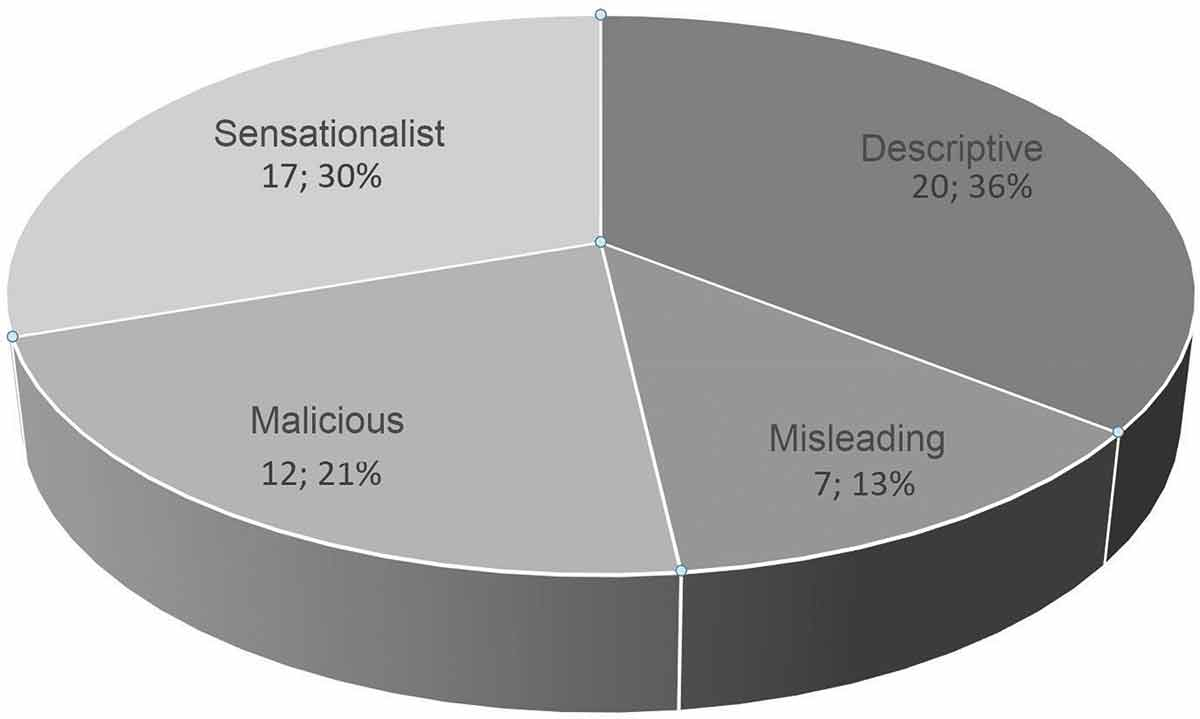
The analysis of the titles used reveals that descriptive titles have the greatest presence, with 20 cases. Nevertheless, this first position is not without its negative side, since 64% of these titles are sensationalist (30%), malicious (21%) or misleading (13%).
The second relevant element when capturing the visual attention of YouTube users is the thumbnail, which serves to attract viewers. In this case, the distribution shows a prevalence of credible thumbnails, whose content is consistent with part of the subsequent message published, for 31 of the 56 units analysed. In turn, 25 of these, equivalent to 45%, use some form of manipulation, consistent with the data found in the analysis of the titles. The need to attract the audience’s attention leads YouTubers to make an explicit and sometimes malicious effort to improve the endearing qualities of the most singular and visible elements of the videos. This manipulation, which can be carried out with aesthetic or formal aspects, alerts us to the fact that these resources are used, in most cases, and in a conscious way, in order to attract the attention of a YouTube consumer who is selecting content within an increasingly more populated and competitive ecosystem.
Considerable attention is given to the keywords that appear in the title, such as ‘trick’. The use of adjectives such as ‘incredible’, ‘easy’ and ‘real’ are also very frequent, or the formulation of a hypothesis which suggests what will happen in specific cases. At the same time, question marks are used in titles to cover up fake news. For example, when various users accuse FrezenHD of using clickbait in his titles, he responds: ‘you might say I’m lying […] In the title I never put exclamation marks to affirm something; I put question marks, as if it was a question, as if it was something that we’re going to confirm […]’ (FrezenHD, video 3_2016).
Similarly, in this same video, to accusations that the thumbnails show unreal or misleading situations, FrezenHD replies: ‘You have no idea what clickbait is because I make the thumbnails myself […]. Let’s see guys, if you start playing Pokémon Go and such and such is not there, then I’m not going to talk about such and such’.
The duration of the videos is directly related to the payments that those who create audiovisual clips and post them on YouTube can receive. In this sense, in around 60% of cases (33 of 56), the videos we have analysed present unnecessarily long durations, prolonging the content in order to exceed the 10-minute threshold after which payments are increased. Many comments are found criticizing this fact. For example: ‘This is a really rubbish video. You don’t explain anything. Your videos are just wasting people’s time and tricking them with titles. What a pathetic content creator you’ve turned into’. Some users even mention the minute when the trick announced is described, so that others do not have to waste their time.
The desire to obtain greater economic returns translates into videos that rely on hooks both to attract the audience and to keep them watching throughout the whole video, in a way which is very similar to the strategies used by mass media.
Analyses of the descriptions published alongside the videos, and in which the video content is anticipated, show a clear predominance of economic interests in 73% of the videos, while those with a purely descriptive purpose constitute only 14 of the 56 videos analysed. In the first case, users are given discount codes to make purchases or download applications, which the YouTuber will receive payment for if they are used (Figure 2). Type of description predominant in the videos analysed.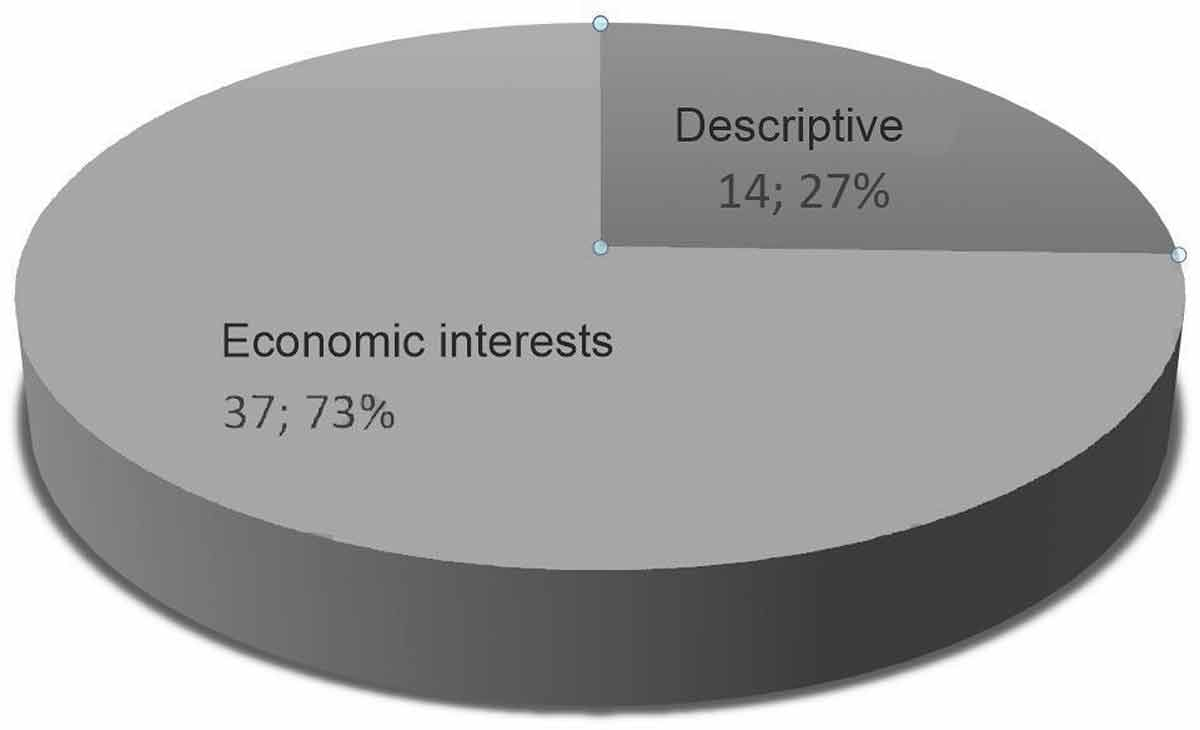
The presence of misleading or malicious aspects in the video content is less than in the titles and descriptions, as we can see in Figure 3. Type of content predominant in the videos analysed.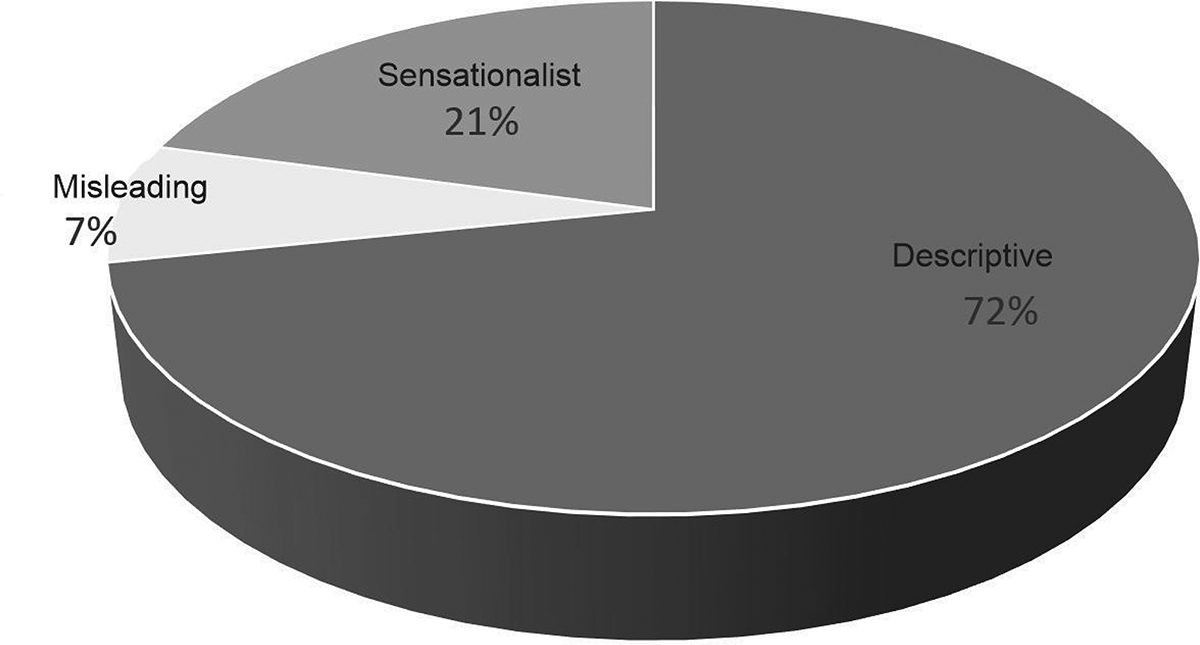
Although content focused on illegal actions within the game is scarce, its mere presence highlights the thin line between respecting and breaking the rules of the game, opening up a debate on the ethics within the game which is addressed in a very sporadic way, and about players’ commitment to competing in equal conditions.
The accounts analysed show that those responsible for them have high levels of digital competence, that they are conscious of techniques for increasing interest in their productions and, consequently, of increasing their economic returns.
Total values of the eight videos analysed by YouTuber.
The YouTubers analysed know how YouTube decides how frequently the videos are shown to users. From 2016 onwards, YouTube modified its algorithms to reward not only the number of views but also interaction, taking into account the duration of the view, the comments and the ‘likes’ or ‘dislikes’ (Covington, Adams, & Sargin, 2016). In order to optimize the monetization of their videos, YouTubers prompt users to react and make comments.
It is clear that in most comments users refer to their experience with the game, whether spontaneously or prompted by the lure of participating in a draw. It is therefore an easy resource that does not require any form of opinion to be given.
Although abundant examples of misleading titles and thumbnails could be found prior to the change in YouTube algorithms, comments against misinformation were scarce. For example: ‘there is a bit of thumbnail in your clickbait’; ‘you give a lot of unsupported information and just give titbits robbed from other networks’; ‘reported for fake title’; or ‘it’s still not official, why do you put things in your title that haven’t happened yet?’
Although scarce, these criticisms do influence YouTubers who use clickbaits and those who do not. On the one hand, in 2017, ErickEcua states: ‘As you already know, my channel is no longer clickbait’ (video 4_2017), going on to say in another video that: many people will have noticed that I don’t post much information about Pokémon Go any more, not because I don’t want to, but because there isn’t any. I’m not going to lie to you about clickbait either […] guys, things are not like that anymore. I think you’re the best and you deserve the best information available (video 1_2017).
Positive comments are received as a result of this: ‘I see that you’re doing things properly. You’re not doing clickbait and so I’m subscribing’.
Other YouTubers, such as FrezenHD, have no intention of stopping using clickbait: ‘If 100% of the channel were against it [clickbait], I’d probably change it; I’d carry on doing it but in another way’.
The case of LuzuGames is particularly noteworthy. This is the most followed YouTuber, with the highest percentage of ‘likes’, for whom we have not found any comments referring to the presence of misinformation in their videos. In the last video he made about Pokémon Go, he reflects that: I‘m not going to post any more videos until there is something new to say about the Game […] I can’t tell you how many Spanish-speaking channels there are making videos about Pokémon Go in which everything is a lie […] Why do people still watch them when the clickbait responds in two days and you see that everything is a lie? I‘ve never wanted to make content based on speculation […] If anything characterizes the Pokémon Go community it’s stamina and patience, because we live surrounded by rumours, we live off the air. (Video 3_2017).
The quantity of ‘likes’ and ‘dislikes’ that each YouTuber receives for their videos may surprise us, since some of them receive many ‘likes’, despite promoting their videos through clickbait and presenting meaningless discourses. These responses appear to be only positive, and are forced by YouTubers, who tell their followers that to participate in draws to win money to play in the game they need to subscribe to their channel, giving a ‘like’ and posting a positive comment.
With the exception of SoninGame and LuzuGames, all the YouTubers analysed use this strategy to increase their income. ErickEcua even intervenes when he sees that the statistics of his video are not going as planned: ‘I see a lot of dislikes so I don’t think people want any more accounts to win the draw like the one we see in the video. That’s a shame’.
The audience is more interested in winning draws than in the need to react to the sensationalist or fake information given in the video. There are comments that even thank YouTubers for this kind of behaviour: ‘That’s really good, but listen, when am I going to win? I’m always watching the videos but I don’t win anything’. Their main goal is to make money to invest and progress in the game, and they even ask others to play with their account, since they cannot do it in their own cities as it is too dangerous: ‘I need help with my account. I’m nine years old and I never go out. I need someone to help me’.
Discussion and possible implications
In general, we have seen how YouTube and other networks provide the ideal climate to spread fake news and misinformation in real and virtual worlds. Misinformation and sensationalism turn out to be profitable thanks to the programmatic advertising systems of Google, Facebook and other platforms, while the truth has little use value and even less exchange value.
In times of confusion and informational profligacy, we are witnessing the convergence or fall of the barrier between the real and the virtual; the true and the false (‘fake news’); the newsworthy and the trivial (‘not news’); objectivity and sensationalism; impartiality and partisanship; the description of facts and opinion. Nowadays, opinion is considered to be more important than facts, and everyone thinks they have a right to give their opinion on any topic, whether they have any authority on it or not. While social networks, virtual communities and the Internet in general must fulfil their role of enabling citizens to express themselves freely, we need to take measures to ensure that they do not become fertile ground for trolls in search of economic benefits on the basis of clickbaits and fake news, or that they serve as a ‘platform for “fake news”; and “alternative facts”, aimed at generating fear or hate of others and thereby justifying discriminatory policies against marginalised groups’ (Speed & Mannion, 2017, p. 249).
The fact that YouTubers use clickbaits, and that their followers sell their ‘likes’ for draws and pokecoins, leads us to think that economic and commercial interests are the priority for all of them. While enrichment may be a licit aim in capitalist society, it does not justify the means being used (fake and misleading news), nor do we consider it to be a priority in the world of communication as a public service.
Internet users should not be considered as merchandise in an insatiable consumer society. The prestigious philosopher Habermas recently argued (in Hermoso, 2018) that ‘before these centrifugal and atomising trends of new media came into play, the disintegration of the citizens’ space had already started with the commercialisation of the public eye’, as in the case of the United States and its exclusive monopoly of private television. Nevertheless, and as Habermas emphasises, ‘new forms of media practice are a much more insidious mode of commercialisation. In this context, the goal is not directly to capture the attention of consumers, but rather to extract economic profit from their public profiles’.
As seen in the recently uncovered case of Facebook and Cambridge Analytica, users’ personal data are used to personalize as much as possible the sale of products and ideas. This has led many experts to requestion the value of media democracies in a similar way to that of Postman (1985) in response to the influence of television.
We are now passing from the Information Age (Castells, 1996) to the ‘Misinformation Age’, due, to a large extent, to the lack of adequate media education. Over recent years, many debates have been conducted with experts, and different reflections and studies have been published on possible solutions for the problem of ‘fake news’. We agree with two of the most repeated proposals, which are closely interrelated: the recovery of the truth as a journalistic value in the digital context adequate digital literacy as a shared responsibility of all: schools, the media, social groups
The measures needed to implement these proposals are not easy. The trivialization of the truth and information is a generalized fact on social networks, as we have verified in this study. As a result, the professional and ethical training of journalists is not enough, and it also becomes essential to develop the critical capacity of consumers, who also become ‘prosumers’ of information.
This leads us to identify education as a solution: that is, a multiple form of media education which includes digital competence, but which is not reduced to technological training and advocates, instead, ‘civic-media literacy’ that encourages citizen participation (Brites, 2015) and promotes value education that prevents the digital propagation of lies and discourses of hate.
Buckingham (2017) warns that ‘fake news is a symptom of much more profound changes in both politics and in the wider media setting’. The problem of misinformation is not solved by attacking the symptoms with a series of tips and checklists for consumers to learn how to detect fake news but, rather, by studying its underlying causes, one of which is excessive monetization and the diminishing value of truth in new virtual environments.
Educación mediática frente a la monetización en YouTube: la pérdida de la verdad como valor de cambio
Punto de partida
La digitalización ha cambiado sustancialmente la forma de codificar, generar, transmitir, almacenar, recibir, procesar e interpretar la información. Lógicamente, la digitalización y el mundo de las redes han aumentado también significativamente la ‘desinformación’, más por sobreabundancia e infoxicación que por falta de noticias. No cabe duda de que, con los nuevos y omnipresentes medios, estamos más, pero no necesariamente mejor, informados. A medida que ha avanzado la digitalización de nuestras sociedades, sostiene Roig (2018), la lucha de poder entre estados ha traspasado al ciberespacio y la propaganda política y la desinformación han inundado Internet y las redes sociales.
Desde sus inicios, uno de los aspectos clave de la educación mediática ha sido hacer entender que la imagen no es la realidad, que los medios ofrecen interpretaciones y representaciones, y que su alto grado de iconicidad (foto, vídeo, 3D, realidad virtual, realidad aumentada) no tiene por qué aumentar su veracidad. Distanciarse de la información para poder analizarla y valorarla; clasificar, catalogar, etiquetar la producción mediática, y verificar la información, se complica en la era de la convergencia y el amasijo, en este maremágnum de datos donde ya ‘nada es verdad ni mentira’, ya todo es del color del cristal a través del que quieren que miremos. Como señala Frederiksen (2017), la identificación y evaluación de las noticias falsas nunca ha sido tan difícil como en este entorno política y digitalmente polarizado en que vivimos; una ‘era de partidismo y desconfianza’ (Mihailidis & Viottyrticle, 2017); un entorno de desilusión popular donde los políticos que más triunfan son los que presumen de ‘antipolíticos’ (Berger & McDougall, 2015).
La convergencia de medios, géneros y formatos en las redes modifica el panorama comunicacional hacia una amalgama de textos y contextos multimedia donde se mezclan las funciones de informar, entretener y educar; donde prima el anuncio impactante y la competencia por vender titulares (Sánchez-Ventero, 2018); donde se ‘picotean’ las noticias sin profundizar sobre los hechos y su posible trascendencia (Carr, 2008); donde la tarea de informar ya no es exclusiva de los profesionales; donde la información se convierte cada vez más en espectáculo (Postman, 1985), y donde, en definitiva, la verdad se funde y confunde con la mentira.
Se diluye la frontera entre lo representado y la representación, entre lo real y lo virtual, entre lo ‘verdadero’ y lo ‘falso’. La realidad aumentada integra mundos virtuales y reales difuminando los límites entre la vida offline y online (BBC-Mundo, 2018). En este sentido, resulta interesante observar, por ejemplo, cómo los bailes del popular juego on-line ‘Fornite’ se viralizan y saltan a la vida real; los deportistas en sus celebraciones y la gente por la calle los repiten; los usuarios se graban nuevos bailes que suben a la red y compiten por que Epic Games los incorpore como ‘emotes’ del juego. ¿Qué es lo ‘real’ y a quién le importa? ¿Qué alfabetización básica es necesaria para este entorno digital?
Vivimos en un entorno abonado para el éxito de las noticias falsas, de los ‘mundos falsos’, en la era de la posverdad. El concepto de ‘post-truth’ (posverdad) se popularizó en las campañas del Brexit y de la elección de Donald Trump, y fue elegido por Oxford Dictionaries como palabra del año en 2016. Esta era de la posverdad, según Lewandowsky, Ecker, y Cook (2017, p. 353) ‘es el resultado de mega-tendencias sociales como el descenso del capital social, el crecimiento de la desigualdad económica, el aumento de la polarización, una creciente desconfianza en la ciencia, y un panorama mediático cada vez más fraccionado’.
La desinformación ha existido siempre, pero se convierte en un verdadero problema en nuestro entorno-amasijo digital, repleto de ‘click-baits’ y ‘fake news’. Para los objetivos de este estudio coincidimos con los autores del Informe de la Comisión Europea (2018) sobre noticias falsas y desinformación en Internet, en que no son necesarias las noticias falsas para desinformar, para transmitir información falsa, engañosa o tendenciosa con la intención de causar daño o conseguir beneficio económico.
Hasta la primera mitad del siglo XX la desinformación o ‘falta de información’ se conseguía con la censura, controlando los medios de comunicación. A medida que la digitalización ha ido haciendo posible la reproducción casi instantánea de la información y su difusión, la desinformación no se basa tanto en la censura como en la manipulación informativa. Si no pueden ocultarse los hechos, se ofrecen interpretaciones sesgadas y puntos de vista interesados. Se sobreexponen unos hechos hasta la saturación y se ocultan otros. Ya a finales del siglo pasado las políticas de desinformación se planteaban que la verdad de los hechos no tenía por qué suponer una limitación. Recordemos el viejo dicho periodístico ‘nunca dejes que la realidad te estropee una buena historia’. En la actual ‘era de la posverdad’, según Keyes (2004), entre las categorías ‘verdad’ y ‘mentira’, claramente diferenciadas, se sitúa una tercera consistente en las verdades a medias o ‘neoverdades’. No importan ya tanto los hechos, la realidad, sino la forma de presentarla distorsionada para manipular creencias y emociones.
En la actual escalada de desinformación, de la presentación distorsionada de los hechos hemos pasado a la invención de la noticia, a las noticias falsas o ‘fake news’, que se presentan descaradamente como ‘hechos alternativos’. Tandoc, Wei Lim, y Ling (2017) nos ofrecen una tipología de noticias falsas basada en 34 artículos académicos sobre este tema. Lo importante de estas noticias no es si se trata de un hecho real o una mentira, lo que importa es que la gente lo crea y actúe en consecuencia. En este panorama informativo, donde, como decíamos, nada parece ser verdad ni mentira, el ciudadano medio no dispone de las herramientas ni criterios necesarios para distinguir las noticias falsas, desconfía de cualquier medio y tiende a dar su porción de credibilidad a los populistas de ideología afín, porque se siente mejor con lo que le transmiten, independientemente de su veracidad o falsedad. La gente ya no confía en las noticias ni le importa si son o no falsas. Chomsky va un paso más allá afirmando que ‘ya no se confía ni en los mismos hechos’ (Martínez-Ahrens, 2018).
Decía Imbert (2008) que en la cultura fragmentada donde el saber se actualiza y renueva constantemente, la información tiende a dominar a la historia, y lo efímero (la producción mass-mediática) prevalece sobre lo acumulativo (lo patrimonial histórico). También apuntaba que ‘hoy basta con ver para creérselo: “Es verdad, lo he visto en la tele”, dice la vox populi, “ha salido en los periódicos”, lo dice la radio’ (Imbert, 2008, p. 26). Tan solo unos años después vemos que tanto la información como la credibilidad de los medios se ven seriamente amenazadas por la desinformación, y esa producción massmediática de los tradicionales medios de comunicación se ve remplazada como principal fuente de información por las redes sociales, web colaborativas y otros sitios de Internet como ‘Reddit’, donde los contenidos agregados o recopilados más populares son los más votados o comentados por los lectores-editores, independientemente de su importancia y veracidad. En 2018 Reddit es ya, tras Google, YouTube y Facebook, la cuarta página más visitada en EE.UU. y una de las principales fuentes tanto de información como de desinformación de los usuarios de Internet y sirve incluso como fuente de noticias para algunos profesionales de los medios (Duggan & Smith, 2013).
En los últimos años se han publicado numerosos artículos sobre las noticias falsas. Sobre sus posibles causas Rochlin (2017) añade a la desconfianza general en los medios, el sistema de recompensas por click que permite que noticias falsas utilizadas como cebo se viralicen, y la escasa alfabetización informacional de sus usuarios. Horne y Adah (2017) sostienen que las noticias falsas se dirigen sobre todo a los lectores que no suelen pasar de los titulares y tratan de crear asociaciones mentales entre realidades y deseos. Se les ofrece, según Ott (2016), un lenguaje ‘simple, impulsivo y grosero’, que el autor demuestra con el análisis de los tuits de Donald J. Trump.
Desde el punto de vista de los profesionales de los medios, Himma-Kadakas (2017) destaca la presión y premura de los periodistas para proporcionar nuevos contenidos, lo que hace que a veces no se establezcan los controles habituales. Por otra parte, Peinado y Alameda (2018) nos describen ‘una industria integrada por consultoras y trabajadores freelance’ dedicados a lanzar campañas de desinformación para inflar la vanidad o la billetera de políticos, grandes corporaciones, artistas, deportistas, abogados, médicos, chefs y pequeños empresarios. La falta de ética profesional de algunos famosos que asumen el rol de periodistas, está también contribuyendo, según Borden y Tew (2007) al aumento de la desinformación. A todas estas razones añadiríamos en este artículo el escaso valor que se da a la verdad en las redes sociales, menosprecio a la verdad informativa que se traslada a los medios de comunicación, donde la información también se convierte en espectáculo.
En esta investigación analizamos la presencia de desinformación en un entorno muy concreto: las cuentas más populares de YouTube sobre Pokémon Go. Algunos estudios como el de Paul Tassi (2016), ya analizan el uso de ‘clickbaits’ en los vídeos sobre Pokémon, pero el principal objetivo de nuestra investigación es analizar no solo el contenido de los vídeos, sino, y sobre todo, las reacciones de los usuarios a la desinformación, y la importancia que dan a la verdad como valor deseable. Planteamos la hipótesis de que la desinformación se ve favorecida por la crisis de la verdad como valor periodístico y social; por el interés económico, y por la falta de una alfabetización digital actualizada.
En nuestro estudio nos centraremos en la plataforma YouTube, que se considera como la ‘televisión extendida’ (Islas, 2016), una nueva televisión interactiva y a la carta que está reemplazando a la televisión como medio de masas, sobre todo entre los jóvenes. Nos referiremos, sin embargo, a YouTube más como una red social, que también lo es, como un espacio donde, según Marwick y Lewis (2017), existe y se comparte mucha desinformación entre millones de personas.
Gracias al Programa para Partners de YouTube (YPP), lanzado en 2007, los creadores, artistas e intelectuales pueden monetizar su contenido en la plataforma para obtener ingresos con los anuncios que se muestran en sus vídeos, lo cual ha creado e inspirado nuevas formas de compartir la cultura. Sin embargo, como veremos en nuestro estudio, esta posibilidad de obtener beneficio económico por el número de visionados ha permitido a individuos sin escrúpulos crear noticias falsas y titulares sensacionalistas con el único propósito de conseguir visitas.
Métodos utilizados
La metodología desde la que parte esta investigación se construye a partir de un primer objetivo de naturaleza descriptiva, que consiste en medir la presencia de determinadas categorías de análisis en los vídeos — y en las reacciones en forma de comentarios — publicados en YouTube acerca del videojuego de Pokémon Go.
Se eligió en principio este juego puesto que su éxito no había tenido precedentes: logró 30 millones de descargas en las dos primeras desde su lanzamiento y obtuvo 26 millones de usuarios activos al día (Grubb, 2016). Además de estos datos, que muestran su éxito en el mercado, se trata de un juego de realidad aumentada, donde se integran mundos virtuales y reales, y donde, como señalábamos anteriormente, se diluye la frontera entre lo representado y la representación, entre lo real y lo virtual, entre lo ‘verdadero’ y lo ‘falso’.
Para medir la presencia de las categorías de análisis y poder enriquecerla con una mirada crítica y constructiva en la fase de discusión, se ha optado por una combinación de métodos cuantitativos, centrados en el recuento de la aparición de los diferentes valores previstos en cada variable, y métodos cualitativos, persiguiendo la necesaria profundización en el significado de esos mensajes. La técnica de investigación utilizada para el registro y la codificación de la información fue el análisis de contenido, tanto cuantitativo como cualitativo, utilizando el programa de análisis de datos Atlas.ti para esta misión.
El uso que le hemos dado al programa ha priorizado la codificación y el recuento de los valores de cada variable, abriéndose una línea futura de trabajo que se centrará en la profundización cualitativa sobre la información recopilada.
El corpus de análisis está compuesto, por 56 vídeos, provenientes de siete canales diferentes, seleccionadas por cumplir los siguientes requisitos: Estar verificados por YouTube. Publicar contenidos en español sobre Pokémon Go. Poseer más de 100,000 suscriptores. Estar activos tanto en una primera etapa (julio-2016 hasta febrero-2017) que coincide con el lanzamiento del videojuego, como en una segunda más reciente (marzo-2017 hasta febrero-2018), en la que el juego afronta su actualización y consolidación
Cuentas de YouTube monitorizadas.
Fuente: socialblade.com (Datos: 27 de mayo de 2018)
El criterio aplicado para la selección de los vídeos de cada una de las siete cuentas ha consistido en localizar los ocho vídeos sobre Pokémon Go (cuatro de cada una de las dos etapas predeterminadas) con mayor número de visualizaciones.
El protocolo de análisis de contenido empleado se divide en dos partes. La primera toma como unidad de análisis el vídeo publicado, explorando las siguientes variables: Título del documento, diferenciando entre títulos descriptivos (informativos), sensacionalistas (emocionales), engañosos (falsedades) y malintencionados (cebos para captar atención). Miniatura que elige el YouTuber para ilustrar el vídeo y que aparece como un elemento identificador, pudiendo optar entre las que representan situaciones verosímiles y aquellas imágenes que intentan engañar al usuario y estimular el clickbait. Duración del vídeo, distinguiendo entre adecuadas para el contenido y excesivas, que son aquellas que, de forma premeditada y con un afán de incrementar el rendimiento económico cosechado por los vídeos, supera los 10 minutos. Contenido, utilizando una clasificación similar a la propuesta en el título, pero incluyendo un apartado especial para identificar todas aquellas menciones explícitas a cuestiones éticas en relación con el videojuego, así como cualquier petición directa al usuario de apoyo y/o seguimiento del canal. Resumen del contenido principal del vídeo.
La segunda parte del protocolo toma como unidad de análisis los 200 primeros comentarios que se ordenan por la categoría de ‘mejores comentarios’ proporcionada por YouTube. Estas reacciones se codificaron diferenciando entre comentarios positivos — por motivos relacionados con la calidad del vídeo o del emisor, o — forzados por la existencia previa de una invitación a ello para participar en un sorteo; comentarios negativos — bien por una crítica acerca del interés económico del YouTuber, o bien por alusiones a falta de ética en relación con el videojuego, como trampas o información falsa — y otros, como una categoría abierta a la diversidad de reacciones que pueden aparecer en estos entornos digitales.
Así, los 56 vídeos previamente mencionados fueron completados por 10,835 comentarios, aplicando al conjunto de los vídeos las cinco categorías de análisis, y la tipología previamente expuesta para los comentarios. El procesamiento estadístico de la información recopilada se ha completado mediante el cálculo de frecuencias simples de las diferentes variables, completado con un abordaje cualitativo a partir de la selección de aquellos fragmentos que condensan un mayor potencial explicativo. En ambos casos se ha utilizado el programa Atlas.ti para la codificación y el análisis de los datos. Los resultados se presentan en el siguiente apartado partiendo de la explotación cuantitativa y evolucionando hacia la interpretación cualitativa.
Resultados obtenidos
Los vídeos seleccionados en este trabajo constituyen una muestra intencional de la que no se pueden extrapolar generalizaciones para abarcar al conjunto de la población. Sin embargo, su estudio permite comprender mejor la lógica según la que operan algunos de los principales canales de YouTube especializados en videojuegos. Es importante recordar que nuestro foco analítico remite al uso y a la relación sociodiscursiva que se establece entre usuarios de una misma plataforma audiovisual en línea, en función de la veracidad y la precisión de los mensajes que se ponen en circulación.
Para el análisis de los resultados obtenidos, distinguiremos entre dos perspectivas: (a) el modo como los YouTubers generan sus contenidos y (b) la reacción que estos producen en la audiencia, como veremos en un segundo nivel de análisis.
(a) Tomando como unidad de análisis el vídeo publicado, se observa que, a excepción LuzuGames, los YouTubers, jugadores experimentados todos ellos, siguen estrategias similares para llegar a la audiencia. Una de ellas es desvelar trucos que, de forma legal o no, hacen la experiencia del juego más sencilla. Otra el ser los primeros en comentar alguna novedad del juego, aunque no se conozca bien todavía. Por ejemplo: ‘Vamos a hablar de la nueva actualización, que va a salir en breve y que está 100% confirmado’ (KeibronGamer, vídeo 4_2016). Para dar credibilidad a la noticia los YouTubers suelen citar sus fuentes, que en la mayor parte de los casos no son los canales oficiales empleados por Niantic, el desarrollador del juego, sino foros alojados en Reddit o webs como pokemongohub.net o thesilphroad.com, creadas por jugadores.
El título elegido para los vídeos con mayor éxito de audiencia en cada uno de los siete canales pone de manifiesto la desigual convivencia entre técnicas propias del periodismo factual, en las que se describe el contenido que aborda el vídeo (36% de los 56 vídeos analizados), y las tácticas propias del campo de la persuasión en las que se perciben argumentos emocionales o sensacionalistas, se recurre a mensajes engañosos o malintencionados (Figura 1). Tipo de título empleado en los vídeos analizados.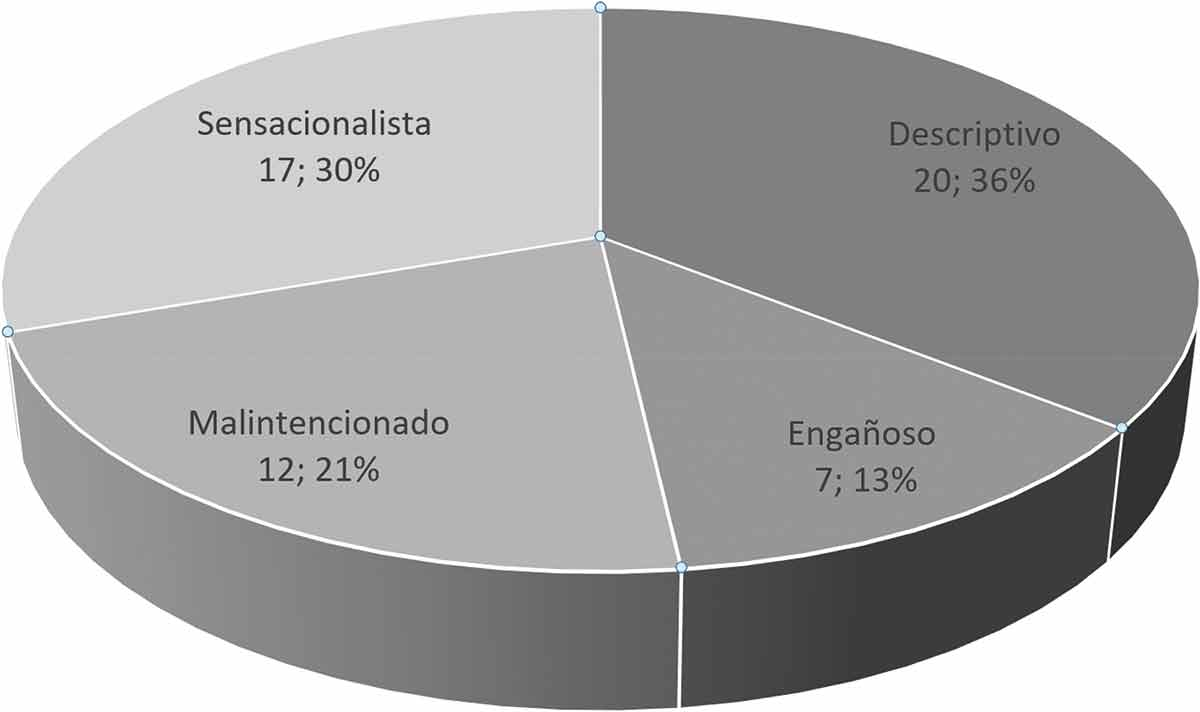
El análisis de los títulos empleados nos devuelve que el valor con mayor presencia remite a los titulares descriptivos, con 20 casos, si bien esta primera posición no consigue eclipsar un hecho negativo, pues el 64% de estos títulos resultan sensacionalistas (30%), malintencionados (21%) o engañosos (13%).
El segundo elemento de relevancia a la hora de captar la atención visual del usuario de YouTube son las miniaturas, que cumplen una función de reclamo. La distribución, en este caso, arroja una prevalencia de las miniaturas verosímiles, cuyo contenido se ajusta a una parte del posterior mensaje publicado, con 31 de las 56 unidades analizadas. Por su parte, 25 de ellas, equivalente a un 45%, recurren a alguna forma de manipulación, en consonancia con los datos encontrados en el análisis de los títulos. La necesidad de llamar la atención de la audiencia lleva a un esfuerzo explícito y, en ocasiones, malintencionado por mejorar el poder apelativo de los elementos más singulares y visibles de los vídeos. Esta manipulación, que se puede realizar sobre la base de aspectos estéticos o formales, nos pone sobre el aviso de que estos recursos son empleados, en la mayoría de las ocasiones, de forma consciente, con el fin de llamar la atención a un consumidor de YouTube que debe seleccionar contenidos en un ecosistema cada vez más poblado y competitivo.
Se presta mucha atención a las palabras clave que aparecen en el título, como ‘truco’. También es muy frecuente el uso de adjetivos como ‘increíble’, ‘fácil’ y ‘real’, o la formulación de una hipótesis donde se plantea qué sucedería en determinados casos concretos. A su vez, se utilizan signos de interrogación en los títulos para disfrazar noticias falsas. Por ejemplo, cuando a FrezenHD varios usuarios le acusan de que emplea el clickbait en sus títulos, él responde: ‘vosotros diréis que estoy mintiendo […] En el título nunca pongo exclamaciones afirmando algo; yo pongo interrogaciones, como si fuera una pregunta, como si fuera algo que vamos a confirmar […]‘. (FrezenHD, vídeo 3_2016).
Asimismo, en este mismo vídeo, a las acusaciones de miniaturas que muestran situaciones irreales y engañosas FrezenHD responde: ‘No tenéis ni idea de lo que es clickbait porque las miniaturas las hago yo […] a ver, chicos, si os metéis vosotros a Pokémon Go y no está eso, pues yo no voy a hablar de eso’.
La duración de los vídeos guarda una relación directa con las retribuciones que pueden alcanzar las personas que elaboran piezas audiovisuales y las ponen en circulación a través de YouTube. En este sentido, los vídeos que hemos analizado presentan, en alrededor de un 60% de los casos (33 de 56), una duración innecesariamente extensa, prolongando contenidos con el fin de sobrepasar una barrera de 10 minutos en la que se produce un salto en las cantidades de recompensa. Abundan los comentarios que critican este hecho. Por ejemplo: ‘¿Pero qué basura de video es esta? No has explicado nada. Tus vídeos ya solo hacen perder el tiempo y engañar a la gente con los títulos. Menudo creador de contenido estás hecho’. Incluso algunos usuarios avisan del minuto donde se habla del truco anunciado para que otros no tengan que perder el tiempo.
El afán de alcanzar un mayor retorno económico se traduce en vídeos que recurren a anzuelos tanto para captar a la audiencia como para mantenerla cautiva durante todo el vídeo, una lógica muy similar a la que emplean los medios de comunicación masiva.
El análisis de la descripción que se publica junto al vídeo, y en la que se anticipa el contenido del mismo, arroja un predominio evidente de los intereses económicos, con un 73% de los vídeos, mientras que la finalidad exclusivamente descriptiva solamente se percibe en 14 de los 56 vídeos. En el primer caso, se facilita a los usuarios códigos descuento para realizar compras o descargar aplicaciones, que reportarán dinero al YouTuber si se utilizan (Figura 2). Tipo de descripción predominante en los vídeos analizados.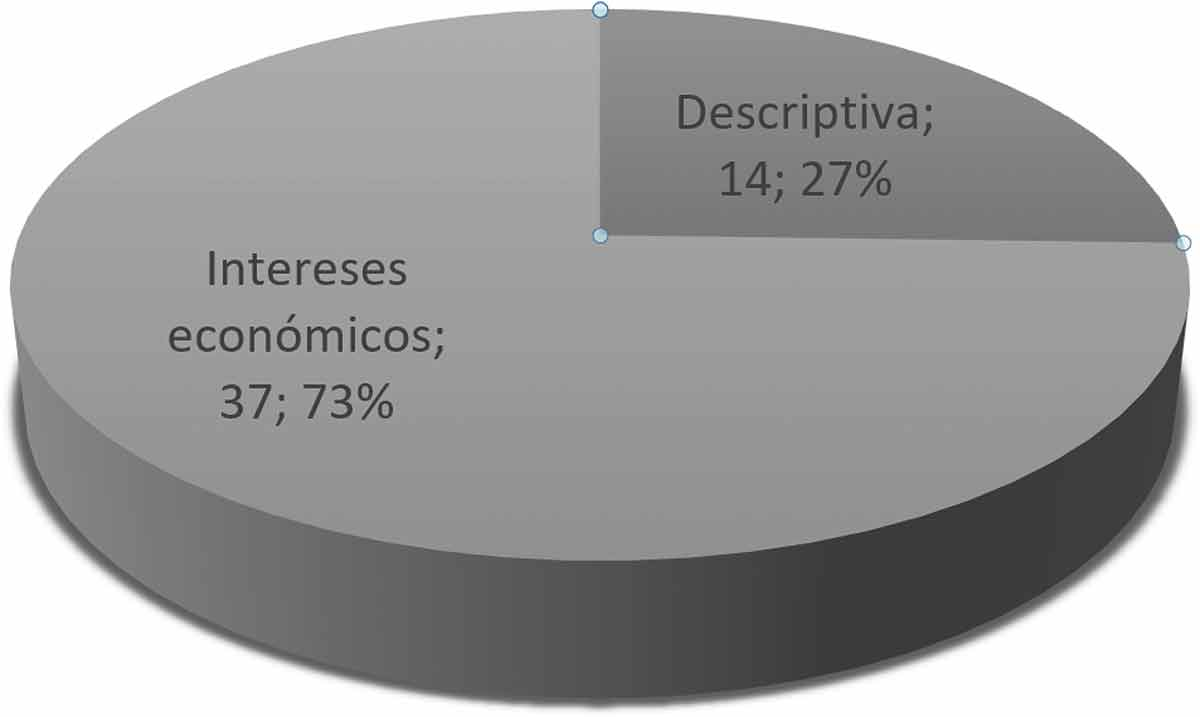
La presencia de aspectos engañosos o malintencionados en el contenido del vídeo es menor que en los títulos y descripciones, como puede observarse en la Figura 3. Tipo de contenido predominante en los vídeos analizados.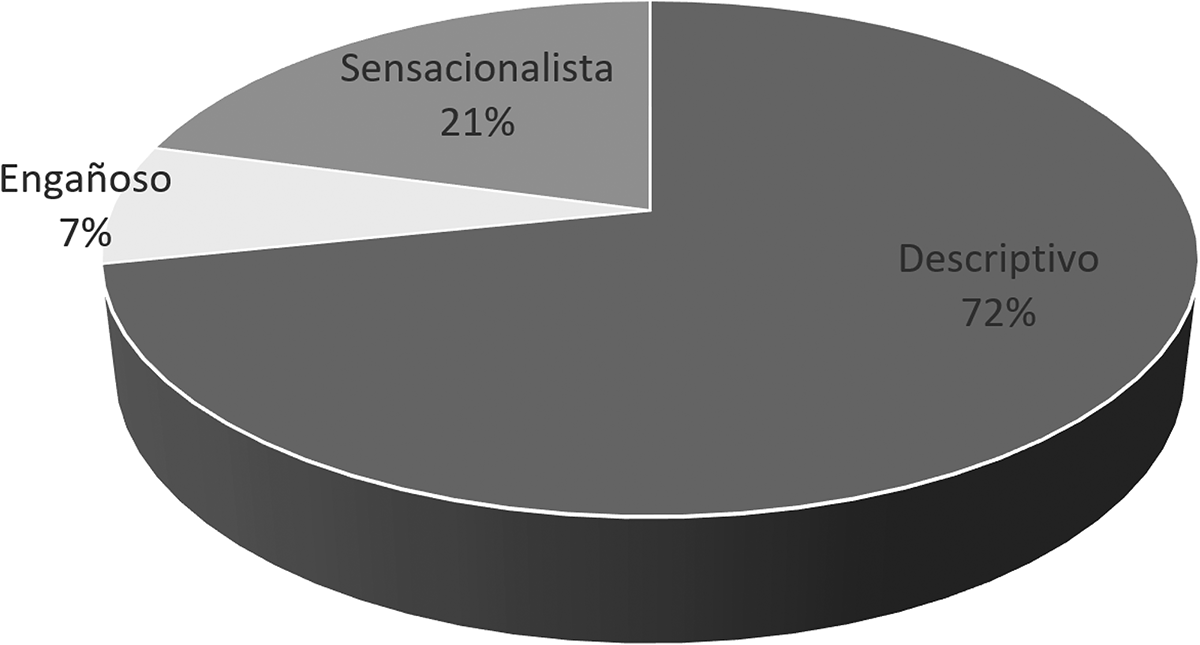
Los contenidos centrados en la información sobre acciones ilegales dentro del juego tienen un protagonismo escaso, pero su simple presencia pone de manifiesto la delgada línea que separa el respeto a las normas del juego de su quiebra, abriendo un debate que se aborda de forma muy esporádica acerca de la ética dentro del juego, y del compromiso por parte de todos los jugadores para competir en igualdad de condiciones.
Las cuentas analizadas ponen de manifiesto una elevada competencia digital por parte de sus responsables, que son conscientes de las técnicas para incrementar el interés de sus producciones y, en consecuencia, aumentar su retorno económico.
Valores totales de los ocho vídeos analizados por cada YouTuber.
Los YouTubers analizados saben cómo YouTube decide la frecuencia con la que el vídeo se muestra al usuario. A partir de 2016 YouTube modificó su algoritmo para recompensar no solo el número de visionados, sino la interacción, teniendo en cuenta el tiempo de visualización, los comentarios o los ‘me gusta’ y ‘no me gusta’ (Covington, Adams, & Sargin, 2016). Para optimizar la monetización de sus vídeos, los YouTubers provocan las reacciones y comentarios de los usuarios.
Salta a la vista que en la mayor parte de los comentarios, bien sean espontáneos o forzados para participar en algún sorteo, el usuario cuenta su experiencia con el juego. Es un recurso fácil que no requiere manifestar ninguna opinión.
Antes del cambio en el algoritmo de YouTube, aunque abundaban los títulos y miniaturas engañosas en los vídeos, se observan escasos comentarios contra la desinformación. Algunos de ellos: ‘hay un poco de miniatura en tu clickbait’; ‘das mucha información sin fundamento y son puras notas robadas de otras redes’; ‘denunciado por título falso’, o ‘todavía no es oficial, ¿por qué pones en el título cosas que todavía no han sucedido?’.
Estas críticas, aunque escasas, sí llegan a influir tanto en los YouTubers que emplean clickbaits como en los que no. Por un lado, ErickEcua afirma en 2017: ‘Como ya saben, mi canal ya no es clickbait’ (vídeo 4_2017) y continúa en otro vídeo: mucha gente se habrá dado cuenta de que ya no subo mucha información sobre Pokémon Go, no porque no quiera, sino porque no sale. Tampoco les voy a mentir con clickbait […] muchachos, ya no son así las cosas, creo que ustedes son lo mejor y tienen que informarse de buena mano (vídeo 1_2017).
Ante esto, recibe comentarios positivos: ‘veo que estás haciendo las cosas bien, ya no haces clickbait y me suscribo’.
Otros YouTubers, como FrezenHD no tienen interés en dejar de lado el clickbait: ‘Si el 100% del canal se lo tomara mal [el clickbait] a lo mejor lo cambiaría; lo seguiría poniendo, pero de otra forma’.
Llama la atención el caso de LuzuGames, el YouTuber más seguido, con más porcentaje de ‘me gusta’ y en el que no hemos encontrado ningún comentario que haga alusión a la presencia de desinformación en sus vídeos. En el último vídeo que realizó sobre Pokémon Go reflexiona: hasta que no haya cosas nuevas en el juego no voy a subir vídeos […] No puedo explicaros la cantidad de canales de habla hispana que hay que hacen vídeos de Pokémon Go en los cuales todo es mentira […] ¿Por qué la gente sigue viéndolos, si se contesta el clickbait en dos días y se ve que todo es mentira? Yo nunca he querido hacer contenido basado en la especulación […] Si algo caracteriza a la comunidad Pokémon Go es el aguante y la paciencia porque vivimos de rumores, vivimos del aire. (Vídeo 3_2017).
La cantidad de ‘me gusta’ y ‘no me gusta’ que recibe cada YouTuber en sus vídeos puede resultar sorprendente, ya que algunos de ellos, a pesar de promocionar los vídeos mediante clickbait y tener un discurso vacío, reciben gran cantidad de ‘me gusta’. Son valoraciones solo aparentemente positivas, forzadas por el YouTuber que indica a sus seguidores que, para participar en sorteos de dinero para gastar en el juego, deben suscribirse al canal, dar ‘me gusta’ y poner un comentario positivo.
Todos los YouTubers analizados, excepto SoninGame y LuzuGames, utilizan esta estrategia para aumentar sus ingresos. ErickEcua incluso interviene cuando ve que las estadísticas de su vídeo no van como le gustaría: ‘creo que ya no quieren que sortee más cuentas como la del vídeo ya que veo muchos dislike. Una lástima’.
En la audiencia prima el interés por ganar los sorteos sobre la necesidad de reaccionar a la información sensacionalista o falsa que se está dando en el vídeo. Hay comentarios que incluso agradecen al YouTuber este tipo de comportamiento: ‘está muy bueno, oye, cuando voy a ganar, que estoy siempre viendo los vídeos y no gano nada’. Su principal objetivo es conseguir dinero para invertir y progresar en el juego, e incluso piden a otros que jueguen con su cuenta, ya que ellos no pueden hacerlo en sus ciudades por ser muy peligrosas: ‘necesito que me ayuden con mi cuenta. Tengo nueve años y nunca salgo de casa y necesito que alguien me ayude’.
Discusión y posibles implicaciones
Hemos visto cómo las noticias falsas y la desinformación en general cuentan en YouTube y otras redes con un clima propicio para su propagación a mundos reales y virtuales. La desinformación y el sensacionalismo resultan rentables gracias a los sistemas de publicidad programática de Google, Facebook y otras plataformas, mientras que la verdad tiene escaso valor de uso y menor aún de cambio.
En estos momentos de confusión y desenfreno informativo, asistimos a la convergencia o caída del muro entre lo real y lo virtual; lo verdadero y lo falso (‘fake news’); lo noticiable y lo trivial (‘not news’); la objetividad y el sensacionalismo; la imparcialidad y el partidismo; la descripción de los hechos y la opinión. Ahora las opiniones se consideran más importantes que los hechos y todos nos consideramos con derecho a opinar sobre cualquier tema, con o sin autoridad. Si bien las redes sociales y comunidades virtuales, e Internet en general, deben cumplir su función de facilitar la libre expresión de la ciudadanía, deberíamos ser capaces de evitar que se conviertan en terreno abonado para los ‘trolls’ a la búsqueda de beneficio económico a base de ‘clikbaits’ y ‘fake news’; o sirvan de ‘portavoz para las “noticias falsas” y “hechos alternativos” con la intención de provocar miedo y odio al otro y así poder justificar políticas discriminatorias para grupos marginales’ (Speed & Mannion, 2017, p. 249).
El hecho de que los YouTubers utilicen clickbaits, y el que sus seguidores vendan sus ‘me gusta’ por sorteos y pokemonedas, nos inclina a pensar que los intereses económicos y comerciales son prioritarios para todos ellos. El enriquecimiento puede ser un fin lícito en la sociedad capitalista, pero ni justifica los medios que se están utilizando (noticias falsas y engañosas), ni consideramos prioritario en el mundo de la comunicación como servicio público.
Los usuarios de Internet no deberían ser considerados como mercancía en una insaciable sociedad de consumo. El prestigioso filósofo Habermas manifestaba recientemente (en Hermoso, 2018) que ‘antes de que entrasen en juego estas tendencias centrífugas y atomizadoras de los nuevos medios, la desintegración de la esfera ciudadana ya había empezado con la mercantilización de la atención pública’, como en el caso de Estados Unidos y su dominio exclusivo de la televisión privada. Ahora, sin embargo, puntualiza Habermas, ‘los nuevos medios de comunicación practican una modalidad mucho más insidiosa de mercantilización. En ella, el objetivo no es directamente la atención de los consumidores, sino la explotación económica del perfil privado de los usuarios’.
Los datos personales de los usuarios se utilizan, como en el caso recientemente desvelado de Facebook y Cambridge Analytica, para personalizar en lo posible la venta de productos e ideas, lo que a muchos expertos les ha hecho replantearse el valor de las democracias mediáticas como ya hiciese Postman (1985) ante la influencia de la televisión.
De la Era de la Información (Castells, 1996), y en parte debido una insuficiente e inadecuada educación mediática, estamos pasando a la ‘era de la desinformación’. En estos últimos años se están celebrando numerosos debates de expertos, y publicando diversas reflexiones e investigaciones, sobre posibles soluciones para el problema de las ‘fake news’. Coincidimos con dos de las propuestas más repetidas estrechamente relacionadas entre sí: la recuperación de la verdad como valor periodístico en el contexto digital una adecuada alfabetización digital como tarea de todos: escuela, medios, grupos sociales
Las medidas para llevar a cabo estas propuestas no son fáciles. La trivialización de la verdad y de la información es un hecho generalizado en las redes sociales, como hemos podido comprobar, por lo que no sería suficiente con la formación profesional y ética del periodista, sino también el desarrollo de la capacidad crítica del consumidor, que se convierte además en ‘prosumidor’ de información.
Esto nos lleva a pensar en la educación como solución, en una educación múltiple necesariamente mediática que incluya la competencia digital, pero que no se reduzca a la capacitación tecnológica; una ‘alfabetización cívico-mediática’ que favorezca la participación ciudadana (Brites, 2015); una educación en valores que imposibilite la propagación digital de la mentira y el discurso del odio.
Buckingham (2017) advierte que ‘las noticias falsas son un síntoma de cambios mucho más profundos tanto en la política como en un entorno mediático más amplio’. El problema de la desinformación no se soluciona atacando los síntomas con una serie de consejos y listas de comprobación para que los consumidores aprendan a detectar las noticias falsas, sino profundizando en el estudio de las posibles causas, entre las que incluimos la excesiva monetización y el escaso valor de la verdad en los nuevos entornos virtuales.
Footnotes
This study has been carried out within project reference no. 069/133321 ‘Strategies for developing media education and digital competence in university education‘ funded by FUNGE-UVA. / Esta investigación se ha realizado dentro del proyecto 069/133321 ‘Estrategias para el desarrollo de la educación mediática y la competencia digital en la educación universitaria’ subvencionado por FUNGE-UVA.
No potential conflict of interest was reported by the authors. / Los autores no han referido ningún potencial conflicto de interés en relación con este artículo.
