







Abstract
Education and the media are two factors that affect a person’s level of awareness of the climate. This study was conducted around these two axes with surveys of 565 secondary, baccalaureate, vocational and university students with the goal of ascertaining whether there is a different degree of awareness according to educational level and to what extent education and the media have contributed to the different sensibilities of these students, who are the future of society. To do so, stratified sampling and principal components, cluster and linear correlation analyses were conducted. The main results include that the group of students with the highest level of awareness and activity regarding climate change are university women, while the media have a heavier influence on youths than education, which should therefore reinforce its role through strategies like environmental educommunication.
Introduction and literature review
Today more than ever, education should focus on training people to live in a plural society where the environment is an essential part of that education. One of the major handicaps teachers have to deal with when addressing the topic of climate change is that they have to take an interdisciplinary approach, as the complex science that it is. For this reason, they should consider not only environmental factors but also economic, social, technological, political, communicative and other components (Monroe et al., 2017). These new factors, along with the inherited ones, that is, claims set forth by environmental movements which have not received great press in general because they have often been presented as anti-system organizations, have created a major gulf between these topics and the educational system. This means that it is difficult to raise social awareness through media campaigns, which makes it more difficult for young people to achieve the awareness they need to gain possible empathy with environmental topics (Kahan, 2009; Moser & Dilling, 2007; Wibeck, 2012). For this reason, the system should emphasize processes that foster the development of educational competences in the actors, that is, educating and training individuals to promote a shift in attitudes, values, practices and behaviours (Aparicio, 2016).
In this sense, numerous publications reveal that universities are playing an essential role in training professionals from the sustainability perspective (Barrón et al., 2010; Geli et al., 2019). It is a proven fact that every day steps are being taken in this direction, and this is reflected in numerous initiatives (Alsina & Calabuig, 2019; Fernández-Morilla et al., 2019; Gómez-Jarabo et al., 2019) and studies (Segalàs & Sanchéz, 2019; Tejedor et al., 2019). However, there is still a long road ahead before the inclusion of the sustainability and climate change perspective at Spanish universities actually becomes transformative (García-González et al., 2017).
In recent years, new lines like environmental educommunication are becoming a key topic among researchers; it seeks to develop digital and technological skills capable of forging bonds between the educational system, society and technology, where participatory processes in which people include criteria of sustainability, feminisms and global justice are allowed (Rodrigo-Cano & Machuca-de-la-Rosa, 2018). Other authors, like Puertas et al. (2019), talk about the civilizing process as a multicausal, complex, systemic juncture in which the dire social, economic and environmental problems we are facing are intertwined, and for which we need completely new forms, responses and solutions.
This increasing interest in environmental education has arisen parallel to a significant increase in the amount of space that the media devotes to environmental problems. Thus, in the United States it is estimated that the information flows on this topic quadrupled between 1988 and 2002 and are showing increasing penetration. The same pattern is found in Europe. This trend may have been influenced by the United Nations Sustainable Development Goals for 2030, which came out around the same time. Along with the major international media repercussions which started with the Rio Summit (1992) and were followed by the Kyoto Protocol (1997) and the Paris Agreement (2015), this is fostering greater awareness of climate change among youths.
Perhaps the case with the greatest media coverage is Greta Thunberg, but she is not an isolated case because the German Luisa Neubaer, the Chilean Ángela Valenzuela and the Russian Arshak Makichyan are appearing in public more frequently in the major intergovernmental summits to defend actions to combat climate change. Therefore, we can say that when motivated and aware of the importance of certain topics, like this one, the youths of the twenty-first century are taking an active attitude (Hallar et al., 2011; Pruneau et al., 2003). This new reality is making it possible for them to communicate their global vision about climate change and, in turn, raise the awareness of other, less sensitive audiences (Lester et al., 2006; Rooney-Varga et al., 2014).
All these approaches lead us to believe that education on climate change requires a global conceptualization in which formal education and the media play a fundamental role ensuring that youths gain awareness of the importance of preventing and mitigating climate change. But to what extent are they relevant? Do all these factors have the same level of influence among youths and adolescents? In order to answer these questions, this study seeks two objectives: first, to ascertain whether the sensibility or level of awareness of climate change among adolescents and youths is different according to their educational level; and second, to see whether there is a relationship between factors like education and the media and the level of awareness of climate change among adolescents and youths.
Material and methods
Measurement instrument
The database used for this study was obtained via an online questionnaire composed of a set of closed-ended questions (dichotomies, Likert scales, numerical scales and multiple choice) aimed at ascertaining the respondents’ sensitivity towards climate change and the possible influence on it from education and the media. The questionnaire also collected profile data on the sample (age, gender and current educational level).
To assess the respondents’ awareness of climate change, we essentially followed the structure outlined in Kuthe et al. (2019), which evaluates it according to five aspects: knowledge, climate-friendly behaviour, multiplicative actions, attitude and personal concern. We also bore in mind previous studies like Howell and Allen (2016), Torres et al. (2017) and López-Fletes et al. (2015) when constructing the questions (see Appendix 1).
The questionnaire was validated with a small group of students, which enabled us to redefine some details, test the functioning of the control questions and find out the average amount of time needed to take it.
Participants and sampling
Details of the sample.
To obtain the information, we contacted the teaching staff at the different schools and faculties in the province of Cádiz, who were given the link to the questionnaire once they had accepted and committed to participating in the study.
The data were collected between January and February 2020. In some cases, the questionnaire was filled out in the classroom during class time with the supervision of a teacher, primarily with the minors (ESO), while in others it was filled out outside class time as homework.
Statistical analysis
The data were analysed in three phases. The first was a principal components analysis (PCA) — one of the factorial analysis techniques used the most — in order to reduce the information contained in the questionnaire regarding awareness of climate change into a smaller number of explanatory variables with greater consistency. Secondly, based on the factors identified, we conducted a cluster analysis and a discriminant analysis to validate it in order to ascertain how these factors are distributed among the different students according to their educational level. Finally, we identified the degree and type of association between the concern with climate change and the different agents that have contributed to raising the respondents’ awareness of this issue. Based on these results, we analysed the role of education and the media in climate change using a linear correlation analysis.
All the analyses were performed using v. 4 of the Dyane software (survey design and analysis; Santesmases, 2009), and they showed sufficient reliability to obtain robust results that sustain the conclusions of this study.
Principal components analysis
Before applying the PCA, we checked whether the factorization of the correlation coefficients matrix was justified using Bartlett’s test. This test is based on the null hypothesis of the equivalency between the identity matrix and the correlation coefficients matrix (Bartlett, 1950). Once it went through this filter, PCA was applied with the goal of transforming a set of correlated variables into another set of independent variables called components which precisely reproduce the structure of the covariance matrix (Ximénez & San Martín, 2013). The criterion used to determine the number of significant factors is eigenvalues higher than 1, because this is the default setting of the statistical software used (Santesmases, 2009).
A varimax rotation was applied to the factorial axes to facilitate the interpretation of the significance of the factors. The loads or correlations of each factor show the degree and direction of the association (Uriel & Aldas, 2005).
Cluster analysis and discriminant analysis
A descending group analysis technique was used, specifically the Howard-Harris algorithm, because it is particularly applicable to large samples, as in our study (Santesmases, 2009). The variables were previously classified so that their measurement scales were homogeneous and to prevent greater variance in the scale from giving the variable higher weight.
In this type of analysis, there is no optimal number of groups to choose (Reger & Huff, 1993), so the number of groups is left to the researcher’s discretion. Therefore, in this study we established a number of groups to retain equal to four, following previous research by Kuthe et al. (2019).
Next, mean values were cross-tabulated applying Snedecor’s F to contrast the significance of the differences between the centres of the conglomerates (Hair et al., 2005; Santesmases, 2009), thus determining the independent variables whose mean values showed significant differences among the groups.
Finally, discriminant analysis was conducted with the goal of validating whether the groups obtained were sufficiently distinct according to the independent variables used (S. Fernández et al., 2004; Quijano, 2009; Santesmases, 2009). Wilks’ lambda indicator measures the differences among groups, which should be higher the closer this indicator is to 0. The significance of the model was calculated using Snedecor’s F and Bartlett’s chi-squared, and the confusion matrix showed the percentage of correct assignments.
Linear correlation analysis
To calculate the Pearson correlation coefficient, the variables ‘concern for climate change’ and ‘factors that have made you aware of climate change’ were used for each of the four clusters; the latter is composed of the following items: education, media, associations/organizations, personal experience, friends and/or family, religion/beliefs and others.
The linear correlation coefficient is the dimensionless quantity that determines the degree of fit and the direction of dependence; it can take on values between −1 and 1, with 0 being the absence of a linear correlation among the variables (Gónzalez & Pérez de Vargas, 2012).
Results
Principal components analysis
The results of Bartlett’s test (chi-square with 55 degrees of freedom = 446.1412 (p = .0000)) rejected the null hypothesis of significant correlation, so the application of PCA was determined to be appropriate.
Varimax rotation. Load of retained factors (after the rotation).
Cluster analysis and discriminant analysis
The Howard-Harris algorithm applied on the five factors detected in the PCA, as well as on the sex and age of the respondents (this latter variable being strongly correlated to educational level), gave rise to a division into four groups with 52.78% explanation of the variance of the variables.
The four conglomerates resulting from applying the algorithm are composed of 210, 110, 30 and 215 students, respectively.
Cross-tabulation of mean values.
Note: +: group with the highest mean; —: group with the lowest mean
Finally, discriminant analysis was applied in which the Wilks lambda indicator took on a value close to zero (.0418), which indicates that the total variability is due to the differences among the groups. The p-value associated with the statistic is statistically significant at a level of 1% (p = .0000), so the null hypothesis of equality of measures among the groups is rejected, and the information provided by the respective discriminant functions is considered statistically significant. The Bartlett’s test also enabled us to reject the null hypothesis of significant non-correlation, so it is suitable for calculating the confusion matrix of the discriminant analysis with the groups from the cluster analysis. The results of the confusion matrix show that there is a 98.76% proportion of correct assignments.
Characteristics of the groups of students from Cádiz according to their awareness of climate change.
Note: Factor 1: ‘My daily activities influence climate change and I am willing to pay more for products or services that help stop it’; Factor 2: ‘I know what climate change is and what its causes are’; Factor 3: ‘Degree to which I’m concerned about climate change and mean actions taken to lower it’; Factor 4: ‘Belief that climate change influences my everyday life, that there is still time to prevent it and that measures to combat it solely depend on governments’; Factor 5: ‘I have been or am a member of an organization/association that struggles against climate change and have participated in a mobilization/demonstration to protest climate change’.
Linear correlation analysis
A correlation analysis was conducted for each of the four groups obtained from the cluster analysis. The highest and most significant correlations of the factors that coincided regarding climate change, which show a direct correlation with concern for climate change, are shown in Figure 1, namely: Main factors of awareness of climate change for each group.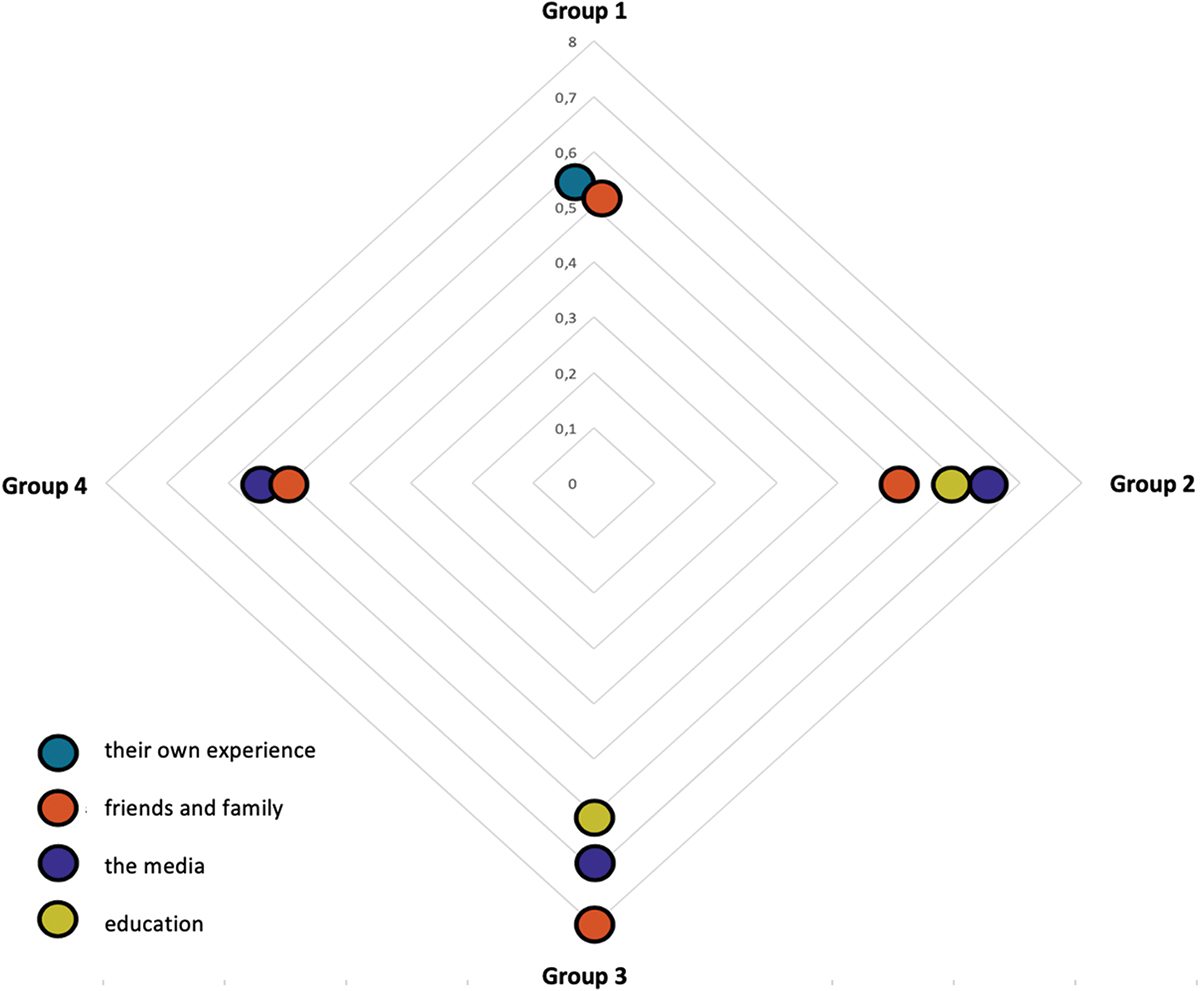
For Group 1: their own experience (.5499) and friends and family (.5179).
For Group 2: the media (.6659), education (.6084) and friends and family (.5151).
For Group 3: friends and family (.8312), the media (.7055) and education (.6221).
For Group 4: the media (.5359) and friends and family (.5126).
Discussion and conclusions
Based on the results obtained from the principal components analysis, we can identify each of the four factors obtained as follows:
The first retained factor explained 13.4% of the variance and is associated with the variables degree of agreement to pay more for goods and services if by doing so they contribute to stopping climate change and degree of agreement on the influence of their daily activities on climate change, with a high positive association in both cases. This factor can be identified as ‘behaviour’.
The second factor (12.67% of the variance) is associated with two variables on knowledge of what climate change is and whether the respondent understands its causes, both of which have high positive factor loads. Therefore, this factor can clearly be identified as the ‘knowledge’ factor.
The third extracted component explains 13.36% of the variance and is composed of a strong positive relationship with the degree of concern for climate change and the number of actions taken to lower it (this latter has the largest factor loads). These two components have led us to identify this factor as ‘personal concern’ with climate change.
The fourth factor (explaining 10.78% of the total variances) is composed of the variables related to the influence of climate change on everyday life and the belief that there is still time to prevent it (both with a positive association), as well as the level of agreement with the statement that measures to counter climate change only depend on governments (in this case, with a negative relationship and the lowest factor load of the entire analysis). Given the values of these factor loads, this factor can be identified as ‘attitude’.
The positive loads of factor 5 — which explains 10.71% of the total variance — in the variables related to membership in an organization/association that struggles against climate change and a weaker though also positive relationship with having participated in a mobilization/demonstration/strike to protest climate change enable us to identify this factor as ‘multiplicative actions’.
According to the different values obtained for these five factors in the cluster analysis, we obtained four groups of youths and adolescents 2 . The two largest groups have almost the same number of students (210 and 215) and account for 75% of the total sample. They are the groups with the strongest awareness of climate change. The first one was called ‘Activists’. It is the group made up of the oldest students, almost 45% of them university students and only 5.5% of them ESO students. Furthermore, more than 85% of its members are women. The activists are the ones that show the greatest concern for climate change and take more actions to fight it. They have a proactive attitude towards climate change and believe that it influences their daily lives but that there is still time to prevent it. These 42.4% belong (or have belonged) to an association that fights climate change or have participated in a demonstration or mobilization. The second group was called ‘Sympathisers’, and almost 50% of it is baccalaureate or vocational education students, while the percentage of university students is minuscule (4.1%). With slightly more men than women (58.6% compared to 41.4%), it is a group that is also keenly concerned with climate change, but unlike the activists, they have a stronger conception of it as a future problem, and although they do take some action, they are less active than the first group. More than 70% of sympathizers have never belonged to an association or participated in a demonstration on this issue.
Finally, the smaller groups are called ‘Unconcerned’ (made up of 19.5% of the students) and ‘Resigned’ (slightly over 5%). In the former, 46.7% are ESO students and 32.9% are in baccalaureate, while in the latter, 46.4% are in ESO and 33.5% are in vocational education. It is worth noting that the Resigned group is the only one with not a single university student and the highest percentage of men (60%). The Unconcerned group, as their name indicates, is the group with the lowest level of awareness about climate change, as 15.5% are not at all concerned by it. Most of them think that climate change does not affect their everyday lives, and therefore they are not involved in acting against it. The Resigned group show the least knowledge about climate change, although their level of concern about it is high. It is the most heterogeneous group, with higher scores than the other groups on the belief that climate change is a natural Earth process (20%) and that the consequences for the planet are mild and will not change their lifestyle (almost 17%).
Therefore, based on these results, we can answer the first objective: we did observe a different awareness level by educational level, with university students, generally women, being the ones who are the most concerned and most involved in the struggle against climate change, thus playing a more active role. These findings are in line with those of Hermans and Korhonen (2017), García-Vinuesa, Iglesias da Cunha, et al. (2020) and B. Lee et al. (2022), who cited women’s greater concern with/awareness of climate change, as well as more activism (James, 2014), which translated into greater support for collective action in the struggle against climate change (energy savings (Du & Pan, 2022), recycling, reforestation, use of public transport, etc. (García-Vinuesa, Bello, et al., 2020)). However, this division is not so clear in the other groups, which are made up of ESO students (around 46%), vocational education students (between 18% and 33%) and baccalaureate students (between 20 and 30%) in different proportions.
Regarding the second objective of the study, each student group’s correlation of their level of concern with the factors that raised their awareness of climate change shows that the only factor that is repeated in all the groups is friends and family, and that the media can be found in all the groups except for Activists. In this sense, Zhang and Skoric (2018) referred to more attenuated forms of commitment in pro-environmental activities, associating consumerism and environmental activism with different uses of the media. The education received at school only appears in two groups, specifically those with the lowest level of awareness of climate change (Unconcerned and Resigned).
Therefore, we can see that the adolescents’ or young adults’ most direct milieu, namely their family and friends, is essential in their awareness about climate change. This is similar to previous studies that emphasize the importance of communication and the frequency of conversations with family (Dayton et al., 2022) and friends (Stevenson et al., 2019), or that allude to the importance of parents’ behaviour in relation to adolescents’ behaviour regarding climate change (Lawson et al., 2019).
Regarding the media, no significant differences were found among the different student groups, so that interpretation was conducted jointly. The most prominent was the Internet, especially via the use of social media, given that 90.4% have received information on climate change by this means. Previous studies have demonstrated that youths trust social media as a source of information on climate change more than traditional media (Neelima, 2018), in addition to it being an innovative medium for environmental education, fostering values like collaborative work and climate change resilience (Villafuerte Holguín, 2019). Social media are followed by television, with 88.1% (similar to the results of Rodríguez et al., 2022); 67.1% and 52.2% believe that climate change is given a lot or a fair amount of importance in the Internet and television, respectively. This contrasts with the perception of other media, such as radio and newspapers, where 51.9% and 49.6%, respectively, believe that they attach little or no importance to climate change. Furthermore, we found that the majority of respondents received this kind of information relatively frequently, at least once a month for 26% and once a week for 46% of the students.
One of the reasons that education only appears in two of the student groups, the least aware ones, may be that only 65% of the respondents have received environmental education at school, with actions like recycling in more than 88% of the cases. And of this 65%, only half (50.1%) of the students believe that their school has attached a lot or a fair amount of importance to climate change. These results may partly originate in teachers’ environmental education and awareness, which may be insufficient in some cases; therefore, not only their environmental literacy but also their pedagogical attitudes should be reinforced in order to encourage pro-environmental attitudes in their students (Andrea & Petkou, 2022). This and strategies like environmental educommunication are considered one of the factors that should be strengthened not only to lead to a greater awareness and more active attitude among the youths but also to ensure that they have truthful information and are better able to judge the vast amount of information on the topic that reaches them via digital resources. This opinion is reinforced by the fact that 92.7% of the students believe that schools should talk more about the problem of climate change, and the fact that authors like Seguido and Cantos (2021) believe education to be ‘one of the most important non-structural elements for adapting to climate change’.
These conclusions can be considered an initial glimpse of the reality of adolescents’ and youths’ relationship with climate change and the identification of the different agents — education, media, closest milieu — which play a crucial role.
Both our conclusions and numerous previous studies have demonstrated a different level of awareness of climate change according to students’ sex and educational level, which would imply the design of different strategies according to these parameters, which should be included in the different curricula so that future generations have better knowledge and awareness and a sufficiently proactive attitude to generate a substantial transformation in the struggle against climate change. These strategies should be developed using a systemic approach (Orhan et al., 2021), planning combined learning (E. H. Lee, 2016) and in-situ knowledge (Delgado et al., 2021), and they should run parallel to greater teacher training in awareness of climate change, accompanied by the pedagogical means and resources needed to actively convey this type of knowledge. To address this problem in a global fashion, a review of the textbooks used is also needed to both ensure their scientific rigour and to update them, adapting them to innovative, creative activities that foster student motivation (Seguido & Cantos, 2021) and enlarging the scope of the contents on this theme to as many school subjects as possible (Onuoha et al., 2021).
Likewise, the entire onus of training a citizenry involved in this issue should not fall on the field of education; instead, many other spheres should also be involved, beginning with the family and the students’ closest social milieu. Previous research endorses this study’s results on the importance of the role of communication and discussions on climate change within family and with friends. Therefore, it is vitally important to increase families’ contributions in this sense with strategies that boost their involvement by fostering greater communication, like engaging in climate change mitigation activities in the family. In order for these proposals to yield a social benefit and to have successful results regarding the problem, the backing of the authorities is needed in the design and implementation of programmes and plans that guide and facilitate this type of activity and bring about a social transformation.
Taking these results as a point of departure, it would be worthwhile to continue the research by extending the analysis to other regions with different educational systems, perhaps where the media have a different influence, as well as by further exploring the aspects that emerged from this study such as: What determines such a clear difference between the awareness of university students and that of the other students? Why are the media an important factor in awareness of climate change in all groups except the group of young activists, most of them university students? What changes should be made at schools so that they become more important in students’ awareness of climate change?
Influencia de la educación y la comunicación en la concienciación sobre el cambio climático
Introducción y estado de la cuestión
Hoy en día, más que nunca, la educación debe apostar por la formación de la persona orientada a desarrollarse en una sociedad plural donde el medio ambiente sea una parte esencial de esa educación. Uno de los grandes hándicaps a los que se tiene que enfrentar el discente cuando aborda el tema del cambio climático es que debe hacerlo desde un enfoque interdisciplinar, como ciencia compleja que es. Por ello, debe considerar no solo factores ambientales, sino también componentes económicos, sociales, tecnológicos, políticos, comunicativos, etc. (Monroe et al., 2017). Estos nuevos factores junto con los heredados, es decir; las reivindicaciones propuestas por los movimientos ecologistas que, por lo general, no han gozado de buena prensa en los medios de comunicación, ya que han sido presentados, en muchas ocasiones, como organizaciones de naturaleza anti-sistema, han provocado el gran distanciamiento de estos temas con el sistema educativo. Esto provoca que sea difícil la concienciación social a través de las campañas mediáticas lo que provoca una mayor dificultad entre los jóvenes a la hora de alcanzar la necesaria sensibilización para lograr posible empatía con las temáticas ambientales (Kahan, 2009; Moser & Dilling, 2007; Wibeck, 2012). Por ello, el sistema debe poner el énfasis en los procesos de fomento del desarrollo de las competencias educativas de los sujetos actuantes; educar y formar individuos para potenciar el cambio de actitudes, valores, prácticas y comportamientos (Aparicio, 2016).
En este sentido, en numerosas publicaciones se pone de manifiesto que la Universidad está jugando un papel esencial a la hora de formar a profesionales desde la perspectiva de la sostenibilidad (Barrón et al., 2010; Geli et al., 2019). Es un hecho contrastado que cada día se dan pasos en este sentido y así lo reflejan numerosas iniciativas (Alsina & Calabuig, 2019; Fernández-Morilla et al., 2019; Gómez-Jarabo et al., 2019) e investigaciones (Segalàs & Sanchéz, 2019; Tejedor et al., 2019). Sin embargo, queda aún bastante camino por recorrer para que la inclusión de la perspectiva de la sostenibilidad y del cambio climático en el ámbito universitario español llegue a ser transformadora (García-González et al., 2017).
En los últimos años se están convirtiendo en una temática clave entre los investigadores nuevas líneas, como la educomunicación ambiental, que plantea desarrollar habilidades digitales y tecnológicas capaces de establecer vínculos entre el sistema educativo, la sociedad, y la tecnología, donde se permitan procesos participativos en los que las personas incorporen criterios de sostenibilidad, feminismos y justicia global (Rodrigo-Cano & Machuca-de-la-Rosa, 2018). Otros autores como Puertas et al. (2019) hablan de la crisis civilizatoria como un trance de naturaleza multicausal, compleja y sistémica en la que se interrelacionan los graves problemas sociales, económicos y ambientales a los que nos enfrentamos, y para la que necesitamos formas, respuestas y soluciones completamente nuevas.
Este creciente interés en la educación ambiental se ha desarrollado paralelamente al aumento significativo del espacio dedicado por los medios de comunicación a los problemas medioambientales. Así, en Estados Unidos se estima que, entre 1988 y 2002, se han multiplicado por cuatro los flujos de información relativos a esta temática, con una penetración creciente (Díaz, 2009) y, en Europa, se ha seguido esa misma huella. Posiblemente esta tendencia se vio influenciada por el planteamiento en aquellos años por Naciones Unidas de los Objetivos de Desarrollo Sostenible 2030. Este hecho, junto con el gran eco en los medios de comunión a nivel internacional, que se inició con la Cumbre de Río (1992), seguida del Protocolo de Kyoto (1997), o el Acuerdo de París (2015) está propiciando una mayor sensibilización en los jóvenes sobre el cambio climático.
Quizás el caso más mediático sea el de Greta Thunberg, pero este no es un caso aislado, ya que, cada vez son más frecuentes las apariciones públicas de la alemana Luisa Neubaer, la chilena Ángela Valenzuela o el ruso Arshak Makichyan en las grandes cumbres intergubernamentales defendiendo actuaciones frente al cambio climático. Se puede decir, por tanto, que los jóvenes del siglo XXI, cuando se les motiva y toman conciencia sobre la importancia de determinados temas, como el que nos ocupa, toman una actitud activa (Hallar et al., 2011; Pruneau et al., 2003). Esta nueva realidad está posibilitando que puedan comunicar su visión global sobre el cambio climático y, a su vez, concienciar a otros públicos menos sensibles (Lester et al., 2006; Rooney-Varga et al., 2014).
Todos estos planteamientos nos llevan a pensar que la educación sobre el cambio climático supone una conceptualización global donde la educación formal, así como los medios de comunicación tienen un papel fundamental que desempeñar para que los jóvenes tomen conciencia sobre la importancia de prevenir y mitigar el cambio climático. Pero, ¿en qué medida son relevantes? ¿tienen todos estos factores el mismo nivel de influencia en los jóvenes y adolescentes? Para responder a estas preguntas, el presente trabajo persigue dos objetivos: por una parte, conocer si la sensibilidad o el nivel de concienciación respecto al cambio climático de los adolescentes y jóvenes es diferente en función de su nivel de estudios. Y, por otra parte, ver si existe una relación entre factores como la educación y los medios de comunicación con el nivel de concienciación sobre el cambio climático de adolescentes y jóvenes.
Material y métodos
Instrumento de medida
La base de datos empleada para realizar esta investigación se obtuvo a través de un cuestionario en línea compuesto por un conjunto de preguntas cerradas (dicotómicas, de escala Likert, de escala nominal y de elección múltiple) destinadas a conocer la sensibilidad del encuestado sobre el cambio climático y la posible influencia en la misma de la educación y los medios de comunicación. Además, el cuestionario recoge datos del perfil de la muestra (edad, género y estudios que cursa).
Para valorar la conciencia del encuestado sobre el cambio climático, se ha seguido, fundamentalmente, la estructura del trabajo de Kuthe et al. (2019), en el que se valora la misma en función de cinco aspectos: el conocimiento, el comportamiento amigable con el clima, las acciones multiplicativas, la actitud y la preocupación personal. Para la construcción de las preguntas, además, se han tenido en cuenta trabajos previos como el de Howell y Allen (2016), Torres et al. (2017), y López-Fletes et al. (2015) (véase Apéndice 1).
La validación del cuestionario se realizó con un pequeño grupo de alumnos que permitió redefinir algunos detalles, así como testar el funcionamiento de las preguntas control y conocer el tiempo medio de realización del mismo.
Participantes y muestreo
Detalle de la muestra.
Para la obtención de la información se contactó con profesorado perteneciente a diferentes centros educativos, institutos y facultades de la provincia de Cádiz, a los que se les facilitó el enlace del cuestionario una vez obtenida su aceptación y compromiso de participación en la investigación.
Los datos se recopilaron entre enero y febrero de 2020. En algunos casos, el cuestionario se realizó en la propia aula durante el transcurso de clase con la supervisión de un profesor, fundamentalmente en el caso de los alumnos de menor edad (ESO), y en otros, fuera del horario de clase como tarea o actividad para casa.
Análisis estadístico
El análisis de los datos se realizó en tres fases. En primer lugar, un análisis de componentes principales (ACP) — una de las técnicas más empleadas del análisis factorial — al objeto de reducir la información contenida en el cuestionario referente a la conciencia respecto al cambio climático en un menor número de variables explicativas de mayor consistencia. En segundo lugar, a partir de los factores identificados, se realiza un análisis cluster, y un análisis discriminante para su validación, para conocer cómo se distribuyen estos factores entre los diferentes estudiantes en función de su nivel de estudios. Finalmente, se identifica qué grado y tipo de asociación existe entre la preocupación por el cambio climático y los diferentes agentes que han contribuido a concienciar a los jóvenes encuestados sobre esta temática. Analizando, a partir de estos resultados, el papel de la educación y comunicación en el cambio climático. Para ello se emplea un análisis de correlación lineal.
Todos los análisis se realizaron utilizando el software Dyane (diseño y análisis de encuestas) v. 4 (Santesmases, 2009), y mostraron una fialibilidad suficiente para obtener resultados robustos que sustenten las conclusiones del presente trabajo.
Análisis de componentes principales
Previamente a la aplicación del ACP se comprobó si se encuentra justificada la factorización de la matriz de coeficientes de correlación, para ello se empleó el test de Bartlett. Este test parte de la hipótesis nula de equivalencia entre la matriz identidad y la matriz de coeficientes de correlación (Bartlett, 1950). Una vez pasado este filtro, se aplicó el ACP con el objetivo de transformar un conjunto de variables correlacionadas en otro conjunto de variables independientes, llamadas componentes, que reproduzcan exactamente la estructura de la matriz de covarianzas (Ximénez & San Martín, 2013). El criterio empleado para la determinación del número de factores significativos es el de los valores propios o autovalores superior a 1, ya que es el que, por defecto, utiliza el software estadístico empleado (Santesmases, 2009).
Se aplica una rotación varimax de los ejes factoriales para facilitar la interpretación del significado de los factores. Las cargas o correlaciones de cada factor muestran el grado y dirección de la asociación (Uriel & Aldas, 2005).
Análisis cluster y análisis discriminante
Se aplica una técnica de análisis de grupo descendente, concretamente, el algoritmo de Howard-Harris, ya que es especialmente indicado para su aplicación a grandes muestras, como es el caso de nuestra investigación (Santesmases, 2009). Previamente se tipifican las variables para que sus escalas de medida sean homogéneas y evitar que una mayor varianza en la escala otorgue mayor peso a la variable.
En este tipo de análisis no existe un número óptimo de grupos a seleccionar (Reger & Huff, 1993), por lo que el número de grupos queda al arbitrio del investigador. En este sentido, en la presente investigación se establece un número de grupos a retener igual a cuatro, siguiendo el trabajo previo realizado por Kuthe et al. (2019).
Posteriormente, se realiza una tabulación cruzada de valores medios, aplicando la F de Snedecor para realizar el contraste de significación de las diferencias entre los centros de los conglomerados (Hair et al., 2005; Santesmases, 2009), determinando así las variables independientes cuyos valores medios muestren diferencias significativas entre los grupos.
Finalmente, se aplica un análisis discriminante con objeto de validar si los grupos obtenidos están suficientemente diferenciados en función de las variables independientes utilizadas (S. Fernández et al., 2004; Quijano, 2009; Santesmases, 2009). El indicador lambda de Wilks mide las diferencias entre grupos, ésta será mayor cuanto más se acerque a 0 este indicador. La significación del modelo se calcula mediante la F de Snedecor y el Chi-cuadrado de Batlett y la matriz de confusión muestra el porcentaje de asignaciones correctas.
Análisis de correlación lineal
Para el cálculo del coeficiente de correlación de Pearson se utilizaron, para cada uno de los cuatro clusters, la variable ‘preocupación por el cambio climático’ y la variable ‘factores que te han concienciado a actuar sobre el cambio climático’, estando esta última formada por los ítems: educación, medios de comunicación, asociaciones/organismos, propia experiencia personal, amigos y/o familiares, religión/creencias, y otros.
El coeficiente de correlación lineal es un número sin dimensión que determina el grado de ajuste y sentido de la dependencia, puede tomar valores entre −1 y 1, siendo 0 ausencia de correlación lineal entre las variables (Gónzalez & Pérez de Vargas, 2012).
Resultados
Análisis de componentes principales
Los resultados del test de Bartlett (Ji cuadrado con 55 grados de libertad = 446.1412 (p = .0000)) rechazan la hipótesis nula de correlación significativa, por lo que se considera adecuada la aplicación del ACP.
Rotación varimax. Carga de los factores retenidos (después de la rotación).
Análisis cluster y análisis discriminante
El algoritmo de Howard-Harris aplicado sobre los cinco factores detectados en el ACP, así como sobre el sexo y edad de los encuestados (esta última variable altamente correlacionada con el nivel de estudios), da lugar a una división en cuatro grupos con una explicación de la varianza de las variables del 52.78%.
Los cuatro conglomerados resultantes de la aplicación del algoritmo se encuentran compuestos por 210, 110, 30 y 215 estudiantes, respectivamente.
Tabulación cruzada de valores medios.
Nota: +: grupo con media más alta; —: grupo con media más baja
Finalmente, se aplica un análisis discriminante en el que el indicador lambda de Wilks toma un valor muy próximo a cero (.0418), lo que indica que la variabilidad total es debida a las diferencias entre grupos. El p-valor asociado al estadístico resulta estadísticamente significativo a un nivel del 1% (p = .0000), por lo que se rechaza la hipótesis nula de igualdad de medias entre los grupos y la información aportada por las respectivas funciones discriminantes se considera estadísticamente significativa. El test de Bartlett también permite rechazar la hipótesis nula de no correlación significativa, por lo que es adecuado calcular la matriz de confusión del análisis discriminante con los grupos del análisis cluster. Los resultados de la matriz de confusión muestran que existe un porcentaje de asignaciones correctas del 98.76%.
Características de los grupos de estudiantes gaditanos en función de su concienciación respecto al cambio climático.
Nota: Factor 1: ‘Mis actividades diarias influyen en el cambio climático y estoy dispuesto a pagar más por productos o servicios si contribuye a frenarlo’; Factor 2: ‘Sé qué es y entiendo las causas del cambio climático’; Factor 3: ‘Grado en el que me preocupa el cambio climático y acciones promedio que se realizan para reducirlo’; Factor 4: ‘Creencia de que el cambio climático influye en mi vida cotidiana, de que estamos a tiempo de evitarlo y de que las medidas para luchar contra él sólo dependen de los gobiernos’; Factor 5: ‘He formado o formo parte de algún organismo/asociación que lucha contra el cambio climático y en alguna movilización/manifestación de protesta contra el cambio climático’.
Análisis de correlación lineal
Se realiza un análisis de correlación para cada uno de los cuatro grupos obtenidos del análisis cluster. Los coeficientes más altos y significativos de los factores que han concienciado respecto al cambio climático, que presentan una correlación directa con la preocupación por el mismo se representan en la Figura 1, siendo los siguientes: Principales factores concienciadores del cambio climático para cada grupo.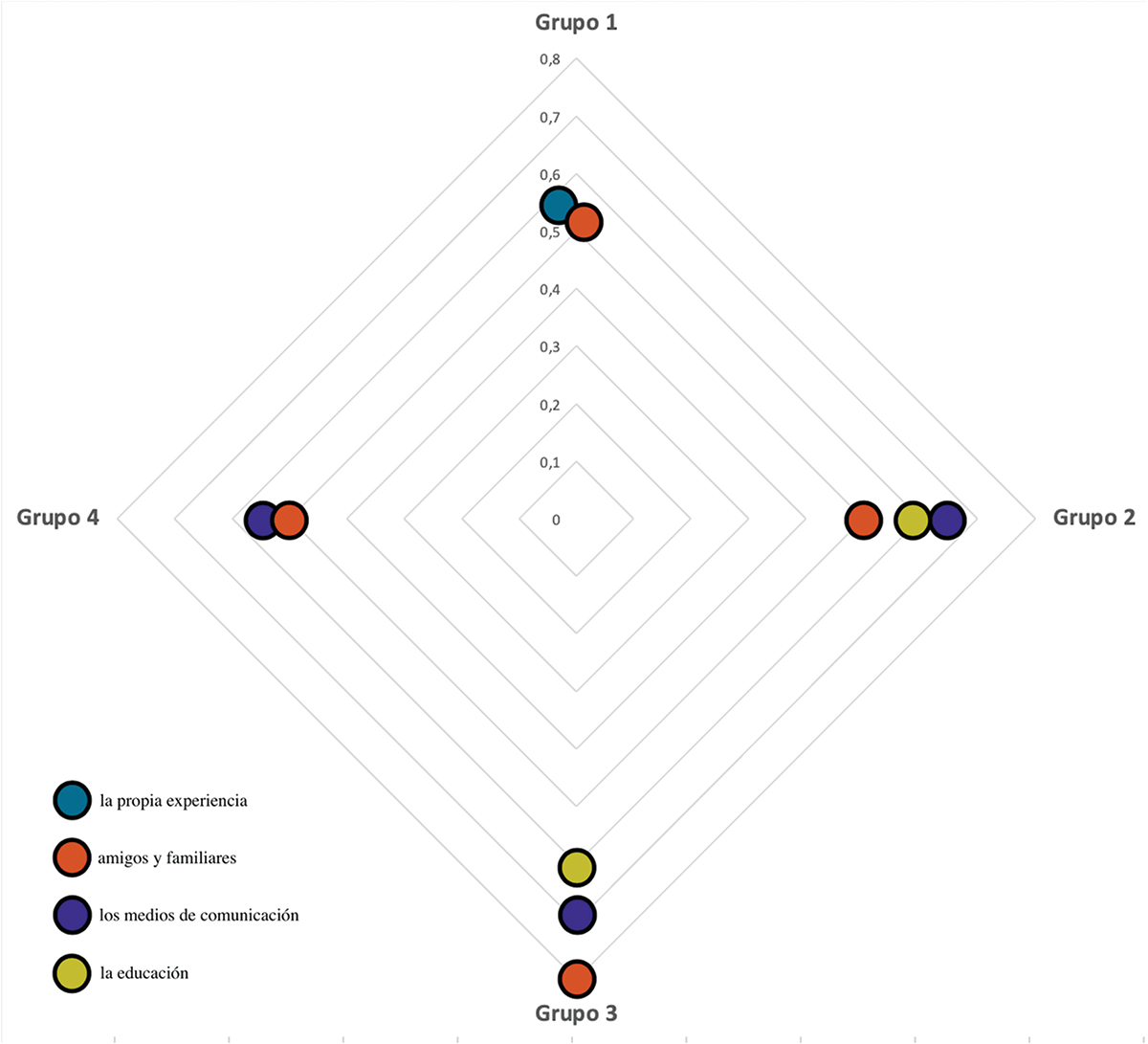
Para el Grupo 1: la propia experiencia (.5499) y amigos y familiares (.5179).
Para el Grupo 2: los medios de comunicación (.6659), la educación (.6084) y amigos y familiares (.5151).
Para el Grupo 3: amigos y familiares (.8312), los medios de comunicación (.7055) y la educación (.6221).
Para el Grupo 4: los medios de comunicación (.5359) y amigos y familiares (.5126).
Discusión y Conclusiones
A partir de los resultados obtenidos del análisis de componentes principales, se puede identificar a cada uno de los cuatro factores obtenidos de la siguiente manera:
El primer factor retenido explica el 13.40% de la varianza y está asociado a las variables grado de acuerdo en pagar más por productos o servicios si con ello contribuyese a frenar el cambio climático y grado de acuerdo en relación a la influencia de tus actividades diarias en el cambio del climático; con una alta asociación positiva en ambos casos. Este factor puede identificarse con el ‘comportamiento’.
El segundo factor (12.67% de la varianza) se encuentra asociado a dos variables de conocimiento sobre qué es el cambio climático y si entiende sus causas, presentando ambas altas cargas factoriales positivas. Por lo tanto, este factor se puede identificar, claramente, con el factor ‘conocimiento’.
El tercero de los componentes extraídos explica el 13.36% de la varianza, estando compuesto por una fuerte relación positiva con el grado de preocupación por el cambio climático y el número de acciones realizadas para reducirlo (esta última presenta las mayores cargas factoriales). Estos dos componentes hacen que identifiquemos este factor como ‘preocupación personal’ con el cambio climático.
El cuarto factor (explica el 10.78% de la varianza total) se encuentra formado por las variables relacionadas con la influencia del cambio climático en la vida cotidiana y la creencia de que aún estamos a tiempo de evitarlo (ambas con una asociación positiva) así como por el nivel de acuerdo sobre la afirmación de que las medidas contra el cambio climático solo dependen de los gobiernos (en este caso con una relación negativa y la carga factorial más baja de todo el análisis). Dados los valores de las cargas factoriales, se le puede identificar con ‘actitud’.
Las cargas positivas del factor 5 — que explica en 10.71% de la varianza total — en las variables relacionadas con la pertenencia a algún organismo/asociación concienciado con la lucha contra el cambio climático y una relación más débil, pero también positiva, con el hecho de haber formado parte de alguna movilización/manifestación/huelga de protesta contra el cambio climático; permiten identificar este factor como ‘acciones multiplicativas’.
En función de los diferentes valores obtenidos para estos cinco factores en el análisis cluster se obtienen cuatro grupos de jóvenes y adolescentes 2 . Los dos grupos más numerosos están compuestos casi por el mismo número de estudiantes (210 y 215) y representan el 75% del total de la muestra. Son los grupos que presentan una mayor concienciación por el cambio climático. Al primero de ellos se le ha denominado ‘Activistas’. Es el grupo formado por los estudiantes de mayor edad, casi el 45% de universitarios y sólo el 5.5% de estudiantes de ESO. Además, más del 85% de sus integrantes son mujeres. Los activistas son los que muestran una mayor preocupación por el cambio climático y realizan un mayor número de acciones para luchar contra él. Tienen una actitud proactiva hacia el cambio pensando que el cambio climático les influye en su día a día pero que aún estamos a tiempo de evitarlo. El 42.4% pertenece (o ha pertenecido) a alguna asociación de lucha contra el cambio climático o ha participado en alguna manifestación o movilización. Al segundo grupo se le ha denominado ‘Simpatizantes’ formado casi en un 50% por estudiantes de Ciclo o Bachillerato, el porcentaje de universitarios es poco relevante (4.1%). Integrado ligeramente por más hombres que mujeres (58.6% frente a 41.4%), es un colectivo también altamente preocupado por el cambio climático pero que, a diferencia de los activistas, tienen una mayor concepción del mismo como un problema futuro y aunque realizan determinadas acciones son menos activos que el primer grupo. Más del 70% de los simpatizantes no han pertenecido a ninguna asociación ni participado en ninguna manifestación respecto a esta temática.
Finalmente, los grupos menos numerosos son los denominados ‘Despreocupados’ (integrado por el 19.5% de los estudiantes) y los ‘Resignados’ (algo más del 5%). En el primero, el 46.7% son alumnos de ESO y el 32.9% de Bachillerato mientras que, en el segundo, el 46.4% cursan ESO y el 33.5% un Ciclo. Es de destacar que el grupo de los Resignados es el único donde no hay ningún estudiante universitario y es el formado por el mayor porcentaje de hombres (60%). Los Despreocupados, como su nombre indica es el grupo con un menor nivel de concienciación sobre el cambio climático, al 15.5% no le preocupa nada o en absoluto. Piensan, en su mayoría, que el cambio climático no le afecta a su vida cotidiana y, por lo tanto, no se involucran en actuar contra él. Los Resignados son los que presentan un mayor desconocimiento sobre el cambio climático, aunque su nivel de preocupación por el mismo es alto. Es el grupo más heterogéneo, presentando puntuaciones más altas que el resto de grupos en la creencia de que el cambio climático es un proceso natural de la Tierra (20%) y que las consecuencias sobre el planeta serán leves y no modificarán su estilo de vida (casi el 17%).
Por lo tanto, a partir de estos resultados se puede dar respuesta al primero de los objetivos: sí se ha observado un nivel de concienciación diferenciado por nivel de estudios, siendo los universitarios, generalmente mujeres, los más preocupados y los más involucrados en participar en la lucha contra el cambio climático, mostrando un papel más activo. Estos hallazgos se muestran en consonancia con los de Hermans y Korhonen (2017), García-Vinuesa, Iglesias da Cunha, et al. (2020), y B. Lee et al. (2022) que hacían referencia a una mayor preocupación/sensibilización de las mujeres por el cambio climático, así como en el activismo de las mismas (James, 2014), que se traduce en un mayor apoyo a la ejecución de acciones colectivas en la lucha contra este cambio climático (ahorro de energía — Du & Pan, 2022 — reciclaje, reforestación, uso del transporte público, etc. — García-Vinuesa, Bello, et al., 2020). Esta división, sin embargo, no es tan clara en el resto de grupos, que se encuentran integrados por alumnos de ESO (sobre un 46%), Ciclo (entre un 18% y 33%) y Bachillerato (entre un 20 y 30%) en diferente proporción.
En cuanto al segundo objetivo del estudio, la correlación para cada grupo de estudiantes de su nivel de preocupación con los factores que le han concienciado sobre el cambio climático muestra que el único factor que se repite en todos los grupos son los amigos y familiares y que los medios de comunicación están presentes en todos los grupos a excepción del grupo de Activistas. En este sentido, Zhang y Skoric (2018) aluden a formas más atenuadas de compromiso en actividades proambientales, relacionando el consumismo y activismo medioambiental con usos diferentes de los medios de comunicación. La formación recibida en los centros educativos sólo aparece en dos de ellos, los de menor nivel de concienciación con el cambio climático (Despreocupados y Resignados).
Se observa, por tanto, que el papel del entorno más directo del adolescente o del joven, como es su familia y amigos, es fundamental en su concienciación sobre el cambio climático. En la misma línea que estudios previos que inciden en la importancia de la comunicación y la frecuencia de las conversaciones con familiares (Dayton et al., 2022) y amigos (Stevenson et al., 2019) o que aluden a la importancia del comportamiento de los padres en relación al comportamiento de los adolescentes frente al cambio climático (Lawson et al., 2019).
En cuanto a los medios de comunicación, no se han observado diferencias significativas entre los distintos grupos de estudiantes, por lo que se realiza una interpretación conjunta. Destaca Internet, sobre todo a través del uso de las redes sociales, ya un 90.4% ha recibido información sobre el cambio climático a través de este medio. Trabajos previos han demostrado que los jóvenes confían más en las redes sociales para obtener información sobre el cambio climático que en los medios de comunicación tradicionales (Neelima, 2018), además de constituirse como un medio innovador para la educación ambiental, fomentando valores como el trabajo colaborativo o la resiliencia ante el cambio climático (Villafuerte Holguín, 2019). A las redes sociales, les sigue la televisión, con un 88.1% (resultados similares a los obtenidos por Rodríguez et al., 2022). El 67.1% y el 52.2% cree que se le da mucha o bastante importancia al cambio climático en Internet y la televisión, respectivamente. Esta opinión contrasta con la percepción que se tiene de otros medios, como la radio o el periódico, donde el 51.9% y el 49.6%, respectivamente, creen que la importancia que le dan al cambio climático es poca o ninguna. Además, se observa que la mayoría recibe este tipo de información de forma relativamente frecuente, al menos una vez al mes para el 26% y una vez a la semana para el 46% de los estudiantes.
Uno de los motivos que puede explicar que la educación tan sólo figure en dos de los grupos de estudiantes, los menos concienciados, puede ser que sólo el 65% de los encuestados han recibido educación ambiental en el centro educativo — destacando acciones como el reciclaje en más del 88% de los casos. Y, de este 65%, sólo la mitad (50,1%) de los estudiantes creen que se su centro educativo le ha otorgado bastante o mucha importancia al cambio climático. Estos resultados pueden tener parte de su origen en la propia formación y conciencia ambiental de los docentes que puede ser insuficiente, en algunos casos, debiendo reforzar no sólo su alfabetización ambiental sino también sus actitudes pedagógicas para fomentar una actitud proambiental en sus estudiantes (Andrea y Petkou, 2022). Se considera que éste es uno de los factores que se debería reforzar, aunando, además, estrategias como la educomunicación ambiental, no sólo para que redunde posteriormente en una mayor concienciación y una actitud más activa de los jóvenes, sino también para que tengan información veraz y mayor criterio para contrastar la gran cantidad de información sobre la temática que les llega a través de los recursos digitales. Esta opinión se refuerza con el hecho de que el 92,7% de los estudiantes cree que se debería hablar más sobre el problema del cambio climático en los centros educativos y que autores como Seguido y Cantos (2021) consideran a la educación como ‘una de las variables no estructurales más importantes para adaptarse al cambio climático’.
Estas conclusiones se pueden considerar como una primera aproximación a la realidad sobre la relación de nuestros adolescentes y jóvenes respecto al cambio climático y a la identificación de los diferentes agentes, educación, medios de comunicación, entorno más cercano, cuyo papel es determinante.
Tanto nuestras conclusiones como numerosos estudios previos han demostrado un nivel de conciencia diferente frente al cambio climático en función del sexo y nivel escolar de los estudiantes, lo que implicaría el diseño de estrategias diferenciadas en función de estos parámetros que se deberían incluir en los distintos planes de estudios con el fin de que las generaciones futuras dispongan de un mayor conocimiento, sensibilización y actitud pro-activa suficiente para generar una transformación sustancial en la lucha contra el cambio climático. Estas estrategias deben configurarse bajo un enfoque sistémico (Orhan et al., 2021), planteando el aprendizaje combinado (E. H. Lee, 2016) y el conocimiento in situ (Delgado et al., 2021), e ir en paralelo a una mayor formación de los docentes en la concienciación sobre el cambio climático, acompañado de los medios pedagógicos y recursos necesarios para transmitir este tipo de conocimiento de una forma activa. Para abordar esta problemática de forma global, se requeriría también una revisión de los libros de texto empleados, tanto para asegurar su rigor científico como para actualizarlos, adaptándolos a propuestas de actividades innovadoras y creativas que fomenten la motivación del estudiante (Seguido y Cantos, 2021), y ampliando el alcance de los contenidos sobre esta temática al mayor número de materias escolares posibles (Onuoha et al., 2021).
Así mismo, no todo el peso de la construcción de un ciudadano implicado en esta problemática debe recaer en el ámbito de la educación sino que otros muchas esferas deben verse implicadas, comenzando por la familiar y el entorno social más cercano al estudiante. Investigaciones previas avalan los resultados de este trabajo sobre la importancia del papel de la comunicación y discusiones sobre el cambio climático en el seno de la familia y amigos, por lo que sería de vital importancia incrementar la aportación de las familias en este sentido, con estrategias que aumenten su implicación fomentando tanto una mayor comunicación como la realización de actividades mitigadoras del cambio climático en el ámbito familiar. Para que estas propuestas puedan redundar en un beneficio social y un resultado exitoso de cara a la problemática tratada, es necesario contar con el respaldo de las autoridades en el diseño e implementación de programas y planes que orienten y faciliten la realización de este tipo de acciones y supongan una transformación social.
Tomando estos resultados como punto de partida, es interesante continuar la investigación extendiendo el análisis a otros territorios con diferente sistema educativo y, quizás, diferente influencia de los medios de comunicación, así como, profundizando en aspectos que han surgido a partir de este trabajo, como: ¿qué determina una diferenciación tan marcada entre la sensibilidad de los universitarios y la del resto de estudiantes? ¿por qué los medios de comunicación se muestran como un factor importante en la concienciación hacia el cambio climático en todos los grupos menos en el grupo de jóvenes activistas, fundamentalmente universitarios? ¿qué cambios se deben operar en los centros educativos para que adquieran más importancia en la sensibilidad de los estudiantes frente al cambio climático?
Footnotes
1.

2.
1.
2.
No potential conflict of interest was reported by the authors. / Los autores no han referido ningún potencial conflicto de interés en relación con este artículo.
Survey on climate change.
1.- Have you ever heard of climate change? Yes No Don’t know/No answer
2.- Do you know what climate change is? Yes No Don’t know/No answer
3.- Do you think that climate change really exists? Yes No Don’t know/No answer
4.- Do you understand the causes of climate change? Yes No Don’t know/No answer
5.- Do you know what an ecological footprint is? Yes No Don’t know/No answer
6.- Do you know what an urban garden is? Yes No Don’t know/No answer
7.- Which of the below is the closest to what you think about climate change? It is a natural Earth process It is a process caused by human activity Both
8.- Which of the following statements is the closest to what you think about climate change? Climate change is a problem today Climate change will be a future problem Climate change is not a problem
9.- Do you think that climate change will have consequences on the planet? Yes, it will have serious consequences Yes, but it will bring mild changes that won’t alter our lifestyle It will not cause any changes
10.- Do you think that climate change influences your everyday life? Yes No Don’t know/No answer
11.- Do you think that there is still time to prevent climate change? Yes No Don’t know/No answer
12.- How much importance do you think is being attached to climate change? More importance than it deserves The importance it deserves Less importance than it deserves No importance
13.- Mark all of the options below from which you have received information on climate change (you may choose more than one): Radio Internet Newspapers Television Lectures Scientific magazines Schools Other
14.- If you marked ‘Other’ on the previous question, please specify:
15.- How often do you hear news about climate change and its consequences? Every day At least once a week At least once a month Every three months Every six months At least once a year Never
16.- What degree of importance do the following media attach to climate change?
A lot
Quite a bit
Enough
Not much
None
Newspapers
Radio
Television
Scientific magazines
Internet
Schools
17.- Are you concerned about climate change?
1 (not at all)
2
3
4
5 (a lot)
18.- What factors have raised your awareness of the need to act on climate change? (you may choose more than one): Education Associations/organizations Media Personal experience Religion/beliefs Friends and/or family Other
19.- Mark the degree to which you agree with the following statements:
Strongly disagree
Disagree
Neither agree nor disagree
Agree
Strongly agree
You would be willing to pay more for goods and services if by doing so you contribute to stopping climate change.
Measures to counter climate change solely depend on governments.
Your daily activities influence climate change.
20.- Do you think that schools should talk more about climate change? Yes No Don’t know/No answer
21.- Of the list of activities below, mark the ones you believe you have done at school (you may choose more than one): Reforestation Recycling Use of used school supplies, like workbooks, books, etc. School garden Save water Recycling point Others
22.- If you marked ‘Other’ on the previous question, please specify:
23.- Do you do any of the following activities to help reduce climate change? (you may choose more than one) Save energy (lower heat, turn off lights, drive a hybrid or electric car, use renewable energies like solar panels, etc.) Save water Consume responsibly (buy in-season products at local markets, organic products, second-hand, etc.) Recycle Use public transport Use other more ecological forms of transport (electric scooter, bicycle, etc.) Care for nature Think about whether or not I need something before I buy it None Others
24.- Have you belonged to or worked with, or do you currently belong to or work with, an organization/association which is aware of the struggle against climate change? Yes No Don’t know/No answer
25.- If you answered ‘Yes’ to the above questions, please state which one(s):
26.- Have you participated in a mobilization/demonstration/strike to protest climate change? Yes No Don’t know/No answer
27.- Please state your sex: Female Male Other
28.- Please state your age:
29.- What level are you studying? 1st year of ESO 2nd year of ESO 3rd year of ESO 4th year of ESO 1st year of baccalaureate 2nd year of baccalaureate Mid-level vocational training Higher-level vocational training University degree
30.- If you chose ‘University degree’ in the question above, please state your degree:
Encuesta sobre el cambio climático.
1.- ¿Ha escuchado hablar sobre el cambio climático? Si No No sabe/ No contesta
2.- ¿Sabe qué es el cambio climático? Si No No sabe/ No contesta
3.- ¿Cree que realmente existe el cambio climático? Si No No sabe/ No contesta
4.- ¿Entiende cuáles son las causas del cambio climático? Si No No sabe/ No contesta
5.- ¿Sabe qué es la huella ecológica? Si No No sabe/ No contesta
6.- ¿Sabe qué es un huerto urbano? Si No No sabe/ No contesta
7.- Qué se acerca más a lo que piensa sobre las causas del cambio climático? Es un proceso natural de la Tierra Es un proceso provocado por la actividad humana Ambas cosas
8.- ¿Cuál de las siguientes afirmaciones se aproxima más a lo que piensa acerca del cambio climático? El cambio climático es un problema actual El cambio climático es un problema de cara al futuro El cambio climático no es un problema
9.- ¿Cree que el cambio climático tendrá consecuencias sobre el planeta? Sí, traerá consecuencias graves Sí, pero serán cambios leves que no modificarán nuestro estilo de vida No traerá cambios
10.- ¿Cree que el cambio climático influye en su vida cotidiana? Si No No sabe/No contesta
11.- ¿Cree que estamos a tiempo de evitar el cambio climático? Si No No sabe/No contesta
12.- ¿Qué importancia cree que se le está dando al cambio climático? Más importancia de la que tiene La importancia que tiene Menos importancia de la que tiene Ninguna importancia
13.- De las siguientes opciones marque todas aquellas a través de las cuales haya recibido información sobre el cambio climático (puede seleccionar varias respuestas): Radio Internet Periódicos Televisión Conferencias Revistas científicas Centros educativos Otros
14.- Si ha marcado ‘Otros’ en la pregunta anterior, diga cuáles:
15.- ¿Con qué frecuencia escucha noticias sobre el cambio climático y sus consecuencias? Todos los días Al menos una vez a la semana Al menos una vez al mes Cada tres meses Cada seis meses Al menos una vez al año Nunca
16.- ¿Qué grado de importancia cree que se le da al cambio climático en los siguientes medios?
Mucha
Bastante
Suficiente
Poca
Nada
Periódico
Radio
Televisión
Revistas Científicas
Internet
Centros Educativos
17.- ¿Le preocupa el cambio climático?
1 (absolutamente nada)
2
3
4
5 (muchísimo)
18.- ¿Qué factores le han concienciado sobre la necesidad de actuar sobre el cambio climático? (puede responder una o varias opciones): Educación Asociaciones/organismos Medios de comunicación Propia experiencia personal Religión/Creencias Amigos y/o familiares Otros
19.- Señale su grado de acuerdo con las siguientes afirmaciones:
Muy en desacuerdo
En desacuerdo
Ni en acuerdo ni desacuerdo
De acuerdo
Muy de acuerdo
Estaría dispuesto a pagar más por productos o servicios si con ello contribuyese a frenar el cambio climático
Las medidas contra el cambio climático solo dependen de los gobiernos.
Mis actividades diarias influyen en el cambio del climático
20.- ¿Cree que se debería hablar más sobre el problema del cambio climático en los centros educativos? Si No No sabe/No contesta
21.- De la siguiente lista de actividades, marque la que considere que has realizado en el centro escolar (puede seleccionar más de una): Reforestación Reciclaje Uso de material escolar, cuadernos, libros, etc. de segunda mano Huerto escolar Ahorrar agua Punto limpio Otras
22.- En el caso de haber respondido ‘Otras’ en la pregunta anterior, indicar ¿cuáles?:
23.- ¿Realiza alguna de las siguientes actividades para contribuir a reducir el cambio climático? (puede seleccionar más de una) Ahorro de energía (bajar calefacción, apagar luces, uso de automóvil híbrido o eléctrico, uso de energía renovables como placas solares, etc.) Ahorro de agua Consumo responsable (compra de productos de temporada en mercados locales, productos ecológicos, de segunda mano, etc.) Reciclaje Uso de transporte público Uso de otros transportes más ecológicos (patinete eléctrico, bicicleta, etc.) Cuidado de la naturaleza Antes de comprar algo considero si lo necesito o no Ninguna Otras
24.- ¿Ha formado o forma parte o colabora con algún organismo/asociación concienciada con la lucha contra el cambio climático? Si No No sabe/No contesta
25.- Si ha contestado ‘Si’ a la pregunta anterior, indicar ¿cuál?:
26.- ¿Ha formado parte de alguna movilización/manifestación/huelga de protesta contra el cambio climático? Si No No sabe/No contesta
27.- Indique su sexo: Mujer Hombre Otro
28.- Indique su edad:
29.- Se encuentra estudiando.. 1° ESO 2° ESO 3° ESO 4° ESO 1° Bachillerato 2° Bachillerato Ciclo formativo de grado medio Ciclo formativo de grado superior Grado universitario
30.- Si ha seleccionado en la pregunta anterior ‘Grado universitario’, indique cuál: