







Abstract
Semi-rigid foams were prepared by NR latex with 0, 2, 5, 10, 20 and 30 phr CaSiO3 added in a sulphur-curing system. The main composition of eggshell is made of 96.23%wt of CaCO3 and 3.77%wt of other oxide compounds. The CaSiO3 induced a spontaneous polarisation and reinforced the NR matrix due to ionic charge contents of Ca2+, Si4+ and O2− in its structure. Furthermore, the CaSiO3 was found to enhance the mechanical, thermal and physical properties of the composite foams. The suitable condition to prepare the semi-rigid composite foams was by adding 30 phr CaSiO3 in the NR latex with the sulphur-curing system. The obtained bulk density, the relative composite foam density, the compressive strength, the contact angle with water, and acetone at the water to acetone ratio of 1:1 were found to be 1.2230 g cm−3, 0.3611, 588.10 kPa, 103.3°, 26.5° and 85.3°, respectively.
Keywords
Introduction
Natural rubber (NR) latex is an important material which can be used to produce various products sponge products known as rubber foams for thermal insulation, structural uses and energy absorption; film products such as gloves and condoms; and specific foams used in medical and dental equipment.1, 2 Rubber foams can be prepared from NR latex or a dry solid rubber. 3 The processing of rubber foams involves curing with vulcanising agents, foaming agents and other additives, namely filler, colour, oil and antioxidant. The specifications of sponge rubbers depend on the foam density, cell microstructure such as cell size, cell morphology, shapes of closed and open cell, mechanical and thermal properties. Rubber foam or cellular rubber can be produced to yield either open or closed cell structure.1-3 There are many important ingredients which control the rubber foam properties: foaming agents such as potassium oleate; type and quantity of fillers such as calcium carbonate, silica, carbon black and other oxide compounds; and the vulcanisation process. 4
Calcium silicate (CaSiO3) is one kind of oxide compounds or inorganic materials which is considered to be a dielectric material having spontaneous polarisation and can be used as a good filler in the NR latex. CaSiO3 can be made from eggshells. 5 Eggs have been used primarily as foods, drugs, cosmetics and foodstuffs. However, eggshells are an egg product industry residue that contributes towards environmental pollution as it favours microbial actions disposed in landfills. The by-product eggshell represents approximately 11% of the total weight approximately 60 g of an egg.6, 7 Eggshell is one source of calcium carbonate (CaCO3) known as calcite which is a stable polymorph at room temperature. An eggshell is also a rich source of mineral salts, mainly CaCO3 (96.23%wt), calcium phosphate (1.19%wt), magnesium carbonate (1.12%wt) and organic substances (1.46%wt).6, 7 CaCO3 can be used as a starting material to prepare dielectric materials (CaSiO3, CaTiO3, CaZrO3, etc.), dental and bone implantation, catalysts, and also fillers used in many industries such as rubber, ink, foodstuff, cosmetic, pharmaceutical and fertilisation.6-8 CaSiO3 can be produced by various methods such as a conventional process, a sol–gel process, a chemical precipitation, a solid-state reaction and a microwave method.5, 8-11 For applications, CaSiO3 can be used as a dielectric material, filler, catalyst and adsorbent when it is added into the NR latex to prepare the composite rubber foams.11, 12 The CaSiO3 acts as a dispersed phase whereas the NR latex functions as a matrix phase. The advantages of adding CaSiO3 into NR latex are to increase the physical, mechanical and thermal properties suitable for uses as adsorbent, catalyst and filters due to the presences of Ca2+, Si4+ and O2− in its structure.
The objective of this work was to fabricate composite rubber foams from NR latex used as a matrix phase. The CaSiO3 was produced from hen eggshells composing of CaCO3 and SiO2 at the ratio 1:1 via the sol–gel process to function as a dispersed phase. Potassium oleate was used as the foaming agent in the sulphur-curing process to prepare the composite foams suitable to be used as an adsorbent, filter or catalyst products. The obtained composite foams possessed good mechanical and thermal properties.
Experimental
Materials and methods
The NR latex, wingstay L (antioxidant), potassium oleate (surface-active agent and an emulsifier), sulphur, zinc oxide (ZnO), zinc diethyl dithiocarbamate (ZDEC), zinc 2-mercaptobenzothiazole (ZMBT), polyethylene glycol (PEG) and sodium silicofluoride (SSF) (vulcanisation agents) was supplied by the Rubber Research Institute of Thailand, the Ministry of Agriculture, Bangkok, Thailand.
CaSiO3 preparation 5 employed chicken eggshells as a starting material. Raw hen eggshells were washed with tap water until the egg white was completely removed and dried at room temperature. The raw and clean hen eggshells were broken into small pieces, crushed by a porcelain mortar and pestle, ground by a high speed mill with a porcelain ball mill for 10 min into a fine powder and then calcined at 900°C for 2 h to obtain CaO. The obtained CaO was mixed with SiO2 at the CaO:SiO2 ratio of 1:1 by the sol–gel process at room temperature. 5
The NR latex foam preparation
Formulae of latex foams
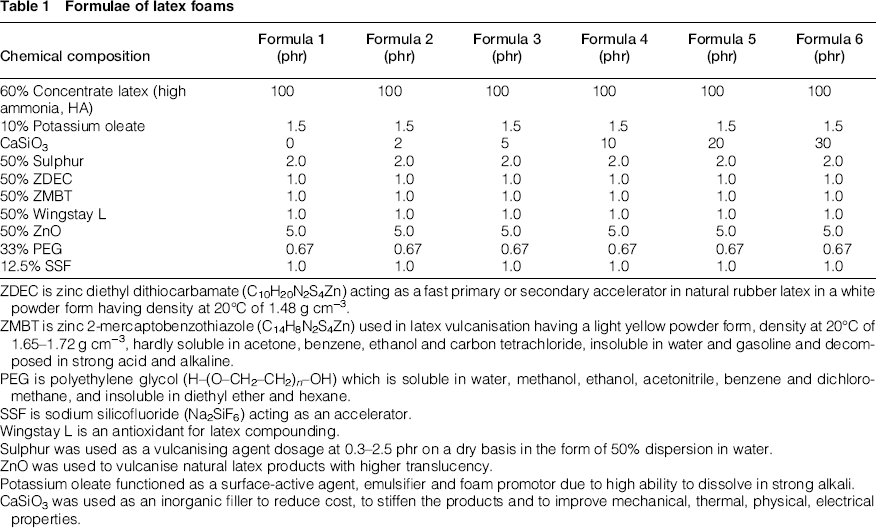
ZDEC is zinc diethyl dithiocarbamate (C10H20N2S4Zn) acting as a fast primary or secondary accelerator in natural rubber latex in a white powder form having density at 20°C of 1.48 g cm−3.
ZMBT is zinc 2-mercaptobenzothiazole (C14H8N2S4Zn) used in latex vulcanisation having a light yellow powder form, density at 20°C of 1.65–1.72 g cm−3, hardly soluble in acetone, benzene, ethanol and carbon tetrachloride, insoluble in water and gasoline and decomposed in strong acid and alkaline.
PEG is polyethylene glycol (H–(O–CH2–CH2) n –OH) which is soluble in water, methanol, ethanol, acetonitrile, benzene and dichloromethane, and insoluble in diethyl ether and hexane.
SSF is sodium silicofluoride (Na2SiF6) acting as an accelerator.
Wingstay L is an antioxidant for latex compounding.
Sulphur was used as a vulcanising agent dosage at 0.3–2.5 phr on a dry basis in the form of 50% dispersion in water.
ZnO was used to vulcanise natural latex products with higher translucency.
Potassium oleate functioned as a surface-active agent, emulsifier and foam promotor due to high ability to dissolve in strong alkali.
CaSiO3 was used as an inorganic filler to reduce cost, to stiffen the products and to improve mechanical, thermal, physical, electrical properties.
Characterisation
X-ray diffraction (XRD) was taken and analysed using a Bruker AXS analyser (D8 Discover) with VANTEC-1 Detector. Samples were analysed using a double-crystal wide-angle goniometry. Scans were measured from 5° to 80° 2θ at a scan speed of 5° 2θ/min at 0.05° or 0.03° 2θ increment using the CuKα radiation (λ = 0.15406 nm). Peak positions were verified with those of the International Center for Diffraction Data Standard (JCPDS) patterns to identify crystalline phases.
Cumulative and fractional distribution was measured by using a particle size analyser (Malvern, Mastersizer S Long Bed, Polydisperse 2.19). The samples were dispersed in a water medium and vibrated in an ultrasonic bath for 20 min.
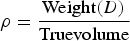
True density of samples was measured by a gas pycnometer (Quantachrome, Ultra pycnometer 1000) and calculated using equation (1)
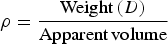
Bulk density of samples was measured and calculated using equation (2)
Relative foam density of samples was measured and calculated according to ASTM D 3575 and ASTM D 1056 using equation (3)

SEM micrographs were obtained from a scanning electron microscope (SEM, JEOL-5200). The samples of CaSiO3 powder and NR latex foams with/without adding CaSiO3 powder were mounted onto stubs using a carbon paste and were sputter-coated to ∼0.1 µm with gold to improve conductivity. An acceleration voltage of 13 kV with magnifications of 200, 500 and 2000 times were used.
Contact angle was measured by using a contact angle metre (Kyowa, model DM-CE 1).
Surface tension of liquid medium for contact angle measurement was measured by an automatic surface tensiometer (Kyowa, model DY 300) in terms of DuNuoy Ring (Platinum ring) or Wilhelmy plate (Platinum plate). The measurement was taken three times at room temperature (25°C).
The compressive strength was measured with a universal testing machine (UTM Hounsfield, model H 10 KM). The samples were prepared in the cubic square shape with the dimensions of 2.0 cm in width, 2.0 cm in length and 1.0 cm in thickness.
Results and discussion
Characteristics and physical properties of raw materials and composite foams
Characteristics of natural rubber latex
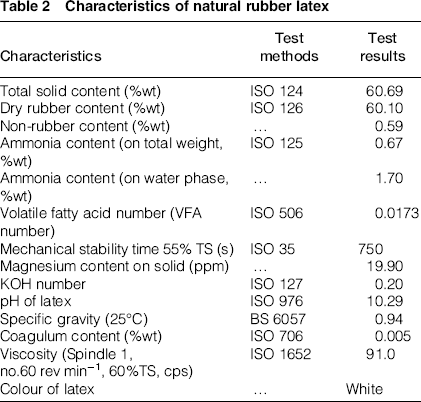
The particle size distribution or cumulative mass percent finer (CMPF) of CaSiO3 at 10, 50 and 90% CMPF was equal to 10.53, 31.92 and 73.34 µm, respectively. CaSiO3 had a surface area of 2.04 m2 g−1, a total pore volume of 0.0034 cm3 g−1 and an average pore diameter of 6.65 nm. 13
Physical properties of composite foams
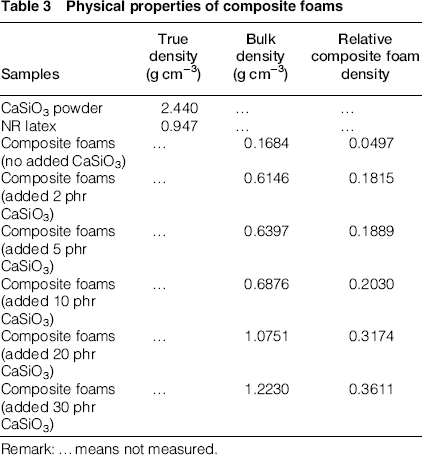
Remark: … means not measured.
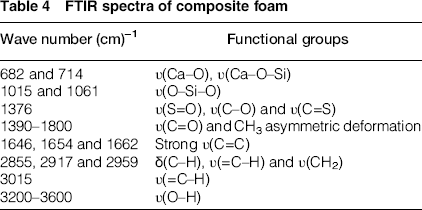
FTIR spectra of CaSiO3 powder, NR latex and composite foams with 30 phr CaSiO3 added were measured in the range of wave number 400–4000 cm−1 as shown in Fig. 1 and the peaks are as tabulated in Table 4. The FTIR spectrum of CaSiO3 powder shows peaks at 682 and 714 cm−1 belonging to the strong ʋ(Ca–O) and ʋ(Ca–O–Si); the peak at 1646 cm−1 corresponds to the strong ʋ(C=C) and a broad peak at 3400 cm−1 can be referred to the ʋ(O–H) consistent with previous work.5, 14 The FTIR spectrum of the NR latex shows peaks at 1376 cm−1 due to the strong ʋ(S=O), ʋ(C–O) and ʋ(C=S); at 1390–1800 cm−1 due to the ʋ(C=O), CH3 asymmetric deformation and ʋ(C=C); at 2855, 2917 and 2959 cm−1 belonging to the δ(C–H), ʋ(=C–H) and ʋ(CH2); at 3015 cm−1 due to the ʋ(=C–H); and a broad peak at 3400 cm−1 due to the ʋ(O–H). The FTIR spectrum of composite foams with 30 phr CaSiO3 added shows peaks consistent with the peaks of the NR latex and the CaSiO3 powder: at 682 and 714 cm−1 due to the strong ʋ(Ca–O) and ʋ(Ca–O–Si); at 1015 and 1061 cm−1 due to the ʋ(O–Si–O); at 1376 cm−1 ʋ(S=O), ʋ(C–O) and ʋ(C=S); at 1390–1800 cm−1 due to the ʋ(C=O) and CH3 asymmetric deformation; at 1646, 1654 and 1662 cm−1 due to the strong ʋ(C=C); at 2855, 2917 and 2959 cm−1 due to the δ(C–H), ʋ(=C–H) and ʋ(CH2); at 3015 cm−1 due to the ʋ(=C–H); and at 3200–3600 cm−1 due to the strong ʋ(O–H).
FTIR spectra of composite foams FTIR spectra of composite foam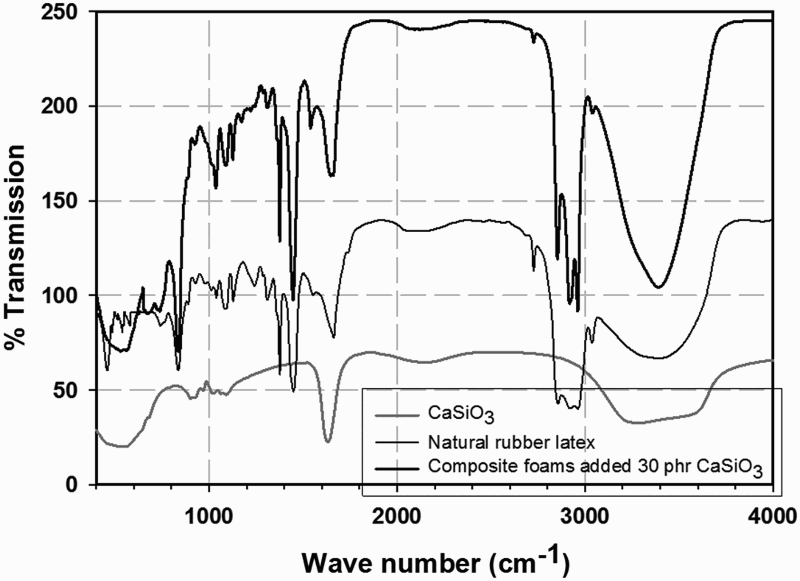
The XRD peak patterns comparison of the CaSiO3, calcined eggshell or CaO, and CaCO3 powder are as shown in Fig. 2. The XRD peak pattern of the eggshell is consistent with the JCPDS file 00-005-0586 of calcite or CaCO3 in the rhombohedral phase formation at 2θ: 29.41°, 39.40° and 43.15°. The XRD peak pattern of CaO obtained from the eggshell calcination at 900°C for 2 h shows the cubic phase formation consistent with the JCPDS file No. 00-048-1467, and the peaks at 2θ: 37.36°, 32.2° and 53.86° are consistent with a previous work.
5
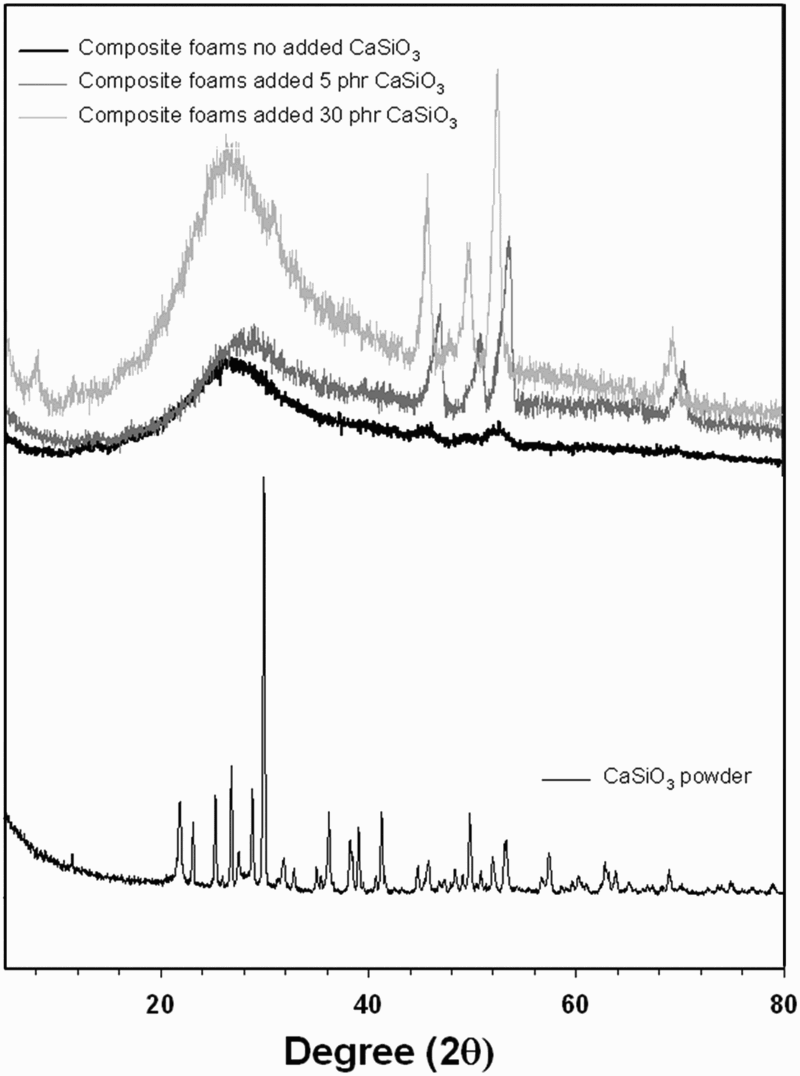
The XRD peak pattern of the CaSiO3 shows the monoclinic phase formation consistent with the JCPDS file nos. 01-089-6463 and 00-043-1460 with the peaks at 2θ: 27.52°, 26.04° and 25.95°. Furthermore, the comparison of the XRD peak patterns between the CaSiO3 and the composite foams with 0, 5 and 30 phr CaSiO3 added is as shown in Fig. 3. The XRD peak pattern of CaSiO3 is of a crystalline phase, whereas the XRD peak pattern of the composite foam without CaSiO3 added shows an amorphous phase formation. The XRD patterns of the composite foams with 5 and 30 phr CaSiO3 added show a semi-crystalline phase.
XRD peak patterns of eggshell, CaO3 and CaSiO3 powders XRD peak patterns of CaSiO3 powder and composite foams with/without adding CaSiO3 powder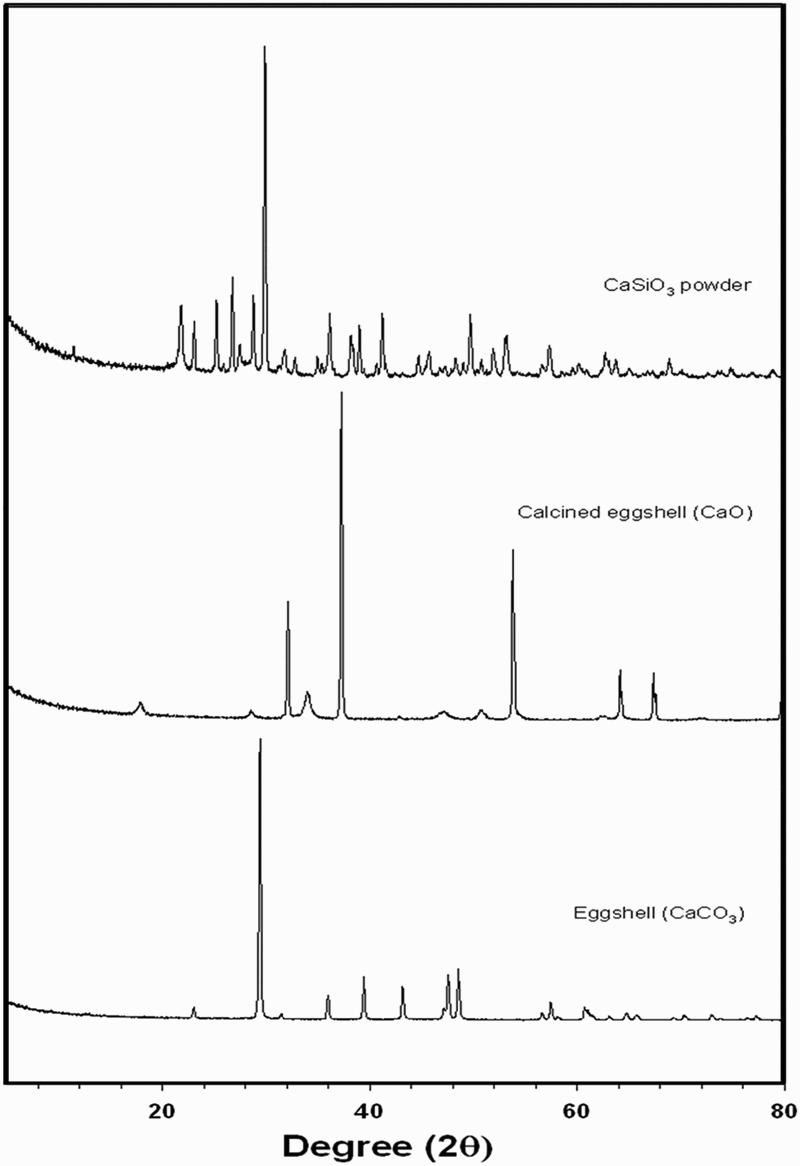
The SEM micrographs of CaSiO3 powder, pure NR latex and composite foams without CaSiO3 powder with magnifications of 100, 500 and 2000× are as shown in Fig. 4. The SEM micrographs of CaSiO3 show a needle or platelet shape, whereas the SEM micrographs of NR latex show smooth and non-porous surfaces. The SEM micrographs of the composite foam without CaSiO3 added show a uniform porosity distribution, consistent with the SEM micrograph results of catalyst foams.
15
and the SEM micrograph results of NR foams.
4
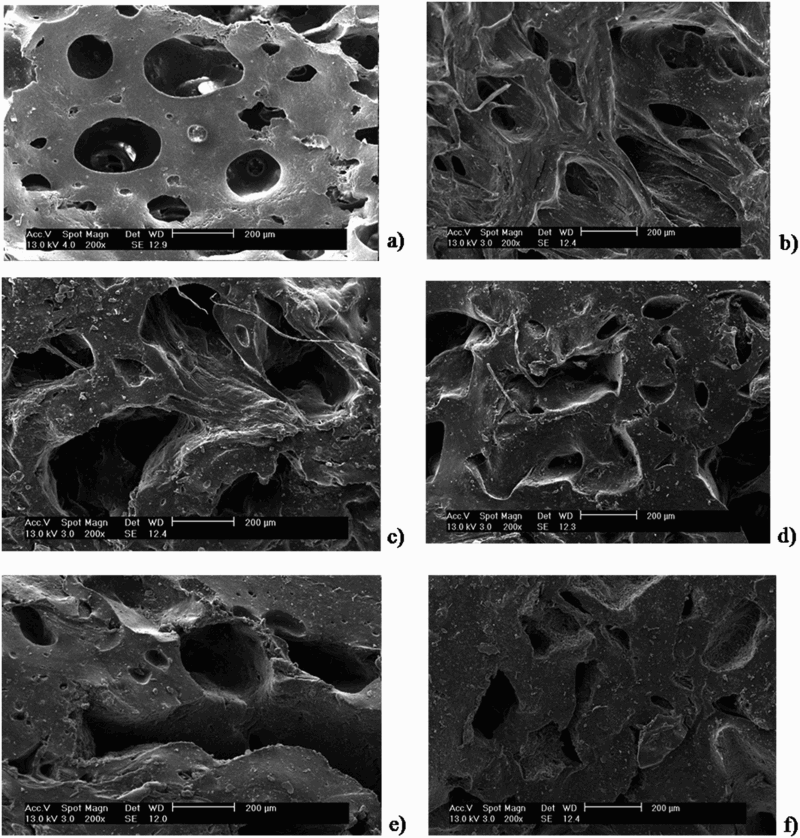
The composite foam contains both open and closed cells. Therefore, the cell morphology characteristics of the obtained composite foam are potentially suitable as an adsorbent to separate polar and non-polar matters. Furthermore, the SEM micrographs of the composite foams with 0, 2, 5, 10, 20 and 30 phr CaSiO3 added with the magnification of 200× are as shown in Fig. 5. It can be seen that the shape of open and closed cell morphology of the composite foams with 0, 2, 5, 10, 20 and 30 phr CaSiO3 added varies from a nearly spherical shape to irregular shape with increasing amount of CaSiO3 added.
SEM micrographs of CaSiO3 powder, pure NR latex and composite foams without CaSiO3 powder with magnifications of 100, 500 and 2000×: a and a-1 CaSiO3 powder; b and b-1 pure NR latex; c and c-1 composite foams without adding CaSiO3 SEM micrographs of composite foams with/without adding CaSiO3 powder with magnification of 200×: a 0 phr; b 2 phr; c 5 phr; d 10 phr; e 20 phr; and f 30 phr added into composite foams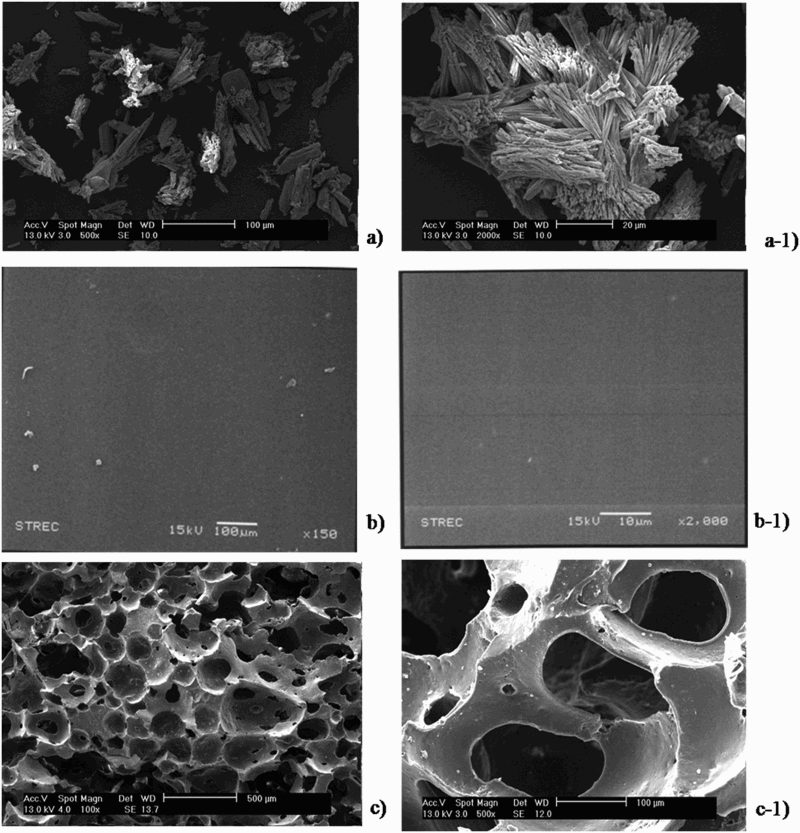
Mechanical properties of composite foams
Mechanical properties of composite foams

Contact angles and adsorption of composite foams
The percentage of porosity per surface area and contact angle of water and acetone of composite foams
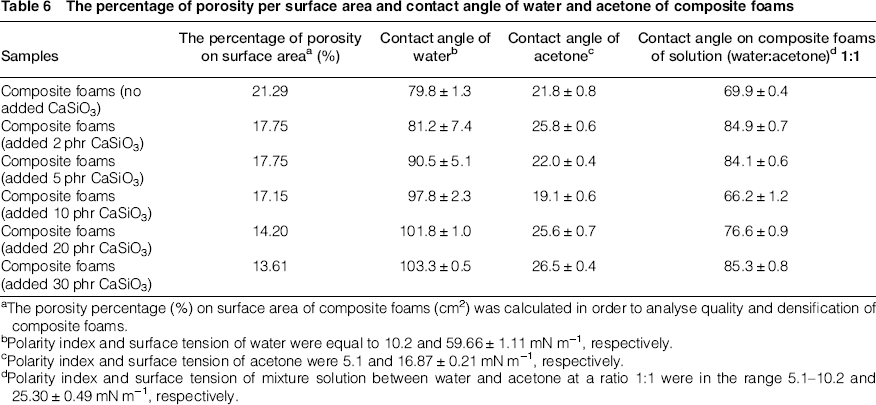
aThe porosity percentage (%) on surface area of composite foams (cm2) was calculated in order to analyse quality and densification of composite foams.
bPolarity index and surface tension of water were equal to 10.2 and 59.66 ± 1.11 mN m−1, respectively.
cPolarity index and surface tension of acetone were 5.1 and 16.87 ± 0.21 mN m−1, respectively.
dPolarity index and surface tension of mixture solution between water and acetone at a ratio 1:1 were in the range 5.1–10.2 and 25.30 ± 0.49 mN m−1, respectively.
Conclusion
The semi-rigid composite foams with CaSiO3 added were fabricated with a potential to be used as an adsorbent or filter to separate polar and non-polar substances. The CaSiO3 is one dielectric material having spontaneous polarisations due to the presence of Ca2+, Si4+ and O2− charges. The CaSiO3 made from eggshell can act as a good bio-filler or a dispersed phase to reinforce and increase mechanical properties of the composite foams with the NR latex as the matrix phase. The semi-rigid composite foams with CaSiO3 added adsorbed or separated the substances or solvents having different polarity index values. The large amount of filler particles added into composite foams is suitable for non-polar or hydrophobic solvent adsorption (ϴ > 90°), while the small amount of filler particles added is suitable for polar or hydrophilic solvent adsorption (ϴ < 90°). The bulk density, relative composite foam density, compressive strength and contact angle increased monotonically with increasing amount of CaSiO3 added.
Footnotes
Acknowledgements
The authors would like to thank the following: The Petroleum and Petrochemical College, and the Scientific and Technological Research Equipment Centre, at Chulalongkorn University, Thailand; the Department of Materials Engineering at Kasetsart University for the use of their analytical equipment. AS also would like to acknowledge the financial supports from the Conductive and Electroactive Polymers Research Unit of Chulalongkorn University, the Thailand Research Fund (TRF) and the Royal Thai Government.