







Abstract
Positron annihilation lifetime spectroscopy (PALS) have been used to investigate the effect of filling each of poly (ethylene-co-vinyl acetate) (EVA), acrylonitrile butadiene rubber (NBR), and their blend (50/50wt-%) with different concentrations of high-abrasion furnace (HAF) (0–60 phr). PALS is characterised by the free-volume parameters (Vh and F %), which is a measure of the size and fraction of free-volume holes in the composites. The results show that the variation in Vh and F % of free-volume holes depends on the chemical structure and the degree of crystallinity of each polymer. The NBR has a smaller size (127.78 Å3) and lower fraction (4.18%) of free-volume holes than the corresponding free-volume holes (177.48 Å3 and 7.03%) in EVA. The size of the free-volume holes increases in EVA with increasing HAF content up to 20 phr in polymer matrix while it decreases in NBR. The fractions (F %) of free-volume holes decrease due to the reduction in positronium formation in polymer and positron trapping at polymer interface. The results also show an inverse correlation between free-volume parameters (Vh and F %) and tensile strength value, and a direct correlation with elongation at break as a function of HAF content in EVA and NBR. The electrical properties are negatively correlated with lifetime of free positron, τ2, and positively with its relative intensity (I2).
Introduction
Blending of two or more polymers to produce new material systems with a combination of properties for specific uses has been extensively developed in several industries as a way to meet new market applications with minimum cost. 1
The combination of thermoplastics with elastomers has given rise to a well-known class of materials. Thermoplastic elastomers become technologically important because they combine the excellent processing characteristics of thermoplastic materials at high temperature and the physical properties of elastomers at service temperature.1, 2 The products obtained from this combination consist of high cross-linked rubber particles dispersed in the thermoplastic matrix. Several thermoplastics were blended with acrylonitrile butadiene rubber (NBR), such as poly(vinyl chloride), polyethylene, polypropylene, nylon and poly (ethylene-co-vinyl acetate) (EVA).3-8
The addition of conductive fillers like carbon black, carbon fibre and metal powder into the polymer has been commonly used for the static dissipative purpose in the field of electronics and in electrical industries. The effect of carbon-based fillers on various properties of EVA and thermoplastic elastomers was studied.9, 10
The existence of free-volume holes in polymers has become a topic of central interest in polymer research. 11 Free- volume cavities or voids are open spaces resulting from the chain folding and molecular arrangements of chains. The most suitable technique for characterising the free-volume properties in polymer systems is positron annihilation lifetime spectroscopy (PALS), since it can determine directly the average free-volume size and their relative number density. 12
In polymers, a fraction of positrons forms the positron–electron bound state known as positronium (Ps) which becomes trapped in atomic-size holes (1–10 Å). 12, 13 The lifetime of positronium provides direct information about the size of the free-volume void space, while the intensity of positronium annihilation correlates with the amount of the free-volume holes.
The usefulness of positron annihilation spectroscopy in material analysis, generally depends on the correlation of positron annihilation parameters, such as the lifetime, with other important physical and chemical properties of the samples. An understanding of the variety of interactions of the positrons can help to elucidate the changes in a sample on the molecular level.10, 13
This work deals with studying the effect of adding high-abrasion furnace (HAF) in different concentrations to ethylene-vinyl acetate copolymer (EVA), NBR, and their blend (EVA/NBR) on the free-volume parameters obtained by PALS. The results obtained from PALS were correlated with the mechanical and the electrical properties.
Materials
Ethylene-vinyl acetate copolymer (EVA, PA-430) having vinyl acetate content of 24% was supplied by Repsol YPF. NBR from Bayer AG, Germany, with 32% acrylonitrile content and specific gravity1.17 ± 0.005 at room temperature was used.
High-abrasion furnace carbon black (HAF-N330) with specific gravity (1.78–1.82), pH value (8–9.3), and particle size (40 nm) was supplied by the Transport and Engineering Company, Alexandria, Egypt. Dicumyl peroxide was reagent grade from Merck, Darmstadt, Germany.
Compounding
The mixing of EVA, NBR and EVA/NBR blend (50/50wt-%) with different concentration of HAF (0–60 phr) was carried out in a Brabender Plasticorder at 120°C and a rotor speed of 30 rev min−1 for 5 min. The dicumyl peroxide (4 phr) was then added as a curing agent on a laboratory two-roll mill of outside diameter 470 mm, working distance 300 mm, speed of slow roll 24 rev min−1, and gear ratio 1:1.4. After completing the mixing, the mixes were subjected to sheeting on the mill, and were compressed in mould under pressure of about 4 kg cm−2 and a temperature of 120°C and then cooled down to room temperature.
PALS measurements
PALS spectra were recorded for polymers using a standard fast-fast coincidence system. The detectors were plastic scintillators fitted with Hamamatsu photomultiplier tubes [H3378-50] NO. BA0828. Two identical pieces of the sample were placed on each side of an 11 µCi 22Na positron source sealed between two Kapton foils (thickness less than 1 mg cm−2). The sample-source sandwich was placed between the two detectors of PALS to acquire lifetime spectrum. Prompt resolution of about 250 ps (full width at half-maximum, FWHM) was used in the present study. All lifetime measurements were performed at room temperature. Lifetime spectra were recorded for each sample with about 5 × 10⁶ counts accumulated under the peak. All the spectra were analysed into three lifetime components using the computer program LT 14 with proper source and background corrections.
The first component with the shortest lifetime, τ1 and intensity I1, is related to p-Ps annihilations. The intermediate lifetime component τ2 and intensity I2, is due to annihilation of positrons trapped at the defects present in the crystalline regions or trapped at the amorphous/crystalline interface regions. The longest-lived component τ3 with intensity I3 is due to pick-off annihilation of the ortho-positronium (o-Ps) localised in free-volume holes present mainly in the amorphous regions of the polymer matrix. Consequently, the third component τ3 is used to determine the average free-volume hole size by a simple relation given by Nakahishi and Jean,
15
which was developed on the basis of theoretical models originally proposed by Tao
16
for molecular liquids and later by Eldrup et al.
17
In this model, positronium (Ps) is assumed to be localised in a spherical potential having an infinite potential barrier of radius Ro with an electron layer in the region R < r <Ro. The relation between τ3 and the radius R of the free-volume hole is


Since the Ps atom probes the local molecular environment and the free-volume is the result of it, the PALS results are more appropriate for understanding the interactions at molecular level, particularly with the use of o-Ps lifetime and its intensity. 18
Results and discussion
It is known that, the o-Ps lifetime τ3 and its relative intensity I3 are related to the size (Vh) and fractions (F %) of free-volume holes in polymers.
The results of o-Ps lifetime parameters show that the virgin NBR has a smaller sizes (127.78 Å3) and lower fractions (4.18%) of free-volume holes than the values of free-volume holes parameters (177.48 Å3 and 7.03%) in EVA. This is due to the polarity of the nitrile group
 in rubber, which is known to be an electron attracting, and thus, reduces o-Ps formation. Furthermore, the triple bond between C and N restricts the free rotation leading to the reduction of size and fraction of free-volume holes in NBR. In addition, free-volume parameters (Vh and F %) in NBR are considered to be reduced due to the packing structures where the main chains of NBR are tightly packed so as to reduce the intermolecular spaces in the amorphous regions.
19
in rubber, which is known to be an electron attracting, and thus, reduces o-Ps formation. Furthermore, the triple bond between C and N restricts the free rotation leading to the reduction of size and fraction of free-volume holes in NBR. In addition, free-volume parameters (Vh and F %) in NBR are considered to be reduced due to the packing structures where the main chains of NBR are tightly packed so as to reduce the intermolecular spaces in the amorphous regions.
19
Figures 1 and 2 show the variation of o-Ps lifetime (τ3 and I3) and free-volume parameters (Vh and F %) as a function of HAF content (0–60 phr) in the EVA, NBR and their blend. It was observed from Fig. 1 that an increase in the size of free-volume holes (Vh) of EVA and a decrease in the case of NBR is observed with increasing HAF content up to 20 phr in polymer matrix. However, further increase of HAF content decreases the size of free-volume holes in EVA and increases the size of free-volume holes of NBR.
(a–c): The variations of free-volume hole size (τ3 and Vh) as a function of HAF content in (a) EVA, (b) EVA/NBR blend and (c) NBR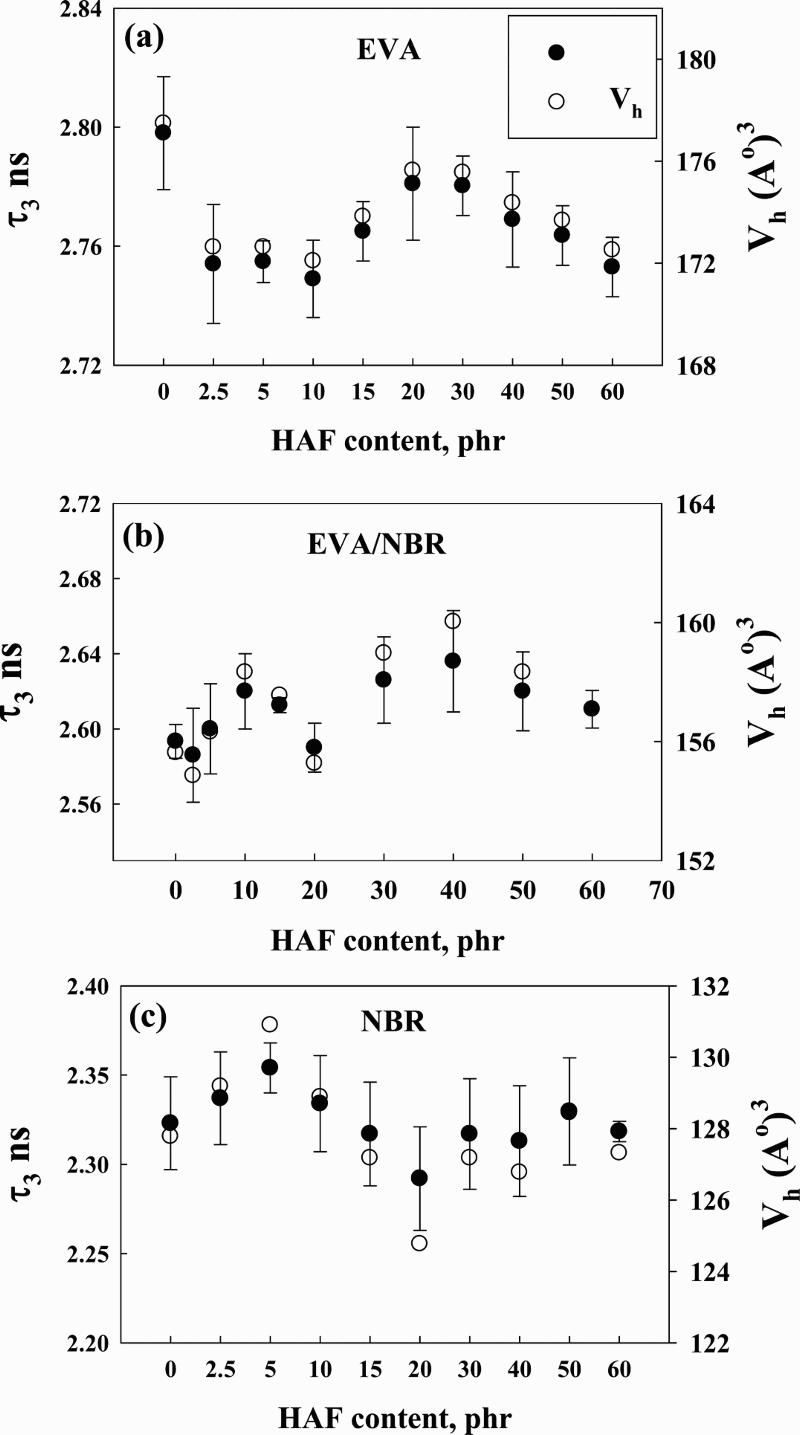
The changes in the behaviours of Vh in EVA are due to the following reasons: (i) The increase in Vh from 172 to 176 Å3 at 20 phr of HAF may be due to the presence of vinyl group in vinyl acetate copolymer which may introduce some chain branching in EVA leading to an increase in the sizes of free-volume holes. (ii) The decrease in Vh with further increase of HAF contents is due to aggregation of filler, where carbon black particles already have aggregating tendency. 2 , 9 The SEM micrographs of these samples in the previous work 9 showed aggregations at 30 phr of HAF particles in samples. However, amorphous nature of NBR causes decrease in Vh from 130 to 124 Å3 at 20 phr of HAF content, follows by increasing in Vh at higher HAF content in NBR. The effect of HAF content on the sizes of free-volume holes in EVA and NBR are almost opposite. This is due to the chemical structure, and degree of crystallinity of each polymer. EVA is semicrystalline in nature whereas NBR is amorphous. 9
The values of the free-volume parameters of EVA/NBR blend are the mean values in the EVA and NBR polymers which indicate the compatibility of the two polymers as shown in Fig. 1.
Figure 2 shows a sharp decrease in the fractions (I3% or F %) of free-volume holes with increasing HAF content, in EVA, NBR and their blend. In this case the trend of the decrease is the same for each polymer. It can be concluded that the positron diffuses to the HAF–polymer interface and finds new trapping sites there.
13
The variation of the free-volume fractions in EVA and NBR can be explained on the basis that EVA is a semicrystalline polymer and that the most of the carbon black aggregates are located in the amorphous region, interspersed by spherulites of polymer crystals.
20
Spherulites, consist of crystalline and amorphous regions and it is possible that some carbon black aggregates can penetrate and place themselves between the lamellae which lead to a decrease in fractions of free-volume holes. This means that the addition of HAF changes the crosslinking density of the polymer and inhibits o-Ps formation.
(a–c): The variations of free-volume hole fractions (I3% and F %) as a function of HAF content in (a) EVA, (b) EVA/NBR blend and (c) NBR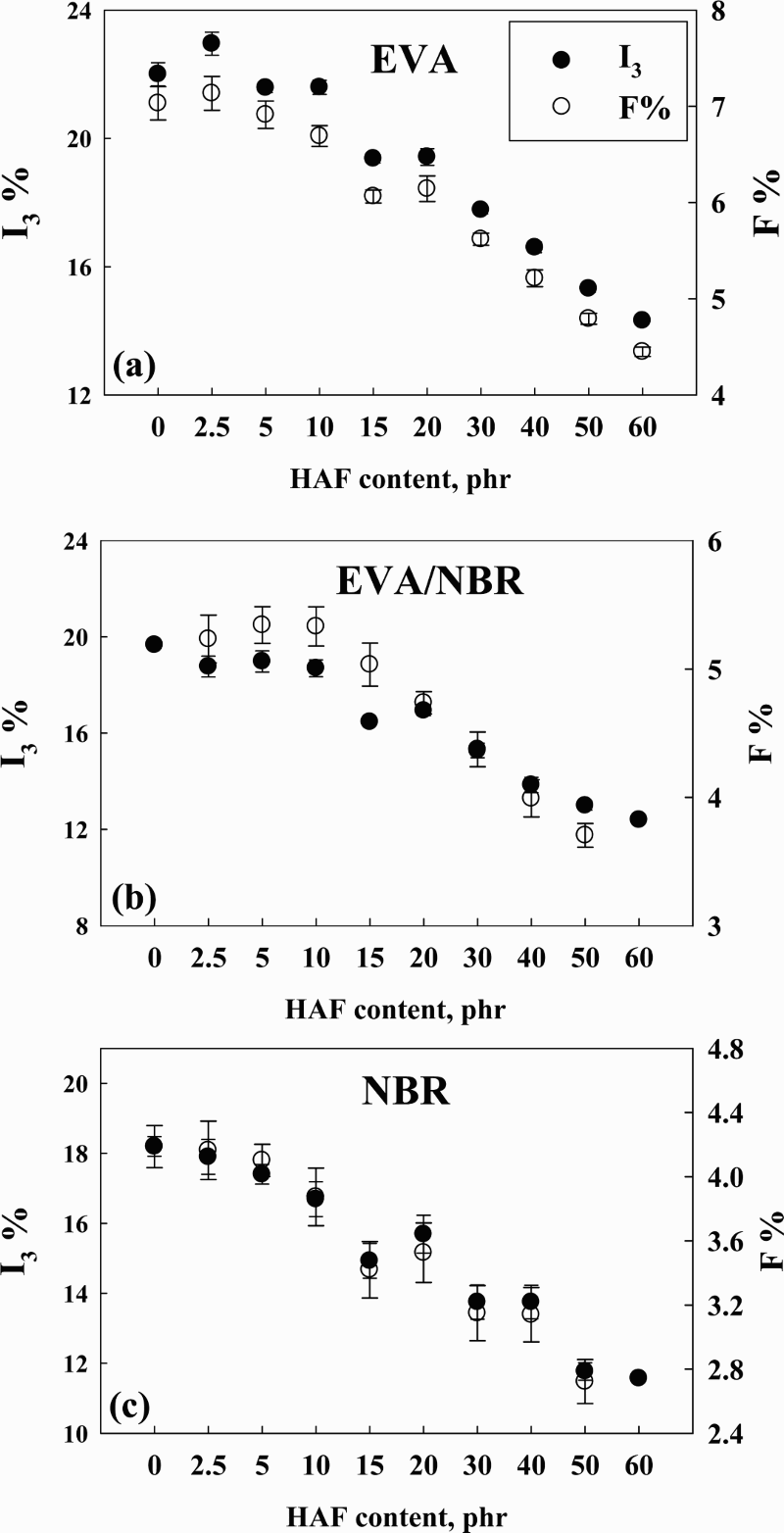
This suggests that the molecular structure of the blend changes with the addition of the fillers, also causing a change in the free-volume properties of the blend. Furthermore, positrons may be annihilated in the crystalline-amorphous interfaces and thus the number of positrons available to form o-Ps in the polymers is reduced with an increasing amount of HAF. This observation was confirmed by the variations of free positron annihilation parameters (τ2 and I2) as shown in Fig. 3.
(a–c): The variations of free positron annihilation parameters (τ2 and I2%) as a function of HAF content in (a) EVA, (b) EVA/NBR blend and (c) NBR
Figure 3 presents the variation of τ2 and I2 as a function of HAF content for EVA, NBR and their blend providing information on the open volume (which are not available to form Ps atoms) changes in crystalline regions and amorphous/crystalline interfaces of the polymer complexes. The decrease in τ2 values indicate small open volumes in this region, which are affected by the addition of HAF in the polymer. In addition, the probability of free annihilation of positrons (I2) is significantly larger than the formation probability of o-Ps. This result indicates that there are variations in the electron densities at the polymer matrix and interfaces of polymers in the presence of HAF filler. On the other hand, an increasing in I2 is observed with increasing of HAF filler content in polymer which leads to reduction in the orientation and create of defects with small size (τ2) and large fraction (I2). This indicates that the addition of HAF filler creates new positron trapping sites at filler/polymer interfaces. This behaviour is due to interaction between filler and polymer matrix resulting in rearrangement of the molecular structure as revealed by the increase in the defects concentration (I2) in crystalline-amorphous interface region.
Correlation between mechanical, electrical properties and free-volume parameters
In polymers, free-volume quantities have been proven to be closely related to its mechanical and electrical properties, so it is interesting to investigate the correlation between them. The results of mechanical and electrical properties were reported elsewhere. 9
Figure 4 illustrates an inverse relationship between free-volume parameters (Vh and F %) and tensile strength while a direct relationship with elongation at break as a function of HAF content in EVA and NBR. The tensile strength values and free-volume parameters (Vh and F %) of EVA were found to be higher than those of NBR. This behaviour can be attributed to the semicrystalline nature of EVA whereas NBR is amorphous in nature. It was observed from Fig. 4 that by increasing the filler loading, the tensile strength of the composites increases while the free-volume parameters decrease. This increase in tensile strength depends on filler–polymer interactions and the dispersion of filler in the polymer. The interaction between the polymer and the reinforcing filler increases by increasing the filler content, resulting from the closer distance between aggregates in the polymer system. This leads to a decrease in size and fractions of free-volume holes in composites.
Correlation between free- volume parameters (Vh and F %) and mechanical properties of EVA and NBR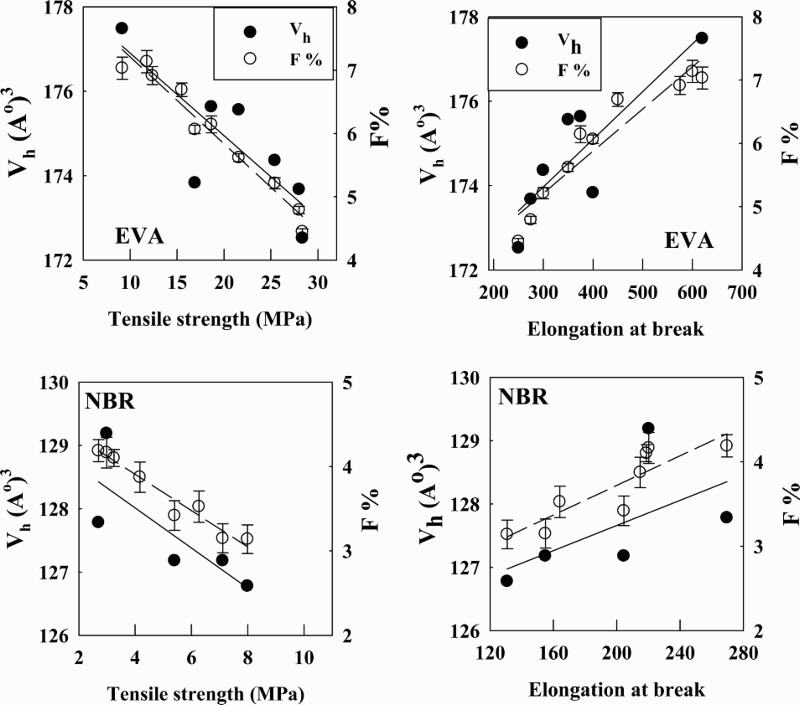
However, the values of elongation at break of EVA and NBR reinforced with HAF decrease with increasing HAF content which consistence with free-volume parameters as shown in Fig. 4. The positive correlation between free-volume parameters and elongation at break can be related to the presence of HAF in the polymer matrix restricts the mobility of polymer chains which decreases elongation at break and reduces the free-volume parameters. The reduction in the size and the fraction of free-volume holes can thus cause improvement in the mechanical properties of EVA and NBR. No correlation is found in case of EVA/NBR blend.
The correlation between intermediate lifetime components (τ2 and I2) and the permittivity (ε′) at 1 kHz, as well as conductivity (σ) as a function of the HAF content in EVA, NBR, and EVA/NBR blend are shown in Fig. 5.
Correlation between free positron annihilation parameters (τ2 and I2%) and electrical properties of EVA, EVA/NBR and NBR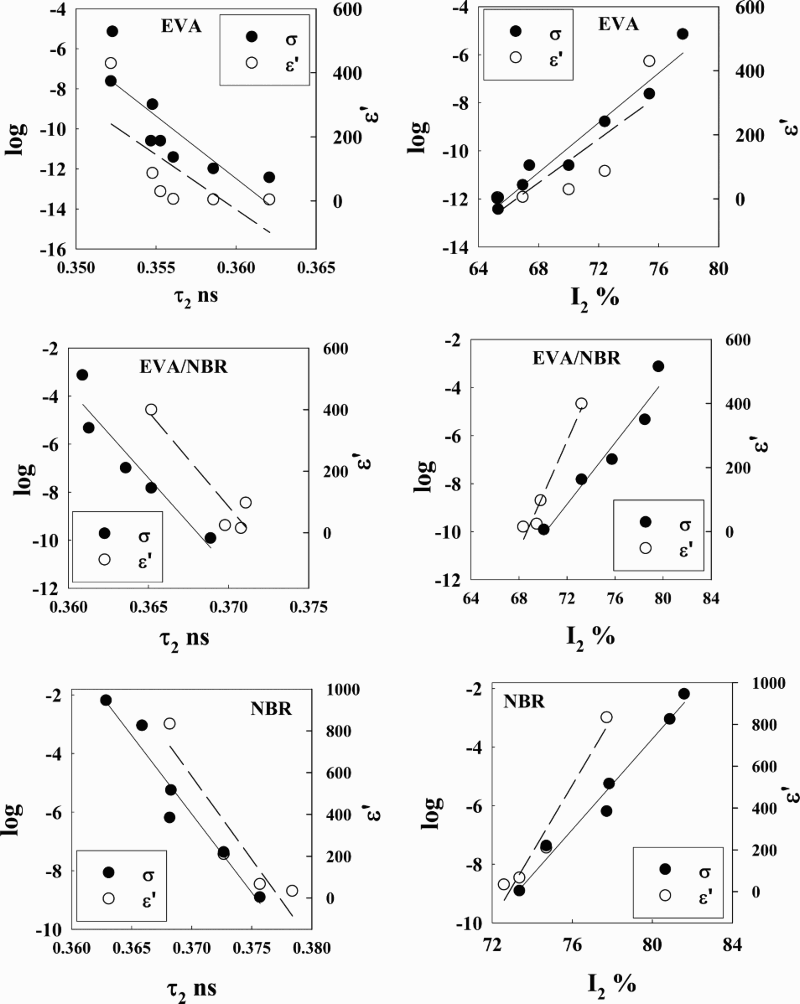
Figure 5 shows a negative correlation between τ2 and both ε′, and σ. The presence of HAF particles in the polymer matrix acts as minute capacitor. Increasing HAF content in polymer increases the number of such capacitor and the number of charge carriers in the polymer matrix, which improves the electrical properties. This leads to an increase in the negatively charged region which causes fast annihilation of free positrons and consequently, shortening in τ2 while an increase in I2 in crystalline-amorphous interface regions. However, a clear positive correlation between I2 and ε′, as well as σ is observed.
As we mentioned before increasing of HAF content leads to aggregation of HAF particles in polymer. This aggregation is responsible for the formation of continuous path and consequently, improving the conductivity.
Conclusion
The effect of HAF content on the free-volume parameters of EVA, NBR and their blend was studied by PALS, it was concluded that:
A sharp decrease in F % and an almost opposite size of free-volume holes was observed by increasing HAF content, in EVA, NBR and their blend. The values of the free-volume parameters of EVA/NBR blend are the mean values of the EVA and NBR polymers which indicate the compatibility of two polymers. The free-volume parameters (Vh and F %) are inversely correlated with tensile strength, and directly correlated with elongation at break as a function of HAF content in EVA and NBR. The electrical properties (ε′, and σ) are negatively correlated with lifetime of free positron, τ2, and positively with its relative intensity I2. The presence of HAF reduces the free-volume holes causing an improvement in the mechanical properties and electrical properties of EVA and NBR blend.
Footnotes
Acknowledgements
The authors thank the National Research Center and are truly indebted to Professor Reinhard Krause-Rehberg for providing the positron experiment in the Martin-Luther-University Halle-Wittenberg, Germany.