





Abstract
Piperazine pyrophosphate (PAPP) was mixed in polyamide 6 (PA6) to investigate its flame retardant properties. The PAPP was characterised by Fourier transform infrared (FT-IR), elemental analysis, proton nuclear magnetic resonance (1H-NMR) spectroscopy and thermogravimetric analysis (TGA). The elemental analysis and TGA results of PAPP indicated it had a high P element content and good thermal stability. The flame retardancy of PA6/PAPP was also characterised by TGA, limiting oxygen index (LOI), UL-94 vertical test and microscale combustion calorimetry (MCC). The TGA results showed that the PAPP increased the stability of the PA6/PAPP and resulted in a significant increase of char residue. PA6/PAPP passed the UL94 V-0 rating with a LOI value of 42 vol %. The MCC test indicated that the PAPP can greatly decrease the peak heat release rate (PHRR) and total heat release (THR). The results of scanning electron microscope (SEM) illustrated that PAPP can promote the formation of compact char layer.
Introduction
As is well known, polyamide materials have been increasingly used in critical applications in modern industry. Polyamide 6 (PA6), one of the most significant polyamide engineering thermoplastics, has many highly valuable properties including suitable mechanical properties, oil resistance, high ductility, low friction coefficient, beneficial chemical resistance and good electrical insulating performance [1, 2]. Due to these excellent properties, it has been widely used in the electrical industry, automobile industry and for civil infrastructure applications. Nonetheless, as a polymer material, easy flammability restricts its applications. Pure PA6 has a limiting oxygen index (LOI) value of 22–23 vol.-%, with no rating in the UL-94 test [3-5]. Thus improving the flame retardancy of PA6 has become a global challenge in modern polymer research.
Traditionally, halogen-containing compounds have been used in PA6 since they are very efficient flame retardants (FRs). These additives, which include chlorinated compounds and brominated compounds, have been widely used in the last century. However, their application prospects have been limited since they release toxic gases and corrosive smokes. For instance, polybrominated dioxin and polybrominated coumarone, produced by pyrolysis or combustion of the deca-bromine biphenyl aether (DBDPO), are deadly to the human body [6-7]. Thus, the development of halogen-free FRs has become a technological trend in polymer FR research.
In recent years, many types of halogen-free FRs have been utilised in PA6 to heighten its flame retardancy; they include phosphorous FRs, nitrogen FRs, nitrogen-phosphorous FRs and other inorganic FRs [8]. Typical phosphorous FRs, red phosphorus and ammonium polyphosphate (APP), are famous for their high flame retarding efficiency. Unfortunately, red phosphorus's colouration and strong moisture absorption prevent its extensive use. Currently, APP needs to be combined with some synergists to obtain its best performance. Melamine and its derivatives, such as melamine cyanurate, melamine sulphate, etc., are used as FRs in modern engineering polymers [9-13]. Nevertheless, a nitrogen FR cannot achieve the desired flame rating by itself in PA6. Some further additives are needed to obtain the optimum functions for melamine and its derivatives. The investigation of inorganic additives is currently concentrated on aluminium hydroxide (Al(OH)3), magnesium hydroxide (Mg(OH)2) and zinc borate. In order to pass a relatively high flame retarding level, large inorganic FR loading (generally 50–60 wt-%) and surface modification are needed, leading to inferior mechanical properties and complicated preparation processing [14-16].
We have previously described the synthesis process of piperazine pyrophosphate (PAPP, Scheme 1) [17]. In this study, PAPP was added to PA6 as a potential FR due to its appropriate initial degradation temperature, high P element content, good char forming property, etc. The expected flame retarding efficiency was achieved. The thermal oxidative stability, flammability properties, structure and possible flame retarding mechanism of PA6/PAPP composites were characterised by thermogravimetric analysis (TGA), LOI, UL-94 test, microscale combustion calorimetry (MCC) and scanning electron microscopy (SEM).
Synthesis of PAPP.
Experimental
Materials
PA6 (YH800, pelletised, the molecular weight was 15000–30000, with relative viscosity of 3.2 in 98% H2SO4 solvent) was supplied by Baling Petrochemical Co., China. The PAPP was self-prepared. PA6 and PAPP were dried in an air oven (at 100°C for 6 h) to be compounded.
The synthesis route of PAPP is shown in Scheme 1.
A certain amount of piperazine phosphate and phosphoric acid (Scheme 1, mole ratio of 1:1) were added into a flask, followed by a continued reaction in an oil bath for a given time (200°C and a rotor speed of 40 rev min−1 with a stirrer). After completion of the reaction, the reaction mixture was cooled down to room temperature, filtered and then dried. The obtained products were finally pulverised to less than 100 μm for the subsequent use. We called the reaction product PAPP.
Flame-retarded samples’ preparation
Compositions of the flame-retarded PA6 materials.

Characterisation
The PAPP and KBr were prepared into slice. The Fourier transform infrared (FT-IR) spectra of the PAPP were collected using a FTIR spectrometer (20SXB, Nicolet Science and Technology Co., Ltd., USA). The elemental analysis of the PAPP was determined by an Elementar (EL III, Vario Technology Co., Ltd., Germany). About 2.0 mg of the sample was used and the N, C, H and P elemental contents analysed. The proton nuclear magnetic resonance spectroscopy (1H-NMR) was performed on a nuclear magnetic resonance spectrometer (500 NB, Varian Technology Co., Ltd., USA) by using CDCl3 as solvent and tetramethylsilane as a reference.
The TGA curves of the PAPP and the PA6/PAPP samples were recorded on a NETZSCH thermal analyser (TG209 F3, Nicolet Science and Technology Co., Ltd., USA). About 5.0 mg of sample was put in an alumina crucible and heated from 50°C to 700° at a scanning rate of 20°C min−1 with a dynamic nitrogen flow of 20 ml min−1.
The vertical burning test was conducted according to UL-94 (ASTM D3801) on a horizontal and vertical burning tester (CZF-3, KEXING Instrument and Equipment Co., China), on sheets 127 × 12.7 × 3.2 mm. The LOI values were obtained on a LOI instrument (HC-2, QILE Science and Technology Co., Ltd., China) with sheet dimensions of 120 × 6.5 × 3.2 mm according to the standard oxygen index test ASTM D 2863–70.
The MCC (IL60050-MCC-2, Govmark Science and Technology Co., Ltd., USA) tests were performed according to ASTM D 7309–7 standard procedures. The sample was heated from ambient temperature to 900°C with a heating rate of 40 K min−1 (80% nitrogen, 20% oxygen atmosphere, flow rate of 100 cc min−1).
The surface of residual charred layer was observed by a XL30E SEM. The residual charred layer was from the burned specimen in the UL94 test. The samples to be observed were coated with a conductive gold layer in advance.
Results and discussion
Characterisation of PAPP flame retardants
The PAPP was synthesised as described above and shown in Scheme 1. Its structure and thermal properties were characterised by FT-IR spectra, elemental analysis, 1H-NMR and TGA test.
FT-IR analysis of PAPP
The FT-IR spectrum of the obtained product is shown in Figure 1. The peak at 3254 cm−1 corresponds to the absorption band of the −OH groups. The peaks at 1211 cm−1 and 1440 cm−1 corresponds to the stretching bands of the P = O and C–N groups, respectively. The peak at 955 cm−1 belongs to the vibration of P–O–P. The peak at 1637 cm−1 corresponds to the N–H in the C–N–H groups [18, 19]. Thus, the FT-IR confirmed that the PAPP was prepared.
FT-IR spectrum of PAPP.
Elemental analysis of PAPP
Elemental analysis of PAPP.

As shown in Table 2, the calculated and measured values agreed well. It indirectly confirmed a complete reaction during synthesis, in agreement with the FT-IR spectrum. The results are strong evidence that the product had been synthesised successfully. However, all of the experimental elemental contents were slightly less than the calculated contents, possibly due to impurities in the sample.
1H-NMR of PAPP
Figure 2 shows the 1H-NMR spectrum of PAPP with the assignments of all the protons. The peak at 3.56 ppm was assigned to the protons of –CH2. Further, the characteristic peak at 4.64 ppm had been observed, which was attributed to the H protons of the D2O molecule (used D2O as solvent in the test). The analysis indicated that the target product had been synthesised successfully in our work.
1H-NMR spectra of PAPP.
Thermal degradation properties of PAPP
In order to understand the thermal stability of PAPP, Figure 3 shows the TGA and DTGA curves of PAPP. The onset degradation temperature (Tonset, the temperature at which the mass loss of 1%) was about 278°C. The results also provided the information that the thermal degradation process of PAPP can be divided into two distinct stages, in the range of 278–500°C and 500–800°C. The first stage began at 278°C and underwent a gradual mass loss process until the mass degradation rate reaching the maximum rate at about 400°C. The mass loss in the first stage maybe be ascribed to the generated polyphosphoric acid. The second stage in the temperature range of 500–800°C, was speculated to be due to degradation of the phosphorus oxynitride (PON)m, which was the reaction product of the phosphoric acid and O2 [20]. We speculate the PAPP should have comprehensive flame retarding efficiency due to the presence of these stages: carbonisation and esterification reaction in the condensed phase and incombustible gas releasing in the end stage [21-23]. It should be noted that the PAPP had a final mass residue of 10.4 wt-% at 800°C.
TGA and DTGA curves of PAPP.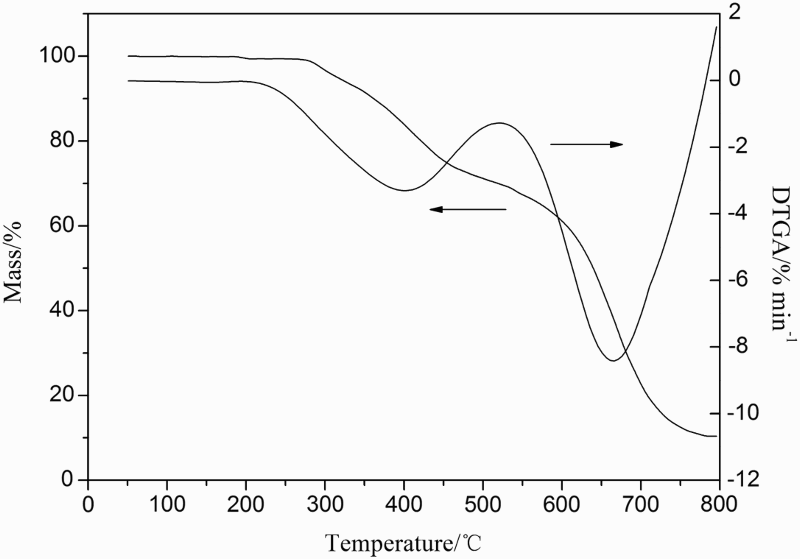
Thermogravimetric analysis (TGA) of PA6/PAPP composites
Figures 4 and 5 show the thermal mass loss (TGA) and differential mass loss (DTGA) curves of neat PA6 and the PA6/PAPP composites. The decomposition temperature at 1% weight loss (Tonset) and final char yields at 700°C are summarised in Table 3. The initial degradation temperatures of all of the PA6/PAPP samples were lower than PA6, attributed to the earlier degradation of PAPP and its initialisation of the degradation of the PA6. Furthermore, the maximum thermal degradation rate temperature (Tmax) was reached at a lower temperature compared with that of pure PA6. The PA6/PAPP degradation process can be divided into the range of 310–430°C and 430–700°C. The first region can be reasonably speculated as being due to: (a) generation of phosphoric and polyphosphoric acids that can react with the caprolactam decomposing from PA6, (b) degradation of the PA6 matrix [24, 25].
TGA curves of the PA6/PAPP composites. DTGA curves of the PA6/PAPP composites. Data of the thermal degradation of the PA6/PAPP with various PAPP content.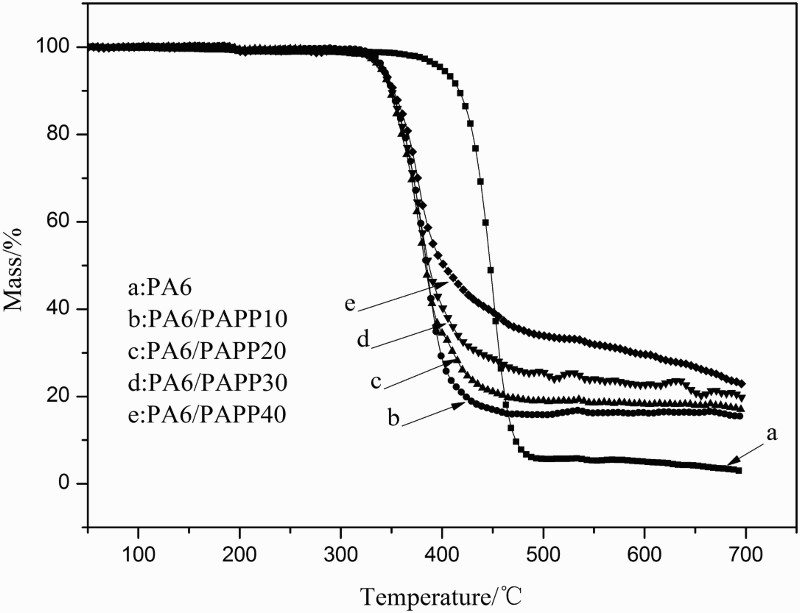
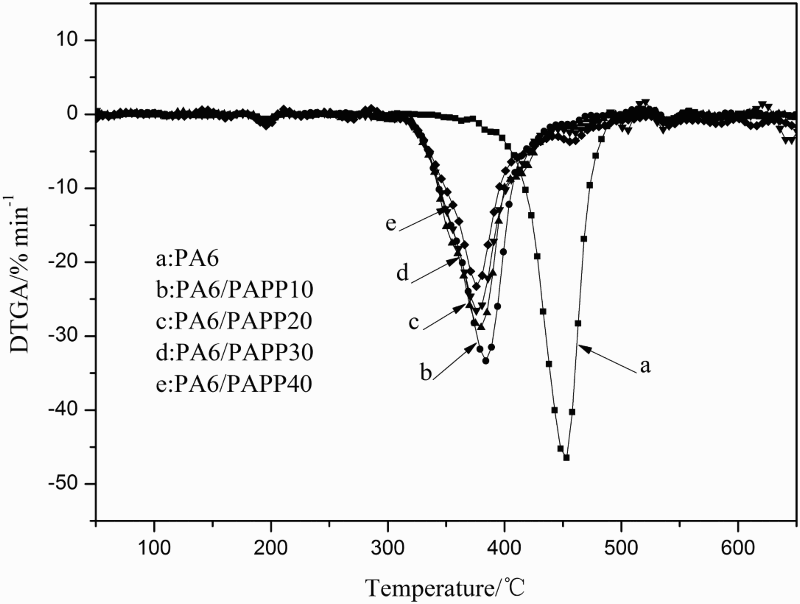

In the second stage, the thermal degradation underwent a smooth decrease until 500°C. Compared with neat PA6, the remaining char (Table 3) of PA6/PAPP (700°C) increased with increasing PAPP and was larger than just due to the PAPP corresponding to its proportion in the samples. For instance, the PA6/PAPP40 left a char residue after combustion that was nearly 10 times that of the PA6 matrix (2.34 wt-%), being 22.4 wt-%. The continuous char residue increase was caused by the carbonisation reaction. As is well known, an intumescent char layer covers a polymer's surface, acts as a barrier and isolates the heat and mass transfer, and thus significantly magnifies the fire retardancy of the compound.
The DTGA curve can also reflect the decomposition rate of a chemical substance. The maximum decomposition rates (DTGA peaks) of PA6/PAPP were at lower temperatures than that of PA6. It illustrates that the PAPP accelerated the mass loss and altered the thermal degradation process of PA6. For instance, compared with neat PA6, the maximal mass loss rate (MMLR) of PA6/PAPP40 showed the largest decrease (50%). So, what it means is that PA6/PAPP is worthless at a lower temperature than PA6.
Flame retardancy of PA6/PAPP
Effect of PAPP content on the flame retardancy of PA6/PAPP composites.

The UL94 test results are also shown in Table 4. Pure PA6 had no rating in the UL-94 testing and underwent melt-dripping. However, the V-0 rating was achieved with the 40 wt-% PAPP, with no melt-dripping. When 10 wt-% of PAPP was added, the PA6/PAPP10 had an improved LOI value, but still exhibited no rating in the UL-94 test. Further, when the loading of PAPP was increased to 30 wt-%, the PA6/PAPP30 sample achieved a V-1 rating, with no melt-dripping. The fact that PA6/PAPP30 and PA6/PAPP40 had no melt-dripping demonstrates good anti-dripping property. The flame analysis in the UL94 test verifies that the addition of PAPP resulted in an expected flame retarding efficiency in the PA6, especially for high loading. So, the improvement of the LOI and UL94 ratings corresponded to the enhancement of the char residue in the TGA test.
Microscale combustion calorimetry tests
The MCC test, based on the oxygen consumption principle, has been an effective method to study and compare the flammability performances of materials. MCC is a useful method to predict the hazards in a real fire. The data of MCC, including peak heat release rate (PHRR, w g−1) and total heat release (THR, KJ g−1), can show a quantitative characterisation of the combustion [26].
The heat release rate (HRR) of materials is a significant parameter to simulate fire safety [27, 28]. Figure 6 summarises a comparison between the HRR curves of virgin PA6 and the PA6 blends with added PAPP powder, with the THR and PHRR values given in Table 5. The results indicated virgin PA6 had a sharp peak, illustrating it had only one degradation process, in agreement with the decomposition process of the PA6 in Figure 5. The sharp release region of pure PA6 was in the range of 350–500°C with the PHRR value of 571 w g−1. The evident decrease in PHRR quantity for the PAPP containing composites was caused by a suppressed oxidation process and indicates a flame inhibition mechanism resulting from radical trapping reaction. Similarly, the HRR curves of the PA6/PAPP had only one peak, corresponding to the thermal degradation process in the TGA tests. The ignition temperature (Tc) is defined as the temperature at which the HRR just rise. Moreover, the ignition temperature (Tc) and THR were lower than for neat PA6. This indicates that the heat release process for PA6/PAPP was shifted to lower temperature. The narrow heat release process and the continuous lessening of the PHRR indicated a rapid diminishment of the THR quantity with increasing PAPP content. Compared to 31.5 KJ g−1 for PA6, the PA6/PAPP40 had a THR of 24.2 KJ g−1. The values of THR and PHRR decreased with increasing PAPP, with a large drop for 20 wt-% PAPP, followed by a slower decrease for 30 wt-% and 40 wt-% PAPP. It indicates that a low content of PAPP can significantly decrease the PHRR of PA6.
HRR curves of the PA6/PAPP samples. Data of the MCC test of the PA6/PAPP samples with various PAPP content.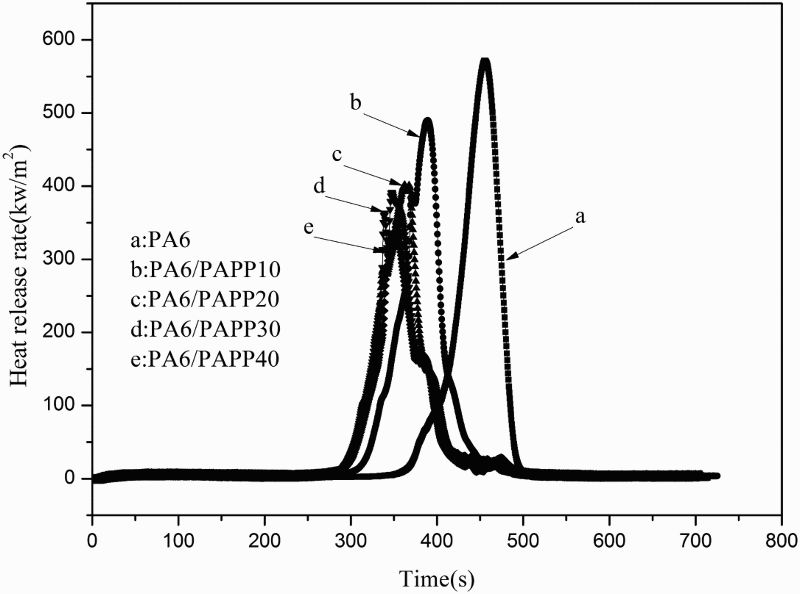

The diminishment of the THR should be attributed to the char formation. The char will block the O2 diffusing from air to the inner material. Hence, the drastic decrease of PHRR and THR for 20 wt-% PAPP containing composites indicated that PAPP reduced the hazards of fire. Based on the HRR results we propose that the flame inhibition action of PAPP was effective for the PA6.
SEM analysis
In generally, the morphology and chemical composition of residue are governed by the flame retardancy mechanism, which have great impact on the actual flame retardancy. The morphologies of the residual char of the PA6/PAPP40 (Mag = 800×) materials were observed by SEM instrument, as shown in Figure 7.
SEM photographs of the residual charred layer of the PA6/PAPP40 (Mag = 800×).
In the SEM results, there is almost no char layer on the surface of PA6 materials after combustion, whereas little char residue was formed. Moreover, its thickness was also not uniform. As a result, the quality of the total charred layer of PA6 composites was poor, which cannot effectively prevent transfer of heat, the penetration of oxygen and combustible gases. In contrary, for FR-PA6 system, the surface of the residue was smooth, compact and tight, indicating a dense and continuous vitreous char layer structure. This vitreous char layer caused in a strong barrier effect against heat, degradation products of matrix polymer and volatiles diffusion, leading to excellent flame retardancy of the FR-PA6 specimens. The qualitative elemental analysis of the selected area from the SEM images supports the generation of char in materials. Compared with pure matrix, the phosphorus element of the residue of PA6/PAPP40 increased to 18.1 wt-%. This could produce many phosphorus-containing free radicals (as the radical scavengers), then combine with the segmental radicals generated from the heterolytic cleavage of PA6 to form compact char layer. Consequently, the presence of PAPP changed the decomposition mechanism of PA6 and induced the formation of cross-linking residue containing phosphorus, which can constrain the transfer of heat and oxygen, thus enhance the flame retardancy of FR-PA6 composites.
Conclusions
PAPP was synthesised and added to PA6 as a potential FR. The effect of PAPP loading on the flame retarding and thermal degradation performances of PA6 was investigated. The FT-IR, elemental analysis, 1H-NMR and TGA tests clearly indicated that PAPP had a high P elemental content, good thermal stability at high temperature and a good char forming property. The initial decomposition temperature of PAPP was 278°C (higher than the processing temperature of PA6) during tests. The addition of PAPP resulted in rapid formation of a dense intumescent char, with a char residue of 22.64 wt-% for PA6/PAPP40. When 40 wt-% PAPP was added, the LOI value had a corresponding increase from 23 vol.-% to 42 vol.-% and a UL94 V-0 rating was achieved. In addition, the THR and PHRR showed a significant decrease compared with pure PA6 in the MCC test. Furthermore, the incorporation of FR resulted in compact char layers with some holes from SEM observation, which was ascribed to the cross-linking carbon reaction.
Footnotes
Disclosure statement
No potential conflict of interest was reported by the authors.