






Abstract
A sizing formulation, containing compatible and incompatible silane coupling agents with epoxy resin in conjunction with nanoscale colloidal silica, was used to modify the surface of glass fabric. The modified glass fabric/epoxy resin composite panels were fabricated and characterised by flexural test, Charpy impact test and scanning electron microscope (SEM). By combining nano silica with silane blend in the fabric sizing, more energy was consumed under bending and impacting, which resulted in an improvement of the toughness in composites. The flexural strength, bending stain and Charpy impact strength of the epoxy composite/glass fabric treated with 1 wt-% nano silica and silane blend were ∼42, ∼22 and 35%, respectively, higher than those of silane blend coated glass fabric-reinforced composites (without nano silica). Furthermore, the change of the brittle fracture of the composite into ductile fracture was investigated by SEM micrographs. A possible toughening mechanism was also proposed.
Introduction
Glass fibre-reinforced composite materials have become the alternatives to conventional structural materials, such as wood and steel in some applications, because of their good mechanical properties [1-3]. Mechanical properties of fibre-reinforced composites depend on the properties of constituent materials, the nature of the interfacial bonds, the mechanisms of load transfer at the interphase, and the adhesion strength between the reinforcement and matrix [4-9]. In this work, the glass fabric/epoxy polymer matrix composite was considered for studying the effect of tailoring fabric–matrix adhesion on the flexural and Charpy impact properties of the material. The adhesion strength between the fibre and matrix can be attributed to some combination of the following phenomena: mechanical adhesion, adsorption and wetting, electrostatic attraction and chemical bonding [9, 10]. Different kinds of treatments are developed to improve the interfacial adhesion. Surface treatment of reinforcement with coupling agents is a common method to improve adhesion properties [11-13]. Organofunctional silanes are the most widely used coupling agents for improvement of the interfacial adhesion in glass-reinforced materials [14-16]. Nanometer-sized materials as a reinforcement also improved the adhesion between the fibre and matrix [17-19]. In fact, mechanical adhesion can be created by incorporating nanoparticles in the fibre sizing, while silane can produce chemical bonding [15, 20, 21].
Studies about achieving desired composite properties by tailoring fibre–matrix adhesion have been conducted. It has been reported that increasing the adhesion strength of the fibre-reinforced polymeric composite material often leads to a reduction in the toughness of the composite material. A large body of these researches has focused on the effect of interfacial chemistry on fibre–matrix adhesion [2, 11, 14, 15, 22], and a limited amount of research has assessed the influence of glass surface texture [5, 18, 21, 23, 24].
In this work, a sizing formulation of silane coupling agents (γ-methacryloxypropyltrimethoxysilane (MPS) and 3-glycidoxypropyltrimethoxy silane (GPS)), in conjunction with nanoscale colloidal silica was used to modify the fabric surface. An incompatible silane coupling agent (MPS), which was non-reactive towards matrix, was selected to be included in the fibre sizing to reduce the density of reactive sites that can bond with epoxy resin and consequently this strategy can help composites with improved toughness [21, 23, 25, 26]. Composite materials were manufactured using the silane sizing glass fabrics. The flexural and Charpy impact tests were performed to investigate how the combination of texturing and chemical bonding affects the mechanical properties of the composites.
Experimental
Materials
The material selected for the present study was E-glass fabric as the reinforcing material and epoxy resin as the matrix material. Commercially available E-glass-woven roving fabric was supplied by Sonmez Textile Advanced (Bursa, Turkey). The silanes used in this work included 3-glycidoxypropyltrimethoxysilane (GPS, Mw = 236.4, Merck), and γ- methacryloxypropyltrimethoxysilane (MPS, Mw = 248.35, Merck). Ludox TMA (Merck) was the silica used in this work. The 22 nm particles were suspended at 34 wt-% in deionised water. Epoxy was chosen as a matrix system for the composites. A room temperature cure epoxy resin EPOLAM 2017 and hardener EPOLAM 2018 based on polyamines were supplied by Axson (Cergy Pontoise, France). The curing agent was mixed in a proportion of 100:30, resin to the curing agent by weight.
Glass fabric surface treatment
Formulations of designed fibre sizing.

a3-glycidoxypropyltrimethoxy silane (GPS); the compatible silane coupling agent.
bγ-methacryloxypropyltrimethoxysilane (MPS); the incompatible silane coupling agent.
cSilica nanoparticles; as a roughening agent.
To study the effect of interphase on the mechanical performance of composite panels, 1 wt-% colloidal silica nanoparticle (water-based solution, 34 wt-% purity) was added to the blend solution of GPS: MPS (1:1). The colloidal silica suspension remains stable at least 24 h in the water/ethanol solution with the pH of 4 [21].
Fabrication of glass fabric/epoxy composites
Hand layup moulding was used for the preparation of glass fabric-reinforced thermosetting epoxy resin matrix composites. First, mixed epoxy and hardener were put into the vacuum oven for 15 min at 30°C and 0.65 bar pressure to reduce the viscosity for better mixing, impregnating and elimination of the entrapped air-bubbles. Afterwards, one layer of treated or non-treated fabric with the size of 250 mm × 250 mm was impregnated with epoxy resins using a hand roller. Then the impregnated composite sheets were cured in a vacuum oven. After being initially cured at room temperature for 36 h, moulded panels were post-cured for 2 h at 45°C, 2 h at 60°C and for 8 h at 80°C.
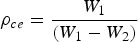
Fibre volume fraction

 ,
,
 and
and
 were the densities of the composite, glass fibres and matrix, respectively, and V
f
was the volume fraction of glass fibres concerning the total volume. To determine the density of the composite panel, the sample was cut into 1 cm × 1 cm × thickness, the dry weight,
were the densities of the composite, glass fibres and matrix, respectively, and V
f
was the volume fraction of glass fibres concerning the total volume. To determine the density of the composite panel, the sample was cut into 1 cm × 1 cm × thickness, the dry weight,
 (in the air) and the wet weight,
 (in the water) were measured. The composite density was then calculated using ASTM D792-98 dry/wet weight method (Equation (2)). The fibre contents of composites are provided in Table 2.
Fibre volume fraction and flexural properties of glass fabric/epoxy composites.

a–eMeans with the same superscript are not statistically different (P < 0.05).
*Mean ± Std. Deviation.
Mechanical testing
The flexural tests were carried out in accordance with ASTM D790, method I (three-point loading), using a minimum of five specimens for each composite sample. The tests were performed on an Instron testing machine (Hounsfield, H50KS model, Salfords (Near Redhill), Surrey, UK) with a span to thickness ratio of 16. The test speed was 2.6 mm min−1. Flexural strength, SF (MPa), flexural modulus, EF (GPa) and bending strain, ε (%) values were obtained and evaluated by the following equations.


where Fmax was the load (N), L was the span length (mm), b was the specimen width (mm), d was the specimen thickness (mm), m was the slope of the linear region of the load-displacement curve and D was the maximum deflection from the centre.
Impact tests were performed on an Instron Charpy impact testing machine (Model PW30/15 K, AMSLER, Darmstadt, Germany). The test method adopted was consistent with EN ISO 179. All the test specimens were un-notched. Impact loading was done with a 15 J hammer. Ten samples were tested and the mean value of the absorbed energy was taken. The impact strength (kJ m−2) was calculated by dividing the recorded absorbed impact energy to the cross-sectional area of the specimens. Specifically, absorbed impact energy, Ec, and impact strength, Gc, were calculated according to the following equations:


where m was the pendulum mass, g was the gravitational acceleration (9.8 m s−2), and h and
Schematic diagram of (a) Charpy impact parameters for calculations and (b) the impact direction on the sample. were the elevations of the centre of mass; moreover, the centre of mass was located at a distance r from the centre of rotation. Other parameters were the angles at the end of the swing (β), the angle of fall (α), and the length (l) and width (b) of the sample. Figure 1 shows the schematic diagram of Charpy impact parameters used for calculations and the impact direction on the sample.

Fracture section observation
The fracture surfaces of impact failed specimens were studied by a scanning electron microscope (SEM; VEGA model, TESCAN Co., Brno-Kohoutovice, Czech Republic) using an accelerating voltage of 25 kV.
Results and discussion
Flexural properties
The flexural test results of epoxy composite panels reinforced with unsized and silane-treated glass fabrics are presented in Table 2. The flexural strength data were normalised relative to the highest fibre volume fraction of composite specimens (24%, Table 2). One-way analysis of variance and Duncan's tests (for multiple comparisons between means to determine significant differences) were used at a significant level set at 0.05 for the analysis of the experimental results.
It is interesting to note that the hybrid sizing sized glass fabric-reinforced epoxy composite (A1B1-NP sample; containing nanoparticles) had the highest flexural strength and modulus. The flexural modulus of this composite was 3.5 orders of magnitude greater than that of A1B1 sample (without nanoparticles), but the increase in flexural strength was only about 42%. For hybrid sizing sized glass fibre/epoxy systems, the nanoparticle and siloxane network formed textures on the fibre surfaces. When the composite failed, the particles perhaps reduced the penetration efficiency of the crack in the interphase region, which formed the mechanical interlocking between the fibre and resin, and changed the stress distribution at the fibre/resin interface involving the considerable plastic deformation of material during fracture [21, 23, 29]. It led to a considerable improvement in flexural strength and modulus. Also, the properties of A1B1-NP sample became tough and ductile (high strength and failure strain of this sample compared with other samples support this explanation).
As seen in Table 2, the flexural strength and modulus of composites produced with unsized and incompatible silane sized (sample B) glass fabrics were lower than those of other composite samples.
The photographs of tensile sides of the flexural fracture surfaces were taken to provide insight on damage mechanisms (Figure 2). Common failures under flexural loading include compressive failure, tensile failure, shear and/or delamination [30]. When the load is applied, the test specimen deflects so that the underside of the test specimen will be under tension, while the upper side will be subjected to compression. In-plane shear stress is also present along the mid-plane of the specimen. Owing to the anisotropic nature of the samples being tested in this analysis, bending failure may be caused by tensile, compressive, shear or a combination of these stresses.
Photograph of the flexural tested glass fabric-reinforced epoxy composites (the sample codes are according to Table 1), the maximum deflection created in the samples decreases from up to down.
It was observed that none of the specimens (except unsized sample) were completely broken at peak load. From Figure 2, it is observed that some whitening (crazing) was formed on the composite samples (A1B1-NP, A and A1B1) after flexural testing. It clearly indicates the high resistance of those samples against the flexural force. The failed surface of unsized and B samples (Figure 2) in flexure shows that these composites exhibited lower flexural strength than other specimens. A small degree of whitening appeared on the tensile side of the fracture surfaces in sample B, and the brittle failure of unsized sample revealed that these composites failed in shear due to the poor mechanical properties offered by these samples. In other words, the resistance towards crack propagation was poor and possibly catastrophic failure was dominated in sample B.
Typical force–extension curves for the composites are shown in Figure 3. As seen from the curves, it is noticeable that the composites A1B1-NP, A and A1B1 had higher fracture strength and bending strain values than B and unsized composite samples. For A1B1-NP, A and A1B1 composites, after the maximum force, the curves drop slowly and the specimens have more ductility, whereas the B and unsized composites showed a brittle fracture behaviour due to the sharp decline of stress and small bending strain, indicating lower flexural ductility.
Force–extension curves from the flexural test (The sample codes are according to Table 1).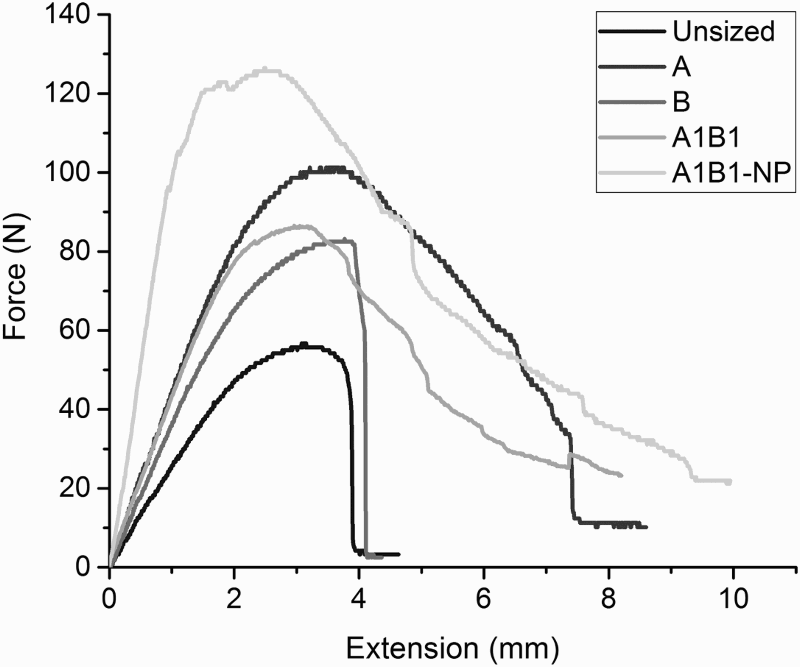
Impact strength
The average impact strength of glass fabric (untreated and treated)-reinforced epoxy composites is depicted in Figure 4. The Charpy impact strength (energy absorbed/cross-sectional area) is the critical work of fracture or the energy required to produce a new surface in a material. The results were normalised relative to the highest fibre volume fraction of composite specimens (24%, Table 2).
Charpy impact strength of glass fabric-reinforced epoxy composites.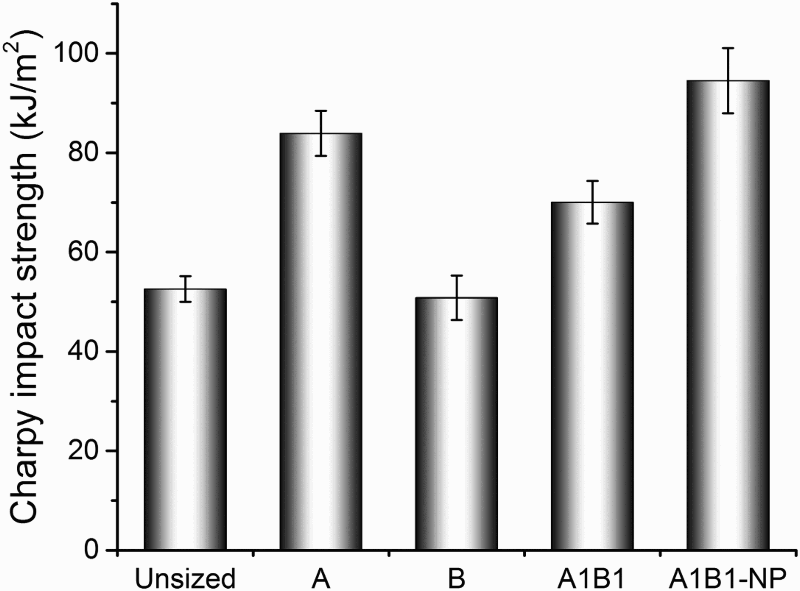
As can be seen in Figure 4, the compatible sizing (in sample A) increases the impact strength by 65% compared to that of incompatible sizing (in sample B) due to the presence of the reactive silane coupling agent on the fabric surface. It is important to conclude that compatible silane coupling agents in the fabric sizing materials fibre plays pivotal role in the improvement of composite impact strength. In the mixed sizing (A1B1 sample), the presence of incompatible silane will dilute the concentration of reactive functional groups from compatible silane coupling agent on the fabric surface. Thus, the available bonding sites decreased and as a result, the impact strength reduced about 16% in comparison to the sample of A. Hybrid sizing sized glass fabric-reinforced epoxy composite (A1B1-NP sample) exhibited the highest impact strengths (94.55 kJ m−2) compared to other composite samples. Addition of SiO2 nanoparticles in the silane blend changed the fibre surface morphology significantly, modified the mode of failure and let the fracture follow a torturous path along the interphase so that more energy was absorbed.
A photograph of impact tested glass fabric/epoxy composites is presented in Figure 5. The unsized and B (containing incompatible silane) samples exhibited a brittle behaviour, but A1B1 sample (treated with mixed silane) showed a progressive failure mode consisting of fibre failure and some debonding (splitting). As can be seen, samples of A and A1B1-NP were not completely separated into two pieces, but fibres bridged the gap to hold the sample together. This mode of failure was associated with mechanisms such as high energy absorption [31].
Photograph of the impact tested glass fabric-reinforced epoxy composites (the sample codes are according to Table 1).
Figures 6 and 7 show SEM micrographs of the fractured specimens after impact test. All images were taken at the centre of the fracture surface. Figure 6 exhibits the low magnification fracture surface morphologies and Figure 7 shows the high magnification SEM images of the details of fracture areas presented in Figure 6. It is well known that the impact response of fibre composites is highly influenced by the interfacial bond strength, the matrix and fibre properties. Impact energy is dissipated by debonding, fibre and/or matrix fracture and fibre pull-out. Energy dissipation of the fibre fracture is less than that of the fibre pull-out. The former is common in composites with high interfacial bond, while the occurrence of the latter is a sign of a weak bond [12, 32-34].
SEM images of fracture surface following Charpy impact test of glass fabric/epoxy composites; (a) unsized, (b) A, (c) B, (d) A1B1, (e) A1B1-NP (according to Table 1). High magnification SEM images of fracture surface following Charpy impact test of glass fabric/epoxy composites; (a) Unsized, (b) A, (c) B, (d) A1B1, (e) A1B1-NP (according to Table 1).

Figure 6(b,e) indicates that crack propagation was suppressed due to the fibre bridging. In unsized and incompatible sizing sized glass fabric/epoxy composites (sample B) (see Figure 7(a,c)), fibres were not well connected with the matrix, and some gaps between the fibres and matrix were evident. In this situation, the load on the composites was not distributed evenly from the fibre to fibre through the matrix, and catastrophic failure of the composites was observed due to poor wetting of the fibres.
In A1B1-NP sample containing nano silica particles, the silica nanoparticles, attached on the fibre surface, can make the crack propagation deviate. This deviation can possibly be ascribed to the mechanical interlocking formed between fibre and resin [35]. It might cause redistribution of the stress at the fibre/resin interface so that more energy could be dissipated during the failure.
Conclusions
A study on the flexural and Charpy impact properties of epoxy composites reinforced with E-glass-woven roving fabrics was presented in this paper. Binary coupling agents, including a reactive and non-reactive silane (GPS and MPS silanes, respectively) towards the epoxy matrix, as well as silica nanoparticles as a roughening agent were chosen to modify the fabric surface. According to the results of flexural and Charpy impact test, the sample modified with silane blend and nano silica showed the best flexural and impact strengths. The flexural modulus of this composite was nearly 3.5 times greater than that of mixed sizing sized one (without nanoparticles), but the increase in flexural strength was only about 42%. The hybrid sizing sized glass fabric-reinforced epoxy composite exhibited the highest impact strengths compared to other composite samples (35% higher than the composite reinforced with mixed sizing sized fabric). When the glass fabric was treated with nano silica and silane coupling agents, the chemical bonds and mechanical interlocking could form the interface between fabric and matrix, which improved the interfacial bond strength between them. Therefore, the mechanical properties of the composites were improved.
Footnotes
Disclosure statement
No potential conflict of interest was reported by the author.