






Abstract
In this paper, the nanotubular halloysite nanotubes (HNTs)/disc-shaped diatomite mixture (HD) was used to study the synergistic reinforcing effect of the filler in polymer matrix (PP and PA6). The structure of the HNTs/diatomite mixture filler-filled polymer composites with different proportions of HNTs/diatomite was determined by XRD and SEM. The mechanical performance of the composites was extensively investigated. The results indicated that the HNTs/diatomite mixture filler with different shapes could significantly reinforce the mechanical performance of polymer regardless of whatever it was filled in — PP or PA6. The synergistic reinforcing effect of HNTs/diatomite mixture filler in polymer matrix was verified.
Introduction
Polymer composites incorporating inorganic nanofillers have attracted growing research interest both academic and industrial perspectives because of the unique characteristics of nanoparticles, including their large surface area, high surface reactivity, and relatively low cost (Liu et al. 2014).
Traditional nanofillers include black carbon, graphite, silica, and silicate; these materials can enhance numerous polymer properties, generating increased mechanical properties, improved thermal resistance, and reduced gas permeability. The Young's modulus and the tensile strength of glass-fibres-reinforced PP increased by 343.5% and 235.3%, respectively, and the friction coefficient decreased to 58.33% (Cherif et al. 2009). The hardness of carbon fibre-reinforced PP was improved by 8.65% and the friction coefficient achieved over 24% decline (Latiff et al. 2016). The micro-hardness and yield strength of the PP/B4C composites were improved by 37% and 18%, respectively (Dike et al. 2014). The large aspect ratio, high strength, and relatively low density of 1D tube-like or 2D nanosheet nanofillers have aroused promising research interest. Thus far, a few research mainly focused on carbon nanotubes (CNTs) and graphene (GN). However, both of these materials are too expensive. Reinforcing PP with 5 wt-% graphene nanoplatelets showed a 66°C increase in the onset degradation temperature (Bafana et al. 2017).The best impact strength of the PP/CNT composites was increased by 152% at 1 wt-% functionalised multiwall carbon nanotubes while still maintaining good tensile modulus, yield stress and strain to failure (Ghoshal et al. 2016).
Halloysite nanotubes (HNTs), as a natural aluminosilicate mineral (Al2(OH)4Si2O5·nH2O, n = 0 or 2), have a high aspect ratio with 0.1–2 μm in length and 10–40 and 40–70 nm in the inner and outer diameters, respectively. A multilayer hollow tubular structure is composed of the siloxane groups (Si–O–Si) located in the outer structure, and the aluminium hydroxyl (Al–OH) oriented in the inner surface (Hillier et al. 2016). Regarding the cost and availability, HNTs are of cheap, abundant and biodegradable characters, and especially have the massive surface active groups that are conductive to the surface modification. These surface hydroxyl group can polish up the interfacial contact between HNTs and polymer matrix (Liu et al. 2007, 2012, 2016; Yang et al. 2016). The high aspect ratio, small dimension and high strength suggest that HNTs have potential uses in high-performance polymer composites. The HNTs’ loading strongly affects the reinforcement of polymer composites. The tensile strength of PP filled with HNTs (2 wt-%) was increased by 22% (Liu et al. 2008a, 2008b, 2009; Ismail et al. 2016). The notched impact strength of PP filled with HNTs (6 wt-%) was increased by 77% (Prashantha et al. 2011). The temperature at 10% weight loss for the HNT-filled composite with 10 wt-% HNTs loading was elevated by 60°C higher than that of neat PP (Du et al. 2006). It was found that the HNTs acted as a nucleating agent and facilitated the heterogeneous nucleation in the PP matrix could polish up the overall crystallisation rate (Ning et al. 2007; Liu et al. 2009). The water resistance of the waterborne polyurethane films containing 0.5 wt-% HNTs was significantly improved (Wu et al. 2016; Liu et al. 2013). HNTs might improve the char-forming property of poly(ethylene terephthalate) (PET), which could protect the polymer surface (Gorrasi et al. 2014). The HNTs-PA6 composite showed that the tensile strength and Young's modulus of PA6 increased with HNTs loading, and the composites had twice the modulus of the neat PA6 when the HNTs content was 30 wt-% (Handge et al. 2010). The effect of HNTs content on the mechanical property of HNTs-PA6 composites was investigated. With the increase in HNTs content, the flexural strength of the clay–polymer composites (CPN) was significantly promoted from 110.0 MPa (neat PA6) to 135.5 MPa (CPN) and the flexural modulus increased from 2711 MPa (neat PA6) to 4557 MPa (CPN). However, the tensile strength and the impact strength were only slightly enhanced (Du et al. 2010). In the composite filling, the different shapes or sizes of the fillers were incorporated to form a three-dimensional (3D) distribution network in polymer matrix, which could offset the shortcoming of each other in reinforcing performance of polymer matrix. The tensile strength, Young's modulus, and elongation at break of the polyurethane (PU) elastomers reinforced with 1 wt-% hybrid nanofillers involving in HNTs and multiwalled carbon nanotubes (CNTs) were significantly improved by 140%, 35%, and 68%, respectively (Jiang et al. 2014). The impact strength of the unsaturated polyester resin (UPE) filled with hybrid filler containing HNTs and SiO2 was increased by 125% while thermal stability of the composite was obviously improved (Lin et al. 2017). The tensile strength of the poly(vinyl alcohol) (PVA) filled with HNTs and cellulose nanocrystals (CNC) was improved by 70% (Aloui et al. 2016). As the natural mineral material, the disc-shaped diatomite has a better reinforcing performance in polymer. The v-notched impact strength of the 6 wt-% diatomite-filled PP was improved by 97.14% (Liang 2009). In addition, diatomite also showed an important effect on crystallisation and the melt flow properties of PP composites (Liang 2010; Hu et al. 2013). The hybrid filler consisting of HNTs with the high aspect ratio and diatomite with the disc-shaped micro-structure may exert the synergistic reinforcing effect in polymer matrix.
Herein, the objective of this work was to develop an approach for the HNTs/diatomite mixture-filled polymer composites (HNTs-diatomite/PP and PA6) with the synergistic reinforcing effect. The structure and morphology of the HNTs-diatomite/PP and PA6 composites were determined by characterisations. The mechanical properties of the HNTs-diatomite/PP and PA6 composites were intensively investigated.
Experimental section
Raw materials
PP and PA6 were purchased from Yanchang Petroleum Refinery in Shanxi Province of China. Halloysite nanotubes and diatomite were provided by Yangzhou Xigema New Material Co. Ltd in Yangzhou of Jiangsu Province of China. Before using, the purification of HNTs powder was carried out by the repeated acid-washing. An amount of HNTs nanotubes powder was dispersed in 0.5 wt-% HCl aqueous solution under vigorous stirring at 60°C for 6 h, and followed by the successive centrifugation and acid-washing at least three repeats. Finally, the purified product was dried at 60°C in the oven for further use The chemical composition of the acid-treated HNTs is containing: SiO2 (54.51 wt-%), Al2O3 (28.84 wt-%), Fe2O3 (2.96 wt-%), CaO (4.25 wt-%), MgO (0.21%), Na2O (1.45 wt-%), K2O (2.89 wt-%), TiO2 (1.39 wt-%), ZnO (0.22 wt-%), ZrO2(0.45 wt-%), SO3 (0.65 wt-%), and other (2.18 wt-%).
The average particle size of diatomite is about 20 μm. The composition of diatomite was made up of SiO2 (80.31 wt-%), Al2O3 (1.58 wt-%), Fe2O3 (1.97 wt-%), CaO (0.97 wt-%), MgO (0.36 wt-%), Na2O (0.18 wt-%), K2O (0.44 wt-%), TiO2 (0.15 wt-%), and other (14.04 wt-%).
Preparation of HNTs-diatomite/PP and PA6 composites
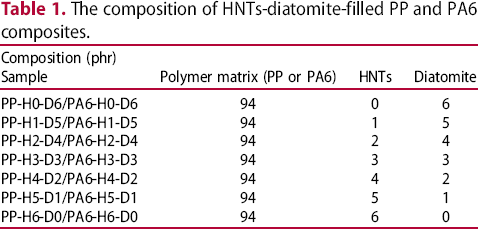
The composition of HNTs-diatomite-filled PP and PA6 composites.
Morphological/structure characterisations
The energy-dispersive X-ray fluorescence (XRF) system (LAB CENTER XRF-1800) was used to determine the presence and ratio of Si and metal in the structure of diatomite and HNTs. The X-ray diffraction (XRD) data were recorded for a 2θ angle between 5° and 70° using a D8 advance XRD instrument (Bruker AXS, Germany) and the X-ray beam was nickel-filter Cu Ka (k = 0.1542 nm) radiation operated. The SEM images were recorded under an acceleration voltage and high vacuum by S-4800 field emission scanning electron microscopy (Rili, Japan). Before observing, the sample surface was coated with a thin layer of gold.
Mechanical characterisations
The tensile and flexural properties of the splines were measured on a computer-controlled electronic universal testing machine (WDW-5, Shanghai Hualong Test Instrument Factory) according to the standard of ASTM D790 & ISO 178. The tensile spline was 33 × 4.2 × 2 mm3 and the tensile rate was 10 mm min−1. The bending spline was made to the shape of 58 × 10.4 × 1.16 mm3 with a span of 50 mm, and the bending rate was 2 mm min−1. Each specimen was tested for five times to acquire the mean value. The notched impact strength test was performed on a MZ-2056 izod impact tester (Jiangsu Pearl Testing Machinery Co. Ltd) with impact energy of 2.75 J and impact speed of 3.5 m s−1. A one-way analysis of variance (ANOVA) was performed to compare the mean values among different groups. Statistical significance was tested at p < 0.05. The Rockwell hardness testing was carried out on XHRD-150 Rockwell hardness tester. The relative modulus (ER) was defined by the value of Young's modulus of the filled polymer vs. that of pure polymer. The relative elongation at break (db) was defined by the value of the filled polymer vs. that of pure polymer.
Result and discussions
As shown in Figure 1, it reveals from the XRD patterns that for as-received HNTs and diatomite, all the observed peaks are in agreement with the characteristic peaks of standard halloysite and diatomite (Figure 1A) (Wang et al. 2011). As to HNTs, the peaks at 2θ = 12° and 20° are the characteristic diffraction peaks. The strong peak at 2θ = 25° is assigned to the characteristic diffraction peaks of quartz. The sharp peak at 2θ = 30° is assumed to the characteristic diffraction peak of alunite. Those weak peaks over 60° are ascribed to the impurities derived from metal oxides (Cheng and Li 2016; Liu et al. 2017). Additionally, as-received PP and PA6 have the crystalline structure in agreement with the standard. With varying the proportion of HNTs and diatomite, the XRD patterns of the polymer composites show the consistency affected by the composite filler. In terms of the pure fillers filled composites, the sole HNTs filled PP composite shows more definite feature peaks of HNTs than diatomite due to owing the crystalline structure for HNTs. With Adjustment of the proportion of HNTs in the mixture fillers, the composites show still more feature peaks of HNTs. A different change at 2θ = ca.12° characteristic of HNTs can be observed in the XRD patterns of the PA6-HD composites, whereas the PP-HD composites are obscure at this site. These results reveal that the molecular structure of polymer keeps intact and is not affected by the filling. The filling in polymer should belong to the physical mixture.
XRD patterns of HNTs and diatomite (A), series of HNTs-diatomite-filled PP nanocomposites (B) and series of HNTs-diatomite-filled PA6 nanocomposites.
Figure 2 displays the morphology of the as-received HNTs and diatomite as well as the cross-section of the polymer composites. The as-received HNTs have the typical hollow tubular structure, being of 1–3 μm in length and 50–70 nm in diameter. No other shaped impurity is found in total scope. Similarly, the as-received diatomite presents the disc-shaped character like sunflower, showing more uniform macrospores of ca.50 nm in the disc centre. The surface of diatomite scatters some debris originated from the mineral. In contrast to HNTs and diatomite, the fracture surfaces of the polymer composites can hardly observe the feature of fillers, indicating that the mixture filler has a good dispersity in polymer matrix, which can undertake to present each individual performance. To our knowledge, nanoparticles are apt to aggregating one other because of their high surface energy. For instance, CNTs have a strong intrinsic van der Waals attraction between nanotubes, making dispersion in polymers difficult (Xie et al. 2005). In contrary, since few hydroxyl groups and siloxane are located on the HNTs surfaces and the tube-like morphologies with a proper aspect ratio generate few opportunities for large-area contact between tubes, HNTs have relatively few tube–tube interactions. Therefore, a uniformly dispersed morphology is usually obtained in HNTs–polymer composites (Yuan et al. 2015).
SEM images of HNTs (a), diatomite (b) and fracture surfaces of PP-H3-D3 (c) and PA6-H3-D3 (d).
Figure 3 gives the tensile strength, relative modulus and elongation at break of the PP–HD composites. Definitely, the nanotubular structure HNTs in promoting the tensile strength and Young's modulus of PP are preferable to diatomite. Interestingly, the optimally reinforcing performance appears at the HNTs/diatomite mixture proportion of 3:3, suggesting that the mixture fillers consisting of the nanotubes-shaped HNTs and disc-shaped diatomite could exert a synergistic effect on reinforcing polymer. This synergistic effect is originated from the result of the tuning proportion with differently shaped fillers in polymer, thus achieving the optimal reinforcing performance in composite. More importantly, compared to neat PP, the mechanical performance of PP-H3-D3 composite has a remarkable augment,16.03% in the tensile strength and 38% in Young's modulus. Unfortunately, the relative elongation at breaks of all composites descend obviously compared to neat PP. At optimal proportion of PP-H3-D3 composite, the elongation at break attains approximately 70% of neat PP. As illustrated in Figure 4, the PP/HNTs composite present much larger flexural strength than the sole diatomite filler, whereas the PP/diatomite composites filler in notched impact strength (B) and Rockwell hardness is larger than HNTs filler. Surprisingly, the PP-HD composites at the HNTs/diatomite mixture proportion of 3:3 in flexural strength, notched impact strength and Rockwell hardness attain an optimal value, increasing by 45.99%, 42.71%, and 12.25%, respectively. Moreover, the appearance of the optimal performance of PP through adjusting the proportion suggests that it is probable to exist the synergistic reinforcing effect in PP matrix. To the best of our knowledge, the shape of fillers to polymer has a significant influence on the strengthening performance index due to affecting the polymer structure. Based on above results, we find that the HNTs/diatomite mixture incorporated with differently shaped fillers can obviously improve the overall mechanical performance of PP. This phenomenon is seldom found and reported among the nanofillers. There are effective interactions between the nanotube filler walls and PP chains as a result of the existence of hydrogen bonding (Liu et al. 2008a, 2008b, 2009). Owing to HNTs nanofibres held together in bundles by van der Waals force, it is necessary to highly disperse nanotubes well with aid of diatomite in polymer matrix to acquire satisfactory mechanical performance of the composites.
The tensile strength (A), relative Young's modulus and elongation at break (B) of the PP-HD composites (0: PP, 1:PP-H0-D6, 2:PP-H1-D5, 3:PP-H2-D4, 4:PP-H3-D3, 5:PP-H4-D2, 6:PP-H5-D1,7:PP-H6-D0). The flexural strength (A), notched impact strength (B) and Rockwell hardness (C) of the PP-HD composites (0: PP, 1:PP-H0-D6, 2:PP-H1-D5, 3:PP-H2-D4, 4:PP-H3-D3, 5:PP-H4-D2, 6:PP-H5-D1,7:PP-H6-D0).

Motivated by this result, we attempted to study the enhancing behaviour of the HNTs/diatomite mixture filler through changing polymer matrix (PA6). Figure 5 represents the tensile strength and relative Young's modulus of the PA6-HD composites. In the tensile strength and relative Young's modulus, the performance of HNTs in PA6 also is slightly preferable to diatomite. However, the tensile strength and relative Young's modulus of the PA6/HD composites at the HNTs/diatomite mixture proportion of 5:1 augment about 46.43% and 23.11% as compared to neat PA6. Unfortunately, the relative elongation at breaks of all composites similarly descend obviously compared to neat PA6. At an optimal proportion of PA6-H5-D1 composite, the elongation at break attains approximately 45% of neat PA6. Followed by the testing in the flexural strength, notched impact strength, and Rockwell hardness (Figure 6), it can be definitely found that the HNTs/diatomite mixture filler in these indexes of the PA6-HD composites still manifest an obviously reinforcing effect, increasing by 43.62%, 45.42%, and 14.5% at the above same proportion, respectively. In addition, we can suppose from the varying trend of the testing performance that there similarly exists the synergistic reinforcing effect between the nanotubular HNTs and disc-shaped diatomite in PA6 matrix. These results were ascribed to the good dispersion of the HNTs/diatomite mixture filler in PA6 matrix and the strong interfacial interactions (hydrogen bonding) between the acylamino groups of PA6 and the hydroxyl or the siloxane groups of the HNTs/diatomite mixture filler (Liu et al. 2008a, 2008b, 2009).
The tensile strength (A), relative Young's modulus and elongation at break (B) of the PA6-HD composites (0: PA6,1:PA6-H0-D6, 2:PA6-H1-D5, 3:PA6-H2-D4, 4:PA6-H3-D3, 5:PA6-H4-D2, 6:PA6-H5-D1, 7:PA6-H6-D0). The flexural strength (A), notched impact strength (B) and Rockwell hardness (C) of the PA6-HD composites (0: PA6,1:PA6-H0-D6, 2:PA6-H1-D5, 3:PA6-H2-D4, 4:PA6-H3-D3, 5:PA6-H4-D2, 6:PA6-H5-D1, 7:PA6-H6-D0).

Figure 7 depicts the thermal stability of PP, PA6, PP-H3-D3, and PA6-H5-D1 composites. Compared to neat PP and PA6, the decomposition temperatures of PP-H3-D3 and PA6-H5-D1 composites are higher than PP and PA6. This result accords with the anticipation, which appears in most filler-filled polymers.
DSC curve of 0:PP, 1:PA6,3: PP-H3-D3 composite and 4:PA6-H5-D1 composite.
Overall, the improved mechanical properties are always attributed to the fact that the external load is efficiently transferred from the polymer matrix to the HNTs/diatomite mixture filler. The impact strength of the polymer composites increased significantly with the loading of HNTs. The mechanical properties, especially the modulus and hardness of the polymer composites, significantly increased after the loading of HNTs. Moreover, the toughening of the polymer composites was achieved at a much lower filler concentration compared to rubber or other nanoparticles. The high increase in the impact strength was attributed to the dissipation of the impact energy via the nanotube bridging/pulling-out/breaking and via the formation of damage zones with a large number of micro-cracks in front of the main crack (Liu et al. 2008a, 2008b, 2009).
Conclusions
We intensively studied the synergistic reinforcing effect of the HNTs/diatomite mixture filler with different shapes in polymer matrix. The results showed that the mechanical performance of PP-HD3 composite at the HNTs/diatomite mixture proportion of 3:3 had a remarkable augment of 16.03% in tensile strength, 38% in Young's modulus, 45.99% in flexural strength, 42.71% in notched impact strength and 12.25% in Rockwell hardness relative to neat PP; the tensile strength and relative Young‘s modulus, the flexural strength, notched impact strength, and Rockwell hardness of the PA6/HD composites at the HNTs/diatomite mixture proportion of 5:1 were increased by about 46.43%, 23.11% 43.62%, 45.42%, and 14.5% when compared to neat PA6. These results also suggested that the HNTs/diatomite mixture filler has a massively attractable prospect in the application of polymer.
Footnotes
Acknowledgement
The data of this paper originated from the Test Center of Yangzhou University.
Disclosure statement
No potential conflict of interest was reported by the authors.