







Abstract
The 2015 Eurocorr meeting was held in Graz, Austria from 6 to 10 September 2015. The focus of the meeting was Earth, Water, Fire, Air, Corrosion Happens Everywhere. The meeting attracted over 805 delegates from 52 countries with Austria, France, Germany and the UK providing around half of the delegates between them. Over 360 papers and 120 posters were presented during the 18 sessions and 5 workshops. Parts 1-4 of this report review the technical sessions over four issues with the opening and plenary lectures and sessions on corrosion and scale inhibition, metallic, inorganic, organic and self-healing coatings, automotive corrosion, and archaeological and historical artefacts being covered in this report (Fig. 1).
Eurocorr 2015 was held on 6-10 September in the ancient city of Graz, Austria. Graz is in the UNESCO list of world heritage sites because of its Historic Centre and Schloss Eggenberg. The conference venue was the Stadthalle Graz – a modern, superbly equipped building with a pleasant airy atmosphere, a range of meeting room sizes and plenty of room for networking. The catering throughout the conference was of a very high quality. On the first evening the organisers arranged a special Eurocorr 2015 concert in the nineteenth century Stefaniensaal concert hall by the world-renowned Vienna Chamber Orchestra, under the baton of Stefan Vladar, who was also the solo pianist (Fig. 2).
Graz from the Schlossberg The conference venue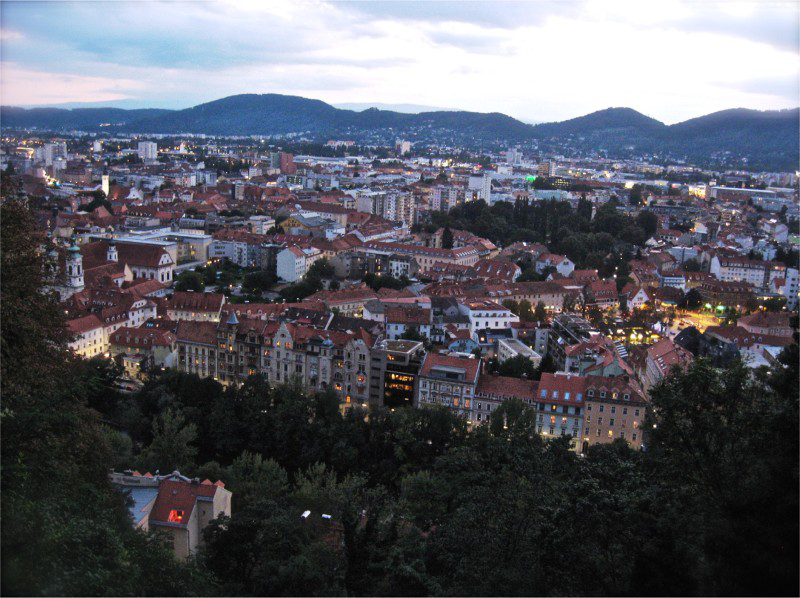
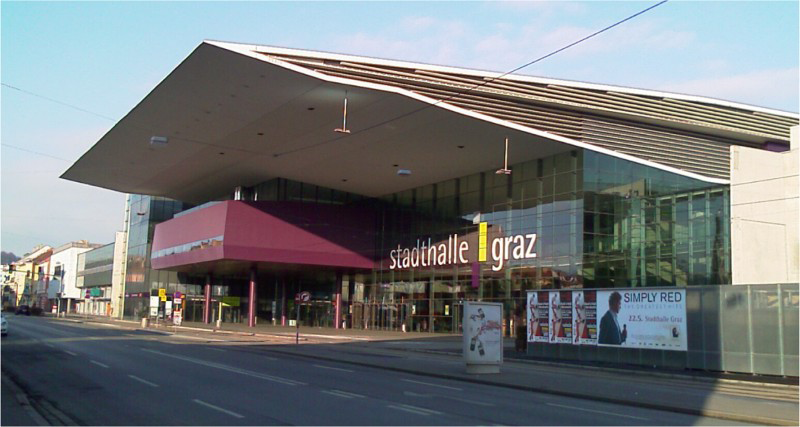
Tuesday evening featured the enjoyable poster party with the young author's poster prize going to Ingrid McCarroll and J. Cairney (University of Sydney, Sydney/AU) for their outstanding poster contribution on ‘Atom probe microscopy of oxidation products’. On the Wednesday evening, the Gala Dinner took place at Restaurant Schlossberg. This is reached by a funicular and has a spectacular location overlooking the town. This was attended by over 400 people, including one of the authors and was an enjoyable event (Fig. 3).
The poster party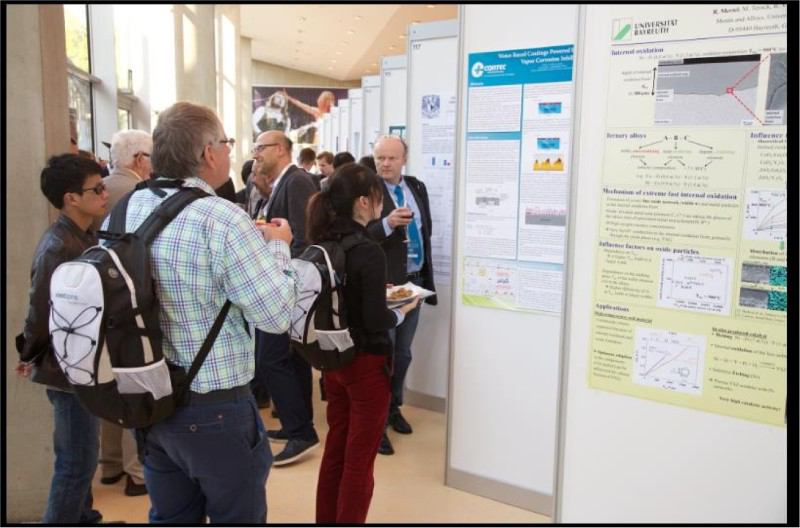
The conference programme followed the well-established format of starting each day with a Plenary lecture followed by parallel sessions organised by the appropriate EFC working party, of which there are currently 22 covering the whole gamut of corrosion interests. The two biggest sessions were coatings, and mechanisms, methods and modelling, with over 50 papers each. Other sizeable symposia (with 20 or more papers) were automotive, corrosion and scale inhibition, nuclear corrosion, corrosion in oil and gas, and microbial corrosion, which each ran over 2 days. Archaeological and heritage artefacts, corrosion of steel in concrete, corrosion by hot gases and marine corrosion all ran for about a day. The fraction of papers on the memory stick provided by the conference organisers was variable between sessions, averaging about 40%. There were several combined sessions or workshops of which the joint sessions on hydrogen in oil, marine and environmental sensitive fracture, cathodic protection in marine environments and the workshop on corrosion reliability of electronic devices were the largest.
Opening session and plenary lectures
Each plenary lecture was given by a recognised world expert in their respective fields, starting with Professor Phillipe Marcus (CNRS, France), the recipient of the 2015 EFC Medal. His talk entitled ‘Passivity of metals and alloys and initiation of localised corrosion’ described the remarkable atomistic level resolution that can be achieved with modern surface analysis techniques (e.g. STM, STS, XPS, ToF-SIMS). These methods had been used to study the crystalline nature of the passive film on stainless steel and the results combined with electrochemical measurements, and complemented by atomistic modelling using density functional theory (DFT), enabled a fuller understanding to be achieved.
The Kurt Schwabe Prize, consisting of a certificate and a sum of 500 Euros, presented every 3 years to an outstanding young corrosion scientist below 35 years of age, was awarded to Dr Marta Mohedano Sánchez for her extensive contribution in the field of corrosion and protection of light alloys. Antoine Pourbaix (Cebelcor), son of the renowned Marcel Pourbaix of Pourbaix diagram fame, was awarded an Honorary Fellowship of EFC. The plenary lecture on Tuesday was given by Srdjan Nesic (Ohio University) on ‘Recent advances in modelling of corrosion of mild steel in CO2 and H2S aqueous environments’. He discussed the development of an integrated electrochemical model for CO2/H2S uniform corrosion, including the effect of H2S on the protective corrosion product formation on mild steel. The key processes were chemical reactions in the bulk solution, electrochemical reactions at the steel surface, mass transport between the bulk solution and the steel surface, and formation and growth of corrosion product (iron carbonate and iron sulphide). This model can accurately predict the rate of corrosion (Fig. 4).
Philippe Marcus receiving his award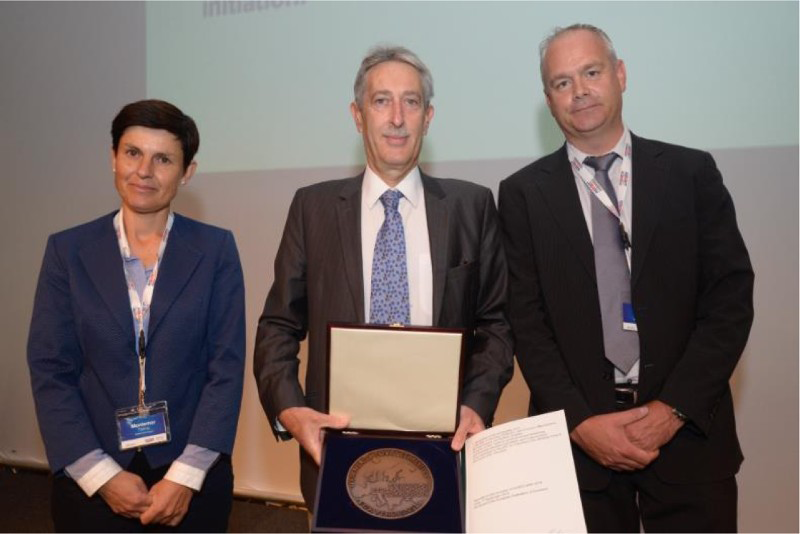
On the Wednesday, Michael Schütze, DECHEMA-Forschungsinstitut, Frankfurt am Main, Germany delivered ‘Corrosion as a key factor for materials performance and life-time in advanced high temperature technologies’. High temperature corrosion is a key issue in many developing applications where materials are being pushed to higher and higher temperatures of operation in the interest of becoming more efficient and environmentally sound. Industry demands materials and coatings solutions on the one hand and design and life-time models on the other hand and both areas are currently seeing a dynamic research and development environment. Some of the more recent results from this work were presented together with a perspective for future research needs.
On the Thursday ‘Understanding mechanisms and kinetics of environmentally assisted cracking’ was given by Stan Lynch from Defence Science & Technology, Melbourne, Australia. This paper reviewed the evidence for an adsorption-induced dislocation-emission (AIDE)/void-coalescence mechanism of liquid-metal embrittlement, hydrogen embrittlement, stress-corrosion cracking and corrosion fatigue. An adsorption-based mechanism is consistent with surface-science, atomistic modelling and thermodynamic considerations. He showed how metallographic and fractographic observations indicate that environmentally assisted cleavage-like and inter-granular cracking generally involves localised plasticity and void formation (often on a nanoscale) ahead of the crack.
Corrosion and scale inhibition
The session on corrosion and scale inhibition ran for the full day on the Monday and was concluded on the Tuesday morning. The session was chaired by Guenter Schmitt (IFINIKOR Ltd, Iserlohn, Germany) and Wolfgang Hater (Kurita Europe APW GmbH, Düsseldorf, Germany). There were 12 oral presentations, 6 of which have been selected for comment here. There were five posters, two of which are commented upon below (Fig. 5).
Marta Mohedano receiving her award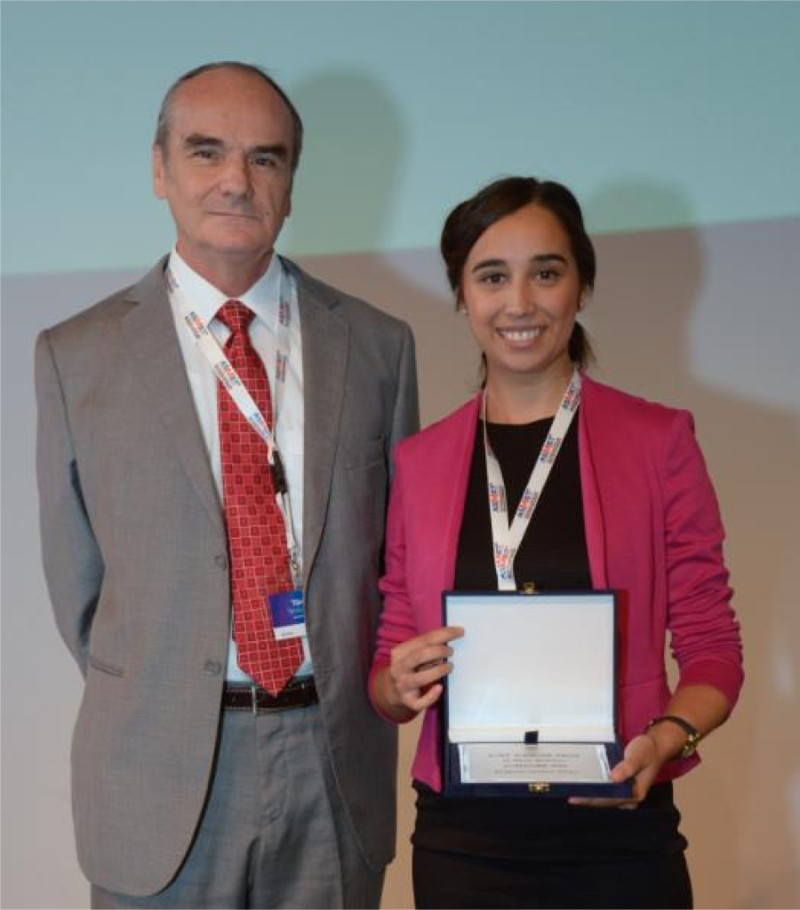
In his presentation ‘Control of microbial corrosion in sewers using a green biocidal agent’, Guangming Jiang (University of Queensland, St Lucia, Australia) described a cheap, environmentally friendly strategy for reducing H2S oxidation by treating the corrosion biofilm with a spray of nitrite solution. Pre-corroded concrete coupons were prepared and tested under well-controlled environmental conditions in a laboratory corrosion chamber. H2S uptake of the coupons, compared to that of control coupons, was reduced by 84-92% 15 days after treatment and showed no detectable increase after 22 months, indicating long-term effectiveness of the treatment.
The paper ‘Characterisation of encapsulated corrosion inhibitors for environmentally friendly smart coatings’ was presented by Benjamin P. Pearman (NASA, Merritt Island, FL, USA). The inhibition efficacy of three organic corrosion inhibitors, incorporated directly into the coatings or encapsulated in microparticles, was evaluated on carbon steel. In the case of 2-mercaptobenzothiazole (2-MBT), polarisation curves and mass loss measurements showed that inhibition effectiveness was greater when it was delivered from microparticles. Phenylphosphonic acid (PPA) did not reduce the corrosion rate in the mass loss testing and showed no significant inhibitive effects in polarisation curves. 8-Hydroxyquinoline (8-HQ) showed significant corrosion inhibition in the electrochemical testing but proved ineffective in longer-term mass loss experiments.
‘The influence of alkalising amines (AAs) on the film formation of oleyldiamine (FFA)’ was presented by Wolfgang Hater (Kurita Europe APW GmbH, Düsseldorf, Germany). Film formation by oleyldiamine-based inhibitors on carbon steel, in the presence and absence of AAs, was investigated using electrochemical impedance spectroscopy (EIS). All spectra for FFA-containing solutions showed two semi-circles characteristic of film formation, whereas the blank specimen showed a single asymmetric semi-circle. The polarisation resistance increased over time for FFA+AA solutions, decreased over time for the blank and remained almost constant for the FFA only solution. The results suggest that the toxic cyclohexylamine can be replaced by the non-CMR-labelled diethylaminoethanol without a deterioration of film formation and thus of the corrosion inhibition.
Behzad Bavarian (California State University, Northridge, USA) presented ‘Implementation of vapour corrosion inhibitors to improve corrosion protection effectiveness of dry air system’. This study examined techniques suitable for corrosion protection of pipelines and equipment during extended periods of shut-down. Electrical resistance probe techniques were used to monitor the corrosion rate of carbon and galvanised steel samples in environments containing 200 ppm chloride solution in the presence of 10% VCl inhibitor or in dry air (RH ≤ 40%). The samples in dry air suffered corrosion and red rust formation after 21 days. A corrosion rate of less than 0.08 mpy was obtained with inhibitor, while the dry air samples showed a corrosion rate of 1.6 mpy. Electrochemical polarisation showed that addition of VCI expands the passive film stable region (Fig. 6).
Audience at the opening ceremony
‘Performance evaluation of polypropylene glycol (PPG) as corrosion inhibitor for X60 pipeline steel in 15% HCl solution’ was presented by Saviour A. Umoren (King Fahd University of Petroleum and Minerals, Dhahran, Saudi Arabia). Electrochemical techniques were used along with weight loss and water contact angle measurements and SEM to show that PPG acts as a good corrosion inhibitor for X60 steel in the strong acid environment. The inhibition effect was concentration and temperature dependent and could be approximated by Langmuir adsorption isotherm model, suggesting a combination of physisorption and chemisorption. PPG behaved as a mixed inhibitor affecting both cathodic hydrogen evolution and anodic X60 steel dissolution reactions.
A study on ‘Ammonium (2,4-dimethylphenyl)-dithiocarbamate (MP-DTC) as an environmentally friendly corrosion inhibitor for steel’ was presented by Nur Kicir (Çukurova University, Adana, Turkey). This inhibitor was tested on mild steel in highly acidic conditions using EIS and potentiodynamic measurements, solution assay analysis with SEM and atomic absorption spectroscopy. The MP-DTC exhibited excellent inhibition efficiency via interaction between the dithiocarbamate end group and the steel surface. Also, the molecule contains a methyl substituted benzene ring which offers a hydrophobic surface towards corrosive solution. The adsorption was so strong that the cathodic reaction was also altered and retarded during the cathodic polarisation.
In the poster session, ‘The synthesis and inhibition efficiency of 2-(2-aminoethylamino)-1-phenylethanol (AEP)’ was presented by Gökmen Sığırcıka (Çukurova University, Adana, Turkey). The compound was synthesised from styrene oxide and ethylene diamine as starting materials. The molecular design was expected to exhibit strong adsorption via the –NH2 group to form a hydrophobic surface due to the presence of an aromatic ring. The inhibitor was investigated using EIS and potentiodynamic measurements and SEM. Polarisation resistance values increased gradually with increasing AEP concentration, hence corrosion rate decreased due to adsorption of the inhibitor on the steel surface. Both anodic and cathodic reactions were affected.
‘Synthesis of TiO2 nanotubular films obtained through electrochemical anodisation in glycerol-H2O+NH4F at high voltage and their corrosion and mechanical performance’ was presented by C. Cuevas Arteaga (Universidad Autónoma del Estado de Morelos, Morelos, México). The nanotubular films were fabricated on both polished and unpolished titanium surface. Both films were annealed to produce a crystalline condition. The films were investigated using potentiodynamic polarisation, nano indentation, SEM and DRX. The best film geometry was obtained from the polished samples, having inner diameter of 130 nm and length of 2.5 μm. The best electrochemical stability and mechanical properties were obtained for the sample that was crystallised at 600°C (Fig. 7).
Marcel Pourbaix receiving his award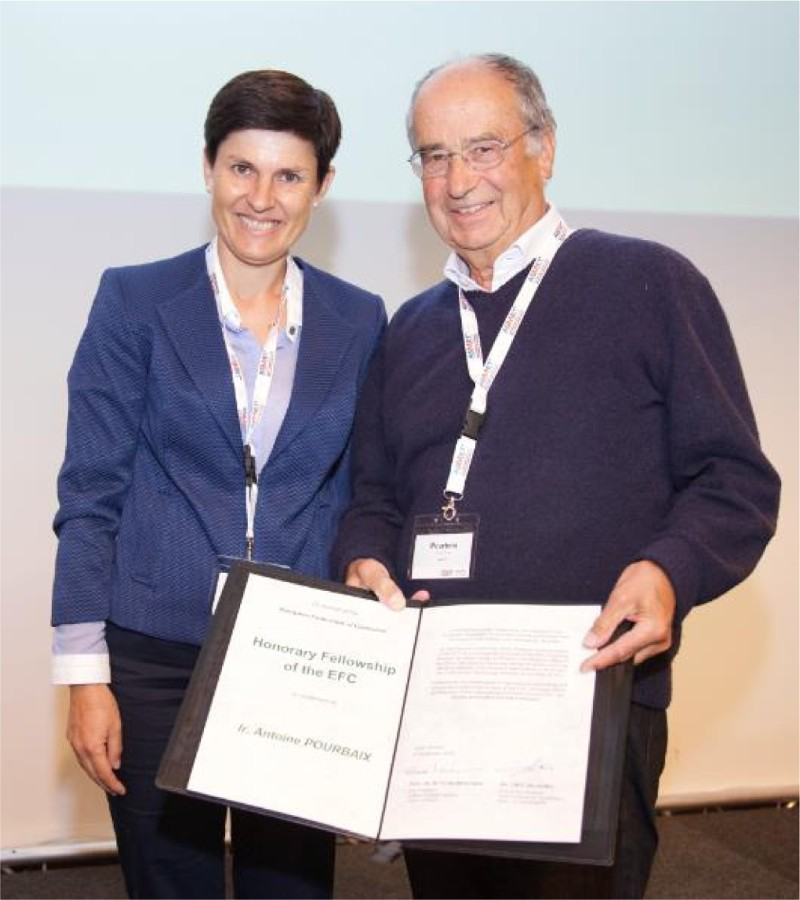
Coatings
Organic and self-healing coatings
The session on organic coatings was convened on the Monday and was chaired by W. Fürbeth (DECHEMA, Frankfurt am Main, Germany), J. Vogelsang (Sika Technology AG, Zürich, Switzerland) and P. Keil (BASF Coatings GmbH, Münster, Germany). There were six oral presentations, two of which have been selected for comment here. There were two posters, one of which is commented upon below. The self-healing coatings session was convened on the Wednesday, chaired by H. Terryn (Vrije Universiteit Brussel, Brussels, Belgium) and M. Zheludkevich (Helmholtz-Zentrum Geesthacht, Geesthacht, Germany).
‘Corrosion protection of steel structures in industrial and marine atmospheres by waterborne acrylics DTM (direct to metal) paint system’ was presented by Paulo Tiano, University of São Paulo, Brazil. This study focused on the corrosion protection properties of a waterborne acrylics DTM paint applied to steel structures in aggressive atmospheric conditions. The results of standard salt spray, humidity chamber and immersion tests showed that just one layer of the paint performed as recommended for C4, C5-M and C5-I equivalent atmospheric corrosivity categories (ISO 12944-2). EIS results indicated a decreased impedance after 24 hours, followed by a steady increase as the paint becomes more resistant. Hence, this paint forms a suitable substitute for a classical epoxy primer and a PU top coating with lower thickness and improved environmental friendliness.
‘Corrosion protection of smooth surfaces – coating adhesion’ was presented by Catalina H. Musinoi Hagen, Norwegian University of Science and Technology, Trondheim, Norway. In this work, samples representing four different machining processes – end milled, rolled milled, angle ground and turned – were tested for dry and wet adhesion, creep corrosion and impact toughness properties. The dry adhesion tests gave no discernible difference between machined and blasted surfaces, whereas wet adhesion testing indicated poor performance of machined surfaces due to permeation of water into the coating. The author suggested that coating degradation on machined surfaces is due to low surface roughness adversely affecting impact toughness as defects are easily created, low wet adhesion properties, easy spread of cathodic disbonding and surface activation by machining, so that cathodic and anodic local spots are more readily formed (Fig. 8).
Accordionist at the welcome reception
‘Dielectric and impedance spectroscopy investigations on highly structured corrosion protection coatings on mild steel’ was presented by C. Becker-Willinger, Leibniz Institute for New Materials (INM), Saarbruecken, Germany. Composite coatings derived from epoxy phenolic resin matrix with up to 40% by weight dispersed platelet shaped SiO2 fillers plus an orientation-additive were applied on mild steel. Neutral salt spray test and SVET indicated improved corrosion resistance with increasing platelet content, whereas the concentration of the orienting additive had almost no influence. EIS revealed barrier functionality for high platelet content in the presence of the orienting additive. Dielectric spectroscopy indicated incomplete matrix curing under confined space conditions when analysed on the low frequency end, in accordance with the observed Martens hardness for extreme platelet contents.
In the self-healing coatings session, the poster ‘Flake type zinc phosphate particles as new corrosion protection additives in organic coatings’ was presented by M. Wild, Leibniz Institute for New Materials (INM), Saarbruecken, Germany. Flake type zinc phosphate particles with nanometre thickness and aspect ratio greater than 10 were synthesised by kinetically controlled precipitation reaction starting from aqueous solutions of zinc acetate or nitrate in the presence of citric acid as complexing agent. Potentiostatic measurements on mild steel samples immersed in aqueous salt solutions containing 0.75 wt-% hopeite particles revealed a corrosion inhibition effect. Increasing the citric acid to zinc ratio led to increased charge transfer resistance and the flake type morphology of the particles led to improved barrier properties.
Metallic coatings
The metallic coatings session ran for the full day on Tuesday and was concluded on the Wednesday morning. Individual sessions were chaired by M.-G. Olivier (University of Mons, Belgium) and J. Fernandes (Universidade Tecnica de Lisboa, Portugal), F. Deflorian (University of Trento, Italy) and T. Prosek (Institut de la Corrosion, Brest, France), L. Fedrizzi (University of Udine, Italy) and S. Garcia (Delft University of Technology, Netherlands). There were seven full oral presentations supplied in electronic version, five of which have been selected for comment here.
‘Relationship between corrosion performance and microstructure of Zn–Al and Zn–Al–Mg model alloys’ was presented by Tomas Prosek, Institut de la Corrosion, Brest, France. Model alloys of identical chemical composition but distinct microstructures were cast and heat treated and characterised by SEM, EDX and XRD. Cyclic corrosion testing and testing under non-rinsing conditions, demonstrated that, for a given composition, microstructure modification can improve the corrosion performance of industrial zinc alloy coatings. Some model alloys showed better corrosion performance than commercial coatings with similar composition. The mechanism was discussed based on measurements of corrosion stability of individual phases, preferential corrosion, composition and stability of corrosion products, d.c. electrochemical characteristics and infrared absorption spectroscopy.
‘Corrosion studies of ruthenium films deposited by RF sputtering’ was presented by Fortunate Moyo, University of the Witwatersrand, Johannesburg, South Africa. This technique, proposed to be more cost effective than bulk alloying, was explored as a non-conventional approach to cathodic modification of 304L austenitic stainless steel. Despite film peeling, which was dependent upon deposition power and exposure time, corrosion resistance of the steel was improved by as much as 98%. Potentiodynamic polarisation indicated that films could effectively shift the corrosion potential in 1 M sulphuric acid into the passive region. This suggests the strength of these films lies in their ability to provide electrochemical protection by catalysing the cathodic evolution of hydrogen as opposed to providing a physical barrier. It is anticipated that pre-deposition removal of air-formed chromium oxide and post-deposition thermal treatment may improve the film adhesion properties.
‘Effects of the sealing process on the corrosion behaviour of thermally sprayed and sealed coatings for corrosion protection of large building parts’ was presented by Dr Monica Sallai, GSI mbH, SLV Duisburg branch, Germany. The author discussed a study of the influence of sealing process parameters on the corrosion behaviour of thermally sprayed coatings based on Zn, Al and their alloys in combination with one or more organic intermediary and cover coats. Coating characteristics such as thickness, porosity, roughness and adhesive strength were evaluated, as well as process parameters involved in thermal spraying, injection and sealing. Samples were also tested for corrosion resistance in artificial atmosphere and under electrochemical methods. Results suggested significant improvement in corrosion performance can be gained by control of the sealing process.
‘Plastic strain effect on the corrosion resistance of continuous hot-dip galvanized steel’ was presented by Mohamed Biskri, University of Bordeaux, France. The objective of this work was to study changes in corrosion resistance induced by plastic deformation at room temperature. Uniaxial tensile tests combined with local strain measurements by image correlation were achieved. Specimens were deformed in air at different plastic strain levels. After mechanical tests inter-granular cracking was observed by SEM. EIS measurements at OCP in 0.6 M NaCl were performed on unstrained and strained specimens during 15 days, to reveal the detrimental effect of plastic deformation on corrosion resistance for high deformation levels (Fig. 9).
Mons group with the posters
‘Thermally sprayed coatings as protection systems for screw connections in offshore wind plants’ was presented by A. Mertke, University of Applied Sciences South Westphalia, Iserlohn, Germany. The aim of this work was to develop an appropriate coating system for rotor blade screw connections of offshore wind energy devices by means of thermally sprayed ZnAl 15 coatings and an additional sealer, without formation of a thick organic cover layer. Bolt connections with the developed corrosion protection systems showed good mounting behaviour comparable with conventional zinc flake coatings. In salt spray chamber and outdoor weathering tests, the developed coating system revealed better corrosion protection properties than conventional zinc flake coating.
Inorganic coatings
The inorganic coatings session ran on the Thursday morning and was chaired by Fatima Montemor (Universidade Technica de Lisboa, Lisbon, Portugal) and John Sykes (University of Oxford, Oxford, UK). There were four oral presentations, two of which have been selected for comment here. There were five posters, one of which are commented upon below.
‘Hydrotalcite coatings to protect spent aluminum-clad nuclear fuels during long term wet storage’ was presented by Lalgudi V. Ramanathan (Instituto de Pesquisas Energéticas e Nucleares, Cidade Universitaria, São Paulo, Brazil). The author described the preparation and post-coating treatments of boehmite and hydrotalcite (HTC) coatings from different baths, the corrosion behaviour of the coated AA 6061 alloy and the results of field studies in which uncoated and coated specimens were exposed to the IEA-R1 reactor spent fuel basin for periods of up to 14 months. Laboratory tests revealed a marked increase in the corrosion resistance of HTC-coated specimens. The HT-HTC coating increased the pitting resistance of the alloy more than the LT-HTC coating. Pitting resistance of the HT-HTC and boehmite coating was increased by incorporation of cerium.
Luca Pezzato (Department of Industrial Engineering, University of Padua, Italy) presented ‘Corrosion resistance and surface characteristics of plasma electrolytic oxidation (PEO) coating produced on steels’. The PEO process was applied on a 39Ni/CrMo3 in a range of electrolytes containing various concentrations of silicates and aluminates. The corrosion performance of the coated specimens was evaluated in a solution containing both sulphates and chlorides. The best result was for the sample treated for 10 minutes at 0.4 A cm−2 in a solution containing 10 g l−1 NaOH, 10 g l−1 Na2SiO3 and 100 g l−1 NaAlO2. The coating was about 50 μm thick and showed the typical double-layer structure of a PEO coating, with an inner layer rich in chromium oxide and an external layer rich in aluminium and iron oxides.
In the poster session, ‘Characterisation and corrosion behaviour of PEO coatings on AM50 magnesium alloy with incorporated particles’ was presented by Raul Arrabal (Departamento de Ciencia de Materiales, Facultad de Ciencias Químicas, Universidad Complutense, Madrid, Spain). The composite ceramic coatings were formed using a phosphate-based electrolyte with α-Al2O3, monoclinic ZrO2 or CeO2 particles in suspension. The effects of particle concentration on the coatings composition, morphology and corrosion behaviour were investigated. The particles were successfully incorporated and preferentially located in the outer layer. Due to high temperatures at the micro-discharges, zirconia particles transformed from monoclinic to tetragonal structure. The porosity and thickness of the coatings decreased with increasing particle concentration in the electrolyte. Coatings formed in the electrolyte containing CeO2 particles revealed the highest corrosion resistance in 0.5% NaCl solution.
Automotive corrosion
The session on automotive corrosion commenced on the Tuesday afternoon, continued for the full day on the Wednesday and concluded on the Thursday morning. All parts were chaired by Fouzia Hannour (Qatar National Research Fund, Doha, Qatar). There were 10 oral presentations, six of which have been selected for comment here.
‘Corrosion protection for mass-produced, light-weight automotive bodies’ was presented by Niamh Hosking, Ford Motor Company, Dearborn, MI, USA. In this study, scribed and painted test panels of two different 6000-series aluminium alloys with two different pre-treatments were mounted to a vehicle and exposed to a cyclic corrosion test. Visual observation along with four different test methods revealed significant variation in corrosion activity for similar panels. Thus, variability in substrate condition, pre-treatment, paint processes and test preparation may preclude the possibility of consistent, repeatable results. Digital microscopy, although time-intensive, allowed detailed observation of corrosion at the scribe/paint interface and valid measurement of affected areas. Hence, studies relating microstructure, pitting susceptibility and passive behaviour to corrosion response are necessary to enable prediction of in-service performance. A common approach to filiform corrosion testing across the industry would be of great benefit.
Christoph Jahn, Automotive Engineering, Dresden University of Technology, presented ‘Metrological analysis of corrosion-climatic stresses in an entire vehicle long-term study’. A test vehicle at the chair of automotive engineering of the TU Dresden was monitored by 55 humidity, flow, temperature and dewing sensors situated in the highly burdened, often covered areas of the underbody and wheel housings. Further measurement points were situated in non-hidden areas, the engine compartment and the interior of the car. The extensive measurements allow a good understanding of general corrosion-climatic load situations in the entire vehicle, without acceleration factors in a customer-related usage cycle in real-time. The test is intended to run to the end of June 2016, providing a 3-year database. Subsequent disassembly and diagnosis of the test vehicles condition may be considered and full results may be used in simulations (Fig. 10).
Stan Lynch delivers the final plenary talk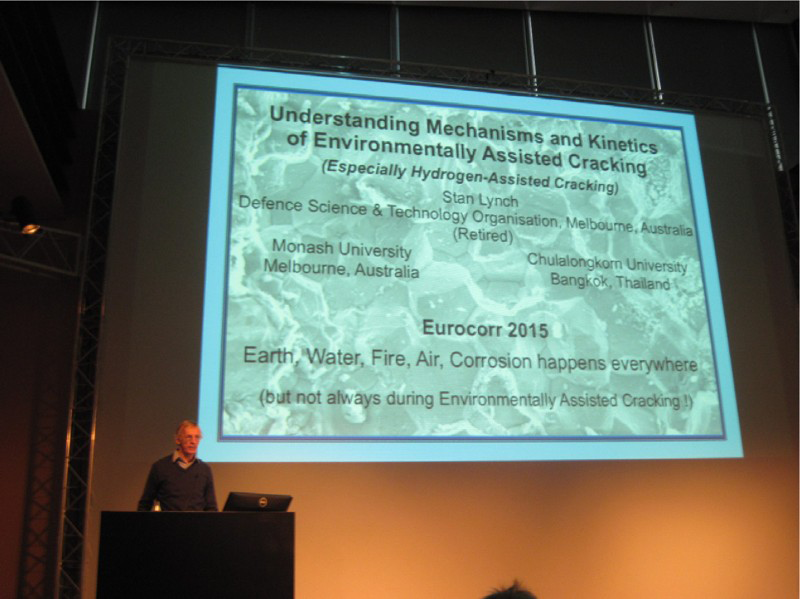
W. Huemer of the Institute of Materials Science and Welding, Graz University of Technology, Austria, spoke on ‘Improvement of the corrosion behaviour of AZ91 via friction stir processing (FSP)’. Hydrogen evolution during immersion in 3.5% NaCl at pH 12 was measured and compared to the OCP of this alloy. The negative difference effect was evaluated by galvanostatic measurement. The FSP quality and the corrosion appearance were analysed by stereomicroscope and optical microscope. Increasing the number of passes during FSP reduced the grain size and the intermetallic phases in the alloy, simultaneously enhancing the corrosion resistance compared to the parent alloy. Due to the simple experimental set-up, suboptimal specimen preparation and limited accuracy of the measurement methods, the level of statistical significance for the results is low.
‘Corrosion test improvement by climatic modelling’ was presented by Robert Mayrhofer of Daimler AG, Sindelfingen, Germany. The author pointed out that the results of the numerous standard automotive corrosion tests carried out world-wide might be combined for statistical analysis. The first step was to determine the most influential factors for corrosion test and field correlation. The corrosion loads of the tests were then separated according to several characteristics. The corrosion parameters were defined as factors, the test results as output variable, and a mathematical model was generated and validated. A best fit model was found and analysed to find sensible testing parameters affecting the corrosion results. The same procedure was then applied to climatic data such as humidity, duration of wetness, salt load, etc., from a variety of field sources. The field and corrosion testing data were compared and mapped to reveal a good correlation.
Konrad Tarka from the Chalmers University of Technology, Volvo Car Corporation, Gothenburg, Sweden compared the corrosion behaviour of zirconia-based thin film pre-treatments (TLPs) with conventional phosphating during short- and long-term cyclic exposure. The initial delamination mechanism was anodic undermining for all four investigated surface treatments, the Zn coating suffering anodic dissolution and the exposed steel scribe acting as the cathode. The zinc layer suffered grain boundary corrosion on the TLP materials. The face of the corroded zinc was wedge shaped. In the plateau areas of the HDG substrate zinc corroded preferentially at the Zn/steel interface. In the trough areas both the Zn/steel and Zn/pre-treatment interfaces were preferentially attacked. Secondary blistering occurred on all four materials.
‘Anticorrosive performance of new thin layer pre-treatments (TLPs) with standard and new materials in automotive coatings’ was presented by Dr Ulrich Christ, Fraunhofer IPA, Department Coating Systems and Painting Technology, Stuttgart, Germany. The mutual influences on corrosion protection of the new TLPs on various automotive substrate materials in combination with electro dipping coatings were investigated and compared to conventional zinc phosphate pre-treatment. The test results show that the investigated systems build-up a closed layer on all substrates. This correlates to a high electrochemical homogeneity measured by scanning Kelvin probe. The cyclic corrosion test results show similar performance of all pre-treatments, but the TLPs show lower protection than zinc phosphating against under-creepage. In cyclic hydro-thermo loading the barrier properties remain high for the test duration and water uptake is highly reversible.
Archaeological and historical artefacts
The session archaeological and historical artefacts on the Wednesday afternoon, chaired by D. Neff (CEA Saclay, Gif-sur-Yvette, France), and Thursday morning, chaired by D. Watkinson (Cardiff University, Cardiff, UK). There were five full oral presentations, four of which have been selected for comment here, along with one abstract. There were four posters, two of which are commented upon below.
‘Patinated bronze protection by long chain organic acids’ was presented by H. Otmacic Curkovic, Faculty of Chemical Engineering and Technology, University of Zagreb, Croatia. In this work, artificial patina was prepared by various chemical and electrochemical procedures. Samples were then treated with long chain carboxylic or phosphonic acids to form a protective organic layer on top of the patina. EIS in artificial rain demonstrated that long chain organic acids significantly reduce dissolution of artificially patinated bronze objects. Protection of sulphate patina was obtained by immersion of the bronze in ethanol solution of stearic acid while protection of chloride patina was possible by either immersion or brush application of stearic acid. Octadecyl phosphonic acid also protected patinated bronze, but only when applied by dip-coating.
‘Quantitative testing of corrosion rates of heritage steel coated with Paraloid B72™, Cosmolloid 80H™ and Siliglide 10™’ was presented by N. Emmerson, Cardiff University, Cardiff, UK. The performance of the coatings on modern steel continuously exposed to fixed high humidity was studied. Test samples were cut from the rear door of a Saracen armoured personnel vehicle circa 1950s. Surface preparation and coating procedure were carefully controlled and assessed to offer both standardisation and alignment with commonly used procedures. Uncontaminated and chloride contaminated surfaces were tested during exposure periods of months to years. Quantitative data were collected by measuring the oxygen consumption of individual samples in controlled relative humidity. Results indicate that all three coatings perform similarly on cleaned surfaces. On surfaces that have undergone chloride contamination post-cleaning the silane was best at preventing corrosion, followed by Paraloid B72 then Cosmolloid 80H.
‘Degradation phenomena of bronze artefacts in coastal archaeological environments of the Mediterranean basin’ was presented by E. Angelini, Dipartimento di Scienza Applicata e Tecnologia, Politecnico di Torino, Italy. The behaviour of an ancient brass object recovered from Tharros was compared with patinas produced by exposure of a reference brass alloy to soils and electrolytes of relevant chemical composition. Due to low conductivity and chloride ion concentration, and presence of dissolved species such as carbonates, sulphates and phosphates, Tharros soil has a stabilising effect on buried brass artefacts. By contrast, the Piraeus was the most aggressive chloride-containing soil examined, leading to rapid dissolution of brass before passivation, regardless of pH. The resistance of the ancient natural patinas was comparable with the much thinner 6-month artificial patina, following the same equivalent circuit model.
‘New coatings for the protection of ornamental cast ironwork exposed in uncontrolled environment’ was presented by Z. Abdel Hamid, Central Metallurgical Research and Development Institute, Cairo, Egypt. In this study, electrochemical techniques were used to evaluate the efficiency of four organic coatings and two corrosion inhibitors for protection of ornamental cast ironwork in uncontrolled environment after 1 year of exposure inside the clock tower of Muhammed Ali's mosque in Salah El-Din Citadel in Cairo. Grey cast iron coupons were prepared to simulate the composition and morphology of the historic cast iron staircase, and treated with the different protection systems. Permalac was the most interesting protection system tested, while a tannic acid/phosphoric acid mix with Paraloid B72 coating gave a satisfactory result.
The poster ‘Removable parylene based barrier multilayers for corrosion protection of metallic archaeological artefacts’ was presented by Lucie Blahova, University of Technology, Brno Czechoslovakia. A novel approach to corrosion protection and preservation of metallic archaeological artefacts was studied. A thin film (parylene C), with a soluble interlayer made of silicone-acrylic lacquer Laksil, was deposited on iron, bronze, copper and brass substrates in order to evaluate its barrier and protective properties. SEM indicates a smooth, defect-free surface. The treatment significantly decreased the oxygen transmission rate, while colorimetry indicated a transparent and colourless multilayer. Based on EDS analysis, removal of the coating was successful, hence the conservation process is reversible. Standard corrosion tests indicated greatly enhanced anticorrosion protection of metallic objects.
The poster ‘Corrosion study of metals of cultural and historical interest in sulphide, sulphate and chloride solutions, and their preservation’ was presented by F. J. Rodríguez-Gómez, Universidad Nacional Autonoma de Mexico, Mexico. An electrochemical study of sterling silver (0.925), standard bronze and brass was carried out by monitoring corrosion potential, linear polarisation resistance, polarisation curves, electrochemical impedance and electrochemical noise during immersion in various electrolytes. Brass 844 and standard brass suffer different types of attack in sulphide and chloride immersion, due to the tin and zinc content in each alloy. Mixed corrosion after 2 hours of immersion was detected and localised corrosion was indicated by the electrochemical noise results.
About the authors
We would like to finish off by thanking Dr Douglas Mills for his dedication and hard work in reporting on the proceedings of Eurocorr for the past 20 years. Douglas began attending and reporting on Eurocorr in 1996 and has covered every year since then. There was one year when EuroCorr did not take place (2002) because an International Corrosion Congress took place in Europe (Granada), which Douglas Mills also reported on. Now, after approximately 200 000 words, Douglas is finally stepping down and handing over to newcomer Ruth Bingham (Fig. 11).
Your correspondent, Douglas Mills
David Nutall, another regular and long-term contributor, will be returning to us for future instalments of this Eurocorr 2015 report.
