







Abstract
The hydrogen embrittlement behaviour of 3Cr has been investigated under mixed H2 with CO2 at different strain rates, hydrogen partial pressures, and in the presence/absence of steam. The slow strain rate test results show that the HE susceptibility of 3Cr increased with increasing hydrogen partial pressure, and the plasticity of 3Cr obviously decreased in the presence of steam. The effect of strain rate was negligible in H2/CO2 environment but showed a significant difference in H2/CO2/steam environment. The fracture was a ductile fracture mode in N2 environment and a brittle fracture mode in H2/CO2/steam environment. The reason for the severe plasticity loss of 3Cr in H2/CO2/steam environment was probably that the steam has a preferential adsorption onto the 3Cr surface compared with H2 and CO2. Consequences in CO2 combined with H2O to form H2CO3, which accelerated the anodic dissolution of 3Cr, and the physical adsorption of H2 on steel was enhanced.
Introduction
Hydrogen embrittlement (HE) is a serious problem concerning the security service of metal in H-containing environments, and it is mainly caused by high-temperature and high-pressure H2 [1,2], H2S solution [3], and other acidic solutions [4].
In recent years, synthetic natural gas (SNG), such as production of coal, containing mainly H2, CO, CO2, CH4, and N2 [5], has been of great importance for both energy safety and CO2 emission reduction [6,7]. Most researchers focused on the high production and good production technology of SNG industry [8–10], but the corrosion and fracture failure problems brought by SNG were always ignored. H2 could induce hydrogen damage, known as HE [11,12], and carbon oxides would cause pitting [13] and uniform corrosion of steel [14]. Moreover, CO2 has been found to promote hydrogen atom entry into steel, though with a considerably lower efficiency than H2S [15].
HE is always an active area of research, and considerable progress has been made in the recent time. Doshida and Takai [16] found that HE susceptibility increased with higher diffusion hydrogen content and varied with hydrogen state because hydrogen-induced lattice defects increased with increasing hydrogen content, and diffusible hydrogen, which was weakly trapped, took the most responsibility. Nanninga et al. [17] conducted a series of slow strain rate test (SSRT) at different gaseous H2 pressures and found that HE susceptibility of pipeline steel in H2 environment increased with higher H2 pressures and lower strain rates. Michler et al. [18] measured the hydrogen environment embrittlement of austenitic stainless steel in different temperament–pressure combinations, and results revealed that HE susceptibility was highest at −50°C/10 bar. Moreover, some researchers investigated the effect of pre-strain on the susceptibility to HE; for example, Sonak et al. [19] found that the effect of hydrogen was more apparent on plastic pre-strain samples resulting from the higher dislocation density in pre-strain samples. From the above, previous studies focused on the effects of hydrogen content, strain rate, H2 pressure, and so on, which are factors on HE in H2 environment; however, in many cases, hydrogen is only one of the components in the environment and even not the primary one, for example, in the SNG environment. Barthélémy [20] investigated the effect of He gas as an impurity component on the HE, but He does not exist in the working environment. However, the role of mixed gas containing H2 on the HE of steel in real SNG environment has not received enough attention. In a previous work, water was found to have an important role on the tensile properties of ×80 pipeline steel in SNG environment, relative tensile property loss increased with increasing PH2/PCO2 without water; and relative property loss decreased first and then increased with PH2/PCO2 with water [5]. Thus, the mechanical properties and corrosion behaviour of steel in SNG environment are complex, especially at high temperatures.
Therefore, the goal of this work is to investigate the influence of hydrogen partial pressure, strain rate, and steam on the HE of 3Cr tube steel, which is an important engineering material that combines excellent mechanical properties, reasonable corrosion resistance, and good weld ability in the mixed gas atmosphere of H2 and CO2. SSRTs were performed to determine the changes in the mechanical properties caused by H2. Scanning electron microscopy (SEM) and energy-dispersive X-ray spectroscopy (EDS) were conducted to observe the fracture surfaces and corrosion products.
Experimental
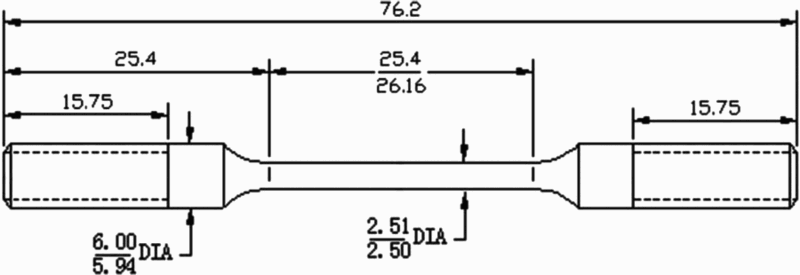
The material used in this study was commercial 3Cr steel, and its chemical composition (wt-%) is provided in Table 1. SSRT method was conducted at strain rates of 1 × 10⁻⁵ s−1 to 1 × 10⁻⁶ s−1. Figure 1 shows the photo of SSRT tensile testing machine, and Figure 2 shows the dimensions of the test specimens for slow strain rate tensile tests. Prior to each test, specimens were decreased with acetone, thoroughly rinsed with distilled water, and dried quickly using cold air to avoid oxidation. The autoclave was deoxidised by N2 for five times to avoid the contact with oxygen. Tests were performed in several different gas atmospheres, and the detailed experimental conditions are shown in Table 2. Conditions 1-3 were designed to determine the role of N2 on the SSRT tests of steel in H2 environment, and conditions 6-9 were designed to determine the role of steam on the HE sensitivity of steel. In addition, conditions 3-5 and 9-11 were performed to study the effect of strain rates on the tensile property of steel. All tests were conducted at 120°C, and 0.2 MPa was the saturated vapour pressure of H2O at that condition. The specimens were immediately removed from the autoclave after being fractured and cleaned as the measures mentioned above for the following tests. To determine the level of variability that can be expected when testing in hydrogen, repeat tests (at least thrice for each condition), and the elongation, plasticity loss, and reduction of area of specimens were average values based on the results of repeat experiments.
SSRT tensile testing machine. Dimensions of test specimens for slow strain rate tensile tests (mm). Chemical composition of commercial 3Cr steel specimens used in this work. Experimental condition details of the tests.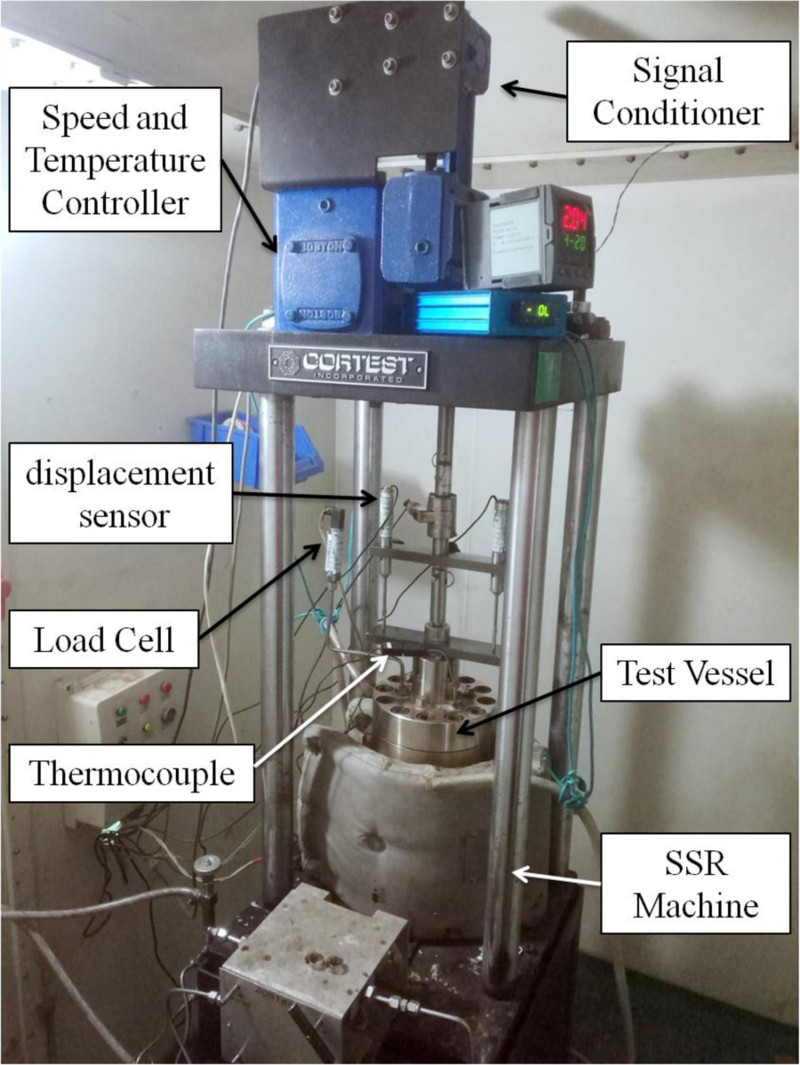


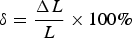
The elongation was determined and calculated according to Equation (1), in which ΔL is the total deformation of the gauge length after the specimen was fractured, and L is the original gauge length.
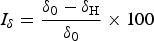
The plasticity loss of elongation was calculated according to Equation (2), in which δ 0 is the elongations of specimens in the N2 environment, and δ H is the elongation of specimens in diverse environment containing H2.
The sectional areas were also measured after the tests and reduction of areas were calculated to describe the HE damage. The reduction of area was determined and calculated according to Equation (3), in which A 0 is the original cross-sectional area of specimen, and A 1 is the cross-sectional area of the specimen after being fractured.
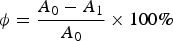
The morphology of the fracture surfaces were observed by SEM (FEI QUANTA 200F) under the following scanning parameters: 200-300 kV, 25-200× magnification, 1 nm resolution and high vacuum scanning mode. EDS analysis was performed using a QUANTA 200F SEM coupled with a Trident XM4-type spectrometer.
Results
Effect of N2 on the mechanical property evaluation test of steel in H2 environment
The gas pressure in industrial environmental condition is constantly high and contains several kinds of gas. As a kind of inert gas, N2 was always regarded harmless to the metal material. Thus, when doing the laboratory simulation experiment, whether N2 in the system should be added to reach the total pressure confused the concerned engineers and researchers.
Figure 3 shows the stress–strain curves of 3Cr steel at conditions 1-3 in Table 2. Figure 2 shows the elongations, plasticity loss, and reduction of area at conditions 1-3.
Stress–strain curves of 3Cr steel at conditions 1-3 in Table 2.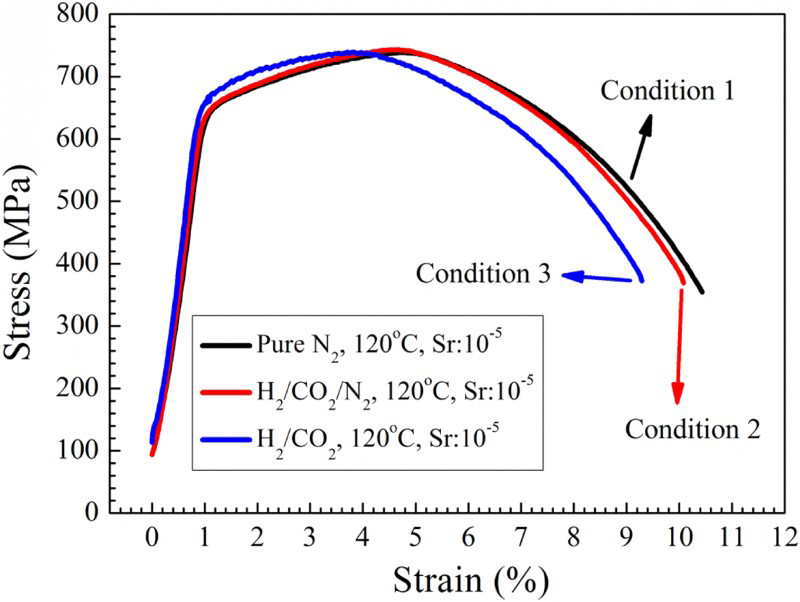
As a comparison, condition 1 was tested in pure N2 at 10 MPa pressure atmospheres, and its elongation and reduction of area were approximately 10.43 and 82.6%, respectively. Then, to determine the effect of H2/CO2 mixed dry gas on HE, specimens were tested in 1 MPa H2, 0.7 MPa CO2, and 8.3 MPa N2 (condition 2); the total pressure was still 10 MPa. Results indicated that H2/CO2/N2 mixed gas caused slight plasticity loss of 3.36%, and for the most part, yield strength and ultimate tensile strength values remained unchanged under such conditions. Many factors were considered to influence the high pressure N2, which diluted the hydrogen concentration in the autoclave. Therefore, several specimens were tested in condition 3, which was similar to condition 2, except for 8.3 MPa N2, to determine the role of N2. The result showed that plasticity loss increased apparently, elongation reduced from 10.43 to 9.29%, and the relative elongation loss was nearly 10%. H2 together with CO2 have more effect on plasticity loss than that in a similar environment containing N2, and the result fitted the elongation results (Figure 4).
Elongations (a), plasticity loss (b), and reduction of area (c) in conditions 1-3.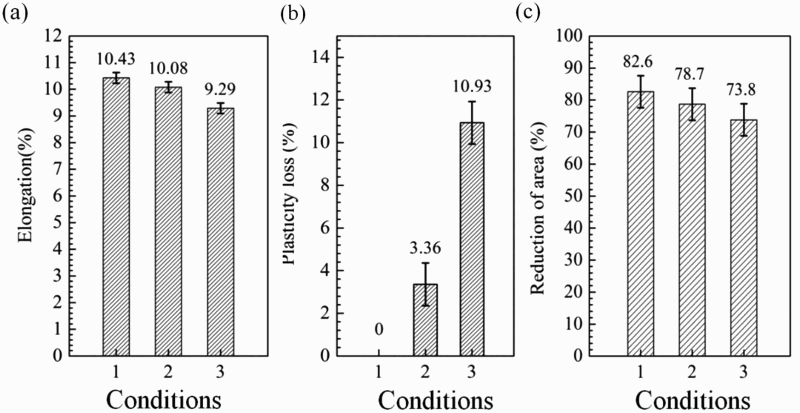
Figure 5 shows the SEM fractographs of the specimens tested in conditions 1-3. The specimen has a ductile fracture mode in N2 environment, and two distinct regions could be observed, which might correspond to the crack initiation and propagation in the central region and a final unstable fracture in the peripheral region, respectively (Figure 5(a–c)). As presented in conditions 2 (Figure 5(d–f)) and 3 (Figure 5(g–i)), both the interior fast fracture region and the outer unstable fracture region deteriorated slightly by hydrogen, exhibiting a ductile dimple fracture. This result indicated that Cr was damaged slightly in conditions 2 and 3 but suffered a certain extent of hydrogen damages in the conditions containing hydrogen. Although no extinct difference was observed in the central region, the outer regions tended to be more like a brittle fracture, expressly the specimens in H2/CO2 without N2.
Morphology of the fracture surfaces of 3Cr conditions 1-3, conditions 1 (a–c), conditions 2 (d–f), and conditions 3 (g–i). The magnified views of (b) centre and c outer parts in (a) are shown in (b) and (c), and the rest of the figures are similar to (a–c).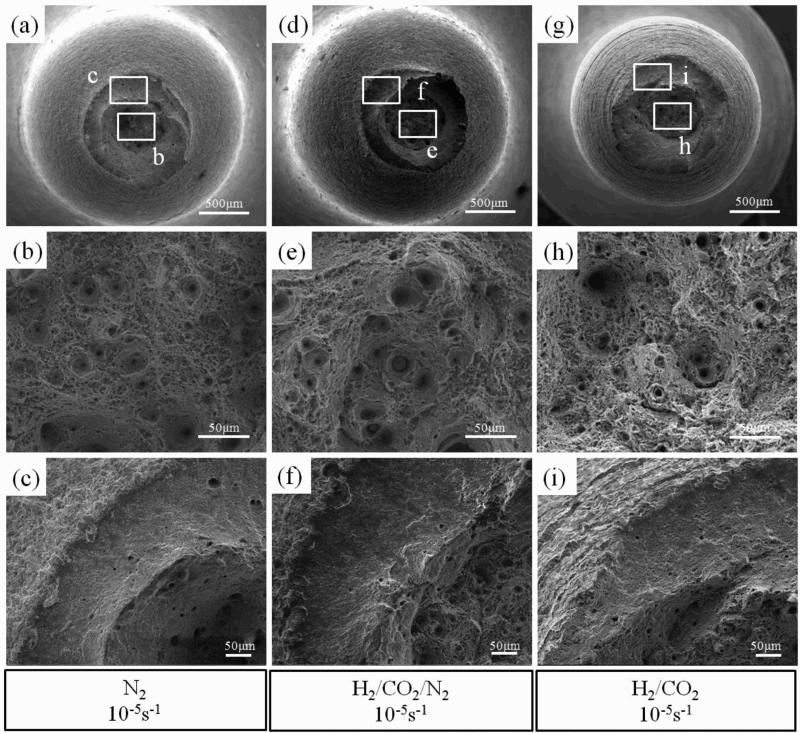
The experimental results show that N2 has a role in the HE sensitivity evaluation test of steel in H2 environment. The reasonable explanation is that high pressure N2 diluted the hydrogen concentration in the system, inducing the decrease of H2 adsorption on the surface.
Role of steam on the tensile property of steel
SNG environment unavoidably contains some steam due to the production process. The problem was a minor detail that could be easily neglected by most researchers. Based on the above-mentioned results and considering the steam, six sets of tests were further conducted.
Figure 6 show the stress–strain curves of 3Cr steel at conditions 1 and 6-9 in Table 2. Figure 7 shows the elongations, plasticity loss, and reduction of area in conditions 6-9.
Stress–strain curves of 3Cr steel at conditions 1 and 6-9 in Table 2. Elongations (a), plasticity loss (b), and reduction of area (c) in conditions 6-9.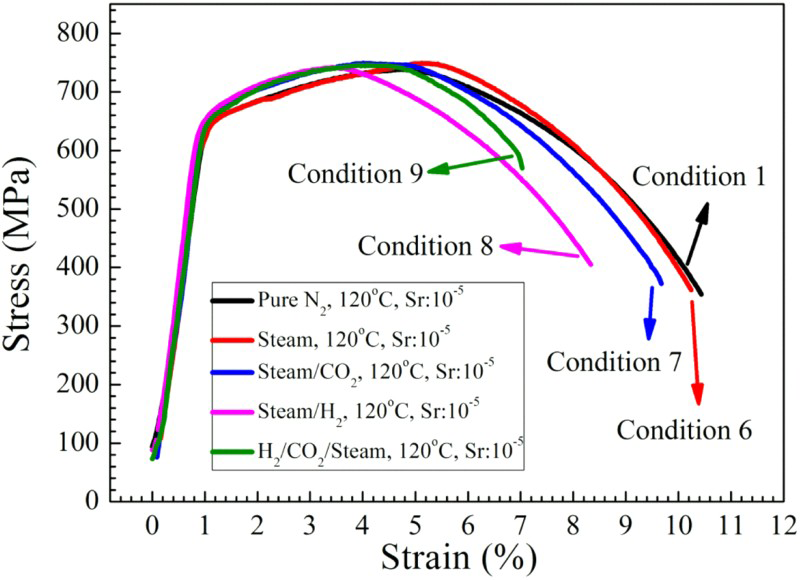
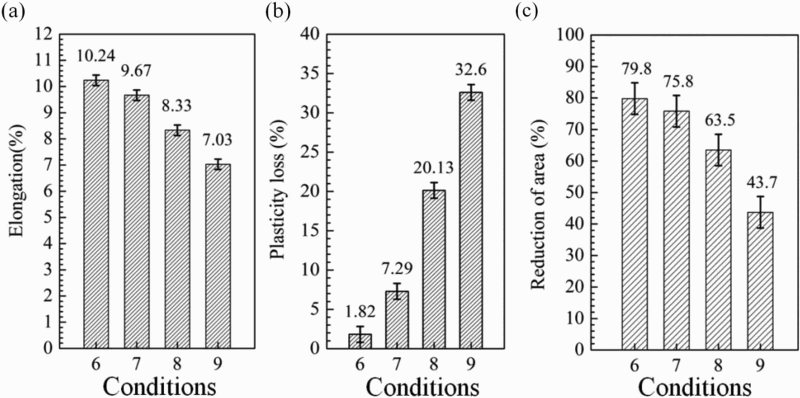
The stress–strain curves of 3Cr steel in the steam and the N2 environments are similar, which indicates that steam virtually has no influence on the mechanical damage of 3Cr. When CO2 was added into the steam environment, the elongation of steel reduced to 9.67%. H2, together with steam, caused considerably serious hydrogen damage with an elongation of 8.33%, which indicated that H2 in wet environment caused plasticity loss of 20%. Plasticity loss in the H2/CO2/steam environment reached 32.6%, which is critical, compared with 10.93% in the dry H2/CO2 environment. Compared with H2/CO2 environment, more damage was created by the addition of steam into the system. The reduction of area sharply decreased to 33.7%, which could be also observed in SEM.
Figure 8 shows the SEM fractographs of specimens tested in conditions 6-9. The specimen clearly has a ductile fracture mode in steam and CO2/steam environment (Figures 8(a–f)), indicating that steam cannot affect the fracture mode without H2. When steam was introduced into the H2 system, the fracture surface showed a tendency to cleavage, although in condition 8 (Figure 8(g–i)), it was also composed of a few dimples. However, a dramatic change occurred while both steam and CO2 were included in the H2 environment. As can be observed from Figures 8(j–l), the fracture surface was brittle, and the specimen lost much more plasticity. The shear lip was hard to see compared with that of other conditions, which indicated a relatively small reduction of area, and many secondary cracks could be observed on the side of fracture.
Morphology of the fracture surfaces of 3Cr conditions 6-9: conditions 6 (a–c), conditions 7 (d–f), conditions 8 (g–i), and conditions 9 (j–l). The magnified views of (b) centre and (c) outer parts in (a) are shown in (b) and (c), and the rest of the figures are similar to (a–c).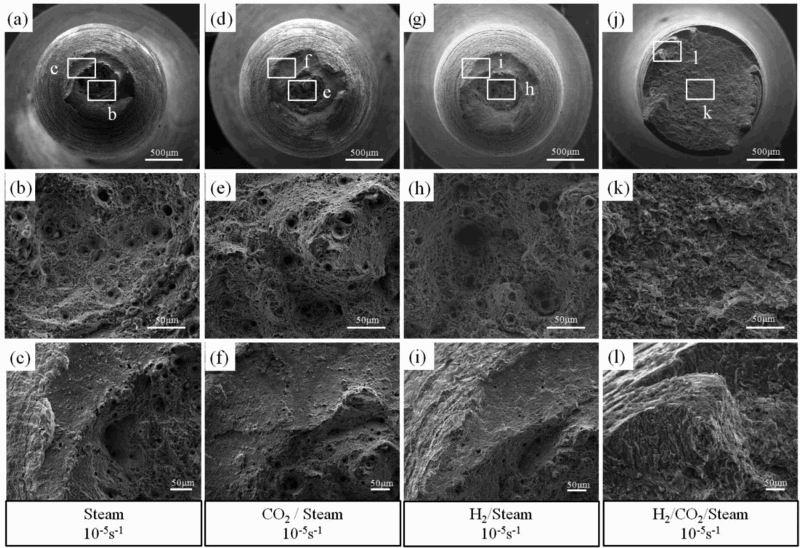
Effect of strain rates on the tensile property of steel in H2 environment
Figure 9 shows the stress–strain curves of 3Cr steel at conditions 3-5 in Table 2. Figure 10 shows the elongations, plasticity loss, and reduction of area at conditions 3-5.
Stress–strain curves of 3Cr steel at conditions 3-5 in Table 2. Elongations (a), plasticity loss (b), and reduction of area (c) in conditions 3-5.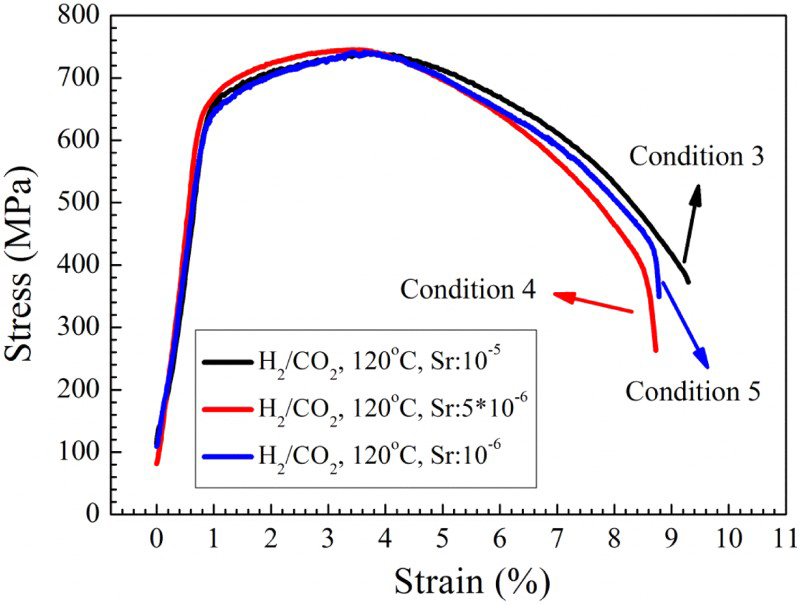
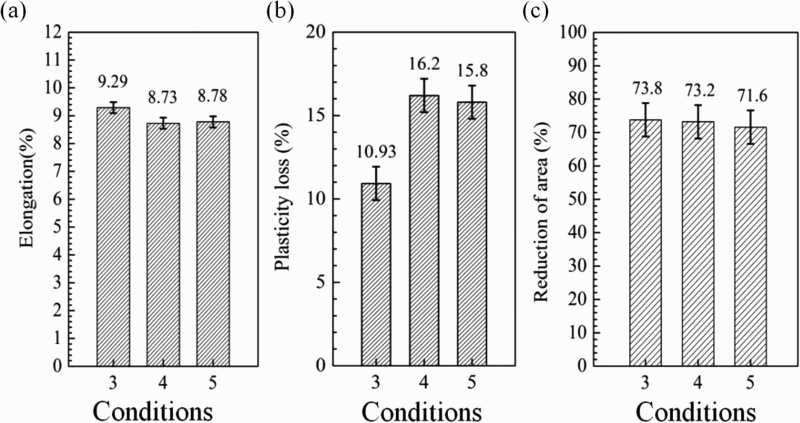
In the H2/CO2 mixed dry gas environment, as the strain rate decreased from 10−5 s−1 to 5*10−6 s−1 and 10−6 s−1, the elongation, respectively, decreased from 9.29 to 8.73% and 8.78%; the plasticity loss, respectively, increased from 10.93 to 16.2% and 15.8%; the reduction of the area was nearly similar. With the decreasing strain rate, the plasticity loss slightly increased. Considering that the fracture times of the specimens were 2, 7, and 24 h, the strain rate is not a serious problem in the dry H2/CO2 environment.
Figure 11 shows the stress–strain curves of 3Cr steel at conditions 9-11 in Table 2. Figure 12 shows the elongations, plasticity loss, and reduction of area at conditions 9-11.
Stress–strain curves of 3Cr steel at conditions 9-11 in Table 2. Elongations (a), plasticity loss (b), and reduction of area (c) in conditions 9-11.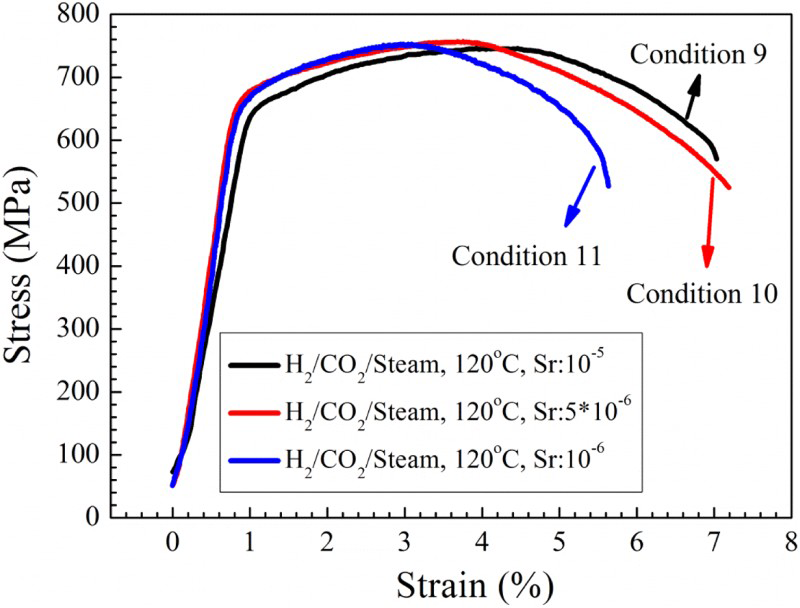
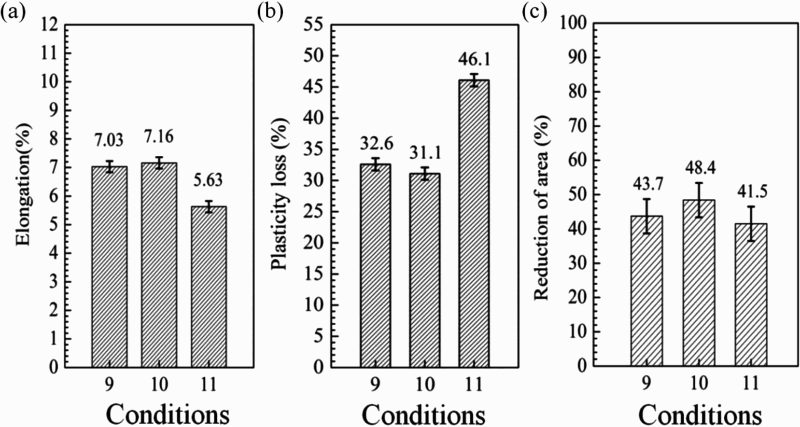
In the H2/CO2/steam environment, as the strain rate decreased from 10−5 s−1 to 5*10−6 s−1 and 10−6 s−1, the elongation were 7.03, 7.16, and 5.63%, respectively; the plasticity loss were 32.6, 31.3, and 46.1%, respectively; and the reduction of area were 43.7, 48.4, and 41.5%, respectively. The plasticity loss of the specimens at 10−5 and 5*10−6 s−1 were similar, and the plasticity loss of the specimen at 10−6 s−1 was the highest. This result may be because more hydrogen atoms entered into the specimen when the strain rate was 10−6 s−1. Thus, the above data show that the stress–strain curves were slightly influenced by strain rates in dry H2/CO2 environment but more severe in wet H2/CO2/steam environment.
Figure 13 shows the SEM fractographs of specimens tested in conditions 4, 5, 10, and 11. At different strain rates, the specimens have a quasi-cleavage feature mode in H2/CO2 mixed dry gas environment (Figure 13(a–f)), similar to Figure 5(g–i); the specimens have a brittle fracture mode in H2/CO2/steam environment (Figure 13(g–l)), similar to Figure 8(j–l). Thus, the evolution of strain rates did not change the feature mode.
Morphology of the fracture surfaces of 3Cr steels in conditions 4, 5, 10, and 11, conditions 4 (a–c), conditions 5 (d–f), conditions 10 (g–i), and conditions 11 (j–l). The magnified views of b centre and c outer parts in (a) are shown in (b) and (c), and the rest of the figures are similar to (a–c).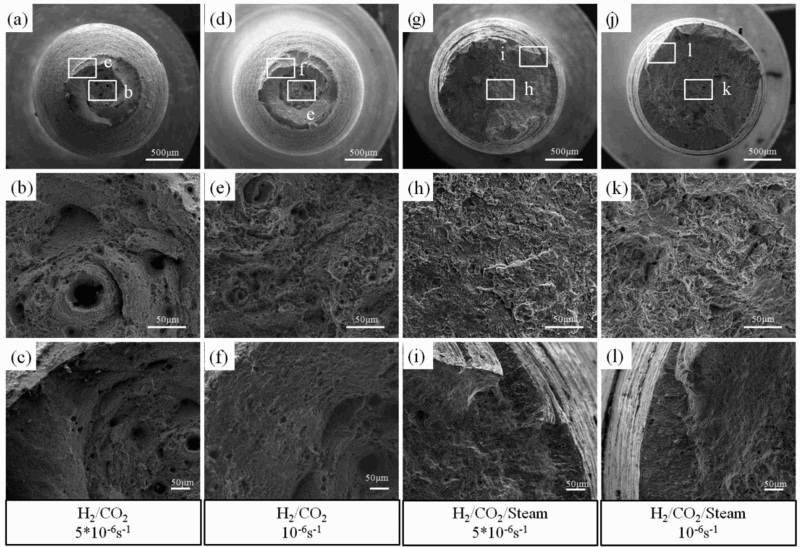
Discussion
Compared with conditions 1 to 2, the result of blank test was observed to be essentially identical to the result in the presence of H2 and CO2, which indicated that H2 in this N2 environment did not cause extinct damage. This phenomenon was due to the large amount of N2 molecule as impurity that diluted the H2 concentration. Barthélémy [20] revealed that nearly all available data from low-pressure tests or other impurity gases were included in the test environment to improve the total pressure. However, as the present research results indicate, although the impurity gas improves the total pressure, considering conditions 3 and 9, H2/CO2 would reduce the material plasticity to some extent. However, lower strain rates did not cause more severe damage of steel in H2/CO2 environment. On the contrary, obvious decrease was caused by the introduction of steam, because the effect of steam increased the amount of molecular hydrogen absorbed on the material [21]. The absorption of H2O had slight effect on the chemisorptions of H2 [22]. Thus, the introduction of steam most probably affected physisorption of H2. In the Hill-de Boer Equation (4), P is the equilibrium pressure, P 0 is the saturated vapour pressure of the adsorbate (H2, CO2, steam in the test condition), K 1 is only a function of temperature and the properties of adsorbate, and K 2 is also a constant related to the gas–solid interaction that reflects the interaction force between the adsorbed molecules and the material surface. θ is the surface coverage of absorbed material [23]. When θ is very small, the equation could be transformed into Equation (5):


As Equation (4) shows, a smaller P 0 results in a higher K 2. As H2O has a much smaller saturation vapour pressure than H2 or CO2 at 120°C, H2O is much easier to absorb onto the specimen.
In general, hydrogen will increase the density of dislocation [24]. Dislocation nucleation is a stress-assisted thermally activated process [25,26]. Thus, hydrogen is considered to affect the energy for dislocation nucleation.
The free energy required for homogeneous dislocation nucleation can be calculated according to Zamanzade et al. [27] by Equation (6), which considers the line energy of newly formed dislocation loop W dis, the energy for extending the loop τ (max)b per loop area (πr 2) [28], and the dislocation loop radius (r).

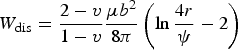
Considering Equations (6) and (7), ΔG can be rewritten as follows:

In Equation (8), hydrogen only affects the dislocation core radius ψ, and the effect on the other parameters is either neglected or inapplicable [28]. Based on the dislocation core theory, the vacancy-like defects formed along the dislocation core have a higher interaction between hydrogen atoms [29]. Segregation of hydrogen atoms to dislocations reduces the formation energy in the way that surfactants reduce surface energies in liquids. Therefore, in the presence of hydrogen, the line energy of the newly formed loop and the formation energy of dislocations are reduced. As hydrogen will affect dislocation core radius and shear modulus in Equation (8), the increase of the dislocation core radius could decrease the dislocation line energy and ease the dislocation nucleation with the absorption of hydrogen. Results of Zamanzade et al. [27] also showed that except for the main influence of hydrogen on the dislocation nucleation process of low chromium content steel, such as 3Cr, it would also decrease the mobility of dislocations.
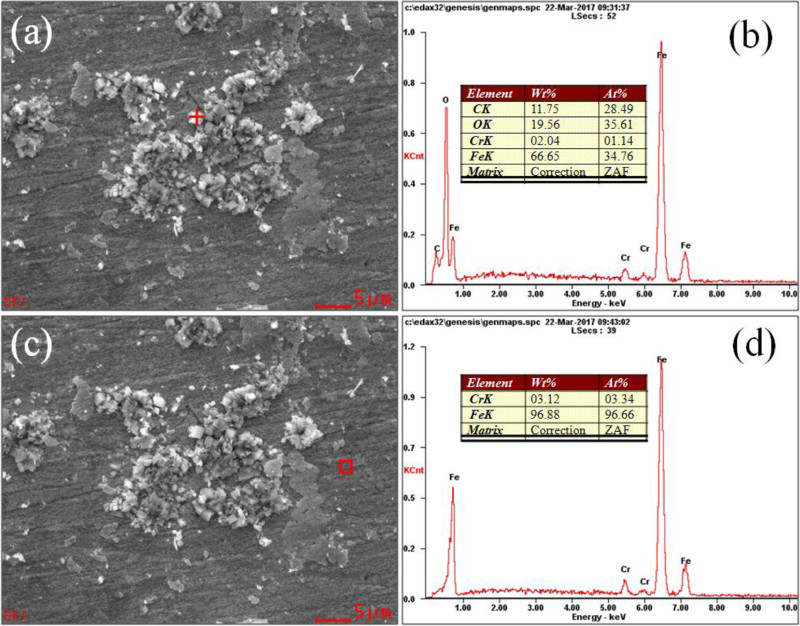
Then, as CO2 was easier than H2 to dissolve into H2O, it would form carbonic acid and followed by its dissociation close to the specimen surface and then accelerate the dissolution of 3Cr. Figure 14 shows the SEM of the surfaces of the specimens after tests in steam and CO2/ steam environment (conditions 6 and 7). Disregarding the weak oxidation of specimen during removal from the autoclave, nearly no corrosion trace on the specimen was observed in steam environment, which was in agreement with the stress–strain curves result. Therefore, single steam does not have any influence on the mechanical property. When CO2 was introduced into the steam environment, the local region of specimen was corroded, as shown in Figure 14(d–f). Sporadic corrosion products were found on the surface of specimen, which was identified as ferrous carbonate (Figure 15). 3Cr has a good resistance to CO2 corrosion, weak corrosion caused a plasticity loss of approximately 7.29%, which is far below 32.6% after H2 was introduced. In addition, the morphology of the fracture surfaces of 3Cr in CO2/steam environment was still ductile fracture mode, indicating that CO2/steam has slight influence on the mechanical property.
Surface topography of 3Cr after corrosion in steam and CO2/steam environment. (a) macrography in steam environment; (b, c) SEM microtopography in steam environment; (d) macrography in CO2/steam environment; (e, f) SEM microtopography in CO2/steam environment. SEM-EDS of corrosion products formed on the steel surface. (b) and (d) are the EDS data of red box in (a) and (c), respectively.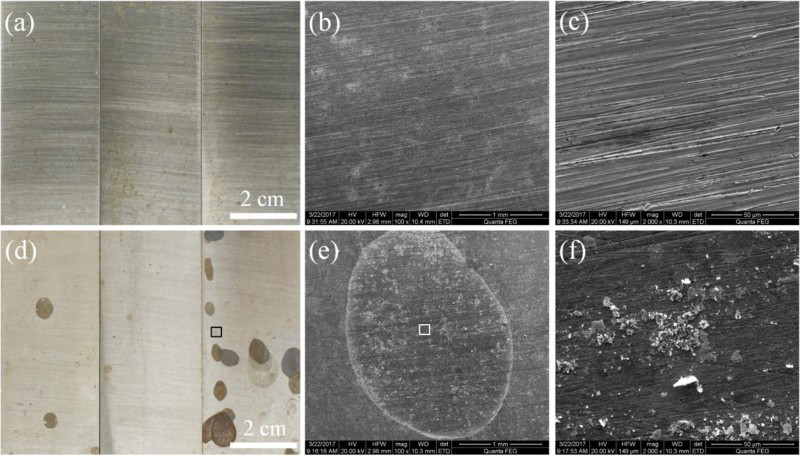
Then, when H2 was introduced into CO2/steam environment, elongation was decreased to 7.03%, plasticity loss reached 32.6%, and reduction of area was 43.7%. Moreover, the morphology of the fracture surfaces of 3Cr in H2/CO2/steam environment at multi- tension rate was brittle fracture mode. The above data proved the mechanical property of 3Cr largely decreased in H2/CO2/steam environment, and the plasticity loss was greater than the sum of the plasticity loss of 3Cr in CO2/steam and H2 /steam environment. Kittel and co-workers [15] found that CO2 promotes hydrogen entry in the steel. Asher and Dean found that bicarbonate ions also have similar effect [30,31]. In the previous work, CO2 has a certain function on hydrogen permeation [32].
In summary, three factors explain the high sensitivity of HE in humid environment. First, CO2 combined with H2O to produce H2CO3 that accelerated the anodic dissolution of 3Cr, which was the weakest factor. Second, physical adsorption of H2 on steel was enhanced in the steam environment. Third, CO2 promotes hydrogen atom entry into the steel. Greater damages occurred in the environment with H2, CO2, and steam because of the above factors.
Conclusion
3Cr suffers less serious HE damage in the SNG environment with H2 and CO2, and the plasticity loss increased with increasing hydrogen partial pressure. N2 has an important role in the HE sensitivity evaluation test of steel in H2 environment, because high pressure N2 diluted the H2 concentration in the system, inducing the decrease of H2 adsorption on the surface. Therefore, related industry could probably reduce the percentage of H2 by adjusting N2 pressure to avoid hydrogen damage. The plasticity of 3Cr obviously decreased in the presence of steam, because the preferential adsorption of steam combined with CO2 to produce H2CO3 that accelerated the anodic dissolution of 3Cr; thus, the physical adsorption of H2 on steel was enhanced. Moreover, CO2 promotes hydrogen atom entry into the steel in the wet environment. Therefore, the SNG environment should avoid containing H2O, particularly in high-temperature environments. The fracture was a ductile fracture mode in the N2 environment; ductile and brittle mixed fracture in H2/CO2 environment; and brittle fracture mode in H2/CO2/ steam environment. The effect of strain rate was negligible in the H2/CO2 environment, and HE sensitivity is low in dry low-pressure H2/CO2 environment. However, the effect of strain rate was more severe in wet H2/CO2/steam environment.
Footnotes
Disclosure statement
No potential conflict of interest was reported by the authors.