







Abstract
Concomitant rust growth on a rust-free surface and conversion by a solution of tannin, propolis and benzoate has been investigated in the present study with the aim of producing a modified rust layer, more resilient and protective than a pure rust layer. Under such circumstances, balancing simultaneous but contradictory processes of corrosion acceleration by iron chelation and corrosion inhibition by ferric tannate precipitation is crucial for layer formation. Benzoate served as an iron corrosion inhibitor in the layer formation stage while the propolis added to the tannin solution improved the modified rust layer protective efficiency. Corrosion rates lower than 5 mpy that are acceptable from the practical viewpoint are attained with the inhibitor-modified rust layer, both, in quiescent solution and up to a linear velocity of the solution approximately equal to 1.5 m s−1.
GRAPHICAL ABSTRACT
Introduction
In countless practical applications, unprotected steel surfaces are exposed to aerated flowing seawater. Corrosion rates of steel in such systems range between 0.1 and 1 mm per year [1] and are unacceptable from a technical viewpoint as structures are rarely designed for lifetimes below 50 years. Besides, steel corrosion allowances rarely exceed 10 mm and are frequently closer to 5 mm. Therefore, in many instances, inhibition of carbon steel is of immense technological importance. Inhibition of steel in neutral chloride solutions still presents a challenge for contemporary corrosion scientists [2 7] because the oxide and hydroxide that form at the steel surface seriously impede adsorption of potentially inhibiting organic compounds [2] making rust conversion in solution an attractive concept. The idea of creating lasting protective layers on different metals through a pretreatment by an inhibitor-containing solution has also been studied elsewhere [8,9]. Tannins can be found as major components of many commercially available rust converters due to the possibility to convert existing rust into ferric tannates, making so modified rusted surface feasible for further processing and top coating [10]. Although the literature is replete with studies of tannins applied under acidic conditions, the studies in weakly acidic and neutral solutions are quite rare [2,11–14]. Also, tannin formulations are applied to partially rusted substrates [11]. The concept of concomitant rust growth on a rust-free surface and conversion by tannins from the solution has not been thoroughly investigated. The formation of a rust layer modified by polyphenolic model molecules rutin, esculin and esculetol under weakly acidic conditions has only recently been studied by Veys-Renaux et al. [15]. They have confirmed formation, investigated the morphology and corrosion inhibiting characteristics of polyphenolate conversion films on the surface of iron that form by precipitation of ferric cations with polyphenolic molecules, catechol group being a bidentate ligand complexing iron.
Chemical reactions of chestnut tannin used in the present study, with ferric ions may be studied through the reactions of its parent polyphenols catechol and pyrogallol. Catechol and pyrogallol moieties have been found to be molecular reaction centres of major constituents of chestnut tannin obtained by molecular modeling [16]. Deprotonation of these groups that may be expected to occur when tannin is introduced into the neutral solution [17], facilitating the formation of iron-tannin chelates. However, in weakly acidic solution (e.g. for 2 g dm−3 of tannin pH drops to 4.2), ferric ion hydrolysis is expected to influence ferric-tannate formation mostly through Fe(OH)3 precipitation. A composite layer of rust layer and ferric-tannate is therefore expected to form at the surface of the metal.
The factor expected to complicate formation of a protective ferric tannate layer from the solution is the fact that tannin as a chelating agent may accelerate leaching of ferric ions from the bare surface through: (i) reaction of iron with chelating ligands in solution and (ii) through bonding of the chelating species to the lattice metal ions and the release of complexes into solution [18].
We have recently proposed the idea of rust layer conversion by a chestnut tannin-based mixture of environmentally acceptable compounds acting from the solution and producing a resilient inhibitor-modified rust layer that would lower corrosion rate to acceptable level and retain its protective properties for a substantial time period even after the inhibitor removal from the solution [19]. In the present study, we focus on the mechanism of inhibition of a simpler tannin-based mixture and quantitation of the synergistic and antagonistic effects between tannin, propolis [20 22] and benzoate [23] during the period of inhibitor-modified rust layer formation in the inhibitor-containing solution and during layer retention period in the inhibitor-free solution. In addition, we investigated the possibility of synergistically lowering our previously reported 2000 ppm tannin concentration [19]. For each compound and various compound mixtures, retention of the inhibitor-modified rust layer at the electrode surface is studied as a function of electrolyte velocity using a dynamic film persistency measurement based on linear polarisation resistance (LPR) technique [24] and potentiodynamic polarisation. The inhibitor-modified rust layers are further studied by X-ray diffraction (XRD), Fourier transform infrared spectroscopy (FTIR) and scanning electron microscopy SEM/energy dispersive X-ray spectroscopy (EDS).
Experimental
Solutions
NaCl in 3% (0.51 M) concentration obtained by dissolving analytical grade NaCl (Lachner, p.a.) in redistilled water was used for solution preparation and subsequent corrosion tests. In particular, 3% NaCl has been found to yield the highest rate for corrosion of iron in aerated solutions at room temperature [25].
Natural propolis (Naturwaren-Niederrhein, GmbH, Propolis Pulver) was used at a concentration of 100 ppm in 3% NaCl. 100 mg of propolis was first dissolved in 5 ml of 70% ethanol before preparing a 1 dm3 of solution. Chestnut Tannin (Tanin Sevnica) and sodium benzoate (AGZ, food additive) were both used at the concentration of 2000 ppm.
The inhibitive mixture of tannin (T), benzoate (B) and propolis (P) used for rust layer modification is in further text denoted by abbreviation T + B + P, and the other combinations of single components are denoted accordingly.
To go a step further, a binary mixture of tannin in concentrations of 300, 500 and 1000 and 100 ppm of propolis was used to evaluate protective properties at lower concentrations of tannin. Benzoate was left out in this case assuming a higher impact on preventing iron dissolution required for tannate formation at lower concentrations. Unfortunately, the formation of modified rust layers had shown to be negatively influenced by chloride presence. Hence, for lowered tannin concentrations, modified rust layers were formed in solutions prepared with redistilled water. These layers were subjected to characterisation with FTIR and SEM in order to compare their morphology to the layer formed in T + B + P solution in 3% NaCl.
All measurements were done in aerated solutions under ambient conditions.
LPR probe
The measurements of corrosion rate were performed on the LPR probe manufactured by RCSL with the data collector MS1500L. The corrosion rate was determined by the software of the MS1500L instrument.
Corrosion monitoring LPR pins made of C1010 steel had composition declared by the producer (Metal Samples) as C (0.02-0.08), Mn (0.3-0.6), P (0-0.04), S (0.05) and Fe (bal.).
Before immersion, LPR electrodes were treated mechanically by an abrasive paper of grit 240, followed by degreasing with ethanol in an ultrasound bath and rinsing in redistilled water. Measurements were made by immersion of the electrodes in the solution of 3% NaCl, as well as in solutions with the chosen concentrations of inhibitors. In the non-inhibited solutions, the rust layer was formed, while in the inhibited solutions, the rust layer modified by the action of corrosion inhibitors was obtained. The layer formed without inhibitor is in the rest of the text referred to as the ‘rust layer’. Depending on the type of experiment, the corrosion rate was measured immediately after 24 h or after the probe had been transferred into the fresh 3% NaCl solution and left exposed for 24 h. In the latest case, the LPR measurement was performed subsequently in a quiescent solution as well at magnetic stirrer speeds of 100, 250, 450 and 700 rpm.
Linear polarisation
The linear polarisation method was performed in a three-electrode system, in which a cylindrical steel sample made of API X52 5L embedded in epoxy resin and having a circular cross-section exposed to the electrolyte, was used as a working electrode. A saturated calomel electrode was used as a reference electrode, while a graphite electrode was used as an auxiliary electrode. Measurements of linear polarisation were performed in the interval of ±250 mV at the open circuit potential at a scanning speed of 1 mV s−1. PalmSens3 device with PC Trace 5.3 software was used.
Before linear polarisation measurements, working electrode had been mechanically treated with the abrasive paper of various grits, namely: 240, 600 and 800. Subsequently, the surface was degreased in an ultrasonic bath with ethanol and washed with redistilled water. The working electrode surface was 0.2826 cm2.
The rust and inhibitor-modified rust layer was formed at the electrode by the same procedure as in the case of the LPR method. Measurements were performed after keeping the electrode for 24 h in a solution of 3% NaCl without inhibitor, without mixing and with magnetic stirrer speeds of 90-150 rpm. Measurements of linear polarisation were performed on each system for 10 days.
XRD analysis
XRD analysis was performed on low- alloy steel plates, type API X52 5L with dimensions 30 mm × 40 mm × 3 mm. Plates were previously mechanically treated with sandpaper of grits, namely: 240, 600 and 800 and then degreased with ethanol and redistilled water. The plates were then immersed for 24 h in a solution of 3% NaCl without inhibitors, as well as in solution with inhibitors of the selected concentrations in non-inhibited solution a layer of rust was formed on plates, while in a solution with inhibitors the rust layer was modified under the influence of the inhibitor. The plates were then transferred to a solution of 3% NaCl and left in the solution for 10 days, after which they were extracted and dried and as such used for XRD analysis.
Determination of the mineralogical composition was performed by XRD using Shimadzu XRD 6000 diffractometer with CuKα radiation, with an acceleration voltage of 40 kV and a current of 30 mA. The measurement was performed in the range of 5-85 °2θ with a step of 0.02 °2θ and a retention time of 0.6 s/step. The samples were placed directly into the apparatus without the sample holder.
Fourier transform infrared spectroscopy
FTIR spectra were recorded using a PerkinElmer spectrometer Spectrum One. Spectra were obtained in the range from 400 to 4000 cm−1, with each spectrum being an average of 10 scans with a resolution of 4 cm−1; 350 mg of KBr was rubbed onto the surface of the rectangular X52 5L and C1018 carbon steel electrode with dimensions 30 mm × 10 mm × 1 mm that had composition declared by the producer (RCL) as C (0.18), Mn (0.84), Al (0.036), Cr(0.02), Cu(0.02), Si (0.02), P (0.01), Nb (0.01), Ni (0.01) and Si (0.02) on which inhibitor layer has been formed identically as for the LPR measurements. Samples bearing KBr were then hydraulically pressed into a 13 mm stainless steel die and the resulting pellets further subjected to FTIR measurement. Preparation of pellets conformed to the standard ASTM E1252:2007.
SEM) and EDX analysis
SEM and EDX analyses were done using Tescan Vega III, SBU EasyProbe scanning electron microscope with 15 kV accelerating voltage of the electron beam at various magnifications. Measurements were done on the surface of the coupons prior to FTIR experiments.
Results and discussion
Measurements at the LPR probe
Corrosion rates and inhibitor efficiencies for individual compounds and compound mixtures during 24 h of rust layer formation in 3% NaCl solution without or with the inhibitors.
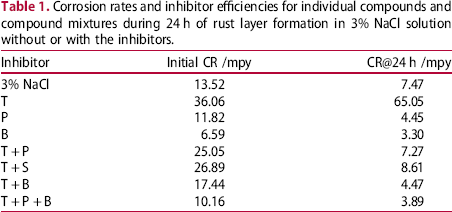
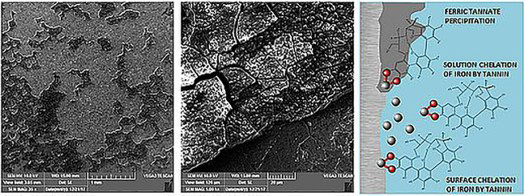
It is apparent that propolis and benzoate inhibit, and tannin as a chelating agent and a weak organic acid significantly increases the corrosion rate of steel [26]. Figure 1 schematically shows the possible effects of tannin in the protective layer formation stage along with the SEM images of the layer formed in the 2000 ppm chestnut tannin (T) solution. The steel surface shows areas covered by a layer and the areas of etched steel with clearly visible grain boundaries. EDS analysis of the layer in wt-% gives 40.4 for O, 39.8 for Fe, 17.3 for C and 2.5 for Cl indicating the probable presence of organic material and iron oxides. EDS analysis of the substrate gives 92.7 wt-% for of Fe and 7.3 wt-% for C indicating plain carbon steel surface. The previously mentioned acceleration effect on steel corrosion is presented through complexation of iron with tannin species at the surface and in the solution. The inhibitive effect is presented by iron-tannate precipitation.
SEM micrographs of the layer formed in 2000 ppm chestnut tannin (T) solution P + T + B mixture and a schematic representation of iron dissolution and tannate layer formation.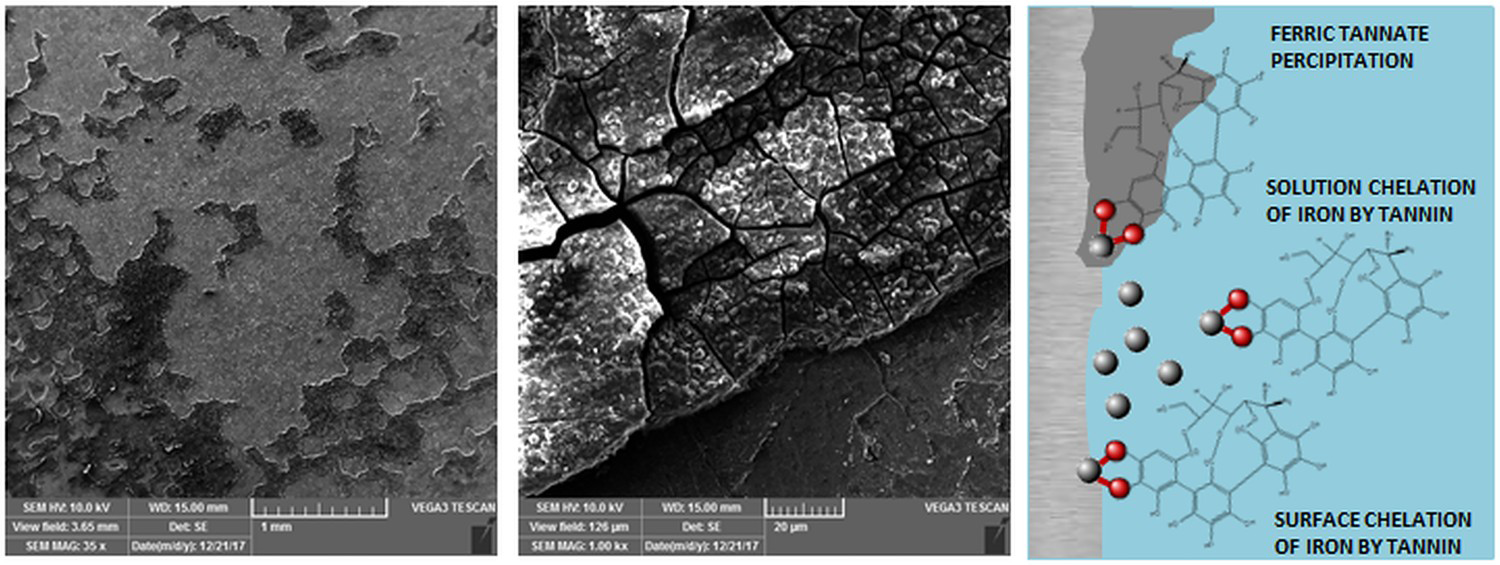
Contrarily, the inhibitor-modified rust layers, after the transfer of the LPR probe to fresh 3% NaCl and after further 24 h of immersion, all show inhibitive effect. Figure 2(a) shows LPR results for the electrodes with the pure or inhibitor-modified rust layers in the case individual inhibitor compounds and binary compound mixtures in quiescent solution without and with stirring at speeds from 80 to 150 rpm. The effect is very weak for all the individual compounds except for tannin, and stronger than tannin for a binary mixture of tannin and propolis.
LPR results for the electrodes with pure or inhibitor-modified rust layers in the case of (a) rust modification with individual inhibitor compounds and (b) rust modification with compound mixtures.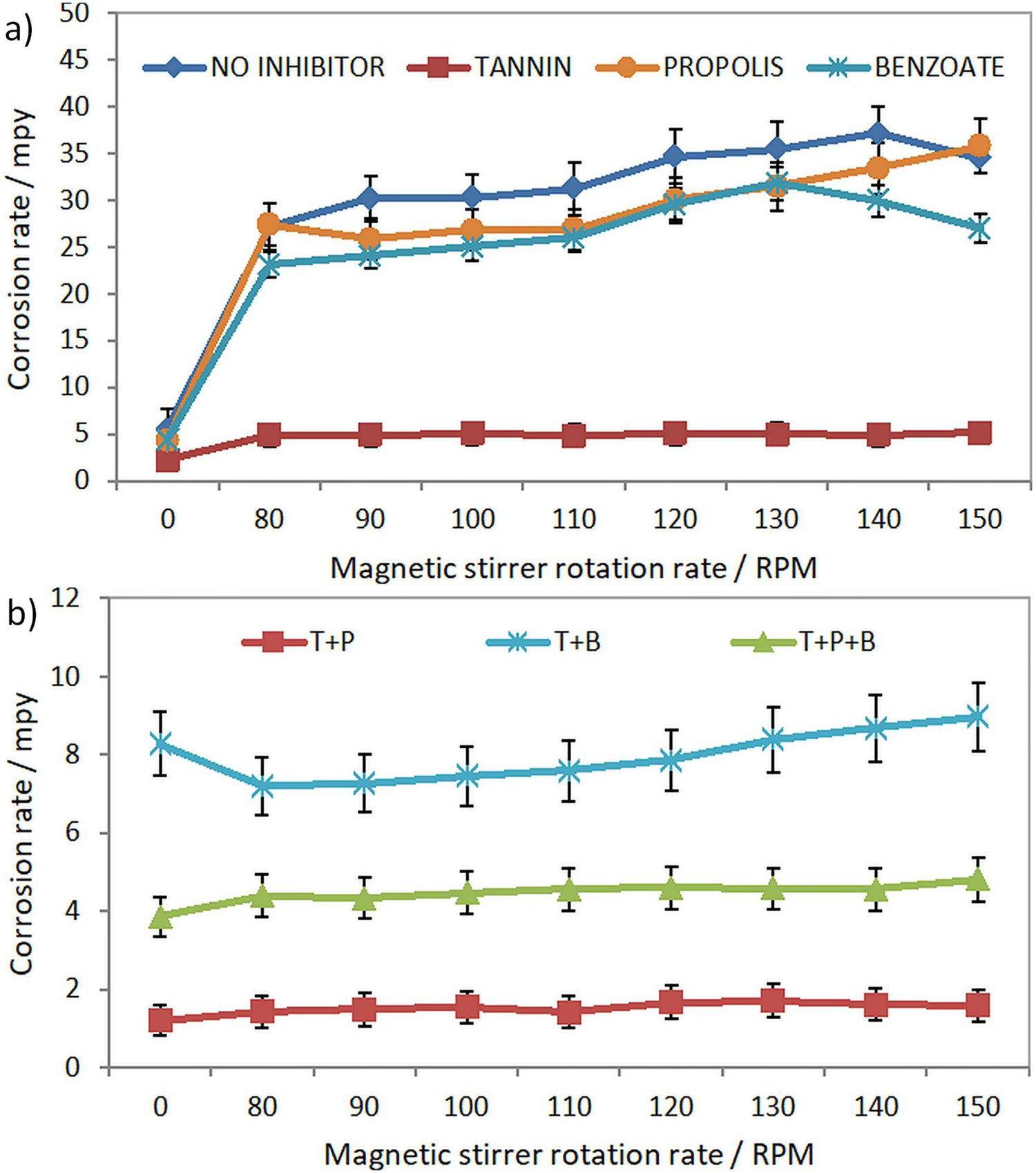
Dependence of the corrosion rate on stirring speed shows that the inhibitor-modified rust layer is highly resistant to shear stress originating from a hydrodynamic flow [27]. Further elaboration of this phenomenon is given in the discussion of the potentiodynamic polarisation results.
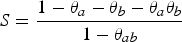
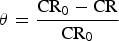
The observed synergistic and antagonistic effect of binary mixtures can be quantified by employing Aramaki and Hackerman [28], the equation:
Synergistic coefficients calculated for quiescent and mixed binary solutions of inhibitor mixture components.

The S parameter approaches unity when there are no interactions between the inhibitor compounds, while S > 1 indicates a synergistic effect and S < 1 indicates an antagonistic effect.
The results point to the significant synergy in the case of T + P mixture and significant antagonism in the case of T + B mixture. The apparent synergistic coefficient is higher in a mixed system than a quiescent system due to the increased influence of oxygen convective transport to the electrode on the corrosion reaction.
Potentiodynamic polarisation results
Measurements by the method of potentiodynamic polarisation were performed on the rusted electrode and an electrode with the inhibitor-modified rust layer in the solution of 3% NaCl. A ternary mixture of tannin, propolis and benzoate (P + T + B) was chosen for rust layer modification with prospects of inhibiting corrosion during the layer formation stage and obtaining a protective layer during the layer retention stage. Each time the measurements were performed in the quiescent solution and solutions with magnetic stirring at stirrer bar speeds of 100, 250, 450 and 700 rpm. Taking into account geometry of the cell, those stirring speeds would roughly correspond to linear fluid velocities of 0.21, 0.52, 0.94 and 1.47 m s−1. These are indeed fluid velocities of interest, as carbon and low alloyed steel, are known to endure velocities up to 1 m s−1 without excessive flow-induced corrosion [29]. A rate of 0.9 m s−1 is suggested as optimal for plain steel in seawater in order to avoid fouling and flow assisted corrosion [30].
Figure 3(a) shows the polarisation results for the electrodes with the rust layer and the inhibitor-modified rust layer obtained after one day of immersion, recorded at various electrolyte mixing rates.
(a) Potentiodynamic polarisation results for the electrodes with pure or inhibitor-modified rust layers in the case of rust modification with P + T + B mixture, recorded at various electrolyte mixing rates and (b) histogram of the corrosion rates calculated from the polarisation data and the inhibition efficiencies.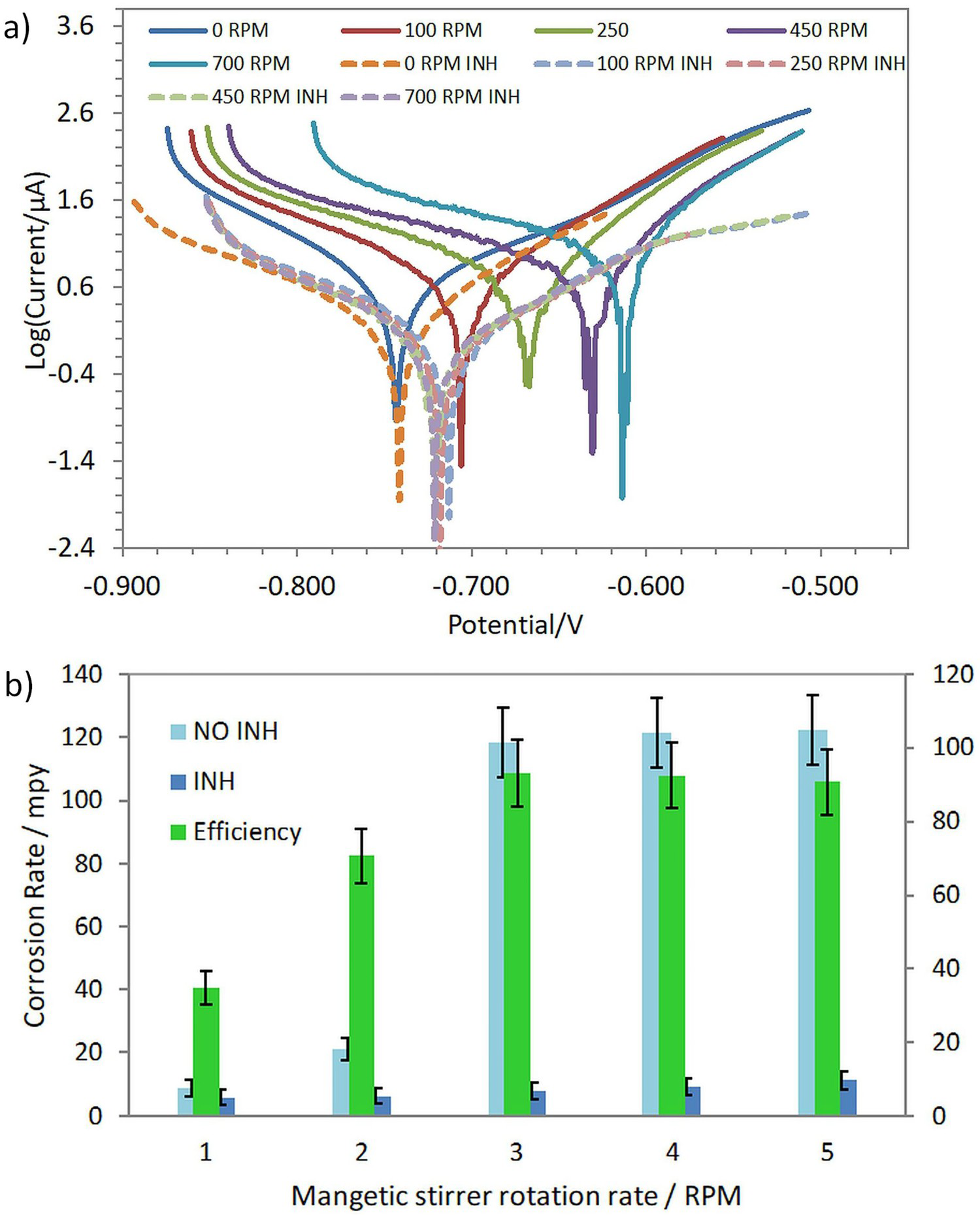
In general, mixing increases the corrosion current, mainly by increasing the cathodic current and at the same time shifts the corrosion potential to the more positive values. Mixing also increases the apparent cathodic Tafel slope and decreases the apparent anodic Tafel slope. The observed behaviour may be explained by the fact that solution stirring increases the transport of oxygen to the metal surface causing the cathodic current and the corrosion potential increase [31,32]. The cathodic reaction in quiescent 3% NaCl on low-carbon was reported to be under mixed mass transfer (oxygen reduction) and charge transfer (water reduction) control. An increase in the electrolyte mixing rate raises the limiting current of oxygen reduction [33], and the diffusion-controlled oxygen reduction becomes the dominant cathodic reaction. Hence, the increase in the cathodic Tafel slope is also observed.
It is apparent from Figure 3(a), that mixing does not significantly affect the magnitude iron dissolution current. However, a decrease of the anodic Tafel slope with the increase in mixing rate is observed meaning that mixing influences the kinetics of the anodic dissolution probably due to the increased transport of dissolved iron ions from the surface of the metal into the solution [32].
The corrosion rates calculated from the polarisation data by the method of Tafel extrapolation are shown in Figure 3(b). The efficiency of the inhibitor-modified rust layer, IE, can be calculated by the equation:
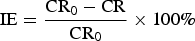
Corrosion rates are similar to those from the LPR experiments at comparable mixing rates for T + P + B mixture. From Figure 3(b) we can conclude that inhibitor efficiency is greater in the flowing system than in the quiescent system probably due to the effective blocking of the oxygen transport to the surface of the metal, which is itself increased with increasing of the electrolyte stirring speed [33,34].
This conclusion is in concordance with the previously published impedance data [19], for the similar system that showed that the inhibitor-modified rust layer has a low-frequency constant phase element n parameter close to 0.5, as well as the typical shape of Nyquist plots [35], which implicates diffusion effects in the porous surface layer.
XRD results
The results of XRD measurements for T + P + B modified rust layer are shown in Figure 4. Ferrite (α-Fe, ICDD PDF No.65-4899) magnetite (Fe3O4, ICDD PDF No. 19-629), lepidocrocite (FeO(OH), ICDD PDF No. 70-714) and akaganeite (FeO(OH), ICDD PDF No. 34-1266) have been identified at the surface of the steel samples both, in the case of rust and inhibitor-modified rust layer. Halite (NaCl, ICDD PDF No. 5-628) and iron chloride tetrahydrate (FeCl2 × 4H2O) have been identified only in inhibitor-modified rust layer. Besides ferrite peaks (F) that reflect the substrate presence, the most prominent peaks, denoted in Figure 4, are those of magnetite (M) and lepidocrocite (L) as previously observed in the presence of tannins [36 38].
XRD spectrum of X52 5L steel plate covered with pure rust and the P + T + B mixture modified rust.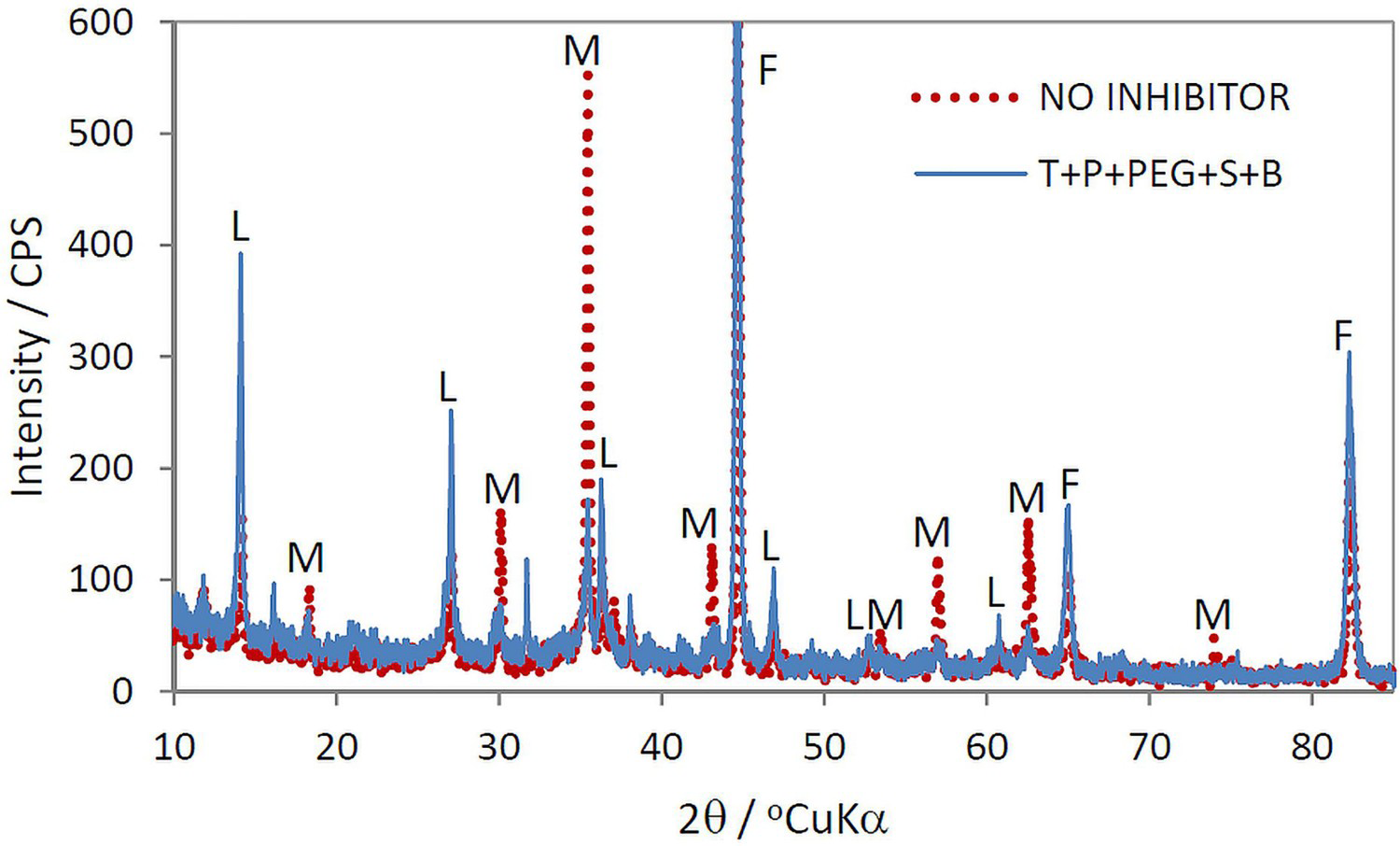
Tannate species that have previously been proven by FTIR [19] and visible due to deep blue–black colour have not been detected due to their amorphous nature.
The intensity of XRD peaks indicates more magnetite than lepidocrocite in the inhibitor-free rust, and a larger quantity of lepidocrocite than magnetite in the inhibitor-modified rust layer. Magnetite formation is, according to some literature references [39 41] favoured in more aggressive environments where the oxidation process is faster.
Scherrer's equation [36]:
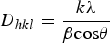
The average calculated size of the rust layer Fe3O4 crystallites equals 103 nm and of the inhibitor-modified rust layer Fe3O4 crystallites equals 52 nm. A decrease in the crystallite size of Fe3O4 has previously been observed for the Fe3O4/tannic acid system but was not accompanied with such a significant reduction in peaks intensity [36]. Decrease of the crystallite size, apart from the peak broadening, also causes a certain decrease in peak height. However, in the present case, in the sample treated with inhibitor mixture the decrease of magnetite peaks occurs, which is so great that is a consequence of a change in magnetite quantity. Therefore, it is safe to say that crystallinity of the Fe3O4 is altered in the presence of inhibitor mixture.
FTIR results
The modification of rust layer by tannin and propolis, as mentioned before, was studied in P and T + P redistilled water solutions with various T:P ratios, namely P100, T300 + P100, T500 + P100 and T1000 + P100, as depicted in Figure 5. Combinations are denoted with the associated concentration value in ppm.
FTIR spectra of C1018 steel plates covered with inhibitor-modified rust layers formed in distilled water solutions of various P:T ratios.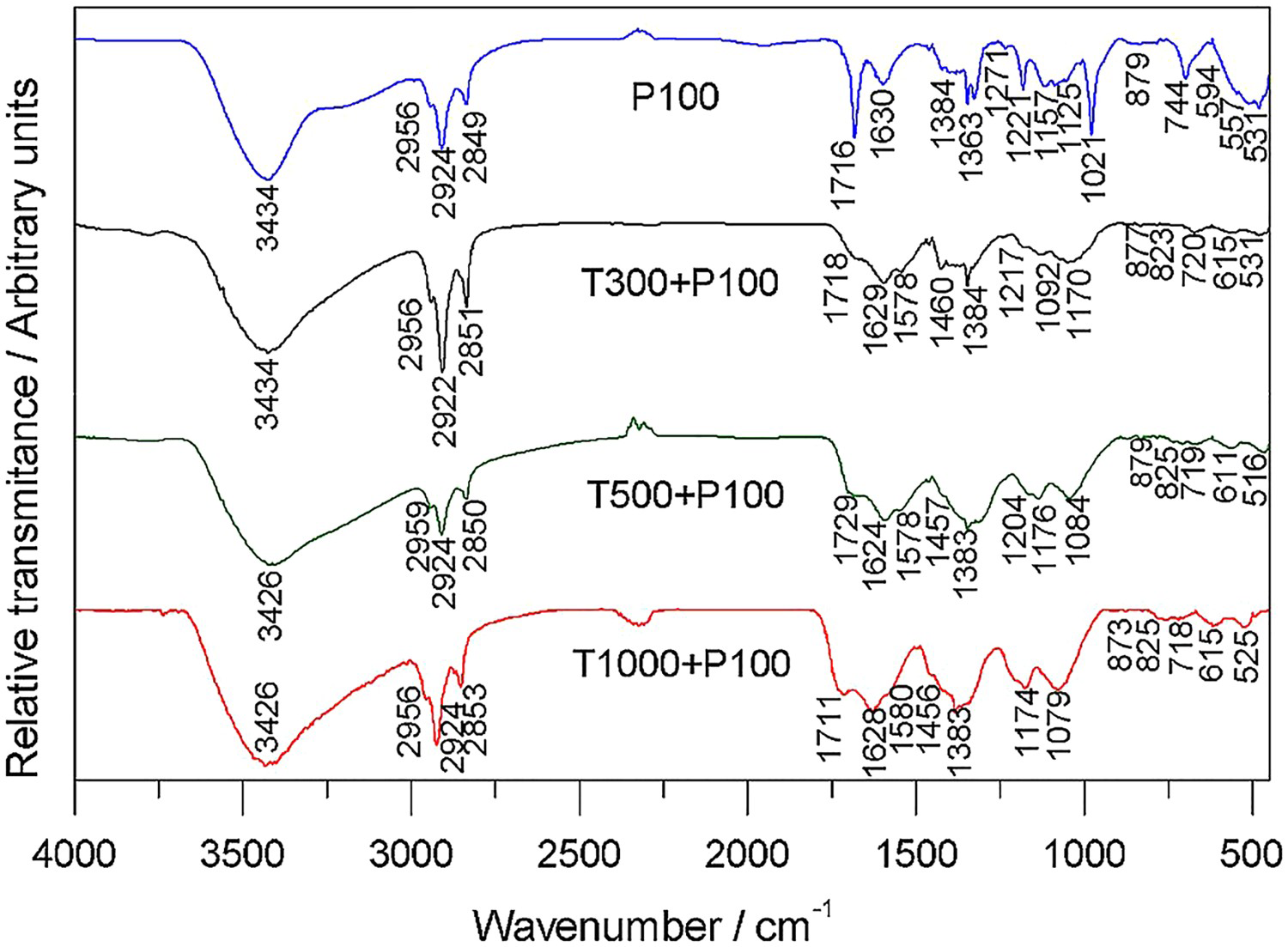
It is apparent from Figure 5 that by increasing the T:P ratio the spectra more and more resemble the tannin spectrum [19,40,42,43] while decreasing the T:P ratio causes resemblance to propolis spectrum [19,21,44]. The peaks present in all spectra close to 2925 and 2850 cm−1 correspond to the stretching vibrations of the CH2 and CH3 groups specific for aliphatic hydrocarbons [44]. Likewise, the broad peak between 3500 and 3100 cm−1 originates from the OH groups of phenols or ethanol, since all solutions contained ethanol [42]. The difference among the spectra in Figure 5 is mainly observed in the type and amount of rust present. A sample containing only propolis, P100 shows peaks of lepidocrocite (γ-FeO(OH)) at 744 and 1021 cm−1 [38,40,45], while goethite (α-FeOOH) becomes the only rust form present in all tannin-containing samples, with a peak occurring at 615 cm−1 [45,46]. As a matter of fact, the latter presents the only difference of spectra in Figure 5 from the previous FTIR spectra obtained in 3% NaCl [19], which is in concordance with literature findings of magnetite formation in more aggressive media [39 41]. Thereby, the independent conversion effect of tannins on rust is confirmed. Undoubtedly, tannate formation is favoured over lepidocrocite, and rust conversion is directed towards the formation of goethite as a more stable form than lepidocrocite [40,47]. Moreover, for the sample T500 + P100, the shift of goethite peaks to 611 cm−1 is observed as a result of interactions with tannin. To sum up, the modifying effect of tannin is visible in FTIR spectra through lacking of lepidocrocite bands and through goethite band of very low intensity.
SEM results
SEM micrographs of C1018 steel plate covered with inhibitor-modified rust layers formed in redistilled water solutions with various P:T ratios are shown in Figure 6. For comparison, pure rust and P + T + B mixture modified rust from 3% NaCl solution are also shown. It is evident that propolis sample (P100T0) partially takes on the appearance characteristic of lepidocrocite (coral-looking crystals) [40] and to a lesser extent of goethite (cotton ball-looking crystals) [48] but differs from the appearance of pure rust (P0T0). On the other side, micrographs with tannins show a layer having mud-like cracks of irregular shapes and edges separated from the surface [40]. It is further observed that the cracks below tannate layers are filled with propolis. Since the surface coverage with dark blue layers of iron tannate has already been determined with the naked eye, this result reaffirms the synergistic effect of propolis as a fixating compound for the tannin protective layer. The formation of cracks is caused by the removal of tannic acid during drying of the excessive moisture, which promotes regrowth of the existing rust [49]. At tannin concentration of 500 ppm and especially in the case of P + T + B mixture, tannate/propolis layer is intercalated between rust spots at the surface [19].
SEM micrographs of C1018 steel plate covered with inhibitor-modified rust layers formed in redistilled water solutions with various P:T ratios. Pure rust and the P + T + B layer are shown for comparison.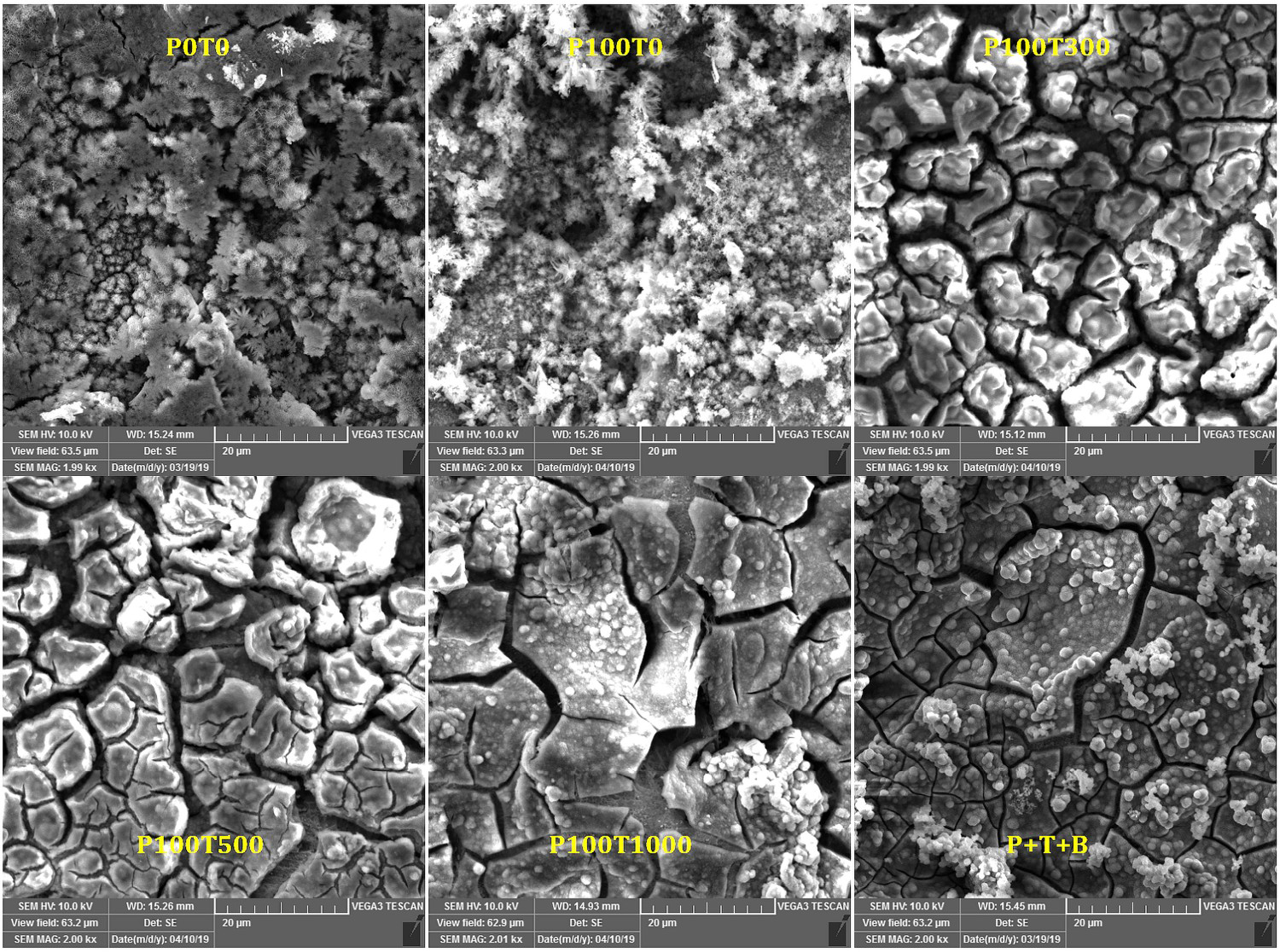
Conclusions
A protective effect has been proven by the LPR and potentiodynamic polarisation techniques in the quiescent and mixed 3% NaCl solution for the rust layer modified by a mixture of propolis, tannin and benzoate. The results indicate efficiencies from around 40% in a quiescent solution and up to 90% in flowing solutions, as well as the resilience of the inhibitor, modified rust grown in layer to the shear stress induced by the hydrodynamic flow up to a linear velocity approximately equal to 1.5 m s−1.
SEM analysis shows a sequence of layer morphology, going from the coral-like structure of lepidocrocite in the inhibitor-free solution towards a cracked mud-like appearance at concentrations of tannin above 300 ppm, while FTIR analysis reveals the tendency of tannates to convert rust into more stable oxide of goethite.
Footnotes
Disclosure statement
No potential conflict of interest was reported by the author(s).