






Abstract
The present work reports a study on the effect that a peptiser species has on the crystallisation of alumina gel produced by a sol–gel process to help develop a method for producing α-Al2O3 at low temperature. The white precipitate of aluminium hydroxide, which was prepared with a homogeneous precipitation method using aluminium nitrate and urea in an aqueous solution, was peptised using various peptisers at room temperature to form a transparent alumina sol. The alumina gel obtained from the alumina sol, which was produced using formic acid as the peptiser, was most dominantly crystallised into α-Al2O3 by annealing at 900°C. The optimal [peptiser]/[Al3+] (P/A) molar ratio for the crystallisation into α-Al2O3 was 0.2. The alumina gel began to crystallise into α-Al2O3 with annealing at as low as 500°C when formic acid and a P/A ratio of 0.2 were used.
Introduction
Alumina contains various crystal structures, one of which is α-type. α-Al2O3 can be used in electronics, material engineering, and optics because it has high electric insulation, high thermal conductivity, large hardness, and high translucency [1-4]. α-alumina has been conventionally produced by annealing aluminium hydroxide from aluminium salts or minerals at over 1000°C [58]. α-alumina can also be produced by fabricating alumina gel using liquid–phase methods, such as precipitation and sol–gel process and by annealing at high temperature [912]. These methods require high temperatures and consume a great deal of energy. Accordingly, low-temperature processes for producing α-alumina are desired to save energy.
In most works on the fabrication of alumina gel [13-17], aluminium hydroxide is produced via the hydrolysis of aluminium alkoxide or a reaction of aluminium salt and a base in aqueous solutions. Aluminium hydroxide is peptised with acid to transform it into alumina sol; then, the sol is gelated under evaporation of the solvent. Our research group has studied the preparation of alumina sol, using a homogeneous precipitation method and fabrication of alumina gel [18]. In this study, acetic acid was used as a peptiser for aluminium hydroxide produced via the homogeneous precipitation method to obtain alumina sol. The alumina gel was amorphous or fine crystallite, even after it was annealed at 500°C and crystallised into γ-Al2O3 at 900°C. Thus, an annealing temperature higher than 900°C is required to crystallise the alumina gel into α-Al2O3.
There are some studies on the effect that the production conditions have on the crystal phase of alumina produced via the sol–gel process. Sharma et al. [19] fabricated alumina with a major phase of α-Al2O3 and a single phase of boehmite in the presence and absence of α-Al2O3 seeds in aluminium hydroxide, respectively. Yang et al. [20] reported that a process that uses tetraethylammonium hydroxide as a peptiser, hydrothermal treatment, and the seeding of α-Al2O3 particles could significantly enhance the transition to α-Al2O3 at a low temperature without forming other transient alumina phases. Yamaguchi et al. [21] studied the effect of adding hydroxyl acid species to a polyhydroxoaluminium (PHA) solution prepared by dissolving Al metal in hydrochloric acid. Functional groups, such as −OH and −COOH in the hydroxy acid molecule, interact with OH groups in PHA ions to modulate the PHA gel structure. The modulation affects the crystallisation of PHA gel. Various hydroxy acids were examined to find effective additives for low-temperature a-transformation. In the results, CA and LA hydroxy acids were the most effective among the examined hydroxy acids. Thus, the production conditions affect the crystallisation behaviour of alumina gel.
As noted, Yamaguchi et al. [21] indicate that the crystallisation behaviour of alumina gel strongly depends on additive species. Their work on the effect of hydroxy acid species suggests that different species of peptiser differently affect the crystallisation of alumina gel, which was produced in our previous work [18]. The present work examines the effects of peptiser species on the crystallisation of our alumina.
Experimental
Chemicals
Aluminium nitrate enneahydrate (Al(NO3)3·9H2O) (98.0%) and urea (99.0%) were used as a starting material for aluminium hydroxide and a precipitation-inducer to prepare aluminium hydroxide, respectively. The peptisers examined in the present work were nitric acid (69.0–70.0%), n-butyric acid (99.0%), propionic acid (99.3%), acetic acid (99.7%), formic acid (88.0–92.0%), oxalic acid dehydrate (99.5–100.2%), lactic acid (85.0–92.0%), mandelic acid (99%, Aldrich), and citric acid monohydrate (99.7%). Except for mandelic acid, all chemicals were purchased from Kanto Chemical Co., Inc., and used as received. Water was ion-exchanged and distilled with Yamato WG-250 and used in all preparations.
Preparation
Precipitate of aluminium hydroxide was prepared using the homogeneous precipitation method or the following procedure. Al(NO3)3 and urea were dissolved in water in a hermetically sealed glass bottle at initial concentrations of 0.2 M Al(NO3)3 and 5 M urea. The mixture was stirred at 80°C for 8 h, which produced a white precipitate. The obtained precipitate was aged at room temperature for 12 h after the preparation. Then, it was washed by repeating centrifugation, supernatant removal, water addition, and sonication for more than three times. Finally, it was peptised at 25°C (room temperature) with the addition of a peptiser at [peptiser]/[Al3+] (P/A) molar ratios of 0.1–0.6. The precipitate was transformed to a transparent sol (alumina sol) after the peptisation. The alumina sol was casted onto a Petri dish. Drying in air at room temperature converted the sol into a solid alumina gel. The solid gel was pulverised with a mortar into powder and annealed in air at 400–900°C.
Characterisation
Crystal structures of the gels were investigated by X-ray diffractometry (XRD). Powder obtained by pulverising alumina gel with a mortar was used as a sample for XRD measurements. The XRD measurements were performed using a Rigaku Ultima IV X-ray diffractometer at 40 kV and 30 mA with CuKα radiation. Al2O3 has two main types of crystal structures: α and γ. The crystallinity of alumina gels was discussed based on their XRD intensities. α-Al2O3 and γ-Al2O3 reveal XRD peaks at 43.4° and 45.8°, respectively, which are not overlapped. The XRD intensity ratio of α-Al2O3/γ-Al2O3 is defined as the peak intensity (counts per second (cps)) of α-Al2O3 at 43.4° divided by that of γ-Al2O3 at 45.8°. When neither the XRD peak of α-Al2O3 nor that of γ-Al2O3 was detected, the ratio was considered to be zero.
Results and discussion
Effect of peptiser species
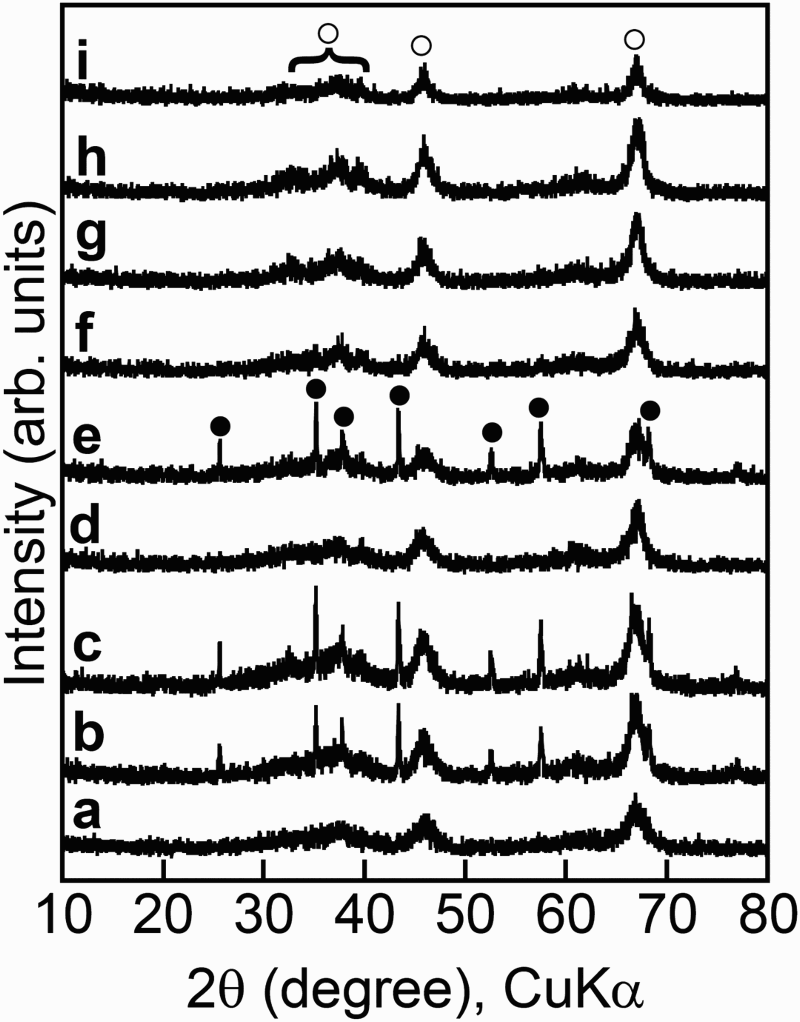
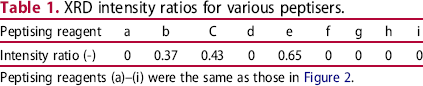
Figure 1 shows the XRD patterns of the prepared alumina gels, whose precursor sols were prepared using various peptisers. For all of the XRD patterns of the prepared alumina gels, the detected peaks were broad and diffused, which indicates that the main components in the prepared gels were amorphous or fine crystallite. A few broad peaks were also detected at approximately 20°, 30°, 40°, and 60°. Their patterns were roughly similar to a reported pattern of pseudoboehmite [22,23], although the peak positions are different for the product in this work and for pseudoboehmite. This result indicates that a trace amount of pseudoboehmite-like species was contained in the prepared alumina gels. Figure 2 shows the XRD patterns of alumina gels produced by annealing the prepared alumina gels. For nitric, acetic, oxalic, lactic, mandelic, and citric acids, the peaks were detected at ca. 38°, 46°, and 67°. They were attributed to γ-Al2O3 (JCPDS card #29–0063), which indicates that γ-Al2O3 formed during the 900°C annealing. For n-butyric, propionic, and formic acids, the peaks were detected at 25.6°, 35.2°, 43.4°, 52.6°, and 57.5° in addition to the peaks of γ-Al2O3. They were attributed to α-Al2O3 (JCPDS card #42–1468). Because these acids are carboxylic acids, their results indicate that the carboxylic acid is effective for crystallising alumina gel into α-Al2O3. Yamaguchi et al. [21] suggested that the interaction between the OH groups in PHA ions and the functional groups, such as −OH and −COOH of the hydroxy acid molecules, may modulate the PHA gel structure, which is favourable for low-temperature α-transformation. A similar mechanism was considered for the present work: the −COOH group of carboxylic acids and the alumina sol form a modulated gel structure that can transform into α-Al2O3. Although the lactic, mandelic, citric, and oxalic acids are also carboxylic acids, they did not effectively promote crystallisation. They have hydrophilic groups, such as the hydroxyl group or another carboxylic group. Because such groups can release protons, their presence may increase the ionic strength of the solution. Because an increase in ionic strength compresses the double layer on the colloidal particles [24-26], using acids with such hydrophilic groups probably decreases the double-layer repulsion between the sol particles and provides particle flocculation, which deteriorates the peptisation of the precipitate. As a result, the sol particles do not become small, which decreases the total surface area of particles and may decrease their surface energy. Thus, the alumina gel was not intensively crystallised into α-Al2O3 by the lactic, mandelic, citric, or oxalic acids. The acetic acid is a carboxylic acid with no hydroxyl group or another carboxyl group except for its carboxyl group. However, it did not promote crystallisation. The mechanism for acetic acid remains unclear. The XRD intensity ratios for various peptising reagents are summarised in Table 1. The ratios were 0.37, 0.43, and 0.65 for n-butyric, propionic, and formic acids, respectively. This result indicates that small carboxylic acid tends to effectively promote crystallisation. Because peptiser molecules act on the aluminium hydroxide precipitate to peptise the precipitate to fine alumina sol particles, they should be close to the sol particles or may be adsorbed onto the sol particle surface. The adsorbed peptiser molecules function as a physical barrier among the sol particles to prevent them from contacting. In the case of small peptiser molecules, the sol particles can contact even during the adsorption of the molecules on the particle surface because of the small size. Consequently, the easy contact promotes the particle growth of the sol molecules followed by their crystal growth.
XRD patterns of the prepared alumina gels. The peptisers to prepare alumina sols were (a) nitric acid, (b) n-butyric acid, (c) propionic acid, (d) acetic acid, (e) formic acid, (f) oxalic acid, (g) lactic acid, (h) mandelic acid, and (i) citric acid. ●: α-Al2O3 ○: γ-Al2O3. All P/A molar ratios were 0.15. XRD patterns of the alumina gels annealed at 900°C. The peptisers to prepare alumina sols were (a) nitric acid, (b) n-butyric acid, (c) propionic acid, (d) acetic acid, (e) formic acid, (f) oxalic acid, (g) lactic acid, (h) mandelic acid, and (i) citric acid. ●: α-Al2O3 ○: γ-Al2O3. All P/A molar ratios were 0.15. XRD intensity ratios for various peptisers. Peptising reagents (a)–(i) were the same as those in Figure 2.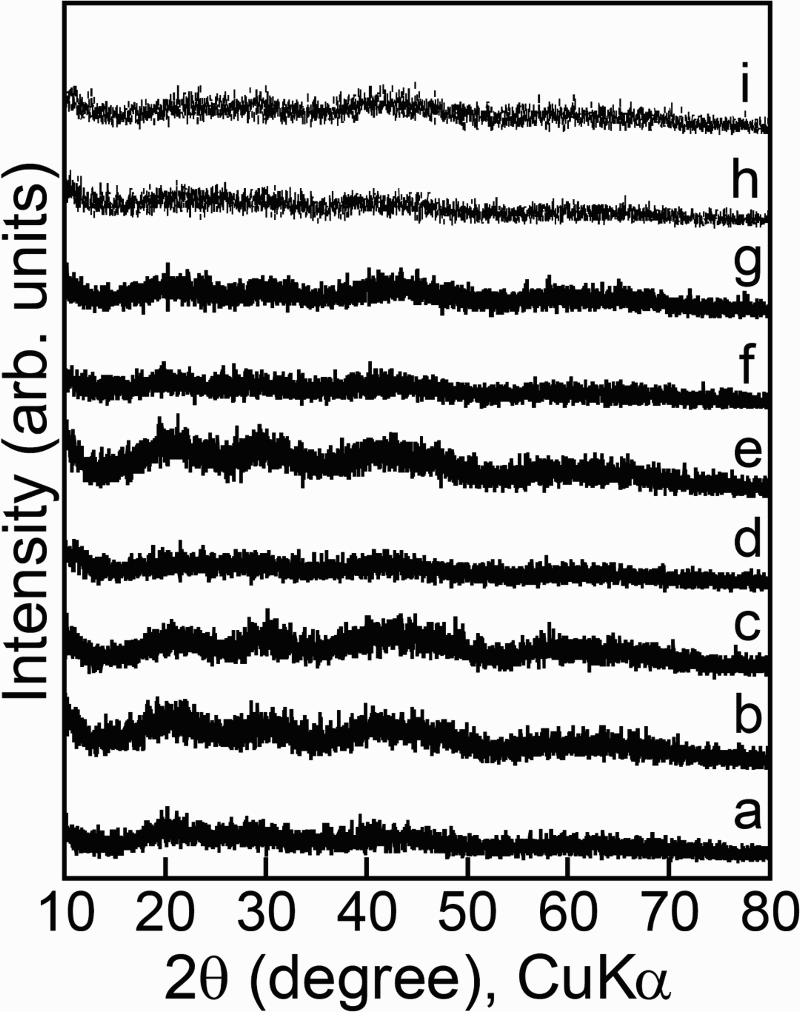
Effect of peptiser concentration
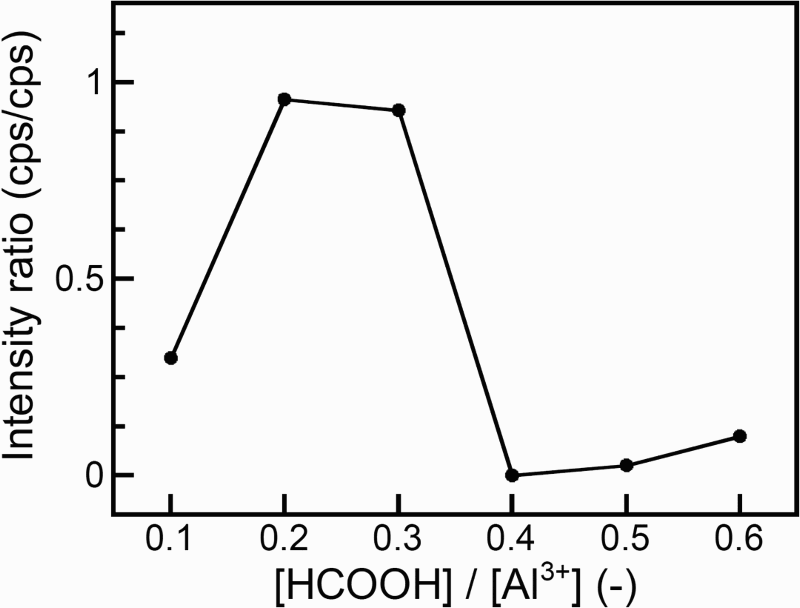
Figure 3 shows the XRD patterns of alumina gels annealed at 900°C, whose precursor sols were prepared using formic acid at various P/A ratios. The peaks of γ-Al2O3 were also detected at all examined P/A ratios. At a P/A ratio of 0.1, the peaks attributed to α-Al2O3 were detected. The intensity of the peaks of α-Al2O3 increased when the P/A ratio increased to 0.2 and 0.3. In contrast, the intensity of the peaks of γ-Al2O3 slightly decreased when the concentration increased. Figure 4 shows the XRD intensity ratio of α-Al2O3/γ-Al2O3 as a function of the P/A ratio. The intensity ratio was 0.297 at the P/A ratio of 0.1 and as high as 0.955 and 0.928 when the P/A ratio increased to 0.2 and 0.3, respectively. This increase in intensity ratio indicates that the crystallisation of alumina gel into α-Al2O3 is more promoted at larger P/A ratios. The high peptiser concentrations promote peptisation of aluminium hydroxide precipitate to form small sol particles. The formation of small sol particles increases the total particle surface area, which may increase the surface energy of particles. As a result, the alumina gel is intensively crystallised into α-Al2O3 at the high formic acid concentrations. Beyond the ratio of 0.3, the peaks of α-Al2O3 almost disappeared but were faintly detected. Further increase in formic acid concentration was considered to greatly increase the ionic strength of the solution. Thus, the high P/A ratios reduce the double-layer repulsion among the sol particles. As a result, the sol particles aggregate to form large particles, which decrease the total particle surface area. Therefore, crystallisation into α-Al2O3 is not intensively promoted at high P/A ratios.
XRD patterns of alumina gels annealed at 900°C. The peptiser to prepare alumina sol was formic acid, and the P/A was (a) 0.1, (b) 0.2, (c) 0.3, (d) 0.4, (e) 0.5, and (f) 0.6. ●: α-Al2O3 ○: γ-Al2O3. XRD intensity ratio of α-Al2O3/γ-Al2O3 from Figure 3 as a function of the P/A ratio ([HCOOH] /[Al3+]).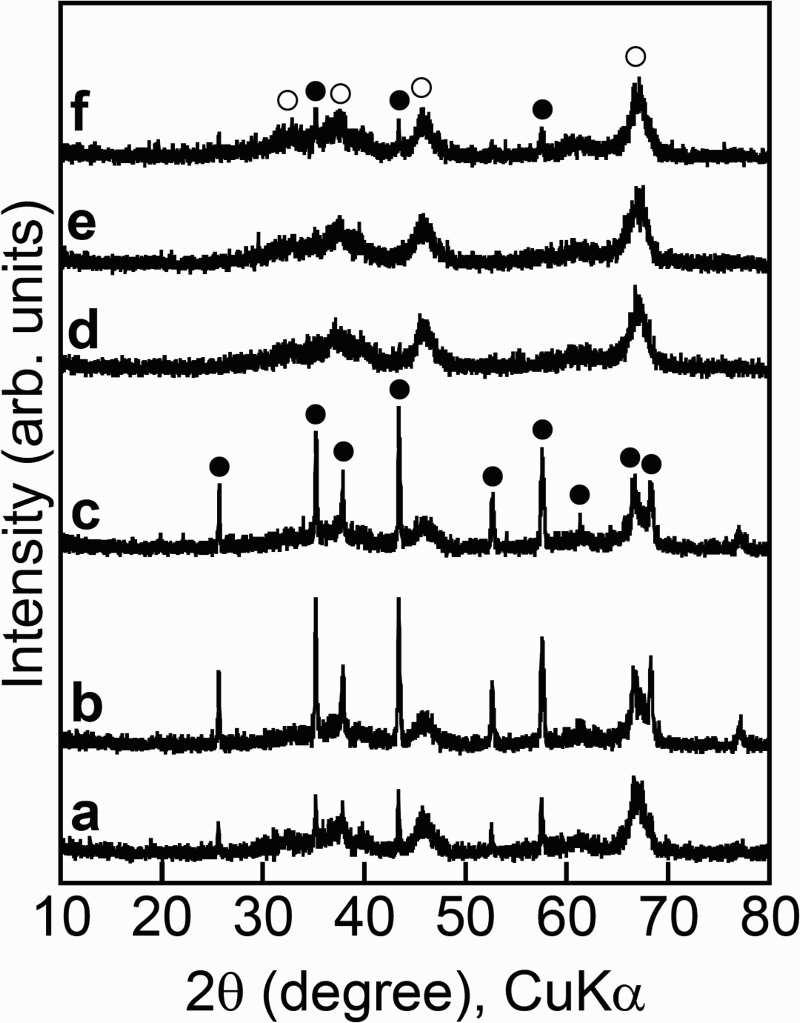
Effect of the annealing temperature
Figure 5 shows the XRD patterns of alumina gels annealed at various temperatures, whose precursor sols were prepared with formic acid at the P/A ratio of 0.2. The main component of the prepared gel was considered amorphous or fine crystallite because of the broad and diffused pattern. A trace amount of pseudoboehmite-like species was confirmed to be contained in the prepared gel. No dominant peaks were detected even at the annealing temperature as high as 400°C, which indicates that the alumina remained amorphous or fine crystallite, even with annealing at 400°C. At 500 and 600°C, the peaks attributed to α-Al2O3 were detected. Note that no peaks of γ-Al2O3 were detected. Various researchers have reported that diaspore (α-AlOOH) can be directly decomposed to α-Al2O3 not via the formation of γ-Al2O3 with annealing at ca. 450°C [27,28]. Accordingly, formic acid may promote the generation of diaspore-like species in the sol and subsequent crystallisation of the gel into α-Al2O3. Formic acid was found to function as an effective peptiser to crystallise the alumina gel into α-Al2O3. In addition, 500°C, which is the point when the crystallisation into α-Al2O3 began, is lower than the temperatures for conventional aluminas, which suggests that formic acid functions as an effective peptiser to produce α-Al2O3 at low temperature. Although the functions were considered to be related to the size of formic acid and the aldehyde of formic acid, its precise mechanism remains unclear. At 700°C, the peaks attributed to γ-Al2O3 were detected. Their intensities increased when the annealing temperature increased. Boehmite is transformed into γ-Al2O3 with annealing below 1000°C [29,30]. The peaks of pseudoboehmite-like species were faintly detected for the prepared alumina gel, as shown in Figure 5(a). The pseudoboehmite-like species, which is similar to boehmite, might have been transformed into γ-Al2O3 with the annealing at high temperatures.
XRD patterns of the annealed alumina gels. Sample (a) was as-prepared alumina gel at a P/A ratio of 0.2. Samples (b), (c), (d), (e), (f), and (g) were obtained by annealing sample (a) at 400, 500, 600, 700, 800, and 900°C, respectively. ●: α-Al2O3 ○: γ-Al2O3. ●: α-Al2O3 ○: γ-Al2O3.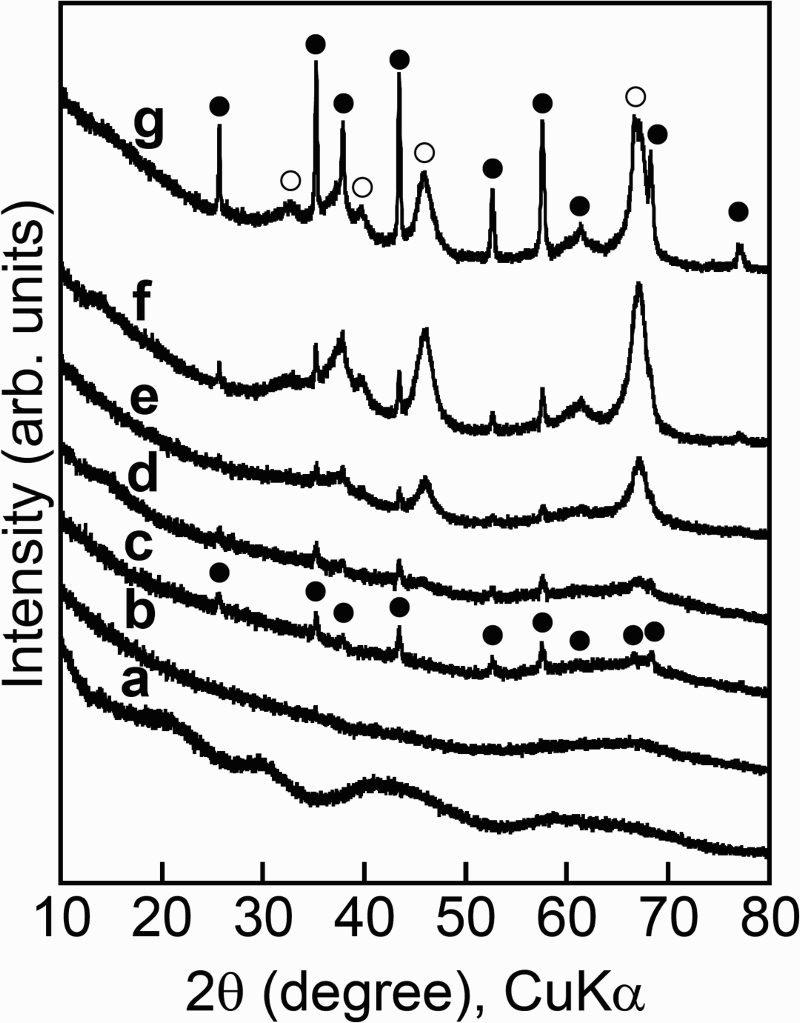
Towards complete crystallisation into α-Al2O3
The crystallisation into α-Al2O3 and γ-Al2O3 began at 500 and 700°C, respectively, and the mixture of α-Al2O3 and γ-Al2O3 was obtained by annealing at 900°C. Accordingly, annealing at over 900°C is required for complete crystallisation into α-Al2O3, which is similar to various studies on alumina hydroxides from aluminium salts, minerals, or aluminium alkoxide [5-12]. In the present work, the temperature at which the crystallisation into α-Al2O3 begins confirms that formic acid is an effective peptiser for generating diaspore-like species or a precursor of α-Al2O3. The temperature at which crystallisation into α-Al2O3 is completed should be decreased to save energy. The optimisation of parameters, such as the formic acid concentration, peptisation time, and annealing time, may decrease the temperature. The optimisation and discussion of the complete crystallisation mechanism are for future work, which is worth performing to save energy via the low-temperature crystallisation into α-Al2O3.
Conclusions
The homogeneous precipitation, using aluminium nitrate and urea in aqueous solutions, was performed to produce white precipitates of aluminium hydroxide. The transparent alumina sol was successfully produced by peptising aluminium hydroxide with the addition of a peptiser at room temperature. The alumina gel was produced by drying the alumina sol on a Petri dish. Various peptisers were examined to find a suitable peptiser for crystallising alumina gel into α-Al2O3 at low temperature. In the results, the crystallisation of alumina gel into α-Al2O3 was most promoted when formic acid was used as the peptiser. The crystallisation efficiency depended on the P/A molar ratio and was most dominant with the P/A molar ratio of 0.2. The alumina gel produced using formic acid at the P/A ratio of 0.2 began to crystallise into α-Al2O3 at the annealing temperature as low as 500°C.
Footnotes
Disclosure statement
No potential conflict of interest was reported by the authors.