







Abstract
Nonwords created by transposing two letters (e.g., RELOVUTION) are very effective at activating the lexical representation of their base words (Perea & Lupker, 2004). In the present study, we examined whether the nature of transposed-letter (TL) similarity effects was purely orthographic or whether it could also have a phonological component. Specifically, we examined transposed-letter similarity effects for nonwords created by transposing two nonadjacent letters (e.g., relovución–REVOLUCIÓN) in a masked form priming experiment using the lexical decision task (Experiment 1). The controls were (a) a pseudohomophone of the transposed-letter prime (relobución–REVOLUCIÓN; note that B and V are pronounced as /b/ in Spanish) or (b) an orthographic control (relodución–REVOLUCIÓN). Results showed a similar advantage of the TL nonword condition over the phonological and the orthographic control conditions. Experiment 2 showed a masked phonological priming effect when the letter positions in the prime were in the right order. In a third experiment, using a single-presentation lexical decision task, TL nonwords produced longer latencies than the orthographic and phonological controls, whereas there was only a small phonological effect restricted to the error data. These results suggest that TL similarity effects are orthographic—rather than phonological—in nature.
When we read the sentence “MARIE ANTOINETTE WAS THE QUEEN OF FRANCE WHEN THE FRENCH RELOVUTION STARTED”, we may not notice that the word REVOLUTION was misspelled—two letters were exchanged. Interestingly, replacing one or two letters of the same word (e.g., REVOMUTION or RESOMUTION) makes the misspelling much more noticeable (see Grainger & Whitney, 2004; Perea & Lupker, 2004). In other words, nonwords created by letter transpositions have a strong tendency to be misperceived as words, a tendency that is greater than that for replacement-letter nonwords (see Bruner & O'Dowd, 1958; Chambers, 1979; O'Connor & Forster, 1981, for early evidence of transposed-letter similarity effects).
The systematic analysis of lexical similarity is a central issue for any computational model of visual word recognition, and transposed-letter (TL) similarity effects are the focus of a growing body of research (e.g., Davis & Bowers, 2004; Grainger & van Heuven, 2003; Perea, Rosa, & Gómez, 2005; Schoonbaert & Grainger, 2004). For instance, in masked-priming lexical decision experiments, TL nonword primes produce not only form-priming effects relative to an orthographic control (e.g., jugde–JUDGE vs. jupte–JUDGE; Perea & Lupker, 2004; see also Andrews, 1996; Forster, Davis, Schoknecht, & Carter, 1987; Schoonbaert & Grainger, 2004), but also associative-priming effects (e.g., jugde–COURT vs. ocaen–COURT; Perea & Lupker, 2003a). Further, TL similarity effects are not restricted to the transposition of adjacent letters, but they also occur when the transposed letters are not adjacent (e.g., caniso–CASINO vs. caviro–CASINO; Perea & Lupker, 2004).
The presence of transposed-letter similarity effects in reading appears to rule out the “position-specific” coding schemes that have been employed in most computational models of visual word recognition (e.g., the interactive- activation model, Rumelhart & McClelland, 1982, and its extensions: the dual-route cascaded model, Coltheart, Rastle, Perry, Ziegler, & Langdon, 2001, and the multiple read-out model, Grainger & Jacobs, 1996). In these models, the replacement-nonword REVOMUTION would share all the letters but one (i.e., nine letters) with its base word, whereas the TL nonword RELOVUTION would only share eight letters with its base words. As a result, these models (wrongly) predict that the replacement-letter nonword REVOMUTION would be “more perceptually similar” to REVOLUTION than would the TL nonword RELOVUTION.
Recently, several researchers have proposed new input coding schemes that can successfully accommodate the presence of transposed-letter similarity effects: the SOLAR model (Davis, 1999) and the SERIOL model (Whitney, 2001). In these models, the order of the letters is coded by the relative activity of the set of letter nodes, so that the TL nonword RELOVUTION and its base word REVOLUTION would just produce different activation patterns across the letter nodes that they share (e.g., in the word REVOLUTION, the letter node corresponding to R is the one associated with the highest activation value, the letter node corresponding to the letter E is associated with a slightly smaller activation value, etc.). But for our purposes, the crucial point here is that, according to both the SOLAR and SERIOL models, nonwords created by transposing nonadjacent letters are highly similar to their base words (see Perea & Lupker, 2003b, 2004, for a more detailed discussion).
In the present paper, we wished to examine the orthographic/phonological nature of transposed-letter similarity effects. For simplicity, the current implementations of the SOLAR and the SERIOL models assume that transposed-letter similarity effects are orthographic in nature, although Davis (1999) has examined how the SOLAR model could be expanded to deal with phonological effects (see General Discussion section). However, a recent finding suggests that transposed-letter similarity effects might have a phonological locus. In a series of masked-priming experiments in Spanish, Perea and Lupker (2004) found that transposed-letter effects occurred especially to consonant transpositions rather than to vowel transpositions (i.e., relovución–REVOLUCIÓN rather than revuloción–REVOLUCIÓN), supporting the claims that there may be some basic processing differences between vowels and consonants (Caramazza, Chialant, Capasso, & Miceli, 2000; see also Berent & Perfetti, 1995; Lee, Rayner, & Pollatsek, 2001; Nespor, Peña, & Mehler, 2003). This finding cannot be readily accommodated by the SOLAR or SERIOL models, because these models do not differentiate between the processing of consonants and vowels. Thus, if TL effects are purely orthographic, these models would require some major modifications in their coding schemes to deal with the different results for consonant and vowel transpositions (see Perea & Lupker, 2004).
One alternative explanation for the consonant/vowel differences observed by Perea and Lupker (2004) is to assume that those differences arise at the sublexical phonological level rather than at the orthographic level. Indeed, there is strong evidence for the involvement of phonological processing in word identification (e.g., masked priming, Carreiras, Ferrand, Grainger, & Perea, 2005; Ferrand & Grainger, 1994; Frost, Ahissar, Gottesman, & Tayeb, 2003; parafoveal preview, Pollatsek, Lesch, Morris, & Rayner, 1992). In this light, some theorists have claimed that the process of identifying visual words necessarily involves the computation of phonology (“strong phonological theory”; see Frost, 1998). Another piece of evidence that is consistent with the key role of phonology in visual word recognition is that masked syllabic priming effects in Spanish seem to be phonological in nature (Álvarez, Carreiras, & Perea, 2004). More specifically, Álvarez et al. (2004; Exp. 2) found that the syllabic primes co.run and its phonological counterpart ko.run are more effective at priming CO.RAL than the nonsyllabic primes cor.me and kor.me. (In these examples, we denote syllable structure using a dot, though the stimuli themselves did not contain the dot.) Further, masked phonological priming effects in Spanish (e.g., co.nal–CA.NAL vs. ci.nal–CA.NAL) are of similar magnitude for high- and low-frequency words (Pollatsek, Perea, & Carreiras, 2005), which suggests that phonological coding occurs for all words; that is, phonological coding is not merely a backup process for low-frequency words.
To examine the involvement of phonology in transposed-letter similarity effects we exploited the pronunciations of the consonant letters B and V in Spanish, which are exactly the same (/b/). (As in modern French or English, the letter V in medieval Spanish used to be pronounced as/v/; this sound has been lost in modern Spanish because of the influence of the Basque language—which lacks the /v/ sound—over the early stages of Castilian Spanish.) Specifically, using the masked-priming technique (Experiment 1), we asked whether transposed-letter similarity effects have a phonological component by comparing pairs such as relobución–REVOLUCIÓN vs. relodución–REVOLUCIÓN—note that relobución is pronounced exactly the same as the TL nonword relovución. (Note that the “nonadjacent” letter transpositions were always separated by a single letter: always a vowel, so that the syllable structure would remain the same.) Further, we also examined the orthographic component of transposed-letter similarity effects by comparing pairs such as relovución–REVOLUCIÓN and relobución–REVOLUCIÓN. That is, the target word REVOLUCIÓN could be preceded by the TL nonword relovución, by its phonological counterpart relobución, or by its orthographic control relodución. As a further control, Experiment 2 was designed to examine masked phonological priming effects when the letters of the prime were in the right order (i.e., the identity prime revolución–REVOLUCIÓN, the pseudohomophone prime rebolución–REVOLUCIÓN, and the orthographic the control redolución–REVOLUCIÓN). In an effort to obtain additional evidence on the role of phonology in transposed-letter similarity effects, in Experiment 3 we employed a single-presentation lexical decision task and asked: (a) whether the TL nonwords created by transposing two nonadjacent letters (RELOVUCIÓN) are more competitive (in terms of the number of false positives and longer latencies) than their phonological controls (RELOBUCIÓN), and (b) whether the phonological controls (RELOBUCIÓN) are more competitive than the orthographic controls (RELODUCIÓN).
Finally, it is important to note that, in terms of calculated similarity in the SOLAR model, the similarity match between the input REVOLUCIÓN and word node REVOLUCIÓN would be 1.00. (The details of the match calculation can be found in Davis, 2005, although any match value varies between 0 and 1, where 0 indicates no match, and 1 indicates a perfect match between the input stimulus and the specified word node.) The similarity match to REVOLUCIÓN would be reduced to .76 for the TL nonword RELOVUCIÓN and to .73 for the phonological control RELOBUCIÓN and for the orthographic control RELODUCIÓN. That is, the SOLAR model predicts a difference between the TL nonword condition and the other two conditions (i.e., the model only predicts an effect of orthography). The SERIOL model would make a similar prediction: The similarity match to REVOLUCIÓN would be .87 for the TL nonword RELOVUCIÓN, whereas it would be reduced to .80 for both RELOBUCIÓN and RELODUCIÓN. 1 These predictions are not surprising: Neither the SOLAR model nor the SERIOL model has implemented a phonological module. If we observe differences between the phonological control condition and the orthographic control condition, the implementations of the SOLAR and SERIOL models would need to be expanded to accommodate the presence of phonological TL effects.
We thank Colin Davis and Carol Whitney for providing us with the match scores.
Experiment 1
Method
Participants
A total of 24 students from the University of València received course credits for participating in the experiment. All of them either had normal or corrected-to-normal vision and were native speakers of Spanish.
Materials
The targets were 60 Spanish words of 6 to 11 letters (mean word frequency in the Alameda & Cuetos, 1995, count, 41 per million; range, 2–170; mean number of “orthographic” neighbours, 0.9; range: 0–5). The targets were presented in uppercase and were preceded by primes in lowercase that were: (a) the same as the target except for a transposition of two nonadjacent interior consonants (always separated by a vowel; TL condition), relovución–REVOLUCIÓN; (b) the same as the TL condition except for the exchange of a B/V letter, relobución–REVOLUCIÓN (phonological control condition); and (c) the same as the TL condition except for the replacement of a B/V letter with a consonant letter that does not sound like /b/, relodución–REVOLUCIÓN (orthographic control condition). The primes were always nonwords. An additional set of 60 orthographically nonwords (e.g., MUVULENTE, FESBENIA) of 6 to 11 letters was included for the purposes of the lexical decision task. The manipulation of the nonword trials was the same as that for the word trials (e.g., muluvente–MUVULENTE, mulubente–MUVULENTE, muludente–MUVULENTE). Three lists of materials were constructed so that each target appeared once in each list, but each time in a different priming condition. Different groups of participants were used for each list. The prime–target pairs are given in the Appendix.
Procedure
Participants were tested in groups of 2 to 4 in a quiet room. Presentation of the stimuli and recording of response times were controlled by Apple Macintosh Classic II microcomputers. Reaction times were measured from target onset until the participant's response. On each trial, a forward mask consisting of a row of hash marks (#s, as many marks as the number of letters of the prime/target stimuli) was presented for 500 ms in the centre of the screen. Next, a centred lowercase prime was presented for 50 ms. (We chose a 50-ms prime duration because it was the same as that used in the consonant/vowel manipulation in the Perea & Lupker, 2004, experiments; see Introduction.) Primes were immediately replaced by an uppercase target item, which remained on the screen until the response. Participants were instructed to press one of two buttons on the keyboard to indicate whether the uppercase letter string was a legitimate Spanish word or not. Participants were instructed to make this decision as quickly and as accurately as possible. Participants were not informed of the presence of lowercase items. Each participant received a different order of trials. Each participant received a total of 20 practice trials (with the same manipulation as that in the experimental trials) prior to the 120 experimental trials. The whole session lasted approximately 8 min.
Results and discussion
Incorrect responses (5.8% of the data for word targets) and reaction times less than 250 ms or greater than 1,500 ms (0.5% of the data for word targets) were excluded from the latency analysis. We conducted two critical contrasts: (a) the comparison between the TL condition and its phonological control (effect of orthography: relovución–REVOLUCIÓN vs. relobución–REVOLUCIÓN), and (b) the comparison between the phonological control and the orthographic control (effect of phonology: relobución–REVOLUCIÓN vs. relodución–REVOLUCIÓN). These contrasts were conducted based on both the subject (F1) and the item (F2) means. To extract the variance due to the error associated with the lists, list was included as a dummy variable in all comparisons. All significant effects had p values less than the .05 level. The mean response times and error percentages from the subject analysis are presented in Table 1.
Mean lexical decision times a and percentage of errors for word and nonword targets in Experiment 1
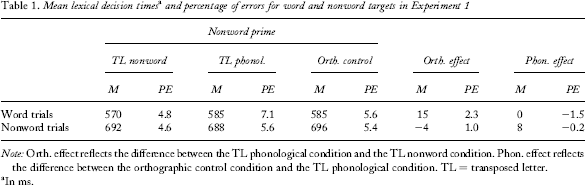
Note: Orth. effect reflects the difference between the TL phonological condition and the TL nonword condition. Phon. effect reflects the difference between the orthographic control condition and the TL phonological condition. TL = transposed letter.
In ms.
Word data
Targets preceded by a TL nonword were responded to 15 ms faster than the targets preceded by the phonological control, F1(1, 21) = 5.42; F2(1, 57) = 4.01. In addition, the mean response time was the same for the targets preceded by the phonological control and for the targets preceded by the orthographic control (585 ms in the two conditions), both Fs < 1. None of the contrasts on the error data was statistically significant (all ps > .10).
Nonword data
None of the contrasts approached significance (all ps > .10).
The results were straightforward. There was a significant priming effect (15 ms) from nonadjacent TL nonword primes (relovución–REVOLUCIÓN) relative to the phonological control condition (relobución–REVOLUCIÓN), whereas there was virtually no difference between the phonological and the orthographic control conditions (relobución–REVOLUCIÓN and relodución–REVOLUCIÓN). It may be worth noting that recent research in Spanish (see Perea & Lupker, 2004) has shown a nonsignificant 7-ms difference between a two-consonant replacement condition and an unrelated condition. As a result, the lack of a difference between the TL phonological condition (relobución–REVOLUCIÓN) and the two-consonant replacement condition (relodución–REVOLUCIÓN) in the present experiment suggests that the TL phonological condition may be only slightly better than a completely unrelated condition.
Thus, nonadjacent TL nonwords do activate, to a greater degree than phonological/orthographic control nonwords, the lexical representation of their base words, extending the findings of Perea and Lupker (2004). Further, this effect is orthographic in nature, as deduced by the lack of a difference between the orthographic control condition (relobución–REVOLUCIÓN) and the phonological control condition (relodución–REVOLUCIÓN). It is important to note that the observed pattern of priming effects is consistent with the predictions of the SOLAR and SERIOL models.
Experiment 2
Experiment 1 has shown that transposed-letter similarity effects seem to be orthographic rather than phonological in nature. However, one could argue that we have not shown the presence of phonological effects in the first place. To overcome this potential criticism, Experiment 2 was designed to examine masked phonological priming effects with the same set of targets when the letters of the prime were in the right order. The conditions were: (a) an identity condition revolución–REVOLUCIÓN, (b) a pseudohomophone condition rebolución–REVOLUCIÓN, and (c) an orthographic control condition redolución—REVOLUCIÓN.
If there is an advantage of rebolución–REVOLUCIÓN over the orthographic control redolución–REVOLUCIÓN (i.e., a phonological priming effect), this would reinforce the view that the lack of a phonological effect in Experiment 1 can be accounted for by considering orthographic structure alone, and it consequently suggests that transposed-letter effects are orthographic in nature.
Method
Participants
A total of 27 students from the University of València received course credits for participating in the experiment. All of them either had normal or corrected-to-normal vision and were native speakers of Spanish. None of them had participated in Experiment 1.
Materials
The word and nonwords targets were the same as those in Experiment 1. The word targets were presented in upper case and were preceded by primes in lower case that were: (a) the same as the target revolución–REVOLUCIÓN, (b) the same as the target except for the exchange of a B/V letter, rebolución–REVOLUCIÓN (phonological control condition), and (c) the same as the target except for the replacement of a B/V letter with a consonant letter that does not sound like /b/, redolución–REVOLUCIÓN (orthographic control condition). The primes were always nonwords. The manipulation of the nonword trials was the same as that for the word trials (e.g., muvulente–MUVULENTE, mubulente–MUVULENTE, mudulente–MUVULENTE). Three lists of materials were constructed so that each target appeared once in each list, but each time in a different priming condition. Different groups of participants were used for each list.
Procedure
The procedure was the same as that in Experiment 1.
Results and discussion
Incorrect responses (4.5% of the data for word targets) and reaction times less than 250 ms or greater than 1,500 ms (less than 0.2% of the data for word targets) were excluded from the latency analysis. We conducted two critical contrasts: (a) the comparison between the identity condition and its phonological control (effect of orthography: revolución–REVOLUCIÓN vs. rebolución–REVOLUCIÓN), and (b) the comparison between the phonological control and the orthographic control (effect of phonology: rebolución–REVOLUCIÓN vs. redolución–REVOLUCIÓN). The mean response times and error percentages from the subject analysis are presented in Table 2.
Mean lexical decision times a and percentage of errors for word and nonword targets in Experiment 2
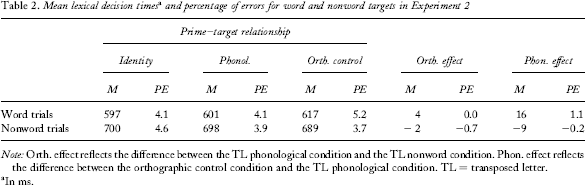
Note: Orth. effect reflects the difference between the TL phonological condition and the TL nonword condition. Phon. effect reflects the difference between the orthographic control condition and the TL phonological condition. TL = transposed letter.
In ms.
Word data
Targets preceded by a pseudohomophone (rebolución–REVOLUCIÓN) were responded to 16 ms faster than the targets preceded by the orthographic control (redolución–REVOLUCIÓN), F1(1, 24) = 4.76; F2(1, 57) = 4.01. In addition, the mean response time was only 4 ms faster for the targets preceded by an identity prime than for the targets preceded by a pseudohomophone (597 vs. 601 ms, respectively), both Fs < 1. None of the contrasts on the error data was statistically significant (all ps > .10).
Nonword data
None of the contrasts approached significance (all ps > .10).
The results were straightforward. There was a significant priming effect (16 ms) from the pseudohomophone condition (rebolución–REVOLUCIÓN) relative to the orthographic control condition (redolución–REVOLUCIÓN), whereas there was virtually no difference (only 4 ms) between the pseudohomophone and identity conditions (rebolución–REVOLUCIÓN and revolución–REVOLUCIÓN).
In sum, the present experiment showed that the pseudohomophone prime rebolución was as effective as the identity prime revolución—and more effective than the orthographic control redolución. This is consistent with previous empirical evidence that shows phonological priming effects at stimulus onset asynchronies (SOAs) of 50 ms or even less (see Frost et al., 2003; see also Pérez, 2004, or Pollatsek et al., 2005, for evidence in Spanish). Thus, these results are consistent with the view that phonological activation appears to be an automatic part of word identification in Spanish (see also Carreiras & Perea, 2002; Pollatsek et al., 2005).
It is important to note that Carreiras et al. (2005; see also Álvarez et al., 2004) found that it is possible to obtain masked phonological priming in a lexical decision task when the overlap between primes and targets is partial (one out of two phonological syllables) and when orthographic overlap is minimal—that is, faster responses to fomie–FAUCON than to fémie–FAUCON (note that fo and fau are pronounced the same in French).
The lack of a phonological effect in Experiment 1 (relobución–REVOLUCIÓN vs. relodución–REVOLUCIÓN) suggests that the inclusion of a consonant letter in the wrong letter position (e.g., the letter b in the TL phonological prime relobución) would be enough to prevent any effect of phonological similarity in masked priming, independently of the pronunciation of that consonant letter. In other words, it is necessary to achieve some degree of orthographic similarity in the left-to-right sequence to obtain a phonological effect.
Experiment 3
The results of Experiment 1 have shown that nonadjacent TL nonwords activate, to a greater degree than phonological/orthographic control nonwords, the lexical representation of their base words. The goal of Experiment 3 was to obtain converging evidence on the role of phonology versus orthography in TL similarity effects using a single-presentation lexical decision task (see Perea & Lupker, 2004). This task has the advantage that the magnitude of TL effects is magnified (see Perea & Lupker, 2004). Furthermore, the single-presentation lexical decision task may tap some late processes that cannot be captured in a masked-priming technique.
We used the masked primes of Experiment 1 as the nonword targets. A set of word targets was selected for the purposes of the lexical decision task. We reasoned that “wordlike” nonwords (e.g., pseudohomophones like BRANE, or one-letter replacement nonwords like BOUSE) should produce slower “no” responses and more errors than “nonwordlike” nonwords (e.g., nonwords with no similarly spelled words like ROSMIL) in lexical decision tasks (e.g., Coltheart, Davelaar, Jonasson, & Besner, 1977; Forster & Shen, 1996; Perea & Rosa, 2000). The explanation is that wordlike nonwords partially activate the lexical representations of their neighbours. Thus, additional time is needed for the activation levels to settle and for the subject to realize that no word unit is being activated over threshold (see Perea & Lupker, 2004). If TL effects are orthographic in nature, TL nonwords (e.g., RELOVUCIÓN) should activate the lexical representation of their corresponding base words (REVOLUCIÓN) to a much higher degree than should phonological controls (REBOLUCIÓN), and hence one would expect a higher rate of “word” responses and longer latencies for the “nonword” responses to TL nonwords than for the phonological controls. However, if TL similarity effects have a late phonological component, TL phonological nonwords (e.g., RELOBUCIÓN) should activate the lexical representation of their corresponding base words (REVOLUCIÓN) to a higher degree than should orthographic controls (RELODUCIÓN), and hence one would expect a higher rate of “word” responses and longer latencies for the “nonword” responses to the phonological controls than to the orthographic controls (see Pérez, 2004, for evidence of a pseudohomophone effect in lexical decision in Spanish).
Method
Participants
A total of 24 students from the Universitat de València took part in the experiment. All of them had normal or corrected-to-normal vision and were native speakers of Spanish. None of them had participated in the previous experiments.
Materials
The 60 word targets from Experiment 1 were used to create the three nonword conditions (the TL nonwords, the phonological controls, and the orthographic controls). That is, the nonword targets in the present experiment had been the nonword primes in Experiment 1. An additional set of 60 words that were 6 to 11 letters long (mean frequency per million words, 42; range, 10–243) was included for the purposes of the lexical decision task. To avoid any uncontrolled effects of initial syllable frequency (Carreiras & Perea, 2004; Perea & Carreiras, 1998), all the nonwords maintained the initial syllable of their base words (see Appendix). The TL nonwords (e.g., RELOVUCIÓN), the phonological controls (RELOBUCIÓN), and the orthographic controls (RELODUCIÓN) were all orthographically legal and had, on average, 0.1 neighbours each. The mean positional token bigram frequencies were virtually the same in the three conditions (2,016, 2,017, and 2,018 per million in the TL nonword, phonological control, and orthographic control conditions, respectively; Sebastián-Gallés, Martí, Carreiras, & Cuetos, 2000).
Three lists of materials were constructed so that if the TL nonword RELOVUCIÓN appeared in one list, its phonological control (RELOBUCIÓN) would appear in another list, and its orthographic control (RELODUCIÓN) in the other list. Different groups of participants were used for each list.
Procedure
Participants were tested individually in a quiet room. Presentation of the stimuli and recording of response times were controlled by Apple Macintosh Classic II microcomputers. On each trial, a centred uppercase target item remained on the screen until response. Participants were instructed to press one of two buttons on the keyboard to indicate whether the letter string was a legitimate Spanish word or not. Participants were instructed to make this decision as quickly and as accurately as possible. Each participant received a different order of trials. A total of 24 practice trials was given prior to the 120 experimental trials. The whole session lasted approximately 9 min.
Results and discussion
Incorrect responses (22.7% of the data for nonword targets, 6.3% for the word targets) and reaction times less than 250 ms or greater than 1,500 ms (4.3% of the data for nonword targets) were excluded from the latency analysis. The mean response times and error percentages from the subject analysis are presented in Table 3. As in Experiment 1, we conducted planned contrasts, this time on the nonword data, to assess the effects of orthography and phonology in TL similarity effects.
Mean lexical decision times a and percentage of errors for nonword targets in Experiment 3
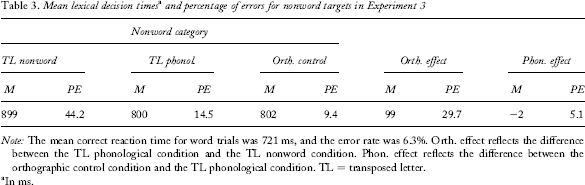
Note: The mean correct reaction time for word trials was 721 ms, and the error rate was 6.3%. Orth. effect reflects the difference between the TL phonological condition and the TL nonword condition. Phon. effect reflects the difference between the orthographic control condition and the TL phonological condition. TL = transposed letter.
In ms.
Nonword targets created by transposing two nonadjacent letters (RELOVUCIÓN) were responded to 99 ms slower than phonological nonwords (RELOBUCIÓN; effect of orthography), F1(1, 21) = 31.93; F2(1, 54) = 42.67. (Three items were not included in the F2 analysis because there were no correct RT data in the TL nonword condition.) Latencies to phonological control nonwords and orthographic control nonwords (RELOBUCIÓN and REVODUCIÓN) did not differ (effect of phonology), both Fs < 1. The median RT did not show any effect of phonology either: The median RTs were 801 versus 797 ms for the phonological and the orthographic controls, respectively.
The ANOVA on the error data showed that there were significantly fewer errors to phonological TL nonwords than to transposed-letter nonwords, F1(1, 21) = 120.49; F2(1, 57) = 88.73. Interestingly, there were also fewer errors to orthographic control nonwords than to phonological control nonwords, F1(1, 21) = 4.54; F2(1, 57) = 6.83.
Consistent with prior research, TL nonwords created by transposing two nonadjacent letters seem to activate their base word to a considerable degree—at least when the nonadjacent letters are separated by a single letter. Indeed, the effect was quite dramatic in terms of error rates (44.2%; see also Perea & Lupker, 2004, for similar error rates). It is important to stress that the very high error rates for the TL nonwords do not reflect a lenient decision criterion for “word” responses; instead, they reflect the high degree of perceptual similarity between the TL nonwords and their corresponding base words (see Perea & Lupker, 2004). For any skilled reader of Spanish, it is rather difficult to process/pronounce correctly a TL nonword such as PRIVAMERA under time pressure (the base word would be PRIMAVERA, the Spanish for spring).
The main result of Experiment 3 is that there was a dramatic effect of orthography over phonology in transposed-letter effects (i.e., a difference between nonwords like RELOVUCIÓN and RELOBUCIÓN) in both response times and error rates (the difference was 99 ms and 29.7% in the latency and error data, respectively). Although there was a small effect of phonology (i.e., a difference between nonwords like RELOBUCIÓN and RELODUCIÓN), this effect was restricted to the error rates (around 5%), and it did not occur in the latency analysis (a 2-ms difference). We must bear in mind that, for the error rates, the size of the orthographic effect (as measured by η2) was dramatically higher (.85 and .61 in the F1 and F2 analyses, respectively) than the size of the phonological effect (.17 and .11 in the F1 and F2 analyses, respectively). We believe that the presence of a small phonological component in transposed-letter effects with the single-presentation lexical decision task may be due to the fact that this technique taps processes that occur later in processing (e.g., some verification mechanisms that are sensitive to phonology, see Ziegler, Jacobs, & Klüppel, 2001) and that cannot be captured with the masked-priming technique.
General Discussion
The present experiments allow the following conclusions: (a) Nonword primes created by transposing two nonadjacent letters produce masked-priming effects relative to phonological controls; (b) phonological TL primes do not enjoy any advantage in the masked-priming technique over the orthographic controls; (c) the absence of phonological priming with TL primes is not due to lack of phonological processing, since pseudohomophone primes are as effective as the identity prime, and they are more effective than an orthographic control condition; and (d) in a single-presentation lexical decision task, TL nonwords produce substantially longer latencies and more errors than phonological controls and orthographic controls, and, in turn, these phonological controls produce slightly more errors (but not longer latencies) than the orthographic controls.
The presence of nonadjacent transposed-letter similarity effects adds further problems for any model that assumes a position-specific coding scheme (e.g., the interactive-activation model and its extensions). But the central finding in the present experiments is that transposed-letter similarity effects have a definite orthographic (rather than phonological) component. This result is consistent with the common view that transposed-letter similarity effects have an early locus, probably at an orthographic/graphemic level of representation. 2
As pointed out by an anonymous reviewer, the fact that only B/V substitutions were used may somehow weaken the implications of the observed results. Nonetheless, the results with the masked-priming technique (in which participants cannot identity the primes) make it unlikely that the participants would have acquired some awareness of the B/V manipulation.
In general, the present data are consistent with the predictions of the SOLAR and SERIOL models. In these models, the similarity between the nonadjacent TL nonwords and their corresponding base words is higher than the similarity between the phonological/orthographic controls and their corresponding base words, leading to the prediction of transposed-letter similarity effects that should not be affected by the phonology of the replaced letters. (Similar predictions can be made by other recently proposed letter-coding schemes: the open-bigram model, Grainger & van Heuven, 2003, and the overlap model, Gómez, Perea, & Ratcliff, 2003.) The only potential shortcoming is that the predicted transposed-letter similarity effect is posited to be quite small. This was indeed the case in the masked-priming experiment (15 ms in Experiment 1); note, however, that masked-priming effects are generally small, and a 15-ms effect is a rather sizeable effect. However, the effect approached 100 ms in the single- presentation lexical decision task.
Taken together, these results suggest that the differences in lexical similarity between RELOVUCIÓN and REVOLUCIÓN on the one hand, and RELOBUCIÓN and REVOLUCIÓN on the other, may be higher than those predicted by the models (the similarity matches in the SOLAR model are .76 and .73, respectively). (Note, however, that the open-bigram model, Grainger & van Heuven, 2003, and the overlap model, Gómez et al., 2003, may predict somehow larger priming effects.) Likewise, in a recent experiment in out laboratory we found that nonadjacent TL nonwords such as RELOVUCIÓN are even more competitive in a lexical decision task than are one-letter replacement nonwords such as REVOTUCIÓN, a finding that is not predicted by the SERIOL and SOLAR models. To accommodate these findings, some tweaking with the parameters of the SOLAR and SERIOL models is required. But perhaps the most critical finding for the SOLAR and SERIOL models is that the present data suggest that the differential transposed-letter effects for consonants and vowels found by Perea and Lupker (2004) are likely to be orthographic (rather than phonological) in origin. 3
One other clue that indicates that transposed-letter effects are orthographic in origin is that, similarly to the density constraint with one-letter different primes (Forster et al., 1987), target words in a low-density neighbourhood show a strong transposed-letter priming effect (relative to an unrelated control condition), whereas target words in a high-density neighbourhood do not show any transposed-letter priming effects (Perea & Lupker, 2004). The point here is that the neighbourhood density constraint has typically been assumed to be due to the way orthography is represented and used in activating lexical units (see Forster et al., 1987; Perea & Rosa, 2000). Thus, it is difficult to maintain the position that transposed-letter priming effects are due to something other than the nature of orthographic coding.
What should also be noted is that the absence of a relevant role of phonology in transposed-letter similarity effects does not preclude the important role played by phonology in visual word recognition (e.g., see Carreiras et al., 2005). Experiment 2 showed an advantage of the pseudohomophone prime rebolución–REVOLUCIÓN over the orthographic control condition (redolución–REVOLUCIÓN), and, indeed, response times for the pseudohomophone condition were very close to those in the identity condition (only 4 ms apart). That is, a robust phonological priming effect emerged when the graphemes were in the right order. Clearly, the implementations of the SOLAR and SERIOL models will need to be expanded to accommodate the presence of phonological effects in lexical decision and reading—and also to be able to simulate data with the naming task. In this light, Davis (1999) suggested that the SOLAR model could account for the pseudohomophone effect (i.e., longer lexical decision times for pseudohomophones like BRANE tha for orthographic controls) on the basis of having a phonological system with a coding structure parallel to that of the (already implemented) orthographic system. This implementation may predict a higher perceptual similarity between the TL phonological nonword RELOBUCIÓN and its base word REVOLUCIÓN than between the orthographic control RELODUCIÓN and its base word REVOLUCIÓN. Nonetheless, the actual perceptual similarity between the TL phonological nonwords and their base words may depend on the time course of the feedback between the orthographic and phonological systems. Simulation work on this extended SOLAR model would be needed to examine its predictions in masked priming and single-presentation lexical decision tasks.
In sum, the present findings provide new constraints for the development of computational models of visual word recognition. The data strongly suggest that the way that the brain codes the ordering of the letters within a word is determined at an orthographic/graphemic level rather than at a sublexical phonological level. 4 Even though we found a small effect of phonology in Experiment 3 (single-presentation lexical decision task), this effect was constrained to the error rates, and its magnitude was substantially smaller than the corresponding (orthographic) transposed-letter similarity effect. Thus, the most parsimonious explanation is that the nature of transposed-letter similarity effects is mainly orthographic, whereas phonology seems to be relegated to a secondary role.
As suggested by an anonymous reviewer, to disentangle a graphemic locus from an orthographic locus for transposed-letter effects, one would need to compare pairs such as paphmlet–PAMPHLET versus papmhlet–PAMPHLET.