







Abstract
One's own face possesses two properties that make it prone to grab attention: It is a face, and, in addition, it is a self-referential stimulus. The question of whether the self-face is actually an especially attention-grabbing stimulus was addressed by using a face–name interference paradigm. We investigated whether interference from a flanking self-face on the processing of a target classmate's name was stronger than interference from a classmate's flanking face on the processing of one's own name as the target. In a control condition a third familiar face served as the flanker for both decisions from the participant's own name and from the classmate's name. The presentation of the self-face as a flanker produced significantly more interference on the identification of a classmate's name than the presentation of that classmate's face did on the identification of one's own name. This result was due to the interfering power of the self-face and not to a particular resistance of one's name to interfering facial stimuli. We argue that the emotional value or the high familiarity of one's own face may explain its attention-grabbing property.
The distractive power of human faces seems to be particularly strong. Several studies found that when shown the name of a familiar person and asked to classify the person by occupation (e.g., as an actor or a politician), participants were slowed when the name was accompanied by a distractor face from the opposite category (e.g., Bindemann, Burton, & Jenkins, in press; Lavie, Ro, & Russell, 2003; Young, Ellis, Flude, McWeeny, & Hay, 1986). This slowdown is known as a (in)congruency effect. Asymmetrically, the presence of a distractor name did not affect, or affected to a lesser extent, semantic categorization of a person from his or her face. Recently, Lavie et al. (2003) suggested that faces are particularly hard to ignore because of their particular biological and social significance. It would not be adaptive to ignore faces, even if they are not task relevant, because they have the potential to carry important social cues.
Self-relevance is a property that makes stimuli particularly prone to attract one's attention as revealed by behavioural responses (Bargh, 1982) or electrophysiological measures (i.e., P300 event-related potentials; Gray, Ambady, Lowenthal, & Deldin, 2004; Ninomiya, Onitsuka, Chen, Sato, & Tashiro, 1998). One's own face may be seen as a particular stimulus in the sense that it possesses two properties that are prone to grab attention: It is a face, and it is a self-referential stimulus. Does possessing these two properties make the self-face be an especially attention-grabbing stimulus? This question, which, to the best of our knowledge, has not been tackled before, is addressed in the present study.
We investigated whether one's own face is more difficult to ignore as a distractor than is another familiar face (a classmate's face) when performing a name identification task (self-name vs. classmate's name). In order to test whether one's own face is a particularly strong face distractor, interference from one's own face on the processing of a target classmate's name was compared with interference from that classmate's face on the processing of one's own name as the target. This procedure must include a control condition. Indeed the own name itself has also been presented as a stimulus that is special for attention (Moray, 1959; Wolford & Morrison, 1980). Hence, the procedure described here might not allow deciding whether the occurrence of a stronger incongruency effect when the self-face is the distractor reflects a stronger interference from the participant's own face on the processing of the classmate's name (compared with interference from the classmate's face on the processing of one's name) or a stronger resistance of one's name to the interference from the classmate's face (compared with the resistance of the classmate's name to one's own face). However, recent research indicated that the visual presentation of one's own name does not really grab attention (Harris & Pashler, 2004; Harris, Pashler, & Coburn, 2004). The appearance of one's own name may provoke a momentary response of surprise that habituates rapidly, but would not enduringly capture attention. Nevertheless, to control whether one's own name was more resistant to incongruent faces than was the classmate's name, a third distractor face (the face of a professor familiar to all participants) was used both when the participant's own name was the target and when the classmate's name was the target.
In the current experiment, participants were asked to search for a name among two letter strings in the centre of a display and to indicate by a speeded key press whether it was their own name or that of a classmate. Letter strings were accompanied with a face to be ignored. The distractor could be the face of the person named (congruent condition) or the face of another person (incongruent conditions). In all conditions, the person named was either the participant or her/his classmate; in the incongruent conditions the distractor face was the participant's, the classmate's, or the professor's face.
Experiment
Method
Participants
A total of 24 volunteers (16 women) aged between 18 and 27 years (mean age = 21.1) participated. They had known their same-gender classmate for at least 2 years. All participants had normal or corrected-to-normal vision. Participants were recruited by pairs so that each participant served as the classmate for another participant. They had all attended one of the courses of the professor whose face was used as stimulus (see Stimuli) during at least one full semester. All participants gave written informed consent.
Stimuli
A full-face, frontal-view photograph of each participant showing a neutral facial expression was taken with a digital camera (Nikon Coolpix 2500). None of these participants had facial hair or wore glasses. The set of stimuli was tailored for each participant: one photograph of the participant's own face, one photograph of a same gender participant's classmate, and finally one photograph of the participant's professor of biology (Professor Pascal Poncin for all participants) were used as face stimuli. These images were cropped to remove extraneous background, but the outlines of faces including differences in hairstyle were preserved. In addition, the participant's forename and her/his classmate's forename served as name stimuli.
All face stimuli were greyscale images on a grey background. Each face was placed in an imaginary rectangle that measured 4.3 × 3.5 cm (subtending 4.1 × 3.3° of visual angle at a viewing distance of 60 cm, with its centre 5° from fixation). The names were printed in black and typed with Arial font, Size 12. These names contained 5 to 10 letters. Each name appeared with one letter string that was randomly selected among six pre-established strings of four to eight letters. Names were equally likely to appear in the top or the bottom position.
Displays contained a central part in which the name and the meaningless letter string appeared. This central part was flanked by a distractor face that could be congruent or incongruent with the target name (see Figure 1). Therefore, in the congruent condition, the participant's own name was flanked by the participant's own face, or the classmate's name was flanked by the classmate's face. In one incongruent condition (incongruent classmate–self condition), the participant's own name was flanked by the classmate's face, and the classmate's name was flanked by the participant's face. Note that hereafter the words “self-face” always refer to the participant's own face. In the other incongruent condition (incongruent professor condition), both the participant's and the classmate's names were flanked by the professor's face. Distractors were equally likely to appear on the left or right of the target (this manipulation produced no significant effect and is therefore not reported further below).
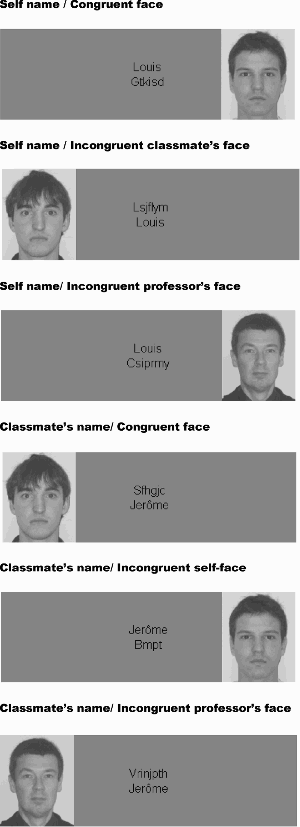
Examples of display.
Procedure
Participants viewed the displays at a distance of 60 cm. Each trial began with a fixation cross appearing for 500 ms. Then the display was presented until the participant responded. The participants were instructed to classify the target name as being their own name or their classmate's name, as quickly and as accurately as possible, while ignoring the face distractor. Button-press response latencies were measured from stimulus onset. Participants completed one practice block of 24 items and one experimental block of 96 trials each. Within each block, all conditions were randomly intermixed.
Design
The design was 2 (target name: self vs. classmate) × 3 (condition: congruent distractor face/incongruent classmate–self/incongruent professor) with all factors manipulated within subjects.
Results
The overall error rate was low (1.8%). A two-way 2 (target) × 3 (condition) analysis of variance (ANOVA) with repeated measures on both factors was conducted on the error rates. This analysis revealed no main effect of the target (F < 1), no main effect of the condition (F < 1), and no interaction between these factors (F < 1).
Mean correct response times were calculated for each participant in each cell of the design, removing all reaction times below 200 ms and over 1,500 ms (0.3% of measures were removed).
A two-way 2 (target) × 3 (condition) ANOVA with repeated measures on both factors was carried out on these mean correct reaction times and revealed a main target name effect, F(1, 23) = 8.30, MSE = 2,357, p < .01; reaction times were shorter for the own name (M = 602 ms, SD = 92) than for the classmate's name (M = 626 ms, SD = 82). The ANOVA also revealed a main effect of condition, F(2, 46) = 15.14, MSE = 1,150, p < .0001, which was qualified by a marginally significant interaction, F(2, 46) = 3.03, MSE = 1,448, p = .058.
Planned comparisons indicated that the professor's face interfered both on the categorization of one's own name, t(23) = 2.47, p < .05, and on the categorization of the classmate's name, t(23) = 2.69, p < .05. Respectively, mean reaction times were significantly slower in the “self name/incongruent professor” condition (M = 611 ms, SD = 111) than in the “self name/congruent face” condition (M = 587 ms, SD = 84), and mean reaction times were significantly slower in the “classmate's name/incongruent professor” condition (M = 621 ms, SD = 88) than in the “classmate's name/congruent face” condition (M = 601 ms, SD = 88). The magnitude of the interference due to the professor's face was similar for the own name (M = 24 ms) and the classmate's name (M = 20 ms); a t test indicated that the difference between these two means was not significant, t < 1.
Therefore, the own name was not more resistant to the irrelevant professor's face than the classmate's name was. Further planned comparisons showed that the self-face interfered on the categorization of the classmate's name, t(23) = 6.47, p < .0001, and that the classmate's face interfered on the categorization of one's own name, t(23) = 2.22, p < .05. Respectively, mean reaction times were significantly slower in the “classmate's name/incongruent self-face” condition (M = 655 ms, SD = 82) than in the “classmate's name/congruent face” condition, and mean reaction times were significantly slower in the “self name/incongruent classmate” condition (M = 609 ms, SD = 96) than in the “self name/congruent face” condition. However, the magnitude of the interference of the self-face on the categorization of the classmate's name (M = 53 ms) was significantly higher than that of the classmate's face on the categorization of one's own name (M = 22 ms), t(23) = 2.41, p < .05. Descriptive data are presented in Figure 2. Finally, reaction times in the “self name/congruent face” condition were not significantly shorter than reaction times in the “classmate's name/congruent face” condition, t(23) = 1.66, p = .11.
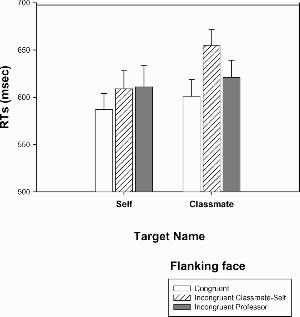
Mean reaction times (in ms) for classifying target names as one's own name or a classmate's name as a function of the condition: congruent distractor, incongruent classmate–self distractor (i.e., the classmate's face when the target is the participant's name and the participant's face when the target is the classmate's name), and finally the incongruent professor distractor. Vertical bars represent the standard error of the means.
Discussion
Previous research showed that faces are difficult to ignore and that distractor faces interfere with the processing of target nonfacial information (Bindemann et al., in press; Lavie et al., 2003; Young et al., 1986). Self-referential information has also been presented as particularly prone to capture attention (e.g., Bargh, 1982; Gray et al., 2004). The present study investigated whether one's own face, being both a facial and a self-relevant stimulus, is more difficult to ignore than other familiar faces. Results of the current experiment showed that, indeed, the self-face is particularly hard to ignore. In a person identification task from target names, the presentation of the self-face as an incongruent flanker produced significantly more interference on the identification of a classmate's name than the presentation of that classmate's face did on the identification of one's own name. This result is clearly due to the interfering power of the self-face and not to a particular resistance of one's name to interfering facial stimuli. Indeed, the magnitude of interference due to the presentation of the face of a participant's professor was very similar when categorizing the participant's own name and when categorizing the classmate's name.
Present results are also consistent with previous studies in confirming that faces are powerful distracting stimuli (Bindemann et al., in press; Lavie et al., 2003). Indeed, participants were unable to ignore irrelevant distractor faces—that is, their own face, a classmate's face, or a familiar professor's face—whether they processed their own name or a classmate's name. It would be interesting to investigate in a future study the pattern of interference obtained by reversing the positions of the faces and names.
Why is the self-face more distracting than other familiar faces? When explaining the attention-grabbing property of self-relevant stimuli some authors have invoked the particular emotional value of these stimuli (Bargh, 1982; Gray et al., 2004). This explanation seems to be particularly relevant as far as the self-face is concerned. Indeed, one's own face is a stimulus of very high emotional importance. The face is a particularly invested part of one's appearance (McNeill, 1998). Recently, functional neuroimaging studies of visual self-recognition using functional magnetic resonance imaging (fMRI) reported an activation of the right limbic system that was interpreted as a strong emotional response to seeing our own face (Kircher et al., 2000, 2001). Although many studies have found that faces showing a negative facial expression are more effective at grabbing attention than faces showing a positive expression (for recent reviews, see Lundquist & öhman, 2005; Pessoa, 2005), it should not be overgeneralized that attention is oriented only, or even mainly, to negatively valenced faces. Indeed, in a recent study, Stone and Valentine (2005) reported that faces of liked familiar persons, or familiar persons regarded as good, are more likely to attract attention than are disliked familiar persons, or familiar persons regarded as evil. Therefore positively valenced faces may also be very effective at attracting attention.
Another factor that might explain the strong distracting power of the self-face observed in the present study is its extreme familiarity. One's own face is processed several times a day during the entire lifetime. Tong and Nakayama (1999) showed that participants were faster to recognize their own face, relative to an unfamiliar face, in different visual search tasks, even after hundreds of presentations of the unfamiliar face. These authors suggested that this processing advantage occurs because we develop robust representations for faces of which we have an extensive visual experience. It will be necessary to determine what aspects of this visual experience are important. For instance, our participants presumably experienced their classmate's face more often than their own face in the recent past. Yet, the own face was more difficult to ignore than the classmate's face.
Practical implications of the present results may be important. For example, in severely brain-damaged noncommunicative vegetative or minimally conscious patients, it is well known that the bedside evaluation of potential residual self-awareness is very difficult (Giacino & Whyte, 2005). Recent functional neuroimaging studies have used self-referential stimuli to objectively quantify patients’ cerebral processing during visual presentation of familiar faces in the vegetative state (Owen et al., 2002) and during auditory presentation of the patients’ own name in the minimally conscious state (Laureys et al., 2004). Similarly, event-related potential studies have aimed to identify P300 responses to patients’ own name as compared to other names in these pathologies (Perrin et al., 2005). Building upon the present results, future studies should further disentangle what self-referential stimuli and modalities are most powerful at seizing attention in healthy subjects, justifying their subsequent use in the assessment of noncommunicative patients.
In conclusion, the present research confirms that the presence of a face in the environment is particularly prone to attract attention even when this face is irrelevant to the task at hand, and it demonstrates that some faces are more powerful distractors than others. More specifically, one's own face appeared to be particularly hard to ignore.