







Abstract
A total of 72 participants estimated products of complex multiplications of two-digit operands (e.g., 63 × 78), using two strategies that differed in complexity. The simple strategy involved rounding both operands down to the closest decades (e.g., 60 × 70), whereas the complex strategy required rounding both operands up to the closest decades (e.g., 70 × 80). Participants accomplished this estimation task in two conditions: a no-load condition and a working-memory load condition in which executive components of working memory were taxed. The choice/no-choice method was used to obtain unbiased strategy execution and strategy selection data. Results showed that loading working-memory resources led participants to poorer strategy execution. Additionally, participants selected the simple strategy more often under working-memory load. We discuss the implications of the results to further our understanding of variations in strategy selection and execution, as well as our understanding of the impact of working-memory load on arithmetic performance and other cognitive domains.
The psychology of arithmetic aims at understanding how people solve arithmetic problems. The present project investigated the role of working-memory resources in strategic aspects of human cognition in general and in arithmetic in particular. Previous empirical research in arithmetic showed three robust phenomena relevant to the present project: namely the impacts of problem difficulty, multiple-strategy use, and working-memory load.
Problem difficulty refers to the fact that participants’ performance (i.e., solution latencies, error rates) decreases as problem difficulty increases (e.g., Ashcraft & Battaglia, 1978; Campbell & Graham, 1985; Duverne & Lemaire, 2005; Duverne, Lemaire, & Michel, 2003; Geary, 1996; Groen & Parkman, 1972; LeFevre et al., 1996a; Siegler & Jenkins, 1989). That is, easy problems like 3 + 4 yield better performance than more difficult problems like 7 + 8. This problem difficulty effect has been found for all arithmetic operations in different arithmetic tasks, in children and adults of different ages, as well as in patients with Alzheimer dementia, and it is mainly assumed to reflect the execution of mental calculation processes (see Zbrodoff & Logan, 2005, for a recent review).
The second robust empirical finding relevant to the present project concerns multiple-strategy use. A strategy can be defined as “a procedure or a set of procedures for achieving a higher level goal or task. These procedures do not require conscious awareness to be called a strategy” (Lemaire & Reder, 1999, p. 365). To solve arithmetic problems, participants use several strategies like memory retrieval (e.g., 7 + 6 = 13), calculation (e.g., 8 + 3 = 8 + 1 + 1 + 1), decomposition into easier problems (e.g., 8 + 9 = 8 + 10 – 1), and arithmetic rules (e.g., N + 0 = N; see Hecht, 2002; Kirk & Ashcraft, 2001; LeFevre et al., 1996a; LeFevre, Sadesky, & Bisanz, 1996b). In computational estimation, investigated here, several strategies are used as well to estimate approximate solutions (Baroody, 1989; Case & Snowder, 1990; Dowker, 1997; Dowker, Flood, Griffiths, Harriss, & Hook, 1996; LeFevre, Greenham, & Waheed, 1993; Lemaire & Lecacheur, 2002b; Lemaire, Lecacheur, & Farioli, 2000; Levine, 1982; Newman & Berger, 1984; Pelham, Sumarta, & Myaskovsky, 1994; Reys, Rybolt, Bestgen, & Wyatt, 1982; Snowder & Markovits, 1990). Especially two strategies seem to be used by adults (e.g., Lemaire, Arnaud, & Lecacheur, 2004; Levine, 1982): rounding both operands to the closest smaller decades and rounding both operands to the closest larger decades. For example, when people have to estimate the product 825 × 36, the first (simple) strategy would imply that they calculate 820 × 30 whereas the second (more complex) strategy would imply that they calculate 830 × 40.
The third phenomenon relevant to the present project concerns the role of working-memory resources in arithmetic performance (see DeStefano & LeFevre, 2004, for a review). Previous works showed that secondary tasks loading on working memory interfere with both verification and production of simple mental arithmetic sums or products (Ashcraft, Donley, Halas, & Vakali, 1992; De Rammelaere, Stuyven, & Vandierendonck, 1999, 2001; De Rammelaere & Vandierendonck, 2001; Hecht, 2002; Lemaire, Abdi, & Fayol, 1996). Logie, Gilhooly, and Wynn (1994) suggested that executive functions of working memory seem to be important in “performing the calculations required for mental addition and in producing approximately correct answers” (our emphasis; p. 395) and that they may be involved in implementing calculation procedures or estimation strategies.
The issue of working-memory involvement in execution of mental calculation processes has been investigated with several arithmetic tasks, but remains not fully understood. Most studies that used simple arithmetic tasks (e.g., 8 + 6 = ?) have shown that problem difficulty effects, an index of the execution of mental calculation processes, do not vary across working-memory load conditions (e.g., Ashcraft, 1995; De Rammelaere et al., 2001; De Rammelaere & Vandierendonck, 2001; Duverne, Lemaire, & Vandierendonck, in press; Lemaire et al., 1996). These results suggest that working memory is not involved in arithmetic strategy execution. Other studies that used more complex arithmetic tasks (e.g., 358 + 261 = ?), however, showed an increased problem-difficulty effect with increased working-memory load, suggesting that working-memory resources may be at stake in mental calculation processing (e.g., Fürst & Hitch, 2000; Seitz & Schumann-Hengsteler, 2000, 2000; Seitz & Schumann-Hengsteler, 2002). Following Hecht (2002), a multiple-strategy use approach might shed light on this discrepancy.
The issue of working-memory involvement in different arithmetic strategies has rarely been directly investigated. To our knowledge, only Hecht (2002) has conducted research on this topic. He asked people to verify simple sums (e.g., 4 + 8 = 13 Yes/No?) while loading working memory and assessed the strategies used on each problem. He found that retrieval was mainly used whether working memory was loaded or not. Strategy execution, in contrast, was hindered by load on working memory, but only when counting was used to solve the problems. In brief, Hecht's study on simple arithmetic strategies and working memory found that strategy execution, but not strategy selection, was influenced by working-memory load. This very interesting study further suggests that the involvement of working memory in arithmetic varies across strategies. Nevertheless, only very easy problems (additions with two one-digit operands) were used in Hecht's study. As these problems have been practised over and over, between 60% and 100% of them are solved via direct retrieval (e.g., Ashcraft & Kirk, 2001; Campbell & Timm, 2000; LeFevre et al., 1996a, 1996b). Such a retrieval bias may obscure the potential role of working-memory resources in strategy selection. In the present study, we used complex arithmetic problems (multiplications of two 2-digit operands) to increase our chances to detect an impact of working-memory load on the ability to adaptively select strategies.
Overview of the present study
The purpose of the present research was to investigate the role of working memory in strategy selection and strategy execution in the computational estimation task. Participants had to provide estimates of two-digit operand products (e.g., 78 × 42) in a no-load condition and in a working-memory load condition. In the latter condition, working memory was loaded by means of a Choice Reaction Time task (CRT task), where participants have to decide whether randomly presented tones are high or low. This task has been shown to interfere with executive functions of working memory, but not to tax slave systems of working memory (i.e., the phonological loop and the visuo-spatial sketch pad; Szmalec, Vandierendonck, & Kemps, 2005; Vandierendonck, De Vooght, & Van der Goten, 1998a, 1998b; see Schunn, Lovett, & Reder, 2001, for an analogous task). In particular, the CRT task affects the executive functions “input monitoring” (as the sequence of tones is unpredictable) and “decision making” (as participants have to decide whether the tone is high or low).
In order to independently determine the involvement of working memory on strategy execution and strategy selection, we used the choice/no-choice method (Siegler & Lemaire, 1997). This method provides a means of obtaining unbiased measures of performance characteristics of strategies (see also Geary, Hamson, & Hoard, 2000; Hanich, Jordan, Kaplan, & Dick, 2001; Jordan & Montani, 1997; Lemaire & Lecacheur, 2001, 2002a, Lemaire & Lecacheur, 2001, 2002a, 2002b). It requires collecting performance under two types of condition: (a) a choice condition in which participants are free to choose between the available strategies on each trial, and (b) no-choice conditions in which participants must use a given strategy on all items. There are as many no-choice conditions as there are available strategies in the choice condition. The choice condition allows assessing of strategy selection (i.e., which strategies are chosen on which problems?), and no-choice conditions provide unbiased measures of strategy execution for each strategy (i.e., how fast and accurately are the strategies executed?). Speed and accuracy characteristics for each strategy can thus be assessed independently of strategy selection and can be compared across different memory load conditions.
We tested each strategy parameter (i.e., strategy selection and strategy execution) by manipulating experimental and problem feature variables in order to collect further evidence of the impact of working-memory load. First, manipulations of strategy complexity and problem difficulty allowed us to test strategy execution. Strategy complexity was manipulated by restricting the strategy repertoire to two estimation strategies that are commonly used by adult participants in computational estimation and that vary in complexity: (a) a simple strategy in which both operands are rounded to the closest smaller decades (e.g., rounding 78 × 42 to 70 × 40), and (b) a complex strategy in which both operands are rounded to the closest larger decades (e.g., rounding 78 × 42 to 80 × 50). Both strategies involve common processes like encoding operands, rounding both operands, holding the rounded operands in memory, calculating an approximate product, and providing the answer aloud. This allowed us to collect data on comparable strategies. However, both strategies also differed in the complexity of the most central arithmetic processes: The complex strategy involves rounding the operands by incrementing the decade digits, holding in memory rounded decade digits that are not displayed on the screen, and calculating products of larger rounded operands. Both strategies have been used in previous studies (e.g., Lemaire et al., 2004) in which it was empirically confirmed that they differ in complexity. Under no-choice conditions and without working-memory load, the simple strategy was executed around 1,000 ms faster than the complex one, indicating that the latter is more resource consuming than the former.
Problem difficulty was also manipulated so as to test the impact of working-memory load on strategy execution. Problem difficulty is a classic effect in arithmetic showing larger latencies and more errors on difficult problems than on easier problems (see Zbrodoff & Logan, 2005, for a recent review). The main interpretation of this effect suggests that it reflects calculation-processing rates.
The hypothesis that working-memory resources are involved in strategy execution predicts Working Memory × Strategy Complexity and Working Memory × Problem Difficulty interactions in no-choice conditions. This should happen because of larger latency and accuracy differences between the simple and complex strategies when working memory is overloaded. Moreover, latencies and errors on difficult problems should increase when working memory is overloaded, compared to easy problems. These predictions related to variations in strategy execution need to be tested in no-choice conditions, since strategy execution in choice conditions might be biased by the number of times each strategy is used.
Regarding strategy selection, two hypotheses were tested. First, we hypothesized that fewer working-memory resources would be left free to use the complex strategy under working-memory load condition. This hypothesis predicts that the simple strategy should be used more often than the complex one, especially under working-memory load condition. Further, if participants select the simple strategy more often on difficult than on easy problems, then we can also predict that the impact of working-memory load on strategy execution observed in no-choice conditions would disappear in choice conditions. In other words, larger effects of working-memory load on the complex strategy than on the simple strategy should not be significant in the choice condition, because participants would use the simple strategy on difficult problems more often, which would increase the effects of working-memory load on the simple strategy. Second, we hypothesized that choosing the most efficient strategy on each problem also requires working-memory resources. This hypothesis predicts that participants would select the most adaptive strategy on each problem less often under working-memory loads. Indeed, effects of working-memory load on strategy execution and strategy selection have been found in other cognitive domains such as reasoning (e.g., Gilhooly, Logie, Wetherick, & Wynn, 1993), but the role of working memory in the ability to select the most adaptive strategy on each problem remains unaddressed. In the Discussion section, we compare the results of the present study with those of previous studies that have investigated the role of working memory in strategy execution, selection, and adaptivity in cognitive domains other than arithmetic.
We are conscious that restricting the strategy repertoire to two available strategies might not fully represent the effects of working-memory load on strategy selection and execution in an ecologically valid way. For instance, in addition to the simple and complex strategies, participants might use mix strategies (e.g., rounding one operand to the closest smaller decade and the other one to the closest larger decade) on some problems. The present study, however, did not include such mix strategies, since the time-consuming nature of the choice/no-choice method makes it impossible to test all strategies in choice and no-choice conditions. Participants were thus not free to choose any strategy they wanted; they had to choose between two available strategies. Although this decision somewhat restricted the notion of “choice” condition, the most crucial manipulation was that choosing strategies was possible in the choice condition and not in no-choice conditions. We further acknowledge that excluding the mix strategy a priori may cause a loss of valuable information. Previous works, however, showed that, when participants’ repertoire was restricted to two computational strategies, they selected the most appropriate strategy on most problems (Lemaire et al., 2004). Thus, although the exclusion of the mix strategy caused some loss in ecological validity, it also enabled us to combine two well-established techniques: namely the choice/no-choice method (disentangling strategy selection and strategy execution) and the dual-task method (to test the role of working memory) in a powerful experimental design.
Method
Participants
A total of 72 undergraduate students of the University of Provence (Aix-en-Provence, France) participated for course credit. Participants were randomly assigned to one of three groups (i.e., choice, no-choice/simple, no-choice/complex). We assessed each individual's arithmetic skill, using both addition and subtraction–multiplication subtests of the French Kit (French, Ekstrom, & Price, 1963). Each subtest consisted of two pages of problems for a total of four pages. All participants were given 2 minutes per page and were instructed to solve the problems as fast and accurately as possible. Number of correct answers on both addition and subtraction–multiplication tests were summed to yield a total arithmetic score. We also collected measures of verbal knowledge, using a French version of the Mill-Hill Vocabulary Scale (MHVS; Deltour, 1993; Raven, Court, & Raven, 1986). The MHVS consists of 33 items distributed across three pages. Each item was a target word followed by six proposed words, and the task consisted of identifying which of the proposed words had the same meaning as the target word. The number of correct items represented the level of verbal ability. There were no differences between the three groups of participants on arithmetic skill, verbal knowledge, gender, or age (all ps > .25).
Stimuli
Stimuli for the primary task were 80 products presented in a standard form (a × b), in which a and b were two-digit numbers. All problems were mixed-unit problems like 23 × 49. That is, all problems were made of one operand with a unit digit smaller than 5 and one operand with a unit digit larger than 5. This set of products was presented twice, once under no-load condition and once under working-memory load condition, in order to have exactly the same problems across both load conditions.
Two problem characteristics were factorially manipulated: problem difficulty and problem type. Based on the median of correct products (3,543), a distinction was made between easy and difficult problems. Easy problems had a mean correct product of 2,474 (range: 1,176–3,534) whereas difficult problems had a mean correct product of 4,633 (range: 3,551–6,586). All problems were matched on the side of the larger operand and on the side of the operand with the smallest unit digit. The larger of both operands was on the left position (e.g., 81 × 46) in half the problems and on the right position (e.g., 32 × 48) in the other problems. The operand with smallest unit digit was on the left position (e.g., 41 × 57) in half the problems and on the right position (e.g., 37 × 52) in the other problems.
In order to determine how participants efficiently choose strategies so as to improve performance, we manipulated problem type. We selected problems based on how close estimates for each problem were with each rounding strategy. Therefore, half the problems were categorized as rounding-down problems, and half were rounding-up problems. Rounding-down problems were problems for which the estimates are closer to correct products when using the simple strategy (i.e., rounding both operands down to the closest decades). Rounding-up problems were problems for which the estimates are closer to correct products when using the complex strategy (i.e., rounding both operands up to the closest decades). The choice of the most adaptive strategy should thus be based on the sum of the unit digits, since small sums of unit digits are more accurately solved with the simple strategy, whereas large sums of unit digits are more accurately solved with the complex strategy. A rounding-down problem like 26 × 71, for example, would be estimated most accurately with the simple strategy, whereas a rounding-up problem like 68 × 34 would be estimated most accurately with the complex strategy.
Moreover, following previous findings in the domain of mental arithmetic (see Ashcraft, 1992, 1995; Campbell, 2005; Dehaene, 1997; Geary, 1994, for reviews), selection of all problems was made so as to control for the following factors: (a) no operand had 0 or 5 as unit digits, to avoid the application of rules (N × 0 = 0); (b) digits were not repeated in the same unit or decade positions (as in 41 × 47), because solving tie problems (e.g., 4 × 4) often requires a different procedure from that for nontie problems; (c) no reverse orders of operands were used (i.e., if 39 × 41 was used, 41 × 39 was not used) in order to reduce training effects; and (d) no digits were repeated within operands (as in 33 × 57).
Stimuli for the CRT task consisted of a series of low (262 Hz) and high (524 Hz) tones. These tones were randomly presented 1,500 or 2,100 ms after the preceding tone. Duration of the tones was 80 ms, and they were presented at a comfortable volume (about 55–60 dB). As soon as they heard a tone, participants had to press the correct key for either high or low tones. Performance on this task was the number of correct key presses. A key press was coded as correct if the right key (i.e., the key corresponding to the presented tone) was pressed at the right moment (i.e., after the tone was presented and before the next tone was presented) and 0 otherwise. Since input and output modes were different for CRT and estimation task (auditory/manual and visual/verbal for each task, respectively), interferences between both tasks could not be accounted for by these processes.
Procedure
Participants were individually tested in one session that lasted approximately one hour. Each participant was tested in one of the following conditions: choice, no-choice/simple, or no-choice/complex. Testing choice/no-choice as a between-subjects factor ensured that there was no influence from prior participation in no-choice condition on choice condition performance. Such training effects could attenuate differences between the different working-memory load conditions. At the beginning of the experiment, we collected information about participants’ sex and age. At the end of the experiment, participants completed a French version of the Mill-Hill Vocabulary Scale and both addition and subtraction–multiplication subtests of the French Kit.
The experimental session started with a description of the arithmetic task. Participants were told that they would see multiplication problems for which they had to give approximate products, without actually calculating the correct products. Participants in the choice condition were instructed to use either the simple or the complex strategy and no other strategies. They were also instructed to choose the most accurate strategy for every single problem, hence the strategy that yields the closest estimates of correct products. No further instructions about how to choose between both strategies were provided. Participants in the no-choice/simple strategy condition were required to use the simple strategy on all problems; they had to round both operands down to the closest smaller decades to generate an answer to all problems (e.g., 78 × 42 = 70 × 40 = 2,800). Participants in the no-choice/complex strategy condition were required to use the complex strategy on all problems; they had to round both operands up to the closest larger decades (e.g., 78 × 42 = 80 × 50 = 4,000). For all participants, it was emphasized that adjusting their answer after having executed the strategy was forbidden. Furthermore, using another strategy (e.g., rounding one operand down and rounding one operand up) was not allowed. The response was considered as erroneous whenever it did not match the result that should be obtained with the strategy that was used (verbally reported in the choice conditions and instructed in the no-choice conditions). In other words, the coding was thus specifically based on the correctness of the execution process (i.e., is the product estimated correctly?) and not on a selection process (e.g., was the most adaptive strategy chosen?). 1 After an initial practice period, no participants had difficulties with either strategy and with the no-adjustment requirements. Instructions equally stressed speed and precision.
This coding of correctness implied that a strategy could be coded as “correct” even though it was not the most adaptive strategy. More precisely, when in the choice condition a rounding-down strategy was executed correctly although a rounding-up strategy would have been more appropriate, the strategy was coded as being executed correctly. As explicated further, the coding of strategy adaptivity was not based on the correctness of strategy execution but on whether the best strategy was chosen according to the problem type.
Each trial began with the 1,000-ms presentation of a fixation point in the centre of the computer screen. Then, the two-by-two digit problems were displayed horizontally in the centre of the screen. Symbols and numbers were separated by spaces equal to the width of one character. Timing of each trial began when the problem appeared on the screen and ended when the experimenter pressed a button, the latter event occurring as soon as possible after the participant's response. On each trial, the experimenter recorded participants’ responses. Moreover, in choice conditions, participants had to say which strategy was used on each trial.
For each between-subjects sample (choice, no-choice/simple, no-choice/complex), the order of testing no-load and working-memory load conditions was counterbalanced. In each sample, half the participants estimated products first without secondary task and then solved them while simultaneously accomplishing the CRT task; the order was reversed for the other participants. Stimuli for the CRT task (a series of low and high tones) were presented by means of another computer. Participants had to press the correct key for either high or low tones. Performance on this secondary task was also measured when carried out alone (i.e., without primary task), for a duration of 2 min/participant.
The same set of 80 problems was used under no-load and working-memory load conditions. So, each participant had to solve 160 estimation problems. The order of presentation of these problems was randomized for each participant. Participants were permitted a 5-min rest period between both memory load conditions. Before the experimental trials, participants were given 6 practice problems to familiarize themselves with apparatus, procedure, and task.
Results
Analyses of data are reported in three major sections. First, we analysed performance in the executive function task (CRT) under the single- and dual-task conditions. The second and third sections aimed at analysing strategy execution and strategy selection, respectively. Initial analyses indicated that there were no order effects between both working-memory load conditions. Therefore, the data were grouped across orders in further analyses. In all results, unless otherwise noted, differences were significant to at least p < .05.
CRT performance
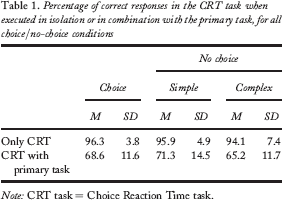
A 3 (participant sample: choice, no-choice/simple, no-choice/complex) × 2 (CRT in isolation vs. CRT in dual-task condition) ANOVA was conducted on correct responses of the CRT task (see Table 1 for the percentage accuracy). The CRT task was performed significantly worse in the dual-task condition than when performed in isolation (68% correct responses vs. 95% correct responses), F(1, 69) = 318.72. This shows interference between primary and secondary task, both competing for working-memory resources. Neither the main effect of participant sample nor the interaction between participant sample and CRT condition was significant (F < 1.8 and F < 1.0, respectively). Further comparisons indeed confirmed that the CRT task was equally well performed in the three participant samples in both the single-task condition and the dual-task condition. Therefore, a comparable number of working-memory resources were devoted to the secondary task in the three samples when solving the primary task.
Percentage of correct responses in the CRT task when executed in isolation or in combination with the primary task, for all choice/no-choice conditions
Note: CRT task = Choice Reaction Time task.
Strategy execution in the estimation task
Analyses of strategy execution were performed on latencies (of correctly solved problems only) and on percentages of errors, 2 separately for choice and no-choice conditions. The analyses run on no-choice performance tested the impact of working-memory load on strategy execution independently of strategy selection. The analyses run on choice performance tested whether having the choice among strategies (i.e., strategy selection) influenced strategy execution.
We also calculated two types of percentage of deviation between estimates and correct products for each problem and each participant (e.g., LeFevre et al., 1993; Lemaire et al., 2004; Lemaire & Lecacheur, 2002b; Lemaire et al., 2000; Levine, 1982). The first one is based on the difference between correct products of operands and participants’ answers. To illustrate, suppose a participant gave 2,000 as an estimate for 41 × 57. That participant would be 17% [(2,000 – 2,337)/2,337] away from the correct product. The second type of deviation is based on the difference between the correct product derived from using a particular strategy and participant's answer. To illustrate, suppose a participant—using rounding-down strategy—gave 2,500 as an estimate for 41 × 57. That participant would be 25% [(2,500 – 2,000)/2,000] away from the correct product expected from rounding down. However, effects on each of these percentage of deviations measure were exactly the same as those present in analyses of mean percentage of errors.
No-choice performance.
Latencies
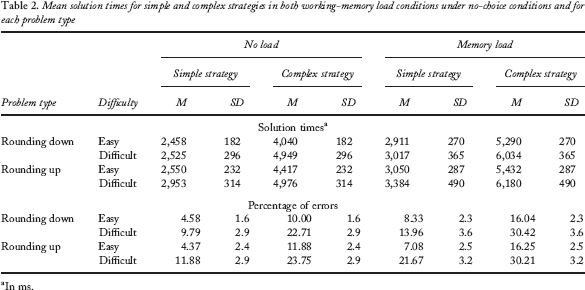
Analyses of variance (ANOVAs) of mean latencies were run with a 2 (load condition: no load vs. working-memory load) × 2 (problem difficulty: easy vs. difficult) × 2 (problem type: rounding-down vs. rounding-up problems) × 2 (strategy complexity: simple vs. complex) mixed design, with repeated measures on the first three factors. Results on latencies showed main effects of load condition, problem difficulty, strategy complexity, and problem type (see Table 2). Problems were solved faster in the no-load than in the working-memory load condition (3,609 ms vs. 4,412 ms, respectively), F(1, 46) = 35.5, MSE = 1,746,519; easy problems were solved faster than difficult problems (3,769 ms vs. 4,252 ms, respectively), F(1, 46) = 15.3, MSE = 1,464,481; using the simple strategy took less time than using the complex strategy (2,856 ms vs. 5,165 ms, respectively), F(1, 46) = 37.4, MSE = 13,701,472, and participants were faster with rounding-down than with rounding-up problems (3,903 ms vs. 4,118 ms, respectively), F(1, 46) = 8.26, MSE = 535,390.
Mean solution times for simple and complex strategies in both working-memory load conditions under no-choice conditions and for each problem type
In ms.
Crucially, the interaction between load condition and strategy complexity was significant, F(1, 46) = 6.16, MSE = 1,746,518 (see Figure 1) and showed larger differences in latencies between simple and complex strategies under the working-memory load condition than under the no-load condition. As expected, this interaction revealed that the execution of the complex strategy was more impaired under working-memory load condition than was the execution of the simple strategy. This suggests that strategy execution varied as a function of working-memory load. It is also worthwhile to note the significant Problem Difficulty × Strategy Complexity interaction, F(1, 46) = 4.30, MSE = 1,464,481, as well as the significant Problem Difficulty × Strategy Complexity × Problem Type interaction, F(1, 46) = 4.47, MSE = 277,106. The Problem Difficulty × Strategy Complexity interaction revealed that the difference between complex and simple strategies was larger on difficult problems than on small problems. This two-way interaction depended on problem type, however, as it was true only for the rounding-down problems but not for the rounding-up problems. Indeed, for the rounding-up problems latencies were always larger on difficult than on easy problems, whereas for the rounding-down problems this was only true when the complex strategy was used.
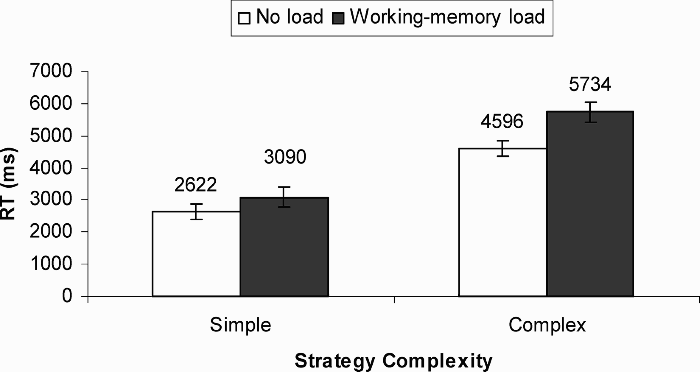
Mean solution times (in milliseconds) for simple and complex strategies in both memory load conditions under no-choice conditions.
Only the Load Condition × Problem Difficulty interaction was significant, F(1, 46) = 5.35, MSE = 0.004, showing larger problem difficulty effects in the working-memory load condition (11.9% vs. 24.1%) than in the no-load condition (7.7% vs. 17.0%). This interaction is consistent with results on latencies suggesting that strategy execution depends on the number of available working-memory resources.
Choice performance.
Latencies
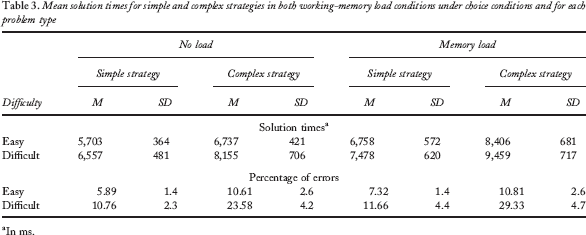
ANOVAs on choice performance involved a 2 (load condition: no load vs. working-memory load) × 2 (problem difficulty: easy vs. difficult) × 2 (strategy complexity: simple vs. complex) design, with repeated measures on each factor. Given strategy selection leading to too many cells with no observations, data were collapsed over problem type. As in the no-choice conditions, three main effects were replicated (see Table 3): Problems were solved faster in the no-load than in the working-memory load condition (6,788 ms vs. 8,025 ms, respectively), F(1, 23) = 5.26, MSE = 13,962,166.83; easy problems were solved faster than difficult problems (6,901 ms vs. 7,912 ms, respectively), F(1, 23) = 29.1, MSE = 1,685,867.58; and the simple strategy was faster than the complex one (6,623 ms vs. 8,189 ms, respectively), F(1, 23) = 26.0, MSE = 4,527,593.70.
Mean solution times for simple and complex strategies in both working-memory load conditions under choice conditions and for each problem type
In ms.
Importantly, and contrary to no-choice conditions, no interactions between load condition and problem difficulty or strategy complexity were observed (Fs < 2). Thus, whereas working-memory load interacted with strategy complexity in no-choice conditions, it did not in the choice conditions. This lack of interaction may stem from strategy selection effects on strategy execution: Participants may have chosen different strategies on different types of problem so that performance varied less across problems in the choice condition.
There was also a Problem Difficulty × Strategy Complexity interaction, F(1, 23) = 6.3, MSE = 0.02. The difference between strategies was larger for difficult problems (26.5% vs. 11.2%, for complex and simple strategies, respectively) than for easy problems (10.7% vs. 6.6%, for complex and simple strategies, respectively). Contrary to results in no-choice conditions, there was no effect of load condition (F < 2) and no interactions between problem difficulty or strategy complexity and load condition (Fs < 2).
Strategy selection in the estimation task
Two analyses were run to examine strategy selection characteristics in the choice condition only. The first looked at overall strategy use and the second at the ability to choose the most adaptive strategy on each problem.
Overall strategy use
The ANOVA on mean percentages of use of the simple strategy involved a 2 (load condition: no load vs. working-memory load) × 2 (problem difficulty: easy vs. difficult) × 2 (problem type: rounding-down vs. rounding-up problems) design, with repeated measures on all factors (see Figure 2). A first important observation is that participants were not biased to using one single strategy, since simple and complex strategies were used with comparable frequencies (53% vs. 47% in no-load condition). However, participants used the simple strategy more often than the complex one in both no-load and working-memory load conditions.
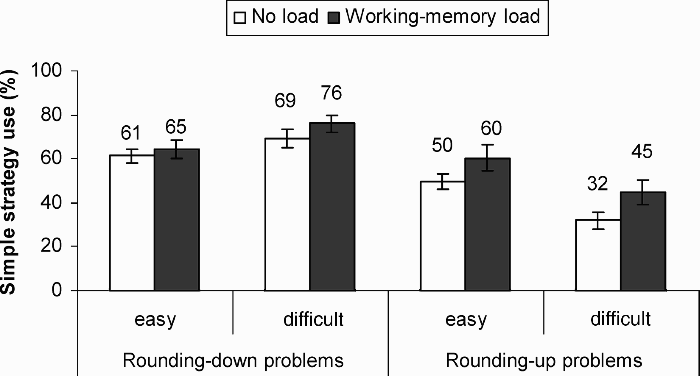
Mean percentage of use of simple strategy as a function of problem characteristics under each memory load condition.
Further, the simple strategy was favoured in the working-memory load condition compared to the no-load condition (62% vs. 53%, respectively), F(1, 23) = 9.02, MSE = 0.02. The simple strategy was also largely used on rounding-down problems compared to rounding-up problems (68% vs. 47%), F(1, 23) = 25.75, MSE = 0.08, and on easy problems compared to difficult problems (59% vs. 56%), F(1, 23) = 3.19, MSE = 0.01, p < .09. Interestingly, the Load Condition × Problem Type interaction showed that the difference between memory load conditions was larger for rounding-up problems than for rounding-down problems (12% vs. 6%); F(1, 23) = 4.53, MSE = 0.01. As expected, participants used the simple strategy more often in the working-memory load condition, especially on the more demanding rounding-up problems. When working memory was not loaded, there were enough resources available to use the complex strategy when necessary. Finally, the Problem Type × Problem Difficulty interaction, F(1, 23) = 50.77, MSE = 0.02, showed that participants used the simple strategy most often on difficult rounding-down problems and least often on difficult rounding-up problems.
Strategy adaptivity
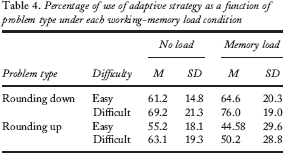
To analyse percentages of most adaptive strategy use for each individual and each problem, we coded “1” if the most adaptive strategy was used (i.e., the simple strategy on rounding-down problems and the complex strategy on rounding-up problems) and “0” when it was not. We analysed mean percentages of adaptive strategy use with an ANOVA, involving a 2 (load condition: no load vs. working-memory load) × 2 (problem difficulty: easy vs. difficult) within-subjects design (see Table 4). Crucially, we observed a main effect of load condition, as participants more often used the most adaptive strategy in the no-load condition than in the working-memory load condition (62% vs. 59%, respectively), F(1, 23) = 4.53, MSE = 0.01. As expected, loading executive functions of working memory had an influence on strategy adaptivity, since participants were significantly less adaptive when their working-memory capacities were taxed. More surprisingly, participants seemed to more adaptively choose strategies on difficult problems than on easy problems (65% vs. 57% most adaptive strategy use, respectively), F(1, 23) = 19.65, MSE = 0.01. However, this was accounted for by the bias towards using the simple strategy almost systematically on difficult problems when this strategy was actually the most adaptive one. There was no interaction effect, Fs < 1.
Percentage of use of adaptive strategy as a function of problem type under each working-memory load condition
General Discussion
Previous studies showed that arithmetic performance is influenced by working-memory load. The present study contributes to our further understanding of this influence. The most original features of this experiment include a strategy approach, a fairly underinvestigated arithmetic domain (computational estimation), independent assessments of strategy execution and strategy selection (via the choice/no-choice method), and a control of participants’ strategy repertoire. The present findings showed that working-memory load influences arithmetic performance via its effects on both strategy execution and strategy selection. We discuss the implications of these findings to further understand the role of working memory in strategic aspects of cognitive performance.
The role of working memory in strategy execution
Above and beyond effects of strategy and problem difficulty usually found in arithmetic, the present results showed two crucial interactions, Working Memory × Strategy Complexity and Working Memory × Problem Difficulty. The complex strategy was more slowed than the simple strategy, and more errors were made on difficult than on easy problems under working-memory load condition. Both interactions are consistent with the hypothesis that executing computational estimation strategies requires working-memory resources. Differential task demands between both strategies may not only account for lower performance with the complex strategy than with the simple strategy; they can also account for the impact of working-memory resources on execution of mental calculation as tested with strategy complexity and problem difficulty. Both simple and complex strategies involve common cognitive processes (i.e., encoding operands, rounding operands, calculating products of rounded operands, and saying these products aloud); the complex strategy involves additional processes like 10-digit increment and intermediary result storage and manipulation. Moreover, calculation difficulty differed across strategies since the simple strategy always involved multiplying smaller numbers than did the complex one, a problem feature that is known to play a crucial role in arithmetic (see Ashcraft, 1995; Geary, 1994, for reviews).
An alternative account for the interaction between working memory and strategy complexity is related to inhibition effects. More specifically, complex strategies might be executed more slowly than simple strategies because the execution of complex strategies involves overriding the execution of simple strategies. This effect would be even more important in no-choice conditions than in choice conditions, because participants need to override the simple strategy on 100% of trials of no-choice/complex conditions, whereas they need to override the simple strategy on 50% of trials of choice conditions. Additional analyses confirmed that (under no-load) the difference between complex and simple strategies was larger in the no-choice condition (1,974 ms) than in the choice condition (1,316 ms), an effect that was even enhanced under working-memory load (2,644 ms vs. 1,815 ms, respectively).
The present effects of working-memory load on strategy execution replicate Hecht's results (2002), who found that execution of the counting strategy was disrupted by shortage in working-memory resources while execution of other simpler strategies (e.g., memory retrieval) remained intact. Hecht's and the present results suggest that working-memory resources are more crucial in the execution of complex strategies than in the execution of simple strategies, at least in arithmetic. Of course, it is unknown how demanding a strategy must be in order to be affected by working-memory load, an issue that future research might pursue.
Further, the interaction between working-memory load and problem difficulty improves our understanding of the impact of working-memory load in strategy execution. Previous studies hardly showed that difficult problems required more working-memory resources than easier problems (e.g., Ashcraft, 1995; De Rammelaere et al., 2001; De Rammelaere & Vandierendonck, 2001; Duverne et al., in press; Lemaire et al., 1996; see, however, Fürst & Hitch, 2000; Seitz & Schumann-Hengsteler, 2000, 2000; Seitz & Schumann-Hengsteler, 2002). Given that retrieval is the dominantly used strategy in mental calculation, one may infer that working-memory resources are not differentially required for easy versus difficult problems when answers are retrieved from long-term memory. The working-memory demands may thus be more related to other aspects of the solution process than those associated with activating long-term memory information (DeStefano & LeFevre, 2004). When strategies other than retrieval (e.g., transformation or counting) are used, however, working-memory load affects difficult problems more than easy problems (Seyler, Kirk, & Ashcraft, 2003).
Finally, we would like to note that the working-memory load by strategy complexity and the working-memory load by problem difficulty interactions only appeared in no-choice conditions, where effects of strategy selection were controlled, and participants used both strategies as many times on each type of problem. Results were different in the choice condition, where strategy execution and strategy selection were not disentangled. Indeed, when strategy selection was not differentiated from strategy execution, no significant interactions between working-memory load and strategy complexity or between working-memory load and problem difficulty were observed. This suggests that, in the choice condition, participants found a way to compensate for the effects of working-memory load on strategy execution. More precisely, participants in the choice condition could opt for the simple strategy when fewer working-memory resources were available. Since the simple strategy is faster and more accurate (as shown by no-choice analyses), this shift towards a greater use of the simple strategy reduced the effects of working-memory load on strategy execution in the choice condition. Separate analyses of strategy execution in choice and no-choice conditions thus show that choosing among available strategies biases strategy execution data since performance differences across strategies and problems are reduced. Such reduction might have decreased potential working-memory effects in previous arithmetic studies that only included a choice condition. At a general level, this suggests that investigating the role of working memory in strategic aspects of cognitive performance requires independent assessments of strategy execution and strategy selection. Note that even if participants compensate for the impact of working-memory load on strategy execution in choice condition by using the simple strategy more often, they did not select the most adaptive strategy according to the goal of the task in choice condition.
The role of working memory in strategy selection
Siegler (1999) already stated that a high trial-by-trial variability is characteristic of human cognition. Therefore, as Roberts and Newton (2005) noted, we need to understand differences in strategy selection within as well as between individuals. The present results showed effects of working-memory load on strategy selection. The simple strategy was used more often under working-memory load than under no-load condition. When fewer working-memory resources were left, participants chose the simple strategy more often, especially to solve the most demanding problems. Moreover, the manipulation of problem type allowed us to test strategy adaptivity and showed that participants chose the most adaptive strategy on each problem less systematically in the working-memory load condition than in the no-load condition. This occurred even if participants were instructed to choose between the simple and the complex strategy so as to produce the best estimate for each problem. Both greater use of the simplest strategy and decreased use of the most adaptive strategy are consistent with the hypothesis that choosing strategies, especially the most adaptive strategies, on a trial-by-trial basis requires working-memory resources.
As it was the case with strategy execution, working-memory effects on strategy selection can be accounted for by inhibition effects as well. More specifically, the present experiment required selecting between two competitors and inhibiting one of them—a competition that is larger in choice conditions than in no-choice conditions because of the goal of the task. However, the purpose of the present study was to determine whether an executive working-memory load would differently affect strategy selection and execution and not to determine which executive functions are at stake in strategy selection and execution. We hope that future studies will investigate this issue.
The effects of working-memory load on strategy selection are inconsistent with Hecht's (2002) lack of effects of working-memory load on the selection of simple arithmetic strategies (i.e., he observed that mean percentages of strategy use did not change across memory-load conditions). First, Hecht used a simple problem verification task, whereas we used a complex computational estimation task. Second, participants in Hecht's study were just required to verify arithmetic problems, whereas in the present study they had to adaptively select strategies in the choice condition. Third, in simple arithmetic, retrieval is used much more often than nonretrieval strategies such as counting, whereas in the computational estimation task, participants’ strategy repertoire was limited to two strategies that varied in complexity. Choice data indeed indicated that participants in the present study were not biased to the use of one single strategy, since simple and complex strategies were used with comparable frequencies. Speculatively, it is possible that, when a cognitive task is not accomplished by a massively dominant strategy (like retrieval in simple arithmetic), strategy selection requires working-memory resources.
The effects of working-memory load on strategy selection may also explain why differences in strategy execution were no longer significant in the choice condition: Participants in the choice condition found a way to compensate the greater working-memory demands on strategy execution. More specifically, they circumvented higher working-memory demands by choosing the simple strategy more often than in no-choice conditions. Therefore, (a) smaller problem difficulty effects were observed in the choice than in the no-choice condition, (b) smaller strategy complexity effects were observed in choice condition as well, and (c) the effects of working-memory load on strategy complexity observed in no-choice conditions disappeared in choice conditions. Such conclusions could only be drawn because we used an appropriate experimental method to independently test strategy execution and selection.
Finally, even if participants could somewhat compensate for the effects of working-memory load on strategy execution in the choice condition, they selected the strategies less adaptively with respect to the goal of the task in the choice condition. As far as we know, the effects of working-memory load on strategy adaptivity in arithmetic tasks have not been previously tested. The present results suggest that strategy adaptivity is also altered under working-memory load. These effects may result from greater complexity to process problem characteristics deeply when working memory is loaded. To choose the most adaptive strategy on each problem, it is necessary to understand that small sums of unit digits are better solved with the simple strategy and that the complex strategy provides most accurate estimates on problems with large sums of unit digits. The processing of these data may have been impaired under working-memory load. A tentative conclusion might thus be that reducing the number of working-memory resources reduces people's strategy adaptivity.
Working-memory effects on strategy use in other cognitive domains and process models
The present study showed that, in complex arithmetic, working memory is needed in strategy execution, strategy selection, and strategy adaptivity. One might wonder whether such findings generalize to other cognitive domains. When other domains, like reasoning or problem solving, are considered, the working-memory effects found run strikingly parallel with those observed in the present project. First, effects of working-memory load have been found on strategy execution, both in conditional reasoning (e.g., Klauer, Stegmaier, & Meiser, 1997; Meiser, Klauer, & Naumer, 2001) and in syllogistic reasoning (e.g., Gilhooly et al., 1993). Gilhooly et al. (1993) for example, observed higher errors rates under working-memory load. Comparable effects have been found in the present study, as we observed slower and less accurate strategy execution under working-memory load.
Second, effects of working-memory load have also been found on strategy selection. In a syllogistic reasoning task, Gilhooly et al. (1993) observed a significant increase in the incidence of guessing under working-memory load. This result was confirmed in a later study (Gilhooly, Logie, & Wynn, 2002), which led the authors to conclude that increasing working-memory load produces a shift towards less demanding strategies. This shift was also observed in the present study, since participants chose the simple (i.e., less demanding) strategy more often under no-load condition than under working-memory load condition.
Third, the effects of working-memory load on strategy adaptivity still remains a debated topic. Schunn and Reder (2001), for example, found that differences in strategy adaptivity were correlated with working-memory capacity, whereas Schunn et al. (2001) did not find a relationship between individual differences in strategy adaptivity and working-memory capacity. More recently, however, Dierckx and Vandierendonck (2005) specifically tested whether task complexity might influence strategy adaptivity. They observed that increasing task complexity reduced participants’ strategy adaptivity since they tended to apply only one strategy consistently to all problems. Thus, as complex tasks load more heavily on working-memory resources, fewer resources are left for the strategy selection process, resulting in lower strategy adaptivity. Otherwise stated, as participants have to trade off resources between problem solving and strategy selection, both processes might be executed worse. This was the case in the present study as well, in which strategy adaptivity was significantly lower under working-memory load condition than under no-load condition.
The present findings suggest several implications for process models on strategy use and working memory. For example, the ACT-R theory of Lovett and Anderson (1996; Anderson, Reder, & Lebiere, 1996) incorporates notions of strategy use and working-memory resources (see also Lovett & Schunn, 1999; Payne, Bettman, & Johnson, 1993; Shrager & Siegler, 1998, for other process models of strategy choices). In this model there is a parameter (W), which determines the available processing capacity and thus limits the amount of attention that can be distributed over the to-be-accomplished tasks. When participants have to perform two tasks that require attentional resources simultaneously (e.g., dual-task paradigms), the total amount of the sources of activation has to be shared between these tasks, resulting in poorer task performance on both tasks. The present results reveal that poorer task performance under working-memory load depends on the ability to use multiple strategies and to adaptively select them as a function of problem type. Based on this, it would be interesting to test the differential role of working memory when participants have different numbers of strategies available or when participants are free to choose whichever strategy they have spontaneously available. The prediction is that less adaptive strategy choices will be made when more alternative strategies are available if the selection processes do require working-memory resources as the present results suggest.
Finally, process models on working memory suggest that working-memory capacity can be differentiated along different functions. For example, Oberauer and his colleagues (Oberauer, 2002; Oberauer, Demmrich, Mayr, & Kliegl, 2001; Oberauer & Kliegl, 2001; Oberauer, Süß, Wilhelm, & Wittman, 2003) have reported data consistent with the idea that three working-memory functions at least can be distinguished: Simultaneous storage and processing, supervision, and coordination of elements into structures (see Miyake et al., 2000, for such distinctions of working-memory functions). More specifically, “supervision (also referred to as executive processes) involves the monitoring of ongoing processes and actions, the selective activation of relevant representations and procedures, and the suppression of irrelevant, distracting ones” (Oberauer et al., 2003, p. 169). One of the most challenging executive functions that might be at stake in strategy selection is related to the suppression of irrelevant strategies like the ability to override a prepotent strategy, in the case of several available strategies but one of them is more easily activated, or the ability to monitor several competitors, when the available strategies are equally difficult to activate. Future research will understand which specific executive mechanisms govern strategy execution and strategy selection, in arithmetic and in other cognitive domains.