







Abstract
Recent evidence shows that outcome maximality (e.g., De Houwer, Beckers, & Glautier, 2002) and additivity training (e.g., Lovibond, Been, Mitchell, Bouton, & Frohard, 2003) have an influence on cue competition in human causal learning. This evidence supports the idea that cue competition is based on controlled reasoning processes rather than on automatic associative processes. Until now, however, all the evidence for controlled reasoning processes comes from studies with rather simple designs that involved only few cues and events. We conducted two experiments with a complex design involving 24 different cues. The results showed that outcome maximality and additivity training had an influence on cue competition but that this influence was more pronounced for forward cue competition than for retrospective cue competition.
In human causal learning tasks, participants are presented with combinations of cues that are said to be potential causes of certain outcomes. After this learning stage, they are asked to assess for each cue separately to what extent it causes the outcome. Cue competition in human causal learning refers to the fact that the causal judgement about a target cue X is not only determined by the contingency between X and the outcome but also by the contingency between the outcome and an alternative cue A with which X co-occurred during the learning stage.
The most well-known cue competition effect is forward blocking (e.g., Dickinson, Shanks, & Evenden, 1984). In a forward blocking design, AX + trials (cues A and X presented together and followed by the outcome) are preceded by A + trials (cue A presented alone and followed by the outcome). Forward blocking refers to the fact that causal judgements for cue X in such a design will be lower than those when only AX + trials are presented. Backward blocking (e.g., Shanks, 1985) refers to the same effect but the order of trials is reversed (AX + trials precede the A + trials). Another cue competition effect is reduced overshadowing (e.g., De Houwer, Beckers, & Glautier, 2002). In a reduced overshadowing design, BY + trials are preceded by B − trials (cue B presented alone and not followed by the outcome). Reduced overshadowing refers to the effect that causal judgement for cue Y will be higher than that when no B − trials precede the BY + trials. Finally, release from overshadowing (e.g., Larkin, Aitken, & Dickinson, 1998) is the same effect as reduced overshadowing but the order of trials in the experimental design is reversed (BY + trials precede the B − trials). Several studies on cue competition (e.g., Aitken, Larkin, & Dickinson, 2001; Chapman & Robbins, 1990; Dickinson & Burke, 1996, Melchers, Lachnit, & Shanks, 2004) combine A+, B−, AX+, and BY + trials in their experimental design and compare the causal judgements of cues Y and X as a measure of cue competition. The difference in causal judgement between cues Y and X is called forward cue competition when A + and B − trials precede the AX + and BY + trials and is called retrospective cue competition when the trial order is reversed.
Since the studies of Dickinson et al. (1984) and Shanks (1985), several associative models (e.g., Miller & Matzel, 1988; Rescorla & Wagner, 1972; Wagner, 1981) that were originally developed to explain animal conditioning have also been applied to human causal learning (e.g., Dickinson & Burke, 1996; Van Hamme & Wasserman, 1994; see Dickinson, 2001). This application of associative models to human causal learning has two foundations. First, the procedures of animal conditioning and human causal learning are very similar. Animals and humans are both faced with a series of trials in which certain stimuli (conditioned stimuli or cues) are followed by other stimuli (unconditioned stimuli or outcomes). The result of these trials is a change in behaviour. For example, in a typical fear conditioning study with animals, rats are faced with a tone followed by an electric shock. This results in an increased fear reaction upon presentation of the tone. In human causal learning, participants are presented with combinations of causes and effects, and the change in behaviour is a changed causal judgement. Second, cue competition effects that were originally demonstrated in animal conditioning (e.g., forward blocking; see Kamin, 1969) were also found in human causal learning (e.g. Dickinson et al., 1984; Shanks, 1985). As a result of the similarity between the procedures of animal conditioning and human causal learning tasks and the observation that robust effects in animal conditioning can also be found in human causal learning, associative models of animal conditioning became increasingly popular in explaining human causal learning.
The core feature of associative models of animal conditioning and human causal learning is that the underlying processes are automatic and bottom-up. They do not include assumptions about the possible impact of controlled, top-down reasoning processes in human causal learning. Recently, however, increasing evidence suggests that cue competition is due to controlled reasoning processes (e.g., Lovibond, 2003; Lovibond, Been, Mitchell, Bouton, & Frohard, 2003; Waldmann, 2000; Waldmann & Walker, 2005; see De Houwer, Beckers, & Vandorpe, 2005, for a review). For example, Beckers, De Houwer, Pineño, and Miller (2005) found that additivity training of cues (see Lovibond et al., 2003, for similar results) and outcome maximality (see De Houwer et al., 2002; Vandorpe, De Houwer, & Beckers, 2005, and Wu & Cheng, 1999, for related results) influenced cue competition in human causal learning. When cues were explicitly pretrained to have additive effects on the outcome (i.e., when two pretraining cues T1 and T2 were presented together the outcome was more intense than when cue T1 and cue T2 were presented on their own) forward blocking was stronger than when cues were explicitly pretrained to have nonadditive effects (i.e., the pretraining cues T1 and T2 presented together caused the same intense outcome as when the cues were presented on their own). Furthermore, when the outcome on A + and AX + trials occurred with a maximal intensity (e.g., with an intensity of 10/10, De Houwer et al., 2002), forward blocking was weaker than when the outcome on A + and AX + trials occurred with a submaximal intensity (e.g., with an intensity of 10/20).
Whereas existing associative models cannot explain the influence of additivity pretraining and outcome maximality on forward blocking (see Beckers et al., 2005, for a detailed discussion), these effects are compatible with higher order reasoning models of causal learning (e.g., De Houwer & Beckers, 2003; De Houwer et al., 2002; Lovibond et al., 2003; Waldmann, 2000; Waldmann & Walker, 2005). These models assume that participants come to a causal judgement by controlled reasoning processes. We can distinguish two broad levels of inference steps. The first level is the formation of premises. In the case of blocking, one has to make the premises that “A causes the outcome” and “A and X together cause the outcome”. In the case of reduced overshadowing or release from overshadowing, one has to make the premises that “B does not cause the outcome” and “B and Y together cause the outcome”. The second level is the derivation of a conclusion about the causal status of the target cue based on the premises. In the case of blocking, one can infer that X is not a cause of the outcome if A is the cause of the outcome, but only if (a) it can be verified that X adds nothing to the effect of A, and (b) cues have additive effects. If these conditions are not met (e.g., if A already causes the effect to a maximal extent or if one does not believe that cues have additive effects), the causal status of cue X is unsure, and X will receive a rating near the midpoint of the rating scale. Hence, blocking should occur only when the conditions for drawing the inference are met. Because manipulations of outcome maximality and additivity pretraining influence the extent to which the conditions are met, these manipulations should have an influence on blocking. In the case of reduced overshadowing or release from overshadowing, one can infer that cue Y is the cause of the outcome if B is not a cause of the outcome, independently of whether the outcome occurs to a maximal extent on BY + trials or whether cues have additive effects or not. As a consequence, outcome maximality and additivity pretraining should have no influence on reduced overshadowing or release from overshadowing. These predictions have been confirmed (e.g., Beckers et al., 2005; De Houwer et al., 2002; Lovibond et al., 2003).
There is, however, an important caveat in the available evidence for the role of controlled reasoning processes in cue competition in human causal learning (see De Houwer et al., 2005, for a review). Until now, all studies that provided evidence for a higher order reasoning account of cue competition involved only very few cues and events. For instance, in the studies of De Houwer et al. (2002) that provided the first evidence for the effects of outcome maximality, there were only four events (A+, Z−, AX+, KL +), which were each presented at least 10 times. With such designs, participants can easily keep track of the different events and have ample opportunity to engage in controlled reasoning. Under these conditions, cue competition might indeed be based on reasoning and be sensitive to factors such as outcome maximality. Some researchers have pointed out that cue competition effects can be found even in situations where controlled reasoning processes are unlikely to take place. For instance, Le Pelley and McLaren (2003; also see Dickinson & Burke, 1996; Larkin et al., 1998; Wasserman & Berglan, 1998) found significant cue competition in a study in which 16 different cues were used, and 16 different compound stimuli were presented. They argued that the large number of cues “helped to ensure a large memory load, hopefully preventing subjects from basing their ratings on inferences made from explicit episodic memories…. Instead subjects should have to rely on associative processes to provide a more “automatic” measure of causal efficacy for each cue” (Le Pelley & McLaren, 2003, p. 74; also see Dickinson, 2001, p. 23). Also other authors (e.g., Waldmann & Walker, 2005) have argued that certain conflicting results in human contingency learning might be due to differences in the complexity of the design used. The aim of our studies was therefore to test whether we could find evidence for controlled reasoning processes in complex designs that involve many cues and events.
We did this by manipulating outcome maximality (maximal versus submaximal outcome, Experiment 1) and additivity pretraining (additive versus nonadditive pretraining, Experiment 2) within a complex design that consists of 24 different cues during the learning stage. If we still find an effect of these manipulations, it would strongly suggest that reasoning does play an important role even when the learning task is complex.
The design of our experiments was based on the design of Melchers et al. (2004; see Table 1), which is one of the most complex designs that has so far been used in causal learning studies. Melchers et al. used a food allergy paradigm wherein cues are foods, and the outcome is an allergic reaction. In order to measure retrospective cue competition, AB+, CD + (first learning stage) and A+, C − (second learning stage) trials were presented. Retrospective cue competition corresponded to the mean causal rating of D minus the mean causal rating of B. In addition, E+, G − (first learning stage) and EF+, GH + (second learning stage) trials were presented. This allows one to measure forward cue competition by subtracting the mean causal rating of F from the mean causal rating of H. Finally, there were also filler items (IJ−, K−, I−, KL −). To further increase the complexity of the design, Melchers et al. (2004) assigned two foods to each cue (i.e., two different foods allocated to cues A up to L), resulting in a design consisting of 24 different names of foods and 24 different events (e.g., two different A + trials). In order to measure not only forward and retrospective cue competition but also the specific cue competition effects forward and backward blocking, reduced overshadowing and release from overshadowing, we made a modification to this original design of Melchers et al. Instead of two different IJ − and two different KL − trials, we only presented one IJ − event and one KL − event. The other nonreinforced IJ − and KL − event was reversed into reinforced trials, indicated by the XY + and WZ + trials in Table 1. As such, forward blocking can be measured by the mean causal rating of W and Z minus the causal rating of F, backward blocking by the mean causal rating of X and Y minus the causal rating of B, reduced overshadowing by the causal rating of H minus the mean causal rating of W and Z, and release from overshadowing by the causal rating of D minus the mean causal ratings of X and Y. As a consequence of our modification to the original design of Melchers et al., there were two different cues allocated to cues A up to H, but only one different food to the other cues. This resulted in a design with 24 cues and 22 different events.
Design of the experiments
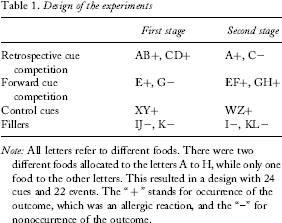
Note: All letters refer to different foods. There were two different foods allocated to the letters A to H, while only one food to the other letters. This resulted in a design with 24 cues and 22 events. The “ + ” stands for occurrence of the outcome, which was an allergic reaction, and the “–” for nonoccurrence of the outcome.
Experiment 1
In our first experiment, we manipulated outcome maximality in a similar manner to that in the studies of De Houwer et al. (2002) but now used the more complex design described above. In the nonceiling condition, the outcome (allergic reaction) occurred with a submaximal intensity of 10/20 while in the ceiling condition the outcome occurred with a maximal intensity of 10/10.
Method
Participants
A total of 32 first-year psychology students at Ghent University participated for course credit. They were randomly assigned to the ceiling and no-ceiling conditions.
Design, Stimuli, and Material
The design (see Table 1) was based on that of Melchers et al. (2004). In the first learning stage, AB+, CD+, E+, G−, XY+, IJ−, and K − trials were presented. In the second learning stage, A+, C−, EF+, GH+, WZ+, I−, and KL − trials were presented. Two different foods were assigned to cues A up to H, while only one food was assigned to the other cues. This resulted in a complex design with 24 cues and 22 events— 17 cues and 11 events in each learning stage. Each stage consisted of four blocks. Within each block, every event was presented twice, resulting in 22 trials per block—88 in each stage and 176 in the entire experiment. The sequence of trials within each block was randomized. There were no breaks between blocks or stages. The cues were presented as coloured pictures of foods against a white background, with the name of the food under the picture in a black colour. The following foods were used (translated from Dutch): apples, avocado, bananas, blueberries, broccoli, carrots, cherries, coffee, eggs, fish, grapes, ice-cream, kiwi, lemon, meat, mushrooms, nuts, pears, peppers, popcorn, potatoes, strawberries, toast, and tomatoes. As outcomes, the messages “allergic reaction: 10/20” (no-ceiling condition) and “allergic reaction: 10/10” (ceiling condition) were presented in a black colour under the picture and the name of the food. If the food was not followed by the outcome, the message “allergic reaction: 0/20” (or 0/10 in the ceiling condition) was presented.
The task was presented on a Pentium I PC and implemented using a custom made Inquisit program. Four different allocations of the foods to the different cues were used and were counterbalanced across participants.
Procedure
At the beginning of the experiment, the learning instructions appeared on the screen (see Appendix for full instructions). Participants were asked to imagine that they were a medical doctor who was treating a patient suffering from allergic reactions after eating certain foods. Their task was to determine for each food separately to what extent it caused an allergic reaction in the patient. After reading the learning instructions, participants could press a key to start the learning stage that consisted of 176 trials. Each trial started with the presentation of one or two foods. After 2,000 ms, information about the intensity of the allergic reaction was added at the bottom of the screen during 3,000 ms. The intertrial interval (ITI) was 3,000 ms. After presentation of all learning trials, participants were asked to judge for each food how likely it was to cause an allergic reaction on a scale from 1 to 9, where 1 stands for “never causes an allergic reaction” and “9” for “always causes an allergic reaction”. On each test trial, the picture and corresponding name of a food was presented in the centre of the screen, and participants could made their causal rating by a click with the mouse on a digit of a Likert rating scale. The scale was presented underneath the picture and name of the food. The presentation of the foods was randomized for each participant separately. The ITI between two test trials was 1,000 ms.
Results
The causal ratings for the cues of importance are given in Table 2. First, we analysed the causal ratings for cues B, F, D, and H in order to investigate the influence of outcome maximality on forward and retrospective cue competition. Secondly, we also looked at the influence of outcome maximality on the specific cue competition effects. The ratings of cues B, F, D, and H were analysed by a 2 (type: blocked cues B and F versus reduced overshadowing cues D and H) × 2 (order: forward cues F and H versus backward cues B and D) × 2 (condition: no-ceiling versus ceiling condition) analysis of variance (ANOVA) with type and order as within-subject variables and condition as between-subject variable. This analysis revealed a main effect of type, F(1, 30) = 270.89, p < .001, a significant Type × Order interaction, F(1, 30) = 9.13, p < .01, and a marginally significant Type × Condition interaction, F(1, 30) = 3.29, p = .08. Also, the three-way Type × Order × Condition interaction was almost significant, F(1, 30) = 4.06, p < .06. In order to clarify these interactions we analysed the Type × Condition interaction for each order separately and the Type × Order interaction for each condition separately.
Mean causal ratings for the blocked cues B and F, the reduced overshadowing cues D and H, and the mean of the control cues W and Z and X and Y in Experiment 1
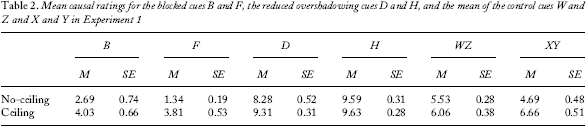
Concerning forward cue competition, the Type (cue F versus cue H) × Condition ANOVA revealed a main effect of type, F(1, 30) = 327.45, p < .001, and an interaction of type with condition, F(1, 30) = 9.84, p < .01. The interaction demonstrates that forward cue competition was stronger in the no-ceiling condition. Furthermore, paired-sample t tests showed that forward cue competition was significant in both conditions, t(15) = 24.37, p < .001, and t(15) = 8.31, p < .001, for the no-ceiling and ceiling condition, respectively. Finally, independent-samples t tests showed that the causal rating of the blocked cue F was affected by condition, t(30) = 4.39, p < .001, but not the causal rating of the reduced overshadowing cue H, t(30) < 1.
Concerning backward cue competition, the Type (cue B versus cue D) × Condition ANOVA revealed a main effect of type, F(1, 30) = 107.48, p < .001, but no interaction with condition, F(1, 30) < 1. Independent-samples t tests showed that the differences in causal ratings between conditions for cues B and D failed to reach significance, t(30) = 1.35, p > .15, t(30) = 1.69, p > .10, respectively.
The Type × Order interaction was significant in the no-ceiling condition, F(1, 15) = 14.68, p < .01, but not in the ceiling condition, F(1, 15) < 1. The interaction of type with order in the no-ceiling condition demonstrates that forward cue competition was significantly stronger than retrospective cue competition.
We also looked to see whether there were differences in specific cue competition effects between conditions (see Figure 1). Independent-samples t tests revealed a significant difference in forward blocking between conditions, t(30) = 2.88, p < .01. This was not the case for backward blocking, reduced overshadowing, and release from overshadowing, ts < 1.10.
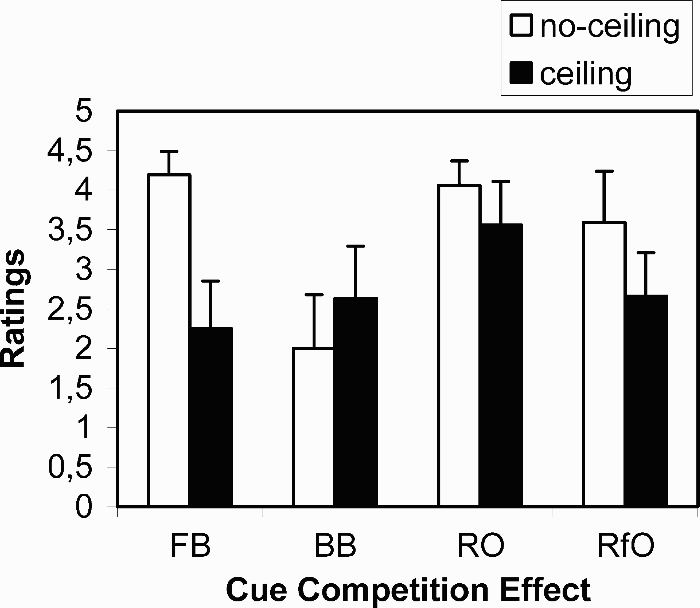
Forward blocking, backward blocking, reduced overshadowing, and release from overshadowing in Experiment 1. White bars represent the competition effects for the no-ceiling condition, and dark bars represent the competition effects for the ceiling condition. Error bars represent standard errors of the mean. FB stands for forward blocking, BB for backward blocking, RO for reduced overshadowing, and RfO for release from overshadowing.
Discussion
Experiment 1 investigated whether outcome maximality still had an influence on cue competition in a complex design. The results showed that the most important influence was a significant decrease of the causal rating of the forward blocked cue F when the outcome was submaximal. As a result of this significant decrease, forward cue competition and forward blocking were significantly stronger in the no-ceiling condition than in the ceiling condition. The manipulation of outcome maximality did not have a significant influence on the causal rating of the backward blocking cue B, and as a result retrospective cue competition and backward blocking were not significantly different between ceiling conditions. Finally, the significant decrease of the causal rating of cue F but not of cue B in the no-ceiling condition resulted in stronger forward cue competition than retrospective cue competition in the no-ceiling condition.
The results of forward cue competition were in line with higher order reasoning accounts of human causal learning. According to these accounts, the decrease in the causal ratings of the forward blocked cue F in the no-ceiling condition is due to the fact that participants can infer the noncausal status of F with certainty in the no-ceiling condition (note that the mean causal rating for cue F is near 1, the lowest possible value) while the causal status of cue F is unsure in the ceiling condition. Outcome maximality, however, should not influence ratings for the reduced overshadowing cue H because participants can infer with certainty on GH + trials that H has to be the cause of the outcome if G is not a cause of the outcome (an assumption that participants can make on the basis of the G − trials), irrespective of whether the outcome on GH + trials is maximal or submaximal.
Higher order reasoning accounts, however, also predict similar results for retrospective cue competition—that is, a significant decrease in the backward blocking cue B in the no-ceiling condition and no significant differences between conditions for the causal rating of the release from overshadowing cue D. Although the results were in line with the latter prediction, no significant difference between conditions was found for the mean causal rating of cue B. We return to this finding in the General Discussion.
One might be surprised that we still found substantial blocking in the ceiling condition. Such a finding seems to contradict the fact that under these conditions, participants should be unsure about the causal status of the blocked cue, and hence no blocking should be found. However, previous research (Vandorpe et al., 2005, Exp. 2) showed that also in a simple design some participants reason that X is not a cause of the outcome, even if the outcome is merely present on A + and AX + trials. These participants thus seem to ignore the possibility that the effect of X was hidden because of ceiling effects. It is likely that some participants also failed to take into account this factor in the present study, especially given the high load imposed by the complex design. When faced with a complex design, it might indeed be easier to simply ignore the possibility of ceiling effects because this removes uncertainty and allows one to classify blocked stimuli as noncauses. Waldmann (2000) pointed at a second reason for why blocking can be found under ceiling conditions. He speculated that participants might infer that the control cues have intermediate causal strength while the causal strength of the blocked cue could range between zero and deterministic strength. Participants could express this difference by giving different causal ratings, notwithstanding that they are aware that they do not have enough evidence to determine the causal status of the blocked cue and the overshadowing control cues. Another reason why blocking might have occurred in the ceiling and additive conditions is that participants pay less attention to the cues that are redundant as information processing becomes more complex. This latter possibility fits well within associative models that assign a crucial role to attentional processes (e.g., Kruschke, 2001, Kruschke & Blair, 2000; Mackintosh, 1975) or could point to attentional processes that interfere with the induction of appropriate premises (see De Houwer et al., 2005). Finally, the possibility remains that the blocking effect in the ceiling condition was due to associative processes like those described in the Rescorla–Wagner model (Rescorla & Wagner, 1972). It would be interesting for further research to investigate these different possibilities.
Experiment 2
In Experiment 2, we investigated the influence of additivity pretraining within a complex design. In the additive condition, participants were pretrained with the following events: T1 and T2 presented on their own and followed by an allergic reaction with an intensity of 5; T1 and T2 presented together and followed by an allergic reaction with an intensity of 10; T3 followed by an allergic reaction with an intensity of 5; and T4 followed by no allergic reaction. The pretraining stage in the nonadditive condition differed in two ways from the pretraining stage in the additive condition. The presentation of foods T1 and T2 together was followed by an allergic reaction with an intensity of 5, and the presentation of food T3 was followed by an allergic reaction with an intensity of 10. The reason why the intensity of the allergic reaction was 10 and not 5 on T3 + trials is that there would otherwise be a confound between the influence of nonadditivity training (T2 adds nothing to the effect of T1 alone) and an influence of outcome maximality (if the intensity of the allergic reaction on T3 + trials was 5, this would be the maximal outcome ever experienced by the participants). The foods allocated to the pretraining cues were different from the foods allocated to the cues used in the learning stage.
Method
Participants
A total of 30 first-year psychology students at Ghent University participated for course credit. They were randomly assigned to the additive or nonadditive condition.
Design, Stimuli, Materials, and Procedure
We only mention the differences compared to Experiment 1. First, the part of the instructions of Experiment 1 (see Appendix) starting at “Note that if the patient ate two different foods … ” and ending with the last sentence of the first full paragraph of the instructions was dropped. Furthermore, after the sentence “You will also receive information about whether the patient showed an allergic reaction or not”, we added the phrase “and information about the intensity of the allergic reaction”. Second, before the learning stage, a pretraining stage was added. In the additive condition, participants were presented T1+, T2+, T1T2 + +, T3+, and T4–, where the + stands for occurrence of the outcome with an intensity of 5 and the + +for occurrence of the outcome with an intensity of 10. In the nonadditive condition, participants were pretrained with T1+, T2+, T1T2+, T3 + +, and T4–. The foods cheese, wine, pineapple, and corn were allocated to the four training cues. Each food was allocated once to each cue, and this allocation was matched with the four different allocations of the foods to the learning cues. Finally, all outcomes that were presented during the learning stage had an intensity of 5. Note that no information was given about the maximum intensity that could be measured (i.e., the upper limit of the intensity scale) because we did not want to confound possible effects of outcome maximality and additivity training.
Results
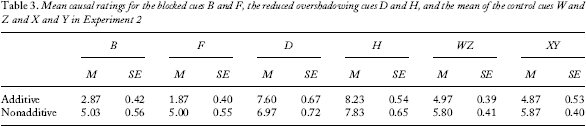
The causal ratings for the cues of importance are given in Table 3. Just like in Experiment 1, the ratings for cues B, F, D, and H were analysed using a 2 (type: blocked cues B and F versus reduced overshadowing cues D and H) × 2 (order: forward cues F and H versus backward cues B and D) × 2 (condition: additive versus nonadditive condition) ANOVA with type and order as within-subject variables and condition as between-subject variable. This analysis revealed a main effect of type, F(28) = 80.40, p < .001, an interaction effect of type and condition, F(1, 28) = 12.81, p = .001, and an interaction effect of type and order, F(1, 28) = 5.56, p < .05. None of the other effects reached significance, Fs < 1.2. Forward cue competition and retrospective cue competition were both significant in the additive condition, t(14) = 8.29, p < .001, and t(14) = 7.70, p < .001, respectively, and in the nonadditive condition, t(14) = 4.77, p < .001, and t(14) = 2.13, p = .051, respectively. More importantly, forward and retrospective cue competition were both stronger in the additive condition than in the nonadditive condition, t(28) = 3.64, p = .001, and t(28) = 2.56, p < .05. Forward cue competition was also stronger than retrospective cue competition in the additive condition, t(14) = 2.44, p < .05, but not in the nonadditive condition, t(14) = 1.07, p > .30. Finally, independent-samples t tests revealed that the causal ratings for the forward blocked cue B and for the backward blocked cue F were affected by additivity, t(28) = 3.09, p < .01, and t(28) = 4.59, p < .001, respectively. This was not the case for the causal ratings for the reduced overshadowing cue H, t(28) < 1, and the release from overshadowing cue D, t(28) < 1.
Mean causal ratings for the blocked cues B and F, the reduced overshadowing cues D and H, and the mean of the control cues W and Z and X and Y in Experiment 2
As in Experiment 1, we also looked to see whether specific cue competition effects were affected by additivity condition (see Figure 2). Independent-samples t tests revealed a significant difference in forward blocking between conditions, t(28) = 3.00, p < .01, and a marginally significant difference in reduced overshadowing, t(28) = 1.75, p < .10. The differences in backward blocking and unovershadowing failed to reach significance, t(28) = 1.64, p > .10, t(28) = 1.65, p > .10, respectively.
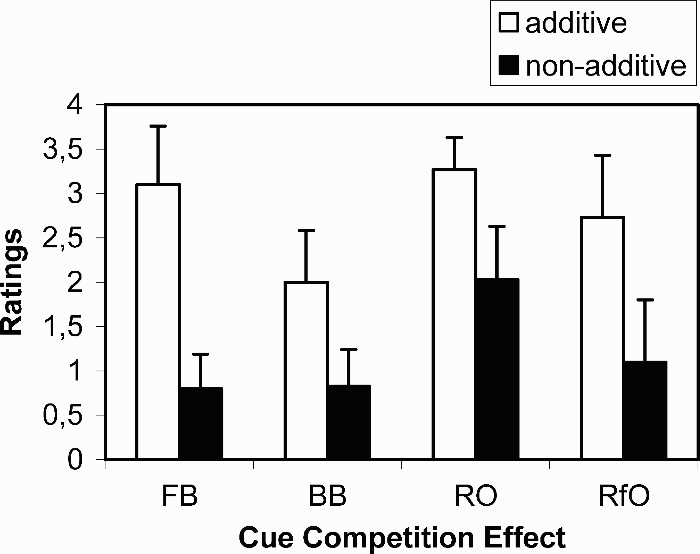
Forward blocking, backward blocking, reduced overshadowing, and release from overshadowing in Experiment 2. White bars represent the competition effects for the additivity condition, and dark bars represent the competition effects for the nonadditivity condition. Error bars represent standard errors of the mean. FB stands for forward blocking, BB for backward blocking, RO for reduced overshadowing, and RfO for release from overshadowing.
Discussion
In Experiment 2, we investigated whether manipulating outcome additivity had an influence on cue competition in a complex design. The results showed that the mean causal rating for the forward blocked cue F and the backward blocked cue B decreased significantly when cues were pretrained to have additive effects. This was not the case for the reduced overshadowing cue H and the release from overshadowing cue D. As a result of the decrease of the causal ratings for cues B and F, forward and retrospective cue competition were stronger in the additive than in the nonadditive condition. Similar to Experiment 1, forward cue competition was stronger than retrospective cue competition in the additive condition but not in the nonadditive condition. Also in line with Experiment 1, only forward blocking was significantly affected by condition.
The results of forward and retrospective cue competition were fully in line with higher order reasoning accounts of human causal learning. According to these accounts, participants will infer that the blocked cues B and F are noncausal when they can verify that both cues add nothing to the effect of an alternative cue with which they were presented together, provided that they assume that cues have additive effects. In line with this latter qualification, causal ratings for cue B and F were significantly higher when the additivity assumption was violated by pretraining than when the additivity assumption was confirmed by pretraining. The causal status of the reduced overshadowing cues, however, was not affected by outcome additivity. When one cue never causes the outcome when presented alone (cue C or G) but is followed by the outcome when presented together with another cue (cue D or H), one can infer that the latter cue has to be the cause of the outcome, irrespective of whether cues have additive or nonadditive effects.
One aspect of the results that does not seem to be in line with higher order reasoning models is the fact that reduced overshadowing tended to be smaller in the nonadditivity condition than in the additivity condition. A closer look at the data revealed that this was mainly due to the effect of condition on the mean causal ratings of the control cues W and Z (an increase of .8) rather than to an effect of condition on the mean causal rating of the reduced overshadowing cue H (a decrease of .4, see Table 3). Also the backward control cues X and Y increased with 1.0 in the nonadditivity condition relative to the additivity condition. A possible explanation for this slight increase in causal ratings of the control cues is that the chance for the control cues to cause an allergic reaction with an intensity of 5 is .75 in the nonadditive condition (either both cause an allergic reaction with an intensity of 5 or only one does) while in the additive condition the chance to cause an allergic reaction of 5 is .50 (only one control cue can cause an allergic reaction of 5). The chance of being causal for a reduced overshadowing cue, however, is always 1, irrespective of whether cues have additive effects or not. Because the difference between the chance for a control cue to be causal and the chance for a reduced overshadowing control to be causal was smaller in the nonadditive condition than in the additive condition, a smaller reduced overshadowing effect in the nonadditive condition could have occurred. Note that the higher causal ratings of the control cues cannot account for the significant difference in forward blocking. On the contrary, the higher causal ratings of the control cues in the nonadditive condition allow, if anything, more blocking whereas blocking was significantly lower in the nonadditive condition.
GENERAL DISCUSSION
We investigated whether outcome maximality and additivity pretraining had an influence on cue competition in complex designs. The results showed that forward cue competition and forward blocking were indeed smaller when the intensity of the outcome was maximal and when cues were explicitly pretrained to have nonadditive effects than when the intensity of the outcome was submaximal and when cues were explicitly pretrained to have additive effects. Also the causal rating of the forward blocked cue F but not the causal rating of the reduced overshadowing cue H was affected by both outcome maximality and additivity pretraining. Retrospective cue competition and the causal rating of the backward blocked cue B, on the other hand, were significantly influenced by additivity training but not by outcome maximality.
The results that we found for forward cue competition are in line with higher order reasoning accounts of human causal learning. According to these accounts (e.g. Lovibond et al., 2003; Waldmann & Walker, 2005) one cannot infer the causal status of a blocked cue X when the outcome on A + and AX + trials is always fully present, whereas one can infer that cue X is noncausal when the outcome occurs to the same submaximal intensity on these trials, provided that one assumes that cues have additive effects (e.g., De Houwer et al., 2002). In line with these hypotheses, causal ratings of the blocked cue were lower and forward blocking stronger when the outcome occurred with the same submaximal intensity than when the outcome had the highest possible intensity (Experiment 1) and when cues were pretrained to have additive effects than when they were trained to have nonadditive effects (Experiment 2). Importantly, the causal status of a reduced overshadowing cue Y can always be inferred with certainty, irrespective of whether the outcome occurs to a maximal or submaximal intensity on B − and BY + trials and irrespective of whether cues have additive or nonadditive effects. In line with this logic, the causal status of the reduced overshadowing cue H was not affected by outcome maximality and additivity pretraining.
The results of retrospective cue competition were less unequivocally in favour of higher order reasoning accounts of human causal learning. On the one hand, the results of Experiment 2 were in line with the predictions of these accounts. That is, causal ratings of the backward blocked cue B but not the release from overshadowing cue D were affected by nonadditivity pretraining. On the other hand, the causal rating of the backward blocked cue B was not significantly affected by the manipulation of outcome maximality in Experiment 1. However, both the influence of outcome maximality and additivity pretraining were more pronounced for forward cue competition than for retrospective cue competition. One could explain these observations by assuming that backward driven inferences are more difficult to make than forward driven inferences. There is indeed evidence from the reasoning literature (Evans, Newstead, & Byrne, 1993, pp. 233–234) and from studies with children (Bindra, Clarke, & Shultz, 1980) that processing information in a backward direction is more difficult than processing information in a forward direction. As we explained in the Introduction, drawing a valid inference involves several steps (i.e., formulating the premises, deriving a conclusion that takes into account assumptions about additivity). As a consequence of the higher cognitive load for retrospective inferences, some participants may have failed to take into account assumptions about additivity.
The fact that we found evidence for controlled reasoning processes within a complex design does not mean that complexity itself cannot affect controlled reasoning processes. In a recent study at our laboratory (Vandorpe & De Houwer, 2006), we manipulated the complexity of the design (simple versus complex condition). The results showed that retrospective cue competition but not forward cue competition was smaller in the complex condition. It was concluded that retrospective but not forward reasoning processes were affected by the complexity manipulation. Instead of manipulating the complexity of the design, one can also affect the influence of controlled reasoning processes on cue competition by asking participants to perform a secondary task during the learning task. Recent studies indeed found that blocking 1 decreased within a simple design when participants had to perform a secondary task (Waldmann & Walker, 2005) or when the difficulty of the secondary task was increased (De Houwer & Beckers, 2003). In sum, what the studies of Vandorpe and De Houwer, Waldmann and Walker, and De Houwer and Beckers suggest is that cue competition effects are due to controlled reasoning processes and that these effects decrease when controlled reasoning processes are affected by an increasing load on working memory capacity.
A higher order reasoning account predicts small or no blocking effects when the outcome always occurs on A + and AX + trials. However, Waldmann and Walker (2005) compared the causal rating of the blocked cue X with the causal rating of cue A, and in the study of De Houwer and Beckers (2003) the outcome occurred with a submaximal intensity. As a consequence, strong blocking effects occurred in the easy task conditions.
One could argue that we still found an effect of reasoning because the task was not complex enough. Undoubtedly one can create even more complex tasks, and we cannot exclude the possibility that the manipulations would not eliminate the effect of reasoning processes in these tasks. What we can conclude, however, is that controlled reasoning processes cannot simply be dismissed a priori as a source of cue competition effects in studies with complex designs. Our data also show that reasoning processes still play a role in designs of similar complexity as in studies that have been assumed to prevent controlled reasoning processes (e.g., Le Pelley & McLaren, 2003). Hence, previous evidence for cue competition effects in studies with complex designs cannot simply be regarded as evidence for associative models of cue competition. Instead, even with complex designs, researchers need to check whether reasoning processes operate.
Footnotes
APPENDIX
Learning instructions for the no-ceiling condition (translated from Dutch; in the ceiling condition, the maximal intensity on thepenultimate line of the first paragraph is replaced by 10).
This experiment is about how people learn relations between different events. Try to imagine that you are a doctor. One of yourpatients suffers from allergic reactions after eating certain foods. To discover which foods lead to an allergic reaction, the patient haseaten specific foods on different days and this was followed by a test on whether an allergic reaction occurred. In a moment, you willsee the results of these daily allergy tests one by one on the screen. On each trial, you will first see what the patient had eaten that day. On some days, he only ate one food; on other days he ate two different foods. Look carefully each time to what the patient ate thatday. You will also receive information about whether the patient showed an allergic reaction or not. Use this information to determinefor each food separately whether it leads to an allergic reaction in your patient. Note that if the patient ate two different foodsand there was an allergic reaction, you do not know which of the two foods was responsible for the allergic reaction. But you willalways get information about the total intensity of the allergic reaction, as caused by all consumed foods. If the intensity is zero, this means that there is no allergic reaction; if the intensity is greater than zero, this means that there is an allergic reaction. Note that the maximal intensity that can be measured corresponds to an intensity of 20. You have to determine for each food separatelyto which extent it causes an allergic reaction in the patient.
First you will see information about 176 allergy tests. After that, you will have to judge for each food the extent to which youthink it is a cause of an allergic reaction in the patient. Notice that only the presented information can help you. The task is to determineto which extent the foods cause an allergic reaction in this specific patient. Your personal experiences with the foods oroccasional knowledge about the properties of the foods are not relevant and cannot help you. Only the presented information matters.