







Abstract
As a means of clarifying the memory dynamics that underlie retrieval-induced forgetting, we explored how instructing participants either to remember or to forget a previously presented list of items influences the susceptibility of those items to inhibition. According to the inhibitory account of retrieval-induced forgetting, it is the items that interfere most with retrieval practice that should be the most susceptible to the effects of inhibition. Consistent with this prediction, items from lists that participants were told to remember suffered from significantly more retrieval-induced forgetting than did items from lists that participants were told to forget.
As counterintuitive as it might seem, forgetting is critical for the adaptive and efficient functioning of human memory (see, e.g., E. L. Bjork & Bjork, 1988; R. A. Bjork, 1989). Without some means of reducing the accessibility of outdated or irrelevant information, it would become increasingly difficult to learn and access new and relevant information. One process that may underlie this adaptive form of forgetting is retrieval inhibition (see R. A. Bjork, 1989), or the executive control mechanisms of inhibition (see Anderson, 2003). When attempting to retrieve a target item from memory, nontarget items that are associated with the same retrieval cue are also activated, creating competition and requiring that those competing items be selected against, or inhibited. This inhibition, furthermore, can have lasting consequences. As studies on retrieval-induced forgetting have shown, recall performance for inhibited items remains impaired even after a delay (e.g., Anderson, Bjork, & Bjork, 1994).
Retrieval-induced forgetting is defined empirically as the detrimental effect that retrieving a subset of items has on the later recall of other items that are associated with the same cue or configuration of cues. The retrieval practice paradigm is typically used to study retrieval-induced forgetting and involves three main phases: a study phase, a retrieval practice phase, and a testing phase (Anderson et al., 1994). In the study phase, a series of category–exemplar pairs from a number of different categories are presented one at a time in an interspersed order. Immediately after study, participants are given retrieval practice for a subset of items from a subset of the categories. Practised items are referred to as Rp + items, nonpractised items from practised categories are referred to as Rp– items, and nonpractised items from nonpractised categories are referred to as Nrp items. Not surprisingly, when participants are given a final test for all exemplars at the end of the experiment, Rp + items are recalled best. The more important finding, however, is that recall performance for Rp– items is worse than recall performance for Nrp items. It is this impaired performance of Rp– items relative to Nrp items that is referred to as retrieval-induced forgetting.
Retrieval-induced forgetting has now been shown to occur with a variety of materials and in a variety of contexts, and, furthermore, its occurrence is not limited to studies employing the retrieval practice paradigm (for a review see Anderson, 2003). Radvansky (1999), for example, found evidence of retrieval-induced forgetting using the fan-effect procedure. Although inhibition is currently considered to be the best supported explanation of retrieval-induced forgetting (e.g., Anderson, 2003; Anderson & Spellman, 1995; E. L. Bjork, Bjork, & MacLeod, 2006; Levy & Anderson, 2002), some researchers remain sceptical about the necessity to postulate inhibitory processes to explain the finding (e.g., MacLeod, Dodd, Sheard, Wilson, & Bibi, 2003). One popular argument against the inhibitory account is that the retrieval of a subset of items may simply strengthen the accessibility of those items, thereby causing them to interfere with or block the ability to recall the other items on a final test. Demonstrations that retrieval-induced forgetting is cue independent (e.g., Anderson & Spellman, 1995), strength independent (e.g., Anderson, Bjork, & Bjork, 2000), retrieval-specific (e.g., Bäuml, 2002), and interference dependent (e.g., Anderson et al., 1994), however, argue against this and other noninhibitory explanations (see Anderson, 2003, for a review).
A recent finding of particular relevance to the current debate is that successful retrieval is not a necessary condition for retrieval-induced forgetting to occur (Storm, Bjork, Bjork, & Nestojko, 2006). If competing items are inhibited to facilitate the retrieval of target items, it should not matter whether the eventual retrieval of those target items is successful. That is, independent of whether a retrieval attempt is successful, the items that compete during that attempt should nonetheless need to be inhibited. If the recall of competing items is impaired because the target items have been strengthened via retrieval practice, however, then whether participants succeed in recalling the target items during retrieval practice should matter a great deal. In Storm et al.'s study, participants first studied a list of category–exemplar pairs and then engaged in retrieval practice that consisted of category-plus-stem cues that either did or did not represent the initial letters of any exemplar associated with that category. In both cases, however, none of the retrieval practice cues matched any of the category–exemplar pairs that had been studied earlier. This manipulation effectively dictated whether retrieval practice could or could not be successful. Retrieval-induced forgetting was observed in both cases, and, furthermore, the size of the effect did not differ for exemplars associated with categories that had received possible retrieval practice versus exemplars associated with categories that had received impossible retrieval practice.
The current research was designed to test another natural prediction from the inhibitory account of retrieval-induced forgetting—specifically, that of interference dependence. If the central function of inhibitory control during retrieval is to reduce interference, the extent to which an item interferes during retrieval should determine the extent to which that item must be inhibited. After all, there is no need to reduce the accessibility of items that do not interfere. In support of this prediction, Anderson et al. (1994) found that whereas exemplars of high taxonomic strength (e.g., oranges and bananas from the category fruit) suffered from the effects of retrieval-induced forgetting, exemplars of low taxonomic strength (e.g., kiwis and pomegranates from the category fruit) did not. Similarly, Shivde and Anderson (2001) found that whereas retrieving the subordinate meaning of a word can inhibit the dominant meaning of that word, retrieving the dominant meaning of a word does not inhibit the subordinate meaning (for opposing evidence, however, see also Williams & Zacks, 2001).
The experiment reported here constitutes a new test of interference dependence by exploring how intentions to remember and forget influence the susceptibility of memories to retrieval-induced forgetting. Work on directed forgetting (see, e.g., E. L. Bjork & Bjork, 1996; MacLeod, 1998) has demonstrated that cueing participants to forget an initially presented list of items can drastically reduce the proactive interference that would normally be observed owing to that list's presentation on the recall of a subsequently presented list of items (e.g., R. A. Bjork, 1970). That is, participants in directed-forgetting experiments are often able to recall significantly more items from a second list after being cued to forget the items from a first list (compared to when they are told to continue remembering the items from the first list).
Combining a procedure similar to that of directed forgetting with a new variant of the retrieval practice paradigm, participants in the current experiment were cued either to remember or to forget a list of words prior to receiving retrieval practice. We predicted that the intention to remember the initial list of items would make those items more likely to interfere during retrieval practice and therefore more likely to be the target of inhibitory control. The intention to forget the initial list of items, however, should make those items less likely to interfere during retrieval practice and therefore less likely to be the target of inhibitory control. Ironically, therefore, whereas the intention to remember may lead one to forget, the intention to forget may lead one to remember.
Method
Participants
A total of 56 undergraduate students from the University of California, Los Angeles (22 male and 34 female), averaging 20.6 years of age, received credit in an introductory psychology course for their participation. All participants were able to read and speak English fluently.
Materials
Seven lists, each consisting of four category–exemplar pairs, were used in the experiment. Each list contained two exemplars from each of two categories (e.g., country: Russia; flower: lily; country: Sweden; flower: tulip), and no two lists across the experiment contained exemplars from the same category. All of the words were two syllables long, and none of the words in a list began with the same letter. Four extralist category–exemplar pairs were used as the basis for the retrieval practice cues for each of the 14 categories (e.g., flower: pa_ for the extra-list category exemplar pair flower: pansy).
Procedure
Participants first received two practice trials to acquaint them with the procedure and then received seven experimental trials. As shown in Figure 1, each trial consisted of four phases: (a) initial presentation, (b) a cue to remember or forget, (c) retrieval practice, and (d) either a test or no test. During the initial presentation phase, participants studied a list containing four category–exemplar pairs, two each from two different categories, arranged in an alternating manner, and with the entire list (i.e., all four pairs) remaining on the screen for 8 s. The pairs were listed vertically on the screen, and the participants were instructed to spend the entire 8 s relating the exemplars to their respective categories.
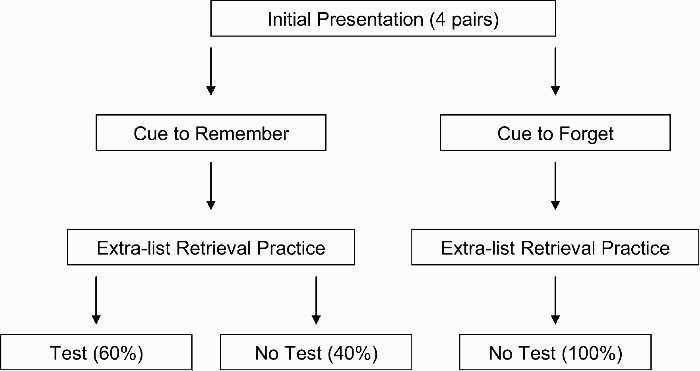
Schematic of the sequence of events for individual trials.
Immediately following the presentation phase, participants were given either a cue to remember or a cue to forget those initially presented pairs. Participants were informed, prior to the start of the experiment, that a cue to remember indicated that there was a 60% chance of being tested at the end of the trial, and a cue to forget indicated that there was a 0% chance of being tested at the end of the trial. Trials 1, 4, and 7 always contained remember cues that led to participants being tested at the end of the trial; Trials 2, 3, 5, and 6, however, either contained a remember cue or a forget cue and never led to participants being tested at the end of the trial. Thus, across all seven trials, any one participant received five trials containing remember cues—three followed by a test and two not followed by a test—and two trials containing forget cues that were never followed by a test. This procedure created four types of critical lists that were not tested during the blocks of trials: two that participants were instructed to remember and two that participants were instructed to forget.
Immediately following the cue to remember or forget, participants were guided to generate four extralist exemplars from one of the two categories that had appeared during the presentation phase. Participants were forewarned that none of the to-be-generated exemplars during retrieval practice would come from the earlier presentation phase. The category name and the first two letters of the to-be-generated exemplar appeared on the screen for 4 s, and the participants were asked to say the exemplar out loud to the experimenter. The particular category that received retrieval practice for each list was counterbalanced across participants.
Immediately after the retrieval practice phase of a given trial, the trial was either completed without a test (Trials 2, 3, 5, and 6) or there was a category-plus-one-letter-stem cued-recall test for all four items that had appeared during the presentation phase (Trials 1, 4, 7). During these end-of-trial tests, the four cues were placed on the screen in the same order in which they had appeared during the presentation phase, and participants had 12 s to retrieve as many of the missing exemplars as possible.
Upon completing all seven trials, participants engaged in an unrelated 5-min distractor task, which was followed by a surprise final cued-recall test for all 28 exemplars that had been studied during the presentation phases of the seven trials. The 16 previously untested exemplars from Trials 2, 3, 5, and 6 were always tested first, and the 12 previously tested exemplars from Trials 1, 4, and 7 were always tested last. The order in which the particular exemplars were tested was set randomly. For each exemplar, a category-plus-one-letter-stem cue was presented on the screen for 4 s, and the participant's task was to recall the previously studied exemplar out loud for the experimenter to record.
Prior to beginning this final recall test, participants were explicitly told that they were to use all of the exemplars (and only the exemplars) that had been presented in the previously studied lists of four category–exemplar pairs, including those that they had been instructed to forget. Consistent with the literature on retrieval-induced forgetting, we refer to exemplars appearing in the initial presentation phase that were from categories that received retrieval practice as Rp– items and exemplars from the initial presentation phase from categories that did not receive retrieval practice as Nrp items.
Results
Retrieval practice performance
Participants generated appropriate exemplars in the extralist retrieval practice phase 57% (SD = 21%) and 61% (SD = 19%) of the time in the remember condition and forget condition, respectively. This difference was not statistically significant, t(55) = 1.08, p > .05.
Recall performance for items initially tested
Participants were always told to remember the items from Trials 1, 4, and 7; furthermore, they were always tested on these items at the end of the trial. Performance on these immediate tests demonstrated a standard retrieval-induced forgetting effect: Whereas items from categories that received retrieval practice (Rp– items) were recalled at a mean rate of .86 (SE = .02), items from categories that did not receive retrieval practice (Nrp items) were recalled at a mean rate of .94 (SE = .01), t(55) = 3.51, p < .05. This effect of retrieval-induced forgetting was also found on the delayed test at the end of the experiment (M for Rp– items = .79, SE = .03; M for Nrp items = .85, SE = .02), t(55) = 2.26, p < .05.
Final-recall performance for items not initially tested
Recall performance on the final test for items presented in Trials 2, 3, 5, and 6 are shown in Figure 2. Participants were told either to remember or to forget these items, but in either case they were not tested on them until the final delayed test at the end of the experiment.
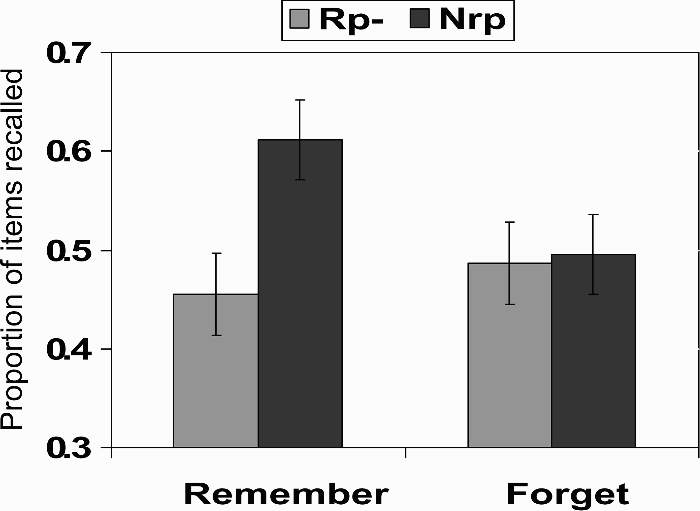
The mean proportion of items recalled during the final test as a function of item type and remember/forget cue. Rp– items are from categories that did receive retrieval practice. Nrp items are from categories that did not receive retrieval practice.
The data were subjected to a 2 (remember vs. forget) × 2 (Rp– vs. Nrp) repeated measures analysis of variance. Items from lists that participants were told to remember (M = .53; SE = .04) were recalled at a higher rate than were items from lists that participants were told to forget (M = .49; SE = .04); this difference, however, was not statistically significant F(1, 55) = 1.33, MSE = 0.101, p > .05. Given the predicted interaction between the remember/forget cue and retrieval-induced forgetting, however, this main effect may not reflect the most appropriate way of assessing the effect of directed forgetting. Rather, a more appropriate comparison is between recall performance for to-be-forgotten items and for to-be-remembered items from only the nonpractised (Nrp) categories. And, as this planned t test indicated, the to-be-forgotten Nrp items (M = .50; SE = .04) were recalled at a significantly lower rate than their to-be-remembered Nrp counterparts (M = .61; SE = .04), t(55) = 2.24, p < .05.
Most importantly, however, the interaction between instructions to remember/forget and retrieval-induced forgetting was significant, F(1, 55) = 5.20, MSE = 0.304, p < .05; η2 = .09. As predicted by the interference dependence assumption intrinsic to the inhibitory account of retrieval-induced forgetting, items from lists that participants were told to remember (Rp– items: M = .45; SE = .04; Nrp items: M = .61; SE = .04) suffered from significantly more retrieval-induced forgetting than did items from lists that participants were told to forget (Rp– items: M = .49; SE = .04; Nrp items: M = .50; SE = .04). In fact, whereas there was a rather large effect (16%) of retrieval-induced forgetting for items that participants were told to remember, t(55) = 3.01, p < .05, there was no evidence of retrieval-induced forgetting (1%) for items that participants were told to forget t(55) = 0.20, p > .05.
Discussion
The present results have a dramatic and unintuitive implication: Rather than protecting our memories from inhibition, the intention to remember may actually exacerbate the susceptibility of our memories to inhibition. Whereas items from lists that participants were told to forget did not suffer from retrieval-induced forgetting, items from lists that participants were told to remember suffered from a substantial amount of retrieval-induced forgetting.
This pattern of results cannot be readily explained by noninhibitory interference-based accounts of retrieval-induced forgetting. If the forgetting seen in the remember condition was caused by blocking or an overload of cues associated with the practised category, that forgetting should also have been observed in the forget condition. Furthermore, although not a significant difference, retrieval practice performance tended to be better when participants were instructed to forget the prior list than when they were instructed to remember the prior list. It would seem, therefore, that if the retrieval-induced forgetting effect were the result of interference or an overload of cues resulting from retrieval practice, the effect should have been, if anything, stronger in the forget condition than in the remember condition. Clearly, however, the opposite was the case.
In addition to arguing against noninhibitory accounts of retrieval-induced forgetting, these results also provide support for the logic that underlies the inhibitory account. If inhibition functions to reduce the accessibility of competing items that interfere with retrieval, the need for inhibitory control should depend on the extent to which competing items interfere. Consistent with this hypothesis, and with other work demonstrating interference dependence (e.g., Anderson et al., 1994; Shivde & Anderson, 2001; Storm, Bjork, & Bjork, 2005), whereas items that participants sought to maintain in memory during concurrent retrieval practice were inhibited, items that had already been dismissed as irrelevant or to-be-forgotten were not.
The fact that less retrieval-induced forgetting was found in the forget condition than in the remember condition despite an equivalent rate of retrieval practice performance deserves some discussion. Storm et al. (2006) have recently argued that retrieval success is not a necessary condition for retrieval-induced forgetting to occur, and the results observed here appear quite consistent with that claim. We argue that the inhibitory process underlying retrieval-induced forgetting is not the automatic by-product of selectively retrieving a subset of items from memory; but rather that it reflects executive control mechanisms that act to resolve interference during attempts to retrieve a subset of items from memory. Because the instruction to forget presumably reduced the extent to which to-be-forgotten items interfered with retrieval practice, inhibitory control was not necessary. It is the competition that arises during retrieval, and not the retrieval per se, that causes forgetting to occur.
Another aspect of the data that merits discussion is the apparent absence of retrieval-induced forgetting for items that participants were cued to forget. The positive effects of directed forgetting have been argued to reflect a reduction in proactive interference (see, e.g., E. L. Bjork & Bjork, 1996; R. A. Bjork, 1970)—more specifically, that instructing participants to forget an initially presented list of words reduces the extent to which that list interferes with the learning of a new list. A potential consequence of this reduction in proactive interference, however, appears to be that directed forgetting may serve to protect to-be-forgotten items from the inhibitory processes underlying retrieval-induced forgetting.
In a different body of work, Wegner (1994) has shown that under certain circumstances, intentional forgetting can lead to unintentional remembering. In his studies, participants who are instructed not to think of something, such as a white bear, subsequently think of a white bear far more often than if they had not been given that instruction (e.g., Wegner, Schneider, Carter, & White, 1987). The experiment presented here demonstrates the flip side of that phenomenon—that intentional remembering can lead to unintentional forgetting. Because it is the memories that we most want to remember that interfere with the retrieval of other memories, it is these memories that are the most affected by the inhibitory consequences of retrieval-induced forgetting.