







Abstract
The picture–word interference (PWI) task is a widely used technique for exploring effects of semantic context on lexical access. In this task, printed words are superimposed over pictures to be named, with the timing of the interfering word relative to the picture systematically manipulated. Two experiments (N = 24 adults in each) explored the time course of effects of associates (e.g., CARROT superimposed on a picture of a rabbit) versus coordinates (e.g., CHIPMUNK superimposed on a picture of a rabbit) on naming latencies. Associates led to faster picture naming than did unrelated words, with facilitative effects occurring at stimulus onset asynchronies (SOAs, in ms) ranging from –450 to 0. Coordinates led to slower naming latencies, with the interference effect restricted to SOAs of –150 and 0. The overlapping time course of associative priming and coordinate interference provides important constraints on models of lexical access in speech production.
Context exerts a strong influence on the ease of word retrieval during speech production. The nature of this effect has had a profound influence on theories of lexical access in speech production. For example, the ability to retrieve the name of a pictured object is influenced by both the semantic and the phonological features of a distractor word when it is presented in close temporal proximity to the target picture (Cutting & Ferreira, 1999; Schriefers, Meyer, & Levelt, 1990). In general, a semantically related distractor has its greatest effect on picture naming when the presentation of the distractor leads, or is simultaneous with, the target picture, but a phonologically related distractor word has its greatest effect when its presentation lags the onset of the picture presentation (e.g., at a positive stimulus onset asynchrony, SOA, of + 150 ms). These facts, coupled with analyses of other data such as speech errors, have led researchers to conclude that lexical–semantic information and phonological/word form information constitute separate levels of representation and that the determination of the lexical–semantic characteristics of a word substantially precede a determination of its phonological characteristics.
Although there is much agreement about these general processing constraints (Caramazza, 1997), there is much less agreement about the exact manner in which the semantic characteristics of a distractor influence lexical access. In many cases, previous studies have found that a related word distractor slows picture naming (Caramazza & Costa, 2000, 2001; Cutting & Ferreira, 1999; Damian & Bowers, 2003; Damian & Martin, 1999; Lupker, 1979; Schriefers et al., 1990; Starreveld & La Heij, 1996; Underwood, 1976). However, in some cases a related word distractor appears to facilitate naming of a picture target (Alario, Segui, & Ferrand, 2000; Bajo, 1988; Costa, Alario, & Caramazza, 2005; La Heij, Dirkx, & Kramer, 1990, Exp. 2) relative to an unrelated word.
Several authors have noted that differences in the SOA between distractor and target as well as the nature of the semantic relation may determine whether interference or facilitation is observed (Alario et al., 2000; Costa et al., 2005; La Heij et al., 1990). In most picture–word studies that have manipulated the semantic relation between distractor and picture target, the distractor word and target belong to the same category and are coordinates (e.g., dog and bear). However, a handful of studies have used distractors that were associates of the target but not coordinates (e.g., dog and bone) (Alario et al., 2000; Costa et al., 2005; Cutting & Ferreira, 1999, Exp. 3; Lupker, 1979, Exp. 2). When distractors and targets are coordinates, and the SOA between target and distractor ranges from –200 ms to + 100 ms, interference is generally observed, and facilitation has not been observed. This interference appears to shift to facilitation when the distractor precedes the target by 400 ms or more (Bajo, 1988; La Heij et al., 1990). When the distractor and target are associates, but not coordinates, then facilitation is generally observed (Alario et al., 2000; Costa et al., 2005); however, a trend toward interference was reported by Cutting and Ferreira (1999) in a condition in which the targets and distractors were associates, and Lupker (1979) found that association produced only a negligible effect on naming latencies.
The exact nature of these patterns is complicated by the fact that these factors are generally confounded in these studies. For example, studies reporting facilitation for coordinate distractors have sometimes used coordinates that were also highly associated with the target (e.g., dog and cat). In fact, La Heij et al. (1990) concluded that facilitation occurs only for highly associated distractors that precede the target by a significant amount of time (e.g., –400 ms).
As Alario et al. (2000) have indicated, the possibility that associates produce facilitation, and coordinates produce interference has important implications for theories of speech production. Semantic interference effects have typically been interpreted as arising from competition between lexical–semantic representations activated by the target picture and the distractor (Levelt, Roelofs, & Meyer, 1999). A related distractor is assumed to provide stronger competition to the target's lexical–semantic representation (e.g., lemma) than does an unrelated distractor because it is activated directly by the distractor and indirectly by the target picture. The fact that associates tend to produce facilitation suggests that some other mechanism is involved. One possibility is that a word activates the word forms of its associates. Cutting and Ferreira (1999) proposed this kind of architecture in their account of the effect of certain distractors on homophones. They found that coordinate and associate distractors that were related to the inappropriate meaning of a target (e.g., dance or formal in conjunction with the picture of a toy ball) facilitated picture naming relative to an unrelated control. In contrast, only coordinate distractors that were related to the appropriate meaning of a target (e.g., frisbee in conjunction with the picture of a toy ball) produced reliable interference. To explain these data they proposed that competitors but not associates have inhibitory connections at the lemma level whereas associates but not coordinates have excitatory links that connect each other at the word form level. Thus, this model predicts that coordinates produce interference because of competition among lemmas, and associates produce facilitation because of excitatory connections among word forms.
A second possibility is that the SOA between a target and distractor may be the more important factor in whether association or interference is likely to be observed. Recently, Bloem, van den Boogaard, and La Heij (2004) proposed a model to explain a shift from facilitation at early SOAs to interference at later SOAs in a word translation task. In this task, native-speaking Dutch participants had to translate an English word (L2) into Dutch (L1) while ignoring a distractor that was either a Dutch word or a picture. Picture distractors always produced facilitation, regardless of SOA, but word distractors produced facilitation at –400 and interference at + 200. To explain these effects, the authors proposed the conceptual selection model (CSM) in which differences in the relative activation of lexical and conceptual information rather than differences between associates and coordinates determine whether a related distractor will produce interference or facilitation.
Similar to some other models of word production, the CSM describes lexical access as a competition between activated lexical representations. At short SOAs, a related distractor produces interference because its lexical representation is directly activated by the distractor and indirectly activated by the conceptual representation of the target picture. Compared to an unrelated distractor, the lexical representation of the distractor is activated to a larger degree and competes more strongly with the lexical representation of the target. At earlier SOAs, the model assumes that the direct activation of the lexical representation of the distractor has decayed to fairly low levels because activation decays more quickly at the lexical than at the conceptual level. This feature of the model leaves the effect of the distractor at the conceptual level intact, and therefore the target's lexical representation receives additional activation via conceptual mediation from a related distractor. This additional activation is not offset by a similar influence from the target concept to the distractor's lexical representation because inputs from the conceptual to the lexical–semantic levels are subject to a threshold. This threshold is not exceeded unless the representation is task relevant (i.e., the target picture's concept). In other words, when the distractor precedes the target by a sufficient amount of time (e.g., –400 ms), the word cat will facilitate naming the picture of a dog because it will activate the concept for dog via the concept for cat. The lexical representation for cat will not compete strongly with the name dog because direct activation at the lexical–semantic level will have decayed, and the threshold requirements will prevent conceptual activation from dog via the concept for cat or backwards facilitation from the original activation of cat. Thus, the target's lexical representation receives additional conceptually mediated activation but the distractor's lexical representation does not receive activation from the conceptual level resulting in facilitation.
The goal of our study is to systematically manipulate the factors that have been identified as being possibly important in determining whether a semantically related distractor will interfere with picture naming or facilitate picture naming. Although coordinates are frequently associates, we selected coordinates that were nonassociated and associates that were not coordinates. These distractors were presented both at a very early SOA (–450) where facilitation has been observed and at later SOAs (0, + 150) where interference has been typically observed. Experiment 1 utilized SOAs of –450, –150, and + 150, and Experiment 2 utilized SOAs of –300, 0, and + 300. If the direction of the influence of distractors is determined by differences in the organization of information at either the conceptual or the lexical–semantic levels then facilitation should only be observed with associates, and interference should only be observed with coordinates. On the other hand, if the direction of a distractor's influence relative to control items is determined primarily by when their influence is introduced into the process of lexical access, then the SOA between target and distractor should be the critical factor.
EXPERIMENT 1
Method
Participants
A total of 24 undergraduates (16 women and 8 men, ages 18–40 years with a mean of 21.7 years) were recruited from introductory psychology classes at a large public university and received extra credit for their participation. All of the participants were native speakers of English.
Materials
The picture–word interference (PWI) task utilized 30 black-and-white line drawings of common objects as pictures to be named (Cycowicz, Friedman, Rothstein, & Snodgrass, 1997). Each target picture was paired with five different interfering words (IWs): (a) an associate—a word that is associated with the pictured concept but is not a member of the same superordinate category (e.g., CARROT superimposed over a picture of a rabbit); (b) an unrelated control for associates—one of the associate words paired with an unrelated picture (e.g., CARROT superimposed over a picture of a ring); (c) a coordinate—a word that is a member of the same superordinate category as the name of the pictured concept, but not associated with it (e.g., CHIPMUNK superimposed over a picture of a rabbit); (d) an unrelated control for coordinates—one of the coordinate words paired with an unrelated picture (e.g., CHIPMUNK superimposed over a picture of a ring); and (e) a neutral word (i.e., GOOD). The IWs were selected based on established category production norms and word association norms (Nelson, McEvoy, & Schreiber, 2004) and on ratings of semantic similarity made by an additional group of 50 undergraduate participants. The average production frequency for the targets as responses to the distractors in the associate condition was 50%. None of the targets was produced as a response to any of the coordinate distractors in the Nelson et al. (2004) norms. A list of the stimulus materials is presented in the Appendix. Four additional pictures (i.e., car, elephant, jar, pickle) were selected as practice pictures, in combination with eight additional distractors to create four items in each of the four conditions.
The IWs appeared in upper-case Arial black font, 20 points bold, in the centre of the screen, with 300-ms duration. To maximize visibility and contrast with the picture, IWs were printed in maroon.
Design
A PWI paradigm was used in which participants were instructed to name the pictures as quickly and accurately as possible while ignoring the visually presented IWs. The onset of the IWs was manipulated in time relative to the presentation of the pictures—that is, SOAs. The experimental design included two within-subject factors of IW type (associate, nonassociate control, coordinate, noncoordinate control, and neutral) and SOA (−450, − 150, + 150). The onset of the IWs occurred either before the presentation of the picture (–450 ms and –150 ms) or after the presentation of the picture (+150 ms). The experiment was blocked by SOA, with the order of presentation of the three SOA conditions counterbalanced across subjects. The 150 experimental trials (30 pictures × 5 IW types) at each SOA were further divided into five lists, such that pictures and IWs were never repeated within a list, with six trials for each of the five IW conditions per list. The order of presentation of the trials within each list was randomized, as was the order of lists at each SOA.
Procedure
Adults were tested individually in a single 1-hour session, conducted in a psychology laboratory. A PC computer running E-Prime 1.1 software (Schneider, Eschman, & Zuccolotto, 2002) was used to present the task. Direct measurement of reaction times (RTs) was accomplished using a custom-made tone generator coupled with a light detector. The light detector responded to the appearance of the picture on the screen (i.e., each picture was preceded by a black screen) and produced a tone in response to the onset of the picture. The tone generator fed directly into the digital CD recorder, but was inaudible to the participant. On a second channel, the participant's naming response was recorded. RTs were measured directly by calibrating the time between the onset of the picture (as indicated by the tone on Channel 1) and the onset of the participant's response (as indicated by the speech waveform on Channel 2). This procedure drastically minimized the loss of trials due to voice key insensitivity and ensured accurate naming latencies.
The experimental task had three training parts and one test part. First, participants practised naming the experimental pictures with no time limit. In the event that a participant used a word other than the target picture name, the examiner corrected the participant and made sure that the participant was familiar with the target name. The examiner instructed the participants to avoid using articles (e.g., “a fork”, or “the cat”) when naming the pictures. Second, the participants were shown the experimental pictures once more, but this time they were instructed to name the pictures as fast as they could. Third, the participants were trained on the PWI paradigm using four practice pictures (coupled with eight additional IWs). Each picture was presented on the screen, one at a time, and participants were instructed to name the picture as quickly as possible while ignoring the IW. Following this practice, the experimental trials were administered using the same PWI procedure. The participant's response triggered the picture to disappear from the screen, with a pause of 2 s separating one trial from another. During the pause, participants were presented with a black screen with a fixation cross in the centre. Each picture was presented on the computer screen for maximum of 4 s. That is, if no answer was produced or the voice key failed to activate, a new trial was initiated after 4 s.
Results
Errors occurred when the participant stuttered in producing their response or produced an incorrect name for the target picture. Error rates were tabulated, taking into consideration any trials lost due to equipment failure. Participants were highly accurate in performing the task, averaging 1.8% errors. An analysis of variance (ANOVA) conducted on the proportions of errors as a function of SOA and IW type revealed no significant effects.
Table 1 presents the mean RTs as a function of IW type and SOA. RTs exceeding a participant's mean by 3 standard deviations (outliers) were removed. Two sets of analyses were conducted, one with subjects as the random factor (F1) and the other with items as the random factor (F2). Each of these sets of analyses was conducted as repeated measures designs in which SOA (−450, − 150, + 150) and IW type (associate, nonassociate control, coordinate, noncoordinate control, neutral) were within-subjects factors. These analyses revealed significant main effects of SOA, F1(2, 46) = 83.12, MSE = 330,370, p < .001; F2(2, 58) = 253.20, MSE = 409,639, p < .001, and IW type, F1(4, 92) = 17.94, MSE = 14,579, p < .001; F2(4, 116) = 14.14, MSE = 26,759, p < .001, which were qualified by a significant interaction of SOA and IW type, F1(8, 184) = 7.62, MSE = 4,282, p < .001; F2(8, 232) = 5.22, MSE = 5,342, p < .001.
Mean RTs for Experiment 1 as a function of SOA and IW type
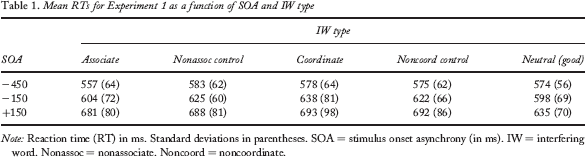
Note: Reaction time (RT) in ms. Standard deviations in parentheses. SOA = stimulus onset asynchrony (in ms). IW = interfering word. Nonassoc = nonassociate. Noncoord = noncoordinate.
Pictures paired with neutral IWs were named significantly faster than those in the other IW conditions, F1(1, 92) = 46.51, MSE = 37,781, p < .001; F2(1, 116) = 37.58, MSE = 71,109, p < .001—that is, 26 ms on average.
Planned comparisons were conducted to test for associative priming and coordinate interference at each SOA. For associative priming, we examined the difference between associate and nonassociate control IW types, and for coordinate interference we examined the difference between coordinate and noncoordinate control IW types. The obtained difference scores are shown in Figure 1. Pictures paired with associates were named faster than their controls, with significant differences at SOAs of –450, F1(1, 184) = 15.19, MSE = 8,533, p < .001; F2(1, 232) = 6.98, MSE = 7,140, p < .01, and of –150, F1(1, 184) = 9.20, MSE = 5,168, p < .01; F2(1, 232) = 7.08, MSE = 7,247, p < .01. Pictures paired with coordinates were named reliably slower than their controls only at an SOA of –150, F1(1, 184) = 5.74, MSE = 3,226, p < .05; F2(1, 232) = 7.54, MSE = 7,712, p < .01.
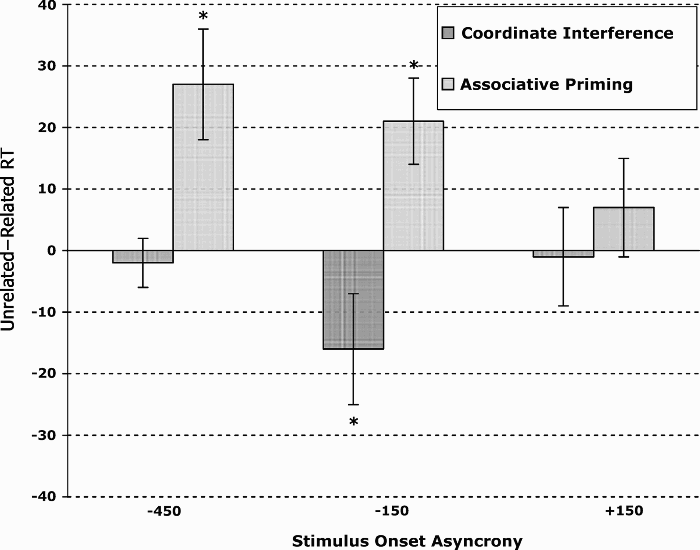
Associative priming and coordinate interference in Experiment 1 at stimulus onset asynchronies (SOAs, in ms) of –450, –150, and + 150 (N = 24). Standard errors are shown.
Discussion
The focus of this experiment was to examine the time course of associative priming and coordinate interference. We observed both predicted semantic effects: Pictures paired with associates were named faster than their controls, whereas pictures paired with coordinates were named more slowly than their controls. Associative priming was reliable at –450 and –150 but did not reach significance at + 150. Coordinate interference was also observed but only at an SOA of –150. Thus, in contrast to Alario et al. (2000), we observed both facilitation for associates and interference for coordinates relative to controls at the same SOA. To our knowledge the only other study to report semantic facilitation and semantic interference effects in the PWI task at the same SOA is that of Costa et al. (2005), which used an SOA of 0 ms. This study reported facilitation for pictures superimposed with noncoordinate, semantically related distractors (e.g., BUMPER superimposed over a car), along with the usual interference effect for coordinate distractors.
EXPERIMENT 2
The findings of Experiment 1 indicated that interference and facilitation can be observed at the same SOA in a PWI task. One reason for the difference between Experiment 1 and the Alario et al. (2000) study might have been the fact that the –150 SOA fell between the earliest (–234 ms) and latest (–114 ms) SOAs that were used in Alario et al. (2000). Therefore, we conducted a second study to determine whether the overlap between the facilitatory effects of associates and interference produced by coordinates could be replicated over a slightly different range of SOAs. In Experiment 2 we used two SOAs that bracketed the –150 SOA at which we had obtained both facilitation and interference as well as a third much later SOA at + 300 ms.
Method
Participants
An additional 24 adult native speakers of English (17 women and 7 men, ranging in age from 17 to 28 years with a mean of 19.9 years) were recruited from the same source as that in Experiment 1.
Materials
The materials were identical to those in Experiment 1.
Design
The design was identical to that of Experiment 1, except that we used SOA conditions of –300, 0, and + 300 ms.
Procedure
The procedure was identical to that of Experiment 1.
Results
Errors
Participants were highly accurate in performing the task, averaging only 2.4% errors. An ANOVA conducted on the proportions of errors as a function of SOA and IW type revealed no significant effects.
Table 2 presents the mean RTs for each modality as a function of IW type and SOA. RTs were trimmed to the same outlier criterion as that in Experiment 1. A set of analyses was conducted on these data that were identical to the RT analyses for Experiment 1.
Mean RTs for Experiment 2 as a function of SOA and IW type
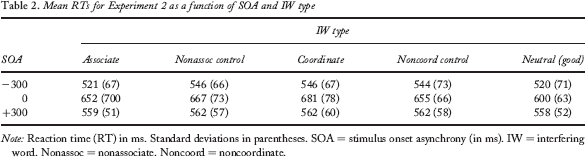
Note: Reaction time (RT) in ms. Standard deviations in parentheses. SOA = stimulus onset asynchrony (in ms). IW = interfering word. Nonassoc = nonassociate. Noncoord = noncoordinate.
There were significant main effects of SOA, F1(2, 46) = 56.36, MSE = 443,051, p < .001; F2(2, 58) = 395.10, MSE = 536,557, p < .001, and IW type, F1(4, 92) = 42.17, MSE = 15,566, p < .001; F2(4, 116) = 26.89, MSE = 23,437, p < .001, and an interaction of SOA and IW type, F1(8, 184) = 17.06, MSE = 5,806, p < .001; F2(8, 232) = 8.48, MSE = 6,155, p < .001.
Pictures paired with neutral IWs were named significantly faster than those in the other IW conditions, F1(1, 92) = 130.16, MSE = 48,041, p < .001; F2(1, 116) = 88.08, MSE = 76,754, p < .001—that is, 29 ms on average.
Planned comparisons were conducted to test for associative priming and coordinate interference at each SOA. The obtained difference scores (associate vs. nonassociate; coordinate vs. noncoordinate) are shown in Figure 2. Pictures paired with associates were named faster than their controls, with significant differences at SOAs of –300, F1(1, 184) = 21.00, MSE = 7,148, p < .001; F2(1, 232) = 12.16, MSE = 8,828, p < .001, and 0, F1(1, 184) = 8.62, MSE = 2,934, p < .01; F2(1, 232) < 1. Pictures paired with coordinates were named reliably slower than their controls only at an SOA of 0, F1(1, 184) = 25.27, MSE = 8,599, p < .001; F2(1, 232) = 13.09, MSE = 9,501, p < .001.
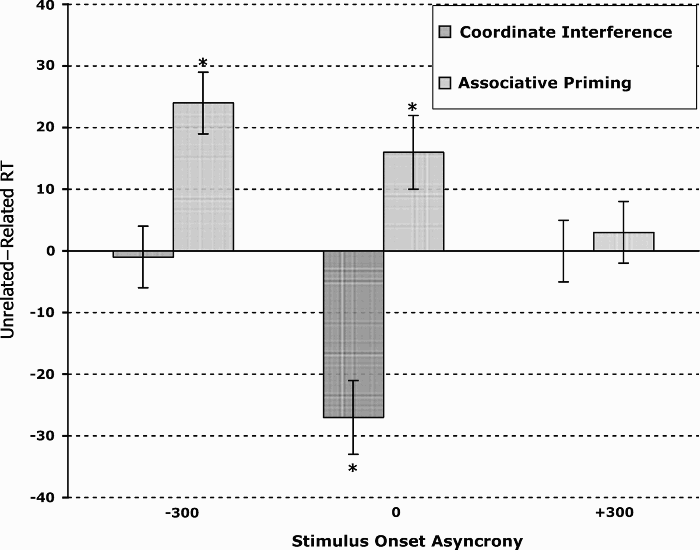
Associative priming and coordinate interference in Experiment 2 at stimulus onset asynchronies (SOAs, in ms) of –300, 0, and + 300 (N = 24). Standard errors are shown.
Discussion
In several respects, the findings were quite consistent with previous research. First, neither facilitation nor interference was observed at the + 300-ms SOA. Our review of the literature indicates that several studies have presented semantically related distractors in the visual modality using an SOA of + 200 (Damian & Martin, 1999; Glaser & Düngelhoff, 1984; La Heij et al., 1990; Starreveld & La Heij, 1996) or greater and none of these studies have obtained a reliable effect. In addition, the results of this experiment are consistent with previous studies in that facilitation appears to be observable at earlier SOAs than is interference (Alario et al., 2000). At the same time, we replicated the finding from Experiment 1 that both facilitation and interference can be obtained at the same SOA.
GENERAL DISCUSSION
Previous studies have found that a semantically related word distractor slows picture naming relative to a neutral word in some cases (Caramazza & Costa, 2000, 2001; Cutting & Ferreira, 1999; Damian & Bowers, 2003; Damian & Martin, 1999; Lupker, 1979; Schreifers et al., 1990; Starreveld & La Heij, 1996; Underwood, 1976) but speeds picture naming in other cases (Alario et al., 2000; Bajo, 1988; Costa et al., 2005; La Heij et al., 1990, Exp. 2). In the current study, the presence or absence of these effects depended on the SOA but the direction of the influence of the distractor (i.e., facilitation or interference) depended entirely on the nature of the relation between the distractor and target rather than the SOA. When the distractor was a coordinate of the target then naming of the target was slowed relative to a neutral control at SOAs of –150 and 0. At all of the other SOAs naming latencies did not differ whether the distractor was a coordinate or unrelated to the target. In contrast, naming was faster when the distractor was associated with the target than for a neutral control at SOAs that ranged from –450 to 0. Thus, the effect of associates was apparent over a greater time course but the time course of the two effects overlapped.
The fact that facilitation was observed at earlier SOAs than interference is generally consistent with other studies (Alario et al., 2000; Bloem et al., 2004; La Heij et al., 1990). However, the specific finding that interference can be obtained with coordinate distractors at the same SOA that produces facilitation with associated distractors is novel. This overlap is problematic for accounts that assume that associates and coordinates are organized similarly at the conceptual or lexical–semantic level. For example, the conceptual selection model (CSM) of lexical access (Bloem & La Heij, 2003; Bloem et al., 2004) explains the patterns of facilitation and interference in terms of the relative activations of the conceptual and lexical–semantic representations of the distractor. If one were to explain the facilitation for associates observed at SOAs of –150 and 0 within the framework of the CSM then one would have to assume that activation of the lexical–semantic representation of the distractor decayed relatively rapidly. However, the absence of a residual effect of the distractor at the lexical–semantic level would make it very difficult to explain how coordinate distractors would still compete with the target picture's name.
The current findings indicate that the direction of the influence of a distractor is determined by whether the distractor is associated with the target or a coordinate of the target. Although facilitation has been observed for coordinate distractors in a handful of studies (Bajo, 1988; Bloem et al., 2004; La Heij et al., 1990), an inspection of the materials that have been used in these studies suggests that the coordinates were also associated with the target. The Bajo (1988) study reported using highly associated coordinates. The Bloem et al. (2004) study reported that the average association frequency for a subset of their materials that were normed was 6.6% but many of the English translations of the Dutch distractors appear to have been associated with the English targets (e.g., cat–dog, garlic–onion, horse–cow), and the degree of association for the stimuli that were not normed is unclear. In the La Heij et al. (1990) study, the only condition in which facilitation was observed utilized coordinate distractors that were also associated with the target, as the authors themselves noted. Thus, the facilitation that has been observed in these studies with coordinate distractors is quite likely the product of their association with the target.
It is worth noting that some of the studies in which interference has been observed for coordinates have included coordinate distractors that were associated with target pictures. One reason that these studies may have failed to obtain facilitation is that the distractors were not sufficiently associated with the target pictures or that the distractors either preceded the target pictures by a very short SOA or appeared simultaneously with the targets (Caramazza & Costa, 2000; Lupker, 1979; Underwood, 1976). The current results suggest that the effect of associates is slightly larger at the longer SOAs (–450 and –300) than at the shorter SOAs (–150 and 0). If a portion of the coordinates were nonassociated, and others were only weakly associated, then the effect of association may have been relatively small at the short SOAs, and the interference produced by semantic relatedness may have been dominant.
The conclusion that associates and coordinates produce different effects as distractors in a picture–naming task is difficult to reconcile with a single-mechanism account. Within most models of lexical access semantic interference effects have typically been interpreted as arising from competition between lexical–semantic representations activated by the target picture and the distractor (Levelt, Roelofs, & Meyer, 1999). This interpretation assumes that related concepts have facilitatory connections or influences on each other. To the extent that associates are also active when associated concepts are active, an associated distractor should also produce interference through semantic or conceptual competition. Therefore, it seems quite likely that the facilitatory influence of associates occurs at a different stage of picture naming than the influence of coordinates.
A second aspect of the data that indicates that coordinates and associates influence different stages of processing is the different time course of the two effects. The fact that coordinates do not produce interference at an SOA earlier than –150 suggests that lexical semantic information must decay fairly rapidly or lexical semantic activation produced by the distractor would still influence target processing if the distractor was processed for a longer period of time. Similarly, the fact that coordinates do not produce interference at late SOAs suggests that the lexical–semantic identity of the target must be resolved relatively quickly or the distractor would produce an effect as lexical–semantic information became available. In contrast to the relatively circumscribed time course of coordinates, the associates produced facilitation at the earliest SOA (–450), and this effect persisted until an SOA of 0. If the effect of a distractor on conceptual or semantic representations decays quickly, as suggested by the results for coordinates, then it is very difficult to see how associates could have their effect at this same level of representation given that they produce facilitation 300 ms earlier than the coordinates. Thus, this difference in the time course of the effects for associates and coordinates suggests that their influence is on a different stage of processing as well.
One very recent exception to the view that coordinates produce interference through competition at the lexical–semantic level is a recent proposal that claims that coordinates prime target processing at the lexical–semantic level but are harder to exclude as possible responses to the target postlexically (Mahon, Costa, Peterson, Vargas, & Caramazza, 2007). According to this view, a distinction can be made between distractors that are possible responses to the target pictures and those that are not. A critical assumption of this hypothesis is that both the target and the distractor can activate production-ready representations. If the distractor does not possess response-relevant criteria then it is more easily excluded or cleared as a possible response. However, if the distractor shares features with the target then it is more difficult to exclude its production-ready representations and allow production of the target's name. Thus, coordinate distractors produce slower naming times than unrelated distractors because they are more likely to possess critical features that are shared with the target than are unrelated distractors.
This explanation of coordinate interference can be assimilated with the current results if one assumes that associates are generally easy to exclude as responses to the target. Similar to unrelated trials this would reduce interference at a postlexical stage of processing but unlike unrelated trials the response exclusion hypothesis assumes that associated distractors would speed processing at the conceptual–lexical–semantic level.
A critical issue for this account is the degree to which semantic criteria are available that can be used to exclude certain responses to the target. In some experimental designs, it seems quite likely that participants are able to use certain characteristics of the distractors and targets to strategically establish response relevant criteria. For example, whether a distractor is a member of the response set (i.e., a target name on some trials) or not can make a difference in the amount of interference that is observed in the PWI task (Hanauer & Brooks, 2005; but see Caramazza & Costa, 2000, for a different conclusion). Similarly, in Experiments 1 and 2 of Mahon et al. (2007) distractor words differed from targets in terms of part of speech, and participants could have adopted a strategy in which distractors that were verbs were more easily rejected than distractors that were nouns. Such a general distinction that can be applied to a large number of trials to aid in excluding a response to the distractor does not appear to exist in a significant number of PWI experiments in which a semantic interference effect has been observed (Alario et al., 2000; Caramazza & Costa, 2000; La Heij et al., 1990; Miozzo & Caramazza, 2003). A review of the materials in these experiments suggests that a very general semantic distinction (e.g., animacy) does not exist that would allow participants to distinguish between the distractor and target more easily on unrelated trials than on related trials. For example, the materials in Caramazza and Costa (2000) include the related target distractor pairs comb–brush and bed–chair and the unrelated pairs comb–skirt and bed–gun. Clearly, the features that a comb and a brush share, but that a comb and a skirt do not, are different from the features that a bed and a chair share, but that a bed and a gun do not.
A considerable challenge for the response exclusion hypothesis is to demonstrate how semantic information could serve to exclude a distractor response when semantic features vary over individual distractor–target pairs. This problem is highlighted in a recent study by Jescheniak, Hantsch, and Schriefers (2005). The authors found that naming an object (e.g., a rose) at the basic level (e.g., flower) was slowed by the presence of a distractor word that was phonologically related to its subordinate level name (e.g., roads). In contrast, the presence of a distractor that was phonologically related to the name of another member of the basic-level category (e.g., daze for daisy) did not slow naming at the basic level. This latter result suggests that the phonological activation of related names is quite limited. Thus, the extent to which a coordinate interference effect for items such as chair paired with the distractor bed can be explained in terms of the activation of response-relevant criteria for chair seems to be an open issue in the absence of an experimental context that affords a strategic use of some general semantic criteria.
Although the current findings and the earlier work of Alario et al. (2000) indicate that coordinates and associates influence different stages of picture naming, the exact locus of the facilitative effect of associates remains unclear. One possibility is that associates influence the production of word forms. If one assumes that associates have facilitatory connections between their word forms, as has been proposed by Cutting and Ferreira (1999), then associated distractors may speed the resolution of the word form of the target by increasing its activation. This influence could only occur if distractors regularly activate their word forms. As this claim is quite controversial, this proposal must remain quite tentative, but the potential impact of the separable effects of coordinates and associates on theories of lexical access is clear.