







Abstract
Older and younger adults searched arrays of 12 unique real-world photographs for a specified object (e.g., a yellow drill) among distractors (e.g., yellow telephone, red drill, and green door). Eye-tracking data from 24 of 48 participants in each age group showed generally similar search patterns for the younger and older adults but there were some interesting differences. Older adults processed all the items in the arrays more slowly than the younger adults (e.g., they had longer fixation durations, gaze durations, and total times), but this difference was exaggerated for target items. We also found that older and younger adults differed in the sequence in which objects were searched, with younger adults fixating the target objects earlier in the trial than older adults. Despite the relatively longer fixation times on the targets (in comparison to the distractors) for older adults, a surprise visual recognition test revealed a sizeable age deficit for target memory but, importantly, no age differences for distractor memory.
Studies comparing visual search in younger and older adults have suggested interesting similarities and differences. Initial studies (Plude & Doussard-Roosevelt, 1989; Zacks & Zacks, 1993) indicated that, while older adults are typically slower, they have similar search patterns to younger adults. Both age groups are able to effectively conduct feature searches (i.e., searches where the target is distinguishable from the distractors by a single feature) and are slowed significantly in conjunction searches (i.e., searches where the target is defined by the union of two features, and the distractors possess one feature or the other but not both), but older adults appear to be hindered more by the demands of a conjunction search task than are younger adults. Recent studies by Madden and colleagues (e.g., Madden, Gottlob, & Allen, 1999; Madden et al., 2002; Madden, Whiting, Cabeza, & Huettel, 2004) indicate that older adults, similar to younger adults, are able to guide their search based on target characteristics (guided search; Wolfe, Cave, & Franzel, 1989). These results indicate that older adults are able, at least under some circumstances, to take advantage of cues in the environment that can aid search (for recent reviews see Kramer & Madden, 2008, and Madden & Whiting, 2004).
Most studies of age-related difference in search have typically relied on the use of global performance measures (e.g., response time and accuracy for an entire trial) rather than examining the specific processing of targets and distractors. One way to obtain processing measures for the specific elements in a search display is to examine the eye movements of a person while he or she searches the display. Relatively few studies have examined eye movement records to determine whether scanning differences account for the age-related differences in conjunction search. In those studies that have explored age-related changes in eye movements during search, older adults tend to produce more saccades and longer average fixation durations than younger adults (Ho, Scialfa, Caird, & Graw, 2001; Scialfa & Joffe, 1997; Watson, Maylor, & Bruce, 2005) suggesting that older adults process less information on each fixation and take longer to process information during a fixation than do younger adults.
Although eye movement measures provide some insight into age-related differences in the processing of search displays, previous studies have primarily used measures that collapse across all of the elements in the display (e.g., average fixation time and overall number of fixations). By focusing on global eye movement measures, the scanning behaviour devoted to the individual elements in the search display is lost. Older and younger adults could differ in how various items in the display affect their scanning pattern. For example, the items, dependent on the relationship to the target in the display, may be selected in a different order and differentially processed. Previous research (Ball, Beard, Roenker, Miller, & Griggs, 1988) on age differences in the useful field of view—the area of the visual field in which information can be extracted within a single fixation—has found that older adults have smaller useful fields of view than younger adults. If older adults cannot attend to as many items at one time as younger adults during a visual search task (as suggested by Scialfa & Joffe, 1997), the items that they select and the order in which they are selected may be different. Unfortunately, a global measure would be insensitive to these types of differences.
Scialfa and colleagues have attempted to examine age differences in the selection of individual items in both a conjunction search (line orientation and colour; Ho & Scialfa, 2002) and triple conjunction search (colour, shape, and orientation; Dennis, Scialfa, & Ho, 2004). In the simple conjunction search, Ho and Scialfa found no age-related difference in selection of distractors indicating similar search patterns for younger and older adults. Dennis et al. also found that younger and older adults demonstrated similar overall search patterns; both age groups were most likely to fixate distractors that shared both the target colour and shape, followed by those that had the same target colour, and were least likely to fixate items that did not share the target colour. One age-related difference, however, that emerged was that older adults tended to fixate distractors that shared the target colour more often than did younger adults, whereas younger adults demonstrated a greater likelihood of fixating distractors that possessed the conjunction of the target colour and shape in a triple conjunction search. Dennis et al. suggested that the additional memory demands of the triple conjunction search (i.e., having to remember multiple dimensions that define the target) may have led to the age differences in selection.
The present study had two major goals: (a) to compare the eye movement patterns of younger and older adults as they carry out a complex visual search, and (b) to relate potential age differences in viewing patterns to differences in long-term visual memory of the search objects. To address the first goal, we investigated the selection and processing of individual objects during visual search (similar to Dennis et al., 2004) in order to determine whether age-related differences existed when more complex search stimuli were used. The present study differed from previous studies in numerous ways that permitted a finer grained analysis of the age differences in the visual processing of search stimuli and allowed an analysis of age-related differences in subsequent visual memory. The first major difference was that we used arrays of photographs of real-world objects (rather than black and white striped shapes as in Dennis et al.) as stimuli, increasing the complexity of the search objects and the search task. More specifically, as in Williams, Henderson, and Zacks (2005), younger and older adults counted the number of instances of a specified basic-level category (e.g., drill) in a specified colour (e.g., yellow) that were included in an array of 12 photographs of real-world objects (see Figure 1). For example, participants counted the number of yellow drills among conjunction distractors that could either be from the same object category as the target (e.g., a red drill) or have the same colour (e.g., a yellow telephone), or be unrelated (e.g., a green door). Importantly, a different target was used for each search array, and all the objects in an array (including the multiple targets if they contained more than one target) were unique image tokens that appeared in only a single array. Thus, for example, if there were two yellow drills present in the display, each drill was a unique token, rather than a repeated presentation of the same image. Scanning of the entire array was encouraged by requiring participants to count the number of targets (0–3) in the display. Each search array was presented twice in the experiment, with a different configuration, but, critically, the role that each object played in the search (i.e., target, colour distractor, category distractor, or unrelated distractor) did not change across the experiment. The use of many different objects within and across trials allowed us to examine the processing of each object separately.
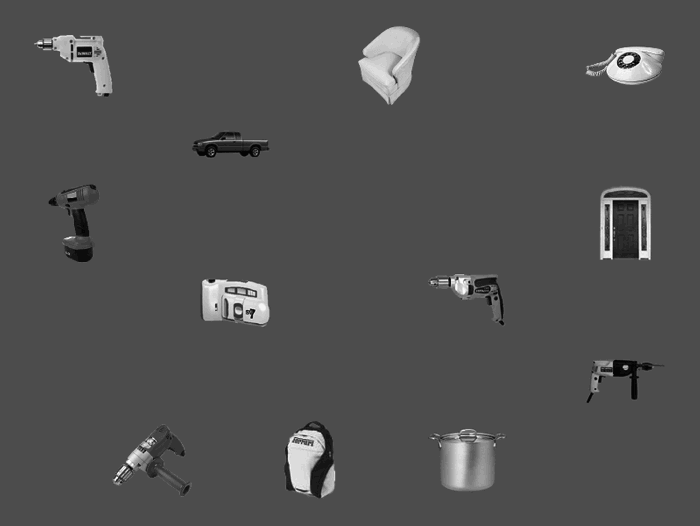
Example display from the search portion of the experiment. The search target for this display was a yellow drill (one present in the upper left corner), which was tested during the memory test. The other objects that appeared in the memory test were the yellow telephone (colour distractor; upper right corner), the red drill (category distractor; left middle), and the green door (unrelated distractor; right middle). Displays were always in full colour.
Several questions arise with respect to age differences in viewing the different classes of objects in the current search arrays. If older adults show a preference for colour as a guiding factor in search (as in Dennis et al., 2004), then they should demonstrate a preference for selecting colour distractors during the search trial. However, this preference for colour items may be eliminated when real-world objects are used as search stimuli due to the fact that objects such as drills, cars, purses, and cats are far more complex than oriented lines or letters, and they possess a natural category that may be more informative in search than line orientation. In other words, when asked to search for yellow drills, older adults may not preferentially look for yellow things to see whether they are drills, but may search for drills to determine whether they are yellow.
Beyond the previously demonstrated preference for colour distractors, older adults, because of reduced useful fields of view and longer search times, could select and dwell on different types of objects in the display more than could younger adults. To address this possibility, we also analysed several eye movement measures, including the average fixation time overall, gaze duration (the amount of time spent viewing the object the first time it is encountered), total fixation time on an object, probability of examining an object, number of fixations on an object, and number of viewings of an object, to determine whether there were any age differences in the selection and temporal processing of individual objects in the display. Each of these measures is sensitive to a different aspect of processing of objects during search. For example, the breadth of the search can be analysed by the probability that an object is examined and the number of times it is viewed, whereas the processing of the individual object is given by the total time and gaze duration measures. If older adults have greater difficulty than younger adults processing information during a fixation (Scialfa & Joffe, 1997), we would expect that older adults would dwell longer than younger adults on objects that were more related to the targets (along with the targets themselves). However, because feature searches are equally efficient for the two age groups, older and younger adults should demonstrate the same viewing patterns for the unrelated distractor objects in the display. We also analysed the likelihood that the different types of objects were viewed for each fixation (up to the 13th fixation), which provides an indication of the time course for the selection of objects for the two age groups. If older adults cannot extract useful visual information as far into the periphery as younger adults, the two age groups should demonstrate different patterns of viewing across the trial with younger adults being able to select more related objects (i.e., objects related to the target by either their colour or their category) earlier in the trial than older adults.
The second goal of the current study was to examine age-related differences in the long-term impact of a search on memory for the objects encountered. Age difference in the use of memory during search has been investigated by Kramer and colleagues. For example, Kramer et al. (2006) examined the likelihood that older and younger adults would refixate a previously viewed distractor in order to determine whether there were age differences in memory for distractor positions in search. They found that older adults were less likely to return to previously viewed distractors than were younger adults, indicating that older adults had better memory for the spatial locations of the distractors than had younger adults. Kramer et al. suggest that older adults may use this better memory to limit the number of revisits to distractors, compensating for age-related slowing in other aspects of search.
Kramer et al.'s (2006) results indicate that older adults use short-term memory of the locations of distractors to speed their search. In contrast, we were interested in age-related differences in the incidental long-term memory that may exist for the visual details of the objects present in search. In other words, if a specific car is encountered during a search for a bird, do older and younger adults remember the distractor car or the target bird differently after the search? Because older adults tend to have longer search times and thus will probably look at the objects longer, they could be more accurate in their visual memory for objects encountered. In fact, age-related differences in viewing patterns (e.g., if older and younger adults are differentially drawn to the colour distractors during search) could predict age-related differences in memory patterns for the different types of objects. However, the possibility exists that even though older adults view some objects longer than the younger adults, general age-related declines in memory could lead to decreased memory performance for some or all types of objects.
Because the objects were unique tokens in the present search arrays, visual memory for the individual objects present in the search displays could be examined. Williams et al. (2005) demonstrated that younger adults could remember both the targets and distractors following the search and an intervening task (see also Castelhano & Henderson, 2005; Hollingworth, 2003, 2004; Hollingworth & Henderson, 2002; Hollingworth, Williams, & Henderson, 2001; Simons, Chabris, Schnur, & Levin, 2002; Standing, Conezio, & Haber, 1970). Williams et al. reported evidence suggesting that visual memory was tied to the way that the objects were initially viewed: Objects that were fixated more frequently or for a longer duration were remembered better. In the current study, if age-related differences were found in the viewing times for target and distractor objects, then we would expect to find differences in subsequent visual memory for various objects that were seen. To examine whether age-related differences in viewing behaviour affected visual memory, we performed regression analyses to evaluate the relationship between viewing time and visual memory for the two age groups.
In the present study, we present eye movement and recognition memory data from 24 younger and 24 older adults. Although less critical, we also report search reaction times and search accuracy for these participants. For the recognition memory, search time, and search accuracy measures, we also have data from additional groups of 24 younger and 24 older adults who were tested in the same procedures but without eye tracking. Use of the search and memory data of these participants increases the power to detect age differences in these performance measures. Preliminary analyses of the relevant measures show minimal differences in the critical search and memory measures as a function of the presence versus absence of eye movement recordings. Consequently, we report combined analyses of the search and memory data below (noting, where relevant, the few significant differences between the two subsets of participants). The data from the younger adults (but not older adults) who underwent the eye-tracking procedure were previously reported in Williams et al. (2005). The data from the younger adults previously reported and the older adults reported here were collected at approximately the same time and using the same equipment. We used the previously reported younger adult data for the age comparisons that appear here. Finally, we report a set of new analyses for both age groups that were not included in the earlier publication.
Method
Participants
For this study, 48 younger adults were recruited from general psychology courses at Michigan State University, and 48 older adults were recruited from the general community. A total of 24 participants from each age group had their eye movements tracked while in the experiment, whereas the other 24 individuals from each group participated in the experiment without eye tracking. The demographics for the participants in both the eye-tracking and non-eye-tracking versions of the experiment appear in Table 1. The age groups differed in their education level and vocabulary scores (Shipley Vocabulary Test; Shipley, 1940). In the Morningness/Eveningness Questionnaire (Horne & Ostberg, 1976), older adults expressed a stronger preference for the morning than did younger adults, who were neutral in their time of day preference. For this reason, an effort was made to test older adults in the morning; younger adults were primarily tested in the later morning to afternoon. These age differences are typical for experiments run on these samples (see Yoon, May, & Hasher, 1999, for review). Although we did not screen for visual acuity, all participants were allowed to use their own glasses or contacts if needed/desired in order to view the display clearly.
Means for age, education level, vocabulary, and Morningness/Eveningness Questionnaire
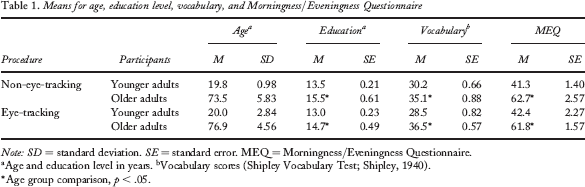
Note. SD = standard deviation. SE = standard error. MEQ = Morningness/Eveningness Questionnaire.
Age and education level in years.
Vocabulary scores (Shipley Vocabulary Test; Shipley, 1940).
Age group comparison, p < .05.
Design
For both eye-tracking and non-eye-tracking versions of this experiment the procedures were divided into two phases: a search phase and an unannounced memory test phase. In the search task, the participants had to count the number of targets present in the search array (0–3). We examined search accuracy and search time for both experiments. Additionally, for 24 participants in each age group, we monitored participants’ eye movements. In the memory test phase for all participants, a two-alternative forced-choice token discrimination task was administered, in which participants had to select the object that had been presented during the search task. For example, two tokens of yellow drills were presented, one of which had been seen before and the other of which was a nonpresented foil, and the participant was instructed to choose the previously presented token. We examined accuracy for four object types for each array that a participant saw: targets, category distractors, colour distractors, and unrelated distractors.
Materials
The materials consisted of 960 coloured pictures taken primarily from the Hemera Photographic Database (Hemera Technologies, 2002) along with a variety of other photographic sources presented in 384 arrays of 12 pictures each (see Williams et al., 2005, for complete details). Each participant viewed a total of 32 search arrays. Participants searched for targets defined by the predominant colour of the object and its basic-level concept (e.g., yellow and drill). As noted previously, each of the 32 search arrays had a different target (e.g., yellow drill on the first trial, a black dog on the next trial, a blue car on the third, etc.). Each object was resized so that its longest dimension (horizontally or vertically) was 3.5° in visual angle (from a viewing distance of 57 cm) while maintaining its original proportions. Objects were separated by a minimum of 3.5°. Because of an equipment change necessary to implement eye tracking, the computer monitor was slightly larger than those used in the non-eye-tracking version. This change made the objects 0.4° larger in each dimension (3.9° × 3.9°) while maintaining the same proportions.
Each search array had a total of 12 objects consisting of 0–3 targets (e.g., “a drill that is yellow”), 3–4 category distractors, 3–4 colour distractors, and 3–4 unrelated distractors (see Figure 1). Four colour, four category, and four unrelated distractors were presented if there was no target in the display. With the addition of each target, one unrelated distractor, one category distractor, and one colour distractor, respectively, were removed. Category distractors matched the target's basic category (e.g., a red drill), and colour distractors matched the target's predominant colour (e.g., a yellow backpack). Unrelated distractors did not match either the category or the colour of the target (e.g., a green door). Objects were counterbalanced in that each object served as a target, a colour distractor, a category distractor, and an unrelated distractor across participants within each age group.
Visual search
Each search array was presented twice during the search portion of the experiment. The number of targets and the configuration of objects were changed between presentations to prevent participants from using memory of the first search to respond to the second presentation. To provide a viewed target to test for each array, at least one target was present in the second presentation of an array, but participants were not informed of this contingency.
Visual memory test
The unannounced memory test was a two-alternative forced-choice task. One target, one colour distractor, one category distractor, and one unrelated distractor were tested from each presented search array. All three tested distractors for each array were present both times the array was searched; the target may have been presented only once if no target was present in the first presentation. Participants were asked to determine which of two pictures was identical to a picture that had been in the earlier search task; the other picture was a nonpresented foil that matched the colour and category of the presented item (e.g., a previously nonpresented yellow drill). Foils for half the participants were the presented objects for the other half, counterbalanced across participants within each age group.
Procedure
At the beginning of the experiment, participants completed the informed consent form and a general demographic questionnaire. Before beginning the experiment, participants were positioned approximately 57 cm from the computer monitor (though in the non-eye-tracking version of the experiment, viewing distance was not strictly controlled) with a button box in front of them labelled with the numbers 0, 1, 2, and 3. They were informed that they were to count the number of objects in an array that fitted a specific description that was displayed prior to each search trial (e.g., “the drill that is yellow”) and to input the answer using the button box. The search display remained visible until the button press. Accuracy was emphasized over speed. The participants were shown an example prior to beginning the experimental trials. In the eye-tracking version of the experiment, following the example display, the eye-tracking equipment was calibrated using a 9-point calibration. Calibration was checked before each trial, and recalibration was performed if necessary. Stimuli were presented using E-prime Version 1.0 software (Schneider, Eschman, & Zuccolotto, 2002).
Following the search task, participants completed unrelated tasks—for example, the Shipley Vocabulary test (Shipley, 1940) and the Morningness/Eveningness questionnaire (Horne & Ostberg, 1976)—for 10 minutes. At the 10-minute mark, participants were given the visual memory test and were informed that they could complete the forms afterwards. They were told that two pictures on each trial would be presented, and their task was to indicate which picture (left or right) they had seen in the previous search task by pressing the left or right button on the button box. If they were uncertain which picture had been seen previously, participants were encouraged to take their best guess. Half of the presented items appeared on the left, and half appeared on the right.
Eye-tracking equipment
Eye movements were monitored using an ISCAN RK-726PCI pupil-tracking system sampling at 240 Hz, which is capable of tracking through eye glasses (including bifocals) and contact lenses. Prior to data collection, the eye-tracking system was calibrated, and accuracy of the calibration was checked periodically throughout the experiment. The calibrated position was accurate to less than 1° of visual angle both horizontally and vertically. Recalibration was performed when the desired level of accuracy was not met for both age groups. All trials began with the participant looking in the centre of the screen. A chin and forehead rest was used to aid in eye tracking and to maintain a consistent viewing distance.
Eye-tracking analyses
Following the analysis procedure from Williams et al. (2005), every sample was averaged with the two preceding and the two following samples to create a more stable eye-tracking record. Fixations were determined by grouping consecutive samples that were no more than 8 pixels in Euclidian distance from the previous sample. Because the objects were 90 × 90 pixels in size, the use of an 8-pixel criterion permits the analysis of multiple fixations on a single object in the array, which is critical for several eye movement measures that will be discussed. Any fixation that was less than 90 ms or greater than 4,000 ms was discarded. One trial from one older adult was eliminated in the eye-tracking results due to an experimenter error. All trials from all of the other participants were analysed. All eye-tracking analyses were performed on all object regions. An object region was defined as the 4.7° × 4.7° box (3.9° + 0.4° in each dimension) centred on the object. Fixations were determined to be on a particular object if they fell within this region. Blinks and other track losses were eliminated prior to the analysis.
Results
The results are divided into three sections: visual search, eye tracking, and visual memory and regression analyses. For all statistical tests, an alpha level of .05 was used to determine statistical significance. As the procedures for the visual search and memory tasks were the same for both versions of the experiment; we report them together but use version as an additional between-participants factor, which is only discussed if there was a significant difference/interaction between the two versions of the experiment.
Visual search
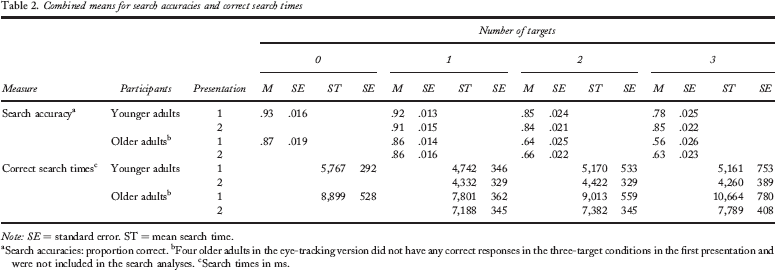
The two measures of interest for the visual search component are search accuracy and time in counting the number of targets present. Because each array was presented twice, the search data are divided into first and second presentations (see Table 2). However, because at least one target was present in the second presentation of an array, the analyses reported in this section do not include the 0 target condition from the first presentation. Because our primary concern is with age differences in search, we only discuss age group differences and interactions for the search accuracy and search times.
Combined means for search accuracies and correct search times
Note. SE = standard error. ST = mean search time.
Search accuracies: proportion correct.
Four older adults in the eye-tracking version did not have any correct responses in the three-target conditions in the first presentation and were not included in the search analyses.
Search times in ms.
For search accuracy, younger adults were more accurate than older adults, F(1, 88) = 87.44, p < .001, MSE = 0.039, and there was an interaction between the number of targets present in the display and age group, F(2, 176) = 21.56, p < .001, MSE = 0.017, with older adults having greater difficulty with additional search targets than younger adults. This finding could indicate greater difficulty for the older adults in the counting task, or greater difficulty identifying all possible targets in the display due to colour or shape variations (because each target was a different token). There was a three-way interaction of experimental version, age group, and number of targets, F(2, 176) = 7.61, p = .001, MSE = 0.017, with older adults in the eye-tracking version performing worse with more targets present. This result was most likely due to the fact that the eye-tracking procedures limited the ability of the participants to look at the buttons used for responding. Although the participant could have rested his or her fingers on the row of buttons (which were labelled from left to right in order from 0–3), the inability to check the position of his or her fingers may have led to increased errors. This difference was also evident in the interaction of experimental version and age group, F(1, 88) = 8.75, p = .004, MSE = 0.039. No other age-related interactions were significant (F < 1.5, p > .10).
With regard to search time, overall, older adults were slower to respond correctly to the search arrays than were younger adults, F(1, 88) = 42.20, p < .001, MSE = 42,706,030, 1 and there was an interaction with the number of targets present, F(2, 176) = 6.70, p = .002, MSE = 4,399,406, with older adults appearing to be more affected by the number of targets in the search array than were younger adults. In addition, older adults’ search times improved more than those of younger adults, F(1, 88) = 6.68, p = .011, MSE = 5,342,012, in the second presentation of the array. Finally, there was an interaction of experiment version and age group in that younger adults had similar search times in the two versions, whereas older adults were faster in the eye-tracking version, F(1, 88) = 3.95, p = .05, MSE = 42,706,030. No other age-related interactions were significant (Fs < 1).
A total of 4 older adults in the eye-tracking portion of the study did not provide any correct responses in the three-target condition and thus were excluded from the search time analysis.
Eye movement results
Although there were age-related differences in the search overall, one of our primary concerns was to examine differences in the way that the arrays were searched and how the individual elements in the displays were processed. We analysed seven different measures of eye movement behaviour (see Table 3 and Figure 2) to provide an overall examination of the age-related similarities and differences in the way that the different classes of objects were viewed during the search. Unlike the search accuracy and search time analyses, all trials were included in the eye movement analyses (including the 0 target condition) discussed in this section.
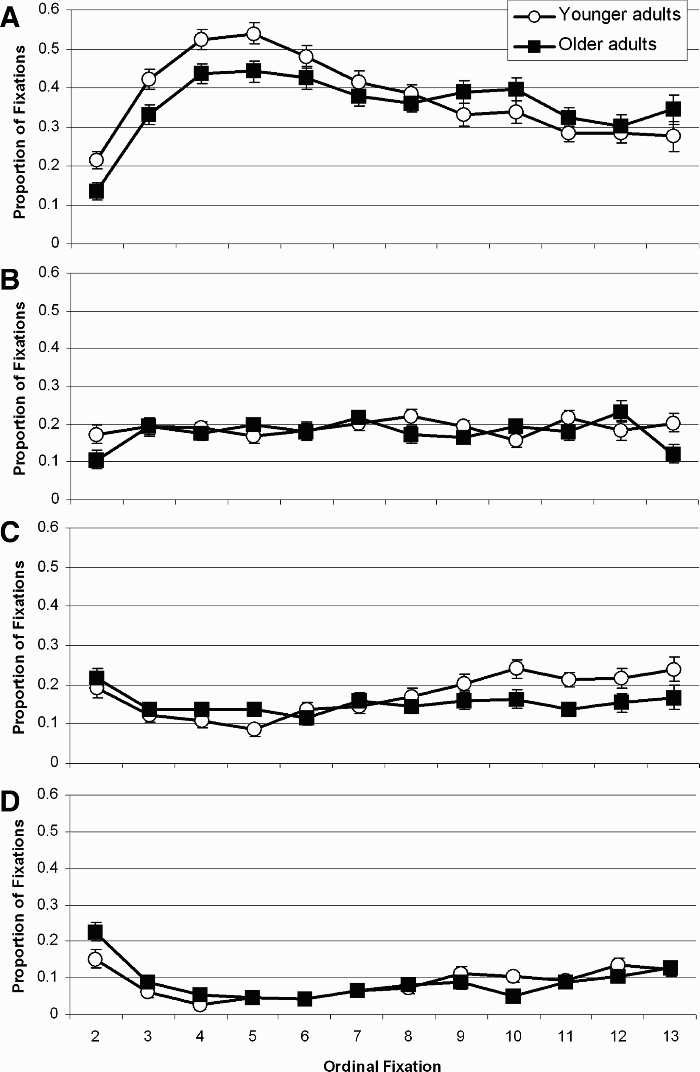
Ordinal fixation data for the two age groups. Target objects are in Panel A, colour distractors are in Panel B, category distractors are in Panel C, and unrelated distractors are in Panel D. Ordinal fixation begins at 2 because the first fixation began the trial and was in the centre of the screen (not on any object). Error bars are standard errors.
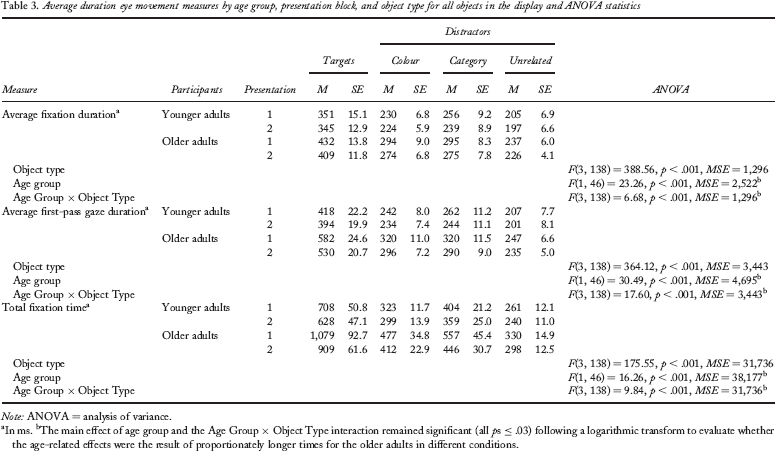
Average duration eye movement measures by age group, presentation block, and object type for all objects in the display and ANOVA statistics
Note: ANOVA = analysis of variance.
In ms.
The main effect of age group and the Age Group × Object Type interaction remained significant (all ps ≤ .03) following a logarithmic transform to evaluate whether the age-related effects were the result of proportionately longer times for the older adults in different conditions.
Duration measures
Three fixation duration measures were examined for the different classes of objects (contingent on the object being fixated): (a) average fixation duration of all fixations on an object (similar to measurements used in previous studies of age-related differences in eye movements); (b) average first-pass gaze duration (the sum of the fixations when an object is viewed for the first time, which indicates the processing of an object when it is first viewed); and (c) total fixation time (the sum of all of the fixations on an object during a trial, which measures the total processing time devoted to an object). All three measures yielded similar results and are discussed together (see Table 3 for analysis of variance, ANOVA, statistics). For each measure, a large difference was found for the different classes of objects with the targets of the search being viewed the longest, followed by the category distractors, colour distractors, and unrelated distractors; all pairwise comparisons were significant (ps < .01) except for the comparison of colour and category distractors for gaze duration (p > .20). More importantly, we found overall age-related differences in each measure along with age-related interactions with object type. Although older adults had longer viewing times for all objects, the age-related differences were greatest for the targets for each measure. The main effect of age and the interaction of age group and object type for all eye movement time measures were also analysed using a logarithmic transform as a way to evaluate whether the effects were the result of proportionately longer times for the older adults in different conditions. Even after these transformations, the age group effect (Fs ≥ 19, ps < .001) and the age group by object type interactions (Fs ≥ 3.2, ps ≤ .025) remained. Finally, main effects of presentation were also found in each duration measure (Fs > 15, ps < .001), with the second presentation having shorter viewing times than the first presentation. However, the presentation factor did not interact significantly with age group in these measures (Fs < 3.25, ps ≥ .078).
Count measures
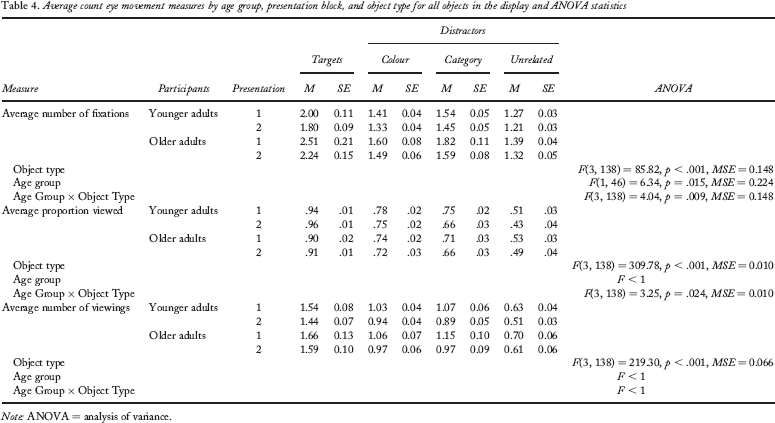
In this section, we examined three eye movement measures that rely on the number of fixations on an object or the number of objects viewed during the trial. The first measure, average number of fixations, is similar to previous work on ageing and visual search (e.g., Scialfa & Joffe, 1997) and is the count of fixations on an object during a trial provided that it was fixated one time. The other two measures, average proportion of objects viewed and average number of viewings, provide an indication of the breadth of search for the two age groups. Average proportion of objects viewed gives the proportion of each type of object that had a minimum of one fixation during a trial averaged across all trials. Average number of viewings measure how many times a specific object is viewed during a trial.
As can be seen in Table 4, all three count measures demonstrated large effects of the type of object that was being viewed. Targets were viewed more frequently than all other types of object in each of these measures (pairwise ps < .001), and the related distractors (colour and category distractors) were viewed more often that the unrelated distractors in all of the measures (pairwise ps < .001). For average number of fixations, category distractors were viewed more often than colour distractors (p < .001). However, in the proportion viewed measure the colour distractors were viewed more often than category distractors (p < .001), and in the number of viewings measure there was no difference between category and colour (p > .20). The inconsistency of the count measures may indicate that the colour distractors were easier, once viewed, to reject as not being the target than the category distractors because although they more likely to be viewed once, they were apparently quickly rejected, and the participant moved onto other objects.
Average count eye movement measures by age group, presentation block, and object type for all objects in the display and ANOVA statistics
Note: ANOVA = analysis of variance.
Similar to Scialfa and Joffe (1997), we found that older adults (1.74) had a greater number of fixations on the objects in the display than younger adults (1.50), but there were no overall age differences for the proportion viewed or number of viewings measures. Age group interacted with the object type for both the number of fixations (older adults had more fixations on target objects than did younger adults) and the proportion viewed (younger adults viewed a larger proportion of targets and fewer unrelated distractors than did older adults). Interestingly, there was no age group by object type interaction in the number of viewings measure. As in the duration measures, presentation block had a large effect on the count measures with objects being viewed more in the first presentation than in the second (Fs > 20, ps < .001), but age group did not interact with presentation (Fs < 1.8, ps ≥ .15).
Ordinal fixation analyses
As a further test of age differences in search, we examined which objects were viewed as a participant searched the display, as indicated by the proportion of the different types of objects that were viewed at each ordinal fixation. We were specifically interested in whether or not older and younger adults view the different classes of objects in a similar order. An age interaction in the order that distractors are viewed might indicate a difference in the relative importance of different types of information to search for older versus younger adults. We limited the analysis to Fixations 2 through 13 because the first fixation was artificially placed in the centre of the display to begin the trial, and all participants had at least 13 fixations on some trials during the search. 2
It is important to note that within an object type, each ordinal fixation represents an independent observation. In other words, because the displays are randomly arranged, whether one looks at a target on, for example, Fixation 4, does not necessarily constrain one to look at a target on Fixation 5. However, across object types (target, colour distractor, category distractor, and unrelated distractor), the observations are not independent (e.g., if one is looking at the target on Fixation 4, one cannot look at a colour distractor on Fixation 4). To account for this fact, we only report the three-way interaction term of the overall analysis, which examines the patterns of the observations for the two age groups. We then analyse the data for each object type separately to eliminate any concern of nonindependence.
Because the composition of the display changed with the differing number of targets, we analysed only the three-target condition, where all types of objects are equally represented in the display. Importantly, we found a significant interaction of ordinal fixation, age group, and object type, F(33, 1518) = 2.81, p < .001, MSE = 0.025, indicating that the two age groups were not viewing the objects in the same order. To further explore this interaction, we examined each object type separately. As can be seen in Figure 2A, younger and older adults differed in the proportion of targets viewed across ordinal fixations, F(11, 506) = 3.23, p < .001, MSE = 0.031, with younger adults viewing target objects earlier in the trial. In contrast, the opposite pattern was evident for the category (Figure 2C), F(11, 506) = 2.72, p = .002, MSE = 0.020, and unrelated distractors (Figure 2D), F(11, 506) = 2.13, p = .017, MSE = 0.011, with older adults viewing more of these objects earlier in the trial while younger adults viewed more of these distractors (especially the category distractors) later in the trial. Finally, the significant interaction for the colour distractors (Figure 2B), F(11, 506) = 2.07, p = .021, MSE = 0.020, appears to be the result of the first and last fixations, in which older adults viewed a smaller proportion of these distractors than did younger adults. The four-way interaction of age group, ordinal fixation, object type, and presentation block was not significant, F(33, 1518) = 1.18, p > .20, MSE = 0.023, indicating that the pattern was similar across both presentation blocks.
Visual memory test and regression analyses
The eye movement analyses provide a good indication of the differential processing of targets and distractors during search. Performance on a visual memory test was used to examine potential memory consequences of the processing of objects encountered in the search task and, in particular, to determine whether older adults’ extended processing of targets would result in remembering these objects better than the distractor objects. Again, experimental version was included as an additional between-participants factor, but this factor did not have a significant effect in any of the visual memory analyses described, nor did it enter into any significant interaction. Because of the lack of an effect, we present the visual memory data collapsed across the experiment versions. The regression analyses described below are, necessarily, limited to only the eye-tracking version of the study.
Because there were trials in the first presentation block of arrays with no targets present (the 0 target condition), a quarter of the target objects for each participant had only one opportunity to be viewed in these experiments. Consequently, all of the analyses reported in this section eliminated these singly viewed target objects from consideration. This analysis ensured that the target objects and the distractor objects (which were always present in both presentations of the array regardless of the number of targets present) had equal opportunities to be viewed within the search portion of the experiment.
All types of objects for both age groups were remembered better than chance (.50) indicating that both age groups demonstrated reliable memory of the search objects (younger adults, all ts ≥ 3.19, all ps ≤ .003; older adults, all ts ≥ 4.01, all ps ≤ .001). More importantly, we examined the age-related differences between the object conditions (see Figure 3). There was an effect of object type, F(3, 282) = 213.23, p < .001, MSE = 0.007, with the target objects (.82) being remembered better than all distractor objects (ps ≤ .001). The category distractors (.59) and colour distractors (.59) were remembered at similar levels (p > .20), and both were remembered better than the unrelated distractors (.54, ps ≤ .001). There was an overall age-related difference in memory, F(1, 94) = 6.04, p = .016, MSE = 0.013, along with a significant interaction between the age groups and object type, F(3, 282) = 4.45, p = .005, MSE = 0.007. To explore this interaction, the age groups were compared for each of the object conditions. Younger adults outperformed older adults in their memory for the visual details of the target objects, t(94) = 3.89, p < .001, which is consistent with most comparisons of episodic memory between younger and older adults (e.g., Zacks, Hasher, & Li, 2000). However, there were no significant differences for any of the distractor conditions—category distractors, t(94) = 1.31, p = .19; colour distractors, t(94) = 1.13, p > .20; unrelated distractors, t(94) = − 0.67, p > .20—thus demonstrating a lack of an age-related decline for these objects.
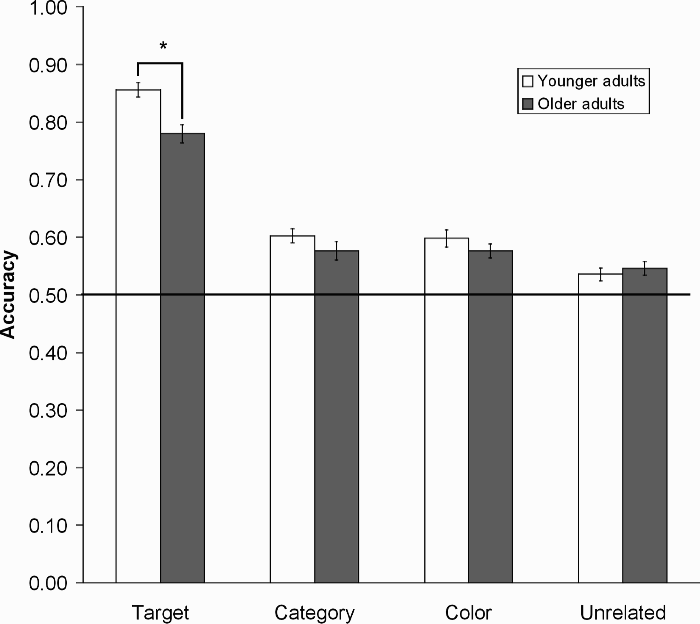
Visual memory test data combined across the eye-tracking/non-eye-tracking groups. Chance performance is indicated by the line at .50. Error bars are standard errors. *p < .05 age-related difference.
In the final section, we examined for the eye-tracking groups the impact of viewing behaviour on memory for objects that were tested in the memory test. Because we were interested in the overall processing an object received and the resultant memory, we combined the eye movement data from both presentations to get an indication of the total processing of the objects prior to the memory test. Williams et al. (2005) found that for younger adults, the more that colour and category distractors and to some extent targets 3 were viewed, the better visual memory tended to be. To determine whether the same pattern existed for the two age groups, we calculated the slopes and intercepts for each participant and compared the two age groups (see Table 5 for values and statistical comparisons of the slopes to 0 and intercepts to chance memory performance, .50). For the slopes of both number of viewings and total time, we found no overall effect of age group—viewings: F(1, 46) = 1.29, p > .20, MSE = 0.006; total time: 4 F < 1—and for total time, there was no interaction of object type and age group (F < 1, all age comparisons ps > .20). There was, however, an age group by object type interaction for the slope of the number of viewings, F(3, 138) = 2.77, p = .04, MSE = 0.007, with younger adults having a larger slope for the colour distractors than older adults, t(46) = 2.28, p = .027; all other ts < 1.65, ps > .10. With respect to the intercepts, we found a similar pattern to the slopes with no overall age difference—viewings: F < 1; total time: F(1, 45) = 2.29, p > .10, MSE = 0.038—and no interaction of age group and object type for total time—F < 1, age comparisons ps > .20, except for target objects, t(45) = 1.80, p = .079. Again, there was an interaction of age group and object type for intercepts in the number of viewings analysis, F(3, 138) = 4.42, p = .005, MSE = 0.032, with younger adults having a greater target intercept than older adults, t(46) = 2.46, p = .018; all other ts < 1.65, ps > .10.
When all targets (those seen on one or both trials) are considered.
One younger adult had perfect memory for the target objects seen in the total time analysis. This participant was removed from all total time analyses. The results do not change if this participant is included with a slope of 0 and an intercept of 1.
Mean slopes and intercepts for memory performance by age group and object type for number of viewings and total time as predictor variables
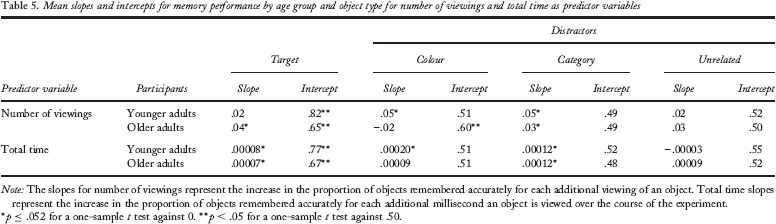
Note: The slopes for number of viewings represent the increase in the proportion of objects remembered accurately for each additional viewing of an object. Total time slopes represent the increase in the proportion of objects remembered accurately for each additional millisecond an object is viewed over the course of the experiment.
p ≤ .052 for a one-sample t test against 0.
p < .05 for a one-sample t test against .50.
The regression analyses demonstrate an overall similarity in the impact of additional viewing on visual memory for both age groups. Both age groups remembered objects better the more they were viewed (especially targets and related distractors). The lack of age differences in the total time analysis is interesting because we found that older adults viewed some objects longer than younger adults even after proportional increases were accounted for (see Table 3). Although older adults were viewing the objects longer, the improvement in memory performance was approximately the same as that for younger adults. More interesting are the intercept differences, in which for both age groups, target intercepts for both measures (older adults: viewings = .65; total time = .67; younger adults: viewings = .82; total time = .77) were greater than the average performance of each type of distractor even though the distractors had been presented twice in the experiment (see Figure 3 for comparison). Finally, with respect to the age differences in target memory, there was a significant difference in the intercepts for number of viewings and a marginally significant difference in the intercepts for total time, whereas there were no age-related differences in the intercepts for any type of distractor, which may indicate that target memory is more affected by ageing than is distractor memory.
Discussion
The present study had two goals. The first goal was to explore potential age differences in visual search for real-world objects. Previous research has found some interesting age similarities and differences in the execution of search. The present study extended the previous work by using more complicated search stimuli and by examining eye movement data at the level of the individual objects in the search, rather than global eye movement measures as in many previous studies. The second goal was to examine age differences in incidental visual memory to determine whether visual memory for the different object types has similar age-related declines as other types of memory and whether age-related differences in viewing pattern could account for any memory differences.
Visual search and ageing
Overall, older adults had more fixations and longer fixation durations, gaze durations, and total times on the objects in the display than did younger adults. Importantly, there were age group by object type interactions, indicating that the two age groups were processing the targets and distractors differently during search. Older adults spent longer viewing all types of objects, but the critical age group by object type interactions appeared to be driven by the fact that older adults dwelled longer on target objects, and to a lesser extent colour distractors, than did younger adults. Even when the data were subjected to a logarithmic transform to correct for potential age-related general slowing, the interaction remained. The exceptions to this pattern were the proportion of objects viewed and the number of entries. Younger adults viewed a greater proportion of target (but not distractor) objects overall, which could provide one reason that older adults were less accurate in the search task. Additionally, there was no age interaction found in the number of viewings of the different types of objects, indicating that while older adults may look at target objects longer, they do not disproportionately return to them.
The ordinal fixation analysis showing that younger adults tended to view target objects earlier in a trial than older adults indicates that younger adults were more efficient at early identification of potential target objects and directing their eyes to the objects. Older adults are apparently not as capable as younger adults at identifying the target objects early on and apparently have greater difficulty in identifying them once the object is fixated. It is possible that older adults had greater difficulty extracting the colour or category of the objects in the display both at fixation and at a distance. Williams et al. (2005) pointed out that it might be easier in real-world searches to identify the shape of the object than the colour. Older adults in the present study may have had greater difficulty extracting colour information from the objects in the display and, thus, may have been less able to select the target objects from the other category-related items. Older adults have been shown to have decreases in overall colour discrimination after the age of 60 (Cooper, Ward, Gowland, & McIntosh, 1991). Along this line, older adults spent more time viewing target objects, which could indicate that they were having difficulty discriminating the colours used in the present study. Also, unlike previous studies (Dennis et al., 2004), we did not find that colour distractors were preferentially selected earlier in the trial by older adults (any difference went in the opposite direction). It is important to note that the colour manipulation in Dennis et al. was black versus white lines, whereas we manipulated colour across the spectrum; brightness distinctions do not show the same age-related decline as hue information (Cooper et al., 1991). Our use of many colours, some of which may have been more difficult to distinguish by older adults, could have led to the reliance on category information as the driving force in selection. Both a limited perceptual span and inefficiency in using colour information could be working in concert to produce the age differences in time on objects and the apparent selection preference early in the trial.
Overall, we found that older adults and younger adults did differ in their initial selection of objects in the task and the time they took to process target objects. The difference in early selection could indicate a difference in the strategy of exploration in a new environment, with older adults relying on what was being looked for (in the sense of a general structure of the object) rather than a conjunction of what and a defining feature (in this case colour). Younger adults appear to be able to use the conjunction information earlier in the search to select target objects (see Dennis et al., 2004). The initial difference does change over the course of the search and may indicate an overall shift in search behaviour where the younger adults explore any other possible targets and older adults more thoroughly examine targets that have been found.
However, even with the differences in the fine-grained analyses reported here, there was a global similarity of search process for younger and older adults. Older adults were slower overall than younger adults, but the two age groups over the course of a trial distributed their fixations to the same objects, indicating a similar attentional set in executing search (Madden et al., 1999, 2002, 2004). Thus, although the paths were not the same through the objects, and the time to process the objects was different, both age groups viewed a similar set of objects during the search. However, the difference in the types of objects selected early in a trial indicates that the attentional guiding mechanisms for older adults cannot use information as efficiently as younger adults to find potential targets.
Visual memory and ageing
The second goal of this study was to explore age differences in incidental visual memory. Both older and younger adults demonstrated memory for target and distractor objects after viewing these objects during a visual search. Consistent with normal age-related declines in memory (see Zacks et al., 2000, for review), older adults did not remember target objects as well as did younger adults; however, memory for distractors was equivalent for the two age groups. The age-related differences in the memory for targets, but not distractors, cannot be accounted for by the way that objects are initially viewed. For the eye-tracking group, the subset of targets that were tested in the memory test had similar proportions viewed collapsed across presentations (younger adults = .99, and older adults = .99) and a similar number of viewings (younger adults = 2.83, and older adults = 3.05). In addition, the regression analyses found an age-related difference in the target intercepts for the number of viewings measure indicating that even when number of viewings is controlled, there is still an age difference in memory performance. We are left with two possible explanations for the difference: (a) some other aspect of the memory task is causing the age-related difference, or (b) there are qualitative differences between the visual memory representations of the goal of a search and the distractors.
With regard to the first point, there are two task-related factors that could contribute to the age difference for targets, but not distractors, found here. One possible explanation derives from the counting task used, which requires participants to compare a currently viewed target to other targets previously seen and then update the count of targets. The additional processing that this task imposes may have added a memorial element that younger adults were able to use on the later memory test, whereas older adults were not. Although a possibility, it is unlikely because older adults spent a proportionally greater amount of time examining/integrating the target objects and thus had at least as good an opportunity to encode the visual details of the targets as did the younger adults. The other possibility is that age-related declines in target memory are due to the fact that the target object was labelled prior to being viewed. Older adults may have greater difficulty than younger adults associating/binding the visual details of the objects to the verbal label (e.g., Chalfonte & Johnson, 1996; Mitchell, Johnson, Raye, Mather, & D'Epositio, 2000; Naveh-Benjamin, 2000), and thus younger adults may then have an advantage at recall because of additional routes to the visual memory that older adults lack.
In contrast to a task-related issue, it is possible that targets and distractors are represented differently in visual memory. Distractors could receive a superficial representation in visual memory whereas the additional processing of the targets results in a deeper, more elaborate representation that may be more susceptible to age-related memory difficulties. On the other hand, rather than different levels of representation on a continuum of visual memory, target memory and distractor memory may be qualitatively separable memory types. This explanation ties in with a finding of Williams et al. (2005) along with the regression analyses described here that target objects were remembered better than distractor objects even when the amount of processing time on the target object was less. Age-related memory declines for only the target objects may indicate that targets form a separate class of visual memories independent of a continuum of information stored about the object. While the current data cannot distinguish between these two options, they do point to very interesting properties of visual memory. Further research will be needed to determine more precisely the representational issues of visual memory.
Conclusion
Overall, the current results indicate that older and younger adults are similar in their search patterns when doing a complex search task, but there are subtle age differences in the search patterns. Older adults were much slower in the search task than the younger adults and spent more time processing the individual objects, especially target objects, during search. However, the two age groups distributed their fixations over the course of a trial to the same objects, indicating a similar attentional set in approaching the task. In incidental visual memory, although both age groups were able to remember the distractors at above-chance levels, when trying to remember the targets of the search, there was an age-related decline in memory performance even though older adults viewed these objects longer. The age differences in memory for the targets, but not for the distractors, indicates that there may be a difference in the representation in memory of the goal of a search compared to the other objects that are encountered. In other words, in a situation where a person is looking for a red coffee cup on a desktop, both younger and older adults will look at and remember a red pen, a white cup, and even a brown stapler equally well. However, when the object of the search is found, the older adults will look at the red coffee cup longer but not remember it as well as will younger adults.