







Abstract
The ability to represent conditional information is central to human cognition. In two self-paced reading experiments we investigated how readers process counterfactual conditionals (e.g., If Darren had been athletic, he could probably have played on the rugby team) and indicative conditionals (e.g., If Darren is athletic, he probably plays on the rugby team). In Experiment 1 we focused on how readers process counterfactual conditional sentences. We found that processing of the antecedent of counterfactual conditionals was rapidly constrained by prior context (i.e., knowing whether Darren was or was not athletic). A reading-time penalty was observed for the critical region of text comprising the last word of the antecedent and the first word of the consequent when the information in the antecedent did not fit with prior context. In Experiment 2 we contrasted counterfactual conditionals with indicative conditionals. For counterfactual conditionals we found the same effect on the critical region as we found in Experiment 1. In contrast, however, we found no evidence that processing of the antecedent of indicative conditionals was constrained by prior context. For indicative conditionals (but not for counterfactual conditionals), the results we report are consistent with the suppositional account of conditionals. We propose that current theories of conditionals need to be able to account for online processing differences between indicative and counterfactual conditionals.
Conditionals of the form if p then q are central to general cognitive abilities such as prediction and decision making. The issue of how people understand conditionals has generated a substantial body of research in the reasoning literature (for a review, see Evans & Over, 2004), which in turn has led to a number of competing accounts of how the reasoning system might operate (e.g., Evans, 2006; Johnson-Laird & Byrne, 2002). Despite the centrality of conditionals to research on reasoning, the way in which conditionals are comprehended online has not received a similar level of attention in the language-processing literature (but see de Vega, Urrutia, & Riffo, 2007; Ferguson & Sanford, 2008, for examinations on processing that occurs after conditionals are read). Without an understanding of the online processing of conditionals themselves, psychological accounts of conditionals are necessarily incomplete.
In this paper we investigated how conditional statements are interpreted in light of a reader's ongoing situation model. Situation models are constructed using the semantic content communicated in a text, together with a reader's knowledge about the way in which such events typically unfold in the world. As a text is read, these models are updated to incorporate the information communicated in the text. When there is an inconsistency between new information and information contained within a reader's situation model, a processing penalty arises (e.g., Albrecht & O'Brien, 1993; Stewart, Kidd, & Haigh, 2009). The point in time at which this penalty occurs indicates the point in time at which a reader is sensitive to the mismatch between their ongoing situation model and incoming text. In the experiments that follow, we used this technique to examine how information communicated using two types of conditional is integrated into a reader's situation model.
Evans and colleagues (e.g., Evans, 2006; Evans, Over, & Handley, 2005) argue that the successful comprehension of conditionals requires a reader to engage in hypothetical thinking—a concept that is captured in the suppositional theory of “if” (Evans & Over, 2004). According to this theory, people evaluate conditionals of the form “if p then q” by considering the consequent (q) in contexts where the antecedent (p) is true. In other words, they suppose the situation where p is true and mentally simulate the situation where the consequent follows. It is important to note that the suppositional theory was developed primarily as an account of conditionals in the context of reasoning, rather than as a processing account of conditionals. However, that does not mean that the theory may not have some value in terms of motivating possible processing models of how conditionals might be comprehended online.
During reading, a counterfactual conditional such as “If Darren had been athletic, he could probably have played on the rugby team” might be presented in the context of a story where we already know something about the character “Darren”. Perhaps (a) we know that he is not at all athletic, (b) we know that he is actually athletic, or (c) we have no knowledge whatsoever of his athleticism. Supposing him to be athletic appears easy in a context in which we know that he is not. For the second case, it seems odd to consider him to be athletic in a context in which we know that this is actually the case. For the third case, it appears acceptable to entertain the notion that he is athletic, given that we have no knowledge about his athleticism. In contrast, in an indicative conditional such as “If Darren is athletic, he probably plays on the rugby team” there appears to be no difference in the degree of intuitive felicitousness of the conditional as a function of prior context and what we know about the character “Darren”.
Such apparent differences in ease of comprehension raise important questions with respect to how a reader might (and might not) represent conditional information. Does a reader's situation model representation (or factual representation) rapidly influence the processing of conditional information? Does the processing of conditional information (and the relationship of that conditional information to a reader's factual representation) vary as a function of whether the conditional is counterfactual or indicative? One aspect of the suppositional theory of conditionals that is potentially relevant to our investigation is that suppositional processing is claimed to involve decoupling between the representation of the conditional information and the representation of the factual situation (Cosmides & Tooby, 2000; Edgington, 1995). If this decoupling is triggered by the presence of the word “if” (as suggested by Evans, 2006), then it would imply that conditional information is initially represented without reference to a reader's situation model. In other words, there should be no early processing penalty arising as a result of a mismatch between a reader's factual representation and the representation of conditional information.
In Experiment 1 we focus on the processing of counterfactual conditionals. It is only recently that researchers have begun to explore how counterfactual situation representations might influence processing. Ferguson and Sanford (2008) measured readers’ eye movements while they read sentences such as “Families could feed their cat a bowl of carrots and it would gobble it down happily”. These target sentences followed conditionals that either did or did not describe a hypothetical situation in which cats were vegetarian. Ferguson and Sanford reported that readers displayed an initial reading-time penalty on the critical region (e.g., “carrots and”) when it was anomalous with respect to real-world knowledge. However, this penalty quickly disappeared if counterfactual-world knowledge was available to the reader to allow for a counterfactual-world interpretation. This suggests that if both factual and counterfactual representations are available to a reader, then both can ultimately be used to facilitate comprehension during the processing of incoming text (with the factual representation taking precedence).
Finding that both real-world and counterfactual-world knowledge is available to the language-processing system, at least at some points, is consistent with data reported by de Vega et al. (2007). Using a probe task, they found evidence suggesting that after reading a sentence such as “If Mary had won the lottery she would have bought a Mercedes car”, readers represent both this counterfactual situation and the presupposed factual situation (i.e., that Mary did not win the lottery).
While the studies of Ferguson and Sanford (2008) and the studies of de Vega et al. (2007) examined how counterfactual situation representations are available to a reader following the occurrence of conditionals, it is important to note that none of the experiments contained within these papers examined the online processing of conditional sentences themselves. To our knowledge, the experiments we present below are the first reported investigations into the online processing of counterfactual and indicative conditionals.
Experiment 1
In Experiment 1 we used word-by-word self-paced reading and manipulated the degree to which a counterfactual conditional was consistent with preceding discourse. Following Fillenbaum (1974), Thompson and Byrne (2002) proposed that a subjunctive conditional presupposes the negation of its antecedent proposition. For the conditional, If Darren had been athletic, he could probably have played on the rugby team the presupposition is that, in reality, Darren is not athletic. We manipulated the degree of consistency between the presupposition associated with the counterfactual and the factual situation by examining how readers process subjunctive conditional sentences in contexts in which (a) the antecedent of the conditional is consistent with respect to the factual situation, (b) the antecedent is inconsistent with respect to the factual situation, and (c) the antecedent is neutral with respect to the factual situation. For the example above, the three conditions correspond to a preceding context where (a) Darren is introduced as not being athletic, (b) Darren is introduced as being athletic, and (c) no information is provided about Darren's athleticism. If readers attempt to integrate the information communicated in the conditional with their situation model as soon as the conditional is encountered, then we would expect to observe an early sensitivity to the extent to which the antecedent is consistent with preceding context. This should be observable once the antecedent has been read. In addition, for contexts in which the information contained within the presupposition (i.e., that Darren is not athletic) has already been explicitly provided, there should be a processing benefit associated with reading the conditional relative to a neutral context in which no information about his degree of athleticism has been given. However, if decoupling between the situation model and the counterfactual situation occurs as soon as the trigger “if” is encountered (as Evans, 2006, suggests), then we would not expect to find evidence for an early sensitivity to the degree of fit between the counterfactual and factual situation model representations.
Method
Participants
A total of 36 participants from the University of Manchester population took part. All participants were native English speakers and did not have a reading disability. They were paid £5.
Materials
A total of 24 experimental passages were used in this study (see Example 1). The full set of materials for Experiment 1 can be found in Appendix A. There were three versions of each experimental passage. Each passage was four sentences long. Sentence 1 introduced the main character and described some attribute associated with them. Sentence 2 provided additional contextual information. Sentence 3 was the subjunctive conditional and thus the target sentence. Sentence 4 provided additional contextual information. These passages were used to create three lists using a Latin-square, repeated measures design. Each participant saw only one of these lists. All participants saw an equal number of passages across the three experimental conditions. The target sentences remained the same across conditions. Each list also contained 16 filler passages. None of these filler passages contained conditionals.
Example 1
Darren was not at all athletic/Darren was very athletic/Darren enjoyed meeting new people. He had just started University and was looking for some clubs and societies to join. If Darren had been athletic, he could have tried out for the rugby team. The team was small but everyone on it was really friendly.
Procedure
Participants were presented with the passages in a random order. Each participant was provided with verbal as well as written instructions. These informed them that they would be presented with a number of passages on a word-by-word basis. In order to advance through the passages, they were told that they had to press the “Next Word” button on a button box. This brought up the next word in the passage and blanked out the previous one so only one word at a time was visible. Dashes were used to represent the rest of the words in each passage. After each passage, participants were told that a comprehension question might appear. Comprehension questions appeared on 25% of the trials. If a question did appear, participants were told to answer it as quickly and accurately as possible, using the buttons marked “Yes” and “No” on the button box. Once the participant had answered the question (or pressed the “Next” button if no question appeared), the next trial began.
Participants completed two practice trials before beginning the actual experiment. The experiment was run using the E-prime programming software (MacWhinney, St James, Schunn, Li, & Schneider, 2001). A button box recorded participants’ reading times with millisecond accuracy.
Results and discussion
Each target sentence was split into three regions for analysis as follows:
/If Darren had been/athletic, he/could have tried out for the rugby team./
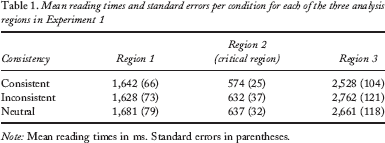
Region 1 was the antecedent up to but excluding the last word. Region 2 was the critical region and was composed of the final word of the antecedent plus the first word of the consequent. We selected our critical region to be composed of these two words in light of previous work that has shown that the effects associated with processing a word often “spill over” onto the following word (e.g., Ehrlich & Rayner, 1983). Region 3 was the remainder of the consequent. Table 1 contains the means and standard errors for each region for each of the experimental conditions. The reading-time data were analysed using repeated measures one-way analysis of variance (ANOVA) with three levels (consistency: consistent vs. inconsistent vs. neutral).
Mean reading times and standard errors per condition for each of the three analysis regions in Experiment 1
Note: Mean reading times in ms. Standard errors in parentheses.
Region 1
One-way ANOVA revealed no effect of condition (both Fs < 1).
Region 2 (critical region)
One-way ANOVA revealed an effect of condition, F1(2, 70) = 6.763, MSE = 6,630, p < .05, partial η2 = .162; F2(2, 46) = 4.226, MSE = 7,190, p < .05, partial η2 = .155. Contrasts revealed that the consistent condition was read more quickly than the inconsistent condition, F1(1, 35) = 9.108, MSE = 13,432, p < .01, partial η2 = .206; F2(1, 23) = 5.559, MSE = 15,251, p < .05, partial η2 = .195, and more quickly than the neutral condition, F1(1, 35) = 14.234, MSE = 13,432, p < .005, partial η2 = .289; F2(1, 23) = 7.299, MSE = 15,251, p < .05, partial η2 = .241). The inconsistent and neutral conditions were read at the same speed (both Fs < 1).
Region 3
One-way ANOVA revealed an effect of condition, F1(2, 70) = 11.847, MSE = 41,637, p < .001, partial η2 = .253; F2(2, 46) = 3.371, MSE = 88,141, p < .05, partial η2 = .140. Contrasts revealed that the consistent condition was read more quickly than the inconsistent condition, F1(1, 35) = 16.783, MSE = 116,863, p < .001, partial η2 = .324; F2(1, 23) = 8.193, MSE = 159,594, p < .01, partial η2 = .263. There was some evidence significant by subjects only that the consistent condition was read more quickly than the neutral condition, F1(1, 35) = 11.793, MSE = 53,532, p < .005, partial η2 = .252; F2(1, 23) = 2.422, MSE = 173,737, p = .113, partial η2 = .095. There was also some evidence again significant by subjects only that the neutral condition was read more quickly than the inconsistent condition, F1(1, 35) = 4.622, MSE = 79,429, p < .05, partial η2 = .117; F2(1, 23) = 1.252, MSE = 195,518, p = .275, partial η2 = .052.
The data reported above provide strong evidence that comprehension of counterfactual conditionals involves the reader rapidly evaluating the antecedent of a counterfactual with reference to their factual situation representation. If the counterfactual and factual situations are mutually incompatible, a reading-time penalty results. We found evidence for this penalty arising rapidly: on the analysis region comprising the final word of the antecedent and the first word of the consequent. This penalty continued to be observed as the rest of the information in the consequent of the conditional was read. We suggest that a processing cost persisted as readers experienced difficulty in creating a coherent representation capturing both the factual and counterfactual information. These findings are not compatible with an account of suppositional processing whereby the factual and counterfactual situation representations are decoupled when the trigger “if” is encountered. If decoupling had occurred, we would not have observed a reading-time penalty for the critical region reflecting the degree of fit between the two representations. There was also evidence that the neutral condition also led to a processing penalty. This may have resulted from inferential processing required to integrate the new information communicated by the conditional in the neutral condition with the factual representation. Although this penalty is similar in magnitude to the penalty associated with the inconsistent condition, we suspect that its locus is different.
The findings of Experiment 1 go further than the studies of Ferguson and Sanford (2008), and de Vega et al. (2007) in that they provide the first investigation into how counterfactual conditionals themselves are actually processed (rather than the processing consequences that follow from reading counterfactual conditionals). However, some important questions remain unanswered. To our mind, the most important is the extent to which the data reported in Experiment 1 reflect the online processing of counterfactual conditionals rather than conditionals more generally. In the introduction we discussed both counterfactual and indicative conditionals. While counterfactual conditionals convey presuppositional information about the factual situation, indicative conditionals do not. Indeed, indicative conditionals do not make any claims with respect to reality. Rather, they invite a reader to entertain the possibility of some hypothetical situation. As the pragmatic function of indicative conditionals differs from that of counterfactual conditionals, it may be the case that online processing associated with them also differs. Finding evidence of such a difference would be important as it would highlight the need for any processing theory of conditionals to take into account the different pragmatic roles played by the different forms of conditional.
Experiment 2
In Experiment 2 we contrasted processing of counterfactual conditionals with that of indicative conditionals. As with Experiment 1, we used word-by-word self-paced reading, and we manipulated the degree to which the information communicated in the conditional fits prior context. In Experiment 1 we examined contexts that were consistent, inconsistent, and neutral with respect to the information communicated in the antecedent of counterfactual conditionals. In Experiment 2 we focused on consistent versus inconsistent contexts. For the counterfactual conditionals we expect to replicate the effect we found in Experiment 1 (i.e., that a reading-time penalty emerges on, or shortly after, the antecedent for the condition where there is a mismatch between the counterfactual presupposition and prior context). For indicative conditionals, two possibilities arise. The first is that they exhibit a similar kind of reading-time penalty. If this is the case, we would expect to find a main effect of consistency (with conditionals that are inconsistent with prior context resulting in a reading-time penalty) regardless of conditional form on reading times to the critical region. The second possibility is that the pragmatic function of indicative conditionals (and lack of pragmatic implicature with respect to the factual situation representation) does not result in a reader's factual situation representation constraining how the conditional information is processed and represented. This second possibility would predict no reading-time differences for indicative conditionals as a function of the degree to which the information contained within their antecedents fitted with prior context. Rather it would predict a consistency effect for counterfactual conditionals and no consistency effect for indicative conditionals (i.e., an interaction between the factors conditional form and consistency). For indicative conditionals, this finding would be compatible with a processing account of conditionals motivated by the basic principle of the suppositional theory.
Method
Participants
A total of 36 participants from the University of Manchester population took part. All participants were native English speakers and did not have a reading disability. They were paid £5. None of the participants in Experiment 2 had taken part in Experiment 1.
Materials
A total of 24 experimental passages were used in this study (see Example 2). They were based on those used in Experiment 1. The full set of materials for Experiment 2 can be found in Appendix B. The passages were used to create four lists using a Latin-square design. Again, this was a repeated measures design with participants in each list of 24 materials seeing equal numbers of items in each of the experimental conditions. Crucially, the critical region remained the same across conditions. Each list also contained 16 filler passages. None of these filler passages contained conditionals.
Example 2
Darren is not at all athletic/Darren is very athletic. He is in first year at University and is a member of lots of teams and clubs. If Darren had been athletic, he could probably have played on the rugby team/If Darren is athletic, he probably plays on the rugby team. The team has a great reputation.
Procedure
The procedure was the same as that for Experiment 1.
Results and discussion
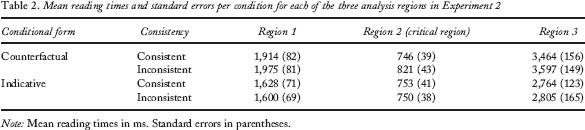
The same analysis region definitions as those that we used in Experiment 1 were also used in Experiment 2. Table 2 contains the means and standard errors for each region for each of the experimental conditions. The reading-time data were analysed using 2 (conditional form: counterfactual vs. indicative) × 2 (consistency: consistent vs. inconsistent) repeated measures ANOVA.
Mean reading times and standard errors per condition for each of the three analysis regions in Experiment 2
Note: Mean reading times in ms. Standard errors in parentheses.
Region 1
A 2 (counterfactual vs. indicative) × 2 (consistent vs. inconsistent) ANOVA revealed a main effect of conditional form, F1(1, 35) = 80.123, MSE = 49,182, p < .001, partial η2 = .696; F2(1, 23) = 50.674, MSE = 51,842, p < .001, partial η2 = .688, with Region 1 of indicative conditionals being read more quickly than Region 1 of counterfactual conditionals. There was no effect of consistency (both Fs < 1) and no interaction between conditional form and consistency, F1(1, 35) = 1.443, MSE = 50,075, p = .289, partial η2 = .040; F2(1, 23) = 1.898, MSE = 25,373, p = .182, partial η2 = .076.
Region 2 (critical region)
A 2 (counterfactual vs. indicative) × 2 (consistent vs. inconsistent) ANOVA revealed no effect of conditional form, F1(1, 35) = 2.395, MSE = 15,548, p = .131, partial η2 = .064; F2(1, 23) = 2.452, MSE = 10,124, p = .131, partial η2 = .096. There was a marginal main effect of consistency, F1(1, 35) = 9.685, MSE = 4,806, p = .004, partial η2 = .217; F2(1, 23) = 3.302, MSE = 9,398, p = .082, partial η2 = .126. There was also an interaction between conditional form and consistency, F1(1, 35) = 6.224, MSE = 8,578, p = .017, partial η2 = .151; F2(1, 23) = 4.027, MSE = 8,839, p = .057, partial η2 = .149. Planned comparisons revealed that there was an effect of consistency for counterfactual conditionals, F1(1, 35) = 18.579, MSE = 5,373, p < .001, partial η2 = .347; F2(1, 23) = 6.716, MSE = 9,908, p = .016, partial η2 = .226, but not for indicative conditionals (both Fs < 1).
Region 3
A 2 (counterfactual vs. indicative) × 2 (consistent vs. inconsistent) ANOVA revealed a main effect of conditional form, F1(1, 35) = 197.602, MSE = 101,427, p < .001, partial η2 = .850; F2(1, 23) = 117.347, MSE = 113,863, p < .001, partial η2 = .836, with Region 3 of indicative conditionals being read more quickly than Region 3 of counterfactual conditionals. There was no effect of consistency, F1(1, 35) = 1.077, MSE = 252,348, p = .306, partial η2 = .030; F2(1, 23) = 1.595, MSE = 113,632, p = .219, partial η2 = .065, and no interaction between conditional form and consistency (both Fs < 1).
In Experiment 2 we replicated the Experiment 1 finding that counterfactual conditionals exhibited a rapidly occurring reading-time penalty associated with the degree of fit between the information communicated in the antecedent of the conditional and prior context. Importantly, however, we found a different pattern for indicative conditionals. For the same critical region of text, we found no reading-time penalty associated with the degree of fit between the antecedent of the conditional and prior context. This was revealed by an interaction between the factors conditional form and consistency. It suggests that the language-processing system is highly sensitive to the differing pragmatic functions of these two types of conditionals and that this results in a reader's factual situation model representation having a differing influence on how the conditionals are processed. For counterfactual conditionals, the presupposition communicated in the antecedent is rapidly evaluated with respect to a reader's factual situation model. In contrast, for indicative conditionals, processing of the antecedent does not appear to be constrained by this factual situation model. Indicative conditionals appear easy to process regardless of the degree of fit between their antecedents and the situation model. This finding for indicatives is compatible with the decoupling aspect of the suppositional theory account of conditionals. We also found in our analyses of reading times to Regions 1 and 3 that these regions were read more quickly in the indicative conditional conditions than in the counterfactual condition. This simply reflects length differences between these two regions for counterfactual and indicative conditionals.
General Discussion
In two experiments we investigated the online processing of counterfactual and indicative conditionals. In Experiment 1 we found a rapidly occurring reading-time penalty on the critical region of text defined as the last word of the antecedent and first word of the consequent. This penalty arose when there was a mismatch between the information communicated about the counterfactual situation and prior context. This mismatch occurred when the antecedent of the conditional either contradicted prior context (the inconsistent condition) or required readers to make an inference in order to satisfy the pragmatic implicature associated with the antecedent (the neutral condition). For the consistent condition (where the presupposition in the antecedent matched prior context) there was no such penalty. For the remainder of the consequent, the inconsistent condition continued to exhibit a reading-time penalty relative to the consistent condition.
In Experiment 2 we found a similar pattern of effects for the same critical region of text in the consistent and inconsistent conditions but only for conditionals in counterfactual form. Indicative conditionals displayed no processing cost as a function of the degree of fit between the conditional and prior context for this region of analysis. In contrast to Experiment 1, the penalty associated with the counterfactual conditionals did not carry over onto the subsequent region of analysis. This region was slightly longer in Experiment 2 than it was in Experiment 1 (and with greater variance) so as a proportion of the overall reading time, the magnitude of the penalty was reduced. Importantly, the critical region of text was exactly the same for the two conditionals, and this is where we found the reading-time penalty for counterfactual but not for indicative conditionals.
Overall then, the data that we have reported show that prior context rapidly influences the processing of a subsequent counterfactual conditional. We found no evidence of a similar influence on the processing of a subsequent indicative conditional. While Ferguson and Sanford (2008) and de Vega et al. (2007) examined processing that follows the presence of counterfactual conditionals, neither of these papers speaks directly to the question of how conditionals are processed online. The question of how conditionals themselves are processed is relatively unexplored in terms of online comprehension. This lack of research is surprising given the importance placed on conditionals in other areas of psychology. A full account of conditionals must involve an understanding of the time course of the processing of conditional information and be able to account for the differing pragmatic functions played by indicative and counterfactual conditionals.
At the beginning of the paper, we described the suppositional theory of conditionals and suggested that the basic tenet of the theory (i.e., that the representation of conditional information is decoupled from what a reader knows the factual situation to be) could be used to motivate a processing account of conditionals. Indeed, the reading-time data associated with the processing of indicative conditionals in Experiment 2 are compatible with such an account. We found no evidence that processing of the antecedent of an indicative conditional was constrained by prior context. This would suggest that the suppositional theory may have value as an account of the online processing of indicative conditionals. In contrast, for counterfactual conditionals we did find that the processing of the antecedent was constrained by prior context. For a processing-oriented form of the suppositional theory to be able to account for this finding, it must allow for the processing of the conditional to be modulated by its pragmatic function. A modified version of the suppositional account could explain our findings if conditional form is used to inform the decoupling (or otherwise) of the conditional from prior context. The suppositional theory would require some modification from its current form as the reading-time data contained within this paper are not compatible with a situation whereby “if” alone acts as a trigger to decouple the representation of the conditional information from the representation of the factual situation. Rather, it would be more cognitively efficient for these representations to be decoupled once it is apparent that the conditional is in indicative, rather than counterfactual, form.
The findings we report above are important not just with respect to the development of our understanding of the processing and representation of conditionals, but also with respect to our understanding of how readers construct (and update) their situation models during comprehension. Previous research on the representation of situation model information has highlighted that readers keep track of key information related to, for example, the characters and temporal aspects of a situation, with reading-time penalties emerging rapidly when there is a mismatch between information contained within a situation model and incoming text (Stewart et al., 2009). In other words, a reader's situation model constrains the processing of subsequent input. Our finding that conditional information is differentially constrained by a reader's situation model as a function of conditional form indicates that the construction and updating processes associated with situation models are highly sensitive to the pragmatic implicatures that follow from conditionals in their differing forms.