






Abstract
Two human associative-learning experiments investigated the relationship between the negative dimension of schizotypy and selective and nonselective prediction-error learning. Experiment 1 demonstrates that individuals low, but not high, on the introvertive anhedonia dimension of schizotypy demonstrate Kamin blocking, which has been taken to reflect the operation of selective learning (Rescorla & Wagner, 1972). In complement, Experiment 2 demonstrates that individuals high, but not low, on the same dimension demonstrate asymmetrical learning about the components of a compound stimulus that differ in their associative history, which has been suggested to reflect the operation of nonselective learning (Rescorla, 2000). The implications of this double dissociation for understanding the nature of the cognitive deficit in schizophrenia and for theories of learning are considered.
Keywords
The ability to learn associations between events is a fundamental feature of human cognition. This ability is essential to many aspects of our lives: from knowing that certain foods will lead to illness, to the knowledge that a red traffic light means stop. Importantly, learning these associations enables individuals to anticipate forthcoming events and moderate their behaviour accordingly. It is perhaps no surprise, therefore, that abnormalities in the maintenance or use of associations between events have been suggested to underlie certain neuropsychiatric disorders. Bleuler (1911), for example, suggested that a “loosening of associations” represented the core deficit in schizophrenia, and a great deal of research has focused on this issue (see Cohen & Servan-Schreiber, 1992; Escobar, Oberling, & Miller, 2002; Gray, Feldon, Rawlins, Hemsley, & Smith, 1991; Gray & Snowden, 2005; Jones, Gray, & Hemsley, 1990; Weiner, 2003).
One of the most influential findings in the field of associative learning is blocking (Kamin, 1968, 1969). In a typical blocking experiment, pairings of a compound of two stimuli, A and B, with an outcome are preceded by pairings of just A with the outcome (A + then AB +). Subsequently, responding to B is found to be weaker than if the original training with A had been omitted, or if A had signalled the absence of the outcome. For example, Le Pelley, Oakeshott, and McLaren (2005) required participants to imagine themselves in the role of an allergist who had to determine the causes of allergic reactions to various foods in a fictitious patient. During test trials, participants rated Food B as likely to cause an allergic reaction when it had previously been presented in compound with Food A and had signalled an allergic reaction (AB +). However if these trials had been preceded with trials in which Food A alone signalled the allergy (A +), participants indicated that Food B had no effect on the patient. Blocking has been demonstrated in a variety of species using a number of different learning procedures—for example, in rats using appetitive and aversive Pavlovian conditioning (Dopson, Pearce, & Haselgrove, 2009; Kamin, 1968), taste-aversion conditioning (Willner, 1978), and spatial learning (e.g., Pearce, Graham, Good, Jones, & McGregor, 2006; Rodrigo, Chamizo, McLaren, & Mackintosh, 1997). In addition, there is evidence of blocking in species as diverse as honeybees (e.g., Blaser, Couvillon, & Bitterman, 2004), goldfish (Tennant & Bitterman, 1975), and, as previously described, humans (Dickinson, Shanks, & Evenden, 1984; Le Pelley et al., 2005).
Despite being a relatively robust phenomenon in animals and humans, blocking is frequently found to be attenuated, or abolished, in individuals with schizophrenia (Bender, Müller, Oades, & Sartory, 2001; Jones, Hemsley, Ball, & Serra, 1997; Jones, Hemsley, & Gray, 1992b; Moran, Al-Uzri, Watson, & Reveley, 2003; Moran, Owen, Crookes, Al-Uzri, & Reveley, 2007; Oades, Zimmermann, & Eggers, 1996). This has led to the suggestion that blocking may be a useful preclinical model for the symptoms associated with schizophrenia (Moran et al., 2007). What is more equivocal, however, is the symptom dimension that is associated with the deficit. Jones et al. (1992b) demonstrated that acute schizophrenia patients tested within two weeks of admission, who were displaying a preponderance of positive symptoms, failed to demonstrate blocking; but blocking was intact in chronic patients. In contrast, Oades et al. (1996) have found that blocking is reduced in nonparanoid schizophrenia patients (i.e., those not displaying paranoid or hallucinatory experiences) but not in those patients classified as paranoid. Further research by Bender et al. (2001) found that it was the negative symptoms, such as poor rapport and poor attention, that were associated with a deficit in blocking. The finding that it is the nonparanoid/negative dimension that is associated with a deficit in blocking has been independently replicated in two further studies by Moran et al. (2003, 2007). Thus a growing body of evidence suggests that having a nonparanoid/negative symptom profile is associated with a reduction in blocking. It seems likely that any ambiguity on this issue is due to: (a) the heterogeneity of patients tested (e.g., age at illness onset is known to affect blocking and symptomatology but is frequently not controlled for); (b) differences in the blocking paradigm (e.g., between-participant or within-participant) and the variable processing requirements of these tasks; and (c) the confounding effects of antipsychotic medication.
In order to eliminate the effects of clinical characteristics and antipsychotic medication an alternative approach to investigating the relationship between blocking and schizophrenia is to take a dimensional approach and measure schizotypy in healthy volunteers. According to this view the symptoms of schizophrenia exist on a continuum ranging from nonexistent to the overt expression of schizophrenia, which is achieved when some threshold (usually defined by diagnostic systems, e.g., Diagnostic and Statistical Manual of Mental Disorders–Fourth Edition, DSM–IV, or International Classification of Diseases–10th Revision, ICD–10) is exceeded. Thus many healthy volunteers will experience and exhibit some of the phenomenological characteristics of schizophrenia, albeit milder in severity and/or fewer of them. There are many lines of evidence that support this view. First, there is evidence from factor analytic studies that schizotypy is a multidimensional construct (e.g., Bentall, Claridge, & Slade, 1989; Venables & Bailes, 1994; Vollema & van den Bosch, 1995), which has the same factor structure as that seen in schizophrenia (e.g., positive, negative, and disorganized; Liddle, 1987; Peralta, de Leon, & Cuesta, 1992). Second, the cognitive, psychophysiological, and electrophysiological deficits that can be seen in individuals with schizophrenia have also been reported in individuals high in certain dimensions of schizotypy (e.g., latent inhibition: Lubow, Ingberg-Sachs, Zalstein-Orda, & Gewirtz, 1992; prepulse inhibition: Evans, Gray, & Snowden, 2005; Swerdlow, Filon, Geyer, & Braff, 1995; P50 suppression: Evans, Gray, & Snowden, 2007b). Finally, the concept of schizotypy appears to have good validity as patients with schizophrenia have higher scores on schizotypy dimensions than do nonpatients (Nettle, 2006). To the best of our knowledge there have been two studies that have examined the link between schizotypy in healthy volunteers and blocking. In the first of these Jones et al. (1990) failed to find any relationship between psychoticism and blocking. 1 The second study, using a questionnaire specifically designed to measure schizotypy, by Moran et al. (2003) found that attenuation of blocking was associated with the positive and disorganized dimensions of schizotypy and with the negative dimensions of schizotypy with extended training.
Jones, Gray, and Hemsley (1992a) provided a reanalysis of these data. The results indicated a nonsignificant trend towards a relationship between positive schizotypal symptoms and the attenuation of blocking.
Despite a wealth of studies finding a deficit in blocking in patients with schizophrenia and indications that a parallel result can be found in healthy volunteers by measuring schizotypy, there has been no systematic research examining the psychological mechanism responsible for variations in blocking within the schizophrenia spectrum. This is a striking omission when one considers that variations in blocking are beginning to be treated as an endophenotype for schizophrenia (Moran et al., 2007). The experiments reported here represent a first attempt to redress this omission. An obvious starting point for us was to explore the possibility that individuals with schizophrenia utilize to a lesser extent the learning mechanism that promotes blocking. The most influential account of blocking, and cue-selection effects more generally, is provided by associative theories of learning, of which the most successful was described by Rescorla and Wagner (1972; Wagner & Rescorla, 1972). According to Rescorla and Wagner, the change in the strength of the association (ΔV n ) between any cue and an outcome is a function of a prediction error—that is, the discrepancy between what is expected from information provided by the environment and what actually occurs. Importantly, the prediction error utilized by the Rescorla–Wagner model can be described as selective (Pearce, Esber, George, & Haselgrove, 2008), because the change in the associative strength to a cue is assumed to be influenced by the associative strength of the cues that accompany it (see also McLaren & Mackintosh, 2000; Pearce, 1987; Pearce & Hall, 1980; Wagner, 2003). Equation (1) expresses this notion more formally.

The prediction error is given by the arithmetic difference between the asymptote of learning supported by the outcome (λ, but set to 0 in the absence of the outcome) and the sum of the associative strengths of all stimuli presented on a learning trial (σV). The prediction error is multiplied by parameters α and β that represent, respectively, the properties of the cue and outcome. Applying these principles to blocking, it can be seen that during AB + trials, the sum of the associative strengths of all the stimuli present will be equal to the associative strength of A (which during training in Stage 1 will approach λ) plus the associative strength of B (which will be zero). Therefore, the difference between λ and σV will be very small, limiting any further learning to A and, importantly, generating the blocking effect by precluding any learning about B.
The Rescorla–Wagner (Rescorla & Wagner, 1972) model can be distinguished from another class of learning theory that has utilized a prediction error, and which can be thought of as nonselective (e.g., Bush & Mosteller, 1951; Hebb, 1949; Spence, 1940). For these theories, the change in the associative strength to a cue is assumed not to be influenced by the associative strength of the cues that accompany it, but only by the cue's own associative strength. Equation (2) expresses this notion more formally.

The prediction error is given by the arithmetic difference between the asymptote of learning supported by the outcome (λ) and the associative strength of just the cue whose associative strength is being updated (V n ). Again, the prediction error can be multiplied by parameters α and β, which represent, respectively, the properties of the cue and outcome. Applying these principles to blocking, it can be seen that the change in associative strength to B during AB + trials will be unaffected by the associative strength of A. Therefore, according to this class of theory, prior learning about A + will not attenuate learning about B on AB + trials, and blocking should not be observed.
The distinction between selective and nonselective prediction errors provides a basis upon which to explain why some individuals demonstrate a blocking effect whilst others do not. For instance, it is conceivable that individuals within the schizophrenia spectrum do not learn associations between cues and outcome on the basis of a selective prediction error, but instead on the basis of a nonselective prediction error. This would enable these individuals to form associations between events in the environment (which of course they can), whilst at the same time precluding effects such as blocking. The two experiments reported here explored this possibility. A dimensional approach was adopted, and schizotypy was measured in healthy individuals using the Oxford–Liverpool Inventory of Feelings and Experiences (O-LIFE; Mason, Claridge, & Jackson, 1995). We focus our attention on the dimension of schizotypy that taps the negative symptoms of psychosis: introvertive anhedonia, due to research in individuals with schizophrenia indicating this as the critical dimension (Bender et al., 2001; Moran et al., 2007; Oades et al., 1996). Our aim in the following two experiments was to delineate the processes implicated in a failure to demonstrate blocking and the relationship of this deficit to the negative dimension of schizotypy. To anticipate the results, Experiment 1 replicated the basic attenuation of blocking in individuals high in introvertive anhedonia: These participants failed to demonstrate blocking, whereas individuals low in the same dimension did demonstrate blocking. This result is complemented by Experiment 2, in which individuals high, but not low, in introvertive anhedonia demonstrate asymmetrical learning about the cues of a compound stimulus that differ in their associative strength. This effect reflects the operation of a nonselective prediction error mechanism (e.g., Bush & Mosteller, 1951). By parity of reasoning it is suggested that variations in a dimension of schizotypy, introvertive anhedonia, reflect variations in selective and/or nonselective prediction error.
Experiment 1
Experiment 1 employed a task similar to that described by Le Pelley et al. (2005) to investigate the relationship between introvertive anhedonia and blocking. Participants were required to imagine themselves in the role of a health and safety inspector who is visiting a hospital after reports of food poisoning in patients. Participants were presented with the details of the meals eaten by a number of fictitious patients and whether or not each meal caused food poisoning. Immersed within this task was a blocking design. Thus, during the first, training, stage participants were given trials in which Food A (e.g., lamb) signalled poisoning, and food E did not. In the second, blocking, stage participants received trials in which compounds of Foods A and B (e.g., lamb and carrots), C and D, and E and F each signalled poisoning. In a series of final test trials, which were presented in the absence of feedback about poisoning, Foods B, D, F, and K were rated in terms of how dangerous or safe they were. If blocking is observed, then Food B should be rated as less likely to cause poisoning than either Food D or Food F. Filler trials were also included throughout the experiment. In Stage 1, trials with compounds of Foods G and H and Foods I and J were paired, respectively, with poisoning and no-poisoning. These trials provided participants with an opportunity to see compounds of foods prior to the second, blocking, stage. In Stage 2 Food L and a compound of Foods I and J were not followed by poisoning. These trials provided participants with the opportunity to see trials that were not followed by food poisoning. Table 1 provides a summary of the overall design of the experiment.
Design of Experiment 1

Note: Letters A to L refer to individual foods (e.g., lamb), which signalled either the presence (+) or absence (–) of food poisoning in fictitious hospital patients. Filler trials are identified with italics.
Method
Participants
A total of 86 healthy nonsmoking participants recruited from the South Wales area, UK, took part in this study (53 females), who had a mean age of 22 years (range: 19–33 years). These participants were not currently taking psychotropic medication. A total of 7 individuals were excluded due to their failure to learn stimulus–outcome associations in Stage 1 or because they repetitively pressed the same button to all trials. Thus the final sample included 79 individuals (49 females). All procedures were approved by the departmental Ethics Committee, and all participants gave informed consent.
Stimuli and materials
A desktop personal computer (Research Machines, Abingdon, Oxon, UK) running Microsoft Windows XP was used to display the stimuli and record the responses made on the computer's keyboard and mouse. The blocking program and the O-LIFE questionnaire were programmed using Visual Basic (Microsoft Corporation).
The design of the blocking task is summarized in Table 1. The stimuli were the names of 12 food products (potatoes, peas, carrots, broccoli, ham, steak, chicken, lamb, tuna, salmon, sardines, and cod), which were randomly and independently assigned to Cues A to L. The position of the food on screen in Stages 1 and 2 was randomized. In Stage 1 there were 10 trials of each of the following types: A+, E–, GH+, and IJ–, the order of which was block randomized. Stage 2 followed seamlessly on from Stage 1, and in this stage there were 5 trials of each of the following types: AB+, CD+, EF+, K+, IJ–, and L–, again ordered in a block randomized fashion. Those trial types denoted above with a + indicate that the patient suffered from food poisoning, and those with a – indicate that the patient did not suffer from food poisoning. In the test phase participants gave their rating of the trial types: B, D F, and K, the order of which was randomized for each participant. Participants were asked to make all ratings on a scale of 1–9 with the following anchors provided: 1 = safe, 5 = uncertain, and 9 = dangerous.
The Oxford–Liverpool Inventory of Feelings and Experiences (O-LIFE; Mason et al., 1995) was used to measure schizotypy. This questionnaire measures four dimensions of schizotypy. The unusual experiences scale examines perceptual aberrations, magical thinking, and hallucinations and is analogous with the positive symptoms of psychosis. The cognitive disorganization scale describes deficits in attention and concentration as well as social anxiety and is consistent with symptoms of thought disorder and other disorganized features of psychosis. The introvertive anhedonia dimension taps an inability to experience pleasure and reflects the negative symptoms of psychosis. Finally the impulsive nonconformity scale contains items describing reckless, impulsive, and antisocial forms of behaviour. The mean schizotypy scores obtained in our final sample were as follows (standard deviation in parentheses after the mean): unusual experiences, 5.57 (5.07); cognitive disorganization, 10.76 (5.42); and introvertive anhedonia, 6.51 (4.53).
Procedure
After signing a consent form, participants completed the blocking task and the O-LIFE questionnaire, the order of which was counterbalanced. The instructions for the blocking task appeared on screen as follows:
Thank you for participating in this research.
In this experiment, we would like you to imagine yourself in the role of a health and safety inspector at a local hospital. It has come to your attention that some hospital patients have developed FOOD POISONING as a consequence of eating some of the hospital meals but not after eating others. It is your job as health and safety inspector to determine which meals are safe and which meals are not. Fortunately, your job has been made easier by the fact that good records have been kept about the meals that different patients have eaten, as well as their health afterwards.
It is your task to enter a rating of the safety of each meal consumed by a number of patients. If you think the meal is safe to eat then rate the meal low on the 9 point scale. If you think the meal will cause food poisoning then rate the meal high on the scale. If you are genuinely uncertain about the safety of the meal (as you will be at the outset of your task) then rate the meal in the middle of the scale. After you have entered your rating, click the “RESULT” button and you will be told if that patient suffered from food poisoning or not. Click the “NEXT PATIENT” button to see what the next patient ate.
The task should only take about 15 minutes of your time. Please try to be accurate with your ratings and use the feedback you get about the health of the patients to guide your ratings. At the end of the experiment you will be asked to present your final report, in which you provide ratings of the meals without any feedback.
A screen shot of the window used for the Experiment is shown in Figure 1. On each trial of Stages 1 and 2 participants were presented with a frame, upon which was displayed the current patient number and within which were two windows that displayed the food item(s) eaten by the patient. Using the keyboard, participants entered a rating (1–9) for the meal eaten by the patient and were then able to view the outcome of this meal, which was displayed in a box at the bottom of the screen. The outcome was either “This patient suffered from FOOD POISONING”, which was printed in red, or “This patient was FINE”, which was printed in green. Participants then viewed the food item(s) eaten by the next patient and followed the same procedure. Following the final trial of Stage 2, a test window replaced the window used for Stages 1 and 2 of the task. Participants were asked to provide their final ratings (1–9) of a number of food items and were reminded that they would not be provided with any feedback.
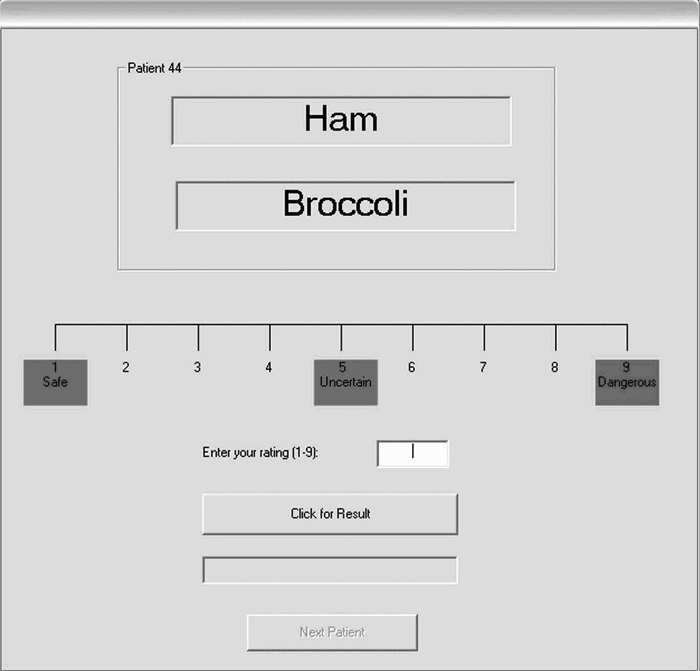
A screenshot of the window used in the learning task for Experiments 1 and 2.
Results and Discussion
All statistical comparisons were evaluated against an alpha level of .05. To determine the effects of introvertive anhedonia on blocking a median split of participants’ data on this variable was completed to give two groups. This split resulted in 41 individuals in the low group (range 1–5) and 38 in the high group (range 6–20). Blocking is demonstrated if the rating given to B in the test phase is less than that given to D or F.
Stage 1
As can be seen from Figure 2, learning proceeded smoothly in Stage 1 for both the high and the low groups. By the end of this stage participants were giving high ratings to A and GH and low ratings to E and IJ. There was no apparent effect of group. A three-way analysis of variance (ANOVA) with the factors of group (high vs. low), stimulus (A + vs. E–), and trial (1 to 10) revealed a significant effect of stimulus, F(1, 77) = 842.24, p < .001, and a significant Stimulus × Trial interaction, F(9, 693) = 76.34, p < .001; all remaining effects were not significant, all Fs < 1.5, ps > .14. Simple effects analysis of the Stimulus × Trial interaction revealed a difference between A and E from Trial 2 onwards, Fs (1, 770) > 282.15, ps < .001. An identical ANOVA performed upon the data from the trials with GH + and IJ revealed the same pattern of results: a significant effect of stimulus, F(1, 77) = 413.83, p < .001, and a significant Stimulus × Trial interaction, F(9, 693) = 37.72, p < .001. None of the remaining effects were significant, all Fs < 1.77, ps > .07. Simple effects analysis of the Stimulus × Trial interaction revealed a difference between GH and IJ from Trial 2 onwards, Fs (1, 770) > 130.76, ps < .001.
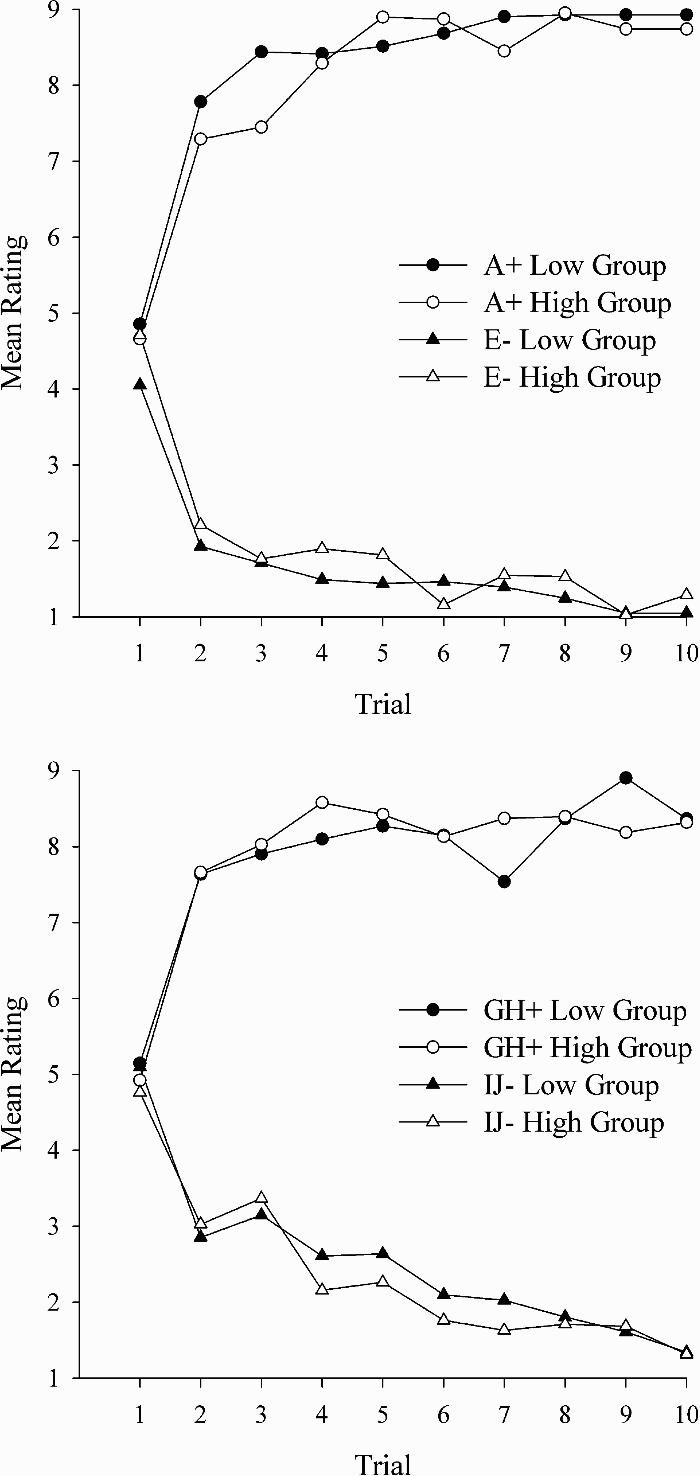
Mean ratings to Cues A and E (top panel) and GH and IJ (bottom panel) in the low and high groups across the 10 trials of Stage 1 of Experiment 1. + and – refer to, respectively, the presence and absence of the outcome.
Stage 2
The top panel of Figure 3, which shows the data of principal interest from Stage 2, demonstrates that learning about A from Stage 1 transferred with little disruption to the AB compound in Stage 2 in both the high and the low groups. In addition, learning about CD + progressed smoothly for both groups throughout Stage 2. A three-way ANOVA of these data with the factors of group (high vs. low), stimulus (AB vs. CD), and trial (1 to 5) revealed an effect of stimulus, F(1, 77) = 50.38, p < .001, and of trial, F(4, 308) = 43.34, p < .001, and an interaction between these factors, F(4, 308) = 17.56, p < .001. The effect of group, F(1, 77) = 1.05, p = .31, and all other interactions, Fs < 1, were not significant. Simple effects analysis of the Stimulus × Trial interaction revealed an effect of trial for both AB and CD, Fs(4, 616) > 3.85, ps < .004, and, with the exception of Trial 4, significant differences between AB and CD on each trial, Fs(1, 385) > 5.43, ps < .020.
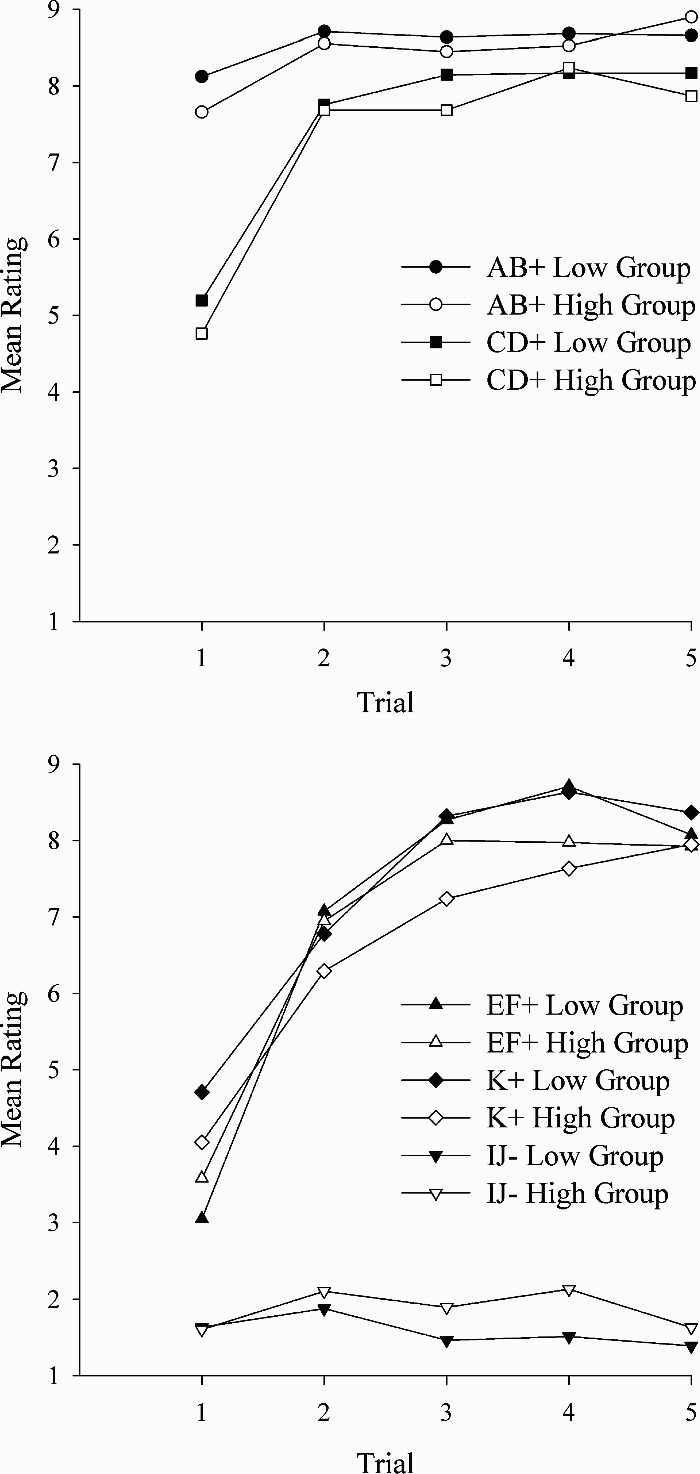
Mean ratings to cues AB and CD (top panel) and EF, K, and IJ (bottom panel) in the low and high groups across the five trials of Stage 2 of Experiment 1. + and – refer to, respectively, the presence and absence of the outcome.
Data from the remaining trials of Stage 2 are shown in the bottom panel of Figure 3. Again, there was little indication of a difference between the high and low groups. Both groups continued to give low ratings to the IJ compound, and learning proceeded smoothly to K and the EF compound. A three-way ANOVA of these data with the factors of group (high vs. low), stimulus (IJ, K, and EF), and trial (1 to 5) revealed an effect of stimulus, F(2, 154) = 299.43, p < .001, and of trial, F(4, 308) = 83.69, p < .001, and an interaction between these factors, F(8, 616) = 25.41, p < .001. The effect of group, F(1, 77) = 1.04, p = .311, the Group × Stimulus interaction, F(2, 154) = 2.16, p = .119, and the Group × Trial and the three-way interactions (Fs < 1) were all not significant. Simple effects analysis of the significant Stimulus × Trial interaction revealed effects of trial for both K and the EF compound, Fs(4, 924) > 51.26, ps < .001, but not for the IJ compound, F < 1. There were also differences among the stimuli on each trial, Fs(2, 770) > 28.01, ps < .001. Related t tests, corrected according to the Bonferroni procedure (adjusted p = .003), revealed that ratings of K and EF were higher than ratings of IJ on each trial, ts(78) > 5.64, ps < .001. No further comparisons were significant, ts(78) < 3.01, ps > .004.
Test
The final ratings of Stimuli B, D, F, and K are shown in Figure 4. There is a clear demonstration of blocking in the low group (B < D), but this effect is substantially attenuated in the high group. A two-way ANOVA of individual ratings with the factors of group (high vs. low) and stimulus (B, D, F, and K) revealed no effect of group, F < 1, but a significant effect of stimulus and a significant Group × Stimulus interaction, Fs(3, 231) > 3.17, ps < .025. Simple effects analysis of this interaction revealed that the groups differed in their ratings of B, F(1, 308) = 7.19, p = .008, but no other stimuli, remaining Fs(1, 308) < 2.37, ps > .125. There were also significant differences among the ratings of the stimuli for both the low and the high groups, Fs(3, 231) > 2.97, ps < .032. Related t tests, corrected according to the Bonferroni procedure (adjusted p = .008) revealed for the low group that the ratings of B were less than those of D, F, and K, and that ratings of D were less than those of K, ts(40) > 3.29, ps < .002. None of the remaining comparisons were significant, ts (40) < 2.26, ps > .029, and none of the comparisons among B, D, F, and K were significant in the high group, ts(37) < 2.53, ps > .016.
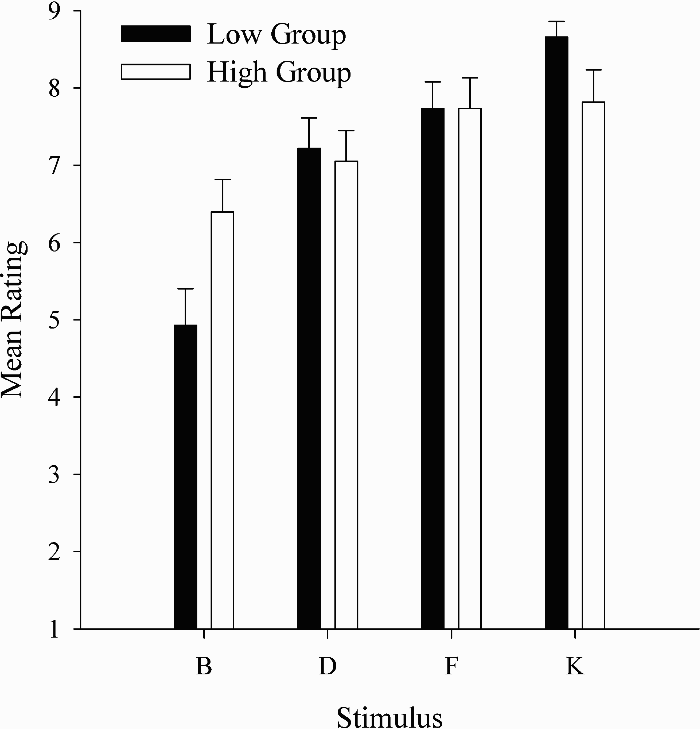
The mean ratings to Cues B, D F, and K in the low and high groups during the test trials of Experiment 1. Bars show one standard error of the mean.
Experiment 1 provided a clear demonstration of an attenuation of blocking in individuals high in the introvertive anhedonia dimension of schizotypy. Following learning about A + and E– in Stage 1 and then (among other trials) AB+, CD+, and EF + in Stage 2, participants in the low, but not the high, group showed a lower rating of B than of D or F. These results are broadly consistent with the findings of Oades et al. (1996) who found a deficit in blocking in nonparanoid individuals with schizophrenia, and they are in agreement with Bender et al. (2001) and Moran et al. (2007) in that they demonstrate a relationship between a deficit in blocking and negative schizotypal symptoms.
These results also provide the opportunity to determine, with greater specificity, the mechanism responsible for this relationship. Two potential explanations for a deficit in blocking can immediately be called into question by an examination of the data from Stages 1 and 2 of Experiment 1. First, it is possible that individuals high in introvertive anhedonia suffer a general deficit in generating a prediction error during learning (e.g., Corlett et al., 2006, 2007; Murray et al., 2008). Such a deficit would be expected to result in incomplete learning about the A-outcome association at the end of Stage 1. If this were the case, then the associative strength of the AB compound from the outset of Stage 2 (VAB) would be less than the asymptote of conditioning (λ), and, perhaps perversely, a prediction error would be generated. According to theories such as that provided by Rescorla and Wagner (1972), this would provide the opportunity for, at least, some learning about B and hence an attenuation blocking. This account can be called into question for it predicts that the high and low groups would differ in their learning about A in Stage 1, yet there was no indication that either the rate or asymptote of learning differed between these two group to this, or indeed any other, stimulus during Stages 1 and 2 of Experiment 1. 2 Second, it may be the case that learning about A is equivalent in the high and low groups, but that the generalization of the associative strength of A to the AB compound at the outset of Stage 2 was attenuated (Pearce, 1987; Wagner, 2003), and that this attenuation was particularly profound in the high group. Again, this would generate a greater prediction error during Stage 2 for the high group and a reduction in the magnitude of blocking. This account can also be ruled out in this experiment because it predicts that the high and low groups will differ in their ratings of the AB compound during the outset of Stage 2, yet no such difference was observed. Furthermore, if a measure of the detrimental effects of adding B to A is computed by subtracting the ratings of the AB compound on the first trial of Stage 2 from the ratings of A on the final trial of Stage 1 then the difference score for the low group (1.08) is not significantly different to the difference score for the high group (0.81), t(77) = 0.62, p = .537. Moreover, the magnitude of this difference score was not significantly correlated with the magnitude of blocking—as measured by the difference between the final ratings of D and B, r(79) = –.003, p = .979.
Additionally, the absence of any difference between the high and low groups in their learning curves seems to be at odds with the more general characterization of the core deficit in schizophrenia as a “loosening of associations” (Bleuler, 1911).
The results of Experiment 1 are, however, consistent with the idea that individuals high in introvertive anhedonia are disrupted in their use of a selective prediction error that computes the discrepancy between the asymptote of learning and the sum of the associative strength of all stimuli present on a trial (e.g., Rescorla & Wagner, 1972). That there was no detectable difference in the basic rate or asymptote of learning between individuals high or low in introvertive anhedonia suggests that another learning system is compensating for this disruption. We have suggested in the introduction that this may be a nonselective learning mechanism of the type suggested by Bush and Mosteller (1951). The purpose of Experiment 2 was to test this possibility.
Experiment 2
Rescorla (2000) identified a major limitation of any learning system that computes changes in associative strength solely on the basis of a selective prediction error (e.g., Rescorla & Wagner, 1972). He considered an experiment in which two stimuli were trained as equivalent predictors of the presence of an outcome (A + and C +) and two stimuli that were trained as two predictors of the absence of an outcome (B– and D–). If A and B were subsequently presented in compound and followed by the absence of the outcome (AB–) then it follows from selective prediction error models such as the Rescorla–Wagner model that the change in the associative strength of A and B will be exactly the same—despite their very different associative histories. It is fairly straightforward to see why, during trials with AB–, the changes in VA and VB according to the Rescorla–Wagner model (see Equation (1)) will be:

With appropriate counterbalancing αA will be equal to αB, and consequently ΔVA = ΔVB.
Ordinarily, it would be very difficult to test this prediction from the Rescorla–Wagner model as any differences in performance to A and B as a consequence of AB– training may not necessarily reflect different changes in associative strength, as the baseline from which the change to A will take place is very different to the baseline from which the change to B will take place. Thus an apparently small change in performance to B may in fact reflect a substantial change in its underlying associative strength. Rescorla (2000; see also Rescorla, 2001) circumvented this problem by, instead of testing A and B, testing compounds of AD and BC. This strategy ensures that the baseline levels of performance to A and B are equated at test as each compound comprises one stimulus that was paired with the presence of the outcome and one stimulus that was paired with the absence of the outcome. If, as predicted by the Rescorla–Wagner model, learning about A and B is equivalent during the AB– trials then performance to AD and BC would also be equivalent. However, if learning about A and B is asymmetrical during the AB– trials then there will be a difference between AD and BC. This is exactly the result that was observed by Rescorla (2000): Following excitatory conditioning of A and C and inhibitory conditioning of B and D, nonreinforcement of AB in Stage 2 resulted in weaker responding to the AD compound than to the BC compound. These results motivated Rescorla to conclude that in addition to employing a selective prediction error (e.g., Rescorla & Wagner, 1972) associative learning must also be determined by a nonselective prediction error, such as that described in Equation (2). It is straightforward to see why, during trials with AB−, the changes in VA and VB according to Equation (2) will be:

As a consequence of the initial A+, C+, B–, D– training, VA will approach λ, and VB will approach 0. The prediction error will therefore be greater for A than B on AB– trials, and consequently ΔVA ≠ ΔVB. More specifically, there will be a greater loss of associative strength to A than to B and thus a weaker response to AD than to BC at test.
The goal of Experiment 2 was to use the experimental design provided by Rescorla (2000) as a measure of nonselective prediction error in individuals high and low in introvertive anhedonia. The results of Experiment 1 are consistent with the proposal that individuals high in introvertive anhedonia suffer a disruption in selective prediction error, yet the same participants also demonstrate a comparable rate of acquisition of learning about both simple (e.g., A +) and compound (CD +) stimuli. We have suggested that this may reflect compensation by an alternative, possibly nonselective, learning mechanism. This possibility leads to a clear prediction: Individuals who are high in introvertive anhedonia should be more likely to demonstrate the type of effect reported by Rescorla than are individuals who are low in introvertive anhedonia. Experiment 2 tested this prediction using the same health and safety inspector task as that used in Experiment 1. In Stage 1, trials with Foods A and C signalled poisoning, and trials with Foods B and D did not. Additional filler trials were given in which a compound of Foods E and F signalled poisoning, and a compound of G and H did not. The purpose of these trials was to familiarize participants with compounds of foods before Stage 2. In Stage 2, the EF compound continued to signal poisoning, and a novel compound comprising Foods A and B was also presented, which signalled the absence of poisoning. In a final test, compounds of AD and BC were presented, without feedback. According to theories of learning that incorporate a nonselective prediction error, A should lose more associative strength than B during the AB– trials. We therefore anticipated lower ratings of AD than BC in the participants who had a high introvertive anhedonia score, but no difference in the ratings of these compounds in participants who had a low introvertive anhedonia score.
Method
Participants
A total of 66 healthy nonsmoking participants were recruited from the Nottinghamshire, UK, area (48 females), who had a mean age of 22 years (range: 18–39 years). These participants were not currently taking psychotropic medication. None of the individuals were excluded due to their failure to learn stimulus–outcome associations in Stage 1 of the task. All procedures were approved by the departmental Ethics Committee, and all participants gave informed consent.
Stimuli and materials
A desktop personal computer (Compusys, Aylesbury, Bucks, UK) running Microsoft Windows XP was used to display the stimuli and record the responses made on the computer's keyboard and mouse. The learning task and the O-LIFE questionnaire were programmed using Visual Basic (Microsoft Corporation).
The design of the task is summarized in Table 2. The stimuli were the names of eight food products (potatoes, peas, carrots, broccoli, ham, steak, chicken, lamb), which were randomly and independently assigned to Cues A to H. The position of the food on screen in Stages 1 and 2 and during the test was randomized. In Stage 1 there were 10 trials of each of the following types: A+, C+, B–, D–, EF+, and GH–, the order of which was block randomized. Stage 2 followed seamlessly on from Stage 1, and in this stage there were four trials with EF + and four trials with AB–, again ordered in a block randomized fashion. In the test phase participants gave their rating of the trial types AD and BC, the order of which was randomized for each participant. Participants were asked to make all ratings on a scale of 1–9 with the following anchors provided: 1 = safe, 5 = uncertain, and 9 = dangerous.
Design of Experiment 2

Note: Letters A to H refer to individual foods (e.g., lamb), which signalled either the presence (+) or absence (–) of food poisoning in fictitious hospital patients. Filler trials are identified with italics.
The O-LIFE (Mason et al., 1995) was again used to measure schizotypy. The mean schizotypy scores obtained in this sample were as follows (standard deviation in parentheses after the mean): unusual experiences, 8.27 (5.16); cognitive disorganization, 11.36 (4.78); and introvertive anhedonia, 4.98 (3.17).
Procedure
After signing a consent form, participants completed the task and the O-LIFE questionnaire, the order of which was counterbalanced. The same instructions as those used in Experiment 1 appeared on the screen.
On each trial of Stages 1 and 2 participants were again presented with a frame, upon which was displayed the current patient number and within which were two windows that displayed the food item(s) eaten by the patient. Using the keyboard, participants entered a rating (1–9) for the meal eaten by the patient and were then able to view the outcome of this meal, which was displayed in a box at the bottom of the screen. The outcome was either “This patient suffered from FOOD POISONING”, which was printed in red, or “This patient was FINE”, which was printed in green. Participants then viewed the food item(s) eaten by the next patient and followed the same procedure. Following the final trial of Stage 2, a test window replaced the window used for Stages 1 and 2 of the task. Participants were asked to provide their final ratings (1–9) of a number of food items and were reminded that they would not be provided with any feedback. Details of the experimental procedure or design that are omitted were the same as those in Experiment 1.
Results and Discussion
To determine the effects of introvertive anhedonia on the learning task a median split of participants’ data on this variable was completed to give two groups. This split resulted in 32 individuals in the low group (range 0 to 4) and 34 in the high group (range 5–16).
Stage 1
There was no difference between the ratings of A and C or between the ratings of B and D. The data for these trials were therefore collapsed. As can be seen from Figure 5, learning proceeded smoothly in Stage 1 for both the high and low groups. By the end of this stage participants were giving high ratings to A/C + and EF + and low ratings to B/C– and GH–. A three-way ANOVA of mean ratings with the factors of group (high vs. low), stimulus (A/C + vs. B/D–), and trial (1 to 10) revealed a significant effect of stimulus, F(1, 64) = 642.01, p < .001, significant effects of trial, F(9, 576) = 7.02, p < .001, a significant Stimulus × Trial interaction, F(9, 576) = 108.00, p < .001, and a three-way interaction that just reached significance, F(9, 576) = 1.91, p = .048. All remaining effects were not significant: all Fs < 1 except the Group × Stimulus interaction, F(1, 64) = 1.43, p = .236. It is difficult to know how seriously to take the significant three-way interaction, for simple effects analysis revealed significant Stimulus × Trial interactions for both groups, Fs(9, 576) > 42.31, ps < .001; however, the Group × Trial interactions for A/C and B/D were both not significant, Fs(9, 1152) < 1.86, ps > .054, and, in particular, the Group × Stimulus interactions on each trial were all not significant, Fs(1, 640) < 3.27, ps > .071. In any case, it is reassuring to learn that across the final three trials of Stage 1, there were no differences between the high and low groups in their ratings of A/C+, Fs < 1, or B/D–, Fs(1, 1280) < 1.37, ps > .242.
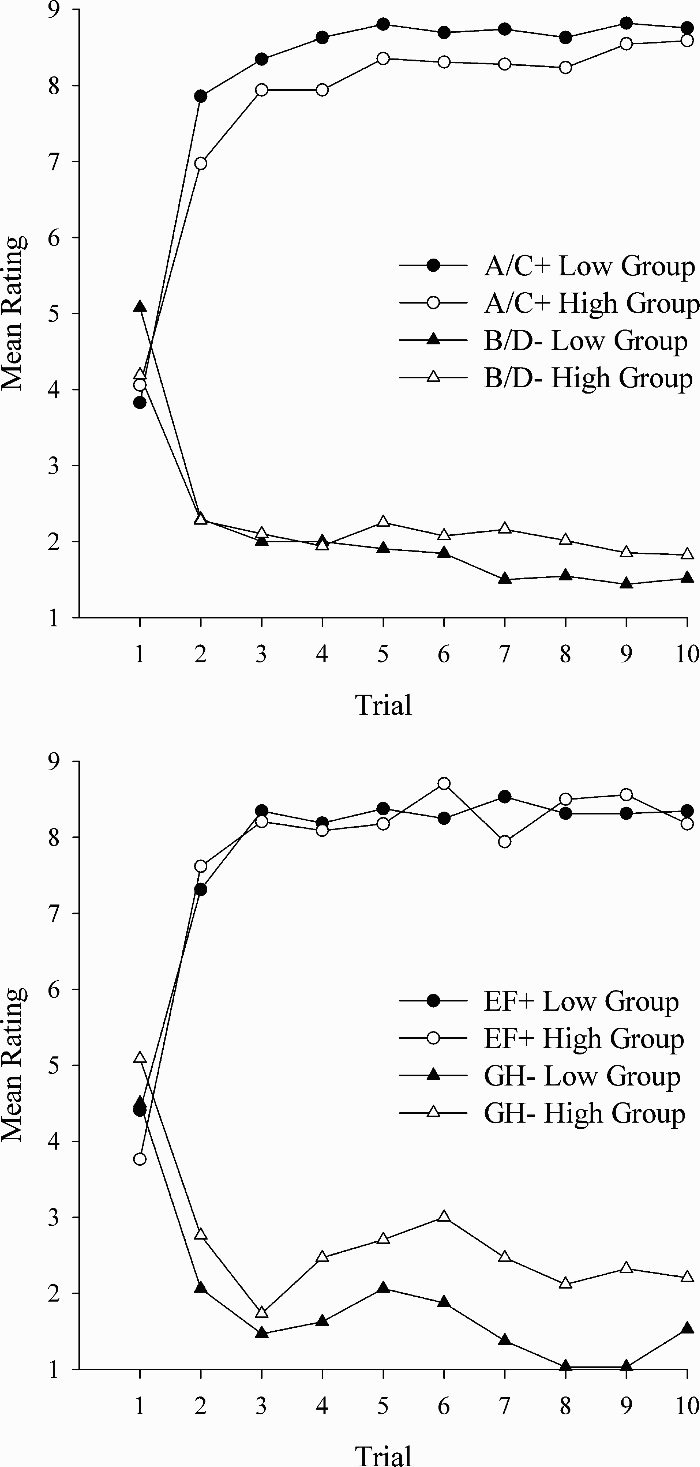
Mean ratings to the average of Cues A and C and to the average of B and D (top panel) and EF and GH (bottom panel) in the low and high groups across the 10 trials of Stage 1 of Experiment 2. + and – refer to, respectively, the presence and absence of the outcome.
An identical three-way ANOVA of mean ratings for the data from trials with EF and GH with the factors of group (high vs. low), stimulus (EF + vs. GH–), and trial (1 to 10) revealed a significant effect of stimulus, F(1, 64) = 507.99, p < .001, and of trial, F(9, 576) = 2.90, p < .001, and an interaction between these factors, F(9, 576) = 43.75, p < .001. None of the remaining effects were significant, Fs(1, 64) < 3.52, ps > .065, and Fs(9, 576) < 1. Simple effects analysis of the Stimulus × Trial interaction revealed an effect of stimulus from Trial 2 onwards, Fs(1, 640) > 154.86, ps < .001.
Stage 2
Learning in Stage 2 also proceeded smoothly. The top panel of Figure 6 shows that ratings of AB for both the high and the low groups were initially high, but then reduced quickly across the four trials. The ratings for EF remained high across this stage for both groups. A two-way ANOVA of individual ratings of AB with the factors of group (high vs. low) and trial (1–4) revealed no effect of group, F < 1, an effect of trial, F(3, 192) = 153.46, p < .001, and a significant Group × Trial interaction, F(3, 192) = 3.26, p = .023. It is difficult to be sure what the source of this significant interaction was, for simple effects analysis revealed effects of trial for both groups, Fs(3, 192) > 56.13, ps < .001, yet any hint of a difference between the groups on each trial was far from significant, Fs(1, 256) < 2.23, ps > .137. An identical ANOVA performed upon the ratings to EF revealed an effect of trial, F(3, 192) = 3.09, p = .028, but no effect of group, F < 1, and no interaction between these factors, F(3, 192) = 1.50, p = .21.
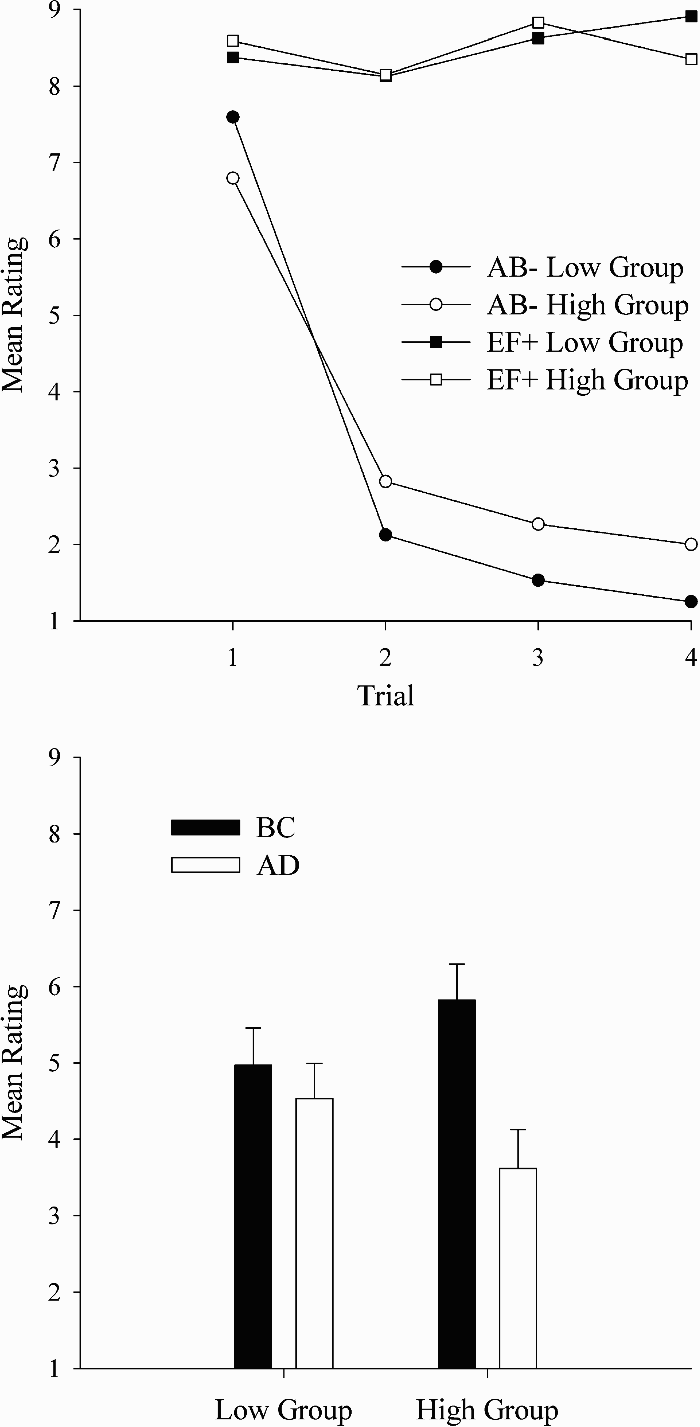
Mean ratings to AB and EF across the 4 trials of stage 2 of Experiment 2 (top panel) and the mean ratings to BC and AD in the low and high groups during the test trails of Experiment 2 (bottom panel). + and − refer to, respectively, the presence and absence of the outcome. Bars show one standard error of the mean.
Test
The mean ratings from the test trials with AD and BC for both the high and low groups are shown in the bottom panel of Figure 6. The high group rated the AD compound lower than the BC compound, but this effect was notably undermined in the low group. These impressions were confirmed by a two-way ANOVA of individual ratings with the factors of group (high vs. low) and stimulus (BC vs. AD). This analysis revealed no effect of group, F < 1, but a significant effect of stimulus, F(1, 64) = 9.71, p = .003, and a significant Group × Stimulus interaction, F(1, 64) = 4.34, p = .041. Simple effects analysis revealed that the difference between AD and BC was significant in the high group, F(1, 64) = 13.52, p < .001, but not in the low group, F < 1. The effects of group for both test compounds were not significant, F(1, 128) < 1.85, p > .176.
Following training in which Stimuli A and C separately signalled an outcome, and Stimuli B and D separately signalled the absence of the outcome, trials were given in which a compound of A and B signalled the absence of the outcome. This training resulted in a greater loss of associative strength to A than to B in participants that were high, but not low, in introvertive anhedonia. This was assessed in a test that equated the overall baseline levels of performance of the stimuli by presenting AD and BC. The high group rated AD lower than BC. The low group did not. The results from the high group are themselves notable as they represent an important replication, in humans, of the results reported by Rescorla (2000). Other attempts at such a replication have provided contrary findings (Le Pelley & McLaren, 2001, 2004). We have suggested that one dimension that might distinguish individuals that are either high or low in introvertive anhedonia is the extent to which a selective or nonselective prediction error is utilized in associative learning. The results of Experiment 2 support this suggestion. AB– trials resulted in a greater loss of the associative properties of A than B for participants in the high introvertive anhedonia group. This result is compatible with nonselective theories of learning (e.g., Bush & Mosteller, 1951), but not selective theories of learning (e.g., Rescorla & Wagner, 1972). For the low introvertive group, however, AB– trials resulted in an equivalent loss of associative strength to A and B. This result is more compatible with a selective than a nonselective prediction error.
General Discussion
Two experiments explored the mechanisms responsible for associative learning in individuals who differed on the negative dimension of schizotypy. The results of Experiment 1 demonstrated that individuals low, but not high, in introvertive anhedonia demonstrated blocking (Kamin, 1968): an effect indicative of a selective learning mechanism (e.g., Rescorla & Wagner, 1972). Experiment 2 demonstrated a complementary effect: Individuals high, but not low in introvertive anhedonia demonstrated asymmetrical learning about the components of a compound stimulus (Rescorla, 2000); this result is indicative of a nonselective learning mechanism (e.g., Bush & Mosteller, 1951).
Together, Experiments 1 and 2 constitute a double dissociation (Teuber, 1955) of the effects of introvertive anhedonia on learning. High introvertive anhedonia resulted in impaired blocking, but preserved asymmetrical learning about the components of a compound stimulus. Low introvertive anhedonia resulted in the opposite pattern of results. In addition to providing specific information about how a negative dimension of schizotypy is related to mechanisms of learning, this double dissociation also allows us to draw two more general conclusions. First, it suggests that the absence of blocking seen at test in individuals high in introvertive anhedonia in Experiment 1 is not simply the result of a lack of experimental sensitivity. It is always a logical possibility that the absence of a difference in, for example, reaction times or ratings to stimuli in a patient group or in a particular population of individuals is simply due to the experimental task being insufficiently sensitive to detect a difference in that population. This possibility is made less plausible by the demonstration in Experiment 2 that individuals high in introvertive anhedonia can, using the same experimental task, demonstrate a difference between test stimuli. Second, it justifies the conclusion drawn by some authors (e.g., Brandon & Wagner, 2003; Le Pelley, 2004; Rescorla, 2000) that separate selective and nonselective learning mechanisms are required to account for instances of blocking and asymmetrical learning about the elements of compound stimuli. It remains to be determined whether theories that attempt to account for both blocking and the results of Rescorla (2000) with a single learning rule (e.g., Harris, 2006) can also provide a complete account of the present data.
An alternative strategy for assessing nonselective prediction error is to give AB + (rather than AB–) trials following the A+, C+, B–, D– training in Stage 1 before finally examining performance to AD and BC. According to theories of learning that adopt a nonselective prediction error, the AB + trials should result in more learning about B than A (as the prediction error for B is greater than that for A). Consequently performance to BC should again be greater than that to AD. Experiments conducted in our laboratory using this procedure have been less successful. For example, we have run experiments that are identical in every fashion to the current Experiment 2, with the exception that in Stage 2, AB– trials were replaced with AB + trials, and EF + trials were replaced with EF– trials. The test results consistently indicated identical, and very high, ratings to BC and AD. The most likely explanation for this failure to observe a difference between BC and AD was a ceiling effect, a problem that was circumvented in the current Experiment 2 by pairing the AB compound with the absence of the outcome.
During Stage 2 of Experiment 1, a single cue (K) and a compound of two cues (CD) were, on separate trials, repeatedly paired with an outcome. According to theories of learning that incorporate a selective prediction error (e.g., Rescorla & Wagner, 1972) the associative strength of K should, after this training, be greater than that of D—that is, learning about C should overshadow learning about D. Theories of learning that employ a nonselective prediction error (e.g., Bush & Mosteller, 1951), however, anticipate that the associative strength of K will be equal to that of D. Other things being equal, therefore, it follows from our analysis that overshadowing should be present in individuals low in introvertive anhedonia, but not in individuals high in introvertive anhedonia. The results of Experiment 1 provided little support for this prediction. The mean rating for K was greater than that for D in the low group, but there was no difference in the ratings for K and D in the high group. However, this difference stems, in the main, from slightly higher ratings of K in the low group than in the high group. Furthermore, there was no difference between the high and low groups in their ratings of D. These results might be taken to suggest that our analysis of the relationship between prediction error and schizotypy is incomplete. However, it is possible that Experiment 1 was not sufficiently sensitive to detect variations in the magnitude of overshadowing. This may have been due to the fact that, overall, Experiment 1 did not reveal a particularly strong overshadowing effect. Alternatively, it may be that overshadowing is determined by multiple associative mechanisms—some of which are not influenced by differences in introvertive anhedonia. In any case, it seems unclear whether differences in schizotypal symptoms are associated with variations in overshadowing in the same way that they are for blocking.
Rather than account for the current results in terms of the extent to which individuals high or low in introvertive anhedonia employ a selective or nonselective learning mechanism, it is possible instead to formulate an explanation for the current results in terms of the extent to which a selective attentional mechanism can be utilized. Mackintosh (1975), like Bush and Mosteller (1951), proposed that the change in the associative strength that a stimulus undergoes was determined by a prediction error similar to that shown in Equation (2). However, the associability of, or attention paid to, a stimulus could also be changed (Δα). This was formalized by Mackintosh, who suggested:

Where Vn is the associative strength of the target stimulus on the preceding trial, and V x is the sum of the associative strength of all stimuli on the preceding trial, minus V n . Thus attention to a stimulus climbs if its prediction error is less than the prediction error of all other stimuli present, and attention to a stimulus falls if its prediction error is at least as great as the prediction error of all other stimuli present. If the extent to which the associability of stimuli can be modified is particularly low then the predictions of Mackintosh's theory approach the predictions of Bush and Mosteller (1951). Thus blocking should not be observed, and stimuli will be able to acquire unequal associative strength when conditioned in compound (Rescorla, 2000). However, if the extent to which the associability of stimuli can be modified is high then Mackintosh's theory does predict blocking (because the associability of the blocked cue will fall) and, with select parameters, predicts very little difference in learning about stimuli conditioned in compound that have very different associative strengths. 3 Thus, the differences we have observed between individuals high and low in introvertive anhedonia may be a consequence of the extent to which an attentional mechanism is utilized. This conclusion is, of course, compatible with the more general conclusion we wish to draw from these experiments—that is, variations in selective/nonselective prediction error are related to variations in introvertive anhedonia—so long as the attentional mechanism utilizes, as part of its computation, a selective prediction error.
According to Equation (2), on AB– trials, the prediction error for B will be less than the prediction error for A. It thus follows from Equation (5) that attention (α) will climb to B and fall to A. If αB becomes sufficiently greater than αA, the effects of the larger prediction error that A possesses on AB– trials will be undermined and could ultimately lead to responding to AC and BD being equivalent. These ideas are considered in more detail by Le Pelley and McLaren (2001).
The relationship between blocking and schizophrenia (or schizotypy) is less well studied than the relationship between latent inhibition and schizophrenia. Latent inhibition refers to the attenuation of learning about a conditioned stimulus (CS)–unconditioned stimulus (US) association as a consequence of mere preexposure to the CS (Lubow, 1989; Lubow & Moore, 1959), and many experiments have now demonstrated that individuals high in schizotypy (e.g., Evans, Gray, & Snowden, 2007a), or with a diagnosis of schizophrenia (e.g., Baruch, Hemsley, & Gray, 1988) show an attenuation of latent inhibition. Although there are many studies of latent inhibition of excitatory conditioning in animals, studies of latent inhibition of conditioned inhibition are much fewer in number (e.g., Nakajima, Takahashi, & Blaisdell, 2006; Reiss & Wagner, 1972; see also Rescorla, 1971). The same is true also for studies of latent inhibition in people (e.g., Escobar, Arcediano, & Miller, 2003). Although few and far between, studies of latent inhibition of conditioned inhibition are important for they rule out the possibility that mere preexposure results in the formation of a conditioned inhibitor (which, like blocking, necessitates a selective learning mechanism, such as that described by Rescorla & Wagner, 1972). To the best of our knowledge, there has been no investigation of the relationship between schizophrenia/schizotypy and latent inhibition of conditioned inhibition. Thus, the possibility cannot be ruled out that the attenuation of latent inhibition in the schizophrenia continuum reflects nothing more than, in fact, a deficit in the acquisition of conditioned inhibition during preexposure. This possibility gains a measure of some support from an experiment by Migo et al. (2006) who show that the establishment of conditioned inhibition is negatively associated with schizotypy.
Thus far, it has been assumed that the only associations formed were between the foods eaten by the hypothetical patients and the presence or absence of poisoning. But it is also possible that on each compound trial (for example an AB + trial) associations were formed between the elements of the compounds themselves. The presence of so-called within-compound associations is now well established both in animal (e.g., Rescorla & Durlach, 1981; Speers, Gillan, & Rescorla, 1980) and in human (e.g., Dickinson & Burke, 1996) studies of learning. Moreover, Melchers, Lachnit, and Shanks (2006) have shown, in a task similar to that used in the current experiment, that the strength of within-compound associations negatively correlates with the magnitude of blocking. This effect is typically explained by assuming that the initial A + training in Stage 1 establishes a strong association between A and the outcome and that subsequent AB + trials result in the formation of a B–A association during Stage 2. Consequently, test performance to B can be expected to be determined by its own (weak) association with the outcome, plus the indirect (strong) association with the outcome that is mediated by the within-compound association with A. It is therefore possible that demonstrations of an attenuation of blocking, rather than being the failure of selective learning, are in fact a consequence of the formation of within-compound associations. A within-compound association analysis of the difference between AD and BC in the test stage of Experiment 2 can also be developed. If strong associations were formed between A and B in Stage 2 of this experiment, then test trials with AD should evoke a representation of B, which in this case has low associative strength, and test trials with BC should evoke a representation of A, which has high associative strength. The associative strength of AD plus the associatively activated representation of B will be less than the associative strength of BC plus the associatively activated representation of A. Consequently, and with no appeal to nonselective prediction error, a within-compound association analysis can correctly predict the presence of a difference between AD and BC in Experiment 2 (see Rescorla, 2000). If individuals high in introvertive anhedonia were particularly disposed to forming associations between simultaneously presented stimuli then these individuals would show an attenuation of blocking, as well as asymmetrical learning about the elements of a compound stimulus, which is precisely the result that is described here. It is difficult to know the merit of this explanation without further experimentation. However, we have some grounds for treating it with some scepticism. First, if within-compound associations undermine the blocking effect in the high group of Experiment 1 by associatively activating a representation of A during test trials with B then we should also expect, in the same group, for test trials with F to associatively activate a representation of E (which has low associative strength) and reduce responding relative to D. There was no indication of this result in the test trials of Experiment 1. If anything, performance to F was, numerically, higher than that to D. Second, conditioning experiments with animals by Rescorla (2000) have shown that his results are obtained even when the contribution of within-compound association are limited, and a human associative learning experiment by Le Pelley and McLaren (2004) has shown that the presence of within-compound associations alone cannot account for differences in responding to AD and BC.
It is relevant to consider, at this juncture, the specificity of our results to the negative, introvertive anhedonia, dimension of schizotypy. Other researchers have noted that deficits in blocking are associated with positive schizotypal symptoms (e.g., Jones et al., 1992b), and Corlett et al. (2006, 2007) have implicated abnormal prediction error in the formation of delusions. However, there was no indication of any influence of the positive schizotypal symptoms in our experiments. The top and bottom panels of Figure 7 show, respectively, the results from the test trials of Experiments 1 and 2 split according to the unusual experiences dimension of the O-LIFE, which is analogous to the positive symptoms of schizophrenia. For Experiment 1 (top panel), participants were separated into a low unusual experiences group (N = 41, score range 0–4) and a high unusual experiences group (N = 38, score range = 5–16). A two-way ANOVA of ratings with the factors of group and stimulus revealed an effect of stimulus, F(3, 321) = 16.71, p < .001, but no effect of group, F(1, 77) = 1.67, p = .200, and no interaction between these factors, F < 1. For Experiment 2 (bottom panel), participants were separated into a low unusual experiences group (N = 41, score range 0–4) and a high unusual experiences group (N = 38, score range = 5–16). A two-way ANOVA of ratings with the factors of group and stimulus revealed an effect of stimulus, F(1, 64) = 8.75, p = .004, but the effect of group and the Group × Stimulus interaction were not significant, Fs < 1. It thus appears, for the current experiments at least, that the selectivity of prediction error covaries specifically with negative schizotypal symptoms.
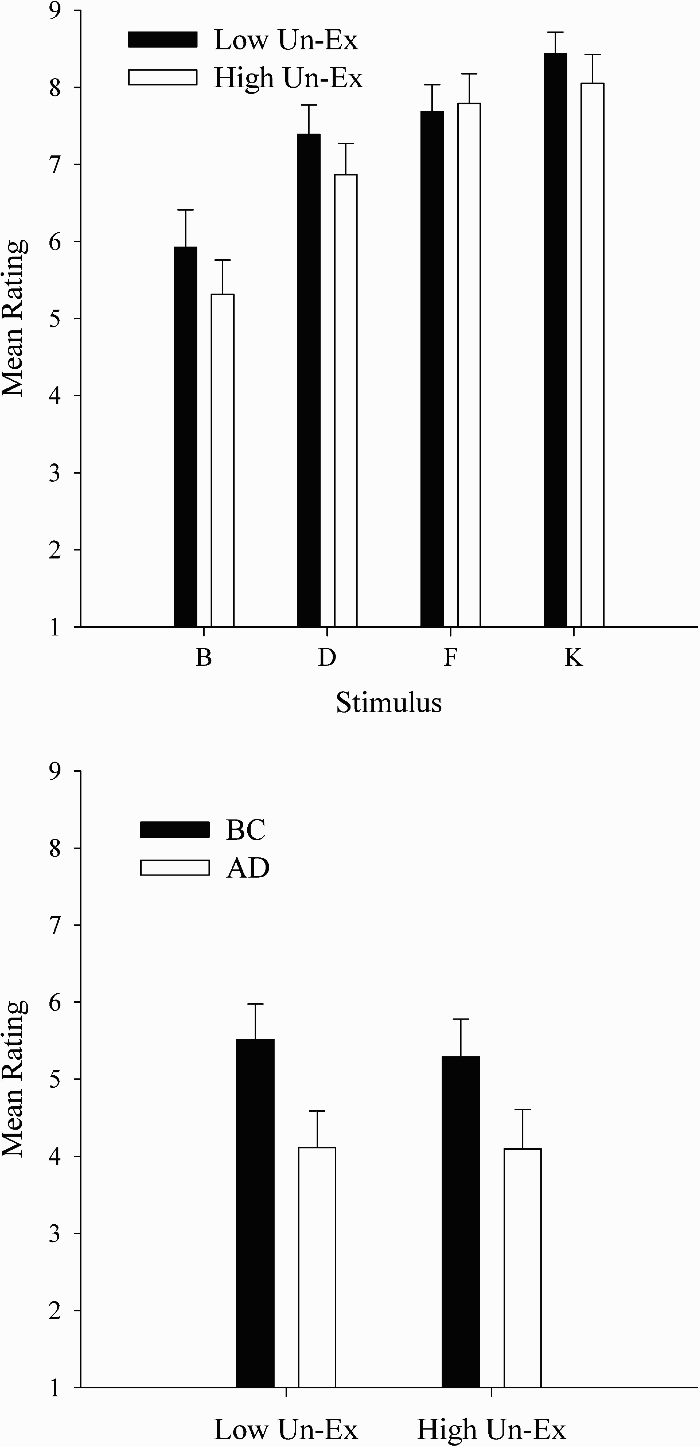
The mean ratings to Cues B, D, F, and K in the low and high unusual experiences groups during the test trials of Experiment 1 (top panel). The mean ratings to BC and AD in the low and high unusual experiences groups during the test trials of Experiment 2 (bottom panel). Bars show one standard error of the mean.
Recent hybrid models of associative learning (e.g., Le Pelley, 2004; Mackintosh & Pearce, in press) assume that blocking is multiply determined, in particular by both cue-processing mechanisms (e.g., Mackintosh, 1975; Pearce & Hall, 1980) and outcome-processing mechanisms (Rescorla & Wagner, 1972). This raises the possibility that different tasks might all reveal blocking, but for rather different reasons. For instance, the current task might have detected blocking by being more sensitive to variations in outcome processing, whereas other tasks might reveal blocking by being more sensitive to variations in cue processing. If variations in cue and outcome processing are differentially associated with the positive and negative schizotypal symptoms then it follows that for some tasks, blocking will be related to the positive symptoms, whereas for other tasks, blocking will be related to the negative symptoms. Whether this analysis provides an appropriate resolution of why blocking is sometimes associated with the negative schizotypal symptoms, but at other times, the positive schizotypal symptoms, remains to be determined.
An important question to consider then is why exactly should the dimension of introvertive anhedonia be related to the selectivity, or otherwise, of prediction error in learning? Although the answer to this question is outside of the scope of the current experiments, studies of the neuroscience and neuropsychology of learning hint that hedonia and selective prediction error are linked. Dopamine has, for a number of years, been implicated in hedonic representations (Wise, 1980), and many studies into the reinforcing role of psychostimulants and addictive drugs implicate dopaminergic systems (e.g., Everitt & Robbins, 2005; Koob & Le Moal, 2006; but see Berridge, 2007). At the same time dopaminergic neurons are known to encode for precisely the type of selective prediction error that is required for phenomena such as blocking and conditioned inhibition to occur (Roesch, Calu, & Schoenbaum, 2007; Schultz, 1998; Tobler, Dickinson, & Schultz, 2003; Waelti, Dickinson, & Schultz, 2001). Furthermore, functional magnetic resonance imaging (fMRI) studies in humans (e.g., Tobler, O'Doherty, Dolan, & Schultz, 2006) have shown significantly lower blood-oxygen-level-derived (BOLD) activity to blocked than to nonblocked stimuli in the orbitofrontal cortex, an area considered by some to be involved in the representation of hedonic experiences (e.g., Kringelbach, 2005). Whether there is a physiological link between anhedonia and nonselective learning remains to be determined. In any case, it is reassuring to learn that tasks that do or do not support blocking are associated with activity in distinct brain regions and that this activity is mediated by ventromedial prefrontal cortex (Doeller & Burgess, 2008; Doeller, King, & Burgess, 2008).
The aim of the experiments reported here was to determine the processes underlying deficits in associative learning—in particular, blocking (Kamin, 1968). No previous studies have undertaken an analysis of the mechanisms contributing to a deficit in blocking in patients with schizophrenia or those high in schizotypy. This is a critical omission as a failure to demonstrate blocking could arise for a number of very different reasons. Providing an understanding of the reasons why individuals with schizophrenia or those individuals high in schizotypy fail to exhibit blocking is an important step in determining the nature of their deficit.