







Abstract
The Simon task is one of the well known tasks that recruit cognitive control. The Simon effect, the reaction time (RT) difference between congruent and incongruent stimuli, has been commonly discussed as interference based. Nevertheless, in recent years some studies have referred to the facilitation component of the task. In the current research we measured effects of cognitive control by conducting sequential analysis and adding neutral conditions. Two neutral stimuli were employed in order to examine their effect and their validity as neutrals. It was found that presentation of Simon stimuli on the central meridian at the top or bottom of a screen (but not at the centre of the screen) created a valid neutral condition. Facilitation as well as interference effects were found. Adding a nonconflict condition modulated cognitive control independently of sequential effects. Namely, the Simon effect increased by adding both types of neutrals, but the decrease in the effect after incongruent trials was only present for the vertical neutral block, in which the Simon effect appeared after congruent but not after incongruent trials. We suggest the possibility of two different mechanisms of cognitive control.
Cognitive control
In many situations we face conflicting information or conflicting demands for our limited resources. We have to decide which object, dimension of an object, or situation we have to attend to, and what should be ignored, inhibited, or deferred for later processing. These situations require control and in many reports come under the title of executive functions. Van Veen and Carter (2006) wrote that control is conceptualized as the ability to suppress irrelevant information. Another aspect of control is selective attention. In order to succeed in a given task one must choose where to direct one's attention, which stimulations to avoid, and, finally, how to carry out one's decisions. As defined by Craik and Bialystok (2006), “Control is the set of fluid operations that enable intentional processing and adaptive cognitive performance” (p. 131).
Measurement of cognitive control
One way to measure effects of control is by sequential analyses. Here one examines effects of control exerted in trial n – 1 on trial n. Such analyses showed large interference effects after congruent and neutral trials and reduction of the effect after incongruent trials (Botvinick, Braver, Barch, Carter, & Cohen, 2001; Gratton, Coles, & Donchin, 1992; Wuhr & Ansorge, 2005). This pattern of results is taken as an indication for a differential application of control in different trials. That is, a conflict (i.e., incongruent) situation on trial n – 1 recruits control, and therefore trial n will show less interference than it would with no conflict on trial n – 1.
Another way to examine effects of control is by introducing neutral trials (Tzelgov, Henik, & Berger, 1992). In a Stroop task Tzelgov et al. changed the number of neutral trials (e.g., xxxx in red) without changing the number of congruent (e.g., RED written in red ink) and incongruent trials (e.g., GREEN written in red ink). It was suggested that such a change modulates control—for example, more neutral trials produce a more lenient attitude and less cognitive control. Control was measured by the magnitude of the interference component (i.e., incongruent reaction time, RT, minus neutral RT) within the Stroop effect—namely, smaller interference indicated greater activation of cognitive control. It was found that increasing the number of neutral trials reduced control.
Moreover, a neutral stimulus should not present a conflict (Goldfarb & Henik, 2007). Hence, performance in response to it should be better than that for conflict trials and worse than that for facilitated trials. Namely, RT for neutral trials should be faster than that for incongruent trials and slower than that for congruent trials. This allows us to distinguish between components of facilitation (neutral vs. congruent) and interference (neutral vs. incongruent) that are present in compatibility effects and to test the magnitude of each component.
Simon task
One of the major tasks employed in studies of control is the Simon task. This task was first reported by Simon and Small (1969). They designed an auditory task where the stimulus consisted of either a high- or a low-pitch sound that was presented to either the left or the right ear. Participants had to respond to the sound with a right or left key-press, according to instructions. This arrangement created two conditions: (a) congruent—when the sound was heard on the same side as the required key-press, and (b) incongruent—when the sound was heard on the opposite side to the required key-press. Participants responded faster to congruent stimuli than to incongruent ones. This difference in RT between congruent and incongruent trials is known as the Simon effect. In subsequent research, the task was conducted visually: Participants were presented with a colour patch, to the left or the right of fixation, and were asked to indicate, as fast as possible, whether it was red or blue. For example, they were asked to press a right-hand key for red and a left-hand key for green/blue (Craft & Simon, 1970; Proctor & Lu, 1994; Umilta & Nicoletti, 1985). Similar to the original study (Simon & Small, 1969), the effect was found with visual presentations. The Simon effect was mostly discussed as an interference effect, implying that it is due only to the elongation of RT in the incongruent condition (when stimulus and response do not correspond) and not due to facilitation when they do (Craft & Simon, 1970). In recent years, studies have shown a facilitation component in the Simon task and have discussed the process of response that evokes facilitation and interference (Hommel, 1993; Vu & Proctor, 2002).
To the best of our knowledge, only a few studies have employed a neutral condition in the Simon task. Bialystok (2006) used neutral stimuli that were presented along the central vertical axis of the screen, randomly alternating between the bottom and top locations. This was of secondary importance to her study and therefore was not analysed in detail. Other studies have used and analysed this kind of vertical neutral and found RT to fall in between congruent and incongruent trial RTs. Namely, they showed that the Simon effect includes facilitation as well as interference (Wallace, 1972; Wuhr & Ansorge, 2005). In a different study, Bialystok, Craik, Klein, and Viswanathan (2004) used another type of neutral condition (a colour patch presented at the centre of a screen) in order to test inhibition and working memory differences between young and old participants. Yet, the Simon task and colour naming task (where a target was presented in the middle) were presented either to different participants or in separate blocks. The same type of visual neutral was used by Grosjean and Mordkoff (2002), as well as auditory stimuli with neutrals. Hommel (1993) used binaural presentation as a neutral condition in an auditory experiment. His study included cross hand responses and visual stimuli as well. This type of neutral is well established as a neutral in the auditory modality but is problematic regarding visual stimuli, since the neutral condition involves more than one target and is different from the commonly used stimuli in the Simon task. Moreover, visual processing is different from auditory processing, and information in one eye field reaches one hemisphere while information presented to both eyes (like the visual version of Hommel's auditory neutral) reaches both hemispheres.
The current study
The current study employs the methods mentioned above (adding neutrals and sequential analysis) to examine cognitive control. We compare two common neutral conditions in a visual Simon task in order to unravel potential components of each neutral type and their influence on the Simon effect. A comparison between a Simon task with and without neutral conditions is carried out in order to evaluate the influence of adding a neutral (similar to Tzelgov et al., 1992). Sequential analysis is conducted to unravel the consequence of activating cognitive control.
The two types of neutral conditions that are tested include: (a) a colour patch in the middle of the screen, and (b) a colour patch on the vertical meridian at the same eccentricity as the horizontal colour patches.
Each type of neutral contains potential difficulties. When the colour patch is presented in the middle of the screen it might facilitate responding relative to the peripheral targets due to eccentricity. If there is no RT difference between the neutral and the congruent conditions, it might mean that either the Simon task is interference based or that the neutral condition is not quite a neutral—rather it facilitates responding due to its central location (there is no time-consuming shift of attention to another location). Hence, a colour recognition pilot experiment was carried out. A total of 12 participants were asked to vocally name the colour patch they recognized on screen. Colour patches appeared on the central horizontal meridian of the screen (left, centre, and right) and on the vertical meridian above and below the centre of the screen (top centre, bottom centre). Results showed that colour location (centre vs. peripheral locations) did not modulate colour recognition, F(1, 11) < 1. RTs ranged between 425 ms for right targets and 438 ms for central targets. Hence, we concluded that eccentricity alone could not account for faster RT for a central stimulus when it was presented as a neutral. It should be noted that according to this experiment there was no need to adjust the colours of stimuli presented in different locations to achieve equivalent recognition performance, and eccentricity was less of a concern. Other than eccentricity, the central stimulus did not include any conflict, and in comparison with the Simon conditions (i.e., congruent and incongruent), it had only one dimension to process—colour—whereas the other conditions each had two dimensions to process—colour and location.
The second type of neutral condition that we wanted to test is one where a colour patch is presented on the vertical meridian at the same eccentricity as the horizontal peripheral colour patches (vertical condition). This type of neutral has two dimensions as classic Simon conditions have, but may create an interference effect. In spite of the fact that participants are not required to respond to the vertical dimension, this irrelevant spatial dimension may initiate time consuming, competing processes. Such ideas were presented by Goldfarb and Henik (2007) who suggested that the Stroop task involves both an informational conflict between the meaning of the word and ink colour (e.g., RED in green ink produces a response of red due to word meaning and green due to ink colour) and a task conflict between processes involved in naming the ink colour and processes involved in reading the word. Accordingly, congruent trials do not create an informational conflict but do create a task conflict. A similar view was recently suggested by La Heij, Boelens, and Kuipers (2010). In the current case, this might result in interference from another dimension that participants might process (i.e., the vertical location of the presented target in this case). Yet, Lichtenstein-Vidne, Henik, and Safadi (2007) found that task-irrelevant information affected performance only when it appeared at the centre of attention, which is not the case with a vertical neutral. In a different study, Vu (2007) presented participants with 72 horizontal or vertical, incompatible mapping trials (e.g., press a right key for a left target) for practice and then presented them with experimental trials with the same or a transfer (i.e., different orientation) Simon task (e.g., vertical–vertical, vertical–horizontal, etc.). He showed that practising incompatible location mappings eliminated the Simon effect in the subsequent session only when the practice and transfer stimuli were arrayed in the same horizontal dimension and not when the practice dimension was orthogonal to the transfer one or when both were vertical. In his discussion Vu (2007) wrote that, “with the 72 trials of practice, there also was no evidence of the prior incompatible mapping on one spatial dimension transferring to the other dimension in the transfer Simon task” (p. 1469). His findings provide even stronger reason to believe that location coding along the vertical dimension will not interfere with the horizontal dimension of Simon stimuli.
Experiment 1
In Experiment 1 participants were asked to perform a regular Simon task to replicate former findings and create a baseline of the Simon effect magnitude for further research.
Method
Participants
A total of 12 undergraduate students, with normal or corrected-to-normal vision, without colour blindness, participated in the first experiment in partial fulfilment of course requirements.
Stimuli
Each stimulus was a red or blue patch displayed on the left or right central horizontal meridian of the screen. Consequently, there were 2 different incongruent stimuli (when the patch appeared on the side opposite to the required key-press) and 2 different congruent stimuli (when the patch appeared on the side corresponding to the required key-press). Each one of the 4 stimuli conditions appeared 20 times in the experimental blocks (i.e., 80 stimuli in each experimental block). A practice block consisting of 16 trials preceded experimental blocks.
Procedure
Data collection and stimulus presentation were controlled by a Compaq computer with an Intel Pentium III central processor. Stimuli were presented on a Compaq S510 monitor. A keyboard was placed on a table between the participant and the monitor. Coloured stickers were placed on the keyboard keys according to the colours they represented, in a balanced layout. For half of the participants the “D” key represented red, and the “L” key represented blue, and for the other half of the participants the “D” key represented blue, and the “L” key represented red. The participants pressed the “D” key with their left index finger and the “L” key with their right index finger.
At the beginning of the experiment, participants performed the Ishihara Colour Blindness Test to insure the correctness of their colour vision. They were then instructed to perform a Simon task. Participants were asked to respond as quickly as possible without making mistakes. They sat approximately 60 cm from the computer screen. Participants practised on 16 Simon trials. Each trial started with the appearance of a blank white screen for 500 ms, followed by a 500-ms fixation point—a black plus sign at the centre of the white screen. After the fixation point disappeared, the stimulus appeared at either the right or the left of the central vertical meridian of the screen and remained in view until the participant responded or 3,500 ms elapsed. For incorrect trials, a 1,000-ms feedback message with the word “error” appeared before the next trial began. RT in milliseconds was measured by the computer from stimulus onset until the participant's response. After performing the practice trials, participants performed two experimental blocks of the Simon task with trials identical to those of the practice block.
Results
Mean RTs of correct responses were calculated for each participant in each condition. Overall error rate was very low (0.02), being uniformly low in each condition, and therefore errors were not analysed. A one-way analysis of variance (ANOVA) was applied to the data, with congruency (congruent, incongruent) as a within-subject factor.
The difference between congruent (420 ms) and incongruent (442 ms) conditions was significant, F(1, 11) = 16.9, MSE = 171, p < .001. Namely, we found the expected Simon effect (22 ms).
A sequential analysis using a two-way ANOVA with congruency (congruent vs. incongruent) and previous trial (congruent vs. incongruent) as within-subject factors was carried out (see Figure 1). The previous trial modulated the Simon effect, F(1, 11) = 38.167, η2 = .776, MSE = 339, p < .000. In particular, there was a Simon effect when the previous trial was congruent but no effect was present when the previous trial was incongruent.
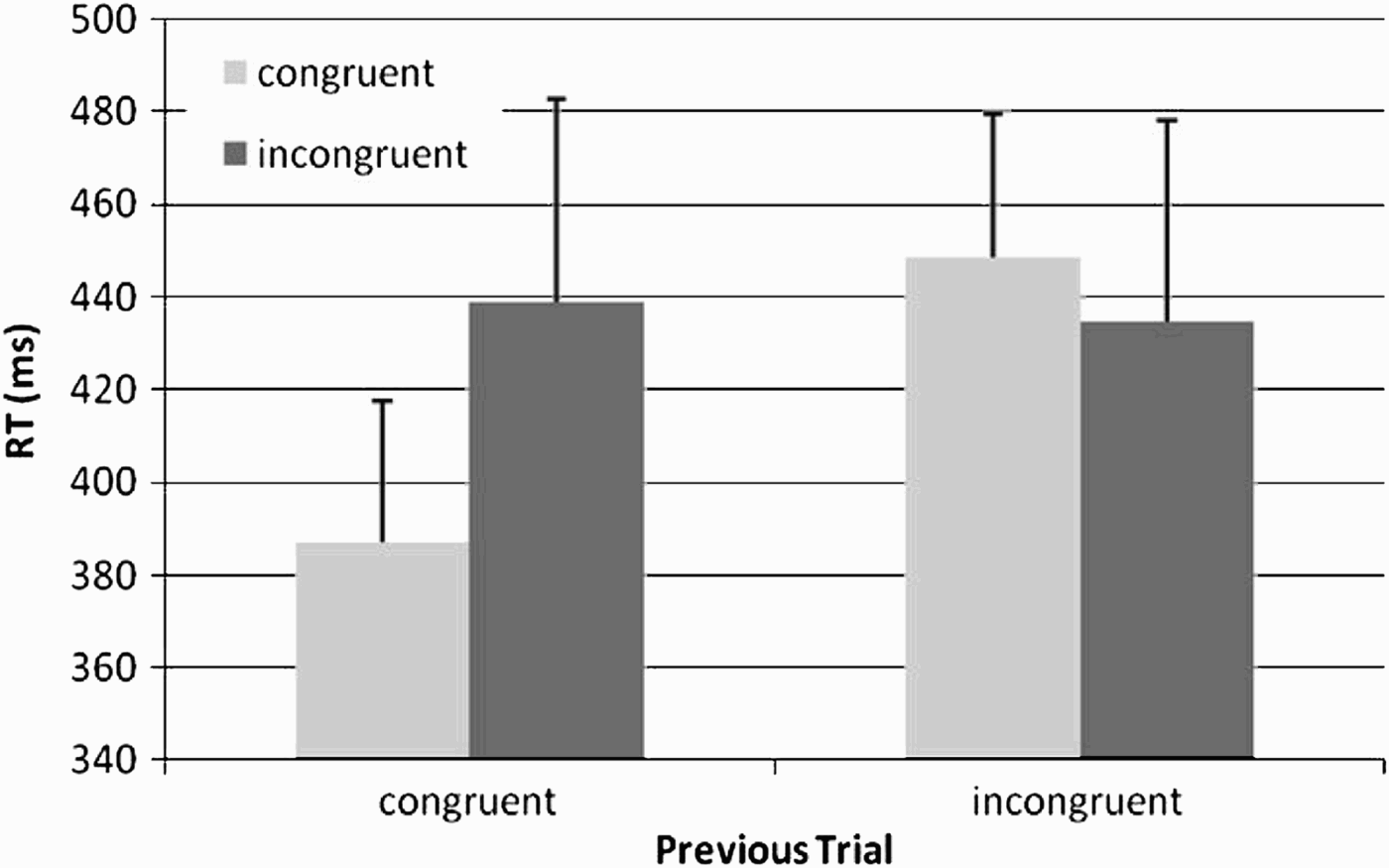
Mean reaction time (RT) in the congruency conditions as a function of the previous trial in Experiment 1. Error bars represent one standard deviation from the mean.
Experiment 2
Experiment 2 was conducted in an attempt to identify a suitable neutral condition for the Simon task between two well-used neutrals and to test its effects on interference and facilitation, as well as the magnitude of the Simon effect. Therefore, the experiment consisted of congruent and incongruent trials as well as two types of neutral trial—a central type and a vertical type (see Figure 2).
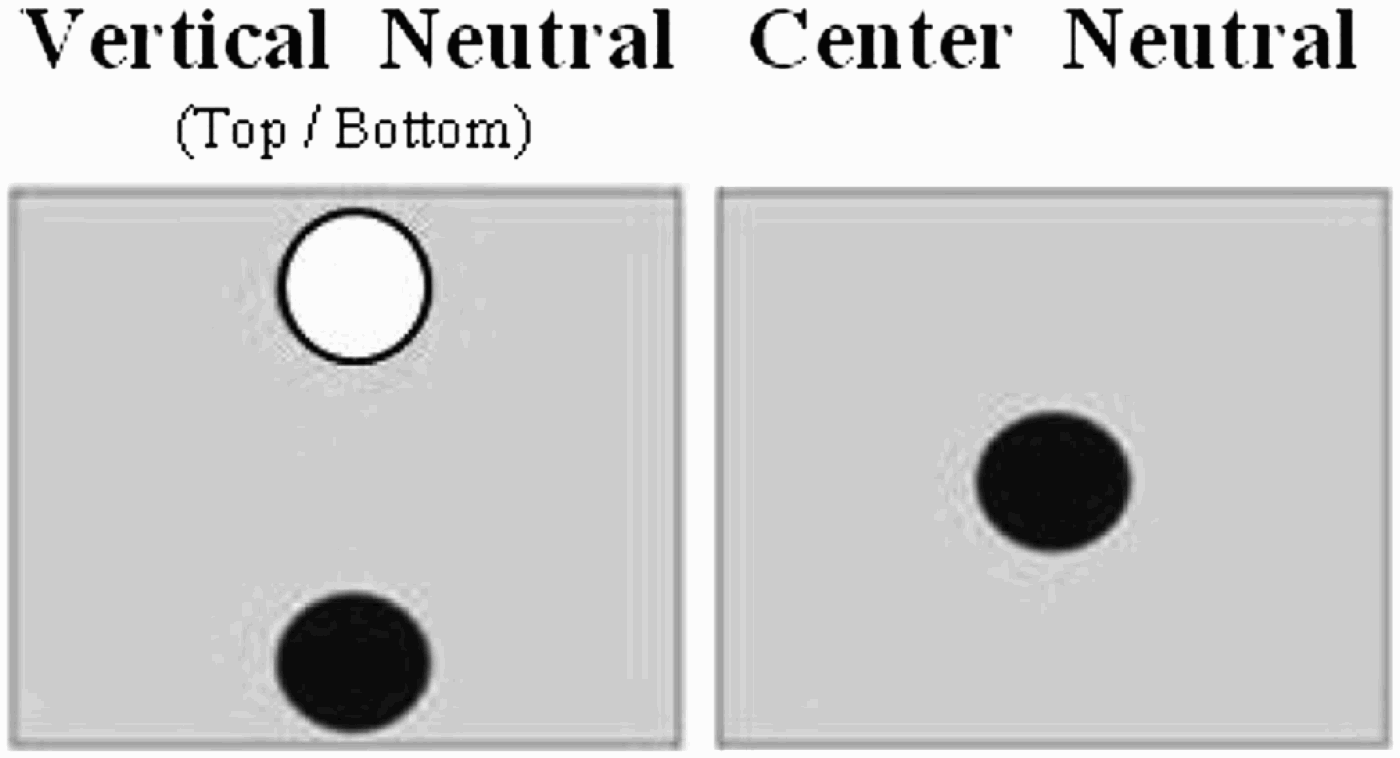
Two types of neutral conditions. White and black represent red and blue, respectively, in the experiment.
Method
Participants
A total of 15 undergraduate students, who did not participate in Experiment 1, participated in this experiment in partial fulfilment of course requirements.
Stimuli
Congruent and incongruent stimuli were identical to those used in Experiment 1. There were two types of neutral conditions that were presented in two different blocks. Since there were two congruent condition trials and two incongruent condition trials, four neutral condition trials were presented in each block. In one block the central neutral was presented four times (twice in red and twice in blue). In the second block the vertical neutral was presented once for each combination of colours (red on top, blue on top, red at the bottom, and blue at the bottom). Overall there were 80 trials in each experimental block (2 incongruent, 2 congruent and 4 neutral, each presented 10 times). Two 16-trial practice blocks were performed, each one consisting of the relevant type of neutral for the subsequent experimental block.
Procedure
The procedure of Experiment 2 was identical to that of Experiment 1 except for the Simon task sequence. Before each experiment block participants performed a practice block, which consisted of the relevant type of neutral for the upcoming block. The conditions were balanced, both for colour–key pressing and for block order (a quarter of the participants performed the central neutral type trials first where red patches were responded to by a right-hand finger press, a quarter performed the central neutral type trials first where blue patches were responded to by a right-hand finger press, etc.).
Results
Mean RTs of correct responses were calculated for each participant in each condition. Overall error rate was low (0.04), being uniformly low in each condition, and therefore errors were not analysed. A one-way ANOVA was applied separately to the data of each of the neutral type blocks, with congruency (congruent, incongruent, and neutral) as the within-subject factor. Mean RTs of correct responses in the congruency conditions are presented in Figure 3.
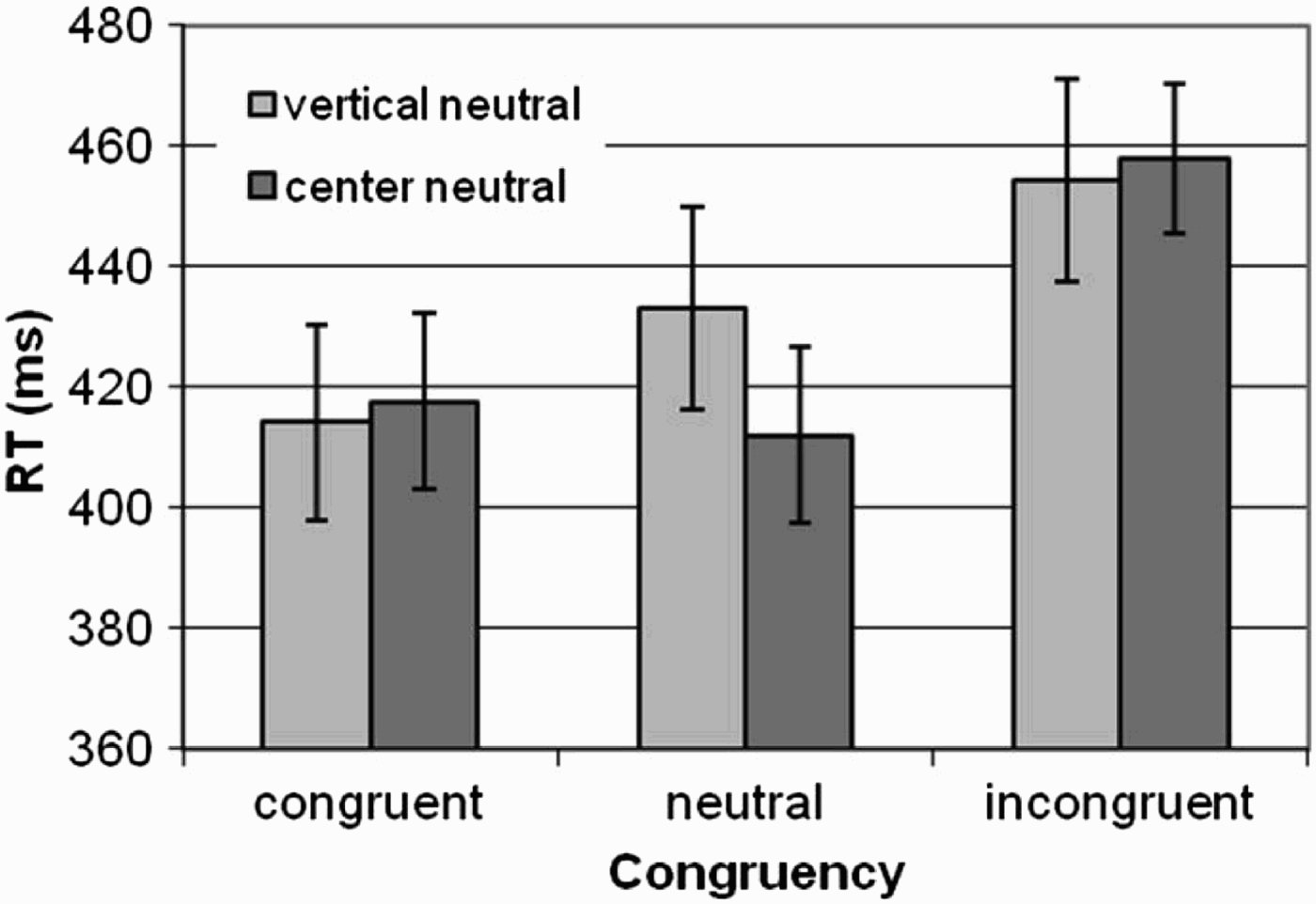
Mean reaction time (RT) in the congruency conditions of Experiment 2. Error bars represent one standard error from the mean.
A significant main effect for congruency was found in the vertical neutral block, F(2, 28) = 14.689, η2 = .512, MSE = 409, p < .000043, and in the central neutral block, F(2, 28) = 16.025, η2 = .533, MSE = 584, p < .000023. The magnitude of the Simon effect was approximately 40 ms for both neutral blocks. Simple contrasts were conducted in order to find out whether the various conditions produced different RTs. The Simon effect, the difference between congruent and incongruent conditions, was found to be significant for both types of neutral: F(1, 14) = 23.055, MSE = 520.64, p = .00028, for the vertical type, and F(1, 14) = 18.663, MSE = 649.01, p = .0007, for the central type. The two neutral conditions differed significantly from the incongruent condition, F(1, 14) = 25.55, MSE = 130.94, p = .00017, and F(1, 14) = 22.866, MSE = 688.2, p = .00029, for the vertical and central neutrals, respectively. In addition, only the vertical neutral was significantly different from the congruent condition, F(1, 14) = 4.648, ηp2 = .17, MSE = 575.48, p = .04, and F < 1, for the vertical and the central neutrals, respectively.
Within each block we carried out a sequential analysis using a two-way ANOVA with congruency (congruent, neutral, and incongruent) and previous trial (congruent, neutral, and incongruent) as within-subject factors. Sequential analyses revealed different patterns for the two types of blocks. In the vertical neutral block (see Figure 4) the previous trial modulated the Simon effect, F(4, 80) = 3.2162, ηp2 = .138, MSE = 1,070, p = .0168. In particular, there was a Simon effect when the previous trial was either congruent or neutral but no effect was present when the previous trial was incongruent. Incongruent trials were faster when they were preceded by an incongruent trial than when they were preceded by congruent or neutral trials, F(1, 20) = 4.941, MSE = 1,259.713, p = .037. In addition, the pattern of the main effect in trial n (i.e., congruent RT was fastest, then neutral RT, and then incongruent RT) was visible following congruent and neutral conditions but not following incongruent conditions. A significant difference between neutral and congruent conditions (i.e., facilitation) was found after congruent trials but not after neutral trials, F(1, 20) = 7.852, MSE = 740.191, p < .011, and F(1, 20) = 3.534, MSE = 891.205, ns, respectively.
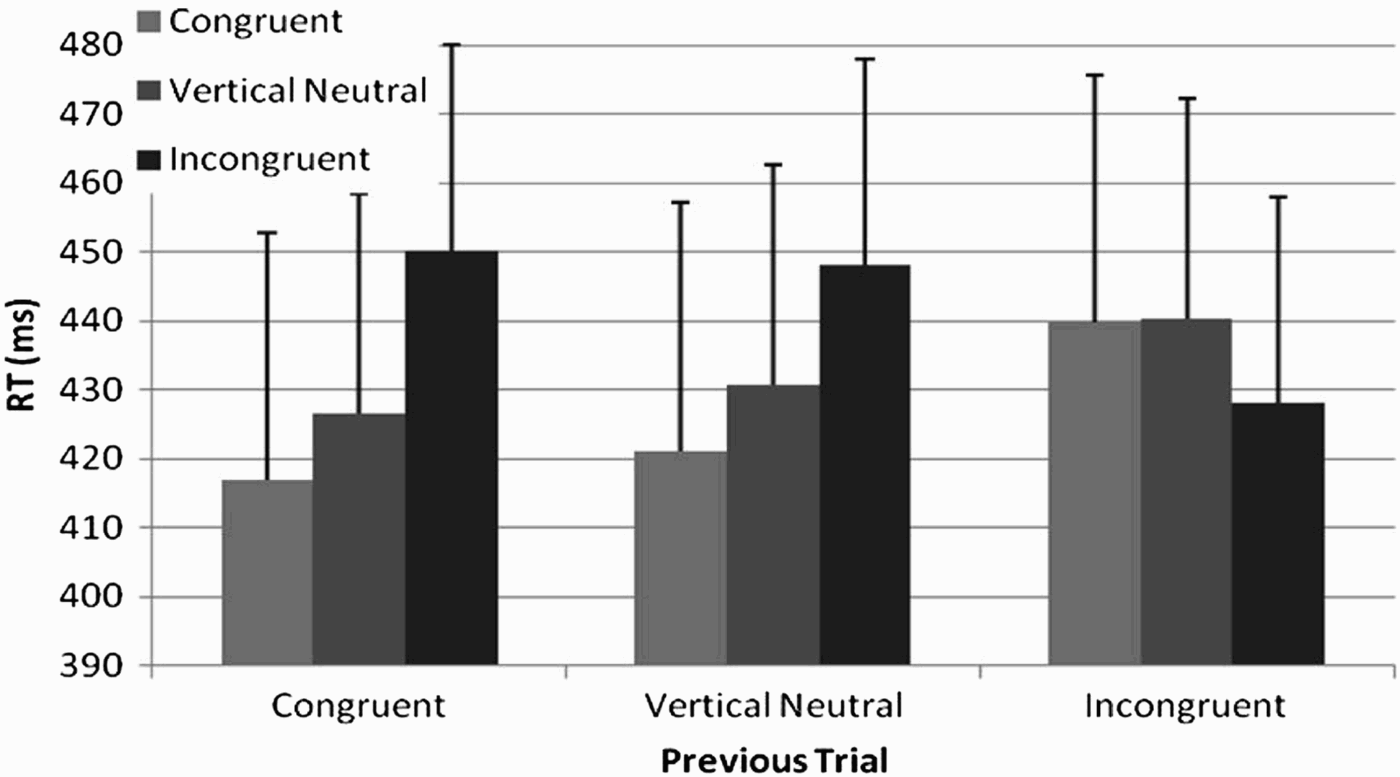
Mean reaction time (RT) in the congruency conditions as a function of the previous trial in Experiment 2 with a vertical neutral. Error bars represent one standard error from the mean.
In contrast, in the central neutral block (see Figure 5), the previous trial did not interact with the Simon effect, F(1, 11) = 4.525, MSE = 2,279.93, p = .056. Note that the pattern is a bit different for the three types of previous trials but this was due to the change in RTs to neutrals and did not produce a significant interaction.
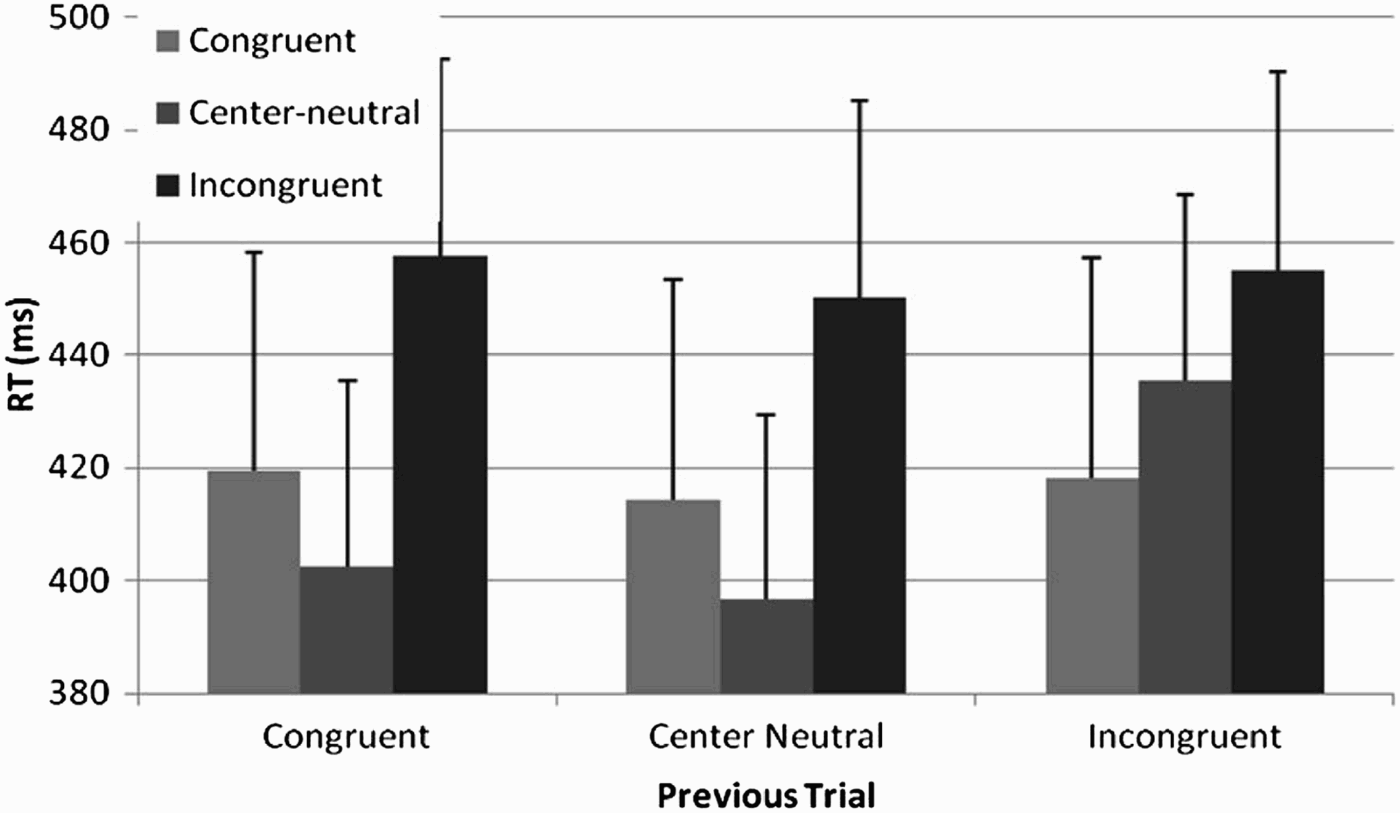
Mean reaction time (RT) in the congruency conditions as a function of the previous trial in Experiment 2 with a central neutral. Error bars represent one standard error from the mean.
As another means for evaluating cognitive control functioning, the results from both experiments were subjected to a two-way ANOVA with congruency as a within-subjects factor and experiment (Experiment 1 no neutral vs. Experiment 2 neutral) as a between-subjects factor. The neutral trials were omitted from the cross-experimental analyses. Congruency and experiment interacted significantly, F(1, 25) = 5.387, MSE = 204, p < .028, with a larger congruity effect in Experiment 2 than in Experiment 1 (see Figure 6).
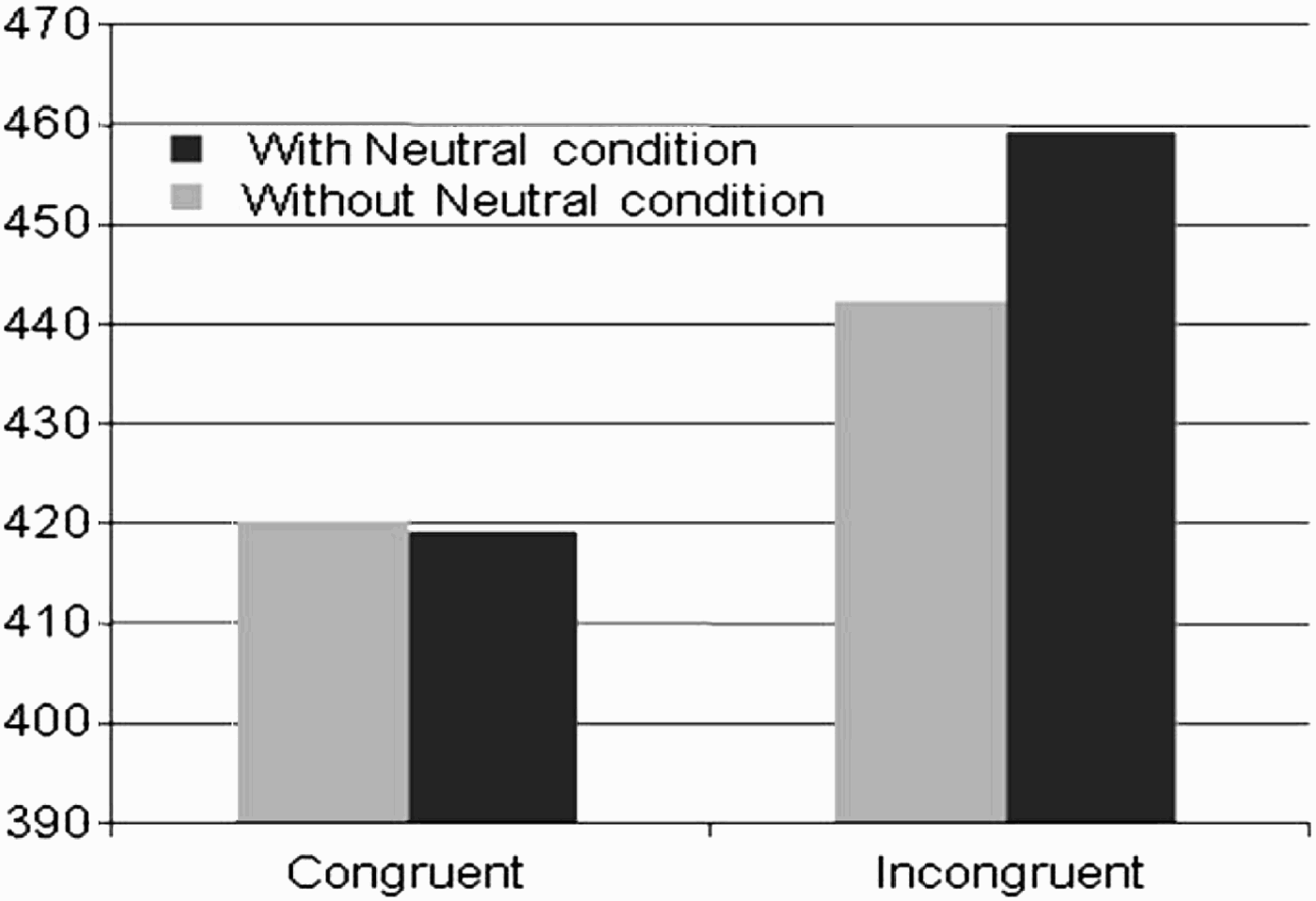
Comparison of the Simon effect reaction time (RT) between Experiments 1 and 2.
General Discussion
Introducing neutral trials increased the Simon effect (i.e., almost doubled the effect). The vertical neutral blocks produced significant differences between the congruent and incongruent conditions, showing interference as well as facilitation effects. The results for the central neutral condition were significantly different only from those of the incongruent condition, as expected. Our sequential results showed an elimination of the Simon effect after incongruent trials in the vertical neutral block. In contrast, a significant Simon effect was observed following either neutral or congruent trials (in the vertical neutral block). The sequential results from the vertical neutral block resemble those found by Wuhr and Ansorge (2005).
The decrease in RT for an incongruent trial after an incongruent trial may be due to repetition. Hommel, Proctor, and Vu (2004) distinguished between complete repetition, partial repetition, or switch trials. Since half of incongruent–incongruent sequences are complete repetition trials, it might provide some of the explanation for the results. In order to test that possibility, we ran the analysis only with the switch incongruent–incongruent sequences (omitting the complete repetition sequences) and found the same significant pattern. This result strengthens the assumption that cognitive control is recruited during conflict trials and affects the following conflict trials.
It is worth mentioning that even though both blocks contained the same proportion of congruent, incongruent, and neutral trials, the central block had more “complete repetition” trials than the vertical one, and this might account for some of the RT decrease (Hommel et al., 2004). This issue should be further investigated in order to fully distinguish the effects of cognitive control functioning from repetition effects.
Choosing a valid neutral condition
Even though our pilot experiment showed that spatial location did not modulate recognition of colour patches (nor was there facilitation for the central location), the addition of a spatial conflict (congruency between response hand and target presentation) did create significant differences in performance.
One can argue that the insignificant RT differences between the congruent and central neutral conditions support the suggestion that the Simon effect is an interference-based effect. This is due to the fact that there was little difference in RT between the nonconflict trial (central stimulus) and a congruent trial. This suggestion would have been true if the RT in the vertical neutral condition had not been significantly different from the RT of both the congruent and incongruent conditions. It seems that when the stimulus has only one dimension (central stimulus—only colour dimension) it cannot be compared to a two-dimension stimulus (top/bottom stimulus—colour and spatial dimensions), whether or not it contains a conflict. This assumption is also supported by the sequential analysis of the central neutral block, in which responses to central stimuli were faster than responses to congruent trials after congruent and after central trials. According to our predictions, it is only reasonable to assume that central trials were much easier and resulted in faster reaction times. Therefore, we conclude that the vertical type is a valid and suitable neutral condition whereas the central type is not.
Components of the Simon effect
We found both facilitation and interference in our Simon task. Responses to the congruent condition (two-dimension stimuli) were significantly faster than those to a typical two-dimension trial (vertical stimuli) and therefore resulted in a facilitation effect. In addition, interference was created in the incongruent conditions.
Our conclusion regarding the appearance of facilitation as well as an interference effect is understandable since there is dimensional overlap, as the stimuli and responses both share a left–right dimension. Moreover, taking a broader view of our results, the conclusion is in line with the definition of facilitation and interference as mentioned in Kornblum's taxonomy (Kornblum, Hasbroucq, & Osman, 1990) and fits their model of results regarding dimension overlap tasks, as in the Simon task (solid line in their Figure 3, p. 257): “The greater the dimensional overlap, the greater the facilitation with congruent mapping and the greater the interference with incongruent mapping.” Nevertheless, it is possible that the facilitation and interference effects found in the Simon task are different and even smaller than those found in the Stroop task or other recognized conflict conditions. This idea was implied in a brain imaging study conducted by Liu and colleagues (Liu, Banich, Jacobson, & Tanabe, 2006) that compared activation of brain structures recruited for conflict solving in spatial Stroop and Simon tasks (e.g., dorso-lateral prefrontal cortex). They found larger activations in these areas during performance of the spatial Stroop task in comparison with performance of the Simon task. They also found greater activation of the anterior cingulate cortex in the Simon task and greater activation of parietal cortices in the spatial Stroop task. Liu and his colleagues suggested that their results showed that different types of conflict recruited different brain areas (they refer to the Simon task as involving stimulus–response conflict and the Stroop task as involving stimulus-stimulus conflict). It would be interesting to further investigate brain activation differences in both tasks with respect to interference only, now that we have a valid neutral condition that distinguishes between the two.
Effects of cognitive control
Adding a neutral condition
Tzelgov et al. (1992) discussed the effects of a neutral condition on facilitation and interference effects. Particularly, they suggested that adding a neutral condition changes the size of the effect in a Stroop task—the differences between congruent and incongruent conditions, known as the Stroop effect, increases as a result of the increase in the proportion of the neutral condition. In our study, adding each type of neutral indeed made a difference; the Simon effect increased, similar to the Stroop effect in Tzelgov et al.'s study. They argued that adding a neutral condition decreases cognitive control, which results in longer RTs for the incongruent trials. A similar argument was also suggested by Goldfarb and Henik (2007). It is worth mentioning that in our study, adding the neutral conditions did not significantly change the congruent condition RT between Experiment 1 and the two blocks of Experiment 2 but did delay responding to the incongruent condition (414–419 ms for congruent trials in all experiments and 441 ms for incongruent trials in the experiment without neutrals vs. 454–458 ms for incongruent trials in blocks involving neutrals). Since the longer RTs occurred in both blocks (with both types of neutrals) it is plausible to assume that every addition that does not present a conflict relevant to the task demands causes a decrease in activation of cognitive control and increases the effect.
Sequential analyses
Another interesting issue arises from our sequential analyses. As reported, in the vertical neutral blocks there was a Simon effect when the previous trial was either congruent or neutral but no effect was present when the previous trial was incongruent. Incongruent trials were processed faster when they were preceded by incongruent trials than when preceded by congruent or neutral trials. This matches the results of Experiment 1, without additional conditions, in which the Simon effect was present after congruent trials but not after incongruent trials. In the central neutral condition, the previous trial factor did not interact with the congruency effect, and the Simon effect was present after both congruent and incongruent trials. This finding distinguishes between both types of neutrals and shows that while the vertical neutral preserves the known pattern of cognitive control recruitment after incongruent trials, the central stimulus does not. Yet, a greater Simon effect was presented in both vertical and central blocks. This enlargement of the effect is also a consequence of cognitive control recruitment, as was suggested by Tzelgov et al. (1992). It would have been reasonable to expect that the cognitive control level, which affects the magnitude of the Simon effect, would also affect the interference created after incongruent trials in comparison to congruent trials. This was not the case; we see here that two different types of neutral stimuli, which create different effects on cognitive control between trials, create the same effect of cognitive control in regard to the overall proportion of trials in the block. Hence, we suggest that the general cognitive control recruited over the blocks might be independent from the trial-to-trial cognitive control process.
Concluding remarks
Our results shed light on Simon task research using neutral conditions and further our understanding about the mechanisms involved in performing this task. We conclude that the vertical type of neutral is the valid one for use in the visual Simon task and supports the presence of interference as well as facilitation in the effect. Moreover, we acknowledge the enlargement of the Simon effect due to adding a condition that does not present a conflict relevant to the task demands. We suggested that sequential effects tap different control processes from those that are engaged as the result of the addition of nonconflict trials. This suggestion, regarding general and trial-to-trial cognitive control processes, requires further investigation.