







Abstract
This study examined the effect of 24 hr per day wheel access on running, body weight, and food intake for 30- or 50-day-old male and female rats under ad lib feeding conditions. Food intake and body weight were also monitored in a control group housed without access to running wheels. A dimorphic effect was observed after wheel introduction in 50-day-old but not 30-day-old rats: A temporary decline in food intake and a lasting decrease in body weight occurred for active male rats in comparison to their sedentary controls, and wheel access facilitated food intake and preserved body weight gain in female rats in comparison to their sedentary counterparts. Hyperphagia in adult females is interpreted in terms of the evolutionary acquired advantage linked to their reproductive function.
Having access to a running wheel entails a major change in the life of a laboratory rat (Looy & Eikelboom, 1989; Sherwin, 1998). The spontaneous indulgence in wheel running seems to have a rewarding effect for rats as it has been shown that animals are motivated to perform diverse operant responses to gain access to a wheel (Sherwin, 1998). However, the introduction of an activity wheel temporarily reduces daily food intake in ad libitum fed male rats (Levitsky, 1974; Premack & Premack, 1963), and this negative impact on food intake is even observed when the opportunity to run is minimal—that is, 2 hr per day (Lattanzio & Eikelboom, 2003). This transient decrease in food intake is observed during the first week before feeding returns to normal, and then levels exceed those of sedentary controls without access to a wheel. Moreover, wheel access results in lower body weight gain, which is maintained as long as the animals have wheel access, and this effect on body weight disappears only when the wheel is removed (Afonso & Eikelboom, 2003; Looy & Eikelboom, 1989).
The extent to which exercise modulates food intake and body weight seems to be influenced by gender although most of the studies on the effects of wheel access on food intake and body weight were performed on male rats, as was the case in the three previously mentioned studies (Afonso & Eikelboom, 2003; Lattanzio & Eikelboom, 2003; Looy & Eikelboom, 1989). To the best of our knowledge, only four previous studies have directly compared the consequences of voluntary access to a running wheel in male and female rats while on ad libitum feeding (Cortright, Chandler, Lemon, & DiCarlo, 1997; Jones, Bellingham, & Ward, 1990; Pitts, 1984; Tokuyama, Saito, & Okuda, 1982). Running wheel activity of females was found to be several times higher than that for males throughout the four studies, and this difference in activity was observed from the outset when animals have access to a wheel. However, these studies have shown diverging results with respect to the course of body weight and food intake for male and female rats. Furthermore, these studies differ in terms of the age and strain of the animals. Thus, two studies (Cortright et al., 1997; Pitts, 1984) employing weanling Sprague Dawley rats have reported that, in comparison to sedentary animals, the introduction of a wheel made no differences in the growth rate of females throughout the duration of the study, which extended for 9 weeks in the former and more than 20 weeks in the latter. Unlike females, both studies reported a lower growth rate for males with wheel access. The differences in males were observed from Weeks 7 to 9 when rats were fully developed adults (60–70 days old), whereas running activity did not affect male growth rate while animals were still immature, between 22 and 50 days old.
The slower weight gain for exercising males was also reported by two studies comparing adult Wistar rats (Jones et al., 1990; Tokuyama et al., 1982).
Similar to the findings of Cortright et al. (1997) and Pitts (1984) with adolescent females, Jones et al. (1990) reported no differences in body weight between active and sedentary adult females, which contrast with the observations of Tokuyama et al. (1982) who observed a long-term (40-day) decrease in body weight for active females in comparison to sedentary females.
In relation to food intake during adolescence, the two studies using weanling rats provide no information concerning the effect of activity on food intake while rats were in their prepubertal phase. That is, Cortright et al. (1997) offer no data on food intake for different developmental stages—that is, reporting only overall data on food intake for male and female rats during the 9-week study. Likewise, Pitts (1984) only provided data on the comparison of male and female food intake during the period of maximum activity—that is, when animals were at least 60 days old.
As regards the food intake in adult rats, the results are somewhat inconsistent. Two studies reported an increase in food intake for both adult male and female exercising rats in comparison to sedentary controls (Pitts, 1984; Tokuyama et al., 1982). Moreover, active females were found to increase their energy consumption well over that of the sedentary females whereas differences in appetite were less pronounced between active and sedentary male rats. In contrast, Jones et al. (1990) did not find this facilitating effect of activity on food intake, but, quite the contrary, food intake of both male and female active animals stayed below that of sedentary controls. This discrepancy was probably due to the shorter duration (9 days) of this study. In all likelihood, had this study been extended, it would have revealed an ensuing increase after the initial transient decrease of food intake, as widely reported in longer studies involving male (Afonso & Eikelboom, 2003; Lattanzio & Eikelboom, 2003; Looy & Eikelboom, 1989), and male and female rats (Tokuyama et al., 1982).
In short, the findings regarding the effect of voluntary exercise on appetite and weight gain in male and female rats are contradictory. Discrepancies in the four previously mentioned studies may be partly due to the different strain of rats studied or most importantly because they involved animals at different points of the maturation axis. Thus, the diversity of subject characteristics and maturational status seriously undermines the internal validity and comparisons across studies given that differences at puberty in ovarian hormones for females and testosterone for males may explain the contrasting results of the aforementioned studies. Hence, the purpose of the present study was to assess the inconsistencies in the literature by comparing the effect of wheel access on body weight and food intake in ad lib fed male and female rats at two different periods of maturational development in order to determine the impact of the hormonal changes on energy balance.
Method
Animals
A total of 63 Sprague-Dawley rats were studied: 31 males and 32 females. Sixteen of the males were 30 days old, and the remaining 15 were 50 days old. Sixteen of the females were 30 days old, and the remaining 16 were 50 days old. Male and female rats were allocated to one of two weight-matched groups: an active or a sedentary group depending on the access to a running wheel or not—the first rat to the active condition, the second to the sedentary condition, the third to the active condition, the fourth to the sedentary condition, and so on.
Apparatus
The laboratory contained 16 running wheels of two types. All were 10 cm wide with a circumference of 1.1 m. Twelve had Plexiglas sides and metal rod flooring. These were attached to acrylic cages, 28 × 28 × 14 cm, with mesh lids in which water bottles and food could be placed. The other four had solid metal walls and mesh flooring. These were attached to mesh cages, 26 × 16 × 13.5 cm, in which food could be placed, and a water bottle could be inserted into a side wall. Sliding doors controlled movement between the wheels and their side cages. Sedentary subjects were housed individually in acrylic cages, 28 × 28 × 14 cm, with mesh lids in which food could be placed, and a water bottle could be inserted. All cages were lined with wood shavings. Sufficient running wheels were not available to test all animals at the same time, so, the experiment was performed in two replications: all males (30- and 50-day-old) in Replication 1, and all females (30- and 50-day-old) in Replication 2.
Procedure
Before the start of the test procedure, rats were group housed and weighed daily for 4 days while in the colony room. On the fourth day (Day –1) animals were transferred to the laboratory, and rats allocated to the active condition were individually housed in cages that provided access to running wheels, whereas sedentary rats remained in single cages. During this period of adaptation to the new housing conditions, active rats had no access to the running wheel. Environmental conditions in the colony and the laboratory room were similar. The procedure started (Day 0) at 10:00 when wheel doors were opened for the active rats. From Day 1 onwards all rats were weighed between 10:00 and 10:40 hours, and standard laboratory chow and tap water were available ad libitum. Daily food intake was monitored by weighing food at the start and finish of each day (10:00). The mean room temperature was 20.7°C (range 19–22°C) for males and 20.3°C (range 19–21) for females, with lights on from 08:00 to 20:00 hours, on a 12:12-hr light/dark cycle. The experiment ended on Day 14. The ethics committee on the use and care of animals of Santiago de Compostela University approved all described procedures.
Statistical analysis
Two dependent variables examined in this experiment—body weight and food intake—were analysed using a mixed four-way analysis of variance (ANOVA) with three between-subjects factors—sex (male vs. female); activity (active vs. sedentary); and age (30 vs. 50 days old)—and one within-subjects factor: day. Wheel turn data were analysed using a factorial Sex × Age × Day ANOVA; initial food intake was analysed using a one-day Sex × Activity × Age ANOVA. Greenhouse–Geisser correction was applied when necessary. An alpha-rate of .05 was considered significant.
Results
Body weight
A 2 × 2 × 2 ANOVA over the five days before wheel access showed a significant day effect, F(4, 220) = 461.203, p < .001, as all rats displayed an increase in daily body weight. Significant results were also detected for the sex factor: Day × Sex interaction, F(4, 220) = 20.782, p < .001, and main effect, F(1, 55) = 300.072, p < .001, as well as for the age factor: main effect, F(1, 55) = 7,441.715, p < .001. Also, significant results were identified for Sex × Age: main effect, F(1, 55) = 517.156, p < .001, and Sex × Age × Day interaction, F(4, 220) = 12.758, p < .001, indicating that differences in body weight between male and female rats depended on the age of the animals, as shown in Figure 1 for preintervention data (Day –4 to Day 0). No main effect or interaction for the activity condition attained significance, Fs < 1, indicating that the body weight of active and sedentary groups did not differ before wheel introduction. All other effects were not significant, largest F(1, 55) = 1.722, p = .195.
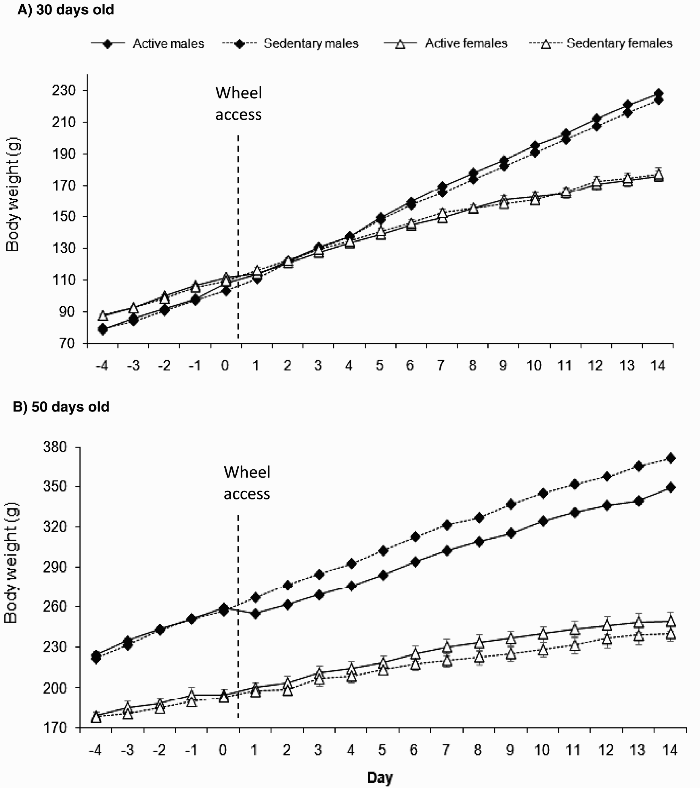
Means (±SEM) over days of body weight for (A) 30- and (B) 50-day-old animals.
A 2 × 2 × 2 ANOVA with repeated measures revealed that after wheel introduction all animals continued increasing their body weight over days, as revealed by a significant day effect, F(13, 715) = 2,512.094, p < .001. A significant main effect and interaction over days for the sex factor were detected, F(1, 55) = 419.830, p < .001, and F(13, 715) = 275.192, p < .001, respectively, indicating that overall body weight and the rate of increase were higher in males, as shown in Figure 1. Also, a significant main effect and interaction over days were detected for the age factor, F(1, 55) = 1,580.265, p < .001, and F(13, 715) = 20.497, p < .001, indicating that overall body weight was greater for 50-day-old rats, and the rate of increase was higher in 30-day-old rats. Significant results were identified for the sex by age interaction: main effect, F(1, 55) = 168.763, p < .001, indicating that age differently impacted differences between male and female overall body weight. Finally, there was a significant main effect for the Sex × Age × Activity interaction: F(1, 55) = 5.621, p < .021, and all other effects were not significant, greatest F(1, 55) = 2.677, p = .108. Thus, as can be seen in Figure 1, having access to the wheel differently affected male and female rats' overall body weight only in 50-day-old rats. In order to further explore these data and this interaction, a repeated measures ANOVA was conducted separately for each sex group at 50 days old. This analysis revealed that access to the wheel had a clear effect on weight gain for 50-day-old males, as sedentary males gained more weight than their active counterparts, F(1, 13) = 12.834, p < .001. There was also an almost significant group by trend interaction, F(13, 169) = 2.507, p = .077. In contrast to males, having access to the wheel had no significant effect on female body weight gain in 50-day-old rats as no significant main effect or interactions over days was observed between active and sedentary female rats, greatest F(13, 182) = 1.849, p = .157.
Overall, these results revealed that wheel access had only a negative repercussion on the body weight of 50-day-old males in comparison with the body weight of sedentary 50-day-old males. But no differences in body weight followed wheel access either for 30-day-old male and female animals or for 50-day-old females.
Food intake
Analysis for initial food intake revealed significant results for the sex factor, F(1, 55) = 19.216, p < .001; for the age factor, F(1, 55) = 11.790, p = .001; and for the Sex × Age interaction, F(1, 55) = 5.933, p = .018, indicating that food intake differences between male and female were larger in 50-day-old than in 30-day-old rats, as shown in Figure 2 for initial food intake (Day 0). No main effect or interaction for the activity condition reached significance, greatest F(1, 55) = 3.393, p = .071 (for the Age × Activity interaction), indicating that food intake for active and sedentary animals did not differ significantly before wheel introduction.
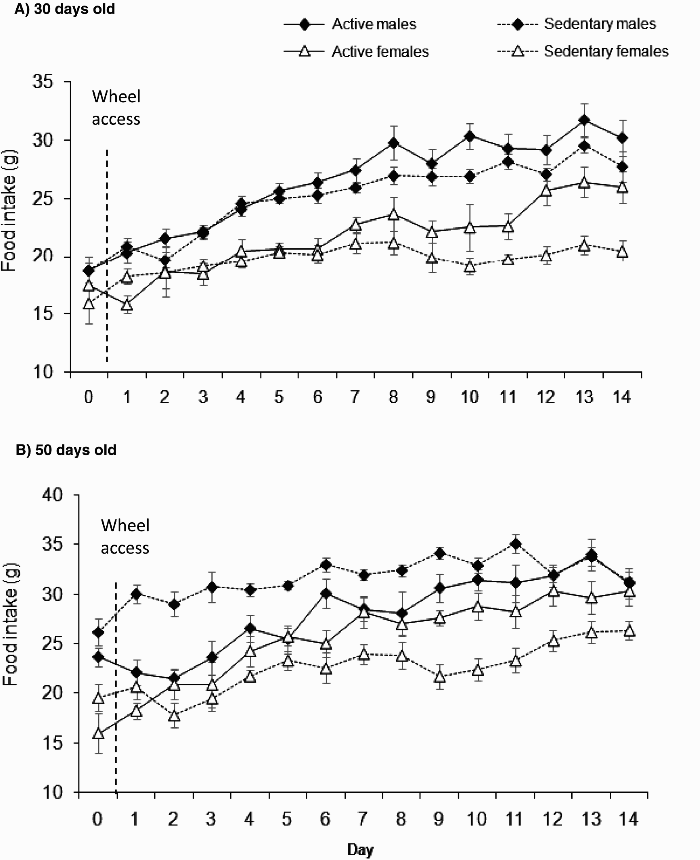
Mean (±SEM) daily food intake for (A) 30- and (B) 50-day-old animals.
A 2 × 2 × 2 ANOVA with repeated measures over days revealed that after giving animals access to wheels, all animals continued increasing their food intake over days, as shown by a significant day effect, F(13, 715) = 71.312, p < .001. Also, significant results were shown for the Day × Sex interaction, F(13, 715) = 4.860, p < .001, and a main effect for the sex factor, as overall food intake was greater for male than for female rats, F(1, 55) = 126.461, p < .001. Likewise, significant results were detected for the Day × Activity interaction, F(13, 715) = 9.835, p < .001, and for the age factor, main effect F(1, 55) = 60.977, p < .001. Moreover, there was a significant Day × Sex × Age interaction, F(13, 715) = 2.746, p = .005, and a Sex × Activity effect, F(1, 55) = 16.291, p < .001; the latter indicated that the effect of activity on overall food intake was different for male and female rats. Finally, a significant Day × Sex × Activity × Age interaction was detected, F(13, 715) = 2.768, p = .001, as well as a significant Sex × Activity × Age effect, F(1, 55) = 16.291, p < .001. Thus, the effect of activity on food intake for male and female rats was influenced by the age of the animals. All other effects were not significant, largest F(1, 55) = 3.387, p = .071 for the Age × Activity effect.
In order to clarify these results, data were similarly but independently analysed for 30- and 50-day-old rats. With respect to 30-day-old rats, significant results were detected for the Day × Activity interaction, F(13, 364) = 4.873, p < .001, as well as the main effect for activity, F(1, 28) = 8.780, p < .001, showing that overall food intake was higher for active than sedentary animals. Activity × Sex × Day interaction did not reach significance, indicating that the effect of activity on food intake was similar for male and female rats, F(13, 364) = 1.359, p = .177.
For 50-day-old animals, a significant result was detected for the Day × Activity interaction, F(13, 351) = 5.432, p < .001. Furthermore, significant results were obtained for the activity by sex analysis: main effect, F(1, 27) = 20.996, p < .001, and interaction over days, F(13, 351) = 2.165, p = .039, indicating that the effect of activity on the food intake pattern was different over days for male and female rats. Further analysis were undertaken to explore the effect of wheel access separately for male and female rats.
Analysis of intake for active versus sedentary 50-day-old males over 14 days revealed a significant interaction between activity condition and trend, F(13, 169) = 3.881, p < .001. As shown in Figure 2B, sedentary males hardly increased their food intake over days, whereas active males increased intake day by day. Overall food intake was greater for the sedentary group, F(1, 13) = 14.419, p < .001.
Similarly, for 50-day-old females, there was a significant interaction between activity condition and trend, F(13, 182) = 3.696, p < .001. As shown in Figure 2B, the food intake rate over days increased more for active females than for their sedentary counterparts. Unlike males, female wheel access resulted in increased overall food intake over the two-week period, F(1, 14) = 8.317, p = .012. Interestingly, no differences were detected between male and female active rats either in overall food intake or interaction, greatest F(13, 169) = 2.236, p = .062.
In summary, age and sex were relevant variables regarding food intake. Thus, activity had no effect for 30-day-old animals. In contrast, activity stimulated food consumption in female rats in comparison to their sedentary counterparts but had a depressing effect on food intake for 50-day-old males.
Wheel turns
All animals showed a daily increase in running: day effect, F(13, 51) = 21.797, p < .001 (see Figure 3). Overall activity was significantly higher for female rats than for their male counterparts, F(1, 27) = 55.625, p < .001. That is, for females the peak mean for daily activity was more than three times higher than that for males, both for young and for adult animals. Similarly, a Day × Sex interaction was significant, F(13, 351) = 9.406, p < .001. No main effect or interaction involving the age factor reached significance, greatest F(13, 351) = 1.041, p = .411.
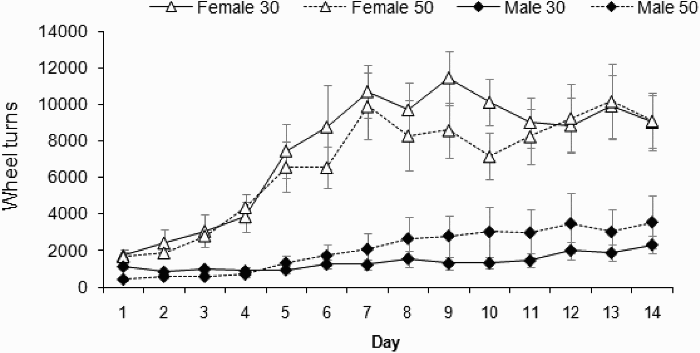
Mean (±SEM) number of wheel turns per day for active male and female rats.
Discussion
There were major differences in food intake and body weight associated with voluntary running in ad libitum fed rats depending on their age and gender. The 30-day-old females exhibited greater activity than males from Day 2 onwards. These 30-day-old female rats were at an early developmental stage—that is, well before the pubertal rise in oestrogens that could be responsible for the greater activity. Furthermore, differences in activity could not be attributed to differences in body weight as differences in body weight did not appear until Day 5.
In terms of body weight, voluntary running did not slow down the growth rate of either male or female 30-day-old rats as no differences were observed with their sedentary counterparts. The results obtained for 30-day-old rats are in accordance with those reported for weanling rats where differences in body weight did not emerge until rats were about 60 days old (Cortright et al., 1997; Pitts, 1984). In our study, sexual maturation was not expected to be a confounding variable for young animals as there were no initial differences in body weight between male and female rats indicating low testosterone levels in males (Tou & Wade, 2002). It is also reasonable to presume that the 30-day-old females were not sexually mature (Rivest, 1991). In summary, voluntary running in 30-day-old animals did not compromise growth for either male or female rats, which is remarkable in the case of females as they showed much higher levels of running than male rats.
When rats were 50 days old, voluntary running had remarkably different results depending on the sex of the animals. Unlike 30-day-old animals, wheel running had a negative impact on the energy balance of males but not for females, which quickly adapted their food intake despite greater activity on the wheel. As a result, body weight gain for exercising females remained close to the weight of sedentary females, whereas the growth rate of active males fell below that of sedentary males. The comparison of the effect of activity on food intake for males and females showed that on the last day of the study food intake for active females was 14% higher than that for their sedentary counterparts, whereas active males did not differ from their sedentary controls. In fact, active females equalled the intake of active males in spite of their smaller size and higher running activity. Thus, energy replenishment for active males was insufficient to maintain growth at the same level as the sedentary group—that is, the body weight of active animals increased 35% during the study whereas the sedentary animals gained 45% of body weight during the same period. In contrast to males, and in spite of the fact that females ran five times the distance run by males, activity did not compromise the growth rate of females as both active and sedentary animals showed the same percentages of body weight gain over the two-week period (25%). However, these observed differences in weight must be understood in the context of a possibly abnormal situation for sedentary control rats, with continuous access to food and no environmental stimulation. Under these housing conditions animals become relatively overweight, insulin resistant, and hypertensive and are likely to experience premature death (Martin, Ji, Maudsley, & Mattson, 2010). Thus, the reduced body weight of active running rats, which in adults is maintained for as long as wheels are available (Lattanzio & Eikelboom, 2003), may be a more appropriate metabolic weight than the weight of nonwheel controls.
Bearing in mind that the main aim of this study was to assess the discrepancies reported in the literature concerning the impact of activity on the body weight of males and females, our results are in line with those reported by Jones et al. (1990), and they disagree with the slowdown in growth from Day 10 onwards for active females in comparison to sedentary animals reported by Tokuyama et al. (1982; see asterisk in Figure 1 in their paper). Perhaps other procedural factors may account for the atypical performance of females reported by Tokuyama et al. (1982). It is worth noting that our results are also in line with those reported by Cortright et al. (1997) and Pitts (1984) for rats of the same age, in spite of the fact that the animals involved in these studies were recruited at an earlier developmental stage. Regarding food intake, in our study active females did not show a transient decrease in food intake as reported elsewhere (Jones et al., 1990; Tokuyama et al., 1982).
In short, female rats appear to be better protected to cope with the energy demands originated by voluntary wheel running, a finding that is coherent with the results of several studies showing that women may compensate for energy expenditure by increasing energy intake to a greater extent than men (Paul, Novotny, & Rumpler, 2004; Westerterp & Goran, 1997). These differences in energy balance between male and female animals seem to be the end point of an evolutionary process placing more pressure on females regarding their capacity to survive in times of short food supply (Hoyenga & Hoyenga, 1982). Thus, endocrine factors underlying “femaleness” seem to confer a homeostatic advantage in the ability to adapt to changes in metabolic status (Horton & Braun, 2004). Our findings substantiate that female rats run longer than male rats, and this fact is related both to the smaller size of females and to a more efficient use of fuel substrates. Animal studies have shown that in mature female rats, oestrogens have a powerful influence on substrate utilization during exercise (Tate & Holtz, 1998). Oestrogens are responsible for the shift of fuel oxidation away from carbohydrates towards fat by promoting lipid oxidation, which increases free fatty acid availability, while decreasing the rate of gluconeogenesis leading to carbohydrate sparing and decreased rate of glycogen use during exercise (D'Eon & Braun, 2002; Horton & Braun, 2004; Tarnopolsky, MacDougall, Atkinson, Tarnopolsky, & Sutton, 1990). As for the effect of testosterone, the hormone contributes to the “male” pattern of substrate use by reducing reliance on lipids and increasing the use of carbohydrates (Braun, Gerson, Hagobian, Grow, & Chipkin, 2005). However, the better female efficiency in energy balance cannot be explained exclusively in terms of circulating oestrogens as the adolescent 30-day female rats of our study ran more than males well before their first expected oestrous cycle as rats reach sexual maturity at 40 to 60 days of age (Quinn, 2005).
In short, free exercise is a stress factor that leads to a decrease in body weight only in adult males whereas female rats can readily compensate for exercise stress with hyperphagia and as a result maintain body weight gain. This advantage of female rats can be also extended to circumstances involving food restriction, as females appear to be less affected in terms of growth and are able to preserve the mass of vital organs to a greater extent than males (Valle & Roca, 2007). Moreover, the advantage of females in terms of energy balance may be derived from the greater demands in their reproductive role, with higher physiological costs of the reproductive event (Speakman, 2008). Thus, this evolutionary hypothesis states that during times of food scarcity females are under greater selection pressure than males and consequently develop mechanisms to facilitate survival during food shortage (Valle & Roca, 2007). Although further data on species other than rodents and humans are required (Hoyenga & Hoyenga, 1982), most studies support the notion that evolution has bestowed on female mammals the greater capacity to conserve energy and to maintain growth or body mass in extreme circumstances such as fasting or endurance exercise (Horton & Braun, 2004; Hoyenga & Hoyenga, 1982).
This study has some limitations: first of all, the time span during which rats have been studied (14 days). In all likelihood, a longer period of observation would have allowed a more complete perspective of the effects of the wheel on food intake and body weight, particularly since the effects of wheel access change over exposure time (Afonso & Eikelboom, 2003; Lattanzio & Eikelboom, 2003).
Furthermore, the ages of the animals studied in this experiment were very close in terms of developmental stage—that is, preadolescence and late adolescence—as were the underlying hormonal influences. The inclusion of animals from different developmental stages would improve our understanding of the effect of exercise on body weight and food intake over the entire life span. However, the interactions between age, sex, and activity are too complex to be addressed in a single study.