







Abstract
Children recognize children's faces more accurately than adult faces, and adults recognize adult faces more accurately than children's faces (e.g., Anastasi & Rhodes, 2005). This is the own-age bias. Research has shown that this bias is at least partially based on experience since trainee teachers show less of an own-age bias than do other adults (Harrison & Hole, 2009). The present research tested the own-age bias in three groups of children (age 4–6, 7–9, 10–12 years) and a group of adults in the recognition of three age groups of faces (age 7–9, 20–22, and 65–90 years). Results showed an own-age bias for 7- to 9-year-old children and adults. Specifically, children could recognize faces more accurately if they were less than two years different from their own age than if they were more than two years older or younger. These results are discussed in terms of short-term experience with faces creating biases, and this rapidly changes with age.
The ability to recognize faces is expert in human adults. This expertise, however, is restricted to faces of our own race, age, and possibly gender. We recognize faces of our own race more accurately than faces of another race (the own-race bias, ORB, see Meissner & Brigham, 2001, for a meta-analysis). It has also been shown that we recognize faces of our own age more accurately than faces of another age (the own-age bias, OAB, e.g., Wright & Stroud, 2002). This effect has been demonstrated in young adults, older adults (e.g., Wright & Stroud, 2002; but see Wiese, Schweinberger, & Hansen, 2008), and children (Anastasi & Rhodes, 2005, but see Mondloch, Maurer, & Ahola, 2006).
Kuefner, Macchi Cassia, Picozzi, and Bricolo (2008) found that 22-year-old participants recognized upright own-age faces more accurately than faces of newborn infants or young children. Their participants showed no inversion effect 1 in the recognition of newborn faces and a significantly smaller inversion effect in the recognition of young children's faces than of adult faces in both accuracy and response time measures. These results were found in participants with no experience with infants or young children. However, when preschool teachers were tested, they could recognize young children's faces as well as own-age faces (see also: Harrison & Hole, 2009, for similar findings in trainee teachers; and Macchi Cassia, Picozzi, Kuefner, & Casati, 2009, in maternity ward nurses). These authors concluded that preschool teachers (Kuefner et al., 2008) or maternity ward nurses (Macchi Cassia, Picozzi, et al., 2009) had sufficient experience to allow for accurately encoding and recognition of children's faces or newborn faces, respectively.
The inversion effect is often considered to be a measure of expertise in face recognition.
These three studies indicate that experience with other-age faces may modulate the OAB. Macchi Cassia, Kuefner, Picozzi, and Vescovo (2009) tested the recognition of newborn faces in children with or without younger siblings. They found that 3-year-old children with younger siblings could recognize infant faces more accurately than children without younger siblings. They also tested mothers with infants. They found that mothers were not accurate in recognizing infant faces. However, mothers who had younger siblings could accurately recognize infant faces. Their conclusion was that early experience with younger faces allows for the perceptual system to tune to those faces. Experience with different faces detunes the face recognition system for those faces in favour of more recently encountered faces (Macchi Cassia, Picozzi, et al., 2009). This hypothesis is very similar to one posited by Hills (2007). The idea is that dimensions of recognition (cf. face-space, Valentine, 1991) are added to the face recognition system for the faces that are being encountered frequently. However, if those faces are no longer being encountered the dimensions that code them may become dormant or extinct.
Given that adults show an OAB for children's faces, yet children seem to be accurate in the recognition of other children's faces (Anastasi & Rhodes, 2005), it seems reasonable that something has changed regarding the processing of children's faces. Two options are possible: either adults’ ability to process children's faces becomes dormant (Hills, 2007; cf. Valentine, 1991) or they no longer have the motivation to individuate children's faces (cf. in-group/out-group model; Sporer, 2001). These theories are not mutually exclusive. For example, expertise needed to process children's faces may become dormant, but can be reactivated should the motivation be present.
Having described the OAB and how experience may play a role in its development, there is one key question that remains unanswered: How much experience is required to develop the OAB? Macchi Cassia, Kuefner, et al. (2009) indicate that experience in the first three years of life is crucial for face-space to remain flexible. Harrison and Hole (2009), however, demonstrated that trainee teachers, with one year of experience with children's faces, did not show the OAB. Thus, between one and three years of experience is sufficient to develop expertise for a particular class of face. In either case, the evidence would suggest that children of one particular age (e.g., 8 years old) should show an OAB for faces of their own age over faces of other-age children, provided they were more than one or three years older or younger (i.e., less than 5 years old or greater than 11 years old). The present experiment aimed to test this hypothesis, with a comparison to the OAB in young adults.
Method
Participants
Participants were: 44 (19 male) 4- to 6-year-old children (mean age 5;8); 44 (22 male) 7- to 9-year-old children (mean age 8;2); and 44 (16 male) 9- to 12-year-old (mean age 11;1) children recruited from a sample who returned consent forms to their school; and 44 young adults (12 male; mean age 18;8) who volunteered for this study. All participants were ethnically White. All participants self-reported that they had normal or corrected vision. All of the children were considered typically developing by their schools.
Materials
Forty-eight faces from the Minear and Park (2004) face database were used in this experiment. These were: 16 White 20- to 22-year-old faces; and 16 White 60- to 80-year-old faces. An equal number of male and female faces were used in all conditions. The faces had no extraneous paraphernalia (e.g., glasses, beards, or earrings) and had the same grey background. In addition, 16 White 8-year-old faces were used that were collected from a primary school yearbook. The images were cropped and adjusted such that they were the same dimensions and resolution as those in the first database. Two images of each face were selected such that a different image of the face was presented during the learning and the test phases of the experiment. These were counterbalanced across participants, such that each image appeared the same number of times in each phase. The faces were presented in 100 × 110-mm dimensions in 72-dpi resolution and in greyscale format. These were presented using Superlab Pro 2TM Research Software using a Toshiba Tecra M4TM Tablet PC.
Design
A cross-sectional 4 × 3 design was employed whereby age of participants was manipulated between subjects (with four levels: 4- to 6-, 7- to 9-, 10- to 12-year-old children, and adults), and age of face was manipulated within subjects (child face, young adult, and old adult). The faces were grouped and counterbalanced across participants such that each face was a target as often as it was a distractor. There was no effect of group of faces so this is not considered further. Faces were presented in a random order (there was no blocking of face type). The signal detection theory (SDT) measure, d′, was used for recognition accuracy.
Procedure
The procedure was similar to that employed by Anastasi and Rhodes (2005), Harrison and Hole (2009), and Wiese et al. (2008). Participants were tested individually. The experimenter controlled the computer screen, but was unaware of what the screen displayed since it was swivelled away from him. The experiment involved three consecutive phases: learning, distraction, and test. The learning phase involved showing the participants half (24) of the faces, including half of each (8) age group. These faces were presented sequentially in a random order. Participants were instructed to rate each face for how attractive they thought the face was using a 1–9 scale. The presentation was response terminated.
Immediately after this presentation, participants were given some control questions. These included questions about the participants’ age and gender, and the number and ages of their siblings. This typically lasted two to three minutes.
Following this, the participants were given the test phase. In this, the participants saw all of the faces and had to make an old/new recognition judgement sequentially in a random order. Each presentation was response terminated. Between each face a grey mask was presented for 150 ms in both the learning and test phases.
At the end of the test phase, the participants were thanked, and a brief posttest briefing took place. We did this to ensure that the participants understood the task and had responded appropriately. All participants understood the task.
Results
The recognition accuracy measure, d′, was calculated using the Macmillan and Creelman (2005) method. The value d′ combines hit rate and false-alarm rate and controls for participant's response bias. Its values typically range from 0 to 4, whereby 0 is recognition at chance levels, and 4 is near-perfect recognition. Incidentally, an analysis was run on the nonparametric A′, and the results were identical to those from the d′ analysis and so are not reported here. Macmillan and Creelman do not indicate that one statistic is more appropriate than another for the present type of data.
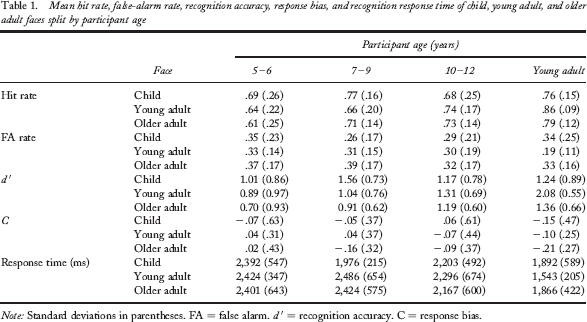
Table 1 shows the mean and standard deviation recognition accuracy and shows that adult participants had the greatest recognition accuracy, especially for own-age faces. Additionally, 7- to 9-year-old children seemed to show an OAB. These data were subjected to a 4 × 3 mixed analysis of variance (ANOVA) with the factors participant age and age of face. This revealed a main effect of face age, F(1.93, 331.90) = 9.13, MSE = 0.45, p < .001, ηp2 = .05. 2 Pairwise comparisons 3 revealed that young adult faces were recognized more accurately than old adult faces (mean difference = .29, p < .001) but not than child faces (mean difference = .09, p = .78), and child faces were recognized more accurately than older adult faces (mean difference = .21, p = .006). There was also a main effect of participant age, F(3, 172) = 11.85, MSE = 0.89, p < .001, ηp2 = .17. Pairwise comparisons revealed that young adults recognized more faces than did 4- to 6-year-old (mean difference = .69, p < .001), 7- to 9-year-old (mean difference = .39, p = .006), and 10- to 12-year-old children (mean difference = .33, p = .027). The 4- to 6-year-old children recognized fewer faces than 10- to 12-year-old children (mean difference = .36, p = .015) and marginally fewer than 7- to 9-year-old children (mean difference = .30, p = .064). No other comparisons were significant.
Mauchley's test of sphericity was significant so a Greenhouse–Geisser correction was applied.
All pairwise comparisons were conducted following a Bonferroni adjustment to the significance level.
Mean hit rate, false-alarm rate, recognition accuracy, response bias, and recognition response time of child, young adult, and older adult faces split by participant age
Note: Standard deviations in parentheses. FA = false alarm. d′ = recognition accuracy. C = response bias.
These main effects were qualified by a significant interaction, F(5.79, 331.90) = 8.97, MSE = 0.43, p < .001, ηp2 = .14. Simple effects were used to explore this. Young adults recognized young adult faces more accurately than any other face type and more accurately than any other group of participants recognized any type of face (all ps < .05). Additionally, 7- to 9-year-old participants recognized 8-year-old faces more accurately than all other types of faces and more accurately than all other children recognized any type of face (all ps < .05). No other simple effects were significant. A parallel analysis was conducted on the response bias measure, C (shown in Table 1 along with hit and false-alarm rates), and this revealed no significant effects, although the effect of participant age was marginal, F(1, 172) = 2.34, MSE = 0.24, p = .075, ηp2 = .04, in which older participants were more liberal than younger participants (though no simple effects were significant).
A parallel analysis was conducted on the recognition response time. These data are presented in Table 1 and show that older participants were faster than younger participants, and that participants appeared to be faster at recognizing faces of their own age than faces of another age. These data were subjected to a 4 × 3 mixed ANOVA. This revealed a main effect of the age of the face, F(2, 344) = 3.31, MSE = 138,384.25, p = .038, ηp2 = .02, whereby older adult faces were recognized slower than young adult faces (mean difference = 98.83, p = .029). There was also a main effect of participant age, F(3, 172) = 19.31, MSE = 538,355.01, p < .001, ηp2 = .25, in which young adults were faster at recognizing faces than 4- to 6- (mean difference = 638.59, p < .001), 7- to 9- (mean difference = 529.06, p < .001), and 10- to 12-year-old children (mean difference = 455.20, p < .001).
These main effects were qualified by a significant interaction, F(6, 344) = 11.63, MSE = 138,384.25, p < .001, ηp2 = .17. Simple effects showed that speed of recognition did not differ across the different face ages for 4- to 6-year-old and 10- to 12-year-old children. However, 7- to 9-year-old children recognized 8-year-old faces faster than young adult faces (mean difference = 510.40, p < .05) and older adult faces (mean difference = 448.13, p < .05). Furthermore, young adults recognized young adult faces faster than older adult faces (mean difference = 323.31, p < .05) and children's faces (mean difference = 349.32, p < .05). We also analysed the response time to make the attractiveness judgements to see whether there was an OAB. It was not found. The authors can be contacted for the full analysis.
Discussion
Young adults demonstrated an OAB recognizing young adult faces more accurately and faster than children's faces or older adult faces. Additionally, 7- to 9-year-old children showed an OAB for 8-year-old faces. However, children more than two years older or younger did not show a recognition bias for the 8-year-old faces. This suggests that the OAB takes less than two years’ experience to emerge. It also demonstrates a degree of plasticity in the face recognition system hitherto unacknowledged (but see Macchi Cassia, Kuefner, et al., 2009). Previously it had been thought that the face recognition system takes circa nine years to reach expertise (e.g., Carey & Diamond, 1977). Here we have shown that one of the markers of expertise (an own-group bias) requires only a few years experience. Better processing of those faces is subsequently lost within two more years due to a lack of motivation or lack of ability.
These results lend themselves to a highly flexible face recognition system in childhood, whereby dimensions of recognition (cf. Valentine, 1991) are constantly changing and updating. Perceptual space is warped with experience (e.g., Furl, Philips, & O'Toole, 2002). We have shown that this process is relatively quick. That is, participants who presumably could recognize faces of 8-year-old children accurately lose some of that ability, presumably to process faces of own-age children. That ability may not be lost forever as Macchi Cassia, Kuefner, et al. (2009) have shown. Indeed, it may be that the dimensions for accurately recognizing faces of a particular age differ from a different age, and thus they become redundant and unused or dormant. They can be reused again should the perceptual demands require it (based upon the results of Macchi Cassia, Kuefner, et al., 2009).
An alternative explanation that cannot be ruled out by the present data is a sociocultural motivational account of the OAB (e.g., Sporer, 2001). That is, children have the ability to recognize all the faces they encounter equally well. However, they do not have the motivation to process other-age faces to the same depth. It is not surprising that children do not have the motivation to process faces in other school year groups (and thus ages) as well as those that are in their own year group.
One limitation of the present work is that we can only hypothesize that the 10- to 12-year-old children tested here were able to recognize 8-year-old faces as well as did the 7- to 9-year-old children we tested here when the faces were own-age. We have not actually shown that children change the types of faces they recognize accurately, merely that at different ages, children can recognize different faces. Thus, a longitudinal study is warranted to test this.
Another limitation of the present work is that the accuracy rates of the children tested here were always significantly lower than the accuracy rates of adults. Indeed, even the OAB of 7- to 9-year-old children still produced accuracy levels similar to those of adults recognizing other-age faces. Thus, we have not found a complete cross-over interaction that other authors have found (e.g., Anastasi & Rhodes, 2005). Thus, what we can say is that even processing own-age faces, children are still immature in their face recognition skills. Additionally, we have only demonstrated an OAB in 7- to 9-year-old children, and it may be that older and younger children do not actually show the bias. We cannot rule this out based upon our data; however, data from Anastasi and Rhodes demonstrated an OAB in 5- to 8-year-old children, and Macchi Cassia, Picozzi, et al. (2009) demonstrated an OAB in 3-year-old children. This suggests that the OAB exists at least up to 10 years old, and we cannot think of a reason why it should not exist for older children. Nevertheless, to conclude that the OAB changes over two years, faces that were age appropriate for the younger and older children would also need to be tested.
There are some important implications of the present work for future experiments exploring children's face-recognition abilities. Experiments that test children's face-recognition abilities using adult faces may well be underestimating their performance. These results indicate that to test children's face-recognition performance at its optimum, it is better to match the age of the face stimuli with the age of the child. Only this way can we be sure that any findings we have obtained are not affected by an additional level of difficulty for the children.
These findings indicate that children are able to make very fine-grained discriminations of face age. This is likely to be the result of the rapid structural changes in children's faces and the fact that children are often segregated based on age in school classes. Based on this, children may actually show a more precise own-age bias than adults. Indeed, children are very able to estimate the age of faces within a margin of error of a couple of years, whereas adults may have a larger margin of error in age estimation (George, Hole, & Scaife, 2000). Similarly, the amount of experience required for the OAB to emerge may change across development since there is evidence that plasticity decreases with age (Macchi Cassia, Kuefner, et al., 2009).
In conclusion, this study has demonstrated an OAB in adults and children. We have shown that the age of face that children are best at processing is within two years of their own age. Children two years older than the faces recognized them at a level no different from that for faces 60 years older than themselves. This finding suggests that the face recognition system is more flexible and plastic in children than has previously been thought either due to updating the face-space or due to motivation to process faces of one's own age.