







Abstract
Sensory experience rating (SER), a new variable motivated by the grounded cognition framework of conceptual processing (e.g., Barsalou, 2008), indexes the degree to which a word evokes sensory/perceptual experiences. In the present study, SERs were collected for over 2,850 words. While SER is correlated with imageability, age of acquisition, and word frequency, the latter variables (along with seven others) account for less than 30% of the variance in SER. Reanalyses of two large-scale studies demonstrate that SER significantly predicts lexical decision times when other established predictor variables are statistically controlled. These results suggest that conceptual processing is grounded in sensory systems. Additionally, a major benefit of this variable is that it allows psycholinguistic researchers to examine semantic–perceptual links for all word classes with a single rating.
According to theories of grounded cognition, cognitive processing is a product of our sensory and perceptual experiences (e.g., Barsalou, 2008). For example, during word recognition, sensory and perceptual systems may automatically become activated so that access to a concept's meaning is influenced by our sensory knowledge of that concept—how it looks, feels, smells, sounds, and tastes. This framework differs from classical amodal views of semantic representations, which, although influential, overlook the potential interface between semantics and perceptual representations (Barsalou, 2008).
Evidence for semantic–perceptual links in isolated word recognition comes from the lexical decision task, where participants discriminate between words and nonwords. Compared to other lexical processing tasks, lexical decision performance has been shown to be particularly sensitive to the semantic processing of words (Balota, Cortese, Sergent-Marshall, Spieler, & Yap, 2004). This line of research has often focused on how action verbs (walk, kick) are processed. Research has revealed that presented action verbs activate areas of the motor cortex within 200 ms of auditory presentation (Pulvermüller, Shtyrov, & Ilmoniemi, 2005), while reading action verbs interferes with reaching movements in a go/no-go lexical decision task (Nazir et al., 2008).
This work on sensorimotor processing has also been extended to sentence comprehension. Zwann and Taylor (2006) observed motor resonance effects during the comprehension of sentences describing rotation movements. Specifically, participants listened to sentences implying either a clockwise or anticlockwise rotational movement (turning on a lamp; opening a jar) while monitoring a visually rotating cross for a colour change. Sensibility judgements on sentences were faster when the visual directional rotation matched the sentence, demonstrating that the perceptual links between action verbs and the motor system can affect the comprehension of larger linguistic units.
According to grounded cognition, all words, not just action verbs, should elicit perceptual or sensory activation. Recent research by Siakaluk, Pexman, Aguilera, Owen, and Sears (2008) suggests that concrete nouns rated as easy to physically interact with (belt) elicit shorter lexical decision times than nouns with lower ratings (cake) of body–object interaction (BOI). In addition, Myung, Blumstein, and Sedivy (2006) observed that individuals were faster to make an auditory lexical decision to a noun (calculator) when it was preceded by an auditory prime that could be manipulated in a similar manner (telephone) than to a prime that did not share manipulation features (newspaper).
While the studies reported above support the grounded cognition view of word recognition, they are concerned with sensorimotor processing, only one aspect of sensory/perceptual experience. Other potential aspects of the sensory experience include sound, taste, and smell. Similarly, reading a strong emotion word could produce perceptual simulations in the reader. For example, the emotion word love could lead to sensory simulations of sweating palms or racing heart that are experienced by a person actually in love. A recent study by Kousta, Vinson, and Vigliocco (2009) provides evidence that emotional words are processed faster than neutral words in lexical decision. In addition, a brain imaging study by González et al. (2006) demonstrates that other types of sensory/perceptual information are, in fact, activated during word recognition. Specifically, words related to the sense of smell activate olfactory cortical areas to a greater degree than control words, establishing that the influence of sensory/perceptual processing generalizes to additional syntactic classes and sensations.
The purpose of the present study was to develop a new variable, Sensory Experience Rating (SER), to index the degree to which all words elicit sensory and perceptual experiences. As such, SER is consistent with a grounded cognition view of conceptual processing. To preview, our results indicate that readers are able to make metalinguistic judgements regarding the degree of sensory/perceptual activation elicited by a word. More critically, these metalinguistic judgements reliably predicted variance in lexical decision performance in two large-scale studies, even after controlling for a host of traditional word recognition variables. While this variable is correlated with other semantic variables, such as imageability, there are many reasons to consider this variable distinct. For example, there exist words that receive relatively high imageability ratings but low SERs (BAG, BEAD), as well as the opposite pattern (THIRST, GUSH). We revisit this issue in the Discussion section.
Method
Participants
Sixty-five Wesleyan University undergraduates participated in the word-rating task for course credit. All participants were native speakers of English.
Stimuli
Ratings were collected on 2,857 monosyllabic words selected from previous studies of word recognition processes (Cortese & Fugett, 2004; Cortese & Khanna, 2007).
Procedure
Stimuli were divided into six questionnaires, of 476–477 words, which were each rated by 10–12 undergraduates. Participants were tested in groups, and the task was untimed. The instructions (see Appendix) required participants to rate the degree to which each word evoked a sensory experience (1 = the word evokes no sensory experience, and 7 = the word evokes a strong sensory experience). The entire session took under one hour.
Word recognition tasks
We assessed the impact of SER on word recognition performance, using the lexical decision data from Balota et al.'s (2004) megastudy with English monosyllabic words and the newly available British Lexicon Project (BLP; Keuleers, Lacey, Rastle, & Brysbaert, in press) database. The Balota et al. database was recently used to examine the influence of age of acquisition (AoA) on word recognition performance (Cortese & Khanna, 2007). The BLP is a repository of lexical decision data for over 28,000 mono- and disyllabic English words.
Data analysis
Stimuli consisted of 2,222 monosyllabic words for which all relevant predictor variables were available in the Balota et al. (2004) database (2,211 words were analysed from the BLP). We used the hierarchical regression procedure applied by Balota et al. and Cortese and Khanna (2007) in which word recognition variables are entered in steps in a theoretically motivated manner. As each additional step is included, only variability not accounted for by an earlier step can be predicted. Initially, variables related to low-level surface characteristics were included. This first level of predictors consisted of 13 dichotomous variables reflecting characteristics of each word's onset. These variables are most likely to have an effect in word naming. However, Balota et al. also reported significant combined effects of these variables on lexical decision reaction time. The second step consisted of lexical-level variables: word length, neighbourhood size (Coltheart, Davelaar, Jonasson, & Besner, 1977), objective frequency (Zeno, Ivens, Millard, & Duvvuri, 1995), 1 and four measures of phonological consistency. These variables were entered second, as they are related to aspects of words more complex than an individual letter or phoneme, but are not associated with semantics. The third step consisted of age of acquisition and imageability, both of which have been linked to semantic processing. SER was entered in the final step in these analyses. The addition of SER in the final step affords a very conservative test of this variable as it can only predict variance not accounted for in the three previous steps.
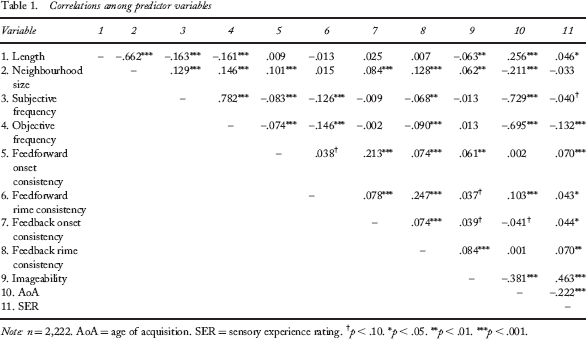
Due to the high correlation between objective and subjective frequency (see Table 1), we did not enter subjective frequency into the regression analysis at this level (in contrast to previous studies). However, the pattern of results remained the same when this additional variable was included.
Correlations among predictor variables
Note: n = 2,222. AoA = age of acquisition. SER = sensory experience rating.
p < .10.
p < .05.
p < .01.
p < .001.
Results
Relationship to established lexical variables
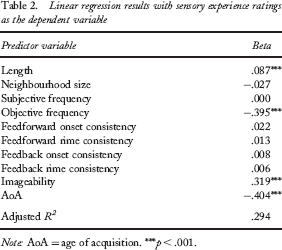
Correlations between the predictor variables entered into the hierarchical regression in Steps 2 and higher were conducted (see Table 1). While SER is significantly correlated with nearly all variables, the magnitudes of the correlations are quite small for most predictors. The only correlations greater than .2 are with other semantic variables (imageability r = .463; AoA r = –.222). A multiple regression analysis was conducted using SER as the dependent variable (see Table 2). Only four word recognition variables significantly predicted SER: word length, objective frequency, imageability, and AoA. SER was negatively related to both AoA and objective frequency. Most importantly, the 10 predictor variables together only accounted for 29.4% of the variance in SER, leaving roughly 70% of the variance in this new measure unexplained. This finding suggests that SER taps unique aspects of a word not currently captured by other variables.
Linear regression results with sensory experience ratings as the dependent variable
Note: AoA = age of acquisition.
p < .001.
It is also important to examine SER in comparison with other semantic variables in the literature. Wurm (2007) reported that the rated usefulness and danger of words predict visual lexical decision time independently of many other word recognition variables. Correlations between SER, danger, and usefulness were examined for the 90 words in Wurm (2007) that also have an SER. Both correlations were negligible (–.075 for SER and danger; .114 for SER and usefulness). In addition, 1,518 words are represented on BOI (Tillotson, Siakaluk, & Pexman, 2008a, 2008b) and SER norms. The correlation between BOI and SER was modest (r = .394).
Influence on word recognition performance
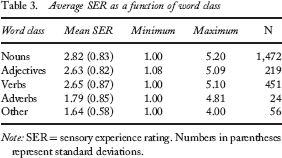
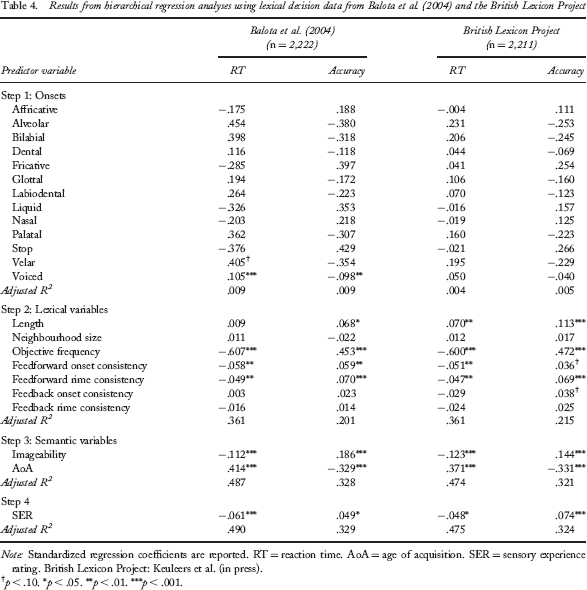
The average SER for words used as a function of syntactic class are reported in Table 3. Average SER is roughly equivalent for nouns, verbs, and adjectives. In order to assess SER's influence on word recognition, hierarchical regression analyses were conducted using the lexical decision data from Balota et al. (2004) and the BLP (presented in Table 4). 2 As expected, high-frequency words resulted in faster and more accurate lexical decisions. In addition, both imageability and AoA influenced lexical decision performance, consistent with previous studies (Cortese & Fugett, 2004; Cortese & Khanna, 2007). Most importantly for the present study, both analyses showed a consistent effect of SER on lexical decision latency, wherein words with a higher SER received significantly shorter lexical decision times. Higher SER also predicted higher response accuracy. The magnitude of this effect might appear modest; adding SER as a final step increased the proportion of variance accounted for in lexical decision reaction times by 0.1–0.3%. However, the theoretical importance of a variable cannot be entirely gauged by its effect size. Moreover, the fact that SER could account for any additional variance after controlling for such a comprehensive array of lexical and semantic variables is noteworthy. 3 Indeed, this is a remarkably stringent test for any new variable to pass (see Kang, Yap, Tse, & Kurby, 2011, for a variable that failed this test).
The same analyses were conducted using the naming data in Balota et al. (2004). SER was not a significant predictor of naming performance.
The motivation for including the predictors in these analyses was to be consistent with earlier published work (e.g., Balota et al., 2004; Cortese & Fugett, 2004; Cortese & Khanna, 2007). Of course, there are other variables that may influence reaction time. When we included additional control variables in the hierarchical regression (including phonological neighbourhood size, regularity, nonlinear frequency, and the frequency by regularity interaction), the general pattern of effects for SER does not change. Spelling–sound regularity was determined using Davis's (2005) N-Watch program, and nonlinear frequency was modelled by including the second-degree polynomial for word frequency (see Brysbaert & New, 2009). SER is still not a significant predictor of naming performance (ps > .5), but predicts lexical decision time in the Balota et al. (p < .01) and BLP (p < .05) datasets, as well as lexical decision accuracy in the BLP (p < .01).
Average SER as a function of word class
Note: SER = sensory experience rating. Numbers in parentheses represent standard deviations.
Results from hierarchical regression analyses using lexical decision data from Balota et al. (2004) and the British Lexicon Project
Note: Standardized regression coefficients are reported. RT = reaction time. AoA = age of acquisition. SER = sensory experience rating. British Lexicon Project: Keuleers et al. (in press).
p < .10.
p < .05.
p < .01.
p < .001.
As a further test of SER's ability to predict lexical decision performance beyond other established variables, we conducted hierarchical regression analyses on a subset of stimuli that also had BOI scores available (Tillotson et al., 2008a, 2008b). BOI was included with imageability and AoA in the third step (see Table 5). Even with BOI controlled for, SER was still a significant predictor of lexical decision performance.
Results from hierarchical regression analyses where BOI is controlled along with other semantic variables, using lexical decision data from Balota et al. (2004) and the British Lexicon Project
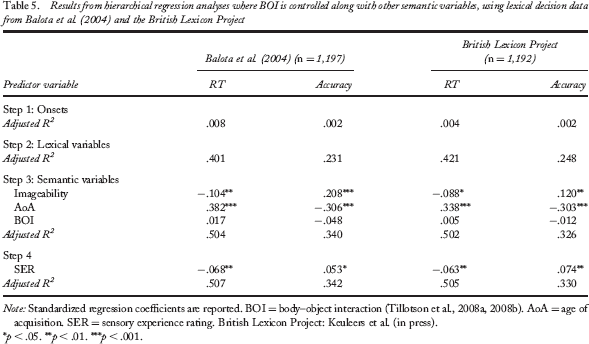
Note: Standardized regression coefficients are reported. BOI = body–object interaction (Tillotson et al., 2008a, 2008b). AoA = age of acquisition. SER = sensory experience rating. British Lexicon Project: Keuleers et al. (in press).
p < .05.
p < .01.
p < .001.
Discussion
SER indexes the degree to which a word evokes a sensory experience in the mind of a reader. Our results indicate that SER reliably influences lexical decision performance in two independent large-scale studies. Furthermore, SER is a unique word recognition variable, since the combination of 10 established word recognition variables only predicts 29.4% of its variance. SER's strongest correlation is with imageability, which indicates that words that easily evoke a mental image are more likely to also evoke a sensory experience. However, there are many reasons to consider these two variables distinct. To begin, if SER was merely another form of imageability, then one would not expect SER to influence lexical decision performance once imageability was controlled, as was found in the present study. Further, while imageability predicts both naming and lexical decision performance (Balota et al., 2004), in the current study SER only influences lexical decision performance (see Footnote 2). In addition, while the correlation between SER and imageability is moderate, at r = .463, the correlation between two measures of imageability has been reported to be much higher, at r = .89 (Cortese & Fugett, 2004). Hence, if SER is simply another measure of imageability, then one would expect the correlation to be higher than it is. Finally, many concrete nouns within the database are easily imageable but receive low SERs, indicating they are not tied to the sensory/perceptual system. Examples of such words are provided in Table 6. The converse (i.e., high SER and low imageability) also exist.
Examples of words with contrasting SER and imageability values (Cortese & Fugett, 2004)
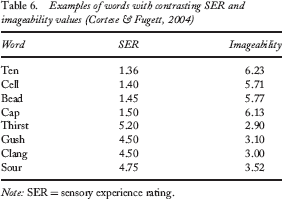
Note: SER = sensory experience rating.
Our analyses suggest that there is no redundancy between SER and a single established semantic variable. In fact, a major advantage of the SER variable is that it could provide a mechanism for incorporating existing semantic variables that are related to theories of grounded cognition into a single rating with relatively simple instructions. Using SER to examine sensory/perceptual links to words also allows researchers to compare the strength of sensory experiences associated with different classes of words that are thought to be tied to perceptual experiences. For example, the concrete noun STOOL has a high BOI rating (6.27) but a low SER (1.73). Similarly, the action verbs CLAP (4.93) and SMACK (4.82) are rated as more evocative of a sensory experience than SHUT (2.00) and HOLD (2.08). In addition, emotion words such as LOVE (4.82), STRESS (4.12), and FEAR (3.55) are rated higher than neutral words like POLE (1.64), KIT (1.27), and SPOUT (1.5). As mentioned in the introduction, emotion words are processed faster than neutral words in lexical decision (Kousta et al., 2009). The SER variable provides an alternative explanation for why these words may have an advantage over neutral words in that emotion words are tied to sensory/perceptual experiences. Of course, further experimentation is needed to test this hypothesis.
SER is also related in interesting ways to other established variables. Words that enter the lexicon early in life are more likely to be grounded in sensory experiences. One explanation for this correlation is that words that are the earliest learned tend to be perceptually based. This hypothesis is consistent with the cross-channel early lexical learning (CELL) model (Roy & Pentland, 2002), which is able to acquire a limited vocabulary of object names through pairings of infant-directed speech and video images of objects. This model suggests that children may acquire early concepts in relation to the visual context within which a spoken word occurs. In natural language, AoA and word frequency are highly negatively correlated (see Juhasz, 2005, for a discussion)—that is, early-acquired words are more frequent. However, the current analyses indicate that high-frequency words are less likely to evoke a strong sensory experience. This intriguing relationship between frequency and SER is therefore theoretically important, as word recognition researchers often debate whether AoA is in fact another form of frequency (Juhasz, 2005). The pattern of intercorrelations with SER indicates that AoA and word frequency are dissociable in terms of the amount of sensory experience a word evokes.
The current results with SER have the potential to inform the grounded cognition framework. As Barsalou (2008) discusses, theories of grounded cognition typically emphasize sensorimotor interactions. This focus has led to the misperception that grounded cognition theories are not able to explain how abstract concepts are represented. SER extends this work by suggesting that all words can be potentially linked to perceptual systems. In addition, the significant negative correlation between SER and word frequency may be interpreted within the context of the language and situated simulation (LASS) theory (Barsalou, Santos, Simmons, & Wilson, 2008), under which words activate both a linguistic form and perceptual simulations. The linguistic form is evoked faster than simulations (although both may overlap in time) and may consist of associated words. The simulations afford deeper conceptual processing of the word, which is tied to the sensory and perceptual systems. In this light, the negative correlation between SER and word frequency may indicate that highly frequent words are more likely to rely on purely linguistic forms for processing while lower frequency words are processed to a greater degree through their perceptual simulations.
In conclusion, the creation of the SER variable, and its relationship to lexical decision performance, extends extant work with action verbs and concrete nouns to suggest that all types of words are grounded in sensory and perceptual systems. Strengths of the SER variable are that it can be used to: (a) examine all sensations using a single instruction, (b) collect ratings on all word classes, and (c) evaluate the relative degree of sensory/perceptual activation of other types of words thought to be grounded in sensory experiences.