







Abstract
Stimulus overselectivity occurs when only one of potentially many aspects of the environment controls behaviour. In four experiments, human participants were trained and tested on a trial-and-error simultaneous discrimination task involving two two-element compound stimuli. Overselectivity emerged in all experiments (i.e., one element from the reinforced compound controlled behaviour at the expense of the other). Following revaluation (extinction) of the previously overselected stimulus, behavioural control by the underselected stimulus element emerged without any direct training of that stimulus element. However, while a series of extinction manipulations targeting the revaluation of the overselected stimulus produced differential extinction of that stimulus, they did not result in differential emergence of the previously underselected stimuli. The results are discussed with respect to the theoretical implications for attention-based accounts of overselectivity.
Overselectivity occurs in human discrimination learning and refers to a situation where one element of a compound stimulus controls behaviour at the expense of other equally important elements of that stimulus (e.g., Dube et al., 1999; Lovaas, Berberich, Perloff, & Schaeffer, 1966; Lovaas & Schreibman, 1971; Reed & Gibson, 2005). The phenomenon is especially pronounced with participants who have intellectual and/or developmental disabilities, those who have brain damage, or older participants (e.g., Dube et al., 1999; Koegel & Schreibman, 1977; McHugh & Reed, 2007; Reed, Broomfield, McHugh, McCausland, & Leader, 2009; Wayland & Taplin, 1985), but it also occurs with individuals without any form of disorder under conditions of high cognitive demand (e.g., Kim, Kim, & Chun, 2005; Reed & Gibson, 2005). The fact that overselectivity is a discrimination learning phenomenon of some generality has made it the subject of theoretical speculation, both with regard to the mechanisms that may produce the effect and in relation to uncovering the central deficits in a number of disorders, such as autism spectrum disorder (ASD; cf. Dube, 2009; Dube et al., 1999; Leader, Loughnane, McMoreland, & Reed, 2009; Reed, 2011). It could also be noted that overselectivity bears a resemblance to overshadowing effects (Mackintosh, 1976), but is usually studied in very different paradigms to overshadowing, and, for the moment, it is unclear whether the two effects have only surface similarity, or whether they are controlled by the same mechanisms. For this reason, the current paper focuses on the theoretical explanations derived to accommodate overselectivity.
Koegel and Schreibman (1977; see also Broomfield, McHugh, & Reed, 2008; Dube & McIlvane, 1999; Leader et al., 2009; McHugh & Reed, 2007; Reed & Gibson, 2005) found that when participants were presented with a simultaneous discrimination task involving 2 two-element compound stimuli (e.g., AB+ CD–), behavioural control was only achieved by one of the stimulus elements from the reinforced compound (i.e., only A or B came to control behaviour strongly). That is, following AB+ CD– training, when elements of the compounds were tested against one another in extinction (e.g., A vs. C; A vs. D, etc.), participants responded much more strongly to one element of the compound than to the other element (e.g., A controlled behaviour to a much greater extent than B).
Despite the finding being well documented in populations with intellectual or developmental disability (Dube et al., 1999; Koegel & Schreibman, 1977; Lovaas et al., 1966; Reed et al., 2009), there have been relatively few demonstrations in populations without such disorders (see Reed & Gibson, 2005; Reynolds & Reed, 2011). However, these latter demonstrations suffer from two critical problems: First, they do not demonstrate that the higher responding to one stimulus of the compound than to the other element is specific to those elements being presented in compound with one another. That is, they do not demonstrate that one stimulus would not be responded to at a greater rate than the other if they were trained separately from one another. Secondly, few of the demonstrations provide solid statistical evidence that one stimulus controls behaviour more than the other to a greater extent than would be expected by chance. An aim of the current series of studies is to address these issues.
The most widely accepted view attempting to account for overselectivity makes reference to attention problems (e.g., Dube, 2009; Dube et al., 1999; Lovaas & Schreibman, 1971; Lovaas, Schreibman, Koegel, & Rehm, 1971). According to such attention views, individuals who display overselectivity are thought not to attend to all of the component elements of the stimulus during training (Dube et al., 1999). Therefore, it is supposed that these stimuli cannot subsequently come to control behaviour as they have not been attended to and, thus, have not been encoded (Lovaas & Schreibman, 1971; Lovaas et al., 1971). In the limiting case, the participant might not have even noticed their presence during initial training (see Dube et al., 1999). This attention view is supported by findings from eye-tracking studies that show that individuals with intellectual impairment do not appear to scan all elements of a compound stimulus when they are presented with one in a discrimination task (Dube et al., 1999; cf. Remington, 1980). This view is also consistent with the finding that high cognitive loads induce overselectivity (Reed & Gibson, 2005). Evidence from the human cognitive attention literature shows that, under conditions of high cognitive load, attention responses become highly focused, and individuals do not attend to all available stimuli (Kim et al., 2005; Lavie & Driver, 1996; but see Lamy, 2000)
However, the conditioning literature suggests that there could be alternative views to this attention-based theory. For example, several types of revaluation findings have been shown in human learning research, and of prime importance for the current purposes is the phenomenon of “unovershadowing”. For instance, Wasserman and Berglan (1998; see also Vadillo, Castro, Matute, & Wasserman, 2008) found that judgements concerning the causal effectiveness of an element in a compound stimulus were enhanced if subsequent extinction training occurred with the other element present in the compound (see also Kaufman & Bolles, 1981; Matzel, Schachtman, & Miller, 1985, for similar results with nonhumans). Such results have theoretical significance, and several different accounts have been put forward to explain them, such as a modified standard operating procedures (SOP) model (e.g., Dickinson & Burke, 1996) and a comparator view (Miller & Matzel, 1988; see Reed, 2011, for a discussion in this context). The key issue is that such views suggest that the initial learning about the underselected stimulus may be influenced by subsequent alterations in learning about the overselected stimulus, and not just a failure to attend to the initial stimuli.
This latter suggestion has found some support from studies conducted with individuals with ASD (although it should be noted that these preparations are often quite different from those used in revaluation of overselectivity studies; see Leader et al., 2009; Reed et al., 2009). These studies have noted that, if the stimulus element that controls behaviour (i.e., the overselected stimulus) is revalued post acquisition, then, without further training, the previously underselected stimulus element comes to control behaviour (see Leader et al., 2009; Reed et al., 2009). In these studies, initial discrimination learning, of the form AB+ CD–, is followed by a further phase of discrimination learning, in which the overselected stimulus from the compound (i.e., A or B) is paired with a series of novel stimuli, and the participant is reinforced for choosing the novel stimuli (e.g., A–X+). Following this revaluation, behavioural control by the previously underselected stimulus (e.g., B) becomes stronger. However, to date, only one study has shown this effect using adults with no form of developmental or intellectual disability (McHugh & Reed, 2007), and this study does not employ conservative statistical controls. Thus, another aim of the current series of studies is to attempt to replicate this finding and to place it within the general framework of revaluation studies, as typically studied within the conditioning literature.
The experiments reported in the current series aim to replicate and extend the work on revaluation in overselectivity and to explore the factors that may control this effect, with an aim of isolating the critical factors controlling this phenomenon and illuminating possible theoretical explanations of the effect. At minimum, this will allow theoretical exploration regarding whether an attention-deficit view of overselectivity (e.g., Dube, 2009; Lovaas et al., 1971) can remain viable, as a strict interpretation of such a view would not predict that revaluation of the previously overselected stimulus element would have any impact on an element of the stimulus to which attention was not paid.
Experiment 1
In previous demonstrations of overselectivity (e.g., Leader et al., 2009; Reed & Gibson, 2005), participants have been exposed to a simultaneous discrimination AB+ CD–, and it has been shown that the elements A and B control behaviour differentially. However, it has not been demonstrated that the differential control over behaviour is the result of the two elements (A and B) being paired together in compound during initial training. To this end, the current study compared the level of differential control exerted by the stimuli following compound training (AB+), compared to when the stimuli were trained separately (A+ B+). It was thought important to investigate this possibility, as such a control has previously been lacking in explorations of overselectivity, which have always implicitly assumed that some within-compound effects are implicated in generating the phenomenon itself (e.g., some form of cue competition, pre or post training), whereas it may result from some form of interference effect (e.g., Matute & Pineño, 1998), which could also supply an explanation for some retrospective revaluation effects.
Method
Participants
Thirty psychology students (8 male and 22 female) from Swansea University participated. All participants received course credit in return for their participation. Their mean age was 20.0 (±1.5, range 18 to 24) years. None of the participants scored over 32 on the Autism Quotient (AQ) questionnaire (Baron-Cohen, Wheelwright, Skinner, Martin, & Clubley, 2001). The criterion on this scale for high-functioning Asperger's syndrome is 32, and this indicated that none of the participants were likely to have undiagnosed Asperger's syndrome.
Apparatus and materials
The experiment was conducted in a quiet room, free from distraction, located in the University. Participants were seated at a table facing a computer, which recorded their responses and presented the stimuli. The stimuli were presented on the computer monitor in the form of two white boxes (8 cm wide by 12 cm long), against a grey screen background. One box was presented on one side of the screen and the other on the opposite side of the screen. Each box contained black stimuli (6 cm wide by 4 cm long). Some of the boxes contained two symbols, one at the top of the box, the other below it (the actual spatial position of specific stimulus elements being randomized across these presentations); these were the compound stimuli. Sometimes one stimulus was presented in the centre of the box. The stimuli elements were symbols and shapes obtained from various fonts from Microsoft Word 2000. These fonts were Wingdings, Windings 2, and Symbol (see Figure 1).
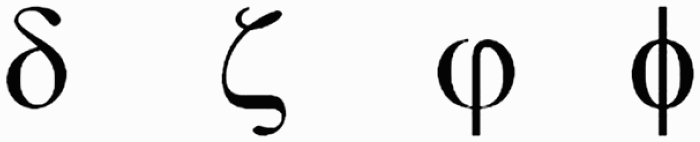
Examples of stimulus elements presented to participants.
In all cases, the stimuli remained on the screen for a maximum of 5 s. If no response was made, the stimulus disappeared, and there was an intertrial interval (ITI) of 2 s. If a response was made, the stimuli disappeared, and the participant was immediately given feedback. If the response was correct, the word “yes” was presented on the screen. This was presented for 1 s and was followed by a 2-s ITI. Choice of the nonrewarded stimulus was followed by the word “no” presented on the screen after the click.
Procedure
Training phase
All participants were trained individually. Participants were presented with two stimuli simultaneously on the computer screen. For group AB +, each box on the screen contained two stimulus elements. On any given trial, participants were presented with one compound stimulus (AB) that, if selected by the participant, resulted in positive feedback. Selecting the other compound (CD) resulted in negative feedback. The positions of the compound stimuli were systematically randomized—that is, 50% of the time the correct box was presented on the left, and 50% of the time it was presented on the right of the screen. Participants were said to have acquired the training discrimination once they had produced 10 consecutively correct responses.
For group A+ B+ (5 trial), the participants were presented with two boxes on the screen. One box displayed a single stimulus (i.e., either A or B) that, if selected by the participant, resulted in positive feedback. Selecting the other box (either C or D), resulted in negative feedback. Stimulus A was paired equally often with Stimuli C and D, as was Stimulus B. The positions of the boxes were randomized—that is, 50% of the time the correct stimulus was presented on the left, and 50% of the time it was presented on the right. Participants were said to have acquired the training discrimination once they had produced five consecutively correct responses to Stimulus A and to Stimulus B. Once an individual element (A or B) had been selected five times in a row, then that element was removed from the training, and training progressed solely with the other element. This group was employed so that the total number of trials in training (i.e., overall amount of reinforcement—up to 10 reinforcers in a row at criterion) would approximate that received in group AB+. However, this has the consequence that the amount of reinforcement received by the individual elements (A and B) would be half that received in group AB+ (i.e., 5 reinforcers instead of 10).
Group A+ B+ (10 trial) had exactly the same procedure as that described above, except that the criterion was 10 consecutive correct responses to A and to B. Once an individual element (A or B) had been selected 10 times in a row, then that element was removed from the training, and training progressed solely with the other element. This group was employed so that each individual element (A and B) was reinforced the same number of times that they received reinforcement in compound in group AB +, although the total number of trials to criterion would be higher than that in group AB+.
For all groups, the actual stimuli that were used as the elements of the compound stimulus (i.e., A, B, C, D) were different for each participant. This was done in order to reduce the possibility of any overselectivity shown by the group as a whole being caused by particular stimuli being intrinsically more salient than others.
Test phase
During the test phase of the experiment, participants in all groups were presented with two boxes simultaneously, each one comprising just one element. The elements were paired so that the participants had a choice of reinforced stimuli or nonreinforced stimuli; so Stimuli A and B were each paired with C and D. There were five trials for each combination of previously positively reinforced and negatively reinforced components (i.e., A vs. C; A vs. D; B vs. C; B vs. D). Altogether, there were 20 trials involving the elements. No feedback was provided during test trials.
Concurrent load
To promote overselectivity, a concurrent load task was presented, as previous reports have demonstrated that overselectivity emerges with such a task (see Reed & Gibson, 2005). Participants were required to subtract 7 continuously throughout the whole study, starting from a random five-digit number (e.g., 76,654). The participants were required to do this verbally “out loud” so that the experimenter knew that they were continuing with the task throughout the study. If they failed to say a number, or slowed down in their subtraction task, they were prompted to continue by the experimenter (“go on, keep subtracting”).
Participants were then required to complete the AQ measure.
Results and discussion
In group AB +, participants on average took 12.9 (±1.4) trials during training to reach the criterion of selecting the correct card 10 consecutive times. In group A + B+ (5 trial), participants on average took 13.3 (±1.4) trials during training to reach the criterion of selecting each stimulus 5 consecutive times. In group A + B+ (10 trial), participants on average took 24.4 (±1.7) trials during training to reach the criterion of selecting each stimulus 10 consecutive times. An analysis of variance (ANOVA) revealed a statistically significant difference between the number of trials taken to reach criterion between the groups, F(2, 27) = 193.65, p < .001. Subsequent Tukey's honestly significant difference (HSD) tests revealed statistically significant pairwise differences between group A + B+ (10 trial) and each of the other two groups, p < .05.
The data from the test phase were organized into the percentage of times that the most selected and least selected stimuli were selected during the test, and the mean of the most selected element and that of the least selected element from AB were calculated. The identities of the actual most and least selected stimuli differed for the participants.
Figure 2 presents the percentage times that each element of the compound stimuli was chosen for each group. Inspection of these data shows that there was a larger difference between the percentage times that the most and least selected stimulus was chosen in group AB+ than in the other two groups. The later two groups displayed relatively smaller differences between the percentage of times that the two stimuli were chosen, with a greater difference being apparent in group A + B+ (5 trial) than in group A + B+ (10 trial). A two-factor mixed-model ANOVA (Group × Stimulus Type) was conducted on these data and revealed statistically significant main effects of group, F(2, 27) = 8.63, p < .001, and stimulus type, F(2, 27) = 39.34, p < .001, and a statistically significant interaction between group and stimulus type, F(2, 27) = 17.73, p < .001. To further analyse the interaction, simple effects were conducted on stimulus type for each group. These revealed a statistically significant simple effect of stimulus for group AB +, F(1, 27) = 10.89, p < .001, a marginally significant difference in group A + B+ (5 trial), F(1, 27) = 3.61, p < .07, and no statistically significant difference for group A + B+ (10 trial), F < 1.
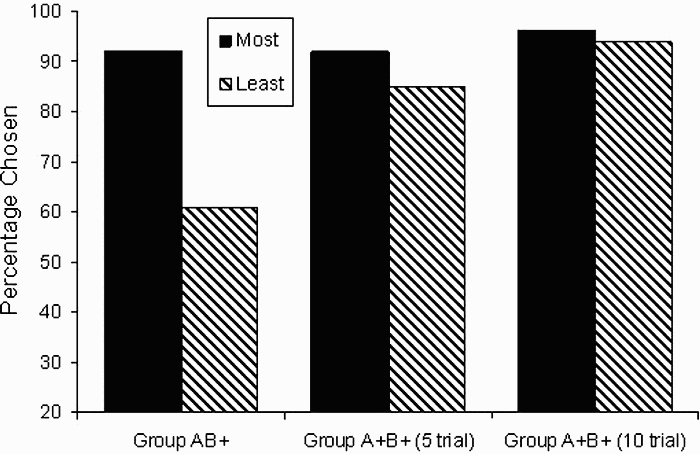
Results from Experiment 1: The group mean of the most and least chosen stimuli in the three groups.
It is reasonable to suggest that such an analysis will tend to produce a difference between the most and least selected stimuli, but it should be noted that, in conditions whereby overselectivity is not expected (i.e., healthy populations with no concurrent task load), no significant differences are found between the most and least selected stimuli (e.g., Reed et al., 2009; Reed & Gibson, 2005). However, given the above considerations, further analysis of these data was undertaken, based on binomial theory, as described by Reynolds and Reed (2011), to determine whether the deviation in the times that the most selected and least selected stimuli were chosen was statistically greater than would be expected by random chance. In the absence of any a priori method of determining the probability of choosing a stimulus, the mean probability of choosing the most and least selected stimuli was first calculated. Given this probability, the binomial equation was used to obtain the probability of choosing all possible combinations of A and B over C or D on 10 trials (thus, this value potentially would be different for each condition depending on the mean probability of correctly choosing a previously reinforced element for that condition). The probability of choosing a reinforced compound stimulus was set at the mean probability of choosing A and B stimuli in a particular condition. Then, the probability of obtaining 10 A and 0 to 10 B, the probability of obtaining 9 A and 0 to 10 B, and so on, were calculated and put in an 11 × 11 contingency table. The contents of this table were then multiplied by an 11 × 11 table that contained the absolute A minus B difference score for each combination. The resulting 11 × 11 table contained the expected frequency of obtaining each possible A minus B difference resulting from all possible combinations of A and B frequencies. The sum of the values in this table (multiplied by 10) provided an estimate of the most minus least selected difference, in percentage terms, expected by random variation of selection of A and B stimuli. Paired t tests were then used to test this sum against the obtained data, in order to investigate whether significant overselectivity occurred.
The expected differences were 14.6% for group AB +, 10.8% for group A + B+ (5 trial), and 6.6% for group A + B+ (10 trial). Paired t tests (one-tailed as the most selected versus least selected comparison could only have an outcome in one direction) were performed to compare the obtained differences and the expected differences based on chance, which indicated a significant difference in group AB +, t(9) = 3.12, p < .05, but not for the group A + B+ (5 trial), t(9) = 1.09, p > .10, and group A + B+ (10 trial), t < 1.
These data suggest that an overselectivity effect can be produced in healthy participants with a concurrent task load (see also Reed & Gibson, 2005). However, the effect is only seen strongly in a group in which there is compound exposure to the elements and not when the elements are presented separately from one another. This is the first time that such a finding has been shown and shows that the elements do need to be presented in compound in order to generate the overselectivity effect.
Experiment 2
Experiment 2 aimed to replicate the overselectivity effect noted in Experiment 1 and also to explore whether underselected cues would come to control behaviour after the overselected cues were revalued (see McHugh & Reed, 2007). To this end, following initial acquisition of behavioural control in a simultaneous compound discrimination task (AB+ CD–), the overselected stimulus element was paired with novel stimuli in a new discrimination and punished (e.g., A– X+), and responding to the previously underselected stimulus element (e.g., B) was examined for signs of emergence of behavioural control. If this were the case, then this finding would be problematic for a strict version of the attention view of overselectivity (e.g., Lovaas et al., 1971), as stimuli that were not attended to should not have been encoded, and no amount of revaluation of the overselected stimulus would subsequently impact their ability to control behaviour.
Method
Participants and apparatus
Eighteen psychology students (4 male and 14 female) from Swansea University participated. All participants received course credit in return for their participation. Their mean age was 22.0 (±3.3; range, 19 to 29) years. None of the participants scored over 32 on the Autism Quotient (AQ) questionnaire (Baron-Cohen et al., 2001. The apparatus and materials were the same as those described in Experiment 1.
Procedure
Training phase
Participants were presented with two boxes on the screen simultaneously, one on the left of the screen and one on the right of the screen. Each box contained two stimulus elements. On any given trial, participants were presented with a box containing one compound stimulus (AB or EF), which, if selected by the participant, by means of clicking on it with the mouse, resulted in positive feedback. Selecting the other box (CD or GH) resulted in negative feedback. The positions of the compound stimuli on the screen were systematically randomized—that is, 50% of the time the correct compound was presented on the left, and 50% of the time it was presented on the right.
The reinforced compound AB was always paired with the compound CD, and the reinforced compound EF was always paired with the compound GH. Participants were said to have acquired the training discrimination once they had produced 10 consecutively correct responses to both the AB and the EF compound. When 10 correct responses in a row to one of these compounds were achieved, that discrimination was removed from the training regime, and training continued with the remaining discrimination until 10 correct responses in a row were achieved. The actual stimuli that were the elements (i.e., A, B, C, etc.) were different for each participant, to reduce the possibility of overselectivity being caused by particular stimuli being intrinsically more salient than others.
Test phase
During the test phase of the experiment, the participants were presented with two boxes on the screen simultaneously, each one comprising just one picture from the compound stimuli. The elements were paired so that the participants had a choice of reinforced stimuli or nonreinforced stimuli; so A and B were paired with C and D, and E and F were paired with G and H. There were five trials for each combination of previously positively reinforced and negatively reinforced components (i.e., A vs. C; A vs. D; B vs. C; B vs. D; E vs. G; E vs. H; F vs. G; F vs. H). Altogether, there were 40 trials involving the components of the compound stimuli. No feedback was provided during test trials.
Participants were then required to complete the AQ measure while the experimenter calculated the percentage of times that the participants had selected each of the elements from the previously reinforced compound stimulus in order to discover which stimuli were overselected during training and, hence, which to subsequently revalue (which was chosen randomly from AB or EF).
Revaluation phase
The element that was selected the most (i.e., the overselected stimulus) was determined for each pair (i.e., A or B, and E or F). Further training trials were conducted involving one of the overselected stimuli and a previously unseen novel stimulus. The overselected element to be revalued (i.e., from the AB or EF pair) was randomly determined for each participant. Participants were rewarded for choosing the novel stimulus and not the previously overselected stimulus. This training continued until the participants choose the novel stimulus 10 times consecutively.
Retesting phase
The same test procedure was used as that in the first testing phase. The retest phase was composed of 40 trials, all comprising components of the complex stimuli.
Concurrent load
Participants were required to subtract 7 continuously throughout the whole study, as described in Experiment 1
Results and discussion
The participants took a mean of 26.8 (±3.5) trials to reach criterion (10 correct responses to both reinforced compounds) in the training phase. The data from the test phase were organized into the percentage of times that the most selected and least selected stimuli were selected during the test for both discriminations, and the mean of the two most selected elements from AB and EF and that of the least selected elements from AB and EF were calculated. The identities of the actual most and least selected stimuli differed for the participants. This revealed a mean percentage most selected stimulus and a mean percentage least selected stimulus, which were highly similar for the most and least selected stimuli that were to undergo revaluation (most = 90.0 ± 17.5; least = 52.8 ± 32.7) and for those that were not (most = 90.0 ± 17.2; least = 58.3 ± 38.3). A two-factor repeated measures ANOVA, with condition (revaluation and control) and stimulus (most and least selected) was conducted on these data and revealed a statistically significant main effect of stimulus, F(1, 17) = 43.77, p < .001, but no statistically significant main effect of condition nor an interaction, Fs < 1.
As in Experiment 1, further analysis of these data was undertaken, based on binomial theory, as described by Reynolds and Reed (2011), to determine whether the deviation in the times that the most selected and least selected stimuli were chosen was statistically greater than would be expected by random chance around an average probability of selection of the two stimuli. The expected differences were 15.9% for the revaluation group pretreatment and 15.2% for the control group pretreatment. Paired t tests (one-tailed) were performed to compare the obtained differences and the expected differences based on chance, which indicated a significant difference for the revaluation group pretreatment, t(17) = 3.84, p < .001, and for the control group pretreatment, t(17) = 2.19, p < .05.
The number of trials in revaluation for the revalued stimulus was 17.3 (±2.9).
Figure 3 presents the change in the percentage times that each element of the compound stimuli was chosen across the two phases (postrevaluation minus prerevaluation phase). Inspection of these data shows that there was a decrease in the number of times that the previously most selected stimulus was chosen and an increase in the number of times that the previously least chosen stimulus was chosen for the condition that underwent a revaluation of the previously most selected stimulus. There was little change in the number of times that the two stimuli in the control condition were chosen.
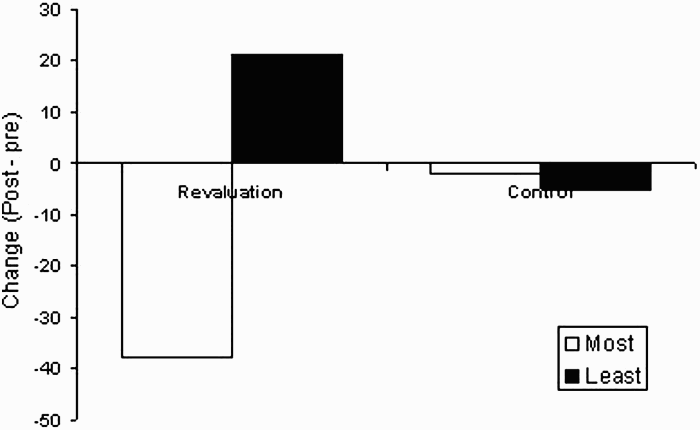
Results from Experiment 2: The mean difference between the test and retest scores for the conditions in which the overselected stimulus was revalued (revaluation) or not (control).
A two-factor ANOVA (Condition × Stimulus) was conducted on these data and revealed a statistically significant main effect of stimulus, F(1, 17) = 17.94, p < .001, and a statistically significant interaction between the two factors, F(1, 17) = 27.35, p < .001, but no statistically significant main effect of condition, F < 1. Simple effects analysis conducted on the stimuli for the two conditions revealed a statistically significant simple effect of stimulus for the revaluation condition, F(1, 17) = 49.00, p < .001, but not for the control condition, F < 1. Simple effects analysis conducted on the conditions revealed a statistically significant simple effect for the previously overselected stimulus, F(1, 17) = 12.08, p < .01, and a statistically significant simple effect for the previously underselected stimulus, F(1, 17) = 10.85, p < .01.
These data confirm that an overselectivity effect can be produced in healthy participants with a concurrent task load (see also the present Experiment 1; Reed & Gibson, 2005). However, they also show that this overselectivity effect can be removed by the revaluation of the previously most selected stimulus. That such a revaluation effect occurs is consistent with previous demonstrations of revaluation in nonhumans using a somewhat similar procedure (Kaufman & Bolles, 1981; Matzel et al., 1985) and with those from humans using quite different procedures (e.g., Vadillo et al., 2008; Wasserman & Berglan, 1998). In the context of overselectivity, these results are difficult for a strict attention-based view to accommodate.
Experiment 3
Experiment 3 aimed to replicate and extend the finding that revaluation of the previously overselected stimulus would subsequently enhance responding to the previously underselected stimulus. Moreover, it also examined the effect of differential amounts of revaluation of the previously overselected stimulus. Previous studies of this effect using individuals with ASD (e.g., Leader et al., 2009; Reed et al., 2009) have always employed a criterion of 10 trials responding away from the previously overselected element in the revaluation phase, as did the current Experiment 2.
Method
Participants and apparatus
Thirty-six volunteers participated in the study (9 male and 27 female). Their ages ranged from 19 to 35 years. None of the participants scored over 32 on the autism spectrum questionnaire. The apparatus was the same as that described in Experiment 1.
Procedure
Each participant completed the study individually. As in Experiment 1, the participants were required to subtract 7 continuously throughout the whole study, starting from a random five-digit number. The participants were randomly divided into three groups, which varied on the number of trials to criterion needed in the revaluation phase of the experiment: Group 5, Group 10, and Group 20.
Training phase
The training phase was the same as that described in Experiment 2, with the exception that only one discrimination was required (i.e., AB+ CD–). On any given trial, participants were presented with one compound stimulus (AB), which if selected by the participant resulted in positive feedback, while selecting the other stimulus (CD) resulted in negative feedback. Participants were said to have acquired the training discrimination once they had produced 10 consecutively correct responses. The actual stimuli that were the elements (i.e., A, B, etc.) were different for each participant, to reduce the possibility of overselectivity being caused by particular stimuli being intrinsically more salient than others.
Test phase
The test phase was the same as that described in Experiment 2, except that there were fewer comparisons tested (i.e., 20) due to there being only one discrimination learnt per group. The stimuli were paired so that the participants had a choice of a previously reinforced element and a previously punished element, and there were five trials for each combination of previously positively reinforced and negatively reinforced components (i.e., A vs. C; A vs. D; B vs. C; B vs. D). No feedback was provided during test trials.
Participants were then required to complete the AQ measure while the experimenter calculated the percentage of times that the participants had selected each of the elements from the previously reinforced compound stimulus in order to discriminate which stimuli were overselected during training and, hence, which to revalue.
Revaluation phase
The card that was selected the most (i.e., the overselected stimulus) was determined (i.e., A or B). Further training trials were conducted involving the overselected stimuli and four previously unseen novel stimuli. Participants were rewarded for choosing the novel stimulus and not the previously overselected stimulus. Group 5 received training until they chose the novel stimuli five times in a row. Group 10 received training until they chose the novel stimuli 10 times in a row. Group 20 received training until they chose the novel stimuli 20 times in a row.
Retesting phase
The same test procedure was used as that in the first testing phase. The retest phase was composed of 20 trials, all comprising components of the complex stimuli.
Results and discussion
The mean trials to reach criterion (10 correct responses) in the training phase for the three groups were: 15.8 (±3.6) for Group 5; 16.9 (±3.5) for Group 10; and 15.3 (±2.9) for Group 20. A one-way ANOVA revealed no statistically significant difference between these scores, F < 1.
The data from the test phase were organized into the percentage of times that the most selected and least selected stimuli were selected; the identities of the actual most and least selected stimuli differed for the participants. This revealed a mean percentage most selected stimulus and a mean percentage least selected stimulus that were similar across the three groups: Group 5, most = 84.1 ± 13.8, least = 60.0 ± 9.7; Group 10, most = 89.2 ± 13.1, least = 62.5 ± 7.4; and Group 20, most = 83.3 ± 12.3, least = 56.7 ± 22.7. A two-factor mixed-model ANOVA (Group × Stimulus) was conducted on these data and revealed a statistically significant main effect of stimulus, F(1, 33) = 35.04, p < .001, but no statistically significant main effect of condition nor an interaction, Fs < 1.
As in Experiment 1, further analysis of these data was undertaken, based on binomial theory, as described by Reynolds and Reed (2011), to determine whether the deviation in the times that the most selected and least selected stimuli were chosen was statistically greater than would be expected by random chance around an average probability of selection of the two stimuli. The expected differences were 15.7% for Group 5, t(11) = 9.43, p < .001; 15.0% for Group 10, t(11) = 12.18, p < .001; and 16.0% for Group 20, t(11) = 14.6, p < .001. These data suggest that a significant overselectivity effect was obtained in all cases.
The actual number of trials in revaluation for each group was noted, and these were: 9.7 (±1.7) for Group 5; 17.3 (±3.8) for Group 10; and 24.0 (±1.9) for Group 20; F(2, 33) = 89.61, p < .001; all pairwise comparisons were statistically significant according to Tukey's HSD tests, all ps < .05.
The change in the percentage time that the two stimuli were chosen (post minus pre revaluation) is shown in Figure 4. Inspection of these data shows a clear downward trend in the change in the previously most selected stimulus as the level of revaluation training increased. However, there was no difference in the increase in the number of times that the previously underselected stimulus was chosen across the groups. A two-factor ANOVA (Group × Stimulus) was conducted on these data and revealed only a marginally statistically significant main effect of group, F(2, 33) = 3.14, p < .06, but a statistically significant main effect of stimulus, F(1, 33) = 64.87, p < .001, and a statistically significant interaction between the factors, F(2, 33) = 4.09, p < .05. Simple effects analysis revealed that there was a statistically significant difference between the groups in the amount of decrease for the previously most selected stimulus after it had been revalued, F(2, 33) = 7.23, p < .05. Tukey's HSD tests revealed all pairwise comparisons to be statistically significant, ps < .05. There was no statistically significant simple effect of group on the change in the underselected stimulus, F < 1. There were statistically significant differences between the changes in the stimuli (previously most selected stimulus versus previously least selected stimulus) after revaluation for all groups, smallest F(1, 33) = 8.47, p < .01.
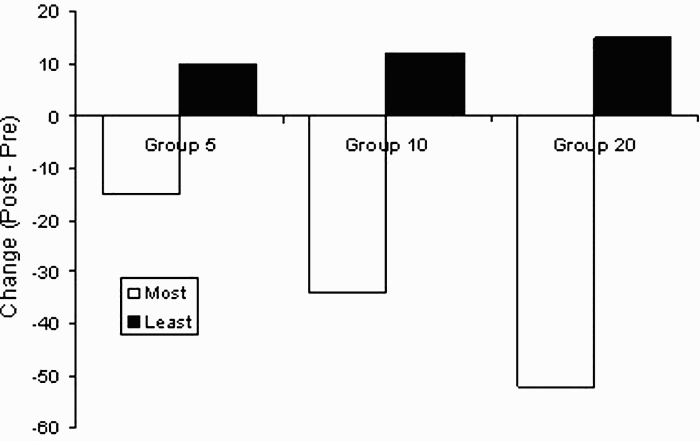
Results from Experiment 3: The mean difference between the test and retest scores for the three groups receiving different numbers of revaluation trials.
As in Experiments 1 and 2, these data suggest that an overselectivity effect can be produced in healthy participants with a cognitive load (see also Reed & Gibson, 2005). However, this effect can be removed by the revaluation of the previously most selected stimulus. That such a revaluation effect occurs is consistent with previous demonstrations of revaluation in humans (Leader et al., 2009; Vadillo et al., 2008; Wasserman & Berglan, 1998). It also confirms that the attention-based view of overselectivity cannot easily accommodate all aspects of the effect.
It should be noted that that different numbers of revaluation trials for the most selected stimulus influenced the response to this stimulus, with more revaluation resulting in greater changes. However, there was no corresponding effect of the number of revaluation trials on responding to the previously least selected stimulus—in all cases, this changed by the same amount. This pattern of results is inconsistent with attention-based views of overselectivity, for if the underselected stimulus simply had been ignored and, thus, not well learned about during training, then revaluation of the overselected stimulus should be without effect on the underselected stimulus. However, these results can be explained in terms of the theoretical analyses of unovershadowing described earlier. For example, presenting the most selected stimulus in extinction would result in the retrieval of representations of both the underselected stimulus and the relevant outcome. The modified standard operating procedures (MSOP; Dickinson & Burke, 1996) model suggests that this concurrent retrieval of the two representations is sufficient to support the formation of an association between them—thus allowing for responding to the previously underselected stimulus to increase. However, repeated presentation of the overselected stimulus will reduce its ability to retrieve both the underselected stimulus and the previous outcome. Thus, repeated presentation of the overselected stimulus will have diminishing effects on the underselected one.
Experiment 4
The final experiment examined the effect of using multiple exemplars in the revaluation phase. This procedure was adopted in previous studies (e.g., Broomfield et al., 2008; Leader et al., 2009; Reed et al., 2009) as it was assumed that the use of only one novel stimulus during the revaluation phase may produce a situation in which participants were being trained on a conditional discrimination between the novel stimulus and the previously overselected stimulus, such that, in the presence of a novel stimulus (e.g., X) and the previously overselected stimulus (e.g., A), participants learnt to choose X. However, when retested using the original stimuli, participants reverted to their previously learnt selection pattern in the absence of X.
It is unclear whether the use of single or greater numbers of alternatively reinforced cues would produce the same effects in the current procedure. Recent work from the behaviour analytic literature would suggest that the revaluation effect would be stronger with the use of multiple exemplars, as the employment of such multiple exemplars has been found to strengthen the effects of the procedures for which they are employed (e.g., Greer & Ross, 2008). Again, it would be predicted that greater revaluation of the target stimulus should lead to greater emergence of control in the previously underselected stimulus. Experiment 4 aimed to address this issue by the comparison of three groups: one in which only a single exemplar was used, one in which four exemplars were employed, and one in which eight exemplars were employed
Method
Participants and apparatus
Forty-five volunteers participated in the study (18 male and 27 female). Their ages ranged from 20 to 48 years (25.60 ± 8.1). None of the participants scored over 32 on the AQ questionnaire. The apparatus was the same as that described in Experiment 1, with the addition of a number of extra novel stimuli, drawn from the same sets, for the revaluation phase of the experiment.
Procedure
Each participant completed the study individually. As in Experiment 1, the participants were required to subtract 7 continuously throughout the whole study, starting from a random five-digit number. The participants were randomly divided into three groups, which varied on the number of exemplars to be used in the revaluation phase: Group 1, Group 4, and Group 8.
Training phase
The training phase was the same as that described in Experiment 2, with only one discrimination (e.g., AB vs. CD) used in each group. On any given trial, participants were presented with one compound stimulus (e.g., AB), which if selected by the participant resulted in positive feedback, while selecting the other stimulus (CD) resulted in negative feedback. Participants were said to have acquired the training discrimination once they had produced 10 consecutively correct responses. The actual stimuli that were the elements (i.e., A, B, etc.) were different for each participant, to reduce the possibility of overselectivity being caused by particular stimuli being intrinsically more salient than others.
Test phase
The test phase was the same as that described in Experiment 3, except that there were fewer comparisons tested (i.e., 20) due to there being only one discrimination learnt per group. The pictures were paired so that the participants had a choice of a previously reinforced element and a previously punished element, and there were five trials for each combination of previously positively reinforced and negatively reinforced components (i.e., A vs. C; A vs. D; B vs. C; B vs. D). No feedback was provided during test trials.
Participants were then required to complete the AQ measure while the experimenter calculated the percentage of times that the participants had selected each of the elements from the previously reinforced compound stimulus in order to discriminate which stimuli were overselected during training and, hence, which to revalue subsequently.
Revaluation phase
The card that was selected the most (i.e., the overselected stimulus) was determined (i.e., A or B). Further training trials were conducted involving the overselected stimuli and previously unseen novel stimuli. Participants were rewarded for choosing the novel stimulus and not the previously overselected stimulus. Group 1 received only one novel stimulus, which was always presented, and reinforced, along with the overselected stimulus. Group 4 received four novel stimuli, as described in Experiment 1. Group 8 received eight novel stimuli in this phase. This training continued until the participants choose the novel stimulus 10 times consecutively.
Retesting phase
The same test procedure was used as that in the first testing phase. The retest phase was composed of 20 trials, all comprising components of the complex stimuli.
Results and discussion
The mean trials to reach criterion (10 correct responses) in the training phase for the three groups were: 14.5 (±3.2) for Group 1; 14.6 (±2.7) for Group 4; and 13.9 (±2.7) for Group 8. A one-way ANOVA revealed no statistically significant difference between these scores, F < 1.
The data from the test phase were organized into the percentage of times that the most selected and least selected stimuli were selected; the identities of the actual most and least selected stimuli differed for the participants. This revealed a mean percentage most selected stimulus and a mean percent least selected stimulus that were similar across the three groups: Group 1, most = 73.3 ± 15.9, least = 57.3 ± 13.9; Group 4, most = 78.0 ± 13.7, least = 51.3 ± 21.0; and Group 8, most = 78.7 ± 15.5, least = 54.0 ± 13.0. A two-factor mixed-model ANOVA (Group × Stimulus) was conducted on these data and revealed a statistically significant main effect of stimulus, F(1, 42) = 109.86, p < .001, but no statistically significant main effect of condition nor an interaction, ps > .1.
As in Experiment 1, further analysis of these data was undertaken, based on binomial theory, as described by Reynolds and Reed (2011), to determine whether the deviation in the times that the most selected and least selected stimuli were chosen was statistically greater than would be expected by random chance around an average probability of selection of the two stimuli. The expected differences were 16.7% for Group 1, t(14) = 14.00, p < .001; 16.8% for Group 4, t(14) = 11.32, p < .001; and 16.7% for Group 8, t(14) = 16.40, p < .001. These data suggest that a significant overselectivity effect was obtained in all cases.
To demonstrate that the groups received equal exposure to the stimuli in the revaluation phase and, thus, differed only in the number of exemplars given and not in the extinction (which would make this study a replication of Experiment 3), the number of trials in revaluation for each group was noted, and these were: 15.8 (±3.0) for Group 1; 15.1 (±3.1) for Group 4; and 14.7 (±2.7) for Group 8, F < 1.
The change in the percentage time that the two stimuli were chosen (post minus pre revaluation) is shown in Figure 5. Inspection of these data shows a clear downward trend in the change in the previously most selected stimulus as the level of revaluation training increased. However, there was no difference in the increase in the number of times that the previously underselected stimulus was chosen across the groups. A two-factor ANOVA (Group × Stimulus) was conducted on these data and revealed only a marginally statistically significant main effect of group, F(2, 42) = 2.74, p > .07, but a statistically significant main effect of stimulus, F(1, 42) = 78.56, p < .001, and a statistically significant interaction between the factors, F(2, 42) = 3.17, p < .05. Simple effects analysis revealed that there was a statistically significant difference between the groups in the amount of decrease for the previously most selected stimulus after it had been revalued, F(2, 42) = 5.90, p < .05. Tukey's HSD tests revealed all pairwise comparisons to be statistically significant, ps < .05. There was no statistically significant simple effect of group on the change in the underselected stimulus, F < 1. There were statistically significant differences between the changes in the stimuli (previously most selected stimulus versus previously least selected stimulus) after revaluation for all groups, smallest F(1, 42) = 11.21, p < .01.
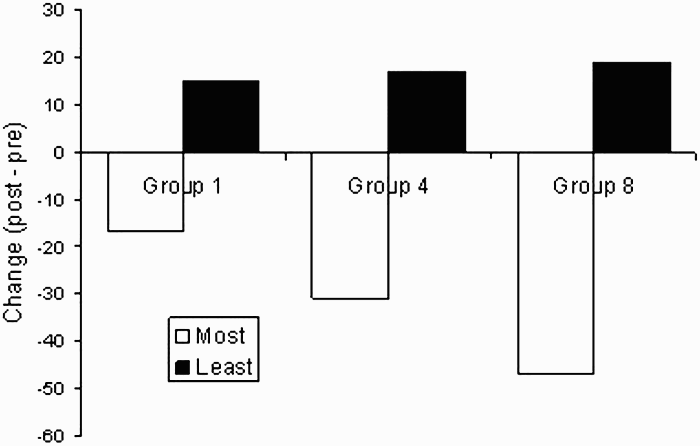
Results from Experiment 4: The mean difference between the test and retest scores for the three groups receiving different numbers of novel exemplars in the revaluation trials.
As in the previous studies reported here, these data suggest that an overselectivity effect can be produced in healthy participants with a cognitive load. In this experiment, the overselectivity effect was removed by the revaluation of the previously most selected stimulus, which, as with Experiment 3, is problematic for a strict attention-view of this finding.
However, as with Experiment 3, there was no differential effect of the revaluation of the previously most selected stimulus on the emergence of stimulus control by the previously underselected stimulus. The differential revaluation procedure using different levels of exemplars had the expected differential effects on the revaluation of the previously most selected stimulus (see Greer & Ross, 2008). However, as in Experiment 3 but using a different manipulation, this was not translated into differential effects on the previously least selected stimulus.
General Discussion
The present experiments had two main aims: to replicate the overselectivity effect in normally developing adults with the addition of a concurrent cognitive load, and to explore whether a retrospective revaluation effect could be obtained in such an overselectivity/overshadowing procedure in humans. In turn, this would have implications for understanding the nature of the overselectivity effect.
The studies found that stimulus overselectivity could be generated in adult subjects who presented no form of autism or learning disability. These results support previous findings of Reed and Gibson (2005; McHugh & Reed, 2007) who found that such overselectivity could be generated by the addition of a cognitive load. One criticism raised concerning the study conducted by Reed and Gibson (2005) was that there was no test to screen for Asperger's syndrome or high functioning autism, and, thus, some of the participants may have scored highly on the autistic continuum, accounting for the results. The current study included such a test (Baron-Cohen et al., 2001), ensuring that overselectivity that was observed was induced in participants without developmental disabilities. The present Experiment 1 also included control to establish that the overselectivity effect was the product of compound presentation of the stimuli, demonstrating that there was no differential control by the stimuli when they were presented separately.
The second aim of the current study was to explore whether retrospective revaluation effects could be obtained for overselectivity effects using an unovershadowing-like procedure (see Kaufman & Bolles, 1981; Matzel et al., 1985; Vadillo et al., 2008). It was found that previously underselected stimuli did emerge to control behaviour when the overselected stimuli were extinguished (Experiments 2, 3, and 4). This finding reflects previous work with developmentally disabled individuals (see Leader et al., 2009; Reed et al., 2009), but demonstrates the effect in adults with no developmental disabilities.
These current findings suggest that overselectivity is not likely to be just the result of an attention problem (Dube, 2009; Dube & McIlvane, 1999; Lovaas et al., 1971). Such a view would suggest that stimuli that were not attended to should not have been encoded, and no amount of revaluation of the overselected stimulus would subsequently impact their ability to control behaviour. Thus, that emergence of the underselected stimulus was noted in Experiments 2, 3, and 4 is problematic for such a view. Of course, such findings have been seen previously in clinical participants (e.g., Leader et al., 2009; Reed et al., 2009), but there have been few demonstrations in nonclinical populations.
It might be suggested that the reduction in the power of the previously overselected stimulus was controlled by one process (punishment/extinction), but that the emergence of the previously underselected stimulus was controlled by another and separate process—generalization of strength from the novel stimuli used in the revaluation phase. While this remains a possibility, it should be noted that there was no such generalization between the novel stimuli and the elements of a compound whose elements had not undergone revaluation (see control group in Experiment 2). Moreover, it is possible that increasing the amount of training that the novel target received, as in Experiment 3, should have served to increase the generalized tendency to select the least selected cue, which it did not. These considerations suggest that the revaluation effect is, to some extent, dependent upon association being formed between the elements of a compound, one of whose elements is subsequently involved in the revaluation training.
Thus, the experiments reported here support the view that overselectivity is not the result of a cognitive attention-based mechanism, but rather may reflect learning processes, perhaps similar to those seen in overshadowing. The findings do support the theory that underselected stimuli are attended to, but do not control behaviour until the revaluation of overselected stimuli.