







Abstract
Reaction time is typically increased following an erroneous response. This post-error slowing is traditionally explained by a strategic adjustment of response threshold towards more conservative behaviour. A recently proposed orienting account provides an alternative explanation for post-error slowing. According to this account, committing an error evokes an orienting response (OR), which inhibits information processing in the subsequent trial, resulting in slow and inaccurate performance. We tested a straightforward prediction of the orienting account in the context of self-paced performance, adopting an individual-differences approach: Post-error slowing should be larger the less frequent an error is. To this end, participants were classified into three groups differing in overall performance accuracy. Larger post-error slowing and stronger post-error accuracy decrease were observed for the high-accuracy group than for the two other groups. Practice pronounced the post-error accuracy decline, especially for the high-accuracy group. The results are consistent with the orienting account of post-error slowing but are problematic for accounts based on strategic evaluation mechanisms.
Keywords
Since Kraepelin (1902), self-paced speed tests have been employed to assess the ability to sustain mental focus and concentration over extended time periods (cf. Van Breukelen et al., 1996, for a review). Individuals in these tasks are usually required to continuously respond to a series of successively presented imperative signals (IS). Each IS follows immediately after responding to the previous one, and no feedback is given after errors. It is therefore surprising that individuals can efficiently detect any errors that they make—they do so even when explicitly instructed to ignore them (Rabbitt, 1966). An indication that response errors are expeditiously detected is the observation that responses are often slower after errors than after a correct trial—known as the post-error slowing effect (Laming, 1979). Post-error slowing is particularly large in self-paced tasks, or tasks where the response–stimulus interval is below 50 ms (Jentzsch & Leuthold, 2006), but gradually decreases when the response–stimulus interval is prolonged within blocks of trials (e.g., Jentzsch & Dudschig, 2009). A standard interpretation of the effect is that individuals actively evaluate their own performance and adjust their speed–accuracy balance towards a more conservative criterion whenever they detected an erroneous response (e.g., Botvinick, Braver, Barch, Carter, & Cohen, 2001; Brewer & Smith, 1984).
Although commonly accepted, several empirical findings do not fit with the assumption of a strategic-monitoring and adjustment of response strategy after errors. For example, post-error slowing has often been found to be accompanied by a post-error accuracy decrease (e.g., Hajcak, McDonald, & Simons, 2003; Hochman & Meiran, 2005), whereas an increase is predicted by strategic models. Recently, Notebaert and colleagues (Notebaert et al., 2009; Notebaert & Verguts, 2011; Verguts, Notebaert, Kunde, & Wühr, 2011) reported further results that are at variance with the strategic account. In one of these studies, Notebaert et al. (2009) required their participants to perform a four-alternatives choice colour discrimination task in which accuracy was dynamically adjusted by an adaptive manipulation of discrimination difficulty. By means of this procedure, Notebaert and colleagues compared participants' post-error performance in three accuracy conditions (75%, 55%, and 35% correct responses). Crucially, post-error slowing decreased from the high-accuracy condition to the medium-accuracy condition and even reversed to a post-correct slowing for the low-accuracy condition. Clearly, this finding is at variance with the strategic account of post-error slowing because this account predicts the opposite pattern of results.
Based on these findings, Notebaert and al. (2009) proposed an orienting account of post-error slowing. This account relies on the assumption that infrequent errors act as oddballs and therefore automatically cause an orienting response (OR), defined as the immediate orienting of attention, away from the current task, towards novel and significant events in the environment (cf. Sokolov, Spinks, Näätänen, & Lyytinen, 2002), which elicits arousal and inhibits subsequent processing. Since the likelihood of an erroneous response is usually less than the likelihood of a correct response, an OR is more likely to be evoked by an error than by a correct response and results in post-error slowing. If, however, errors are more frequent than correct responses, as in the low-accuracy condition of Notebaert et al. (2009), an OR is elicited by correct instead of erroneous responses, resulting in post-correct slowing. In contrast to strategic accounts, the orienting account thus assumes that post-error slowing is not caused by strategic adaptive-control mechanisms but by an automatic orienting response to an infrequent error.
The present study aimed to provide a further test for the orienting account of post-error slowing by examining post-error phenomena within the context of self-paced continuous performance and adopting an individual-differences strategy (e.g., Maylor & Rabbitt, 1995). Specifically, a large sample of participants was tested in a self-paced continuous performance tasks and was then classified into groups of different accuracy. According to the orienting account (Notebaert et al., 2009), slower but less accurate responses should be observed following an error because erroneous responses automatically evoke an OR that interferes with subsequent task processing as long as errors are rare events (oddballs). Specifically, the orienting account implies that highly accurate (compared to lowly-accurate) individuals should exhibit enhanced error reactivity, because the characteristic of an error as an oddball is especially pronounced for this group. Furthermore, it is conceivable that practice (due to retesting) may result in higher error reactivity for all groups, because it should lower overall error rates and thus may sharpen the oddball characteristic of an erroneous response.
Method
Participants
A student-based sample of 99 volunteers (44 male, 55 female; mean age = 24.5 years, SD = 5.1 years) participated in the study. Most of them were right-handed (9 left-handed), and all of them had normal or corrected-to-normal vision. All of them reported to be in good health condition. The sample was recruited via advertisements on the university campus of the Dresden University of Technology. Participants obtained course credit points or money for participation and received feedback after the testing sessions.
Task
The Serial Mental Addition and Comparison Task (SMACT) version adopted here requires participants to self-pace their work speed, since each item in a trial is presented until response and is replaced immediately after the response by the next item. As in other self-paced speed tests, no feedback is given, neither for erroneous responses nor for too slow responses. In each trial, an addition term together with a single number is presented; both are spatially separated by a vertical bar (e.g., “4 + 5 | 10”). Figure 1 shows a schematic illustration of the task procedure. Participants are required to solve the addition task and to compare the result with the numerical value of the single number. This value was either one point smaller or one point larger than the result of the addition but never of equal value. Participants were required to indicate the larger numerical value by pressing either the left or right shift key as fast as possible, in accordance with the side the larger value was presented at. When the value on the left side was larger (e.g., “2 + 3 | 4”), they had to respond with the left key, and when the number value on the right side was larger (e.g., “5 | 2 + 4”), they had to respond with the right key. A large set of 148 items (problem size ranging from 4 to 19) was used to prevent participants from building item-specific stimulus–response associations. Each item was presented only four times during a session, amounting to a total of 592 randomly presented trials.
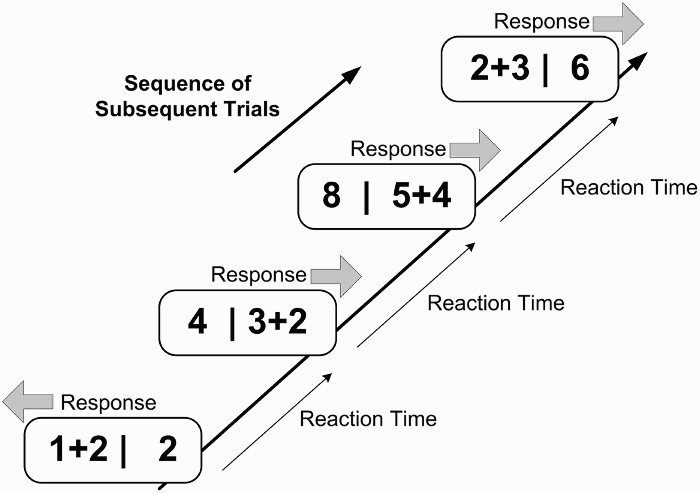
Example of a typical sequence of trials in the Serial Mental Addition and Comparison Task (SMACT). Individuals are required to solve the addition term and then to compare the solution with the number value on the other side. They are required to respond towards the larger number value. The task is self-paced since each new item appears immediately after participants have responded to the previous one.
Procedure
Altogether, the task lasted about 30 min. The experiment took place in a noise-shielded room and was run on a standard IBM-compatible personal computer with colour display (19′, 150 Hz frequency), using the software Behringer Experimental Runtime System (ERTS; BeriSoft GmbH) for task presentation and response recording. Participants were seated at a distance of about 60 cm in front of the screen, and the stimuli were presented at the centre of the screen. The SMACT was administered twice within a test–retest interval of three days.
Results
Participants were classified into three groups according to their overall accuracy (high: 98.8%; medium: 97.7%; low: 94.3%), so that each group contained 33% of the entire sample. The analysis of variance (ANOVA) included the between-subjects factor group and the within-subjects factors trial sequence (post-correct vs. post-error) and practice (Session 1 vs. Session 2). Median response time (RT) for correct responses and error rate in trial n served as dependent variables. Correct responses shorter than 100 ms were regarded as anticipations and were excluded from analysis. Figure 2 displays RT and accuracy as a function of group and trial sequence, separately for Session 1 (Panels A, C) and Session 2 (Panels B, D).
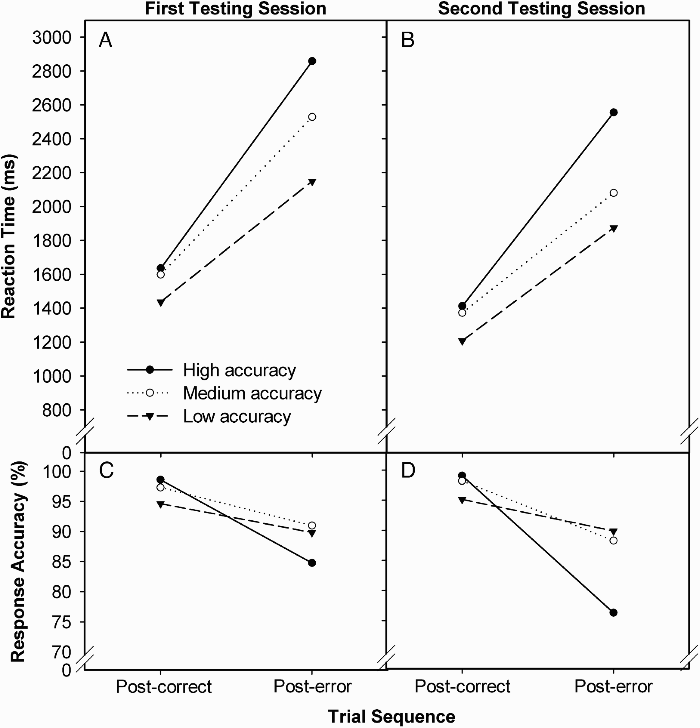
Reaction time and response accuracy in the Serial Mental Addition and Comparison Task (SMACT) as a function of group (high accuracy vs. medium accuracy vs. low accuracy) and trial sequence (post-correct vs. post-error) separately for the first (Panels A, C) and second (Panels B, D) testing sessions.
The ANOVA for RT revealed a significant effect of group, F(2, 95) = 7.4, η2p = .13, p < .001, with RT being longest for the high-accuracy but shortest for the low-accuracy group. The effect of trial sequence was also significant, F(1, 95) = 187.1, η2p = .66, p < .001, reflecting a post-error slowing effect of 897 ms. In addition, the factor practice reduced overall median RT by 284 ms, F(1, 95) = 187.1, η2p = .66, p < .001. Importantly, and consistent with the orienting account of post-error slowing (Notebaert et al., 2009), the amount of post-error slowing differed between groups, F(2, 95) = 5.0, η2p = .10, p < .01, and was larger for the high-accuracy (1,184 ms) than for the medium-accuracy group (819 ms) and the low-accuracy group (689 ms).
Consistent with the orienting account (Notebaert et al., 2009), accuracy performance was substantially lower following an erroneous (86.7%) than following a correct response (97.1%), F(1, 95) = 245.3, η2p = .72, p < .001. Practice resulted in slightly increased accuracy in post-correct trials (Session 1: 96.8%; Session 2: 97.5%), whereas it decreased accuracy in post-error trials (Session 1: 88.5%; Session 2: 84.8%), F(1, 95) = 13.3, η2p = .12, p < .001. Importantly, the post-error decrease of performance accuracy was larger for the high-accuracy group (18.4 percentage points) than for the medium-accuracy group (8.2 percentage points) and the low-accuracy group (5.0 percentage points), F(2, 95) = 35.9, η2p = .43, p < .001. This pattern was even enhanced by practice, as was reflected by the significant three-way interaction of group, trial sequence, and practice, F(2, 95) = 4.4, η2p = .08, p < .05.
Discussion
A recently proposed orienting account of post-error slowing (Notebaert et al., 2009) argues that post-error slowing results from an automatic OR that inhibits subsequent task-related processing. The present study tested the predictions of this account by adopting an individual-differences approach in a large sample, within the context of a self-paced RT task. Specifically, we compared performance of three groups differing in their overall accuracy (high vs. medium vs. low), but in a situation (self-paced task) where overall performance accuracy was considerably high on average (>95%) and where individual differences in overall performance accuracy were rather small. In summary, the present study revealed that individual differences associated with performance accuracy can substantially modulate post-error reactivity. The more accurately participants worked overall, the slower and less accurate their responses were following an erroneous response. Test–retest practice even enhanced this pattern (by slightly increasing overall performance accuracy), at least for post-error accuracy.
These results are clearly consistent with and extend previous findings of Notebaert et al. (2009), who reported a similar pattern of results for a within-subjects manipulation of response accuracy, with average overall accuracy being much lower (35–75%) than that in the present experiment. Thus, the finding that the post-error response slowing and the post-error accuracy decrease depend on overall accuracy is not restricted to situations in which accuracy is manipulated in an extreme fashion. Instead, it generalized to a situation in which (a) the task was self-paced (i.e., the response–stimulus interval was zero), (b) overall accuracy was relatively high on average, (c) interindividual differences in overall accuracy were rather small (differing from 94% to 99% between groups), and (d) no feedback about performance accuracy was provided. According to Burns (1971), these experimental features are important pre-conditions to reveal an error-induced OR, since an evoked OR decays over time (e.g., with long response–stimulus intervals).
Our results further revealed that practice increased overall accuracy following correct responses, whereas it decreased accuracy following erroneous responses. Importantly, this effect again was larger in the high-accuracy group than in the two other groups. On the first glance, this finding seems to be paradoxical, since individuals with almost perfect response accuracy after correct responses (∼99% accurate responses) turned to being the most inaccurate ones after erroneous responses. This result, however, is perfectly consistent with the assumption of an OR as source of post-error behaviour (cf. Burns, 1971; Notebaert et al., 2009), according to which the likelihood of an OR following an erroneous response should be negatively related to the frequency of committing an error. That is, the more infrequent errors are (i.e., the more oddball property the error has), the better an error can be detected (cf. Coles, Scheffers, & Holroyd, 2001, p. 174; Falkenstein, Hoormann, Christ, & Hohnsbein, 2000; Holroyd, Yeung, Coles, & Cohen, 2005, p. 182) and the more likely an OR should be elicited by an error. 1
It should be noted here that errors do not always induce negative effects on performance such as a decline in performance accuracy, but can (under some circumstances) also reactivate an individual's attention to the task at hand, yielding an increase in post-error accuracy (cf. Laming, 1979). A challenge for future research therefore is to reveal and establish particular cases and situations where errors induce either an OR (yielding interference in the subsequent trial) or a real strategic adjustment of the response criterion. Probably, the time available to re-collect the mind after an error is an important prerequisite to observe strategic effects on performance; hence the response–stimulus interval should be considered a critical variable in future error-processing research (cf. Dudschig & Jentzsch, 2009; Jentzsch & Dudschig, 2009).
The present results are also partly consistent with previous findings of Maylor and Rabbitt (1995). These authors classified their participants in two groups based on their intelligence scores and tested them in a visual four-choice RT task. Longer overall RTs and larger post-error slowing were observed for the low-intelligence than for the high-intelligence group, with post-error slowing being proportional to overall RT. Hence, the pattern of results regarding the relationship of overall RT and post-error slowing was similar to the one observed in the present study. The different groups of participants in the Maylor and Rabbitt study, however, did not differ in accuracy performance. Thus, their study does not allow for any conclusions regarding the orienting account. From an orienting-account perspective, this finding could be explained such that low-intelligent individuals may become more severely startled after an error than their highly intelligent counterparts.
One limitation of the orienting account of post-error slowing is that it is rather silent to the nature of the orienting response. Traditionally, OR research has focused on deviant environmental stimuli, which are thought to automatically attract attention. In regard to error processing, however, it is rather unclear to which specific internal process(es) participants orient to following an error. Some authors therefore have proposed that an error acts as an aversive event producing a defence response rather than an orienting response (cf. Hajcak & Foti, 2008). Clearly, such a defence response could also account for the present results. Because both an orienting response and a defence response are thought to pull away attention from task-specific processing, these two possibilities are not mutually exclusive but can be rather seen as two faces of the same coin. Sokolov et al. (2002) even argued that an evoked OR elicits arousal that can intensify both positive or negative affect, depending on whether an unexpected outcome is better or worse than expected (cf. Holroyd et al., 2005, p. 164).
It should be noted, that alternative accounts for post-error slowing have been proposed. For example, Jentzsch and Dudschig (2009) argued that post-error slowing is caused by a centrally demanding error monitoring process, which leads to a post-error refractory period of about 200–300 ms. Consequently, central information processing in the subsequent trial gets postponed until this refractory period is over. In general, such a resource-demanding process of checking for the correctness of a delivered response can also account for post-error slowing phenomena. However, the account of Jentzsch and Dudschig (2009) has no straightforward prediction available regarding effects of error frequency on post-error reactivity and therefore cannot explain easily why post-error reactivity is larger in highly accurate than in low-accurate individuals. To account for this pattern, this model would have to include the additional assumption that rare errors result in a longer post-error refractory period than frequent errors.
Another alternative account assumes that during an experiment, participants undergo periods of low attentional efficiency, or lapses of attention, respectively (Gehring, Goss, Coles, Meyer, & Donchin, 1993). As a consequence, errors often occur within recurrent periods of cognitive inefficiency that are accompanied by an increase in both error liability and response-speed variability. According to Van Breukelen et al. (1996), these periods of low attentional efficiency occur especially in self-paced tasks, since participants in these tasks cannot take a rest between trials, resulting in accumulated attentional overload. This account can explain both post-error slowing and post-error accuracy decrease. However, it cannot explain why highly accurate participants exhibit especially large post-error reactivity. In order to account for this specific result, this account would need to include the additional assumption that highly accurate participants suffer more from accumulated attentional overload than lowly-accurate participants.
Considering the possibility that highly accurate individuals tend to invest particular effort for continuous monitoring of performance accuracy during a self-paced task, one would predict from the Gehring et al. (1993) account that highly accurate individuals less frequently undergo periods of low efficiency, but that the consequences these periods have on performance are more severe for these individuals. There is experimental evidence that supports this assumption. For example, if the task instruction puts emphasis on accuracy rather than speed, increased post-error reactivity has been observed, compared to when the instruction emphasizes speed at the expense of accuracy (Jentzsch & Leuthold, 2006). Similarly, if monetary incentives motivate individuals to put emphasis on accuracy (by penalizing erroneous behaviour), post-error reactivity has been shown to become more pronounced (Gehring et al., 1993). Hence, given that current motivation to perform well affects overall performance accuracy, this should cause a larger error-related OR (Notebaert et al., 2009), which then should result in stronger interference, conceptualized by Jentzsch and Dudschig (2009) as a longer post-error refractory effect.
Taken together, our results indicate that post-error performance in self-paced speed tests is substantially determined by automatic (i.e., by inhibition of ongoing processing activity, due to an OR) rather than by top-down control mechanisms (i.e., strategic evaluation and adjustments of response strategy). This is supported by the fact that even a subtle difference in overall response accuracy between groups yielded a substantial difference in post-error performance of these groups. Of course, one should have in mind that the groups in our study do not represent an experimentally manipulated but an individual-differences variable in which individuals self-select themselves into the different groups. Future research should thus consider trait variables that have been related to overall performance accuracy. Yet, the finding that practice (by decreasing error rate) independently resulted in a more pronounced post-error accuracy decline indicates that an increase in post-error reactivity can also be induced experimentally. By showing that committing an error results in a severe performance decline in the subsequent trial that was clearly dependent on individual differences in accuracy, the present study may be relevant for scientists in both basic and applied domains interested in human performance reliability.