






Abstract

In Volume 64, Issue 12 of The Quarterly Journal of Experimental Psychology (December 2011), pp. 2405–2424, the incorrect version of ‘There goes the neighbourhood: Contextual control over the breadth of lexical activation when reading aloud’ by Michael G. Reynolds and Derek Besner was published.
The publisher, Psychology Press, would like to apologise to the authors and to the readers for this error.
The correct article with all corrections has now been published online and can be found here.
In particular, we should like to draw your attention to corrections made to Tables 4, 5 and 6, and to several updated references. The correct versions of the tables and the updated references are shown below as well as in the online version of the article.
Mean RTs and percentage error for pseudohomophones as a function of base-word frequency, neighbourhood density, and list context
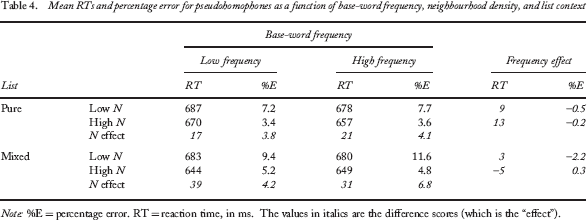
Note: %E = percentage error. RT = reaction time, in ms. The values in italics are the difference scores (which is the “effect”).
Cycles to criterion in DRC for the broad and narrow lexical activation parameter sets as a function of minimum naming parameter, base-word frequency, and neighbourhood density for the stimuli used in the present experiment
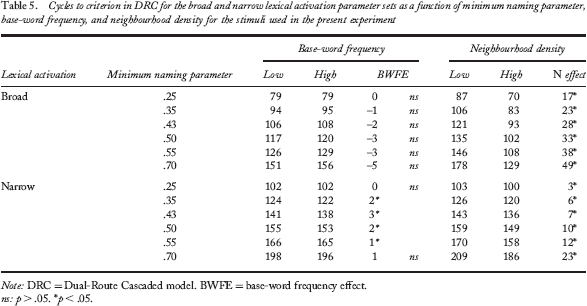
Note: DRC = Dual-Route Cascaded model. BWFE = base-word frequency effect.
ns: p > .05.
p < .05.
Mean cycles to criterion in CDP+ as a function of minimum naming parameter, base-word frequency, and neighbourhood density for the stimuli used in the present experiment
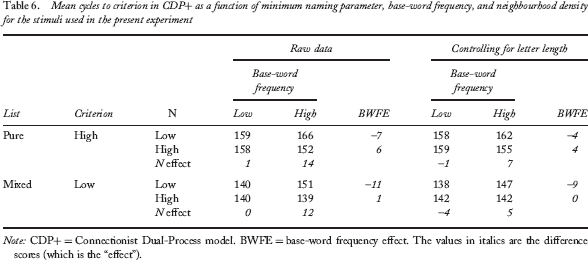
Note: CDP+ = Connectionist Dual-Process model. BWFE = base-word frequency effect. The values in italics are the difference scores (which is the “effect”).