







Abstract
The original aim was to examine the effect of perceived distance, induced by the Ponzo illusion, on left/right asymmetries for line bisection. In Experiment 1, university students (n = 29) made left/right bisection judgements for lines presented in the lower or upper half of the screen against backgrounds of the Ponzo stimuli, or a baseline. While the Ponzo illusion had relatively little effect on line bisection, elevation in the baseline condition had a strong effect, whereby the leftward bias was increased for upper lines. Experiment 2 (n = 17) eliminated the effect of elevation by presenting the line in the middle and moving the Ponzo stimuli relative to the line. Despite this change, the leftward bias was still stronger in the upper condition in the baseline condition. The final experiment (n = 17) investigated whether upper/lower visual stimulation, which was irrelevant to the task, affected asymmetries for line bisection. The results revealed that a rectangle presented in the upper half of the screen increased the leftward line bisection bias relative to a baseline and lower stimulation condition. These results corroborate neuroimaging research, showing increased right parietal activation associated with shifts of attention into the upper hemispace. This increased right parietal activation may increase the leftward attentional bias—resulting in a stronger leftward bias for line bisection.
The original motivation for this set of experiments was to use the Ponzo illusion to examine the effects of perceived depth on attentional asymmetries. This part of the study proved to be less important and interesting than the subsequent outcome, which demonstrated an unexpected effect of elevation on attentional asymmetries. In the interest of explaining our methodological choices, however, we begin by outlining our original motivations and then, based on the data observed, move towards our revised thinking.
The brain represents near (within reach) and far (outside reach) space with different cognitive and neural mechanisms, perhaps related to the dorsal (intraparietal sulcus) and ventral (medial temporal cortex) streams, respectively (Weiss et al., 2000; see Konen & Kastner, 2008, for a review). Studies of patients with spatial neglect, who fail to attend to one side of space (Nichelli, Rinaldi, & Cubelli, 1989), demonstrate that shifts of attention along the near/far axis interact with attention along the left/right axis. For stimuli placed in near space, the neglect manifests as an inability to attend to stimuli placed in the contralesional (left) hemispace (Nichelli et al., 1989). A dissociation has been observed whereby some patients show leftward neglect for objects in near space (Halligan & Marshall, 1991) while other patients only show left neglect for stimuli located in far space (Vuilleumier, Valenza, Mayer, Reverdin, & Landis, 1998).
Manipulations of distance also affect attentional asymmetries in the intact brain. For near stimuli, the features on the left usually receive more attention than the features located on the right. For tasks such as line bisection, this attentional bias (also known as pseudoneglect) causes participants to place the bisector to the left of the true middle. When the line bisection stimuli are placed in far space, the leftward bisection bias can be annulled (Bjoertomt, Cowey, & Walsh, 2002; McCourt & Garlinghouse, 2000) or reversed towards a rightward bisection bias (Longo & Lourenco, 2006).
The effect of distance on attentional asymmetries has traditionally been investigated by physically moving the stimulus from near to far space (e.g., Longo & Lourenco, 2006; McCourt & Garlinghouse, 2000). Recently, Nicholls et al. (2011) demonstrated that shifts in the representation of near and far also have an effect. They presented prebisected lines against backgrounds depicting objects in near (e.g., a light switch) or far (e.g., a building facade) space. They found the typical leftward bisection bias for lines superimposed against a near background, which reversed to a rightward bias for lines superimposed over a distant background. Therefore, despite the fact that the stimuli were at the same physical distance, the manipulation of the background from near to far had an effect that was analogous to physically moving the stimuli.
The initial motivation for this set of experiments was to determine whether the manipulation of distance used by Nicholls et al. (2011) could be reproduced using visual illusions of distance. To do this, we used the Ponzo illusion, which usually involves the presentation of a stimulus between two vertically converging lines. Stimuli presented at the wider point are perceived to be smaller, and perhaps closer, than are stimuli presented at the narrow point (Gregory, 1963). Over the years, a number of different mechanisms have been proposed to account for the Ponzo illusion, including: size constancy (Gillam, 1973), assimilation (Pressey, Butchard, & Scrivner, 1971), low-pass filtering (Ginsburg, 1984), and tilt constancy (Prinzmetal, Shimamura, & Mikolinski, 2001).
Experiment 1
Prebisected lines, modelled on those first used by McCourt and Jewell (1999) and subsequently used by McCourt (2001), were presented against three different backgrounds (see Figure 1). In the baseline condition, the prebisected lines were presented against black and white random pixelated noise. In the Ponzo condition, the prebisected lines were presented against two diagonal lines, which receded towards the top of the screen. Finally, in the train line condition, the prebisected lines were presented against a photograph of train lines receding into the distance. This version of the Ponzo illusion was included to provide an impression of distance with more contextual cues. In all three conditions, the prebisected lines were presented in either the lower or the upper half of the screen. In the baseline condition, this manipulation was expected to have no effect. In the Ponzo and train conditions, however, when the line was presented in the lower half of the screen, it was expected to appear nearer (Gregory, 1963). If this illusion of proximity affects attention in a similar manner to that observed by Nicholls et al. (2011), a leftward bias should be observed. In contrast, lines presented in the upper half of the screen were expected to appear more distant. If this impression of distance affects attentional asymmetries in a similar manner to manipulations of contextual distance (Nicholls et al., 2011) or physical distance (Longo & Lourenco, 2006, 2007; McCourt & Garlinghouse, 2000), a rightward bisection bias should be observed.
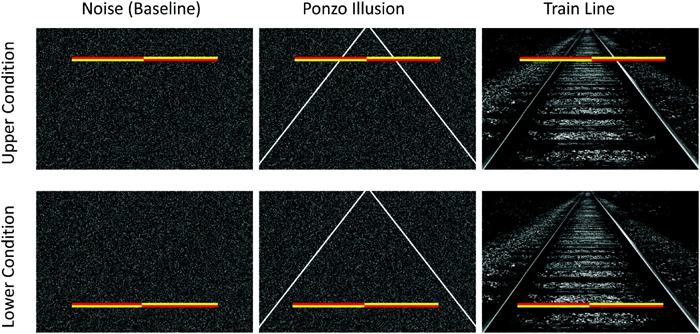
Diagram showing stimulus layouts for the baseline, Ponzo, and train-line backgrounds across the upper and lower conditions. To view a colour version of this figure, please see the online issue of the Journal.
Method
Participants
Psychology students (females = 23, males = 6) participated in the experiment as part of their course requirement. Participants with an error rate less than chance (50%) were excluded from the sample. All participants were right-handed (M = 92.5, SD = 13.9) as determined by the Edinburgh Inventory (Oldfield, 1971). Participant's modal age was 20 years. All had normal or corrected-to-normal vision and were naïve about the purpose of the experiment, although prior informed consent was obtained. The study had approval from the Flinders University Human Research Ethics Committee.
Apparatus
Stimulus presentation was controlled via a PC running E-prime 2.0 software. The stimuli were displayed on a LCD screen (model: Dell U2212HM) with a diagonal width of 545 mm. Responses were recorded using a model 200A PST Serial Response Box. The box was placed in front of the participant parallel with their midsagittal plane. Responses were made use the two most lateral response keys. A height-adjustable chin rest maintained participants' head position so that the centre of the display panel was in line with their midsagittal plane at eye level at a distance of 500 mm. A closed-circuit video camera ensured that participants' concentration was maintained during the experiment. If the participant appeared to be moving their head or eyes too much, they were reminded to keep still and concentrate on the task.
Stimuli
The prebisected lines were 140 mm (15.6° viewing angle) long and 4.2 mm (0.5°) high. Each line was composed of two red and two yellow bars, which were arranged in diagonally opposite pairs. Bright colours were chosen instead of black and white lines (as in McCourt, 2001) so that they could be clearly differentiated from the background. The point at which the inner edge of the bars intersected was shifted 1 mm (0.011°), 2 mm (0.022°), or 3 mm (0.033°) to the left or right of the true centre. To prevent participants from using landmark cues (e.g., a speck of dust or any mark on the screen), the horizontal centre of the prebisected lines was jittered between three positions located 2 mm (0.02°) to the left or right of centre, or in the centre, on a trial-by-trial basis. The lines could appear 60 mm (6.8°) either above or below the vertical centre of the screen (see Figure 1).
Stimuli were presented within a window that was centred on the screen. The window was 210 mm wide and 130 mm high. The lines were presented against three backgrounds within this window. In the baseline condition, the prebisected lines were presented against black and white pixelated noise. In the Ponzo condition, two white diagonal lines (1 mm thick) were superimposed over the pixelated noise. The position of the lines are defined as x y coordinates in mm, with the top, left-hand corner of the window being 0,0 and the bottom right-hand corner being 210, 130. On the left side of the window, one line ran from point 0, 125 to point 100, 0. The mirror-reverse arrangement occurred for the line on the right side of the window and ran from point 110, 0 to point 210, 125. In the train line condition, the lines were superimposed over a black and white photograph of a set of train tracks receding into the distance. The position of the train tracks was roughly equivalent to the lines in the Ponzo stimuli. Because the photograph was not perfectly symmetrical, the background was left/right mirror reversed half way through the trials (see Figure 1).
Procedure
The different backgrounds were presented in three blocks of 288 trials each. The order in which the blocks were presented was balanced. Within each block, the factors of elevation (top, bottom), bisection point (–3, –2, –1, +1, +2, +3 to the left/right of centre), polarity (red/yellow), and jitter (–2, 0, +2 to the left/right of centre) gave rise to a 2 × 6 × 2 × 3 design. There were four repeats of the basic 72 factorial combinations, and these were balanced and presented in a random sequence.
The background remained on throughout the entire block. Each trial began with the presentation of a prebisected line, which remained on the display for 500 ms. The line was then removed from the display, and the original background was resumed. Participants made a two-alternative forced-choice response indicating whether the left or right segment of the line was longer. To indicate that the left side was longer, participants pushed the leftmost button on the panel with the index finger of their left hand (and vice versa for right responses). Because of the natural mapping between stimulus and response, the assignment of responses to buttons was not changed throughout the experiment. The next trial was commenced after an intertrial interval of 1,000 ms. Although accuracy was stressed, if participants did not respond within two seconds, the trial was rejected and was replaced by an identical trial later in the sequence. Prior to commencing the experimental trials, participants received training in how to carry out the task.
Results and discussion
Average error rate was 19.6% (SD = 6.1). Initial analyses using a cumulative normal curve fitting procedure revealed that the curves provided an unsatisfactory fit for some participants. This could be due to the relatively small number of trials in each cell or strong levels of bias in particular participants. We therefore used a simple subtractive technique, which has been successfully used before (e.g., Nicholls et al., 2011). To obtain a measure of bias with this measure, the number of “left longer” responses was subtracted from the number of “right longer” responses and was converted to a percentage of the total number of trials. Scores can range from –100 (always responded “left longer”) to +100 (always responded “right longer”), with a score of zero indicating no bias.
The bias data were analysed with an analysis of variance (ANOVA) with background (baseline, Ponzo, and train-line) and elevation (upper, lower) as within-subjects factors (see Figure 2). There was no significant effect of elevation, F(1, 28) < 1, ns, ηp2 = .02, but there was a significant effect of background, F(2, 56) = 3.48, p < .05, ηp2 = .11. Post hoc comparisons revealed that the leftward bias was stronger for the baseline condition than for the Ponzo condition, t(28) = 2.84, p < .01. There were no significant differences between the other backgrounds. The main effect of background was moderated by an interaction with elevation, F(2, 56) = 3.35, p < .05, ηp2 = .11. Post hoc tests revealed that the leftward bias was significantly stronger for upper than for lower presentation in the baseline condition, t(28) = 2.73, p < .01. There was no effect of elevation for the other background (ts < 1).
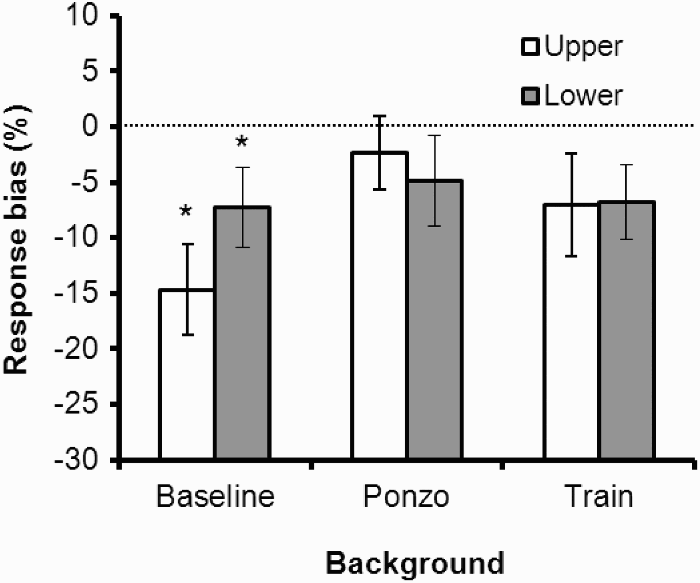
Graph showing mean bias (with ±SE bars) for upper and lower trials across the baseline, Ponzo, and train-line backgrounds. Results of one-sample t tests, which are significantly different from zero (p < .05), are indicated by an asterisk.
A series of one-sample t tests was conducted for the six conditions to determine whether the level of bias was significantly different from zero. The results are shown in Figure 2 by an asterisk next to the data point. A significant leftward bias was observed for the upper and lower elevations for the baseline condition only (p < .05).
The data do not conform to the hypotheses outlined in the introduction. If the Ponzo illusion affected left/right attentional asymmetries, a leftward bias should have been apparent for the lower condition in the Ponzo and train-line backgrounds. This leftward bias should have reversed to a rightward bias (or, at least been annulled) for the upper condition. The results therefore suggest that the effect of contextual distance observed by Nicholls et al. (2011) for images of near and far objects does not occur for visual illusions of depth. While this conclusion seems reasonable, however, the baseline condition suggests that another process might be in operation.
Unexpectedly, there was a significant effect of elevation for the baseline condition whereby the leftward bias was stronger for upper than for lower presentations. A review of the literature reveals that the effect of elevation may not be that surprising. Thomas and Elias (2011) required participants to make forced-choice luminance judgements for pairs of greyscale stimuli. Despite the fact that the stimuli are equiluminant, participants reliably overattend to the features on the left, a bias that is consistent with pseudoneglect (Nicholls, Bradshaw, & Mattingley, 1999). Thomas and Elias found that the bias depended on the presentation time and elevation of the stimulus. For short presentations (150 ms), a strong leftward bias was observed for upper presentations, but not for lower presentations. The reverse was true if participants were given unlimited time to inspect the stimuli. In this case, a leftward bias was observed for lower presentations, but not for upper presentations. A stronger leftward bias for line bisection has also been observed by McCourt and Garlinghouse (2000) for stimuli presented briefly to the upper visual field compared to the lower visual field. The effect of elevation observed for the baseline condition in the current study is therefore in line with previous research.
The effect of elevation may have inadvertently masked the influence of the Ponzo illusion. That is, the leftward bias has been inflated across all of the background conditions for upper presentations. As a result, there may have been a rightward bias in the upper (far) condition for the Ponzo and train backgrounds, but this was masked by the general effect of elevation. The second experiment was designed to investigate this proposition further.
Experiment 2
Experiment 1 investigated the effect of the Ponzo illusion on lateral asymmetries by shifting the prebisected line relative to the Ponzo stimuli. By shifting the prebisected line from the bottom to the top of the screen, we may have inadvertently contaminated the data with processing differences, which are known to differ between the upper and lower hemispaces (Thomas & Elias, 2011). Experiment 2 eliminated this issue by always presenting the prebisected line in the centre of the screen. In contrast to the first experiment, the Ponzo stimuli were shifted up and down relative to the prebisected line (see Figure 3). Half of the trials contained the Ponzo stimuli. In the lower diagonal condition, the Ponzo stimuli were placed below the line and had their apex towards the line, creating an impression of distance. In the upper diagonal condition, the Ponzo stimuli were placed above the line with their apex away from the line, creating an impression of proximity. If the impression of distance induced by the Ponzo illusion affects asymmetries for line bisection in a manner analogous to that observed by Nicholls et al. (2011), a leftward bias should be observed for the upper (near) condition, which reverses to a rightward bias for the lower (far) condition. For the other half of trials, a baseline condition was introduced using vertical lines. In the lower vertical condition, the lines were placed below the prebisected line. In the upper vertical condition, the lines were placed above the prebisected line. Note that the vertical lines crossed the prebisected lines at the same point as the diagonal stimuli and also terminated at the same heights. It was expected that no difference would occur between the upper and lower vertical conditions (See Figure 3). Because of the similarity in results for the Ponzo and train conditions in Experiment 1, the train condition was dropped from Experiment 2.
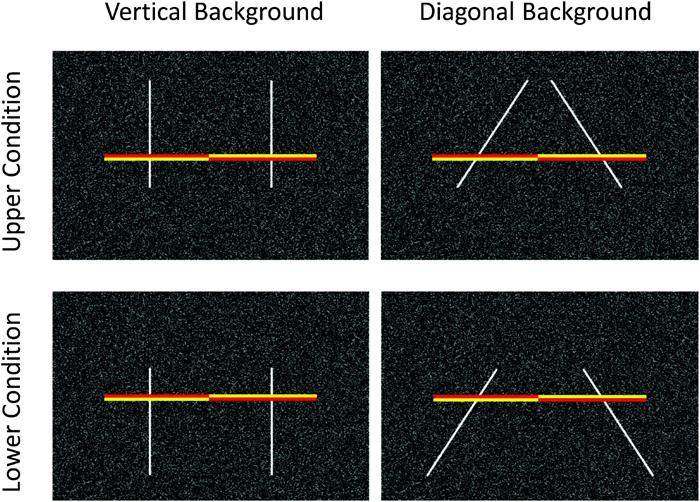
Diagram showing stimulus layouts for the vertical and diagonal backgrounds across the upper and lower conditions. To view a colour version of this figure, please see the online issue of the Journal.
Method
Participants
Psychology students (females = 13, males = 4) participated in the experiment as part of their course requirement. All participants were right-handed (M = 90.0, SD = 14.5). All other participant characteristics were the same as those in the previous experiment.
Apparatus and stimuli
The apparatus and stimuli were the same as those in the previous experiment, except where noted below. The prebisected lines were always presented in the vertical centre of the screen, but like Experiment 1, they were jittered slightly to the left or right of horizontal centre. The lines were presented against four different backgrounds (see Figure 3). In two of the backgrounds, two white lines were drawn diagonally across the screen to give rise to the Ponzo illusion. In the upper diagonal condition, a line was drawn on the left from point 5, 82 to point 93, 9. The mirror reverse occurred on the right, and a line was drawn from point 117, 9 to point 195, 82. In the lower diagonal condition, lines were drawn from points 5, 125 to 93, 58 and from points 117, 58 to 195, 125. In the other two backgrounds, two vertical lines were presented. In the upper vertical condition, lines were drawn from points 18, 9 to 18, 82 and from 192, 9 to 192, 82. In the lower vertical condition, lines were drawn from points 78, 55 to 78, 128 and from 132, 55 to 132, 128. Note that the point at which the white lines intersected the prebisected line was the same within the upper and lower conditions.
Procedure
The different backgrounds were presented in four blocks of 144 trials. Within each block, the factors of bisection point (–3, –2, –1, +1, +2, +3 to the left/right of centre), polarity (red/yellow), jitter (–2, 0, +2 to the left/right of centre), and elevation (upper/lower) gave rise to a 6 × 2 × 3 × 2 design. There were two repeats of the basic 72 factorial combinations, and these were balanced and presented in a random sequence. The vertical trials were presented in two blocks, and the diagonal trials were presented in the other two blocks. All other aspects of the experiment were the same as those described for Experiment 1.
Results and discussion
Average error rate was 21.7% (SD = 8.9). The bias data were analysed with an ANOVA with line slope (diagonal, vertical) and elevation (upper, lower) as within-subjects factors (see Figure 4). While there was no effect of line slope, F(1, 16) < 1, ns, ηp2 = .01, there was an effect of elevation, F(1, 16) = 4.60, p < .05, ηp2 = .01—reflecting a stronger leftward bias for upper presentations. Figure 4 appears to show an interaction between line slope and elevation, but this just failed to reach statistical significance, F(1, 16) = 3.10, p = .09, ηp2 = .16. Post hoc tests revealed a significant effect of elevation for the vertical condition, t(16) = 2.85, p < .05, but not for the diagonal condition, t(16) < 1.
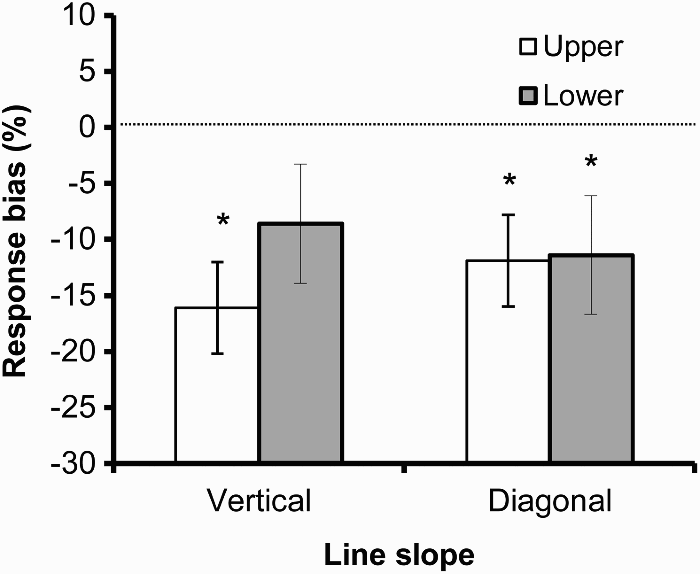
Graph showing mean bias (with ±SE bars) for upper and lower trials across the vertical and diagonal backgrounds. Results of one-sample t tests, which are significantly different from zero (p < .05), are indicated by an asterisk.
A series of one-sample t tests were conducted for the four conditions to determine whether the level of bias was significantly different from zero. The results are shown in Figure 4 by an asterisk next to the data point. A significant leftward bias was observed for all conditions (p < .05) except for the vertical lower condition (p = .055).
Once again, the data did not conform to our hypotheses. For the diagonal condition, which was designed to elicit the Ponzo illusion, there was no effect of elevation. Thus, illusions of distance elicited by the Ponzo illusion do not appear to affect asymmetries in line bisection. Unexpectedly, the leftward bias was stronger for upper than for lower presentations. Although the interaction was not significant, there is some suggestion that the effect of orientation was present for the vertical condition, but not for the diagonal condition. The results therefore seem to be very similar to those obtained in the Experiment 1. That is, there was an effect of elevation for the baseline condition, which was moderated when the background was arranged to give rise to the Ponzo illusion.
The present experiment sought to avoid elevation effects, such as those described by Thomas and Elias (2011), by always presenting the prebisected line in the centre of screen and shifting the background stimuli above and below the prebisected line. Despite this manipulation, there was still a clear effect of elevation. It therefore appears that effects of elevation can be induced without shifting the prebisected line—but merely by placing associated stimulation in the upper or lower field. The third experiment examined this proposition more directly.
Experiment 3
This experiment investigated the effect of irrelevant information presented in the lower or upper half of a computer screen on line bisection asymmetries. There were three conditions. In the baseline condition, a rectangular box was drawn around the prebisected line, which extended equally into the upper and lower halves of the screen. In the upper condition, an inverted “u” was drawn so that it extended into the upper half of the screen. Conversely, in the lower condition, a “u” was drawn so that it extended into the lower half of the screen (see Figure 5). All three conditions were designed to cross the prebisected line at the same point and have the same basic stimulus characteristics. If the effect of upper/lower stimulation observed in Experiment 2 is reliable, the leftward bias should be stronger for the upper than for the lower condition. The inclusion of a baseline allows us to determine whether the effect of elevation is symmetrical for the upper/lower conditions.
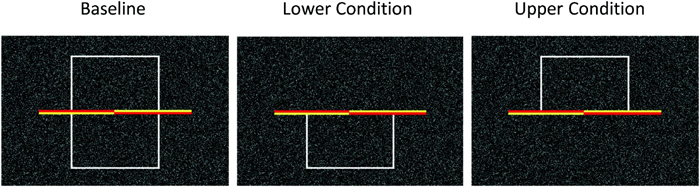
Diagram showing stimulus layouts for the baseline, lower, and upper conditions. To view a colour version of this figure, please see the online issue of the Journal.
Method
Participants
Psychology students (females = 12, males = 5) participated in the experiment as part of their course requirement. All participants were right-handed (M = 92, SD = 13.4). All other participant characteristics were the same as those in the previous experiment.
Apparatus and stimuli
The apparatus and stimuli were the same as those in Experiment 2, except where noted below. The lines were presented against three different backgrounds (see Figure 5). In the baseline condition, a rectangle, drawn using white lines, was centred around the centre of the screen. The rectangle was 80 mm wide and 92 mm high. In the upper condition, an inverted “u” was drawn so the open face touched the prebisected line. The “u” was 80 mm wide and 46 mm high. In the lower condition, a “u” with the same dimensions was drawn so that its open face touched the prebisected line.
Procedure
The different backgrounds were presented in three blocks of 144 trials. The upper/lower trials were mixed within two of the blocks whereas the baseline trials were presented in a single block. All other aspects of the experiment were the same as those described for Experiment 2.
Results and discussion
Average error rate was 23.2% (SD = 10.4). The bias data were analysed with an ANOVA with elevation (baseline, upper, lower) as a within-subjects factor (see Figure 6). There was a significant effect of elevation, F(2, 32) = 5.35, p < .01, ηp2 = .25. Post hoc tests revealed that the leftward bias was stronger for the upper than for the baseline, t(16) = 3.26, p < .005, and lower, t(16) = 2.69, p < .05, conditions. There was no difference between baseline and lower conditions, t(16) < 1.
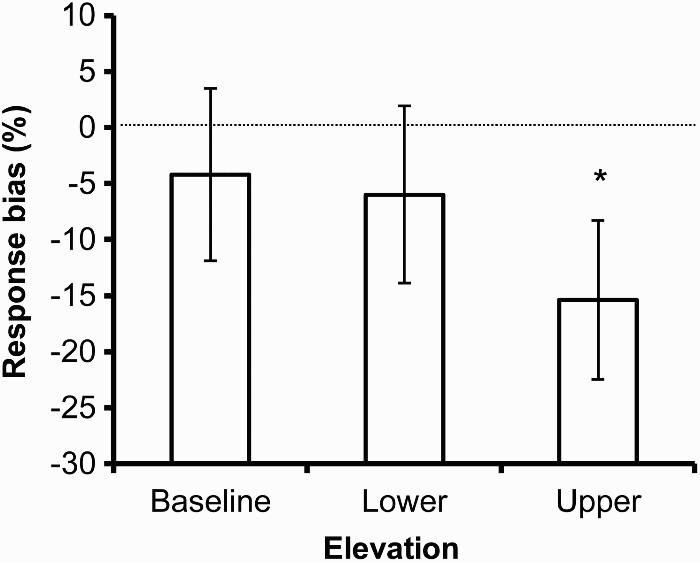
Graph showing mean bias (with ±SE bars) for the baseline, lower, and upper conditions. Results of one-sample t tests, which are significantly different from zero (p < .05), are indicated by an asterisk.
A series of one-sample t tests were conducted for the three conditions to determine whether the level of bias was significantly different from zero. The results are shown in Figure 6 by an asterisk next to the data point. A significant leftward bias was observed for the upper condition only (p < .05).
In the current study, the visual information presented above or below the prebisected line was irrelevant to the task. Despite this, there is clear evidence that this visual stimulation affected left/right asymmetries for line bisection. Information presented below the prebisected line seemed to have little impact on performance. In contrast, when the stimulation was presented above the line, there was a clear increase in the leftward bias. The reasons why—and how—upper visual field stimulation can affect performance along the horizontal dimension is outlined in the discussion.
General Discussion
This series of experiments began as an investigation of the effect of perceived depth on asymmetries in spatial attention—as revealed by the line detection task. Using the Ponzo illusion to induce depth perception, it was hypothesized that lines that appeared to be more distant would show a rightward bias. In contrast, for lines that appeared nearer, a leftward bias was predicted. If such an effect was observed, it would demonstrate that the effect of pictorial depth context observed by Nicholls et al. (2011) also occurs for illusions of depth. Relatively little evidence for an effect of perceived distance was observed in the experiments reported in the current study. One possible reason for this is that although the Ponzo illusion does lead to dramatic changes in perceived size, its effect on perceived distance is more subtle (Reardon & Parks, 1983). It is therefore possible that the Ponzo illusion did not produce a change in perceived distance that was sufficient to affect left/right asymmetries in attention. Indeed, it is possible that changes in perceived size worked against changes in perceived distance. A well-known finding in the pseudoneglect literature is that longer lines produce a stronger leftward bias (Jewell & McCourt, 2000). Therefore, if the more distant lines appear longer, the rightward bias for distance may have been counterbalanced by a stronger leftward bias for longer lines.
Inadvertently, this study introduced an effect of upper/lower field stimulation in Experiment 1. Although no effect of elevation was expected for the baseline condition, a clear effect emerged whereby the leftward bias was stronger for lines presented in the upper half of the screen. A similar effect of elevation on pseudoneglect has been observed by Thomas and Elias (2011) and McCourt and Garlinghouse (2000) for briefly presented stimuli. To eliminate the effect of elevation, in Experiment 2 the prebisected lines were always presented in the centre of the screen and moved the Ponzo stimuli relative to the prebisected lines. Despite this manipulation, an effect of elevation was still observed in the baseline condition. The perseverance of an elevation effect suggests that the position of the prebisected line is not as important as the elevation of any stimulation. To investigate this proposition more directly, the final experiment presented visual stimulation into the upper and lower halves of the screen, which was irrelevant to the task. Once again, stimulation presented in the upper visual field increased the leftward bias for line bisection.
The data indicate an interdependency between visual processing in the upper/lower hemispaces and shifts of attention along the horizontal plane. Behavioural evidence for an association between attentional asymmetries in the vertical and horizontal plane has been found by Nicholls, Mattingley, Berberovic, Smith, and Bradshaw (2004). They presented greyscale stimuli in vertical and horizontal orientations as well as 45° forwards and backwards. Consistent with previous literature, they found a leftward bias for horizontal stimuli and an upward bias for vertical stimuli. More interestingly, they found an especially strong asymmetry for the 45° backward condition, where one end of the stimulus fell in the upper/left quadrant, and the other end fell in the lower/right quadrant. In this case, it appeared as though the leftward and upward attentional biases were additive—and combined to produce a strong attentional bias towards the upper/left quadrant and a bias away from the lower/right quadrant. While the attentional biases from the different vectors did appear to be additive, there was also evidence that they were independent within an individual. Thus, an individual with a particularly strong leftward attentional bias did not also have a strong upward bias.
While the data confirm reports of a stronger leftward bias for lines presented in the upper visual field (McCourt & Garlinghouse, 2000; Thomas & Elias, 2011), they also provide an important extension of these studies. In previous studies, the location of the stimulus to be bisected has been confounded with the location of attention. In the current study, we demonstrate that a line placed in the centre of the screen is affected by irrelevant stimulation located above or below that line. The current data therefore rule out the possibility that the effect of elevation is related to simple processing differences between the visual fields. For example, Previc (1990) has suggested that the upper hemifield is specialized for spatial perception, which might facilitate line bisection. The effect of elevation is unlikely to be the result of differences in sensitivity between the upper and lower visual fields. For example, Lundh, Lennerstrand, and Derefeldt (1983) reported reduced contrast thresholds in the lower than in the upper visual field. There is also some evidence that the lower visual field has greater attentional resolution than the upper visual field (He, Cavanagh, & Intriligator, 1996). If either of these mechanisms played an important role in the present results, however, an upper/lower difference in error rate would be expected. None of the current experiments showed an effect of elevation for error.
The current study therefore suggests that the effect of elevation is not directly related to processing differences between upper/lower hemifields, but is related to some other cognitive or neural mechanism that links processing in the two dimensions. Examinations of the neural basis of attentional shifts along the horizontal and vertical axes suggest some commonalities—as well as differences. Fink, Marshall, Weiss, and Zilles (2001) used functional magnetic resonance imaging (fMRI) to examine brain activation for vertical and horizontal versions of the landmark line bisection task. They found that the vertical and horizontal versions activated a number of brain regions bilaterally ranging from early visual areas to the parietal cortex. Activation of the superior and inferior parietal lobes, while bilateral, was stronger on the right, consistent with lesion research (Nichelli et al., 1989). While the activation for the vertical and horizontal versions was generally similar, more activation was observed for right parietal occipital and superior posterior parietal cortex (bilaterally). This differential activation was attributed to the increased difficulty associated with judging bisections for vertical lines.
While Fink et al. (2001) emphasized the commonalities between shifts of attention along the vertical and horizontal axes, Mao, Zhou, Zhou, and Han (2007) have reported a number of distinctive elements. They used fMRI to examine brain activation for a task that required participants to detect targets presented to the upper, lower, left, or right visual fields. Relative to attending to a central location, shifts along the vertical or horizontal axes produced activation of the superior parietal and frontal lobes bilaterally and the cerebellum. There was also activation specific to the horizontal and vertical axes. Shifts along the vertical axis produced stronger activation in the medial frontal cortex, anterior cingulate, precuneus, and cerebellum than did those along the horizontal axis. Particularly important for the current study, Mao et al. (2007) also found activation specific to the upper and lower fields. A contrast between upper and lower targets: “showed activation in the right inferior postcentral gyrus, suggesting that an additional brain structure is involved in guiding spatial attention to the upper visual field relative to the lower visual field” (p. 145).
If sections of the right parietal lobe are more active for shifts of attention to the upper hemispace, as suggested by Mao et al. (2007), it could explain the results of the current experiment. Asymmetrical activation of the hemispheres has been suggested as a cause of attentional asymmetries in the intact brain (Kinsbourne, 1970; Nicholls & Roberts, 2002) and in clinical neglect (Kinsbourne, 1987). Bearing in mind the role of unilateral hemispheric activation on attentional asymmetries, it is possible that visual stimulation in the upper visual field in the current study activated the right parietal cortex more than the left. This increased rightward activation then produced a stronger leftward attentional bias—resulting in more pronounced pseudoneglect.
A mechanism based on unilateral activation associated with upper field stimulation may also explain the result of other studies. McCourt and Jewell (1999) reported that pseudoneglect was stronger for superior than for inferior visual field presentations, and this effect was subsequently replicated by McCourt and Garlinghouse (2000). Thomas and Elias (2011) have also found increased pseudoneglect for greyscales stimuli presented in the upper visual field. To explain the effect of elevation, Thomas and Elias referred to research demonstrating specialization of the upper and lower visual fields. Previc (1990) suggested that the upper and lower visual fields are specialized for the processing of stimuli located in extrapersonal and peripersonal space, respectively. In addition, the processing of information from the upper (far) and lower (near) visual fields is thought to be carried out by the dorsal and ventral streams—and this distinction is borne out by neuroimaging research (Weiss et al., 2000). It is difficult to know, however, how this functional distinction could explain the increased leftward bias for upper field presentations. For example, if the upper field is specialized for processing distant stimuli, a reduced leftward bias might be predicted (see Longo & Lourenco, 2006, 2007; McCourt & Garlinghouse, 2000; Nicholls et al., 2011). McCourt and Garlinghouse (2000) also noted the discrepancy between the stronger pseudoneglect for the upper visual field and the superior spatial processing ability of the parvocellular system in the error data they collected. The mechanism proposed by the current study provides a better explanation. In this case, the upper field presentation caused more activation of sections of the right parietal lobe (Mao et al., 2007), leading to increased activation of the right hemisphere and an increased leftward attentional bias (Kinsbourne, 1970).
The results of the current study demonstrate that stimulation in the upper visual field, which is not relevant to the task, affects attentional asymmetries in the orthogonal horizontal plane. The behavioural evidence collected in the current study therefore corroborates recent imaging research examining the relationship in the neural basis of attentional shifts along the vertical and horizontal axes (Fink et al., 2001; Mao et al., 2007). While a linked neural mechanism may affect shifts of attention in the vertical and horizontal dimensions, evidence collected by Nicholls et al. (2004) demonstrates that the biases are independent within individuals. That is, a person with a strong leftward bias does not also have a strong upward bias. Given the relatively low correlations between different purported measures of pseudoneglect (Luh, Rueckert, & Levy, 1991; Nicholls et al., 1999), this may not be that surprising. Indeed, while the direction of the asymmetry may be a stable individual trait, there is no reason to believe that the degree of asymmetry is also a stable trait. The fact that individual differences in line bisection are consistent when exactly the same task is administered (see McCourt, 2001) may reflect task-related strategies rather than trait asymmetries. The finding that vertical distractors affect attention along the horizontal plane also raises the interesting question of whether the relationship is bidirectional. In light of the proposed neural mechanisms, it seems reasonable to predict that shifts of attention to the right could increase the upward bisection bias usually reported for vertical lines (Drain & Reuter-Lorenz, 1996; McCourt & Olafson, 1997).