







Abstract
The results of three experiments explore the role of familiarity in face processing. Using the complete-over-part advantage (Experiment 1) and the chimeric faces task (Experiment 2), the results revealed evidence for what may be termed “holistic processing” of unfamiliar, newly learned, and famous faces. Notably, the extent of holistic processing on both tasks was not moderated by the familiarity of the stimuli. Experiment 3 replicated this pattern using a simultaneous chimeric task to rule out a simple explanation through memory demands. Taken together, these three experiments provide robust and convergent evidence to suggest that all faces regardless of familiarity can be processed in a holistic fashion. On the basis of these results, discussion is presented regarding the value of considering different “types” of facial processing over and above a more simple consideration of task difficulty.
There is now a considerable literature exploring the impact of familiarity on face processing. Several findings emerge as robust demonstrations. However, as yet, there is not perhaps a satisfactory explanation for these familiarity effects when taken together. The purpose of the present paper is to explore the evidence for the familiarity effect when processing faces, with a particular emphasis on the conditions under which familiarity effects are present and the conditions under which they are not. Our aim here is to provide a framework that may help in accounting for familiarity effects and in predicting the circumstances under which additional familiarity effects may emerge.
The influence of familiarity
According to the Bruce and Young (1986) face recognition framework, expression analysis and early structural encoding occur at stages prior to recognition; however, it is only when the face recognition unit (FRU) becomes activated that familiarity becomes processed and may be expected to exert an influence. Consequently, it is sensible to predict that familiarity will not affect expression decisions or early processing stages, but will affect stages involving recognition or subsequent processing.
Considerable support exists for this view. In particular, recognition is better for familiar than for unfamiliar faces under several paradigms. For instance, a familiar face can be identified as “old” (or having been presented before within an experimental context) with greater speed and fewer errors (Scapinello & Yarmey, 1970) and can be retained for longer in memory (Ellis, Shepherd, & Davies, 1979) than an unfamiliar face. Additionally, a familiar face is better recognized from its internal features (the internal feature advantage) than an unfamiliar face (Ellis et al., 1979; O’Donnell & Bruce, 2001; Young, 1994; Young, Hay, McWeeny, Flude, & Ellis, 1985), and the magnitude of this effect increases as familiarity develops (Bonner, Burton, & Bruce, 2003; Clutterbuck & Johnston, 2002, 2004a, 2005; Osborne & Stevenage, 2008). Similarly, whilst recognition performance is generally good for faces, performance can be facilitated through the presentation of caricatured images in which features, or the relationship between features, are exaggerated. Importantly though, this caricature advantage is only demonstrated when faces are familiar (Rhodes, Brennan, & Carey, 1987; Rhodes, Byatt, Tremewan, & Kennedy, 1996; Stevenage, 1995). Indeed, Benson and Perrett (1991) suggested that the familiarity of the face is positively correlated with the degree of caricaturing required to generate a “best likeness”.
Set against this, a series of studies has also revealed familiarity effects at stages prior to recognition, and these results pose a challenge for the Bruce and Young (1986) framework. For example, whilst unfamiliar faces have been shown to elicit a scan pattern indicative of a top-to-bottom serial search, familiar faces elicit a scan pattern suggestive of a parallel feature search instead (Hines & Braun, 1990). Additionally, familiarity improves performance on a face classification task with “Thatcherized” and “normal” faces despite identity being irrelevant to the task at hand (Stevenage, Lee, & Donnelly, 2005). Familiarity also improves performance on an expression analysis task even though Bruce and Young considered this to be quite separate from familiarity and identity-based processing. On tasks requiring fine-level expression judgements, performance was better for familiar than for unfamiliar faces when participants were presented with expressions that were either difficult to discriminate (i.e., fear and disgust: Etcoff & Magee, 1992), or were presented under masked or brief exposure (Baudouin, Sansone, & Tiberghien, 2000).
Finally, performance during a gender classification task has also been shown to be affected by familiarity. Participants were quickest when making speeded decisions to faces that were highly familiar, were significantly slower with newly learned faces, and were slower again with unfamiliar faces (Clutterbuck & Johnston, 2004a; see also Roberts & Bruce, 1988). Using a somewhat different methodology, Stevenage and Osborne (2006) reiterated this familiarity effect on a gender classification task. Their results revealed a significant impairment in performance when gender classification was made difficult through stimulus rotation. However, this effect reached significance only when faces were familiar, and performance started from a high baseline.
Processing styles
Given that a simple explanation in terms of Bruce and Young's (1986) framework fails to account for these data, there may be merit in testing an alternative account based on processing styles. This rests on a distinction between holistic and relational processing, with holistic processing referring to the processing of the face “as a whole”, and relational processing referring to the processing of features or regions relative to one another (see Maurer, LeGrand, & Mondloch, 2002). This distinction is supported by the suggestion that the two processing styles might serve two quite distinct functions within the face processing system. In particular, it has been suggested that holistic processing underpins the classification of a face (Hole, George, & Dunsmore, 1999) or its initial perceptual encoding (Calder & Jansen, 2005), whilst relational processing enables the differentiation of one encoded face from another (Hole et al., 1999). Given this, it is possible that an early, coarse holistic processing stage is available for all faces regardless of familiarity, whereas the later, more fine-grained relational processing stage is applied only to faces that possess a degree of familiarity.
The studies cited so far provide some support for this processing styles perspective. Arguably, all are relational processing tasks and, in line with the reasoning above, show sensitivity to familiarity. What remains is the need to demonstrate holistic processing effects for all faces regardless of familiarity.
Two experimental paradigms are helpful in this regard as both have been used as indicators of holistic rather than relational processing. The first task is the complete-over-part advantage (CPA) in which recognition of individual features is better when those features are presented in the context of the whole face than when they are presented in isolation. This effect is readily demonstrable with learned faces (Donnelly & Davidoff, 1990, 1999; Homa, Haver, & Schwartz, 1976; Tanaka & Farah, 1993), but has also been demonstrated with unfamiliar faces through the use of a sequential matching task rather than a recognition task (Donnelly & Davidoff, 1999, Experiment 5; Tanaka, Kiefer, & Bukach, 2004; although see Leder & Carbon, 2005, for a discussion of context effects).
The second task is the chimeric face task (Young, Hellawell, & Hay, 1987) involving the presentation of the top half of one face and the bottom half of another. The chimeric face effect occurs when recognition of the top half is better when the two halves are misaligned than when they are aligned. This has been demonstrated for both famous and learned faces (Young et al., 1987) and, again, has been demonstrated with unfamiliar faces through the use of a matching task rather than a recognition task (Hole, 1994).
Whilst the above evidence supports the prediction that holistic processing is available for all faces regardless of familiarity, the potential for picture-related processing in all the studies suggests caution in interpreting these findings. Only one study has addressed this issue, by using different viewpoints of the faces during study and test (Teunisse & de Gelder, 2003). Whilst their data confirm Hole's (1994) demonstration of a chimeric effect with unfamiliar faces, this is the only clear demonstration of holistic processing for previously unfamiliar (once-seen) faces.
Given the importance of this issue for the “processing styles” perspective, it is examined again here. Three studies are reported, using two different paradigms. Whilst the literature shows that relational processing is sensitive to familiarity, the expectation for the current studies is that holistic processing may emerge for all faces regardless of familiarity.
Experiment 1
As an established method of demonstrating holistic processing, the CPA task is used here with stimuli that vary systematically in their level of familiarity from “unfamiliar”, through “newly learned”, to “familiar”. The use of a sequential CPA task provides direct replication of Donnelly and Davidoff (1999, Experiment 5) and Tanaka et al. (2004). However, the use of different images from study to test protects against picture-related processing to provide a more superior assessment of holistic processing across familiarity.
Method
Design
A 3 × 3 × 2 within-subjects design was used in which familiarity (unfamiliar, newly learned, famous), feature (eyes, nose, mouth), and context (whole, part) were varied in the complete-over-part advantage paradigm. Participants took part in a sequential matching task, and accuracy was recorded as the dependent variable.
Participants
A total of 18 undergraduate students (16 females) participated in return for course credits. Ages ranged from 18 to 31 years (mean = 19.67, SD = 3.16), and all had normal or corrected-to-normal vision.
Materials
Eighteen faces were used for the present study. Of these, 12 were unfamiliar, 1 and 6 were famous celebrities selected through pilot work to be good representations of highly familiar individuals. Two images (frontal, three-quarter right) were obtained for each famous face so that different images could be used at study and test stages to remove simple picture processing. An additional image (three-quarter left) was obtained for the 12 unfamiliar faces, and this was used as a training image for the stimuli within the “newly learned” set. All faces were presented as greyscale images, and image size was controlled by standardizing the frontal images according to interocular distance (18 pixels) and standardizing all other views so that the head-to-chin measurement matched the frontal images.
The unfamiliar faces used throughout this paper were supplied by the Computer Vision Laboratory Face Database, University of Ljublijana, Slovenia (Solina, Peer, Batagelj, Juvan, & Kovac, 2003).
During the complete-over-part trials, participants saw a target face followed by two test alternatives. In “part” trials, these two alternatives were presented as isolated features (eyes, nose, or mouth), whereas in “whole” trials the two alternatives presented the same features but in the context of a whole face. This meant that for each target face, six distractors were generated, involving a change to the eyes, nose, or mouth, in isolation (“part” trials) or in context (“whole” trials). Faces were paired so that the distractor features for Face A came from Face B and vice versa. In this way all features from each face were seen equally often. Figure 1 provides an example of these trials.

Example complete-over-part advantage (CPA) stimuli. In both cases, the correct image is located on the left of the two-alternative forced-choice (2AFC) screen. [Faces from the Computer Vision Laboratory Face Database, University of Ljublijana, Slovenia (Solina, Peer, Batagelj, Juvan, & Kovac, 2003).]
Stimuli were presented and data were recorded within Superlab 2.1 running on an IBM Pentium 4 PC within a Windows XP environment. Screen resolution was set to 1024 × 768 pixels, and images were presented at a viewing distance of approximately 60–70 cm.
Procedure
The study consisted of two phases: a familiarization phase and a test phase. During the familiarization phase, participants learned a series of six previously unfamiliar faces presented as three-quarter left profile images. The identity of these faces was counterbalanced across participants to remove item effects. Each face was shown 36 times for 5 s each, and attention was maintained by asking participants to rate each face on nine characteristics—distinctiveness, attractiveness, confidence, honesty, approachability, friendliness, age, intelligence, and familiarity. Ratings were made on a 5-point scale with 1 being low and 5 being high in the respective quality. The order of ratings was blocked so that each of the six study faces was rated for one of the characteristics in turn, and the ratings on each of the nine scales were repeated four times. The entire familiarization phase lasted about 30 min.
Following the familiarization phase, participants were given a self-paced break before completing the test phase. This consisted of a series of two-alternative forced-choice (2AFC) sequential matching trials to unfamiliar, newly learned, and famous faces. On each trial, participants saw a target face presented as a three-quarter right profile for 1 s, followed by a 500-ms visual mask. Two test images were then presented depicting the critical features (eyes, nose, mouth) in frontal view either in isolation (part trials) or in the context of a face (whole trials). Hence, for each of 18 target faces, there were 6 test trials, making 108 trials in total. The participant's task was to indicate which image matched the original target, and the location of the correct image was counterbalanced across trials. Participants responded as quickly but as accurately as possible by pressing “z” for the left image, or “/” for the right image. The order of trials was blocked according to the familiarity of the target, and self-paced breaks separated each block. At the end of the test phase, participants completed a post-experimental familiarity check. All participants were able to recognize all famous faces, and hence no items were removed prior to analysis.
Results and discussion
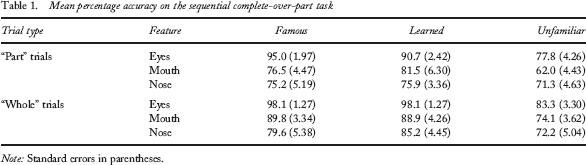
Accuracy of performance was summarized across conditions and is presented in Table 1. A 3 × 3 × 2 repeated measures analysis of variance (ANOVA) was conducted to explore the effects of familiarity, feature, and context on performance. This revealed a main effect of familiarity, F(2, 34) = 13.80), with performance being worse for unfamiliar stimuli than for faces with any familiarity, F(1, 17) = 26.52, p < .001, but equivalent between familiar and newly learned faces, F(1, 17) < 1, ns. Analysis also revealed a main effect of feature, F(2, 34) = 17.72, p < .001, indicating better performance when recognizing the eyes than when recognizing the mouth and nose taken together, F(1, 17) = 41.74, p < .001, but no difference between performance with the mouth and the nose themselves, F(1, 17) < 1, ns. Finally, and most importantly, the analysis revealed a main effect of context, F(1, 17) = 14.45, p < .001, reflecting the expected complete-over-part advantage (CPA).
Mean percentage accuracy on the sequential complete-over-part task
Note: Standard errors in parentheses.
Neither two-way nor three-way interactions modified these effects, all Fs(2, 34) < 1.4, p > .05. Notably, the absence of an interaction between context and familiarity meant that the CPA emerged regardless of the level of familiarity of the stimuli, F(2, 34) < 1, ns. In this sense, familiarity was not shown to influence performance in this task.
These data present an interesting pattern of results, which can be accommodated within the processing styles framework. In this regard, whilst emergent familiarity appears to affect the degree of relational processing (i.e., Bonner et al., 2003; Clutterbuck & Johnston, 2002, 2004a, 2004b, 2005; Osborne & Stevenage, 2008), it does not affect the degree of holistic processing (here). Experiment 2 seeks to verify these findings using a second and convergent methododology—the chimeric face task.
Experiment 2
Whilst the tendency for holistic processing enhances performance in the CPA task, it hinders performance in the chimeric face task, because it becomes very difficult to pull apart the two halves of the chimera in order to identify each in isolation. Indeed, the perception of a novel third face, quite distinct from the donor of either half, is very compelling.
To date, the chimeric face effect has been demonstrated with famous and learned faces using a recognition task (Young et al., 1987) and with unfamiliar faces using a simultaneous same/different matching task (Hole, 1994; but see also Weston & Perfect, 2005). Concern over picture-related processing prompted the replication by Teunisse and de Gelder (2003), who were able to demonstrate a clear chimeric effect for once-seen faces using a sequential matching task in which nonidentical images were used at study and test. This provides the strongest demonstration of a chimeric effect for faces of limited familiarity. Experiment 2 provides a replication of this strong test using faces that vary systematically in familiarity. If the results of Experiment 1 are reliable, holistic processing should be demonstrated using this second task regardless of the familiarity of the face.
Method
Design
A 3 × 2 × 2 within-subjects design was used to explore the chimeric face effect across stimuli that varied in familiarity (unfamiliar, newly learned, famous), alignment (aligned, misaligned), and orientation (upright, inverted). Participants took part in a sequential matching task, and the dependent variables were speed and accuracy of response.
Participants
A total of 26 participants (22 females) participated in return for course credits. Ages ranged from 18 to 35 years (mean = 19.85, SD = 3.18), and all had normal or corrected-to-normal vision and had not taken part in Experiment 1.
Materials
Thirty faces were used as stimuli. Of these, 20 were unfamiliar, and 10 depicted famous celebrities selected on the basis of pilot work as above. Two images (frontal, three-quarter right) were obtained for each famous face as before so that different images could be used at study and test stages. An additional image (three-quarter left) was obtained for the 20 unfamiliar faces, and this was used as a training image for the “learned” set. All facial images were standardized for size and greyscale presentation as in Experiment 1.
Chimeric stimuli were constructed using top and bottom halves drawn from a pair of the frontal images. Pairings were carefully controlled to ensure that each face was paired with another similar-looking face of equivalent familiarity. Each pair was then rated for similarity (using a scale of 1–7) by a panel of five independent judges. A Wilcoxon test confirmed that there was no difference between the similarity of the unfamiliar and famous pairs (z = 0.014, p > .05). Thus, any differences in task performance across unfamiliar and familiar stimuli could not be attributable to differences in image similarity, or level of fusion that might result from their chimeric combination. Corel PhotoPaint was then used to combine the top half of each face with the bottom half of the other face in the pair. An aligned image was created by positioning the top half directly above the bottom half, whereas a misaligned image was created by positioning the left edge of the top half above the midline of the nose in the bottom half. Finally, inverted versions of each of these stimuli were generated by flipping each image around its horizontal axis. Example stimuli are shown in Figure 2.
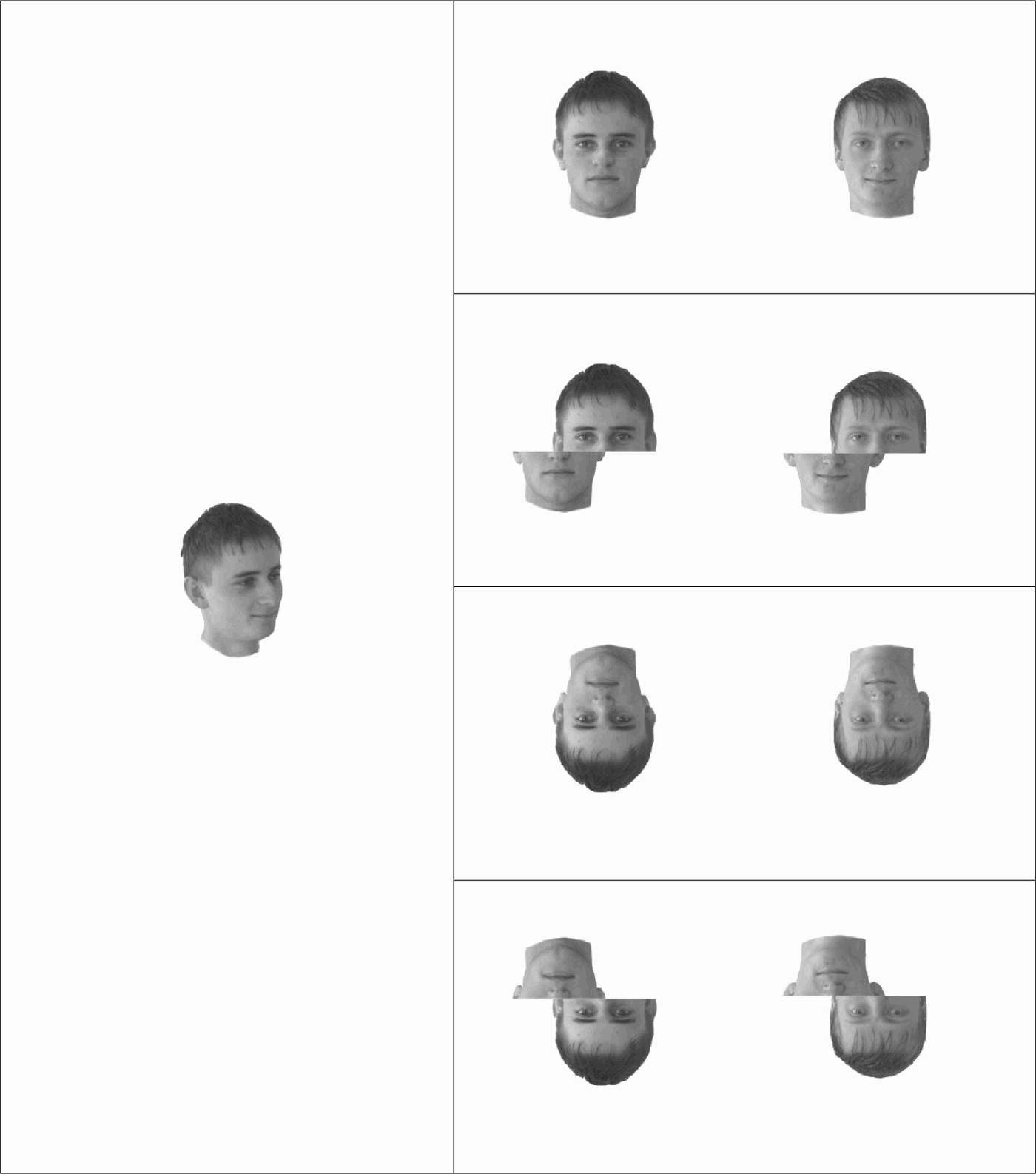
Example chimeric stimuli. In all cases, the correct response is the image on the left. [Faces from the Computer Vision Laboratory Face Database, University of Ljublijana, Slovenia (Solina, Peer, Batagelj, Juvan, & Kovac, 2003).]
Procedure
As with Experiment 1, Experiment 2 consisted of two parts: a familiarization phase and a test phase. During the familiarization phase, participants learned a set of 10 previously unfamiliar faces from 36 repetitions of a 5-s exposure to a three-quarter left profile image. Identity of the familiarized stimuli was counterbalanced across participants as before, and all other aspects of the familiarization phase were identical to those in Experiment 1. This phase lasted approximately 40 min.
After a self-paced break, participants completed the test phase with unfamiliar, newly learned, and famous faces. The format of each trial was identical and involved the presentation of a three-quarter right profile image of a target face for 1 s followed by a 500-ms visual mask. Two test images were then presented showing an image pair either aligned or misaligned and either upright or inverted. Hence, for each of 30 target faces, there were 4 test trials, making 120 trials in total. The participant's task was to indicate which of the two images had the same top half as the target, and location of the correct half was counterbalanced across trials. The order of trials was blocked according to the alignment and orientation of stimuli, and self-paced breaks separated each block. Participants responded as quickly but as accurately as possible by pressing “z” for the left image, or “/” for the right image. At the end of the test phase, participants completed a post-experimental familiarity check to determine their familiarity with the famous celebrity faces.
Results and discussion
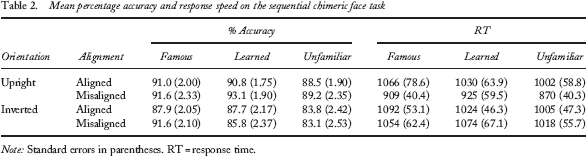
Despite pilot work to select the celebrities, the post-experimental familiarity check revealed that 7% of the celebrities were not recognized across participants. These were excluded from further analysis on a case-by-case basis. The speed and accuracy of response for the remaining stimuli are summarized in Table 2 across aligned and misaligned trials and upright and inverted conditions for each level of familiarity.
Mean percentage accuracy and response speed on the sequential chimeric face task
Note: Standard errors in parentheses. RT = response time.
Accuracy
A 3 × 2 × 2 repeated measures ANOVA explored the effects of familiarity, alignment, and orientation on performance. This revealed a main effect of familiarity, F(2, 50) = 3.48, p < .05, with performance being worse for unfamiliar stimuli than for faces with any familiarity, F(1, 25) = 9.72, p < .005, but equivalent between familiar and newly learned faces, F(1, 25) < 1, ns. There was also a main effect of orientation, F(1, 25) = 6.92, p < .025, with performance being better when stimuli were upright than when they were inverted. No other main effects or interactions emerged as significant, suggesting that the chimeric face effect may be revealed in the more sensitive measure of response speed rather than accuracy.
Median response time for correct decisions
Median response time (RT) for correct decisions was calculated across each condition and was used as the dependent variable to minimize the influence of outliers within the RT data. This is summarized in Table 2, and a 3 × 2 × 2 repeated measures ANOVA was conducted as above. This revealed no main effect of familiarity, F(2, 50) = 2.26, p > .05, alignment, F(1, 25) = 2.31, p > .05, or orientation, F(1, 25) = 3.25, p > .05. However, the expected interaction of alignment and orientation did emerge, F(1, 25) = 6.64, p < .025. Paired-samples t tests (α = .025) confirmed this to be due to faster responding to misaligned than to aligned faces when stimuli were upright, t(25) = 2.45, p < .025, but not when inverted, t(25) < 1, ns. This confirms the presence of the chimeric face effect. Importantly, this effect was not moderated by facial familiarity, F(2, 50) < 1, ns. Thus, in common with Experiment 1, holistic processing was demonstrated here regardless of the familiarity of the face.
Before the current results can be accepted, however, it is necessary to address a potential discrepancy between the studies reported here and those in the literature. More specifically, familiarity effects have been demonstrated in tasks that have no memory load (Thatcher illusion, internal feature advantage), whereas the lack of a familiarity effect here emerged in tasks that imposed a memory load through the use of sequential paradigms (sequential CPA, Experiment 1; sequential chimeric task, Experiment 2). In this regard, the possibility emerges that the apparent insensitivity of the present tasks to facial familiarity results from the task demand to create and maintain a mental representation of each face in working memory rather than the holistic nature of the task. This possibility has been discussed in terms of the binding of features to form an integrated mental representation (Allen, Baddeley, & Hitch, 2006; Baddeley, 2000), and such effects have been demonstrated with abstract patterns and letters (see Luck & Vogel, 1997; Treisman & Gelade, 1980). Given this, it becomes necessary to examine whether the observed pattern of results remains stable when memory components are removed from the task. Experiment 3 addresses this issue.
Experiment 3
The chimeric face task is used again here, but whilst Experiment 2 made use of a sequential task, Experiment 3 used a simultaneous task as a way of removing the memory load. This change gives the best possible experimental opportunity for a familiarity effect to emerge in our holistic processing task. If holistic processing is possible regardless of familiarity, then the results in this simultaneous task will confirm those of Experiments 1 and 2. However, if a differential holistic processing across familiarity had been masked in our previous studies by task demands associated with a memory load, such an effect should emerge when the memory load is removed.
Method
Design
Experiment 3 was identical in design to Experiment 2 except that a simultaneous version of the chimeric face task was used. Speed and accuracy of response represented the dependent variables.
Participants
A total of 24 participants (18 females) participated in return for course credits. Ages ranged from 17 to 22 years (mean = 19 years, SD = 1.10), and all had normal or corrected-to-normal vision. None had taken part in any of the previous studies.
Materials
The materials were identical to those in Experiment 2.
Procedure
Participants followed a similar procedure to that in Experiment 2 with the only exception being that the test phase consisted of simultaneous same/different trials rather than sequential same/different trials. Participants viewed the target stimulus positioned centrally above two chimeric test stimuli and were asked to decide which of the two chimeric images shared the same top half as the target. Simple picture-related processing was avoided by presentation of the target stimulus as a three-quarter right image and presentation of the chimeric stimuli as frontal images.
As before, trials with unfamiliar, newly learned, and famous faces were blocked and counterbalanced according to the alignment of the face halves (aligned, misaligned) and according to the orientation of the stimuli. Self-paced breaks separated each block, and participants made their decisions as quickly but as accurately as possible by pressing “z” for the left image and “/” for the right image.
Results and discussion
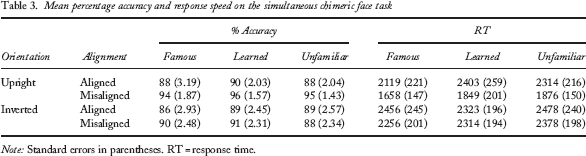
The data for two participants were removed due to performance at a level below chance. Across the remaining participants, 7% of the famous faces were consistently not recognized and were excluded from analysis on a case–by-case basis. The remaining data are summarized in Table 3, across aligned and misaligned trials and upright and inverted conditions for each level of familiarity.
Mean percentage accuracy and response speed on the simultaneous chimeric face task
Note: Standard errors in parentheses. RT = response time.
Accuracy
A 3 × 2 × 2 ANOVA revealed a significant main effect of alignment, F(1, 21) = 23.72, p < .001, with performance being better with misaligned than with aligned stimuli. It also revealed a main effect of orientation, F(1, 21) = 6.32, p < .025, with performance being better on upright than on inverted trials. The expected chimeric face effect was also evident as revealed through the interaction of alignment and orientation, F(1, 21) = 4.79, p < .05. Paired-samples t tests confirmed that alignment only mattered when stimuli were presented upright, t(21) = 4.34, p < .001. There was no effect of alignment when stimuli were presented inverted, t(21) = 1.51, p > .05. This reflected the anticipated chimeric face effect. Of most importance, however, was the fact that this classic chimeric face effect was not influenced by the familiarity of the face, F(2, 42) < 1, ns. In other words, the chimeric face effect was again demonstrated regardless of the level of familiarity and despite the removal of a memory load here.
Median RT for correct decisions
An identical pattern of results was revealed on analysis of response speed. The 3 × 2 × 2 ANOVA revealed a main effect of alignment, F(1, 21) = 6.83, p < .025, with performance being quicker with misaligned than with aligned stimuli. It also revealed a main effect of orientation, F(1, 21) = 4.20, p = .05, with performance being quicker upright than inverted. The expected chimeric effect was also demonstrated through the interaction of alignment and orientation, F(1, 21) = 7.01, p < .025. Paired-samples t tests confirmed the importance of alignment when upright, t(21) = 3.25, p < .005, but not when inverted, t(21) < 1, ns. Again, no other interactions modified these results, importantly indicating the chimeric effect regardless of familiarity of the stimuli.
Comparison of Experiment 2 with Experiment 3
The current data enabled comparison of performance on the chimeric face task across sequential (Experiment 2) and simultaneous (Experiment 3) testing conditions. In this regard, it may be anticipated that the simultaneous task would be easier than the sequential task due to the removal of the memory load. On inspection, the accuracy levels appeared equivalent, and indeed, a four-way mixed ANOVA including “experiment” as a between-participants variable revealed that it had no effect either alone, F(1, 48) < 1, ns, or in combination with any other variable(s), all Fs < 4.95, ns. Importantly, the main effects of orientation, F(1, 48) = 10.68, p < .005, and alignment, F(1, 48) = 6.71, p < .025, remained significant, with better performance when upright and when misaligned, respectively. In this combined analysis, the expected chimeric effect as revealed by an interaction of orientation and alignment also reached significance as a one-tailed test, F(1, 48) = 3.03, p(1-tailed) = .044, and this emerged regardless of familiarity, F(2, 96) = 1.86, ns. This suggested that the lack of the chimeric effect in the analysis of accuracy in Experiment 2 may have been due to a lack of power. It does not, however, negate the emergence of the chimeric effect for both experiments when examining RT.
Whilst formal comparison of RT across across the two tasks was not conducted, it is evident from inspection of the individual analyses that both experiments revealed the chimeric effect regardless of familiarity and despite the fact that performance in Experiment 3 was substantially slower than that in Experiment 2. It is tempting to interpret this slowed performance as being indicative of a more difficult task in Experiment 3 than in Experiment 2. However, this runs counter to methodological expectation and instead may simply indicate the fact that participants had more to take in during the simultaneous test given that they had not had the benefit of inspection time during the prior presentation of the target. As such, the comparison of accuracy data across Experiments 2 and 3 are taken to indicate equivalence in task difficulty despite the removal of the memory load and indicate a relatively weak chimeric face effect for both studies taken together, which is confirmed by the analysis of the more sensitive RT measure.
General Discussion
The three experiments reported here provide a consistent message: Holistic processing is demonstrable regardless of the familiarity of the face. In this sense, holistic processing is set apart from relational processing, and support is provided for the notion of holistic processing as a coarse processing stage available for all faces regardless of familiarity.
Three points are worthy of note in terms of the robustness of the present findings. First, care was taken here to ensure that picture-related processing could not be used by participants as a basis for task performance. As a result, fast and accurate performance within the present studies can be confidently attributed to holistic processing rather than to the recognition of a face, or a face-half, from an idiosyncratic cue in a given photograph. Second, the evidence presented here gains strength from the use of two convergent methodologies—the CPA (Experiment 1) and the chimeric face task (Experiment 2)—meaning that these effects cannot be accounted for in paradigm-specific or task-dependent terms. Finally, the findings are replicated across two levels of memory load through the use of sequential matching (Experiment 2) and simultaneous matching (Experiment 3). This serves to test, and then reject, a simple explanation for our results. More specifically, it cannot be concluded that the current results are an artefact of memory demands as the results hold whether sequential or simultaneous methods are used.
Some theoretical reflections
In sum, the data support the predictions of the “processing style” account of familiarity and face processing. Specifically, the demonstration of holistic processing for all faces regardless of familiarity supports its involvement at early stages of facial processing when the function may be to classify the face “as a face” (Hole et al., 1999) or to facilitate initial encoding (Calder & Jansen, 2005). In contrast, the demonstration within the literature of relational processing for familiar faces only supports its involvement at later stages of facial processing when the function may be to differentiate one familiar face from another (Hole et al., 1999). This explanation has parsimony and now has a body of data in support of it. However, it raises two important points, which the literature should begin to examine.
First, the definition of a task as being “holistic” or “relational” in nature has historically been problematic, and, indeed, different researchers have used the same paradigm to illustrate configural, relational, or holistic processing. As evidence of this, it is worth reflecting on the discussion of Maurer et al. (2002), which sought to draw a distinction drawn between configural, relational, and holistic processing. Simultaneously, the work of Hole, George, Eaves, and Rasek (2002) confirm the difficulty in defining exactly what is meant by these terms and in determining exactly how faces might be transformed to isolate and test their contribution. The consequence now is a literature that uses these terms interchangeably, inconsistently, or potentially inappropriately. In this sense, the empirical distinction between various processing styles may not be clear, and thus a theoretical framework based on differentiation of function may not be satisfactory.
Second, there is a logical problem in the interpretation of familiarity effects when an explanation begs us to consider one type of processing before familiarity is determined and another type of processing afterwards. Implicit in such a suggestion is some level of pre-processing, and this then merely introduces another layer of processing into our explanation without necessarily accounting for anything.
With these two major issues in mind, the suggestion here is to return to the empirical findings and be led by the data rather than their potential indication of processing styles. The data clearly indicate instances where familiarity makes a difference and instances where it does not. What then might differentiate these instances? One suggestion is to consider a series of parallel tasks, some easier than others. Where the task is sufficiently easy, it may be completed with speed and accuracy and with no apparent benefit when the face is familiar. However, when the task is more difficult it may take longer or be more error-prone, requiring more fine-grained perceptual skills (such as categorical perception: Beale & Keil, 1995; Stevenage, 1998) or more complex decisional processing (Cornes, Donnelly, Godwin, & Wenger, 2011). It is under these increased levels of cognitive load that facilitatory effects of familiarity may emerge.
In support of this argument, note that several effects of familiarity previously reviewed are evident under conditions where task difficulty has been increased: For example, familiarity effects emerge in expression classification when expressions are difficult to discriminate (Etcoff & Magee, 1992) or presentation is degraded in some way (Baudouin et al., 2000). Similarly, familiarity effects emerge in gender classification when gender is ambiguous (Roberts & Bruce, 1988), decisions are speeded (Clutterbuck & Johnston, 2004a), or stimuli are rotated away from upright (Stevenage & Osborne, 2006). Familiarity effects also emerge in face classification studies when scrambling is subtle through Thatcherization and difficult through inversion (Stevenage et al., 2005). In all cases, task difficulty is increased, performance is slowed, and familiarity has time to express a facilitatory effect.
At some level, merely appealing to task difficulty as an explanation for familiarity effects may also be criticized for failing to point to any explanatory mechanism. Whilst recognizing this as an area that urgently needs strong theoretical input, two ideas may be worthy of note. First, Clutterbuck and Johnston (2004a) articulate a mechanism for familiarity effects by relying on the traditional Bruce and Young (1986) and later the interactive activation and competition (IAC; Burton, Bruce, & Johnston, 1990) framework. Within this context, an existing or newly formed FRU may act to facilitate processing in related modules, but only if these modules are developed to articulate interconnections between identity, expression, and other face-related processing. The feature units (FTUs), from which FRUs and other visual processing stages are activated, are important in operationalizing this bidirection and interactive interconnection. Second, and perhaps more mature, is a mechanism grounded in the notion of attractor fields. In this regard, Tanaka, Giles, Kremen, and Simon (1998) suggest that familiarity effects may emerge through the benefit of having a local point of comparison when a face is familiar rather than a more global point of comparison when a face is unfamiliar. This local point of comparison may facilitate the processing required when tasks are complex or taxing (see Stevenage et al., 2005, pp. 1116–1117), hence accounting for the familiarity effects that emerge under these more difficult conditions.
In conclusion, the present paper demonstrates a CPA effect and a composite face effect regardless of facial familiarity. Whilst this may be understood within a framework associated with distinct processing styles, it is suggested that there may be merit in presenting these results within the body of work on familiarity effects and appealing to the consideration of task difficulty as a basis for understanding these effects. This may offer a level of simplicity and transparency that is of help when accounting for the existing body of findings. Moreover, it is anticipated that such a framework will enable the clearer prediction of conditions under which familiarity effects will emerge in future studies.