







Abstract
Experiments involving blocked and continuous manipulations of the semantic naming context demonstrate that, when speakers name several taxonomically related objects in close succession, they display persistent interference effects. A review of studies using the blocked paradigm shows that, unlike the continuous paradigm, it typically does not induce cumulative interference effects in healthy speakers. This contrasts with the simulation results obtained from a model of semantic context effects recently put forward by Oppenheim and colleagues [Oppenheim, G. M., Dell, G. S., & Schwartz, M. F. (2010). The dark side of incremental learning: A model of cumulative semantic interference during lexical access in speech production. Cognition, 114, 227–262], which generates cumulative effects in both paradigms. We propose that the effects are non-cumulative in the blocked paradigm, because it allows participants to bias top-down the levels of activation of lexical-semantic representations, thereby curtailing the accumulating interference. Indeed, prior research has shown that the interference effects in the blocked paradigm are exacerbated when participants carry out a concurrent digit-retention task, loading on working memory and reducing their capacity to exert a top-down bias. In Experiment 1, combining the continuous paradigm with a digit-retention task, we demonstrate that this does not exacerbate cumulative context effects, corroborating the selective role of working memory and the associated top-down biasing mechanism in the blocked paradigm. A review of neuropsychological and neuroimaging studies demonstrates that left inferior frontal regions may play a critical role in controlling semantic interference top-down. We discuss the implications of these findings for language production research and for models of lexical-semantic encoding.
Lexical-semantic encoding is a central processing stage in word production, because it enables speakers to map a concept onto its name. Psycholinguistic models of lexical-semantic encoding in word production incorporate at least two distinct representational levels: a preverbal, conceptual level and a lexical level (see, e.g., Caramazza, 1997; Dell, Schwartz, Martin, Saffran, & Gagnon, 1997; Goldrick & Rapp, 2002; Howard, Nickels, Coltheart, & Cole-Virtue, 2006; Levelt, Roelofs, & Meyer, 1999; Oppenheim, Dell, & Schwartz, 2010; Schade, 1999). Proponents of all models further converge on the assumptions that, during lexical-semantic encoding, several conceptually related lexical entries are activated initially and that there is a process that selects the most activated entry from this candidate set. In WEAVER + +, the model of lexical access proposed by Levelt et al. (1999), the lexical units that are activated and selected during this processing step are called lemmas, which constitute one of two lexical levels of representation (lemmas and lexemes); in the alternative models, the selection occurs at the lexeme (Caramazza, 1997) or lexical level (Dell, Schwartz et al., 1997; Howard et al., 2006; Oppenheim et al., 2010; Schade, 1999), which constitutes the only lexical level of representation.
Experiments using manipulations of the semantic naming context typically show that repeated access to the same semantic category induces substantial semantic interference. This interference is thought to arise during the selection of a target entry from among coactivated semantically related lexical entries, which is assumed to be more difficult when many semantically related lexical entries are named in close succession than when unrelated lexical entries are being named. The study of semantic context effects on object naming in healthy speakers has proven to be a powerful tool for investigating lexical-semantic representations and processes (Abdel Rahman & Melinger, 2007, 2011; Belke, 2008a, 2008b; Belke, Brysbaert, Meyer, & Ghyselinck, 2005; Belke, Meyer, & Damian, 2005; Damian & Als, 2005; Damian, Vigliocco, & Levelt, 2001; Howard et al., 2006; Kroll & Stewart, 1994; Schnur, Schwartz, Brecher, & Hodgson, 2006). There are two types of context manipulation: a blocked and a continuous paradigm. The purpose of the present paper is to further the understanding of the semantic context effects induced by these paradigms, which is an indispensable prerequisite for using them as a research tool.
In the blocked context manipulation, participants name lists of objects from the same semantic category (homogeneous context) or from different semantic categories (heterogeneous context). In most variants of this paradigm, the lists are compiled from small sets of objects that are presented in a sequence of stimulus cycles, with each cycle featuring all members of the set once in varying orders (blocked-cyclic naming, e.g., duck, snake, fish, mouse, fish, mouse, snake, duck, etc.). Naming latencies are consistently longer in homogeneous than in heterogeneous contexts. In healthy speakers, the effect typically emerges from the second presentation cycle onwards and does not increase thereafter. A similar, non-cumulative pattern of results can be obtained when the homogeneous and the heterogeneous naming lists are interleaved, such that semantically related and unrelated objects are mixed, and up to three unrelated objects are named between two related ones (Belke, 2012; Damian & Als, 2005). This suggests that the context effect is not contingent on the sustained presentation of semantically homogeneous stimuli, but survives several intervening, unrelated trials.
Howard et al. (2006) have recently worked out a continuous context manipulation that does not involve any repetitions of individual items. They compiled five target objects each from 24 semantic categories, and 45 unrelated objects serving as fillers. With these materials, they constructed 24 stimulus lists by orthogonally varying the number of same-category exemplars preceding a target object in the list (0 to 4) and the lag between successive same-category members (2, 4, 6, or 8 trials). Across lists, each lag order occurred once for each participant, and, across participants, each category was combined once with each lag order. Similarly, the order of the items of a given semantic category and the order of the semantic categories within the lists were fully counterbalanced. Analyses of participants' naming latencies showed that, on average, they were slowed down by 30 ms each time a given semantic category was accessed. This cumulative semantic inhibition effect was unaffected by the number of objects intervening between two successive category exemplars, demonstrating that the semantic context effect in the continuous paradigm is also long lasting. However, unlike the effect seen in blocked naming, it cumulates over time.
The finding that context manipulations induce long-lasting semantic interference effects has motivated models of lexical-semantic encoding that incorporate an incremental learning mechanism that renders the lexical-semantic representation of a target word persistently more accessible than its competitors (Howard et al., 2006; Oppenheim et al., 2010). Howard et al. (2006) have argued that an account of their findings requires a theory of lexical-semantic encoding that minimally includes a long-term priming mechanism, competition between coactivated lexical entries, and shared activation between conceptually related representations that leads to an automatic coactivation of semantically related lexical entries. While the last mechanism is implemented in all models of lexical-semantic encoding, only some models incorporate competition between coactivated lexical entries (Howard et al., 2006; Levelt et al., 1999; Schade, 1999; but see Dell, 1986; Mahon, Costa, Peterson, Vargas, & Caramazza, 2007). Long-term priming mechanisms have, as yet, not been implemented in any of the major theories of lexical access; however, they have been discussed as a relevant addition to the existing models for a number of years (Damian & Als, 2005; Wheeldon & Monsell, 1992, 1994), most frequently in terms of more or less permanent weight changes in the connections between conceptual representations and their corresponding lexical entries or as increased resting levels in the target representations (Damian & Als, 2005; Howard et al., 2006; McCarthy & Kartsounis, 2000; Oppenheim et al., 2010). Howard and colleagues have shown that positive weight changes in successfully retrieved target representations, shared activation between semantically related representations, and competition among coactivated lexical representations are necessary and sufficient to account for cumulative semantic interference effects in non-cyclic semantic blocking.
Oppenheim et al. (2010) have suggested that a different kind of learning mechanism may be responsible for the long-term cumulative semantic context effects. They developed a connectionist model of lexical-semantic encoding that incorporates an incremental learning mechanism that not only reinforces the weights between the lexical entry of a target word and its semantic features but also decreases the weights between coactivated nontarget words and their semantic features. The rate at which these changes take place is specified by means of a learning rate. Within this framework, lexical selection is accomplished by selecting the first representation whose level of activation exceeds the levels of activation of all other representations to a sufficient extent. If at a given time step no lexical entry has met this selection criterion, a booster mechanism multiplies the current levels of activation of all representations by a constant boosting factor, thereby exacerbating the differences between the levels of activation of coactivated lexical entries. The authors demonstrate that their model does not necessarily require the additional assumption of competition among coactivated lexical entries in order to model cumulative semantic interference in experiments involving continuous context manipulations.
Cumulative and non-cumulative semantic context effects in blocked and continuous naming paradigms
The models of lexical-semantic encoding presented so far predict that semantic context effects should increase with each access to a semantic category. However, for healthy speakers, this does not appear to be the case in the blocked paradigm. This has most often been demonstrated in the cyclic variant of the blocked paradigm; here, the effect typically emerges in the second presentation cycle and remains stable thereafter. As a result, there is a significant interaction of semantic context and presentation cycle when all presentation cycles are included in the analyses, but this interaction disappears when the first presentation cycle is excluded (e.g., Belke et al., 2005). Oppenheim et al. (2010), nevertheless, refer to the results from blocked-cyclic naming experiments as “cumulative semantic interference”, but in our view, a nonsignificant interaction of Context × Cycle in analyses including all but the first of four to eight presentation cycles can hardly be referred to as cumulative. To prove our point, we have revisited the data from most of the published experiments with healthy speakers featuring the blocked-cyclic naming paradigm.
Power analyses of the Context × Presentation Cycle interaction
Table 1 presents for 17 sets of data from blocked-cyclic naming experiments the interaction of context and presentation cycle in the by-participants and the by-items analyses when all cycles were included and, where available, when the first presentation cycle was excluded. In addition, minF′ scores are provided. Where available and relevant, the significance of the linear component of the interaction was assessed. 1 As Table 1 shows, the minF′ scores only reached significance when all presentation cycles were included in the analyses. When the first presentation cycle was excluded, none of the minF′ scores were significant.
We are grateful to Rasha Abdel Rahman for providing the relevant data for the categorically related and unrelated object sets tested in Experiments 1 and 2 reported in Abdel Rahman and Melinger (2007, 2011).
Interactions of context and presentation cycle for 17 sets of data from healthy speakers performing blocked-cyclic naming tasks when all cycles are included and when the first presentation cycle is excluded (by-participants, by-items, and minF' analyses. Where available and relevant, the significance of the linear component of the interaction was assessed.)
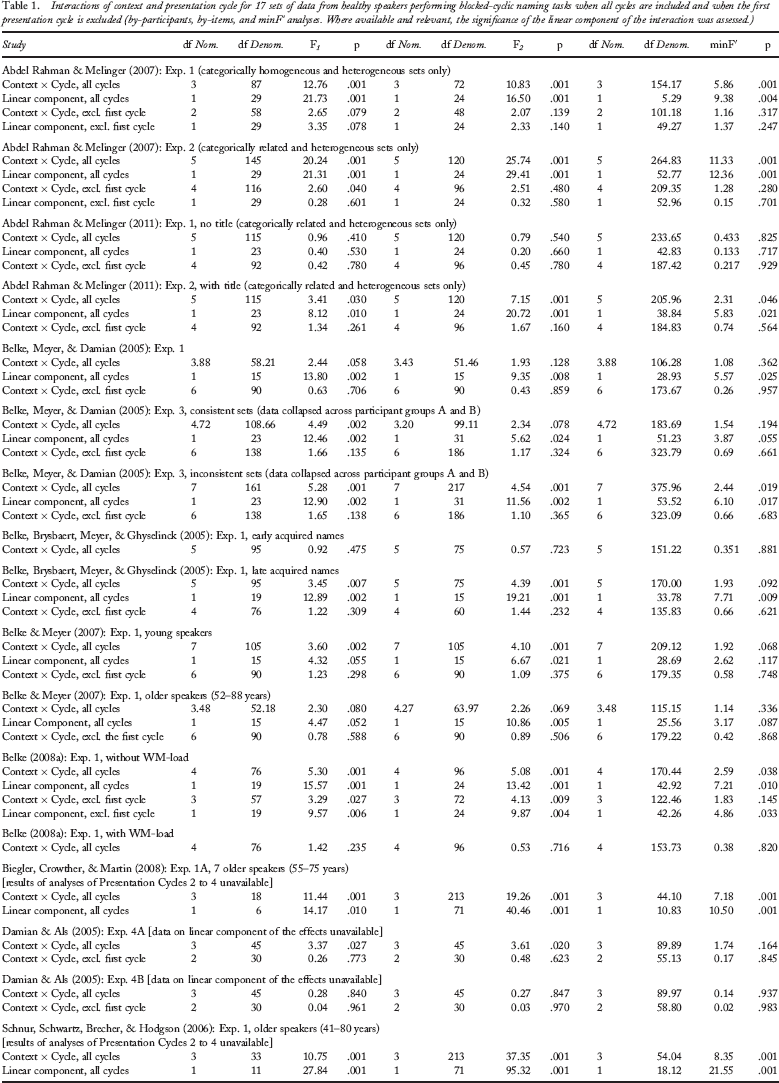
Note that in most of the experiments that have yielded a significant interaction of context and presentation cycle in the overall analysis, the linear component of the effect was also significant. However, the absence of an interaction in the analysis without the first presentation cycle demonstrates that there is clearly no linear accumulation of the semantic context effects over presentation cycles in any of the studies. This suggests that in analyses of all presentation cycles, the linear increase of the context effect over presentation cycles may often be overestimated.
Alternatively, it is conceivable that excluding the first presentation cycle decreased statistical power to such an extent that a linear increase of the context effect from Presentation Cycle 2 onwards was not detected. Table 2 presents the power achieved in each of the analyses of presentation cycle and context for the subset of the studies listed in Table 1, on which the first author has (co)reported. The values λ and 1 – ß were established with respect to obtaining a small effect (Ω2 = .01), using G*Power (Faul, Erdfelder, Lang, & Buchner, 2007; Rasch, Friese, Hofmann, & Naumann, 2010a, 2010b). In the by-participants analysis, the ß-error does not exceed 18%, and in more than half of all analyses it was less than 10%. This indicates that there was indeed no interaction of context and presentation cycle when the first cycle was excluded.
Power achieved in each of the interactions of cycle and context for a subset of the studies listed in Table 1
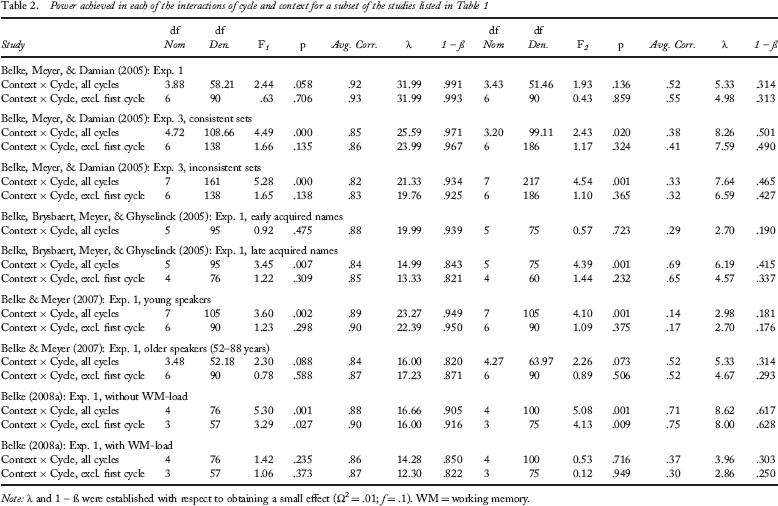
Note: λ and 1 – ß were established with respect to obtaining a small effect (Ω2 = .01; f = .1). WM = working memory.
The power analyses for the by-items analyses suggest that the restriction to small object sets, which is an inherent feature of the blocked-cyclic paradigm (see Damian et al., 2001), severely limits the statistical power of item analyses. Furthermore, the items are carefully selected and do not consist of a random selection from a larger item pool (see Belke, et al., 2005), so the meaningfulness of item analyses in this paradigm is questionable.
To summarize, both continuous and blocked-cyclic context manipulations induce long-lasting semantic interference effects (Damian & Als, 2005; Howard et al., 2006). However, only the continuous paradigm induces cumulative effects. In blocked-cyclic naming, the context effect seen in healthy participants typically increases from the first to the second object presentation but remains stable thereafter. Parallel findings have been reported for non-cyclic variants of the blocked paradigm (Damian & Als, 2005), which, like the cyclic variant, feature multiple repetitions of an object set within the stimulus list, but the order of appearance of the items in the list is fully randomized. Similarly, variants of the paradigm, which feature mixed homogeneous and heterogeneous lists or lists with unrelated filler stimuli interleaved between the target stimuli from a homogeneous or heterogeneous set, have yielded non-cumulative effects (Damian & Als, 2005). This demonstrates that short-term trial-to-trial priming cannot be the reason for the non-cumulative effects in the blocked paradigm.
Discussion
If one assumes, like Belke (2008a) and Oppenheim et al. (2010), that both cumulative and non-cumulative effects are based on the same long-lasting and cumulative semantic interference effects, there must be some mechanism that curtails the interference in the blocked-cyclic paradigm. One way of thinking about such curtailing mechanisms is in terms of cognitive control mechanisms influencing lexical selection.
In the framework of Baddeley's (1986, 2000, 2012) influential theory of working memory, such cognitive control mechanisms would be part of the central executive module. This central executive mediates selective attention and controls and manipulates the contents of modality-specific buffers that constitute distinct modules in the model. This modular differentiation between maintenance functions (buffers), on the one hand, and the control and the manipulation of their contents through the central executive, on the other, has been called into question by behavioural evidence and, in particular, by evidence from functional neuroimaging studies (Badre, Poldrack, Paré-Blagoev, Insler, & Wagner, 2005; Badre & Wagner, 2007; Miller & Cohen, 2001; Thompson-Schill, D'Esposito, Aguirre, & Farah, 1997; Thompson-Schill, D'Esposito, & Kan, 1999). In a review of this evidence, Wagner, Bunge, and Badre (2004, p. 711) have concluded that
[instead of] a single executive processor … executive functions, which may include both working memory manipulation and maintenance processes, likely emerge from a set of elemental cognitive control mechanisms. … Putative control functions include dual-task coordination and task-switching (task management); retrieval of goal-relevant information from long-term memory (controlled retrieval); selection of appropriate responses (response selection) and inhibition of inappropriate responses (response inhibition); resolution of distraction from competing representations (interference resolution); transformation, re-ordering, or updating of information maintained in working memory (manipulation); and evaluation of whether information in working memory meets the criteria associated with one's goal (monitoring).
Thompson-Schill and Botvinick (2006) have argued that the distinction between retrieval processes on the one hand and selection affordances on the other hand is a “false dichotomy” (p. 402; see also Martin & Cheng, 2006). According to their view, the levels of activation of the lexical-semantic representations competing for selection are influenced bottom-up, by the stimulus properties and the way activation induced by the stimulus spreads within the lexical-semantic network, and top-down, by a representation of the task. In a cue-based verb generation task, for instance, the bottom-up activation induced by the cue “dog” might activate two dominant response candidates, “bark” and “bone”. The representation of the task-specific requirement for a verb response would then bias the pattern of activation towards “bark” and against “bone”. The joint effects of the bottom-up activation and the top-down response biases will eventually determine the levels of activation of all lexical entries competing for selection (competition hypothesis; Thompson-Schill & Botvinick, 2006). According to Thompson-Schill and colleagues, the role of the LIFG is to mediate top-down (task-dependent) biases on lexical access.
How would this argument relate to lexical-semantic encoding in object naming? Figure 1 presents a working model of lexical-semantic encoding in object naming in general and blocked-cyclic naming in particular (cf. Belke, 2008b). In its centre, Figure 1 presents a section of a network model of lexical-semantic representations, consisting of two separate strata for conceptual representations (conceptual features and lexical concepts) and a stratum of lexical representations (lemma representations), respectively. 2 Each node within the network section shown in Figure 1 is activated, with darker shades indicating higher levels of activation. The pattern of activation shown here is induced bottom-up by presenting the picture of a duck. This leads to high levels of activation for the representations of duck and semantically closely related animals (swan), somewhat less activation to more distantly related animals (fish), and even less activation to animals not living in the water (dog, cat, …). Note that the influences of the top-down modulation mechanism are not shown in Figure 1. We will describe these influences shortly for the two cases of naming “duck” in a semantically homogeneous context and a semantically heterogeneous context, respectively, in a blocked naming task.
The model's architecture is based on a hypothetical unification of the featural and unitary semantic space (FUSS) model of conceptual representations (Vigliocco, Vinson, Lewis, & Garrett, 2004) and non-decompositional models of lexical access in language production (Levelt et al., 1999; Schade, 1999; see Belke, 2008b and Belke, 2012, for details). The links between conceptual features and lexical concepts (dashed lines) carry variable weights, which were established in Vigliocco et al. (2004).
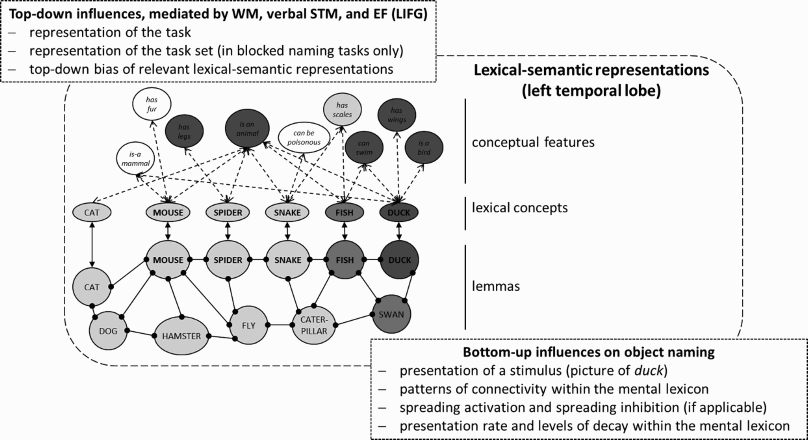
A working model of lexical-semantic encoding in object naming (see Belke, 2008b) (WM, working memory; STM, short-term memory; EF, executive functions; LIFG, left inferior frontal gyrus).
At the lemma level, one target representation must be selected from among the coactivated representations. This selection process may be more or less effortful, depending on how clearly a target entry stands out. If it stands out clearly (referred to as a low-selection condition in Thompson-Schill et al., 1997), selection is quick and easy. However, if several lexical entries qualify as target entries (high-selection condition), selection will require more effort. In this situation, a top-down biasing signal may help to swiftly identify one target entry by biasing the levels of activation towards task-relevant and against task-irrelevant representations. Such a biasing mechanism is bound to involve working memory resources, not least because it requires participants to maintain a representation of the task. Critically, for top-down biasing to occur, the task must be constructed in such a way that participants are capable of distinguishing task-relevant and task-irrelevant representations.
Belke (2008a) has pointed out that, contrary to the continuous paradigm, the blocked-cyclic paradigm allows participants to encode the members of the current object set during the first presentation cycle as part of the representation of the naming task and to subsequently bias the relevant set members top-down during lexical retrieval (biased-selection account). In semantically heterogeneous contexts, which feature one object each from various semantic categories, such a top-down bias renders the selection process considerably more efficient, because it biases only one lexical entry in each of the semantic categories, thus singling it out from among its within-category competitors that have been coactivated bottom-up by the picture to be named (such as swan and fish in Figure 1). In homogeneous contexts, by contrast, the top-down bias is applied to several exemplars of a single semantic category. This may reduce the competition from category members outside the naming set, such as cat, dog, hamster, fly, caterpillar, or swan, but it does not alleviate the competition within the set (duck, mouse, snake, fish, spider). As a result, the competition among these members of the homogeneous set of target entries will be consistently more severe than that seen among the members of the heterogeneous target set, inducing a significant but non-cumulative semantic interference effect. To conclude, according to the biased-selection account, the cyclic and the non-cyclic semantic blocking paradigms elicit the same cumulative patterns of activation at the lexical-semantic level, but they differ in that the cyclic semantic blocking paradigm enables participants to keep the ensuing interference under top-down control.
As detailed previously, maintaining a representation of the task and exerting top-down biases during lexical-semantic encoding apparently engage central working memory (WM) capacities. Consistent with this claim, Belke (2008a) has shown that the semantic context effect is exacerbated when participants complete a blocked naming task under a WM-load induced by a digit-retention task—arguably due to reduced WM-capacities for the efficient top-down control of lexical-semantic encoding. Importantly, the effects still do not cumulate under cognitive load (see data on Belke, 2008a, in Table 1), suggesting that the top-down modulation was not absent but merely less efficient.
Experiment 1
A central prediction from the biased-selection account is that in picture-naming tasks that do not allow for a top-down, task-specific modulation of lexical-semantic representations, cumulative semantic context effects should emerge. Indeed, this is the pattern of results observed in the continuous paradigm, which requires participants to repeatedly access identical semantic categories but does not allow for any top-down biasing of individual lexical-semantic representations. Critically, if this account of semantic context effects in the blocked and continuous paradigms is correct, a WM-load should interact with semantic context in the blocked paradigm (see Belke, 2008a), but it should not interact with semantic context in the continuous paradigm. This is because a WM-load can reduce the efficiency of the top-down modulation of lexical-semantic processing in blocked naming but not in continuous naming, which does not allow for top-down modulation in the first place. We tested this prediction by assessing the naming performance of a group of participants in the continuous paradigm with and without a concurrent digit-retention task.
Method
Participants
Twenty-four native speakers of German participated in the experiment. They were reimbursed for their participation.
Material
A total of 165 coloured photographs of man-made and natural entities were used, including 120 targets (five members each of 24 semantic categories) and 45 unrelated fillers. A total of 140 five-digit random numbers were created in MS-Excel for the digit-retention task. In this task, we had participants first retain a probe string and, shortly afterwards, compare it to a prompt string. To this end, 18 “same” probe–prompt pairs (e.g., 82315–82315) and 17 “different” probe–prompt pairs (e.g., 31497–31947) were created.
Design
Twenty-four different stimulus lists were constructed in such a way that each category featured once with each lag order, and each list featured a different order of the semantic categories and a different order of the exemplars of a given category. The design comprised the within-participants factors WM-load (present, absent), the number of same-category exemplars preceding a target in the list (0 to 4), and the number of trials intervening between two successive exemplars of a category (2, 4, 6, or 8). The number of same-category members preceding an exemplar in the list is fully correlated with its ordinal position in the list, so we call this variable “position” in the following. WM-load was tested in a blocked fashion, and the order of completing the two load conditions was counterbalanced across participants.
Procedure
In the naming-without-load condition, participants completed the naming task only. In each trial, they first saw a fixation point for 500 ms, followed by a blank screen for 250 ms, and the picture for 2,000 ms. Response times were measured from picture onset. After a 500-ms intertrial interval, the next naming trial commenced. In the naming-with-load condition, participants retained a five-digit probe over five successive naming trials and subsequently judged whether a five-digit prompt was identical to or different from the probe. In the probe presentation trials, participants were shown a fixation point for 800 ms, followed by a blank screen for 50 ms, and the probe for 2,000 ms. After a 100-ms intertrial interval, the first of five naming trials commenced. After the fifth naming trial, participants were shown a prompt for 1,000 ms asking them to judge whether the upcoming digit string was identical to or different from the digit string shown in the probe trial. After that, the screen was blank for 50 ms, and the prompt string was shown for 3,500 ms. It was masked subsequently by a row of XXXXX, to erase any afterimage of the prompt string. This was done so that the participants were ready to encode the next probe prior to naming another five objects.
The experiment was controlled by the Nijmegen Experimental SetUp (NESUv4.29). Naming latencies were registered using a voice-key (Hasomed Nesu-Box 2) and a Sony ECM-MS907 microphone, and responses to the digit-retention task were registered using a two-button response box. Response times were coded as time-outs when they exceeded 1,500 ms (naming task) or 3,000 ms (digit-retention task).
Results
Wm-Load Task
A total of 22.9% of the “same”–“different” responses were given too late or were wrong, suggesting that the WM-load task was reasonably difficult. Participants made more errors on “same” responses (28.2%) than on “different” responses (17.7%); t1(23) = 2.59, p = .016; t2(31) = 1.91, p = .065, and correct “same” responses were significantly slower (M = 1,461 ms, SD = 313 ms) than correct “different” responses (M = 1,285 ms, SD = 236 ms); t1(23) = 3.87, p = .001; t2(31) = 3.15, p = .004.
Naming task
A total of 660 responses to the naming task (11.5%) were associated with errors or time-outs in the digit-retention task and were excluded. Of the remaining data, 9.2% (528 trials) had to be excluded because of voice-key or participant errors. Statistical analyses of the proportion of participant errors yielded no significant effects.
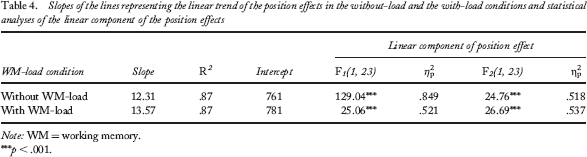
Prior to the analyses of naming latencies, latencies deviating more than two standard deviations from a participants' individual mean were excluded (1.1% of valid trials), leaving 78.5% of all original data for analyses. Figure 2 displays the naming latencies broken down by WM-load, position, and lag. Table 3 presents the results of the statistical analyses by participants (F1) and categories (F2, cf. Howard et al., 2006) of the latencies obtained in Positions 2 to 5, including position, WM-load, and lag as independent variables. There was a significant position effect but no effects of lag or its interaction with position. The main effect of WM-load was significant by categories, but did not reach significance in the by-participants analyses. Importantly, there was no interaction of position and WM-load. Further analyses including all positions, collapsing over lags, showed effects of WM-load and position but no interaction of WM-load and position (see Table 3). 3 The slopes of the position effects seen with and without WM-load were very similar (see Table 4).
One might argue that the interaction of position and WM-load did not reach significance because the effect of WM-load was weak in the by-participants analyses in the first place. However, the first author has recently replicated the present pattern of results in an experiment designed to assess the WM-load effect across different tasks, including object naming, word naming, and semantic classification, yielding a significant main effect of WM-load on object naming in the by-participants and the by-categories analyses and no interaction with position in either analysis (Belke, 2012).
Statistical analyses of naming latencies for Positions 2 to 5 with respect to the effects of WM-load, position, lag, and their interaction, and for Positions 1 to 5 with respect to the effects of WM-load, position, and their interaction
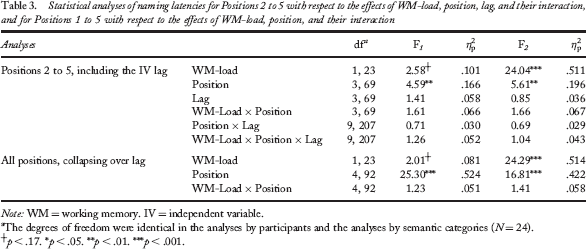
Note: WM = working memory. IV = independent variable.
The degrees of freedom were identical in the analyses by participants and the analyses by semantic categories (N = 24).
p < .17.
p < .05.
p < .01.
p < .001.
Slopes of the lines representing the linear trend of the position effects in the without-load and the with-load conditions and statistical analyses of the linear component of the position effects
Note: WM = working memory.
p < .001.
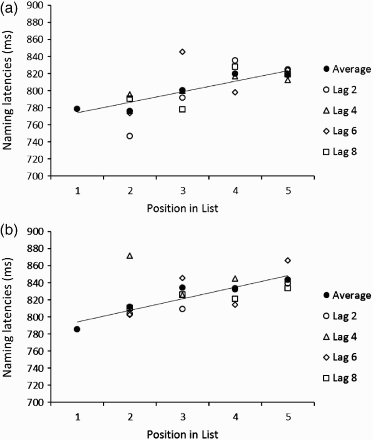
Mean naming latencies (in ms) in the without-load (a) and the with-load conditions (b), broken down by position and lag. Solid dots indicate the average naming latency obtained for each position, collapsed over lags.
When reassessing the data from Belke (2008a, Experiment 1) on the effect of WM-load on the context effects seen in the blocked paradigm, we obtained a strong interaction between WM-load and context (f > .5 and 1 – ß = .9999). Accordingly, we assessed the ß-error for the analyses of the interaction of WM-load and position in the present data with respect to a large effect (Ω2 = .14; f = .4), yielding 1 – ß scores for the by-participants and by-categories analyses of .9997. This suggests (with ß < .001) that the semantic context effect seen in the continuous paradigm is indeed unaffected by a WM-load.
Discussion
Unlike the blocked context effect, the continuous context effect does not interact with a WM-load. This finding is consistent with the biased-selection account. As reviewed in the introduction, there are currently two models of lexical-semantic encoding, which, by virtue of incorporating incremental learning mechanisms, are able to account for long-lasting semantic interference effects. However, neither of these models incorporates a top-down modulation mechanism of the kind proposed here. Instead, the prediction from both models is that semantic context effects accumulate in both paradigms and interact with a WM-load in either both paradigms or neither paradigm.
It should be noted, however, that top-down modulation mechanisms have been put forward in other models of lexical access that do not incorporate an incremental learning mechanism. For instance, in WEAVER + +, lexical selection at the lemma level is accomplished through a production rule, which is applied as soon as the level of activation of a lemma node exceeds the summed levels of activation of all its competitors, and its status as a target lemma has been verified. During verification, “executive” production rules can control the application of the selection production rules with reference to the current task or goal (see Roelofs, 2003, p. 100). This way, the application of the selection production rules can be restricted to the set of lexical-semantic representations most pertinent to the current task, such as the members of the naming set in the blocked paradigm.
Furthermore, virtually all of the models implementing the generation of complex utterances or sentences (Dell, 1986; Schade, 1999) incorporate top-down sequencing mechanisms ensuring that the right words are inserted to the utterance frame at the right time. These mechanisms enforce the serial selection for articulation of each upcoming word in an utterance at a certain time stamp. They typically apply to the most activated representation at this time stamp that fulfils the grammatical requirements of the utterance frame. The utterance frame specifies the grammatical class of an upcoming word, thereby restricting the pool of potential words for production to words from this word class only (e.g., Dell, 1986; Schade, 1999; see also Dell, Burger, & Svec, 1997; Dell, Oppenheim, & Kittredge, 2008). While the sequencing mechanism is typically thought to operate on the long-term lexical representations, some accounts of complex utterance production have suggested that they operate on representations stored temporarily in an external buffer of lexical-semantic representations (Martin, Lesch, & Bartha, 1999).
The top-down influences that enforce the selection for articulation operate language-internally only (see Schnur et al., 2006) and do not cover more general task-related influences, as proposed in the biased-selection account. Furthermore, the top-down selection enforcement implemented in models of complex utterance generation is primarily geared towards tackling syntagmatic interference—that is, interference from upcoming or previously produced words in the utterance. By contrast, the top-down modulation mechanism put forward with the biased-selection account is geared towards resolving paradigmatic interference arising when several semantically related lexical candidates compete for selection for verbalization in a single slot of the utterance frame (see also Dell et al., 2008). It would appear that, in the long run, models of complex utterance production require that both types of top-down mechanisms be implemented so as to be able to swiftly retrieve the right word (through paradigmatically biased selection) at the right time (through syntagmatically biased selection).
In the remainder of this paper, we want to explore to what extent independent evidence for paradigmatically biased selection can be found in neuropsychological and neuroimaging studies. Two critical predictions follow from the biased-selection account of semantic context effects on object naming. First, if, in principle, the effect is cumulative, cumulative effects should be observable in the blocked paradigm, if only occasionally. This prediction is borne out. As seen in Table 1, some of the studies with young, healthy speakers have yielded cumulative effects (e.g., Belke, 2008a). In addition, blocked context manipulations in object-naming experiments with older speakers have occasionally yielded cumulative effects (Biegler, Crowther, & Martin, 2008; Schnur et al., 2006; but see Belke & Meyer, 2007, all listed in Table 1).
Second, neurologically impaired patients with damage to the LIFG, which, as we have reviewed above, is thought to mediate the top-down biasing mechanism, will display cumulative interference effects. Indeed, there are a number of single-case and group studies demonstrating that patients with left frontal neurological disorders display exacerbated and cumulative semantic context effects (Biegler et al., 2008; McCarthy & Kartsounis, 2000; Schnur et al., 2006; Scott & Wilshire, 2010; see also Wilshire & McCarthy, 2002). Unfortunately, for many of the patients documented in these studies, no detailed information on the extent and precise location of the neurological damage causing their language impairment is available. However, a left frontal damage can be inferred from the quality of the language production impairment, which is characterized by nonfluent speech, frequent hesitations, and, in most cases, agrammatic symptoms. We review these studies in detail in the next section.
Biased selection in blocked naming: Evidence from patient studies
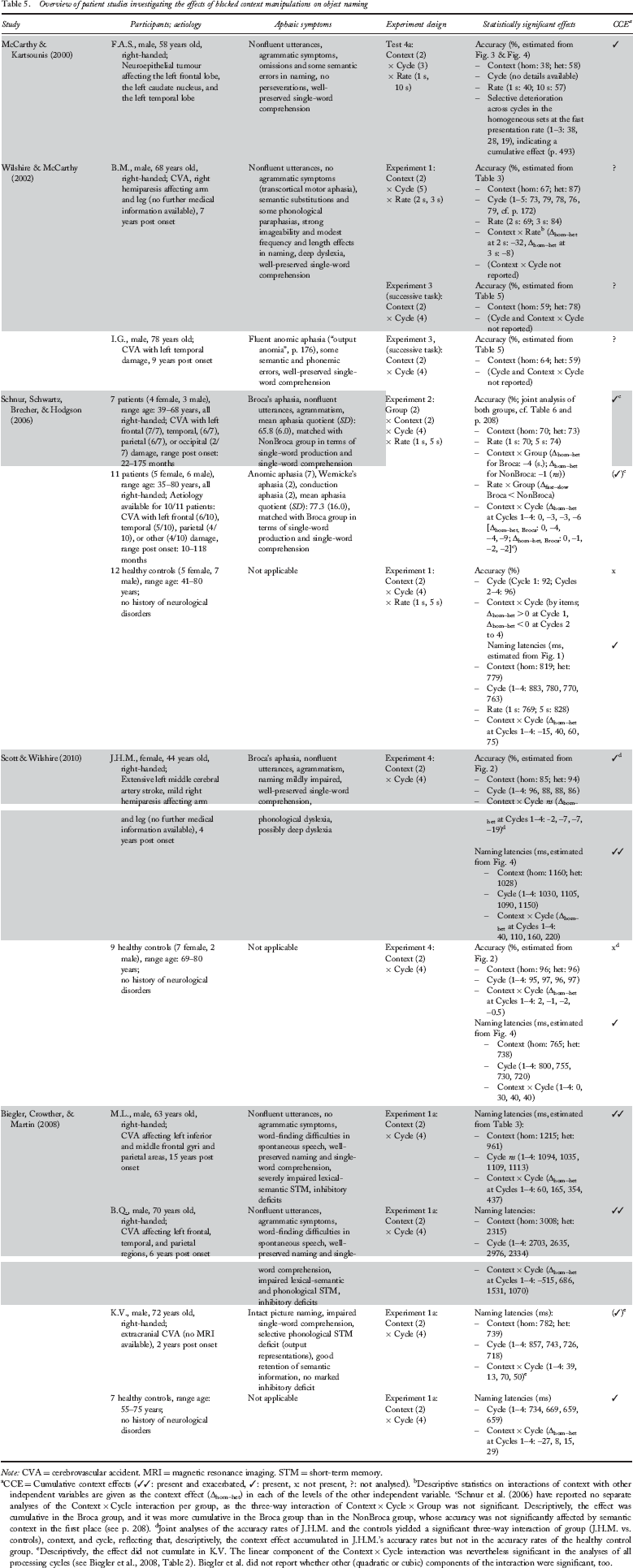
Table 5 presents the existing single-case and group studies documenting the performance of patients in the blocked naming paradigm who have been diagnosed or inferred to suffer from left frontal cortical damage. In all studies, the patients repeatedly named small sets of semantically related or unrelated objects—that is, in all studies, the variables context (homogeneous, heterogeneous) and cycle (ranging from 3 to 6 repetitions of the set members) were varied. In addition, many of the studies involved manipulations of the rate of picture presentation. Within the framework of the working model presented in Figure 1, this manipulation constitutes one of the bottom-up influences on the pattern of lexical-semantic activation: The more quickly two successive stimuli are presented, the less time there is for residual activation to decay. When several semantically related objects are presented in this way, this will most likely increase the levels of interference induced by the context manipulation (e.g., McCarthy & Kartsounis, 2000; Wilshire & McCarthy, 2002; but see Schnur et al., 2006).
Overview of patient studies investigating the effects of blocked context manipulations on object naming
Note: CVA = cerebrovascular accident. MRI = magnetic resonance imaging. STM = short-term memory.
CCE = Cumulative context effects (✓✓: present and exacerbated, ✓: present,
bDescriptive statistics on interactions of context with other independent variables are given as the context effect (Δhom–het) in each of the levels of the other independent variable. cSchnur et al. (2006) have reported no separate analyses of the Context × Cycle interaction per group, as the three-way interaction of Context × Cycle × Group was not significant. Descriptively, the effect was cumulative in the Broca group, and it was more cumulative in the Broca group than in the NonBroca group, whose accuracy was not significantly affected by semantic context in the first place (see p. 208). dJoint analyses of the accuracy rates of J.H.M. and the controls yielded a significant three-way interaction of group (J.H.M. vs. controls), context, and cycle, reflecting that, descriptively, the context effect accumulated in J.H.M.'s accuracy rates but not in the accuracy rates of the healthy control group. eDescriptively, the effect did not cumulate in K.V. The linear component of the Context × Cycle interaction was nevertheless significant in the analyses of all processing cycles (see Biegler et al., 2008, Table 2). Biegler et al. did not report whether other (quadratic or cubic) components of the interaction were significant, too.
Many of the studies listed in Table 5 also document the performance of healthy controls (Biegler et al., 2008; Schnur et al., 2006; Scott & Wilshire, 2010) or control patients who suffered from similarly severe forms of production disorders, but whose neurological disorder did not involve frontal areas, or whose speech was not dysfluent (K.V. in Biegler et al., 2008; 11 patients in Schnur et al., 2006). The lines pertaining to these participants are shown with a white background in Table 5. All lines with a grey background pertain to patients with left frontal neurological disorders and/or Broca's aphasia.
Table 5 demonstrates that the accuracy observed for all but two of the 12 patients who had been diagnosed with Broca's aphasia or related nonfluent language production disorders displayed cumulative semantic context effects in blocked naming (F.A.S.; the “Broca” group of 7 patients with Broca's aphasia presented in Schnur et al., 2006; M.L.; B.Q.). For B.M. (Wilshire & McCarthy, 2002), it is not documented whether the context effect increased over presentation cycles. J.H.M. (Scott & Wilshire, 2010) displayed a substantial and cumulative semantic context effect in the analysis of response times, hence presenting a similar pattern of results to those of the other patients (see Table 5 for details on the analysis of his accuracy). By contrast, the accuracy and, where applicable, the reaction times of most of the healthy controls (Biegler et al., 2008; Scott & Wilshire, 2010; Wilshire & McCarthy, 2002) or the control patients (K.V.; the “NonBroca” group of 11 patients with anomic, Wernicke, or conduction aphasia reported in Schnur et al., 2006) were either entirely unaffected by semantic context or showed substantially weaker and less cumulative context effects. This pattern is most apparent in the analyses of the naming latencies of patient J.H.M. and a group of healthy controls, documented by Scott and Wilshire (2010): Here, an overall analysis of the naming latencies of both groups of participants yielded a three-way interaction of context, cycle, and group (J.H.M., controls), suggesting that J.H.M.'s performance differed systematically from that of the controls (note, however, that this three-way interaction disappeared when the latencies were z-transformed). Descriptively, Schnur et al. (2006) found a similar pattern of results for the accuracy levels of their Broca and NonBroca groups, but the Group × Context × Cycle interaction was not significant.
The general pattern of results obtained in the studies reviewed in Table 5 is fully compatible with the biased-selection account illustrated in Figure 1. Cumulative interference effects induced by blocked semantic context manipulations are a defining feature of the performance of patients with moderate to severe aphasic production impairments resulting from neurological damage involving left frontal cortical sites, including the LIFG. This pattern of results differs markedly from the pattern of results typically obtained with healthy speakers (see Tables 1 and 2). The presence of Broca's aphasia, especially of agrammatic symptoms, does not seem to be a necessary condition for exacerbated cumulative context effects to arise. This is in keeping with the general notion that the cognitive control functions mediated by the LIFG are language-unspecific and are deployed to language processing in a similar fashion as to any other cognitive task (see also Novick, Trueswell, & Thompson-Schill, 2010).
It is also noteworthy, however, that in the group study by Schnur et al. (2006), both the Broca and the NonBroca groups included patients who presented with left frontal neural damage, involving the LIFG in 6 out of 11 of the participants in the NonBroca group. This is striking given that, as a group, they showed no substantial cumulative semantic context effects in the blocked naming paradigm. More conclusive evidence in favour of a direct link between disorders of the LIFG and cumulative semantic context effects in blocked naming was reported by Schnur et al. (2009). These authors conducted a lesion analysis study with a subgroup of 12 of the 18 patients documented in Schnur et al. (2006), including six patients with Broca's aphasia and six with anomic or conduction aphasia. The authors found that the degree of growth seen for the context effect across cycles was significantly larger for patients with large LIFG damage than for patients whose LIFG was damaged to a lesser extent. The correlation of LIFG damage and effect growth was marginally significant (“r = .56, p < .06, N = 12”, p. 324). Visual inspection of the scatterplot of the F-values of the growth effect and the percentage of damage to the LIFG for the 12 patients (Schnur et al., 2009, p. 325; see also Table S2 in the supplement to the paper by Schnur et al.) shows that two of five patients who showed no growth effect (F < 1) had only very small lesions to the LIFG (<16%), while the person with the most LIFG damage (77%) showed the second strongest growth effect (F = 3.72). The pattern of growth effects for patients with intermediate-sized lesions to the LIFG (35–75%) was more mixed, with two patients showing virtually no growth effect (F < 1) and others showing quite strong growth effects. Overall, these data strengthen the claim that the LIFG plays a relevant role in curtailing cumulative interference in the blocked manipulation of semantic context. However, they also highlight that, clearly, there is no one-to-one mapping of this brain area and its behavioural correlate.
Before turning to evidence from neuroimaging with healthy participants, we want to take a closer look at patients M.L., B.Q., & J.H.M. (Biegler et al., 2008; Scott Wilshire, 2010). These patients have been shown to suffer from severe disorders of lexical-semantic short-term memory (STM), characterized by frequent intrusions of irrelevant targets in STM-tasks and exacerbated proactive interference effects. This suggests that the STM-disorder is not caused by an inability to maintain lexical-semantic representations in verbal STM over time, but to select from among the representations maintained in STM (but see Barde, Schwartz, Chrysikou, & Thompson-Schill, 2010). Indeed, apart from the lexical-semantic STM disorder, all three patients were found to be impaired in tasks involving inhibition (e.g., picture–word interference or Stroop tasks), which Martin and colleagues have argued to be a potential cause for the lexical-semantic STM deficit observed in M.L. and B.Q. (Biegler et al., 2008; Martin & Allen, 2008). They proposed that M.L. and B.Q. suffer from a lack of self-inhibition of previously produced representations, which causes many lexical representations to be highly active and renders the patients unable to select a target representation, especially when they name objects in a homogeneous semantic context.
Thus, the cases of these two patients point to the possibility that functionally different disorders—a lack of self-inhibition and an insufficient top-down biasing mechanism—might induce the identical behavioural symptom—namely, a cumulative semantic context effect in the blocked paradigm. Alternatively, the lack of self-inhibition might be a functional result of impaired top-down control mechanisms mediated by the LIFG. Scott and Wilshire (2010, p. 529) argue along those lines for J.H.M., proposing that “J.H.M. suffers from an impairment to a control mechanism that modulates the flow of activation throughout the lexical network”.
One way of testing the unified account, according to which the reduced verbal span and the exacerbated context effect originate from the same underlying impairment of lexical-semantic control mechanisms, is to test patients in both the blocked and the continuous context manipulation. If the cumulative context effect in the blocked paradigm is due to a disorder of the top-down biasing mechanism, these patients should show no exacerbated context effects in the continuous paradigm, since this paradigm does not allow for top-down biases to operate in the first place. However, if they display cumulative context effects in the blocked paradigm due to a lack of self-inhibition, it is likely that they also show exacerbated context effects in the continuous paradigm—that is, steeper cumulative context effects than for control participants, especially at short lags. It is worth recalling that healthy speakers are thought to display cumulative semantic context effects in the continuous paradigm because of the incremental learning mechanism, which renders the lexical-semantic representation of a target word persistently more accessible than its competitors. The adverse effects of this learning mechanism on naming other words than the target are exacerbated if a target's self-inhibition is impaired.
In conclusion, this review of patient studies demonstrates that exacerbated and cumulative semantic context effects in the blocked naming paradigm can be a useful diagnostic tool in identifying and specifying disorders of lexical access. If possible, future research should aim at testing patients with left frontal cortical damage in both the blocked and the continuous paradigm, so as to establish whether the context effect is exacerbated relative to healthy controls in both paradigms or in the blocked paradigm only.
Biased Selection in Blocked Naming: Evidence from Neuroimaging and Neurostimulation Studies with Healthy Speakers
If healthy speakers engage the LIFG in the blocked naming paradigm in order to bias the activation of the coactivated lexical-semantic representations top-down, we should see evidence of this in functional neuroimaging. Indeed, Schnur et al. (2009) have demonstrated recently that when healthy participants named objects in a cyclic semantic blocking paradigm, both the LIFG and left temporal regions were activated more in homogeneous than in heterogeneous contexts. This is in line with the notion that in the homogeneous context, activation accumulates in a concentrated fashion within a small section of the left temporal lexical-semantic network. It involves all set members, which constantly coactivate each other and joint competitors. By contrast, the pattern of activation is more scattered across the network in the heterogeneous context, spanning several semantic categories (Belke et al., 2005). Accordingly, it takes more executive control to curtail the interference arising within the mental lexicon in the homogeneous context than it does in the heterogeneous context.
Of course, the increase in LIFG activity in the homogeneous naming contexts does not point exclusively towards the top-down biasing mechanism suggested in this paper. Prima facie, it simply reflects that, in healthy speakers, the LIFG is more active in situations that are characterized by high levels of lexical-semantic competition. Indeed, Schnur et al. (2009) have reported that the activation seen in the LIFG, but not that seen in the left temporal lobe, was associated with the number of errors produced in the semantically homogeneous condition, suggesting that the LIFG plays a specific role in resolving competition at the lexical-semantic level. Critically, however, an account that links the LIFG activity exclusively to resolving interference cannot explain the findings from Experiment 1 reported in the present paper. Here, we have shown that a WM-load, which is likely to interact with executive control mechanisms, does not interact with the magnitude of the semantic context effect in the continuous paradigm. If it did, we would have expected a steeper effect of position on naming latencies.
More recently, Pisoni, Papagno, and Cattaneo (2012) have tested participants' naming performance under anodal transcranial direct current stimulation (aTDCS). Their aim was to elucidate the role of the left superior temporal gyrus (LSTG) and the LIFG in the emergence of the semantic interference effect in a blocked context manipulation. Within the framework of the working model, stimulation at the LSTG corresponds to increased bottom-up activation, and stimulation at the LIFG corresponds to increased or more efficient top-down modulation. Accordingly, one would expect increased interference effects after LSTG stimulation but decreased interference effects after LIFG stimulation. Indeed, this is the pattern of results reported by Pisoni et al. (2012): Relative to sham stimulation, real stimulation increased the behavioural interference effect when applied over the LSTG and decreased it when applied over the LIFG.
Wirth et al. (2011) have reported parallel findings after online aTDCS stimulation of the left dorsal prefrontal cortex. These authors concurrently tracked the electroencephalography (EEG) activity at left and right temporal and parietal sites (left: P7/TP7; right: P8/TP8). Of particular interest was the time window of 200 to 400 ms after stimulus onset, which is assumed to encompass lexical-semantic encoding processes. Comparisons of the pooled activity over the left and right electrodes during this time showed that, compared to sham stimulation, real stimulation led to a significantly increased semantic interference effect at the left sites whereas there was no difference between real and sham stimulation at the right sites. Hence, the reduction in the behavioural interference effect after real stimulation was accompanied by an electrophysiological increase of the effect at temporal sites associated with the representational system underlying lexical-semantic encoding. Wirth et al. (2011, p. 3995) conclude that “The increased electrophysiological SI-Effect during A-tDCS suggests a superior tuning in neural responses within the temporally distributed representational system”. We suggest that one way of conceiving of such superior tuning is in terms of a more efficient top-down biasing mechanism. Unfortunately, neither Pisoni et al. (2012) nor Wirth et al. (2011) have detailed the growth of the effect over cycles, which would, of course, have been informative with respect to the argument put forward in the present paper.
A strong prediction from our working model is that, if the continuous paradigm was combined with aTDCS, we would not expect the cumulative interference effect to interact with the stimulation type (sham, real). Together with the studies by Pisoni et al. (2012) and Wirth et al. (2011), this pattern of results would parallel the results from Experiment 1 in this study and Experiment 1 reported in Belke (2008a). These experiments have shown that a WM-load interacts with the semantic interference effect in the blocked paradigm but does not do so in the continuous paradigm.
General Discussion
The study of semantic context effects on object naming has proven to be a powerful tool for investigating lexical-semantic representations and processes in language production. In the present study, we have highlighted that there are important differences between the blocked and continuous forms of manipulating the naming context. Understanding the similarities and differences between the blocked and continuous paradigms is an indispensable prerequisite for using the paradigms in the study of lexical-semantic encoding in healthy and impaired speakers.
We have shown that, unlike the continuous paradigm, the blocked paradigm typically induces non-cumulative effects in young, healthy speakers. There are some exceptions to this, suggesting that the effect is cumulative in nature, but that the growth of the effect over cycles may be curtailed by some other mechanism. We have suggested that one such mechanism might be a top-down modulation of those lexical-semantic representations that feature in a given homogeneous or heterogeneous naming set. As of the first presentation cycle onwards, participants can memorize the task set at hand and subsequently bias the levels of activation of the lexical-semantic representations towards these set members. This way, lexical selection is rendered easy and efficient in the semantically heterogeneous context. However, in the homogeneous context, this biasing mechanism cannot dissolve the competition ensuing within the representations pertaining to the naming set. As a result, lexical selection is more effortful in homogeneous than in heterogeneous contexts.
Critically, for top-down biasing to occur, the task must be constructed in such a way that participants are capable of distinguishing task-relevant and task-irrelevant representations. This is, as we have argued, the crucial difference between the blocked and continuous context manipulations. In the latter, participants essentially name long lists of objects, and they have no way of forming a relevant task set. In the blocked paradigm, by contrast, they can infer the task-relevant representations based on the first presentation cycle. Accordingly, Experiment 1 has shown that, unlike the context effect seen in the blocked paradigm, the context effect induced by the continuous paradigm is not exacerbated when participants carry out a concurrent digit-retention task loading on working memory.
Of course, the blocked and the continuous paradigms differ in other respects as well. First, the interference effect in blocked and continuous paradigms is assessed in different ways. In the continuous paradigm, the semantic interference effect consists in the increment in naming latencies for exemplars of a category that arises from having named another exemplar of the same category before. This yields a linear increase of the naming latencies with each additional category exemplar that has been named prior to a given target (cf. Howard et al., 2006). Critically, in this paradigm, interference is assessed between category exemplars, with each exemplar coactivating a slightly different set of competitors. In the blocked paradigm, by contrast, interference is computed as the difference between the naming latencies observed for identical objects being named in a semantically homogeneous and a semantically heterogeneous context, respectively. Most likely, the competitor sets that are coactivated by any given target object are very similar across contexts. According to this view, the interference arises primarily because the levels of activation of individual competitors differ between otherwise largely identical competitor sets. It is not clear to date whether the interference arising from naming objects with different competitor sets, as in the continuous paradigm, or identical competitor sets, as in the blocked paradigm, is functionally equivalent or not. This issue will have to be addressed in future research.
Second, the number of categories differs quite dramatically between the two paradigms, with a maximum of 12 categories (typically 4 to 6) being tested in the blocked paradigm, as compared to 24 different categories in the continuous paradigm. In current models of lexical-semantic encoding, this does not appear to be a decisive variable. These models predict that semantic interference accrues almost exclusively within any given semantic category (e.g., vehicles) and does not spread spontaneously across categories (e.g., from vehicles to furniture; see Abdel Rahman & Melinger, 2011, for a more detailed discussion). According to this view, it would appear less relevant how many different semantic categories are being tested than how many exemplars per category appear in the experiment. To our knowledge, this prediction has not been tested experimentally. Such an experiment would require that both the number of semantic categories and the number of exemplars per category are varied systematically in both the blocked and the continuous manipulations of semantic context.
In summary, the biased-selection account put forward in this paper explains the discrepant interference effects induced by continuous and blocked context manipulations and accommodates a number of findings from the literature. First, patients with lesions affecting the LIFG display exacerbated and cumulative context effects in the blocked paradigm, arguably due to reduced capacities for top-down modulation. Second, healthy speakers display exacerbated semantic context effects in the blocked paradigm when they perform the naming task alongside a concurrent digit-retention task, arguably due to reduced WM-capacities for the efficient top-down control of lexical-semantic encoding (Belke, 2008a). Importantly, the effects were non-cumulative under a cognitive load, suggesting that the top-down modulation was not absent, but merely less efficient. Experiment 1 of the present study has shown that an additional digit-retention task did not affect the magnitude of the cumulative semantic context effect induced by the continuous paradigm. This is in line with the hypothesis that this paradigm does not allow for top-down modulation in the first place and that, accordingly, the semantic context effect is unaffected by a cognitive load that diminishes the capacity for such modulation. Third, neuroimaging studies and neurostimulation studies have identified a critical role of the LIFG and of the interplay of the LIFG with left temporal cortical regions in the emergence of non-cumulative and cumulative semantic context effects in the blocked paradigm.
To date, none of the models incorporating an incremental learning mechanism to account for the longevity of semantic context effects (Howard et al., 2006; Oppenheim et al., 2010) can explain the full set of findings listed above. It appears that any future model of word production unavoidably faces the challenge of specifying how left frontal mechanisms of domain-general cognitive control interact with paradigmatic interference during lexical-semantic encoding. In order to do so, a full understanding of the task at hand is indispensable, especially with respect to the extent to which cognitive control can play a role in completing the task (Novick et al., 2010). Oppenheim et al. (2010) have suggested tentatively that their booster mechanism might be functionally comparable to top-down biasing mechanisms mediated by the LIFG. This would seem to be a plausible approximation of the function of the LIFG; critically, however, the model fails to simulate the non-cumulative nature of the semantic context effect typically seen in healthy speakers in the blocked paradigm. We assume that this is the case because the booster mechanism is only sensitive to whether selection is difficult or not; it is not sensitive to the extent to which top-down biases can be exerted based on a representation of the task and the task-relevant representations.
Apart from these implications for models of lexical-semantic encoding, the present study demonstrates that in using the blocked paradigm, it is most informative to establish whether the effect increases continuously with each new presentation of a stimulus from the set or whether this increase is restricted to the first two presentations. Ideally, reports of experiments employing the blocked naming paradigm should, therefore, always comment on this particular detail.
Finally, the present study raises several empirical questions to be addressed in future research. First, do patients with neurological damage to the LIFG, whose naming abilities are reasonably well preserved, show exacerbated cumulative semantic context effects in the continuous paradigm—that is, a steeper increase of error rates or, if applicable, response times with each access to a given semantic category? If they do not and if they simultaneously present with significantly exacerbated and overly cumulative semantic context effects in the blocked paradigm, this would constitute strong evidence in favour of the working model put forward in this paper. Further to this point, is it the case that functional changes to the LIFG, as induced by aTDCS, do not interact with the cumulative semantic context effect induced by the continuous paradigm but only with that induced by the blocked paradigm?
Second, is there a general link between disorders of lexical-semantic STM and exacerbated and overly cumulative semantic context effects? Biegler et al. (2008) and Scott and Wilshire (2010) had documented such a link for M.L., B.Q., and J.H.M., and it cannot be excluded that it was also present for the other patients listed in Table 5 (see also McCarthy & Kartsounis, 2000). Biegler et al. (2008) noticed that the cumulative context effect in M.L. and B.Q. arose because their naming latencies increased linearly over cycles in the homogeneous context and decreased linearly in the heterogeneous context. J.H.M.'s naming latencies increased linearly in the homogeneous context but remained stable in the heterogeneous context. By contrast, the control patient, K.V. (Biegler et al., 2008), who suffered from a less severe lexical-semantic STM disorder than M.L. and B.Q., showed linearly decreasing naming latencies in the heterogeneous context but no increase at all in the homogeneous context. Such details about how precisely a cumulative semantic context effect arises in the blocked paradigm might be informative in establishing the specific role of lexical-semantic STM in the emergence of cumulative and non-cumulative semantic context effects in healthy and impaired speakers.