







Abstract
A number of previous studies reported a phenomenon of syntactic priming with young children as evidence for cognitive representations required for processing syntactic structures. However, it remains unclear how syntactic priming reflects children's grammatical competence. The current study investigated structural priming of the Japanese passive structure with 5- and 6-year-old children in a visual-world setting. Our results showed a priming effect as anticipatory eye movements to an upcoming referent in these children but the effect was significantly stronger in magnitude in 6-year-olds than in 5-year-olds. Consistently, the responses to comprehension questions revealed that 6-year-olds produced a greater number of correct answers and more answers using the passive structure than 5-year-olds. We also tested adult participants who showed even stronger priming than the children. The results together revealed that language users with the greater linguistic competence with the passives exhibited stronger priming, demonstrating a tight relationship between the effect of priming and the development of grammatical competence. Furthermore, we found that the magnitude of the priming effect decreased over time. We interpret these results in the light of an error-based learning account. Our results also provided evidence for prehead as well as head-independent priming.
Keywords
It is known that recent exposure to a particular syntactic structure affects linguistic representations of relevant structures in adults as well as in children. For instance, after hearing a passive sentence such as The politician was questioned by the reporter, one becomes more likely to describe a simple action event of a boy kissing a girl using the same passive structure (i.e., The girl is kissed by the boy). This phenomenon whereby people tend to reuse a particular structure if the structure was very recently experienced is called syntactic priming (Bock, 1986). Syntactic priming is now well documented both in production and in comprehension, suggesting that representations of syntactic structures are influenced by and highly adaptive to distributional information of recent linguistic exposure. An important question concerning this phenomenon is its underlying mechanism. One important proposal is that syntactic priming is a form of implicit learning (e.g., Bock & Griffin, 2000; Chang, Dell, Bock, & Griffin, 2000). In particular, Chang, Dell, and Bock (2006) argue that learning occurs due to an error-correction mechanism. In their connectionist network model, the weight of the network between related structural representations changes when the predicted input mismatches the received input, which causes a priming effect in subsequent processing. In support of this, recent studies showed that an effect of priming can be quite long lasting (Bock & Griffin, 2000; Branigan, Pickering, Stewart, & McLean, 2000; Hartsuiker, Bernolet, Schoonbaert, Speybroeck, & Vanderelst, 2008), that adults can quickly learn an unfamiliar structure through recent exposure (Kaschak & Glenberg, 2004), and also that the magnitude of priming in adults is inversely correlated with structural preference of individual verbs (Bernolet & Hartsuiker, 2010, for production; Fine & Jaeger, 2013, for comprehension). Importantly, they assume the very same mechanism to account for syntactic priming with children. Provided that children indeed learn an unfamiliar structure or the one that they have not yet fully acquired every time they process it, priming should result in better understanding as well as facilitation in subsequent processing of the structure. There is, however, little evidence on how an effect of priming relates to children's grammatical competence and learning or development of syntactic structures. The current study addressed this issue by examining syntactic priming in the comprehension of the Japanese passive structure as well as competence with the passives in 5-year-olds, 6-year-olds, and adults.
It is well known that the passive structure in English poses a difficulty for young children. It is hardly produced by English-learning children before well into the fourth year of their lives (Harris & Flora, 1982; Whitehurst, Ironsmith, & Goldfein, 1974). Many previous studies investigated how early children acquire abstract grammatical knowledge for the passives. In particular, recent studies using a syntactic priming paradigm revealed a great deal about the development of abstract passive syntax in children. For example, Savage, Lieven, Theakston, and Tomasello (2003) tested 3-, 4-, and 6-year-old children with the active and passive structures using a picture-description task. They observed that 4-year-olds and 6-year-olds showed priming with high lexical overlap between prime and target but only the latter group showed evidence of priming without lexical overlap, indicating that 4-year-olds or younger children do not possess abstract (or schematized) grammatical knowledge of the passives. Their follow-up study tested 4-year-olds with the same structures by exposing one group of children to multiple instances of the passive structure with varied verbs before each target trial and the other group to identical prime sentences with the same verb (Savage, Lieven, Theakston, & Tomasello, 2006). Their results revealed that the former group showed a greater and more long-lasting priming effect than the latter group. These studies indicated that 4-year-olds still have not developed fully abstract grammatical knowledge of the passives although they are sensitive to priming if appropriate input is provided. Consistently, Huttenlocher, Vasilyeva, and Shimpi (2004) found an effect of priming with 4-year-olds for the active transitive and passive constructions using the picture-description task. Importantly, these studies are largely compatible with previous studies with a novel-verb paradigm, which showed that children start producing overgeneralization errors after the age of four (Akhtar, 1999). However, more recent priming studies suggested that children younger than four in fact possess abstract knowledge of the passive construction. Messenger, Branigan, and McLean (2011) found that short passive sentences prime full passive sentences with 3- and 4-year-old children, indicating that children of this age possess shared abstract representations for the full and short passive structures. Also, Bencini and Valian (2008) reported production priming of the passive structure with 3-year-old children (ranging between 35 and 42 months) using the picture-description task (See also Brooks & Tomasello, 1999; Shimpi, Gamez, Huttenlocher, & Vasilyeva, 2007). These studies together suggest that children possess certain abstract knowledge about the passive structure before the age of four (at least for actional verbs; Maratsos, Fox, Becker, & Chalkley, 1985, but also see Messenger, Branigan, McLean, & Sorace, 2012, for an alternative interpretation). One potential limitation of the above studies is that they did not include comprehension questions, so that it is not clear whether children who showed a priming effect with the passive structure indeed comprehended the passive sentences correctly. One exception to this is Bencini and Valian (2008), who asked comprehension questions following their priming session. They, however, failed to find evidence for improved understanding of passive sentences as a result of priming. In fact, despite the effect of priming, the rate of correct responses to the comprehension questions was a little more than the chance level (58%). Although the fact that some studies observed syntactic priming with an older group of children but not with a younger group indicates a certain link between the priming effect and the development of children's grammatical knowledge, it remains largely unknown how the effect of priming relates to learning and development of certain grammatical competence in children. In the current study, we examined an effect of priming in children and their understanding and competence of the passive structure.
One possible pattern of the relationship between an effect of priming and the linguistic competence is that syntactic priming directly reflects the development of grammatical knowledge, and thus the magnitude of priming with the passives would become stronger with age. It predicts that older children would show stronger priming than younger children and also that adults would show even stronger priming than the older children. This could be accounted for by error-based learning models by assuming that older children and adults may make more consistent and stronger prediction of the active structure than young children due to their large database with respect to the relative frequency of the active and passive structures, which would result in larger error on encountering the passive structure. However, several production studies have provided contradictory results. Bencini and Valian (2008) found that the magnitude of priming with the passives with 3-year-olds was no smaller than that reported with adults. Similarly, Rowland, Chang, Ambridge, Pine, and Lieven (2012) reported that the magnitude of abstract syntactic priming with datives was greater in 3- and 4-year-olds than in 5- and 6-year-olds and adults. These production studies are in line with other production studies that reported a greater effect of structural priming with the speakers whose production skill is limited due to certain language disorders (Hartsuiker & Kolk, 1998; Leonard et al., 2000). These studies indicate that children who are younger or in greater need may be more susceptible to priming than older or typically developing children or adults. Interestingly, Rowland et al. found that lexically dependent priming (viz., an effect observed with the verb repeated between prime and target) showed an opposite pattern; the magnitude of lexically associated priming increased with age. Rowland et al. mentioned that the lexically independent priming effect could be explained by an error-based implicit learning account; since syntactic structures, especially infrequent ones, are weakly represented in young children and are thus less predicted than those in older children or adults, exposures to these structures result in larger error and consequently a greater priming effect. Therefore, assuming that language users access common structural representations both in production and in comprehension, it is possible that the size of priming with the passive may also be larger with children than with adults in comprehension. It is, however, also possible that the difference in the modalities—that is, production and comprehension—may lead to a different pattern of results in terms of the magnitude of priming across different age groups. This possibility may not be so far-fetched given the previous studies that showed that priming of a syntactic structure is greatly affected by the modality of processing the syntactic structure (see Tooley & Traxler, 2010, for a summary). To test this, the current study examined syntactic priming in the comprehension of the passive structure in Japanese with children as well as adults.
Like in English, it is known that the passive construction in Japanese is structurally more complex and occurs much less frequently in child speech than the active structure, contributing to the children's difficulty in acquiring the Japanese passive syntax (e.g., Sugisaki, 1999). The current study tested 5- and 6-year-old children, who are somewhat older than those tested in the previous studies mentioned above. One reason for this is that we are primarily interested in the relationship between priming and learning of the passive structure and not in how early the abstract grammatical knowledge with the structure emerges. Another reason is that, as suggested by several previous studies, Japanese-speaking children tend to show longer delay in acquiring the passive structure than do English-speaking children. For example, Sano, Endo, and Yamakoshi (2001) reported that 5- and 6-year-old children still experience difficulty in processing the passives (see also Minai, 2000; Sugisaki, 1999). One possible reason for this delay could be that the Japanese passive structure is structurally ambiguous before the sentence-final verb is encountered. For so-called direct (or accusative) passives (for other types of passive sentences, see Dubinsky, 1997; Kuno, 1973), a Japanese passive sentence consists of an agent noun phrase (NP), a patient NP, and a verb with passive form inflection—(r)are as in (1a). Since Japanese is a head-final language, the verb, syntactically disambiguating information, does not appear until the end of the sentence. Furthermore, the case-marking morphemes ga (nominative) and ni (dative, locative/instrumental, or by-agent) do not provide sufficient information to identify the passive structure as they can appear in an active sentence as in (1b).
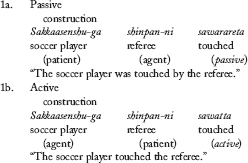
This suggests that these sentences are temporarily ambiguous between the active and passive structure before encountering the passive inflection. Given the active structure being far more frequent than the passive, it is conceivable that these sentences are initially analysed as the active transitive. Such prehead analysis would force comprehenders to revise the initially assigned thematic roles on encountering the verb in (1a) (cf. Mazuka & Itoh, 1995). It is likely that the cost due to structural ambiguity contributes to Japanese children's extra difficulty in acquiring the passives.
The current study uses this temporary ambiguity to examine syntactic priming in comprehension by examining anticipatory eye movements toward upcoming referents. It is known that language users make predictions about upcoming words on the basis of the information received so far and that in head-final languages like Japanese, case-markers can drive such predictions (Kamide, Altmann, & Haywood, 2003). Thus, we predicted that Japanese listeners would anticipate upcoming linguistic information upon hearing the role-ambiguous sentence-initial NP (sakkaasenshu-ga, “The soccer player”) when an appropriate context is provided. The current study investigated whether this prediction is influenced by the type of structure that appeared in an immediately preceding sentence (see Scheepers & Crocker, 2004, for a finding of such prehead priming with German verb-second constructions). A few studies already provided evidence for syntactic priming in the production of the Japanese passive structure but no study has yet explored priming of this structure in comprehension (Deng, Ono, & Sakai, 2011; Tanaka, Pickering, & Branigan, 2009, as cited in Tanaka, Branigan, & Pickering, 2011). Assuming that the same structural representation is accessed between production and comprehension (see Tooley & Traxler, 2010, for a summary), we expect to find an effect of priming with this structure in comprehension as well. In addition, provided that the magnitude of priming is inversely proportional to the frequency of syntactic structures, and priming of the infrequent passive structure results from the incorrect prediction of the frequent active structure, the effect of priming is expected to be strongest at the beginning of the experiment and should diminish gradually over the course of the experimental session. Such a finding would support the claim that comprehenders are highly adaptive to the distributional information of recent linguistic input (e.g., Fine & Jaeger, 2013).
The role of the lexical head for syntactic priming in comprehension is another issue addressed in our study. Many previous studies on English showed priming in comprehension only when the verb was repeated between prime and target but did not when it was not (Arai, van Gompel, & Scheepers, 2007; Branigan, Pickering, & McLean, 2005; Pickering & Traxler, 2004; Tooley, Traxler, & Swaab, 2009, but see Thothathiri & Snedeker, 2008). This contrasts with production studies, which typically observed priming both when the verb was repeated between prime and target and when it was not, although the effect tends to be greater in size in the former case (often referred to as lexical boost). Some argued that this discrepancy results from the difference in how structures are processed in the two modalities (Arai et al., 2007; Tooley et al., 2009; Traxler & Tooley, 2008). In particular, Arai et al. (2007) claimed that in production speakers are able to access multiple syntactic frames independently of individual lexical entries, resulting in lexically independent priming in production, whereas in comprehension syntactic structures are almost always accessed via lexical entries, resulting in lexically dependent priming in comprehension. It is important to note that this account concerns structural information about arguments; it has been shown that information about adjuncts is not associated with particular lexical entries (Traxler, 2008). The above account for the production–comprehension discrepancy is, however, based almost exclusively on the results of a head-initial language (i.e., English), and it may not be suitable with typologically different head-final languages such as Japanese. Thus it is still not clear whether the lexical dependence of a priming effect in comprehension is entirely due to the bottom-up characteristic of comprehension process or whether it somewhat depends on the structural configuration unique to head-initial languages.
If Japanese comprehenders access syntactic structures only through the head, syntactic priming is not expected to occur before encountering the verb. Furthermore, if syntactic priming in comprehension always relies on the experience of the same verb as that in the prime sentence, it is not expected to occur in the absence of lexical overlap between prime and target. However, recent studies demonstrated that comprehenders do not usually delay making structural analysis until the head is received during the processing of structurally ambiguous sentences in Japanese (e.g., Aoshima, Phillips, & Weinberg, 2004; Kamide et al., 2003; Kamide & Mitchell, 1999; Miyamoto, 2002). Also, there is one study by Tanaka, Tamaoka, and Sakai (2007) that reported lexically independent priming in the comprehension of canonical (subject–object–verb, SOV) and scrambled (OSV) sentences. Their measure of acceptability judgement, however, requires a conscious decision about sentence structures, which may have led to some strategic responses by noticing the relationship between the prime and target sentences. Thus, it still remains to be seen whether syntactic priming would occur in the absence of lexical overlap between prime and target.
Participants in our study first heard a prime sentence (2) and next heard a target sentence (3). Both prime and target sentences were either in the active (2a, 3a) or in the passive structure (2b, 3b).
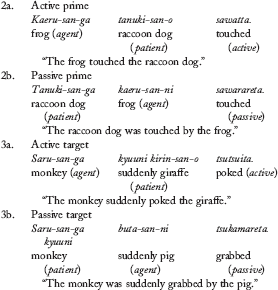
For each prime and target auditory sentence, participants were presented with a visual scene such as Figure 1. The prime picture depicted two animate entities and one action event (one acting on the other). The target picture depicted three entities and two action events, with the middle character (monkey) involved in both events as an agent role for one and a patient role for the other (cf. Knoeferle, Crocker, Scheepers, & Pickering, 2005). Importantly, the initial part of the target sentences (underlined) was identical between the active and passive structure until the second NP—kirin-san-o “giraffe” in (3a) and buta-san-ni “pig” in (3b)—is heard. We examined the looks to the agent entities for the prediction of the passive structure. We also tested adult participants to compare the effect of priming with that of children (Experiment 2). Previous studies on the development of children's syntax rarely tested an adult population in the same experimental setting mainly because methodologies such as the act-out paradigm are simply not suitable for adults (see Messenger et al., 2012, for an exception). In contrast, the visual-world paradigm requires no specific task apart from attending to auditory stimulus and visual scenes and hence is a natural task for both children and adults.
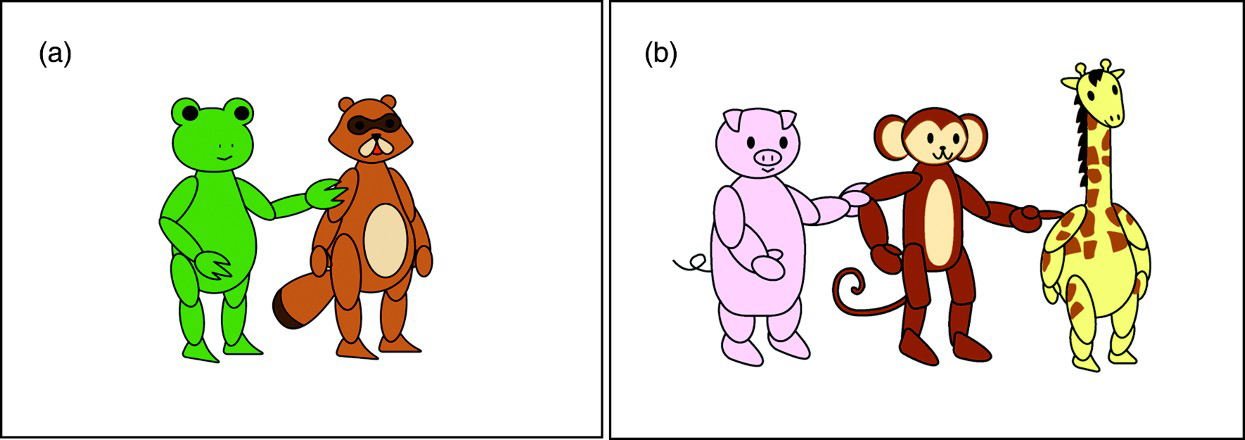
Example pictures for a prime (a) and a target item (b). To view this figure in colour, please visit the online version of this Journal.
Experiment 1
Method
Participants
We tested 48 children in total; among those, half of the children were 5-year-olds (N = 24, mean age: 5:4), and the other half were 6-year-olds (N = 24, mean age: 6:4). The data from two further children were excluded due to recording difficulty. All the participants were native speakers of Japanese with normal or corrected-to-normal visual acuity.
Materials
Sixteen experimental items were created, each of which consisted of a prime and target sentence. The sentences were either the active (2a, 3a) or passive structure (2b, 3b), which resulted in a 2 × 2 design. We selected 8 frequent verbs (kusuguru, “tickle”, tsukamu, “grab”, tsutsuku, “poke”, hipparu, “pull”, osu, “push”, sawaru, “touch”, arau, “wash”, oikakeru, “chase”), and each verb was used twice in the items (both for prime and for target). The sentences were recorded by a female speaker with a standard Tokyo accent. To eliminate any influence of possible differences in prosodic properties between the active and passive target sentences, we spliced the ambiguous part of the target sentence using commercial sound-editing software. This ensured that both active and passive target sentences were identical not only lexically but also acoustically up to the onset of the second noun phrase (henceforth NP). We prepared pictures for each prime and target sentence, using commercial graphical software. The layout of the picture (i.e., the location of agent and patient entities in the scene) was counterbalanced across the items as well as within items (i.e., prime–target pictures). There was no overlap of lexical entries (nouns and verbs) as well as corresponding visual entities between the prime and target descriptions. We also included 16 filler items, the sentences of which contained either copulative or intransitive verbs.
Design and procedure
We combined a visual-world eye-tracking paradigm with priming methodology (Scheepers & Crocker, 2004). Participants first listened to a prime description while seeing a prime picture. They next heard a target description with a target picture. Following passive target sentences, participants were asked comprehension questions. The question was always in the form of “What happened to X?” (X-ni naniga okotta kana?), and X always referred to the character in the middle (i.e., the subject of the target sentence). The question could be answered using either an active or a passive construction. The answer was recorded and was later manually transcribed. Participants’ eye movements were recorded during the presentation of the target picture using Eyelink Arm Mount (SR Research) at the sampling rate of 500 Hz. The order of presentation was randomized for each participant with a constraint that one filler always appeared between experimental items. Each experimental session started with a brief calibration procedure, which typically took approximately 5 min. Practice items appeared in the first two trials, following which children were checked for their comprehension of the task. The experimenter explained the task again when they had any difficulty. The whole experimental session took approximately 40–45 min.
Data analysis and results
Production data (answers to comprehension questions)
As regards the answers to comprehension questions, we coded the sentence as active if the verb was used in an active form and correctly described the event in question, passive if the verb was used in a passive form and correctly described the event, and other for all other incorrect answers including no-answers. On average, children answered questions correctly 72.4% of time (64.1% for 5-year-olds and 80.7% for 6-year-olds). Table 1 shows the percentage and the raw number of active, passive, and other answers.
Percentage and raw number of answers for each type
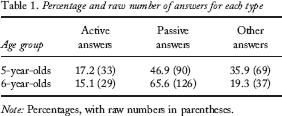
Note: Percentages, with raw numbers in parentheses.
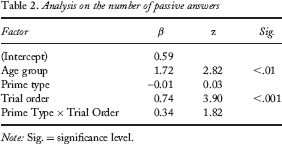
We analysed the log-transformed odds (logit) of passive answers against all other answers using linear mixed-effects (LME) models with a binomial function (Jaeger, 2008). We included prime type (active or passive), children's age group (5- or 6-year-olds), and trial order (the order in which each comprehension question appeared in the experimental session, included as a continuous variable). We allowed prime type to interact with age group and with trial order, respectively. Also, participants and items were included as random variables in the model. The model was simplified by removing nonsignificant redundant factors and interactions (p < .10) if a simpler model yielded a smaller Akaike information criterion (AIC) value. We continued this procedure until the model was minimally optimized. Table 2 reports the coefficients (β), Wald's z statistic, and significance levels for all the fixed factors that remained in the minimally optimized model. The significance levels are based on the posterior distribution computed using Monte Carlo Markov chain sampling. To reduce a risk of collinearity, all the fixed factors in the models were centred. Since the regression coefficients correspond to the differences between the marginal means, one can interpret main effects of fixed factors in the same way as in the traditional analysis of variance. Table 2 shows the results from the optimal model.
Analysis on the number of passive answers
Note: Sig. = significance level.
First, there was a main effect of age group. The positive coefficient suggests that 6-year-old children produced more passive answers than did 5-year-old children. We also found a main effect of trial order. The positive coefficient suggests that children produced more passive answers as they proceeded with the experiment. Interestingly, the interaction between prime type and trial order was marginally significant (p = .07). We analysed the data separately for each prime type in order to investigate the pattern of this interaction. The results showed that the simple effect of trial order was significant in the passive prime condition (β = 1.36, z = 3.88, p < .001) but not in the active prime condition (β = 0.26, z = 1.12, p = .26). Although not fully significant, a trend suggests that children became more likely to produce passive answers as they proceeded with the experiment only when the question was preceded by the passive prime.
We also conducted the analysis on the logit of active answers against all other answers using the same procedure. The results showed that none of the predictors was significant, demonstrating that the production of active answers was influenced by neither age group nor trial order. Furthermore, we conducted another analysis on the logit of other answers against all other answers. The results showed that there was an effect of age group (β = –2.12, z = 2.51, p = .01) and trial order (β = –0.82, z = 3.53, p < .001). This demonstrated that 6-year-old children produced fewer other answers than 5-year-old children and that they overall produced fewer other answers as they proceeded with the experiment.
Eye-movement data
Participants’ eye movements were recorded for the duration of the target sentences. The spatial fixation coordinate output from the eye tracker was mapped onto four different areas in a visual scene: agent, role-ambiguous subject, recipient, and background. The three objects in each picture were manually defined, allowing the fixations in an area of approximately 30 pixels around the contour of an object as belonging to the object. Areas that were not associated with any object were coded as background. Extremely short fixations (with a duration of less than 80 ms) with immediately preceding or following fixations were pooled if the short fixation lay within 0.5° of visual angle (ca. 12 pixels) from a longer fixation (otherwise short fixations were eliminated from analyses). For the purpose of analysis, gazes were created out of fixations; a gaze was defined as the accumulation of all consecutive fixations on an object within a visual scene until another object (or the background) was fixated. We excluded trials from the analysis if at least one of the three entities in the visual scene received no gaze throughout the trial as such trials are likely to have suffered from many tracker losses. This resulted in excluding 11.3% of whole trials. To enable synchronization of eye movements with corresponding events in the auditory sentences, the onset of the first noun, the adverbial phrase, and the second noun in each target sentence were hand-coded in millisecond-resolution using commercial sound-editing software.
Our interest is in looks to either the agent entity or the patient entity that are both adjacent to the central role-ambiguous object. We thus analysed the log-transformed ratio (log-ratio) between the looks to the agent entity and the looks to the patient entity following the onset of the case-marker of the sentence-initial NP as an index for the prediction of structural alternatives. Figure 2 shows eye movements as log-ratio from the onset of the case-marker ga to 1,800 ms following it. The more positive value indicates more looks to the patient entity than to the agent entity, thus reflecting the prediction of an active sentence, and similarly the more negative value indicates more looks to the agent entity, reflecting the prediction of a passive sentence.
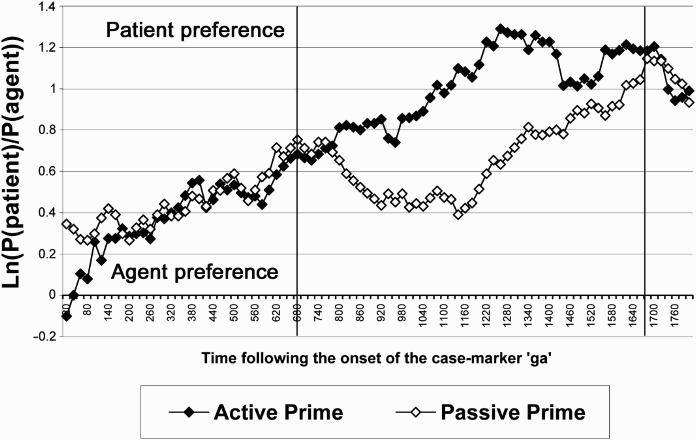
Log-ratio of agent looks and patient looks for each prime condition plotted in 20-ms time intervals following the onset of the nominative case-marker. The first vertical line is the mean onset of the adverb, and the second is that of the second noun phrase (NP).
The left vertical line in Figure 2 indicates the average onset of the adverb following the subject NP (on average 672 ms from the case-marker), and Figure 2 indicates that the eye movements in the two prime conditions started to diverge shortly after the onset of the adverb. Assuming that anticipatory eye movements are triggered by linguistic input, it appeared that children delayed launching anticipatory eye movements until they heard the adverb following the subject NP. Taking into account 100–200 ms that takes listeners to initiate a saccade in response to linguistic information (Allopenna, Magnuson, & Tanenhaus, 1998), we analysed the gazes within the 800-ms time interval from 800 ms to 1,600 ms following the onset of the nominative case-marker. The 1,600-ms end point was decided based on the onset of the second NP (1,673 ms on average, 1,477 ms for the minimum), so that it is extremely unlikely that the gazes during this time interval were in any way affected by the disambiguating second NP. 1
We also conducted an analysis on the gazes within the 800-ms time window from 200 ms to 1,000 ms following the adverb onset. The analysis showed essentially the same results, showing a significant main effect of prime type (β = –0.20, t = –5.08, p < .001) as well as an interaction between prime type and age group (β = –0.09, t = –2.39, p < .05). This supports that children made a structural prediction and launched anticipatory eye movements on hearing the adverb. Furthermore, we also analysed the gazes within the 600-ms time interval from 200 ms to 800 ms following the onset of the nominative case-marker. The result did not show either an effect of prime type (t = 0.01, p = .99) or an interaction between prime type and age (t = 0.85, p = .39), which confirms the absence of a priming effect before encountering the adverb.
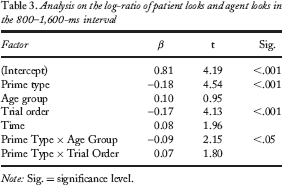
We conducted statistical analysis on the log-ratio of looks to the agent entity and those to the patient entity within the 800-ms interval using LME models. In addition to the main predictor prime type, we entered age group, trial order (the order of individual trials that appeared in each experimental session, included as a continuous variable), and time (series of eight 100-ms windows within the 800-ms time interval). To examine whether an expected effect of prime type depends on any of these additional predictors, we allowed prime type to interact with all other variables (i.e., three binary interactions: Prime Type × Age Group, Prime Type × Trial Order, and Prime Type × Time). As in the earlier analysis, we included participants and items as random factors. Target type was not included as the target auditory stimuli are acoustically identical for the two target types during this interval and had no influence. Table 3 reports the results from the optionally minimized model.
Analysis on the log-ratio of patient looks and agent looks in the 800–1,600-ms interval
Note: Sig. = significance level.
First, a significant intercept with a positive coefficient suggests that there were generally more looks to the patient entity, which is most likely to reflect the preference for the active structure over the passive structure. Importantly, there was a significant effect of prime type, demonstrating the effect of priming with the Japanese passive structure in comprehension. Its negative coefficient indicates that children looked more at the agent entity following a passive prime than that following an active prime. Also, there was a main effect of Trial Order, indicating that children increased looks to the agent, reflecting the prediction of a passive structure, as they proceeded with the experiment. This finding is not surprising given that children were exposed to this usually infrequent passive structure as often as the active structure, which quickly increased their expectation for the passive. There was also a marginally significant effect of time (p = .05), implying a trend that there were overall greater looks to the patient in the later time windows. Most importantly, there was a significant interaction between prime type and age group. In order to examine the pattern of the interaction, we conducted a separate analysis for each age group, including only prime type as a predictor. The analysis revealed that the effect of priming was highly significant with 6-year-olds (β = –0.28, t = 4.85, p < .001) whereas it was only marginal with 5-year-olds (β = –0.09, t = 1.66, p = .09). Figure 3 plots the eye movements separately for 5-year-olds and for 6-year-olds and illustrates this pattern clearly. 2
There is an ongoing discussion regarding the inclusion of random slopes in LME modelling. In particular, between-participants variance is predicted to be larger in children's data than in adults’ data. To check this, we tested a model that added prime type as a random slope for participants while keeping all other fixed and random factors including the interactions the same. The output from this model showed that the effect of prime type and the interaction between prime type and age group were attenuated considerably (β = –0.17, t = 1.75, and β = –0.06, t = 0.66, respectively, and p-values computed using a likelihood-ratio, LR, test were, respectively, p = .08 and p = .51), indicating that there was a nontrivial amount of variance across participants and items for the effect of prime type as well as for the interaction between prime type and age group. This is possibly because individual children differed greatly in the timing when they launched anticipatory eye movements. Thus, in order to make sure that the priming effect is reliable beyond sample population and specific experimental items, we conducted another analysis, in which all the fixations within the 800–1,600-ms time interval following the onset of the nominative case-marker were aggregated, and the log-ratio between the looks to the agent entity and those to the patient entity was calculated, with a LME model that included prime type as a single fixed factor and participants and items as random factors with a maximum random slope structure (i.e., prime type included as a random slope for both participants and items). The results showed a significant effect of prime type (β = –0.25, t = –2.14, p < .05), providing evidence for the effect of priming in 5- and 6-year-old children.
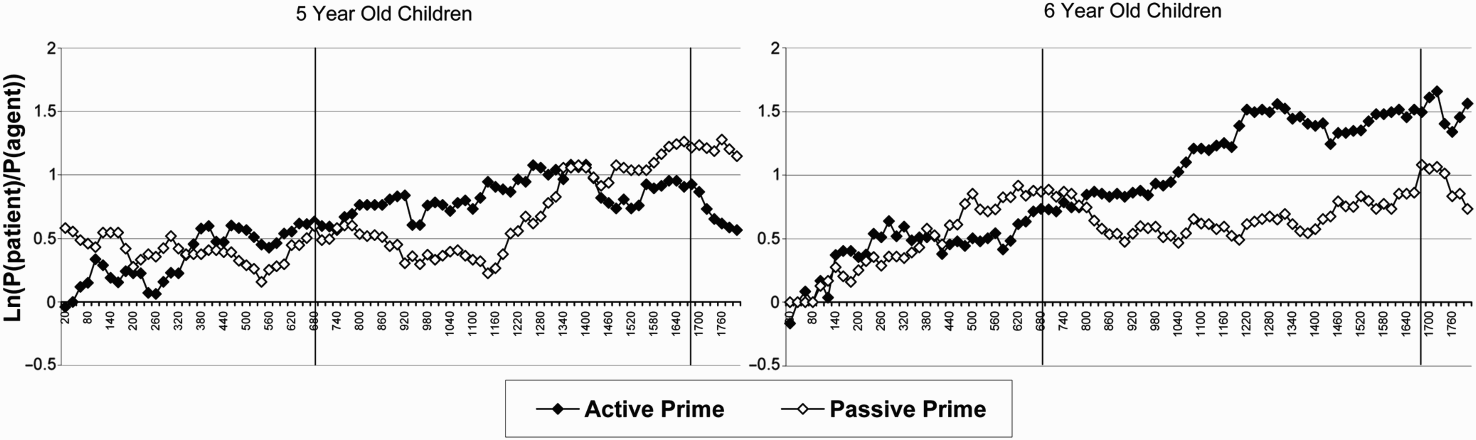
Log-ratio of patient looks and agent looks for each prime condition for 5-year-old children (left) and 6-year-old children (right). The first vertical line is the mean onset of the adverb, and the second is that of the second noun phrase (NP).
Finally, there was also a marginally significant interaction between prime type and trial order (p = .07). The positive coefficient indicates a trend that the effect of priming became weaker as participants proceeded with the experiment (the marginal mean of the differences for participants in log-ratio between the two prime conditions was 0.68 in the first half, SE = 0.30, and it was 0.06 in the second half, SE = 0.28).
Discussion
The results from comprehension questions and eye movements during the comprehension of target descriptions together demonstrated a close link between structural priming and grammatical competence of the Japanese passive structure with 5- and 6-year-old children.
The results from comprehension questions showed that 6-year-olds produced more answers using the passive structure than did 5-year-olds. Five-year-olds produced a similar number of active answers to that of 6-year-old children but produced significantly more incorrect answers, which suggests that 5-year-olds were less competent with the passive sentences than were 6-year-olds. Children also showed increased use of the passive structure as they proceeded with the experiment. Interestingly, the marginally significant interaction between prime type and trial order indicated that the increased use was mostly limited to the trial when it was preceded by a passive prime.
The results from eye movements during the target sentences showed a clear influence of prime sentences on structural prediction. Children launched more anticipatory eye movements toward an upcoming agent entity following the case-marker ga when they previously heard a passive prime than when they heard an active prime. Furthermore, the effect of priming interacted with the age group. Further analysis revealed a robust priming effect for 6-year-olds but only a marginally significant effect for 5-year-olds. This demonstrates that the effect of priming in the comprehension of the Japanese passive structure reflects children's grammatical competence with the structure.
Also, the results showed the tendency that the effect of priming became weaker over the course of experimental sessions. This finding, although not fully reliable, is consistent with error-based implicit learning accounts, which predict that the magnitude of prediction error with the passive structure is largest at the beginning of the experiment, and it gradually lessens as participants experience this marked structure at an unusually high rate (Fine & Jaeger, 2013).
In sum, the results from comprehension questions and eye movements together demonstrated that 6-year-olds have better linguistic competence with the passive structure and showed a greater priming effect than 5-year-olds. Furthermore, we observed the tendency that the effect of priming became weaker as participants proceeded with the experiment although children used more passive answers in the later trials than in the earlier trials. We next tested adult participants and examined whether comprehenders with complete linguistic competence with the passive structure would show even greater priming and also whether a similar tendency of diminishing priming would be observed or not.
Experiment 2
Method
Participants
Twenty-four adults participated in the study. Participants were recruited from various universities in the vicinity of Tokyo (Kanto region). They received a book voucher in exchange for their participation. All the participants were native speakers of Japanese with normal or corrected-to-normal visual acuity.
Materials
We used the same set of experimental materials as that in Experiment 1 except for one difference: We added 16 fillers in an effort to mask the purpose of the experiment for adult participants. Those fillers also used either copula or intransitive verbs. There were hence 16 experimental items and 32 fillers in total.
Design and procedure
The experimental design and procedure were identical to those in Experiment 1 except that adult participants were not asked comprehension questions. Experimental items were separated by at least one intervening filler.
Data analysis and results
We followed the same procedure as that in Experiment 1 and removed the trials that contained no record of a gaze for at least one of the three objects in a scene, which led to removing 9.7% of the whole data. As in Experiment 1, we analysed eye movements from the onset of the nominative case-marker ga. We calculated the log-ratio of looks to the patient entity and the agent entity. Figure 4 shows the gazes in log-ratio from the case-marker onset until 1,800 ms following it for each prime condition.
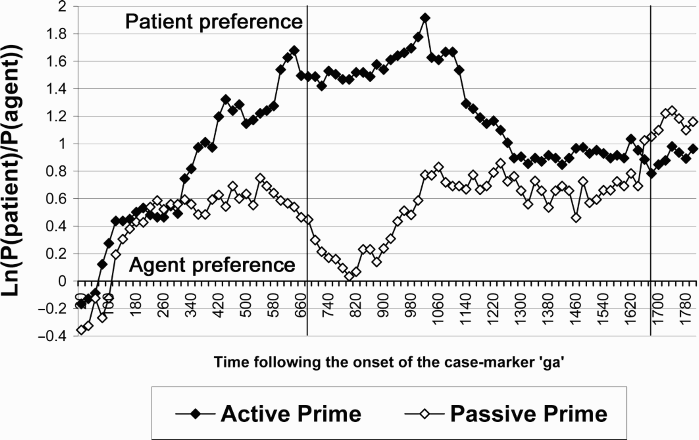
Log-ratio of patient looks and agent looks for each prime condition for adults, plotted in 20-ms time intervals following the onset of the nominative case-marker. The first vertical line is the mean onset of the adverb, and the second is that of the second noun phrase (NP).
It appears that Figure 4 indicates that the eye movements for the two prime conditions started to diverge approximately 300 ms after the onset of the nominative case-maker. Considering the 100–200 ms for programming a saccade in response to linguistic information, it is likely that adult participants launched anticipatory eye movements almost immediately on hearing the subject NP. We thus conducted an analysis on the log-ratio of looks to the patient entity and those to the agent entity for the 800-ms time interval from the 200 ms to 1,000 ms following the case-marker onset using LME models. The 1,000-ms cut-off point was selected as the interval of the same length makes a direct comparison between the two experiments possible and the equal amount of the data guarantees the similar power of statistical analysis.
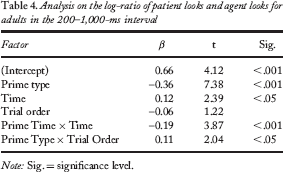
For the LME model, we entered prime type, time, and trial order as fixed factors, allowing prime type to interact with time and trial order, respectively. Participants and items were included as random factors. Table 4 shows the output from the optimal model.
Analysis on the log-ratio of patient looks and agent looks for adults in the 200–1,000-ms interval
Note: Sig. = significance level.
The significant intercept with a positive coefficient suggests that the participants were overall more likely to look at the patient than the agent entity, reflecting a general bias for the active structure over the passive structure. There was a robust effect of prime type. Participants looked at the agent object more following a passive prime than an active prime. There also was a main effect of time, indicating that participants increased looks to the patient entity during this time interval. There was an interaction between prime type and time, showing that the difference between the two prime conditions was more pronounced in the later than the earlier time windows. Furthermore, there was an interaction between prime type and trial order, which is consistent with the tendency observed in Experiment 1. This demonstrates that the effect of priming became weaker over the course of experimental sessions (The marginal mean of the differences for participants in log-ratio between the two prime conditions was 0.90 in the first half, SE = 0.29, and it was 0.66 in the second half, SE = 0.33). 3
It is important to point out that none of the significant contributions of predictors with adults reported in Table 4 diminished below the significance level by including a random slope of prime type for participants (main effect of prime type, β = –0.38, t = 3.51; interaction between prime type and time, β = –0.19, t = –3.93).
Combined analysis
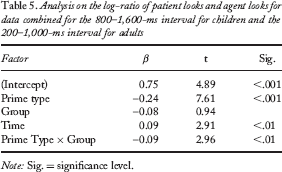
We conducted a further analysis to examine whether the size of the priming effect was significantly larger for adults than for children. We combined the two sets of data for the 800-ms time interval that we analysed earlier (i.e., 800–1,600 ms for children and 200–1,000 ms for adults) and analysed the log-ratio of looks to the patient entity and looks to the agent entity using the same procedure as that in the earlier analyses. We included prime type and group (children or adults) and an interaction between the two factors and time as fixed factors besides random factors of participants and items. Table 5 shows the results from the model.
Analysis on the log-ratio of patient looks and agent looks for data combined for the 800–1,600-ms interval for children and the 200–1,000-ms interval for adults
Note: Sig. = significance level.
The results showed a main effect of prime type and of time and, most importantly, a significant interaction between prime type and group. This interaction demonstrates that adult participants showed stronger priming than 5- and 6-year-old children.
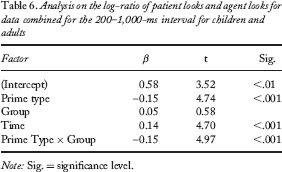
Furthermore, we also analysed the eye movements in the 200–1,000-ms time interval for both children and adults using the same model as that above. Table 6 shows the results from the model.
Analysis on the log-ratio of patient looks and agent looks for data combined for the 200–1,000-ms interval for children and adults
Note: Sig. = significance level.
The results again revealed an interaction between prime type and group. To explore the pattern of the interaction, we examined the effect of prime type for each group separately. The results showed that the simple effect of prime type was only significant for the adult group (β = –0.36, t = –7.40, p < .001) but not for the child group (β = –0.04, t = –1.01, p = .31). This suggests that the effect of priming occurred earlier in time for adults than for children.
Discussion
Experiment 2 demonstrated that syntactic priming of the Japanese passive structure in comprehension was also observed with adult participants. However, an analysis on the eye-movement data for children and adults combined revealed that the effect occurred earlier in time and was greater in size for adults than for children. Furthermore, the results also showed that the effect of priming diminished gradually over the course of the experimental session. The same pattern of results was observed with children although the trend was not fully reliable. This finding is consistent with the prediction made by error-based implicit learning accounts and can possibly be generalized to syntactic priming in comprehension in general.
General Discussion
The current study demonstrated evidence for syntactic priming in the comprehension of the passive structure in Japanese. The results from Experiment 1 showed that 5- and 6-year-old children were more likely to predict the passive prior to the disambiguating second NP following a passive prime than following an active prime. Importantly, our results revealed that the magnitude of priming was significantly greater in 6-year-old children than in 5-year-old children. The results from comprehension questions also showed a difference between 5-year-olds and 6-year-olds; 6-year-olds produced more correct answers and more answers using the passive than did 5-year-olds. The results in Experiment 2 demonstrated a compatible effect with adult participants. The combined analysis revealed that the priming effect in the adults was greater in size and occurred earlier in time than the one for the children. Thus, the results together demonstrated that language users with greater competence with passives showed a stronger priming effect, reflecting a close link between the effect of syntactic priming and the development of grammatical competence with the passive structure.
Our results appear at odds with some production studies that reported an opposite pattern; young children showed stronger priming than adults (Bencini & Valian, 2008; Rowland et al., 2012). This is important because the results in these production studies seem consistent with those in the studies with adult aphasics (Hartsuiker & Kolk, 1998) and children with specific language impairment (SLI; Leonard et al., 2000), suggesting that syntactic priming tends to be stronger with less proficient language users in general. To account for the pattern of these results, Hartsuiker and Kolk (1998) suggested a role of language users’ cognitive capacity. They claim that a speaker with limited cognitive resources may have trouble maintaining the structures that receive low activations, and as a consequence a primed structure becomes more strongly activated by receiving reallocated activations and suffers less from competition than it does in a speaker with no resource limitations. Alternatively, it is also suggested that the pattern of these results reflects the fact that syntactic structures are less strongly represented in children than in adults, thus causing a stronger learning effect (Bencini & Valian, 2008; Rowland et al., 2012).
One possibility for the opposite pattern observed in our comprehension study is a difference in how syntactic priming occurs between production and comprehension studies. In production studies, participants were typically provided with a fair amount of time to plan and execute speech, and selecting the same structure as the prime straightforwardly results in syntactic priming. On the other hand, in comprehension studies using the visual-world paradigm such as ours, participants need to make timely eye movements to an upcoming referent according to a predicted structure within a fairly limited amount of time. In other words, participants are required not only to access the same structure as the prime but also to make anticipatory eye movements based on the structure. It is possible that young children are less capable of this complex task in comprehension studies than are older children and adults and thus produced weaker priming. This possibility, however, goes against the view that a production task is generally more difficult than a comprehension task, and thus young children tend to be more susceptible to syntactic priming in comprehension than in production (Thothathiri & Snedeker, 2008). Also, it only explains the comprehension results but does not account for greater priming in young children than in adults in production studies.
As an alternative account, we suggest that syntactic priming in production may be motivated by an additional principle of moderating cognitive load in speech production. Repeating a syntactic structure is beneficial for a speaker as it saves cognitive resource for selecting a syntactic structure and allocates it to other units of production process. We thus expect that a speaker benefits most from repeating a structure when production process is resource intensive and imposes high cognitive load. Such a situation most likely occurs when the selected structure is a highly infrequent one like the passive, speaker's cognitive resource is fairly limited as in young children, or an experimental task is challenging as with a picture-description task (Bencini & Valian, 2008; Shimpi et al., 2007). On the other hand, it is not clear how or whether people benefit from accessing the same syntactic frame as the prime during comprehension. In fact, in controlled experiments that provide participants with structured input as in the current study, predicting the same structure as the prime would provide no benefit at all as the prime-contingent prediction would turn out to be incorrect half of the time. Thus, it is possible that the cost-saving motive is only at work in production and not in comprehension.
Then, what is the reason for the opposite pattern in our comprehension study; older participants produced stronger priming than younger participants (adults vs. children as well as 6-year-olds vs. 5-year-olds)? We argue that our results are consistent with error-driven accounts and that older children and adults most likely produced stronger prediction errors than young children. In our study, what counts as an erroneous prediction is a prediction of the active. Adult language users have already been exposed to a great number of instances of both active and passive structures and possess highly stable and reliable relative frequency information relating to the active and passive structures. Based on this information, adults usually make a strong prediction of the active upon hearing a nominative NP, and this results in a large error when they actually encountered a passive sentence, leading to strong priming of the passive. On the other hand, young children have a fairly limited amount of linguistic exposure to the passive and may not draw upon the frequency information to bias structural predictions as much as adults do. This results in weaker predictions of the active and a smaller error due to the exposure to the passive structure, leading to weaker priming of the passive. Interestingly, our results showed an influence of accumulated exposure to the passive structure in children independently of prime type; as shown by an effect of trial order, children predicted the passive more as they proceeded with the experiment. This perhaps indicates that due to their limited exposure to the passive, each experience to the passive exerted a strong influence on the relative frequency of the two structures in children. Unsurprisingly, there was no effect of trial order in adults, indicating that each exposure to the passive had little influence on the relative frequency information of the active and the passive structures in adults.
Another important finding in our study is that the magnitude of priming gradually decreased over the course of experimental sessions for both adults and young children although the effect for the children was not fully reliable. We argue that this is best explained by error-based implicit learning accounts. Since the passive structure occurs much less frequently than the active structure in Japanese, it is generally less expected. The low expectation of passives results in a large error on actually encountering the structure. Through the experimental session, our participants experienced the passive sentences at an unusually high frequency (viz., as much as the active structure) and quickly adapted to the situation so that the magnitude of the error with passives gradually decreased over the course of the experiment. This is consistent with the view that comprehenders constantly update their expectations of syntactic structures based on recent linguistic exposures (Fine & Jaeger, 2013). In particular, error-based implicit learning models predict that a less probable syntactic structure like the passive causes a larger change in the probability distribution, which results in an increased probability of accessing the same structure in subsequent processing. Therefore, when an equal number of instances of alternating structures are received, the initially less probable structure quickly becomes somewhat probable and causes a small change in the distribution, which results in weak priming.
Lastly, our results provided clear evidence for head-independent priming; a priming effect was observed prior to the verb, and the verb was never repeated between prime and target sentences. This finding demonstrates that syntactic priming in comprehension is not always dependent on the head and is in stark contrast to previous studies that observed priming only when the verb was repeated. We argue that this is due to the difference in processing syntactic structures between head-final languages and head-initial languages. As discussed earlier, it is known for head-final languages like Japanese that comprehenders compute structural attachments prior to the sentence-final verb. Such a prehead structural analysis is possible largely due to case-marking morphology that signals the grammatical functions of individual constituents (Miyamoto, 2002). Our results showed that comprehenders made a prediction about the second constituent upon encountering the first NP with a nominative case-marker ga and that the prediction was influenced by the structure that they experienced in an immediately preceding sentence. They also suggest the possibility that the verb in head-initial languages plays a more dominant role in deciding sentence structures than that in head-final languages; in the languages in which there is little case morphology, and the verb appears before the constituents of a verb phrase, it is often not possible to discern a sentence structure before encountering the verb so that the verb provides a strong cue regarding possible structural frames. 4
Although our results demonstrated evidence for head-independent priming, they do not necessarily suggest that the effect is entirely lexically independent. The prime and target sentences in our study did not share any content words but did share the nominative case-marker ga for the sentence-initial NP. It is left to future research to examine whether the repetition of the case-marker was crucial for the priming effect observed in the current study.
Conclusions
The current study examined syntactic priming in the comprehension of the Japanese passive structure with 5- and 6-year-old children and adults. The results from the first experiment showed a converging pattern of results in both the answers to comprehension questions and children's eye movements while listening to target sentences. Six-year-olds showed better understanding and greater grammatical competence with passives than 5-year-olds. Also, 6-year-olds showed a stronger priming effect through the prediction of the passive than did 5-year-olds. The results from adult participants revealed an even stronger priming effect. The results together demonstrated that language users with greater linguistic competence showed stronger structural priming in the comprehension of the passive, reflecting a close link between the development of children's grammatical competence and the effect of syntactic priming. Furthermore, we found that the magnitude of priming of passives became gradually attenuated over the course of the experiment, as predicted by error-driven implicit learning accounts. Lastly, our study also provided clear evidence for comprehension priming in the absence of verb repetition between prime and target sentences. We argue that this is due to prehead structural building in Japanese and possibly highlights a difference in the processing of syntactic structures between head-final languages and head-initial languages.
Footnotes
Acknowledgements
Manabu Arai is currently a research fellow of the Japan Society for the Promotion of Science and acknowledges its support. The authors thank Katherine Messenger and Franklin Chang for their insightful comments on earlier versions of this paper, and Chie Nakamura and Deng Ying for help in preparation of the manuscript.