







Abstract
Politeness theory posits that speakers can use verbal probabilities (e.g., there is a chance, it is likely) to hedge bad news. So far, only indirect evidence supports that claim: From the hearer's standpoint, verbal probabilities are interpreted either as plain likelihood-communication devices or as face-management devices, resulting in different risk perceptions. The present research aims to test more directly the postulate of politeness theory by focusing on the effects of speakers' intentions on risk communication. In three experiments, participants communicated a probability by choosing an expression from a list of verbal probabilities. Results consistently showed that polite speakers communicated a different risk magnitude than informative speakers. Further findings indicate that the effect of the speakers' intention depends on the valence of the uncertain outcome. The theoretical and applied implications of these findings are discussed.
Recipients of a message might take as a threat any imposition limiting their degree of freedom (e.g., having to ask a service of someone) or weakening their positive sense of self (e.g., criticism, bad news; Brown & Levinson, 1978). Politeness theory suggests that to enable the recipient to save face, speakers use face-management strategies, such as introducing uncertainty or moderating their degree of certainty. For example, Statement A is threatening because it conveys the certainty of a negative outcome for the recipient, whereas Statement B hedges the threat in uncertainty.
It is certain you will fail.
It is possible that you will fail.
A consistent body of findings supports the view that hearers believe that speakers moderate the risk they are communicating to serve face-management goals (Bonnefon, Feeney, & De Neys, 2011; Bonnefon & Villejoubert, 2006; Juanchich, Sirota, & Butler, 2012; Pighin & Bonnefon, 2011; Sirota & Juanchich, 2012b). Yet, we remain ignorant as to whether and how speakers use face-management strategies in the process of risk communication. The present research aims to introduce evidence that the speaker's intention determines the risk they communicate.
Verbal probabilities (e.g., it is possible, there is a small chance) can be interpreted as likelihood-communication or face-management devices. Further, there exist two categories of face-management strategies: one directed toward the hearer, to soften a threat and to smooth social interaction; and the other directed toward the speaker, to avoid blame in case the predicted outcome does not occur (Juanchich et al., 2012). Findings indicate that verbal probabilities qualifying a negative outcome interpreted as face-management devices (orientated toward either the hearer or the speaker) were perceived to convey a higher probability than when interpreted as likelihood-communication devices (Bonnefon & Villejoubert, 2006; Juanchich et al., 2012). Indeed, a tactful speaker is believed to give an underestimate to avoid offending the recipient by being too blunt, because the unlikely occurrence of a negative outcome is less threatening than its likely occurrence. On the other hand, a cautious speaker is believed to give an underestimate to avoid being blamed in case the outcome does not occur. This is because an unlikely prediction is considered more correct than a likely one, should the outcome not occur, and the speaker is, therefore, less likely to be blamed (Keren & Teigen, 2001). It is important to note that the perception of a speaker-orientated strategy involves a smaller deviation from a likelihood-communication strategy than does the perception of a strategy aiming to protect the recipient (Juanchich et al., 2012). Figure 1 summarizes the different interpretations of risk quantifiers and their effects on risk perception.
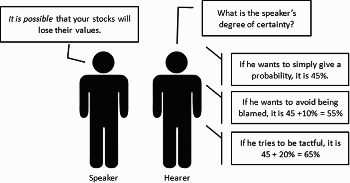
Summary of the different interpretations of risk quantifiers found in previous research. Note that the magnitudes of adjustments are rounded-up averages from Juanchich et al. (2012).
In the research into hearers' interpretations of verbal quantifiers, it has been assumed that speakers with hearer- or speaker-face-management intentions use a probability term communicating a lower probability when qualifying negative outcomes to hearers (e.g., “there is a small possibility” for a 50% probability). This research aims to test this hypothesis to gain a better understanding of the risk communication dynamic from the speakers' standpoint.
Experiment 1
The experiment was designed to test the effect of speakers' intentions on the probability communicated.
Method
Eighty-four Amazon Mechanical Turk (AMT) workers aged from 18 to 81 years (M = 35.10, SD = 15.37) took part in this study and were rewarded $0.15. AMT is recognized as providing a valid pool of participants for research purposes in psychology (see Buhrmester, Kwang, & Gosling, 2011; Paolacci, Chandler, & Ipeirotis, 2010). Participants were Americans who completed seriously at least 80% of their tasks. Participants were instructed not to take part in questionnaires with the same label. Most participants were female (66.7%) and in work (71.5%). Education ranged from high-school diploma to PhD, with a majority of participants reporting having a college degree (70%).
In a 3 × 2 within-subjects design, participants' intentions (i.e., being informative, cautious, or tactful) and the context (i.e., car and investment) were manipulated, resulting in six vignettes. In each vignette, participants were asked to communicate a 50% probability of a negative outcome (i.e., car breaking down or investment loss). The conversational intentions of participants were manipulated as follows: likelihood communication, be as informative as you can; hearer-face-management intention, avoid being blamed by your friend in the case that the car does not break down/the stocks do not lose their value; speaker-face-management, soften the announcement of bad news.
Participants read the six vignettes on separate pages and for each selected a verbal probability to communicate the given bad news to a friend. To communicate the 50% probability, participants chose a verbal probability from the seven expressions presented in Table 1. When designing the verbal probability list, we selected only positive terms (i.e., avoiding negative terms) to ensure that the verbal probability preference was guided by the probability magnitude and not by the directionality of the expressions. Directionality has been shown to have pragmatic implications, indicating, for example, a decision to be made (Teigen & Brun, 1999) or previous degrees of certainty of the speaker (Juanchich, Teigen, & Villejoubert, 2010). Note that the probabilistic meaning of the verbal probability “evenly probable” fits the 50% probability that participants were asked to communicate. The verbal probability list was used as a scale where very small probability = 1 and quite probable = 7.
Verbal probabilities list from which participants selected an expression to formulate a negative outcome prediction, and associated subjective probability
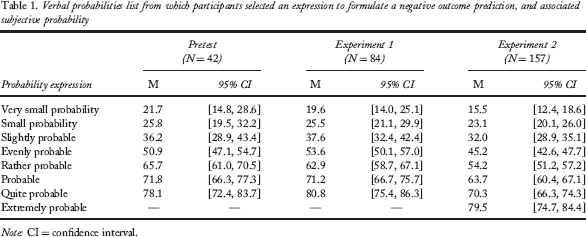
Note: CI = confidence interval.
The intentions of participants within scenarios and the contexts were presented in a randomized order. At the end of the questionnaires, participants assessed the probability associated with each verbal probability in the selection list with a slider and by increments of 1 (see results in Table 1) and finally provided their sociodemographic details (in this experiment and those following).
Results and discussion
The probabilities communicated by the participants as a function of the given intention are presented in the left panel of Figure 2. We conducted a 3 × 2 within-subjects analysis of variance (ANOVA) integrating as independent variables the intention of the speaker (i.e., likelihood communication, speaker and hearer face management) and the context (i.e., car and investment) along with the communicated probability as a dependent variable. Participants perceived that there was a greater risk of stock loss than of the car breaking down, F(1, 83) = 6.77, p = .011, η2p = .07, but the context did not interact with the intention of participants, F(2, 166) < 1.
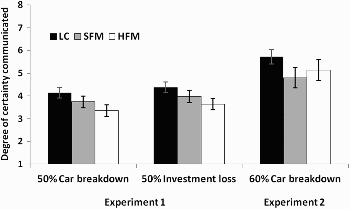
Risk communicated for a 50% risk in the car and investment vignettes (Experiment 1; N = 84), and for a 60% risk in the car vignette (Experiment 2; 51 < n < 54) as a function of the conversational objective of participants (likelihood communication, LC; speaker face management, SFM; and hearer face management, HFM). Error bars represent 95% confidence intervals.
Probability communicated as a function of manipulated intentions
The intention of participants had an effect on the probability communicated by participants, F(2, 166) = 20.83, p < .001, η2p = .20. As described in Figure 2, participants who were asked to be cautious (i.e., use a speaker-face-management strategy) or to be tactful (i.e., use a hearer-face-management strategy) communicated a lower probability than speakers who were just informative (respectively, Mdiff = −0.41, p = .001, CI [–0.69, −0.13] and Mdiff = −0.77, p < .001, CI [–1.11, −0.44]; using Bonferroni correction). Further, in line with our expectations, the face-management intention orientated toward the hearer gave rise to a lower probability than the face-management intention orientated toward the speaker (Mdiff = −0.36, p = .003, CI [–0.62, −0.10]).
Results showed in a within-subjects experimental design that the conversational intention of speakers did indeed affect the risk they communicated. Further, findings corroborate the different effect of self- and other face-management intentions on risk communicated. To test the robustness of these findings, Experiment 2 aims to replicate the effect of politeness on risk communication when speakers have a different probability in mind than 50% and in a between-subjects design.
Experiment 2
Method
Overall 157 Amazon Mechanical Turk workers aged from 18 to 68 years (Mdn = 33) took part in this study and were rewarded $0.15; 53.5% were females. Of the participants, 70.7% were in work, 25.5% were unemployed, and 3.8% were retired. Education ranged from pre-high-school diploma to PhD with the majority of participants holding a university degree (56.7%).
Participants read only the car vignette, in which they were asked to communicate a 60% probability that the recipient's new car would break down in the next few months. Conversational intentions were manipulated between subjects by asking participants to communicate the probability, either in a plain speaking manner (likelihood communication), or to avoid being blamed by the friend in case the car does not break down (hearer-face-management intention), or to soften the announcement of bad news (speaker-face-management intention). Participants were first randomly allocated to one of these three conditions and communicated the probability that the car would break down by selecting an expression from the list presented in Table 1. The list had been augmented by one expression associated with a very high probability: extremely probable. This aimed to widen the range of probabilities that participants could communicate.
Results and discussion
The degrees of certainty communicated as a function of the given intention are presented in Table 1. We conducted an ANOVA integrating the speaker's intention as independent variable and the communicated probability as dependent variable.
Probability communicated as a function of manipulated intentions
The conversational intention of participants had an effect on the probability they communicated, F(2, 156) = 11.32, p = .009, η2p = .06. As described in the right panel of Figure 2, participants asked to be cautious or tactful communicated a lower probability than speakers who were asked to be informative, but this difference was statistically significant only for the speaker-face-management condition (Mdiff = −0.57, p = .170, CI [–1.28, 0.15] and Mdiff = −0.92, p = .007, CI [–1.64, −0.20]). Finally, participants did not provide a significantly different risk according to the type of face-management intention (Mdiff = −0.35, p = .737, CI [–1.08, 0.38]).
Results partially confirmed that the speakers' intention affects the risk they are communicating, but also indicated that the within-subjects design may have magnified the differences across conversational intentions, especially the difference between the two face-management intentions.
Experiment 3
This study tests the robustness of our findings in a setting where participants communicated risk in a more realistic conversational context. In Experiment 3, people gave their personal estimates of negative and positive real-life outcomes. Further, a new verbal probability scale was used to ensure that findings observed in previous studies were not limited to a specific set of verbal probabilities and could be extended to a larger set of uncertainty expressions.
Method
One hundred and eighty-two Amazon Mechanical Turk users took part in the experiment. They were Americans aged from 18 to 80 years (M = 32.75, SD = 12.52). Most of the participants were male (54.4%), currently in work (74.7%), and Caucasian (77.5%). Education ranged from less than high school (0.5%) to a doctoral degree (2.2%) with most of the participants having received a higher education (63.1%).
In a 2 × 3 mixed design, we manipulated the valence of the predicted outcome (negative and positive) within subjects and the speaker's intention (informative, cautious, and tactful) between subjects. Each participant therefore communicated the probability of a positive and a negative outcome with one of the three conversational intentions. The order of presentation of the negative and positive outcomes was randomized, and participants were randomly assigned to the intention condition.
The conversational intention of participants was manipulated by prompting them to be informative, cautious, or tactful in conversation with a new neighbour. Participants read the following instruction: Your task is to fill the gaps by trying to … speak as plainly as possible so as to inform Jane (i.e., likelihood communication); speak as cautiously as possible so as to avoid being blamed if you are wrong (i.e., speaker face management); speak as tactfully as possible so as to not upset Jane (i.e., hearer face management). The questionnaire is available in Appendix A.
After reading an informed consent, participants wrote the name of the city where they were living in a space provided. The name of the city was then used in the subsequent dialogue so that each participant provided a personal degree of certainty about the outcomes at hand. To communicate their estimates, participants selected an expression from a new verbal probability scale comprising the following expressions: there is no chance (M = 16.71; CI [6.70, 26.71]), there is a very small chance (M = 24.54; CI [16.28, 32.80]), there is a small chance (M = 36.17; CI [26.66, 45.67]), it is possible (M = 56.46; CI [47.46, 65.46]), it is likely (M = 62.50; CI [55.96, 69.03]), and it is very likely (M = 72.96; CI [67.22, 78.70]). This scale was derived from two pretests, which are described in Appendix B. After completing the script, participants read the conversation with their individual responses replacing the blanks and had the opportunity to change their answers if they were not satisfied.
Results
The mean degrees of certainty given by participants to describe the probability of finding a good used car for less than $500 and having a house burgled when left unoccupied for 3–4 weeks, in their respective cities, are presented in Figure 3.
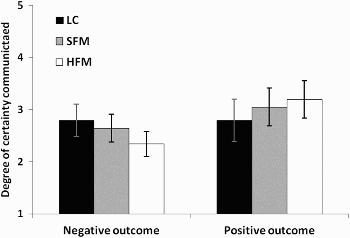
Mean degrees of certainty given by participants as a function of their conversational objective (likelihood communication, LC; speaker face management, SFM; and hearer face management, HFM) and of the outcome valence. Error bars represent 95% confidence intervals.
The effect of the conversational intention and valence of the outcome on probability was tested by conducting a mixed-design ANOVA including conversational intention as between-subjects and valence as within-subjects independent variables, together with the degree of certainty as a dependent variable. The analysis revealed a main effect of valence, F(1, 179) = 9.00, p = .003, η2p = .05, reflecting that participants provided a higher degree of certainty for the positive than for the negative outcome. The main effect of conversational intention was not significant, F(1, 179) < 1, but results showed the expected interaction effect between valence and conversational intention, F(2, 179) = 3.76, p = .048, η2p = .03. The interaction effect illustrates that the conversational intentions had a different effect on probability perception as a function of the valence of the predicted outcome. When the outcome was positive, tactful speakers provided a higher probability of occurrence than cautious or simply informative speakers, whereas, when the outcome was negative, tactful speakers provided a lower probability of occurrence than the cautious and informative speakers.
Cautious speakers provided a lower probability assessment than informative speakers in the negative outcome prediction, which replicates the previously observed effect of speaker-face-management intention (Juanchich et al., 2012). By contrast, cautious speakers provided a higher assessment in the positive outcome, which departs from previous findings where cautious speakers were deemed to provide a risk perception adjusted downwards whether the outcome was negative or positive.
General Discussion
The present research aimed to test whether politeness expectations ruling hearers' interpretations of verbal probabilities also apply to speakers. The goal was to assess how different intentions of speakers (i.e., likelihood communication, hearer face management, or speaker face management) affect the probability communicated. Three experiments demonstrated that the strategies of speakers influence the probability they are communicating.
Politeness theory (Brown & Levinson, 1978) posits that speakers can soften bad news for hearers by using an optimistic and vague uncertainty quantifier (e.g., saying, “it is possible” instead of “it is likely” that you will lose your money). Previous research indirectly supported that claim, by showing that recipients of polite face-threatening predictions perceived higher probabilities than recipients of plain-spoken predictions. The present results provide, for the first time, direct evidence in favour of the politeness theory's postulate. When predicting a negative outcome, tactful and cautious speakers (i.e., adopting either of the face-management intentions) gave lower probabilities than informative speakers, and tactful speakers gave an estimate even lower than that of cautious speakers. This was true based on fictitious outcomes (e.g., your friend's car has a 50% probability of breaking down; Experiments 1 to 2) or based on real-life outcomes (e.g., what is the probability of finding a good second-hand car for less than $500?; Experiment 3). Experiment 3 showed that the effect of speakers' intentions on the probability communicated depends on the nature of the outcome described. For a positive outcome, tactful participants gave higher estimates than blunt participants, whereas when describing a negative outcome, tactful participants gave a lower estimate than blunt ones. These results dovetail with the findings of Juanchich et al. (2012) showing the effect of the outcome valence from the hearer's standpoint.
It seems unlikely that the effect of politeness would be merely due to a demand effect (Orne, 1962), since it was observed in a between-subjects design and interacted with the outcome valence in the predicted way. Further, different and less direct manipulations generated consistent effects from the hearer perspective (Bonnefon & Villejoubert, 2006; Juanchich et al., 2012). Nevertheless, future research should rule out whether the observed effect of politeness could partially be explained as an effect of the task demand owing to a less direct manipulation of politeness expectations.
An effective communication can be achieved by a correspondence between the probability the speaker has in mind and the probability the hearer perceives: The hearer should interpret correctly the intention of the speaker and adjust the probability proportionally to the extent the speaker did, but in the opposite direction. Given the complexity of the process, risk of polite miscommunication is high (Bonnefon et al., 2011) and should be taken into account in future attempts to design risk communication guidelines (Sirota & Juanchich, 2012a). Further research could investigate whether an enriched conversational environment would help to reduce the risk of polite miscommunication. However, research should still be pursued in minimal contexts where risk is given outside a conversational context, as this is quite common (e.g., drug leaflets, health information brochures).